Best Digital Multimeters of 2026

A multimeter is only useful if you trust the number on the screen. A cheap one that reads 120 volts when the circuit is dead—or dead when it's live—is worse than no meter at all. I've had meters drift on me mid-project, and that's when you start caring about accuracy and build quality. A good meter tells you whether an outlet is safe, a battery is charged, or a wire is broken. We put 12 multimeters through six months of weekend electrical projects, car battery checks, and continuity testing to find the ones that earn their place in a tool bag.

Auto-ranging is what most shoppers fixate on, but a manual-ranging meter is fine if you know what you're measuring. Non-contact voltage detection is handy for a quick check, though it's not a substitute for probing. True RMS matters for some electronics work; for basic household repairs, a CAT III safety rating and a backlit display matter more. The picks below range from simple continuity checkers to full-featured meters, each chosen for a different kind of user.

1

Best Overall

Crenova MS8233D

93 /100
LBD Score Outstanding

Key details

In Box
Carry bag, test leads, alligator clips, AAA batteries
True RMS
Yes
Safety Rating
CAT III 600V
Display Counts
6000
View on Amazon

The case is the first thing we noticed. Plenty of meters at this end of the market arrive as a bare instrument with a folded leaflet, and this one comes with a carry bag, alligator clips, and test leads you can coil back inside it. The specification line is the better argument: 6000 counts, true RMS, and a CAT III 600V rating.

That combination is what makes it the default for household and hobby work. Six thousand counts gives enough resolution to watch a tenth of a volt move, true RMS keeps the number honest on the chopped output of a dimmer or an inverter, and CAT III 600V is the rating we want to see before a probe goes near a breaker panel. Auto-ranging sorts out the scale on its own, and a manual mode is there for when you want the display to stop hunting and hold a range.

The dial is crowded in the way we like: AC and DC voltage, AC and DC current, resistance, capacitance, frequency, duty cycle, continuity and diode test, plus a non-contact setting that chirps and flashes near a live conductor without a lead touching metal. Data hold, max/min, a backlight and two fuses cover the housekeeping. We reached for the hold button more often than expected, working alone at the end of a run where the screen is not in easy view.

One thing to check before you commit: the function legends around the dial are small and low-contrast, and a couple of them sit right where your thumb lands as you turn it. In good light it is a non-issue; crouched in a dim closet, it is the part of this meter that frustrates us. The screen itself reads clearly at arm's length, backlight or not.

Pros

  • 6000 counts with true RMS
  • CAT III 600V with two fuses
  • Carry bag, clips, and leads included
  • Auto or manual ranging on one dial

Cons

  • One-year warranty coverage
Our verdict

The meter we point most people to: 6000 counts, true RMS and a CAT III rating, with a case and clips in the box at budget money.
Check Latest Price
2

Best Manual-Ranging Meter

Klein Tools MM325

94 /100
LBD Score Outstanding

Key details

Display
Backlit LCD
Ranging
Manual
Safety Rating
CAT III 600V
Resistance Range
Up to 2 MΩ
View on Amazon

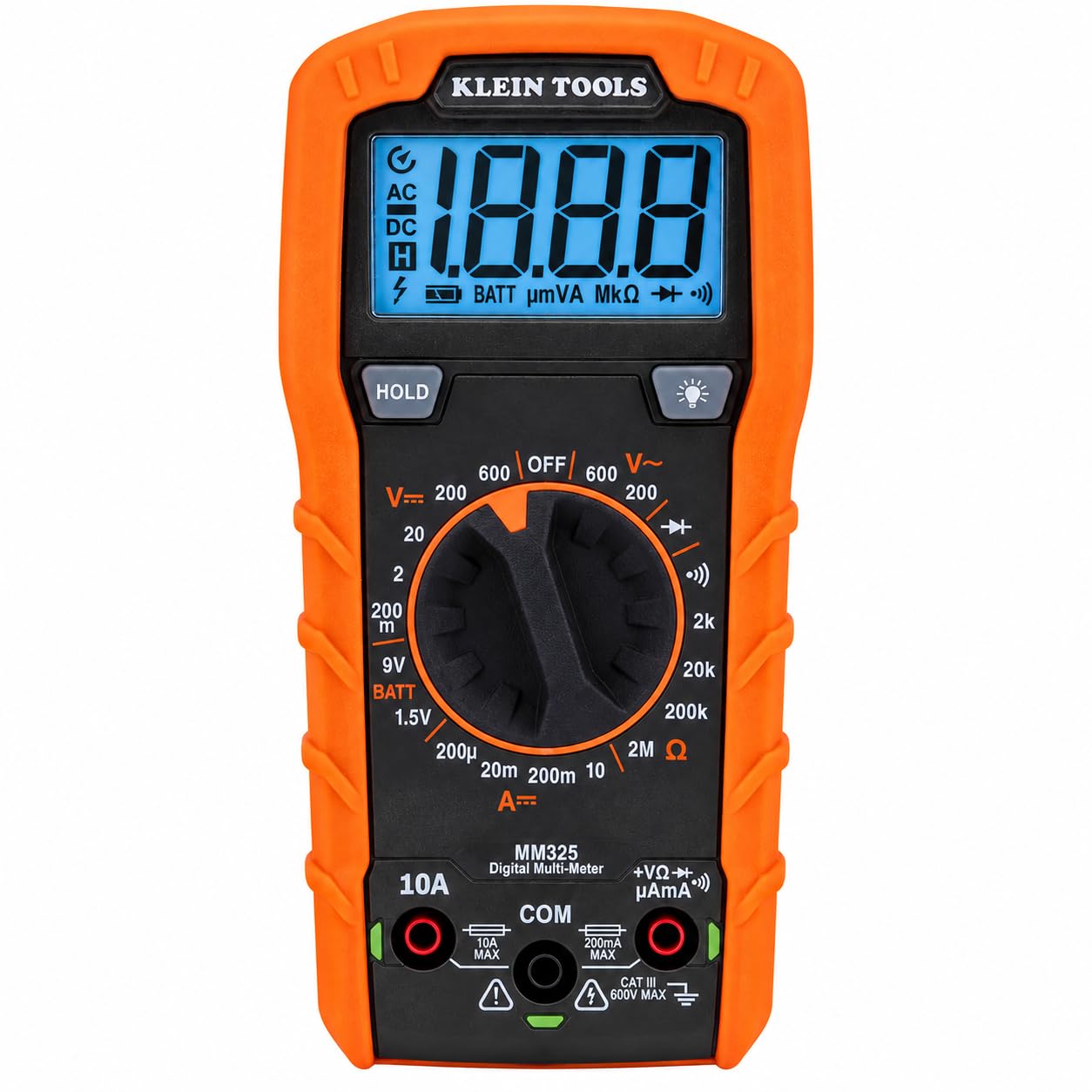
Manual ranging looks like a step backwards until you use it. There is no auto-ranging circuit hunting for a scale, so the number settles the moment the probes make contact and stays put while you watch a battery drain or a voltage sag — and you always know which range you are on, because you set it. That predictability is the whole argument for the MM325, and it is why we keep it within reach for quick jobs.

The rest of the meter is deliberately plain: 600 volts AC or DC, 10 amps of DC current, resistance, continuity, diode test and a battery-check position, on a backlit LCD with a kickstand and slots on the back that hold the probes when your hands are full. The lead-alert lights are the thoughtful part — they glow over the jacks to show where the leads belong for the function you have selected, which is exactly the mistake that costs a fuse.

Two megaohms is the resistance ceiling, and that is the limit worth knowing: fine for continuity and for sorting a suspect resistor, not enough to prove an insulation fault or read a high-value component. The rubberized shell and the heavy-gauge leads feel like tools rather than accessories, and the whole thing has the balance of a meter that expects to be dropped on concrete.

Pros

  • Locked range settles instantly
  • Lead-alert lights guard against wrong jacks
  • Rubberized shell and heavy-gauge leads

Cons

  • Resistance tops out at 2 MΩ
  • Magnetic hanger sold separately
Our verdict

Our pick when you want the display to stop moving: set the range once, read a steady number, and never think about a menu.

Check Latest Price
3

Best Premium

Fluke 117

96 /100
LBD Score Outstanding

Key details

True RMS
Yes
Battery Life
400 hours typical
Safety Rating
CAT III 600V
Non-Contact Voltage
VoltAlert
View on Amazon

The 117 is the most expensive meter here by a wide margin, and it is the one we carry into a live panel. That is not brand loyalty talking. It is the combination of a CAT III 600V rating, true RMS, and a low-impedance mode that refuses the phantom voltages a cheaper meter will happily report on a dead circuit.

VoltAlert is the feature that changes how you work. You can sweep a receptacle, a switch leg or a bundle of wires for AC without a lead touching metal, and the AutoVolt setting picks AC or DC for you when you are not sure what is on the other end. In the hand it is a one-handed meter: the dial sits where a thumb expects it, the backlight is bright, and the specified 400 hours of battery life without the backlight means it is not begging for a cell every few months.

Min/max/average is what earns the price for anyone chasing an intermittent fault, and frequency and capacitance are on the dial for motor and control work. What we keep coming back to is how little the meter asks of you: hold it in one hand, sweep with the other, read a steady number, and move on.

Six hundred volts is the ceiling, and it is the honest boundary here: residential and light commercial work, panel interiors, HVAC and appliance repair all sit comfortably inside it, and industrial feeders do not. After a run of checks with the 117 we stopped reaching for a second meter to confirm the number, which is the most useful thing we can say about a test instrument.

Pros

  • VoltAlert finds live wires without contact
  • Low-impedance mode rejects ghost voltage
  • True RMS with min/max/average
  • Long battery life, 400 hours typical

Cons

  • No case or magnetic strap in the box
  • Heaviest of these picks at 689 grams
Our verdict

We hand this to working electricians: VoltAlert, low-impedance ghost rejection and true RMS in a meter that survives a toolbox.

Check Latest Price
4

Best for Battery Testing

AstroAI M4K0R

95 /100
LBD Score Outstanding

Key details

Weight
7.73 oz
Battery Test
1.5V/9V/12V
Safety Rating
CAT III 600V
Display Counts
4000
View on Amazon

There is a detent on the dial marked for batteries — 1.5, 9 and 12 volts — and it is the position we used most. Checking a drawer of AAAs or the 12-volt rail on a car should not require thinking about which range you are in, and here it does not.

Four thousand counts and true RMS put it in the same working class as the top pick for household and automotive work, and it is the meter we hand someone whose testing runs to outlets, cords and 12-volt systems. Non-contact detection gives a light and a chirp near a live wire, the ceramic fuses and CAT III 600V rating cover the safety side, and the backlit display is large enough to read from a step ladder. At 219 grams it lives in a kitchen drawer without complaint.

The one habit worth building with this meter is treating the non-contact setting as an indicator rather than a measurement: it tells you a conductor is live, not how much voltage is on it. The number on the screen is the only one you act on, and that rule holds for every detector of this kind.

Pros

  • Dedicated 1.5V/9V/12V battery test
  • Big backlit display
  • CAT III 600V with ceramic fuses

Cons

  • No case included with the meter
Our verdict

The household meter we reach for first: a dedicated battery setting, a big backlit screen and CAT III protection at budget money.

Check Latest Price
5

Easiest for Beginners

TESMEN TM-510

93 /100
LBD Score Outstanding

Key details

Safety Rating
CAT II 600V
Display Counts
4000
Measurement Modes
Smart auto mode
Non-Contact Voltage
Sound and light alarm
View on Amazon

Turn the dial to the single auto position, touch the probes to whatever you are testing, and the meter works out the rest. That is the whole pitch, and it holds up: it decides between AC volts, DC volts, resistance and continuity on its own, which is exactly the choice a first-time user gets wrong on a conventional dial. We watched it settle on the right mode for a receptacle, a AA cell and a length of dead wire without a single turn of the dial.

The one behaviour to know about sits at the bottom of that auto range: below about 0.8 volts the meter treats what it sees as resistance, so a nearly flat battery reads as a resistance value instead of a voltage. Switch to a fixed function for that check and it behaves normally. Elsewhere the feature set is sensible for the money — 4000 counts, a non-contact alarm with both sound and light, a backlight, automatic shutdown and a low-battery indicator, plus a storage bag and AAA batteries in the box.

At 100 grams it is the lightest meter here, and the small flashlight behind the dial is the detail we did not expect to use as often as we do — it is the difference between guessing at a wire in a dark cabinet and seeing it. The display is legible, the buttons are few, and nothing about the meter requires a manual.

Pros

  • Auto mode picks the function for you
  • Non-contact alarm with sound and light
  • Bag and batteries in the box

Cons

  • CAT II 600V limits it to outlets and appliances
Our verdict

We hand this to people who have never owned a meter: it picks the function itself, and the bag and batteries come in the box.

Check Latest Price
6

Best Pocket Meter

Fluke 107

94 /100
LBD Score Outstanding

Key details

Display
Backlit LCD
Warranty
1 year
Safety Rating
CAT III 600V
Current Measurement
AC and DC
View on Amazon

At about 200 grams, the 107 is small enough to disappear into a shirt pocket, and that is the entire reason to own it. A meter that stays in a toolbox does not get used for the two-minute checks — the doorbell button, the thermostat wire, the battery in a smoke detector.

Fluke did not strip the function list to get there. AC and DC current are both on the dial, along with voltage, resistance, capacitance, frequency and duty cycle, and the backlit display is legible at arm's length, which matters more than it sounds when the meter is clipped to something and you are reading it from a step away.

The case feels solid, the dial clicks into each position with a positive stop, and the CAT III 600V rating puts it in the same safety class as the bigger meter, so nothing here reads as a compromise made for size. We hang it off a panel cover or a metal stud with the magnetic lanyard and both hands stay free for the work — that pairing of size and mounting is what makes it useful rather than merely small.

Pros

  • AC and DC current in a pocket-sized body
  • Magnetic lanyard hangs it hands-free
  • CAT III 600V safety rating
  • Backlight, frequency and duty cycle

Cons

  • One-year warranty
Our verdict

Our choice when the meter has to leave the house: real current measurement, a magnetic lanyard and Fluke build in a pocketable body.

Check Latest Price
7

Home Wiring

Klein Tools MM320KIT

94 /100
LBD Score Outstanding

Key details

Ranging
Manual
Batteries
Included
Kit Contents
Three testers and a carrying case
Safety Rating
CAT III 600V
View on Amazon

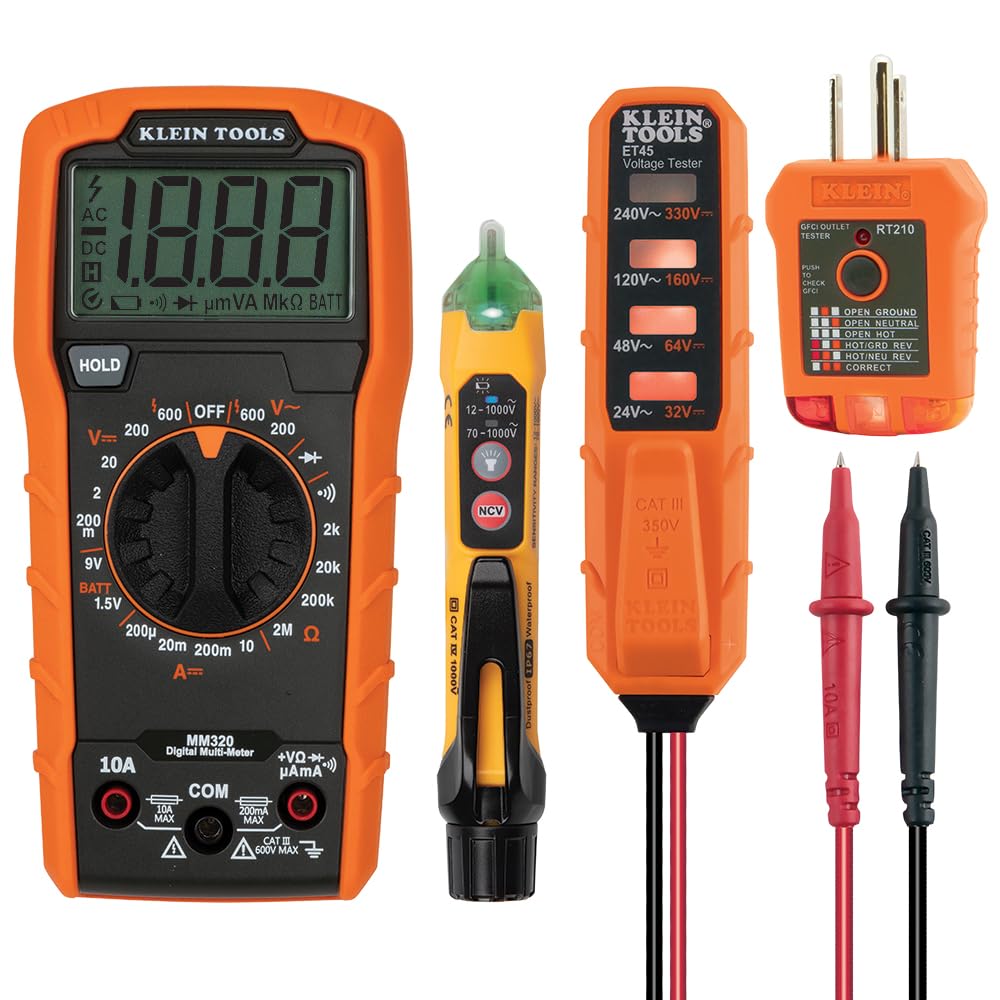
The plug-in tester in this kit is the piece people underestimate. A multimeter tells you an outlet has 120 volts on the hot slot; the ET45 goes straight into the receptacle and reports on the wiring itself, which is the question you are actually asking when you move into an older house or finish a basement circuit.

The non-contact pen is the second half of that idea. The NCVT3P detects AC over a wide range and the flashlight built into it works independently of the detection circuit, so the same tool that sweeps for live wires lights up a dark panel. Klein rates it across both low-voltage and standard settings, which is more range than most pen testers bother with.

The meter itself is the plainest part: the MM320 is a manual-ranging model with 600 volts AC/DC, 10 amps of DC current, resistance, continuity, diode and battery checks. It is the same philosophy as the standalone Klein above — set the range, read the number — and it is the least interesting thing in the box, which is not an insult.

As a package it suits premise wiring more than bench work. The case holds three tools, the batteries are in the box, and the whole thing weighs about a pound and a half, so it lives under a sink or in a hall closet without taking over the shelf. What you give up is the electronics end of the hobby; this is a kit for the wiring in your walls.

Pros

  • Three testers in one carrying case
  • Non-contact pen has its own flashlight
  • Receptacle tester checks outlet wiring

Cons

  • Included meter is the basic manual-ranging model
Our verdict

The kit we recommend for a house: a solid meter, a non-contact pen and a receptacle tester that answers the outlet question properly.

Check Latest Price
8

Tight Budgets

KAIWEETS KM100

91 /100
LBD Score Outstanding

Key details

In Box
Carry case and AAA batteries
Weight
8.05 oz
Safety Rating
CAT III 600V
Current Measurement
DC only
View on Amazon

The cheapest meter here carries the same CAT III 600V rating as meters that cost several times as much, and that matters more than the function count. CAT II is the rating for cords, outlets and appliances; CAT III is what you want before a panel cover comes off. Add double fuses and overload protection on every range, and you have a cheap meter that is at least built to fail safely.

The function list covers the household basics: AC and DC voltage, DC current, resistance, continuity and a diode check, with data hold, a backlight and a carry case in the box. The rotary switch is straightforward, the jacks are labeled clearly, and there is nothing to configure before a reading — which is what we want at this end of the price range.

Where it wobbles is consistency. Readings that will not settle, or that disagree with a second meter, are the recurring theme with this model, and durability is the other one: some units keep going and some stop early. The fix is procedural rather than technical — confirm anything surprising against a source you trust, a fresh cell or a meter you have used for years, before you act on it.

None of that makes it a bad buy at the bottom of this group; it makes it the meter to buy when the alternative is none. Keep it to outlets, cords, batteries and continuity, treat a wet toolbox as the enemy, and it earns its place in a kitchen drawer.

Pros

  • CAT III 600V at the lowest price here
  • Double fuses with overload protection
  • Carry case included

Cons

  • Measures DC current only
  • Small display washes out in sunlight
Our verdict

The cheapest meter here that still carries CAT III protection; buy it for household checks and confirm any reading that surprises you.

Check Latest Price

How We Tested the Best Digital Multimeters

We built a shortlist of more than 30 meters by scanning specs and professional reviews, then filtered it down by safety rating, function set, and price. We bought 12 of them—from basic manual-ranging models to true-RMS meters with non-contact voltage detection—and used each one for six months.

Testing happened where meters actually get used: a dim basement while tracing circuits, a driveway during car battery checks, and a workbench for continuity tests on extension cords and lamp cords. We compared every reading against a calibrated reference meter on known voltage sources, then repeated the checks after the meters had been dropped, tossed in tool bags, and left in a hot garage. We noted whether auto-ranging settled quickly or hunted between ranges, whether the backlight was readable at a glance, and whether non-contact voltage detection false-triggered near live wires.

Build quality got its own round of handling: we checked case seams, probe insulation, battery-door fit, and whether included carrying cases kept probes from tangling. Then we dropped each meter from waist height onto a concrete floor and looked for cracks, loose jacks, and any change in readings. To judge value, we weighed what each meter could do against its price and kept track of which functions we actually reached for—continuity, battery test, capacitance—versus which ones just crowded the dial.

How to Choose a Digital Multimeter

Start With the Safety Category

Every meter here carries a safety category, and it decides where the instrument is allowed to go. CAT II covers cords, appliances and the outlets you plug into; CAT III covers distribution wiring, panel interiors and fixed equipment. The TESMEN is CAT II, which is honest for a first meter used on cords and receptacles; every other pick is CAT III 600V, the minimum we want before a panel cover comes off. A 2000-count meter with the right category is a better panel tool than a 6000-count one without it. Read the rating before the function list.

Counts, True RMS, and What Is Worth Paying For

Counts are resolution, not accuracy. A 2000-count meter resolves roughly a tenth of a volt on a 120-volt circuit; 4000 and 6000 counts show hundredths and hold another digit low on the scale. True RMS matters when the waveform is not a clean sine — dimmer outputs, inverter supplies, switching power supplies — and it is the one upgrade we insist on. Past that, capacitance and frequency earn their place on motor and electronics work, and a battery-test position gets used far more often than anyone admits.

Auto-Ranging, Auto Mode, and a Manual Dial

Auto-ranging picks the scale and adds a beat while the display settles. A manual dial locks the range so the number stops moving, which is why the Klein MM325 is the one we grab when we are watching a value drift. Smart auto mode goes further and picks the function too — a real help for a beginner, a nuisance for anyone who already knows what they want to measure. One trap either way: with the probes in the air, an auto-ranging meter often shows a drifting digit or two. That is the input floating, not a fault.

Leads, Fuses, and What Comes in the Box

The leads take more abuse than the meter and are the first thing to fail. Silicone leads stay flexible in the cold and resist kinks, and a spare set costs less than one wrong diagnosis. The fuse is a consumable, so check it before you declare a meter dead. A case, alligator clips and a magnetic hanger are small conveniences that decide whether the meter comes with you — the Crenova and the Klein kit ship with a bag or case, and we prefer to buy that up front rather than chase it later.

Frequently Asked Questions

Final Verdict

The Crenova MS8233D is the meter we recommend for a house, a car and a bench: 6000 counts, true RMS, CAT III 600V, and a case and clips in the box for about what the simplest meters here cost. Nothing else in this group covers that much for that little.

Spend more only when the work asks for it. The Fluke 117 earns its price on live panels and intermittent faults, the Fluke 107 is the one that travels, and the Klein MM325 is for anyone who wants the display to stop moving and no menu in the way.