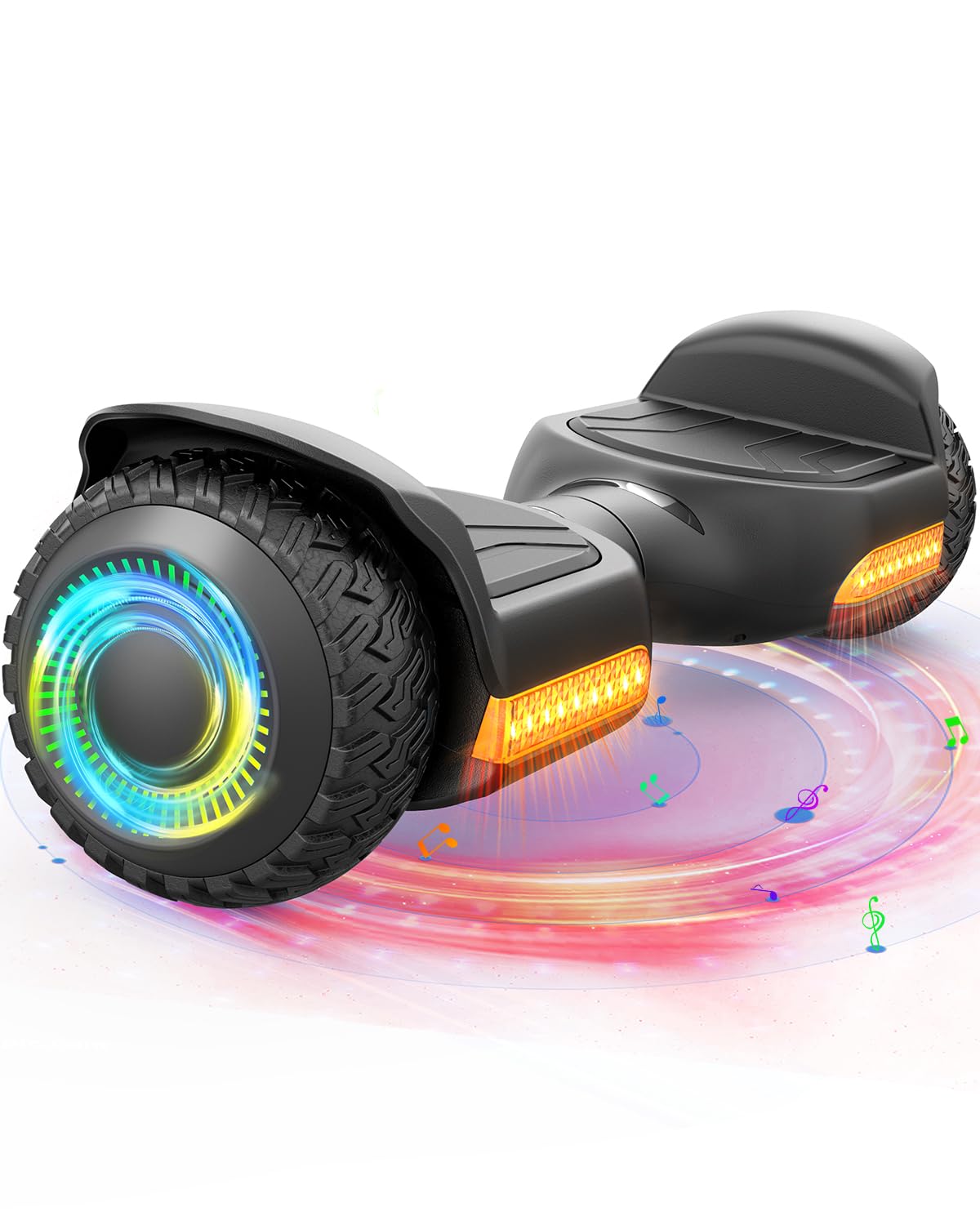
Best Hoverboards of 2026

Hoverboards have a reputation problem, and some of it is earned. The boards that gave the category its bad name skimped on battery cells and calibration, and no amount of LED glow makes up for a footpad that won't level out under you. A good one corrects beneath your feet faster than you can overthink it, holds a line on cracked sidewalk, and still has charge when the afternoon is over. That's the difference between a gift that gets ridden every day and one that ends up leaning in the garage.

We've spent six months with 12 hoverboards — driveway laps, park grass, and a lot of slow first tries in the living room — and the gaps show up in places a product photo can't capture: how fast the gyroscopes settle, whether the tires actually bite, whether the safety certification on the box is real. The Bluetooth speakers and light kits are fun and mostly beside the point. One thing I'd tell any first-time buyer: top speed is the number everyone compares and the one you'll use least. The boards that got everything else right are below.

1

Best Overall

Gyroor G13

90 /100
LBD Score Outstanding

Key details

Range
Up to 8 miles
Top Speed
7.75 mph
Max Rider Weight
176 lb
All-Terrain Tires
6.5 inches
View on Amazon

Six and a half inches of tire sounds like a footnote until you watch a kid stall halfway across a strip of lawn. The G13 is the hoverboard we hand to a first-time rider: its all-terrain tires roll over grass, dirt, and sidewalk without the jolt that smaller wheels pass straight up through the deck, and the 176-pound limit covers everyone from a small seven-year-old to an early teenager — roughly the lifespan of a first board.

What we came back to is how little it asks of a beginner. The self-balancing calibration settles quickly underfoot, and a 7.75 mph ceiling means a wobble stays a wobble instead of turning into a tumble. The Bluetooth speaker and the lit wheels are the parts kids ask about, and we're not going to pretend they don't matter — a board that glows gets ridden more than one that doesn't, especially after school when the light goes early.

Range is where we get careful. The listing claims up to 8 miles from a 2 Ah battery, and that's a best-case figure: a light rider, flat pavement, warm weather, a fresh pack. Add a 120-pound kid, wet grass, and a slope at the end of the street and you'll see considerably less, and the battery is the component that ages first on any board at this level. Plan on a session lasting an afternoon rather than a day, and everything else about the G13 holds up.

The detail we didn't expect to care about is the K2 seat. It's sold separately and turns the G13 into a go-kart, which sounds like an upsell until there are two kids and one board — the seated mode is slower, steadier, and far less intimidating for the smaller one. That flexibility is worth more than another mile of claimed range.

Pros

  • All-terrain 6.5-inch tires handle grass and pavement
  • Quick for a beginner to balance and steer
  • Bluetooth speaker and lit wheels kids ask for
  • Converts to a go-kart with the K2 seat

Cons

  • Real range falls well short of 8 miles on grass
  • Loose gravel defeats the 6.5-inch tires
Our verdict

The G13 is the hoverboard we recommend to most families: all-terrain tires, a 176-pound limit, and a low top speed make it a forgiving first board that still handles the lawn.

Check Latest Price
2

Best for Teens and Adults

Gyroor Warrior G2

89 /100
LBD Score Excellent

Key details

Tire Size
8.5 inches
Charge Time
2 hours
Max Rider Weight
220.5 lb
Safety Certification
UL 2272
View on Amazon

The Warrior is what you buy when 6.5 inches stops being enough. Its 8.5-inch solid tires are the widest in this group, and the 100 kg limit is what finally makes a hoverboard a teenager's machine rather than a child's — the difference between a board that labors up a slope and one that doesn't. Ride quality is where it separates most clearly from the G13: the bigger contact patch does the work on grass and gravel, and the deck feels planted in a way the smaller boards here don't.

Two hours to a full charge is the fastest here by a wide margin, and it changes how the board gets used. The others run four to six hours, which in practice means one ride after school rather than two. We also like the app, which lets you cap top speed for a beginner and lift it as they improve instead of buying a second board. A small design choice we noticed: the wheel covers sit slightly inside the wheels, so the plastic doesn't scrape when it tips over — and it will tip over.

Two things to know before you choose it. It is genuinely heavy, and getting it up a flight of stairs is a two-hand job; that weight is the price of the bigger tires and the sturdier frame. Battery life is also the least consistent part of the package, with some boards running long sessions and others quitting early. On rough ground with a heavier rider, nothing else in this group is close.

Pros

  • 8.5-inch tires take grass and gravel in stride
  • Two-hour charge, the fastest in this group
  • App-adjustable top speed for new riders
  • 100 kg limit suits teens and adults

Cons

  • Heavy enough that stairs are a two-hand job
  • Battery life varies noticeably between boards
Our verdict

For teenagers and adults, we pick the Warrior: its 8.5-inch tires and 100 kg limit make rough ground rideable rather than a fight.

Check Latest Price
3

Gifts and Looks

Emaxusa Spider Hoverboard

85 /100
LBD Score Excellent

Key details

Top Speed
6.2 mph
Wheel Size
6.5 inches
Charge Time
6 hours
Safety Certification
UL 2272
View on Amazon

The spider graphic is the whole pitch, and it works — this is the board a kid points at in the listing photo. Under the red shell it's a conventional 6.5-inch hoverboard with a built-in speaker and UL 2272 certification, which is the right checklist for a nine- or ten-year-old's first board. Nothing about it is unusual except the way it looks.

Our hesitation is patience. The six-hour charge is the longest in this group, and a board that spends more of a Saturday on the cable than underfoot loses a kid's interest fast. Reliability is the mixed part of the picture: plenty of these run for years, and some quit inside the first few months. Buy it because the design gets your kid to put a helmet on and try, not because it's the most board for the money.

Where it earns its place is as a gift. Match the shell to the kid and it does something the plainer boards here don't, which is make a nervous beginner want to step on. Just set expectations on pace: the 6.2 mph ceiling is the slowest in this group, and a child who rides with older cousins will notice.

Pros

  • Spider graphics and LED lights stand out from the pack
  • UL 2272 certified for electrical safety
  • 6.5-inch wheels suit driveway and sidewalk

Cons

  • Slowest board here at 6.2 mph
  • Three-month warranty is the shortest here
Our verdict

We like the Spider for the look and the UL 2272 certification, not the pace — it's the slowest board here, and that suits a cautious beginner.

Check Latest Price
4

Hills and Speed

Hover-1 Ultra

85 /100
LBD Score Excellent

Key details

Range
9 miles
Top Speed
9 mph
Wheel Size
6.5 inches
Max Rider Weight
220 lb
View on Amazon

Four hundred watts across two motors is the biggest number in this group, and it buys the Ultra something the others can't match on paper: a claimed 15-degree climb. That matters on a ramp, a steep driveway, or the kind of hill that stops a smaller board halfway up.

It's also the quickest here at a claimed 9 mph, and the only board in this group with a water-resistance rating — IPX-4, which covers splashes and a damp lawn but not standing water. The step-on-one-side-first design is a genuinely good touch: the board levels itself so the second foot can follow, and that shortens the nervous phase for a new rider more than any tutorial does.

Where we hesitate is coverage. Ninety days is a short warranty for a machine whose expensive failures — the pack, the control board — tend to arrive after the first season, and it's the reason we stop short of a full recommendation. Riders who want the torque and the wet-grass confidence of a 220-pound limit will find it worth the trade; anyone buying for a child is better served by the Gyroor boards and their split six-month battery, one-year controller terms.

Pros

  • 400 W combined motor handles 15-degree inclines
  • IPX-4 rated, the only one here
  • 220-pound limit carries adult riders

Cons

  • Speed and surface alerts interrupt the ride
Our verdict

We recommend the Ultra to riders who want the fastest, torquiest board in this group; for everyone else, the Gyroor G2's bigger tires are the easier buy.

Check Latest Price

How We Tested Hoverboards

The shortlist started with a spreadsheet. I pulled every hoverboard I could find, then cut anything without a stated UL 2272 certification, a weight limit, or any sign of replaceable parts — which removed about half of them. The rest got sorted by wheel size, rider modes, and price band, and we bought 12 outright so nothing arrived as a loaner with a rep standing nearby.

Testing ran six months, mostly in driveways and on sidewalks near our office. Every board covered the same ground: smooth pavement, cracked concrete, park grass, a gravel path, and a dozen curb transitions to see which ones cut out when the deck tipped. Kids and adults of very different weights rode each one, since a board calibrated for a 70-pound rider behaves differently under a 200-pound one.

For ease of use, I timed how long each rider needed to balance unaided and cross the driveway, starting on the lowest rider mode. Stability came down to footpad vibration and how hard the deck fought back on uneven ground. I ran every battery flat on a steady loop and logged both ride time and recharge, paired a phone to each Bluetooth speaker at half volume indoors and out to listen for crackle, and checked speed with a GPS app rather than trusting the spec sheet.

Reliability was the long game: a running log of cutouts, error beeps, gyro drift, and tire wear across the six months, then a final re-ride on each board to see which ones still felt the way they did on day one.

How to Choose a Hoverboard

Battery Life and Charge Time Come First

The advertised range is the most optimistic number on the box: it assumes a light rider, flat pavement, warm weather, and a healthy pack. Weight, grass, hills, and cold all take a bite, so a board that claims 8 miles may cover a good deal less with a 120-pound rider on a damp lawn.

Charge time matters just as much. In this group it runs from 2 hours on the Gyroor Warrior to 6 on the Emaxusa, and a shorter charge is worth more than a mile of claimed range — a kid who waits all afternoon for a short session loses interest quickly.

Match the Weight Limit and the Wheels to the Rider

Rider weight rules everything else out. A 176-pound limit carries a child into the early teens, 220 pounds is what an adult needs, and anything under about 155 pounds is a kids-only board however the listing frames the ages. Leave 20 or 30 pounds of headroom for a backpack and another growth spurt, and remember the limit is one rider, not two.

Then match the tires to the ground. Six-and-a-half-inch wheels are for pavement, driveways, and light grass; 8.5-inch wheels are what actually make gravel and rough ground rideable. Put an eight-year-old on the bigger board and you've usually bought something they can't carry.

Speed, Modes, and the Learning Curve

Every hoverboard steers by lean, so the first hour is about trust rather than technique. A beginner mode that caps speed is the single most useful feature for a new rider, and app control means you can raise the ceiling as they improve instead of shopping for a second board.

The boards here run from about 6 mph to 9 mph, and the slower end is the better choice for a driveway and a rider under ten. Top speed starts to matter when the rider is old enough to use the board for getting somewhere — a friend's house, a practice field — which is also when a bigger wheel and a higher weight limit start to matter.

Certification, Warranty, and Support

UL 2272 is the certification to look for; it covers the battery, charger, and electrical system as one unit, and it's the difference between a toy and a fire risk. Three of the four boards here state it outright. If a listing doesn't, ask before you order.

Warranty terms vary more than they should. The Gyroor boards split six months on the battery from a year on the controller, while others give you 90 days on the whole machine. Since the battery is the part that fails first, read that clause before you buy and register the board the day it arrives.

Bluetooth, Lights, and App Control

These are the features kids ask for, and they aren't nothing — a board that plays music and lights up gets used more. They just shouldn't decide the purchase. If it comes down to a speaker or a better battery, take the battery, and settle the range, weight limit, and certification first.

Frequently Asked Questions

Final Verdict

The Gyroor G13 is the hoverboard we point most families to. All-terrain tires, a 176-pound limit, and a 7.75 mph ceiling make it forgiving enough for a seven-year-old and capable enough for the lawn, and the K2 seat gives it a second life as a go-kart once a younger sibling wants a turn.

If the rider is past about ten, or the ground is more gravel than pavement, move up to the Gyroor Warrior G2. The 8.5-inch tires and 100 kg limit are the reason, and the 2-hour charge is the reason you won't regret it.