Best Drafting Chairs for Standing Desks of 2026

The standing half of a standing desk is easy — you press a button and the top rises. The sitting half is where people get stuck. A standard desk chair leaves you reaching uphill for the keyboard, and a counter stool leaves your feet dangling, which your lower back starts filing complaints about inside an hour. A drafting chair closes that gap: a taller gas lift brings the seat up to counter height, and a foot ring gives your feet somewhere to land so your elbows sit at desk level instead of your shoulders.

I've had 12 of them parked at standing desks, art tables, and one unfortunate kitchen counter over the past six months, raising and lowering the desks around them all day long. Here's what first-time buyers don't expect: the foot ring does more for your comfort than the cushion does, and the arms decide whether the chair slides under your desk at all. Get the arm style wrong and you'll spend every workday sitting a foot back from your own keyboard. The picks below are the ones that got both of those right.

1

Best Overall

Primy PR777-Z Drafting Chair

90 /100
LBD Score Outstanding

Key details

Backrest
Mid-back mesh
Foot Ring
Height-adjustable
Seat Height
Up to 30 inches
Weight Capacity
250 lb
View on Amazon

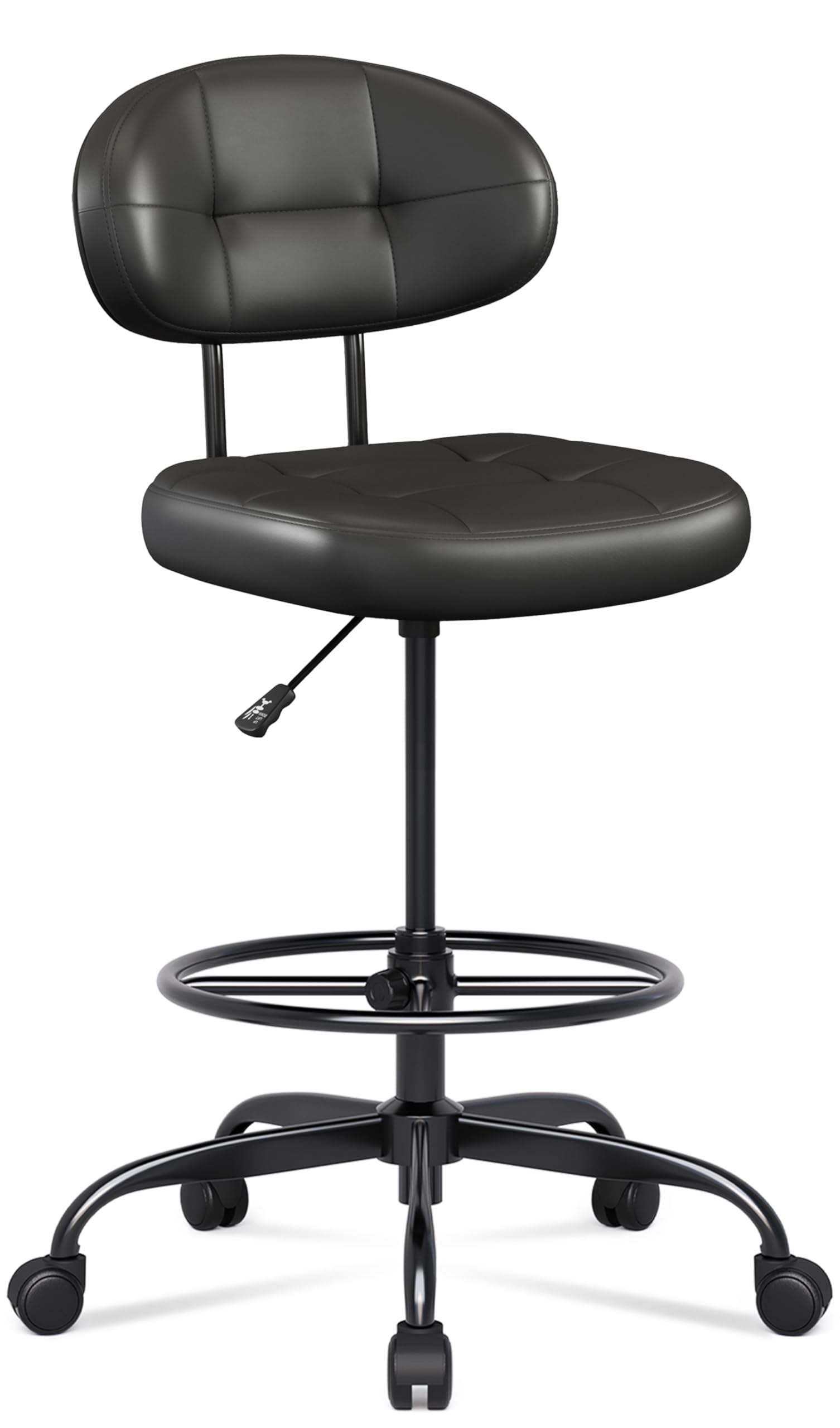
The test a standing-desk chair really has to pass comes the moment you stand up. You want the chair gone, and anything heavy, armed, or wide fights you on it. This one weighs about as much as a loaded grocery bag, and with no armrests to catch the desk edge, a single push sends it clear and under. Of everything we sat in for this guide, it's the chair we stopped noticing, which is the highest compliment furniture at a standing desk can earn.

It reaches, too. Thirty inches of seat height put us level with a desk in standing position, and the foot ring adjusts on its own collar so your legs stop swinging. Set that ring once and it does more for a long sit than any amount of foam. The back is a mid-back mesh curve rather than a full high-back, and we came around to it: it meets the lumbar spine where a perch actually needs meeting, and you don't stand up with a damp patch on your shirt.

If you want arms to take weight off your shoulders during long sitting stretches, or you need a chair rated for a heavier sitter, this isn't the one — the BOLISS and the ORRSAKER cover that ground. What's left is a chair with a 17.3-inch seat pan, a five-star base that stays flat when a caster catches a rug edge, and a plainness that suits a desk you're trying to keep clear.

Pros

  • Light enough to push aside one-handed
  • Seat height reaches 30 inches
  • Adjustable foot ring sets leg length
  • Breathable mesh back stays cool

Cons

  • 250-pound capacity, the lowest here
  • No armrests at all
Our verdict

Our default for a standing desk: it's light enough to shove aside with one hand when you stand up, and tall enough at 30 inches to sit back down into.
Check Latest Price
2

Best for Tall Sitters

Misolant Armless Drafting Chair

89 /100
LBD Score Excellent

Key details

Seat Depth
16.3 inches
Seat Width
16.5 inches
Upholstery
Faux leather
Seat Height
23.5 to 31.9 inches
View on Amazon

Most tall chairs advertise a ceiling. This one's floor is the interesting number: the seat bottoms out at 23.5 inches, so it never collapses into an ordinary desk chair. You buy it for the top of the range — 31.9 inches, near the highest here — and you accept that even at its lowest it's still a perch.

The upholstery is the other reason it stands out. Faux leather over sponge, 16.5 inches wide and 16.3 inches deep, with a wrap-around curve to the back rather than a flat panel. It's a compact seat that holds you instead of spreading you out, and it wipes clean, which matters more than it sounds when the chair lives within reach of a coffee mug.

If you want something to lean on, this isn't it — the chair is armless, full stop, which is exactly what lets it disappear under a desk and also what leaves you unsupported at hour six. Heavier sitters should step up to the BOLISS, which carries a 400-pound rating. For everyone else at a tall bench or a raised desk, the proportions here are the point.

Pros

  • Seat range runs 23.5 to 31.9 inches
  • Wipe-clean faux leather over sponge
  • Compact frame slides under the desk

Cons

  • No published weight capacity
Our verdict

The tall sitter's pick: it goes to 31.9 inches, so a high desk finally gets a chair that meets it, and the leather seat wipes clean.

Check Latest Price
3

Best for Big and Tall

BOLISS 2818HD Drafting Chair

88 /100
LBD Score Excellent

Key details

Armrests
Flip-up
Headrest
3D adjustable
Seat Height
24.8 to 32.1 inches
Weight Capacity
400 lb
View on Amazon

Forty-six pounds comes out of the box, and the base underneath it spans 27.6 inches — the widest footprint in this group. That isn't incidental to the 400-pound rating; it's how the rating gets delivered. A chair built this way sits planted at the top of its height range instead of feeling like a bar stool with ambitions.

The seat travels from 24.8 to 32.1 inches, the highest ceiling here, and the high back runs 19.68 inches wide with a headrest you can position in three dimensions. The arms fold up through 90 degrees so the chair clears the desk when you stand. Five inches of molded foam held its shape through a full afternoon, which is more than we expected from a seat this firm on first contact.

The catch is that everything about it is scaled for a large person. The seat is 20.1 inches square, the frame is broad, and shorter sitters can find their feet hunting for the ring even at its lowest position. If you're well under average height, the armless Misolant or the Primy will fit you better for a lot less.

Pros

  • 400-pound rating on a wide base
  • Seat reaches 32.1 inches, highest here
  • Flip-up arms clear the desk
  • Adjustable headrest and high back

Cons

  • Seat can sink under weight at the top of its range
Our verdict

The one for bigger, taller sitters: a 400-pound rating, an adjustable headrest, and a seat that reaches 32.1 inches without feeling fragile.

Check Latest Price
4

Best Budget

Brick Attic T12 Drafting Chair

89 /100
LBD Score Excellent

Key details

Backrest
Removable
Seat Width
15.8 inches
Height Range
33.86 to 41.75 inches
Weight Capacity
300 lb
View on Amazon

The backrest detaches and lifts away, leaving a rolling shop stool with a 15.8-inch cushion; reattach it and you have a chair with a curved, padded back. We used it both ways — stripped down at a workbench, back on at a raised desk — and the convertible part stopped feeling like a gimmick after the first afternoon. The base spans 23.6 inches and carries a 300-pound rating, the casters are set wide, and the memory foam in the seat is genuinely thick rather than a token layer.

Height runs from about 34 inches to almost 42 inches of overall chair height, which covers a standing desk and still drops far enough for a bench, and nothing about the build feels like it's about to give up. Just know what you're buying: a shop stool that can wear a backrest, not an all-day ergonomic chair. If you want a padded back that adjusts and a seat that spreads out, the Misolant is the better chair for a little more money.

Pros

  • Backrest removes to make a shop stool
  • 300-pound rating on a 23.6-inch base
  • Thick memory-foam seat wipes clean

Cons

  • Backrest is fixed once attached
  • Narrow 15.8-inch seat cushion
Our verdict

The shop-first pick: pull the backrest and it's a rolling stool, put it back and it's a desk chair, and it costs the least of anything we recommend.

Check Latest Price
5

Small Home Offices

ORRSAKER O355-S Drafting Chair

86 /100
LBD Score Excellent

Key details

Armrests
Flip-up
Height Travel
7.9 inches
Lumbar Support
2-inch adjustable
Weight Capacity
300 lb
View on Amazon

If our top pick is the chair you shove out of the way, this is the one for people who want something to lean on while they're seated. The arm pads flip up through 90 degrees so the chair still clears the desk when you stand, and they're padded enough to take real weight when you're not.

The adjustment is where it earns its keep: 7.9 inches of height travel, a lumbar pad that slides two inches up and down on its track, and a foot ring on its own collar. The lumbar pad is the useful part — most chairs mold one curve into the back and hope it lands in the right place on you. For a small office where the chair has two jobs and the desk has one height, this is the most sensible thing here.

Pros

  • Flip-up arms clear the desk
  • Lumbar pad slides two inches
  • 7.9 inches of height travel

Cons

  • Sits high even at its lowest setting
  • No recline; back angle is fixed
Our verdict

The pick for a shared or narrow desk: flip-up arms let it tuck away, and the lumbar pad moves two inches so it lands on your back, not below it.

Check Latest Price
6

Adjustable Lumbar Support

Misolant MI300-01 Drafting Chair

86 /100
LBD Score Excellent

Key details

Seat Depth
19.7 inches
Backrest Width
22.75 inches
Lumbar Support
2-inch adjustable
Weight Capacity
350 lb
View on Amazon

Lumbar support on most chairs is a shape molded into the backrest — one curve, in one place. Here it's a separate pad on a track, and it slides up and down through two inches so you can put it at the small of your back instead of hunting for the spot the chair picked for you.

The rest is upholstered and generously proportioned: a 22.75-inch backrest, a 19.7-inch seat depth, waterfall cushion edges that keep the front from cutting into your thighs, and a 350-pound rating. It's the least office-like chair here, in the way a leather armchair is less office-like than a mesh task chair.

Where it suits is the room, not the spec sheet: this is the chair for a desk that guests see, in a way mesh task chairs never quite manage. Tighten the foot ring collar when you assemble it, since that joint is the one that comes loose, and what you're left with is the most positionable back support in this guide.

Pros

  • Lumbar pad adjusts up and down two inches
  • Wide 22.75-inch backrest
  • 350-pound rating
  • Upholstered finish suits a shared room

Cons

  • Back angle doesn't adjust
Our verdict

For a home office where the chair is part of the room: upholstered, wide-backed, and the lumbar pad moves to fit your back rather than the reverse.

Check Latest Price

How We Tested Drafting Chairs for Standing Desks

We started with every drafting chair we could find whose gas lift reached counter height — roughly 24 to 32 inches at the seat — then narrowed by weight capacity, arm style, and whether the foot ring adjusts independently of the seat. Mesh and upholstered versions both stayed in, as did armless and flip-up designs, because which one works depends on whether the chair lives at a desk or a drafting table. That left 12 chairs, which we built, sat in, and rolled around for six months.

Assembly came first, since the hardware tells you a lot. I built each chair alone using only the tools in the box, timed it, and noted whether the bolt bags were labeled, whether the holes lined up without wrestling, and whether the foot ring bracket really needed a second set of hands.

Then they went to work. I ran full days at each one, dropping the desk from standing to seated height and back, and logged where the seat landed relative to my elbows. I set every foot ring as high as it would go without lifting my knees, then sat in two-hour stretches to see whether the foam bottomed out or the mesh sagged. Size got checked by measuring the footprint and trying to tuck each chair under a 30-inch desk. For stability, I rolled them over a rug edge and a threshold, rocked side to side with my weight on one armrest, and pushed the seat back at full height to watch the column flex. Recline was tested mid-task — lean back, come forward, see whether the backrest followed. Finally, I wiped each one down weekly and watched the seams, the base finish, and the casters for wear.

How to Choose a Drafting Chair for a Standing Desk

Work Backward From Your Desk Height

Your seat needs to land roughly 10 to 11 inches below the work surface — about the distance from a seated person's seat to their elbows — so your forearms rest level instead of reaching up or dropping down. A standing desk that sits at 40 inches therefore wants a seat around 29 to 30 inches, and one set to 44 wants closer to 32.

The trap is that listings quote overall chair height, not seat height. A chair advertised as 33.86 to 41.75 inches tells you nothing about where you sit until you subtract the backrest. Hunt down the seat figure, and if the manufacturer doesn't state a range, treat that as a reason to keep looking.

Insist on an Adjustable Foot Ring

Once the seat goes above about 26 inches, your feet stop reaching the floor, and legs left hanging pull on the lower back within an hour. A foot ring fixes that. A ring on its own adjustable collar fixes it for your leg length, which is the difference between a chair one person can use and a chair anyone in the house can use.

The ring is also the part most likely to disappoint you, so tighten its collar with the chair upright during assembly and check it again after a week. A ring that creeps down an inch a day is worse than no ring at all, because you keep resetting your posture to chase it.

Decide Where the Arms Go Before You Buy

Armrests matter more at a standing desk than they do at a sitting one. Seated at 30 inches with a work surface in front of you, fixed arms hold the chair too far back to type comfortably, and they catch the desk when you try to push it away. Flip-up arms solve both problems; armless chairs never had the problem in the first place.

Fixed arms are the one arrangement worth avoiding here. If you want something to lean on during long sitting stretches, choose a chair whose arms fold through 90 degrees so the seat can still get right up to the desk.

Match the Rating and the Base to the Sitter

The gas lift and the base are rated as a unit, and that rating is the cheapest thing to check and the most annoying thing to get wrong. The heavier-rated chairs in this group weigh 41 to 46 pounds with bases 26 to 28 inches across; the light ones run 15 to 22 pounds on narrower bases. If two people share the chair, buy for the heavier one.

Base diameter matters for the room as much as for the body. A 27.6-inch base is stable and also needs somewhere to live, so measure the corner or the alcove before you fall for the chair with the 400-pound rating.

Test Height Retention in the First Week

Every drafting chair is a gas lift holding a person at arm's length, and its failure mode is slow: the seat drops an inch over an afternoon, or the ring slides down under your heels. Sit deliberately at the top of the range for the first week, while the return window is still open, rather than at the comfortable middle setting.

If the seat sinks or the ring creeps, use the return window rather than a wrench. A lift that loses height under load isn't a break-in quirk, and it's the one fault that makes a tall chair useless for the job you bought it for.

Frequently Asked Questions

Final Verdict

Buy the Primy PR777-Z if you want the chair that makes a standing desk actually work. It's light enough to push aside with one hand when you stand, it's armless so it clears the desk completely, and 30 inches of seat height with an adjustable foot ring covers most setups without asking for much money.

Step up to the armless Misolant if your desk sits high or you're tall — 31.9 inches of seat is the difference between perching and sitting — and go to the BOLISS if you're a heavier or broader sitter, since it's the only chair here rated to 400 pounds and the high back that rating buys is genuinely useful.