Best Home Security Systems for Large Homes of 2026

A big house is lovely right up until the sun goes down and you can't remember whether the side door got locked. That's usually the moment people start shopping — and the moment they find out that a system sized for an apartment leaves the far corner of the yard, the detached garage, and the long side path completely blind. What a properly sized system buys you is coverage you don't have to think about: cameras that actually see the back gate, a recorder with enough channels and storage to hold a week of footage, and alerts that fire for the person walking up the driveway without pinging you every time a branch moves.

Over the past six months we've installed 12 systems across two large homes, and the thing that separated the good ones from the frustrating ones was rarely megapixels. It came down to how the pieces talk to each other — a sharp image is worth very little if the clip lives behind a subscription you forgot to renew, or if the alert lands nine minutes after the delivery driver left. We also learned to listen to the closet where the recorder lives, because a fan that hums all night in a hallway is its own kind of security problem.

Below are the kits that earned a permanent spot on the wall, whether you want a contract-free DIY alarm or a wired eight-camera setup with a drive full of footage.

1

Best Overall

REOLINK RLK16-1200D8-A

86 /100
LBD Score Excellent

Key details

Channels
16, expandable to 24
Resolution
12MP (4512x2512)
Local Storage
4TB HDD
Cameras Included
8
View on Amazon

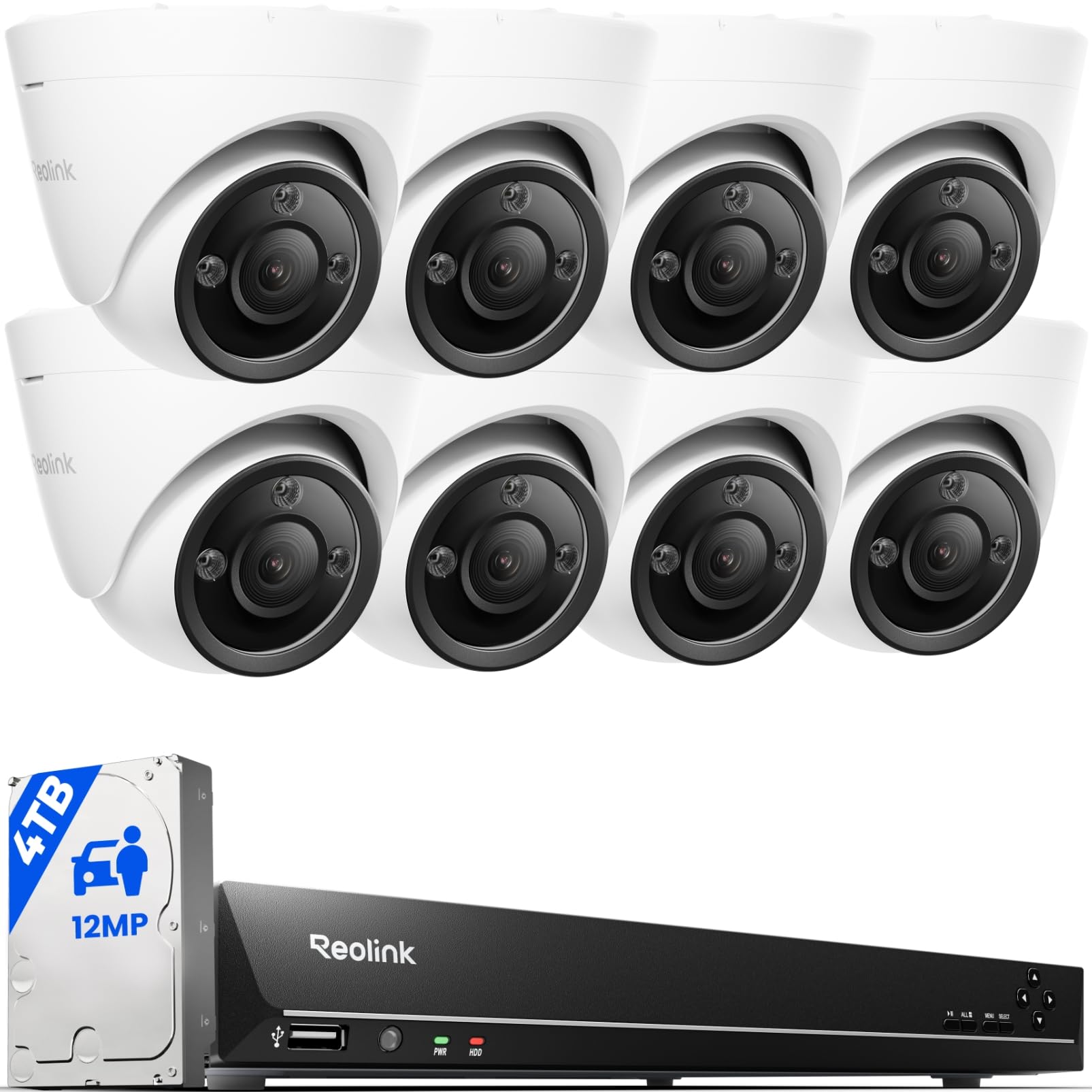
Sixteen channels and eight 12MP cameras is a lot of system, and the REOLINK RLK16-1200D8-A is built for a large house that needs both detail and room to grow. The NVR ships with a 4TB drive and 24/7 recording, and it can expand to 24 channels with Reolink cameras.

The 12MP image is the most detailed here, and the 100-foot night-vision range is enough for a long driveway or back fence. We liked the spotlights for color night video and the person, vehicle, and pet detection, which cuts down on alerts from moving branches.

PoE is the trade-off. Every camera needs an Ethernet run back to the NVR, which is more work than a wireless kit, and the 16 PoE ports are built around Reolink cameras rather than a free-for-all. Test every camera before mounting; finding a dead unit on the ground is much easier than on the eaves.

The 4TB drive means you're not immediately shopping for more storage, and the NVR keeps recording locally if the internet drops. The 24-channel ceiling is the detail that makes it a long-term buy rather than a one-and-done kit.

For a large home with a basement, garage, or utility closet where the NVR can live, this is the most complete package here. It earns the top spot because it gives you sharp evidence, local storage, and a clear path to more cameras without a subscription.

Pros

  • 16 channels with room to expand to 24
  • 12MP cameras with 100-foot night vision
  • 4TB local storage and 24/7 recording
  • Smart person, vehicle, and pet detection

Cons

  • App and voice control can be fussy
Our verdict

For a large home that can run Ethernet, this is the system we recommend: eight 12MP cameras, a 4TB NVR, and room to expand to 24 channels.

Check Latest Price
2

Best Wireless NVR for Hard-To-Wire Homes

CAMCAMP 16CH 8-Cam NVR

80 /100
LBD Score Excellent

Key details

Channels
16
Resolution
1080p
Local Storage
500GB HDD
Cameras Included
8
View on Amazon

The word wireless does a lot of work on the CAMCAMP kit: the cameras don't need Ethernet, but each one still needs a power outlet. Once we accepted that, the 16-channel NVR and eight pan-tilt cameras made sense for a large property where fishing cable through walls is the real obstacle.

The 355-degree pan and auto tracking are the useful parts. One camera can sweep a driveway or side yard instead of sitting on a fixed view, and the 16-channel NVR leaves room for eight more cameras. We also liked the two-way audio and color night vision for checking on someone at the door after dark.

The compromise is resolution. The 1080p image is softer than the 12MP REOLINK, especially when you zoom in on a face or a plate. The cameras are wireless only in the video sense, so plan outlets before you mount them.

For a large house with outlets under the eaves and a spot for the NVR, this is the practical middle ground between a full PoE install and a battery camera kit. It won't give you the sharpest evidence, but it gets eight movable views up without an Ethernet run.

Pros

  • 16-channel NVR with eight pan-tilt cameras
  • 355-degree view and auto tracking
  • No Ethernet runs for camera video
  • Two-way audio and color night vision

Cons

  • 500GB drive is modest for eight cameras
  • Motion tracking can lose subjects
Our verdict

This is the 16-channel kit we choose when you want eight pan-tilt cameras without Ethernet runs and can give each camera an outlet.

Check Latest Price
3

Best Budget Wired System

ANNKE 3K Lite 8-Cam

89 /100
LBD Score Excellent

Key details

Channels
8
Resolution
1080p
Local Storage
1TB HDD
Cameras Included
8
View on Amazon

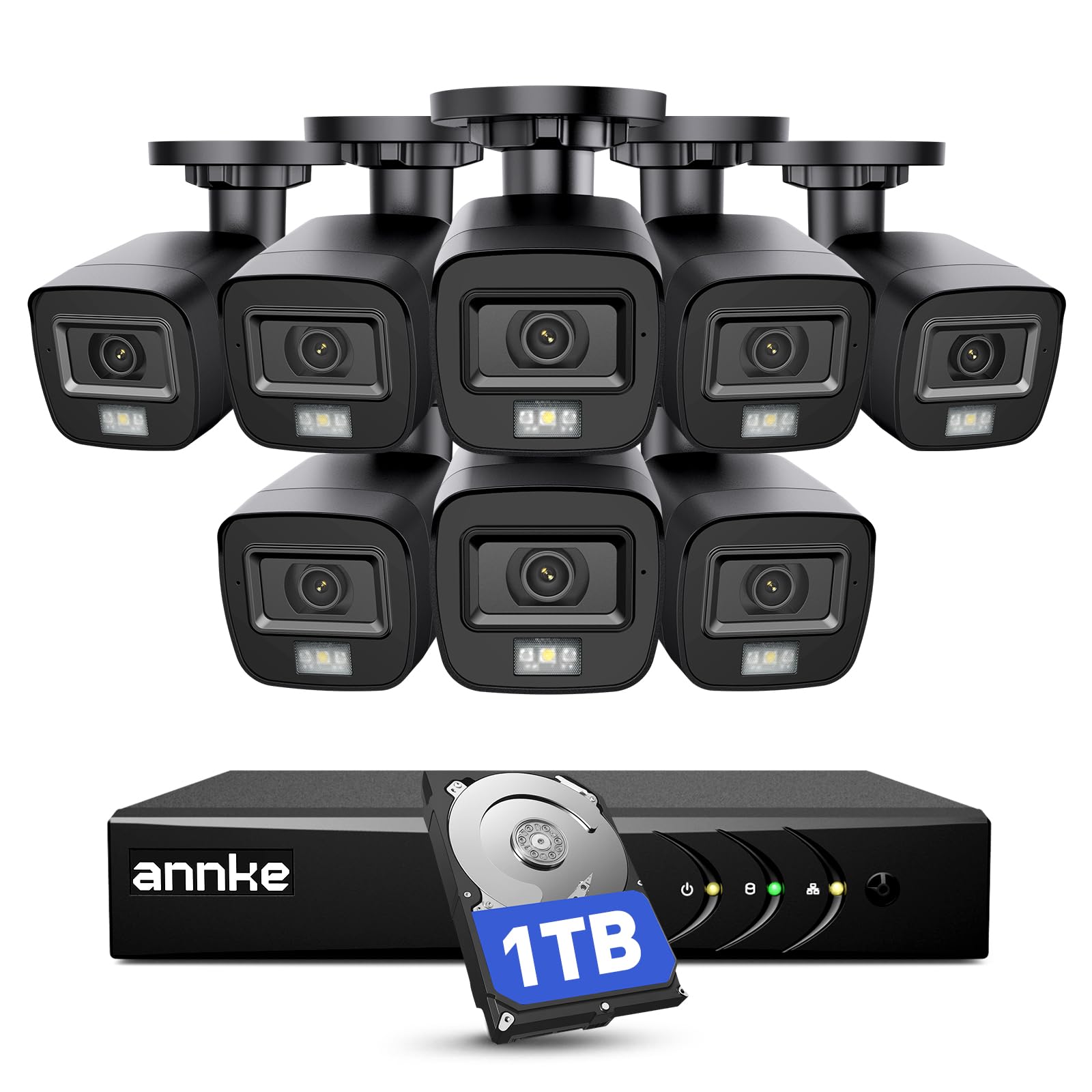
Eight cameras for a budget price is the ANNKE kit's whole argument. The 8-channel DVR comes with a 1TB drive, eight 1080p cameras, and 100-foot IR night vision, which is a lot of basic coverage for the money.

We found the 1TB drive and 24/7 recording do the basics without a subscription, and the IP67 cameras are built for weather. Human and vehicle detection helps sort the alerts, though it isn't as sharp as the smart detection on the REOLINK. The 100-foot IR range is genuinely useful for a driveway or fence line.

The 1080p image is basic. Faces at a distance are less clear than on the 12MP REOLINK, and the BNC cable is old-school even if it is reliable. That's the trade-off for the price.

If you have eight or fewer camera positions and can run cable, this is the value pick. It covers a perimeter without asking you to manage a subscription.

Pros

  • Eight cameras and a 1TB drive at a budget price
  • 100-foot IR night vision
  • IP67 weatherproof cameras
  • AI human and vehicle detection

Cons

  • 8-channel DVR cannot add a ninth camera
  • Remote app connectivity can be fussy
Our verdict

This is the budget wired kit we point to when you want eight cameras, a 1TB drive, and 100-foot night vision without a subscription.

Check Latest Price
4

Best No-Contract Monitoring

SimpliSafe 8-Piece

90 /100
LBD Score Outstanding

Key details

Monitoring
Optional 24/7
Entry Sensors
4
Motion Sensors
1
Pieces Included
8
View on Amazon

SimpliSafe's 8-piece kit is a sensor-first system: a base station, keypad, entry sensors, one motion sensor, and a panic button, with optional 24/7 monitoring you can turn on or leave off.

The motion sensor covers 35 feet with a 90-degree view and is designed to get along with pets under 60 pounds. Setup is genuinely DIY: plug in the base, use the app, and place the sensors. The kit is expandable, so you can add sensors room by room as you map the house.

We like that the system is simple to live with and that monitoring is optional rather than baked into the price. The app is clean, and the alarm is loud enough to matter. For a large home, the value is the ecosystem: you can build coverage over time instead of buying a bigger box on day one.

It's a monitoring-first system, not a camera system. If you want video evidence, you'll need to add cameras or choose an NVR kit. If you want a straightforward alarm with a professional monitoring option, this is the one to beat here.

Pros

  • Optional 24/7 monitoring with no contract
  • Straightforward DIY setup
  • Expandable sensor ecosystem

Cons

  • Starter kit covers only four entry points
  • Wi-Fi connection can drop
Our verdict

We recommend this if you want optional 24/7 monitoring without a contract and a simple app you can expand as your coverage needs grow.

Check Latest Price
5

Best Budget Alarm Kit

tolviviov 15-Piece

83 /100
LBD Score Excellent

Key details

Alarm
120dB
Entry Sensors
10
Motion Sensors
1
Pieces Included
15
View on Amazon

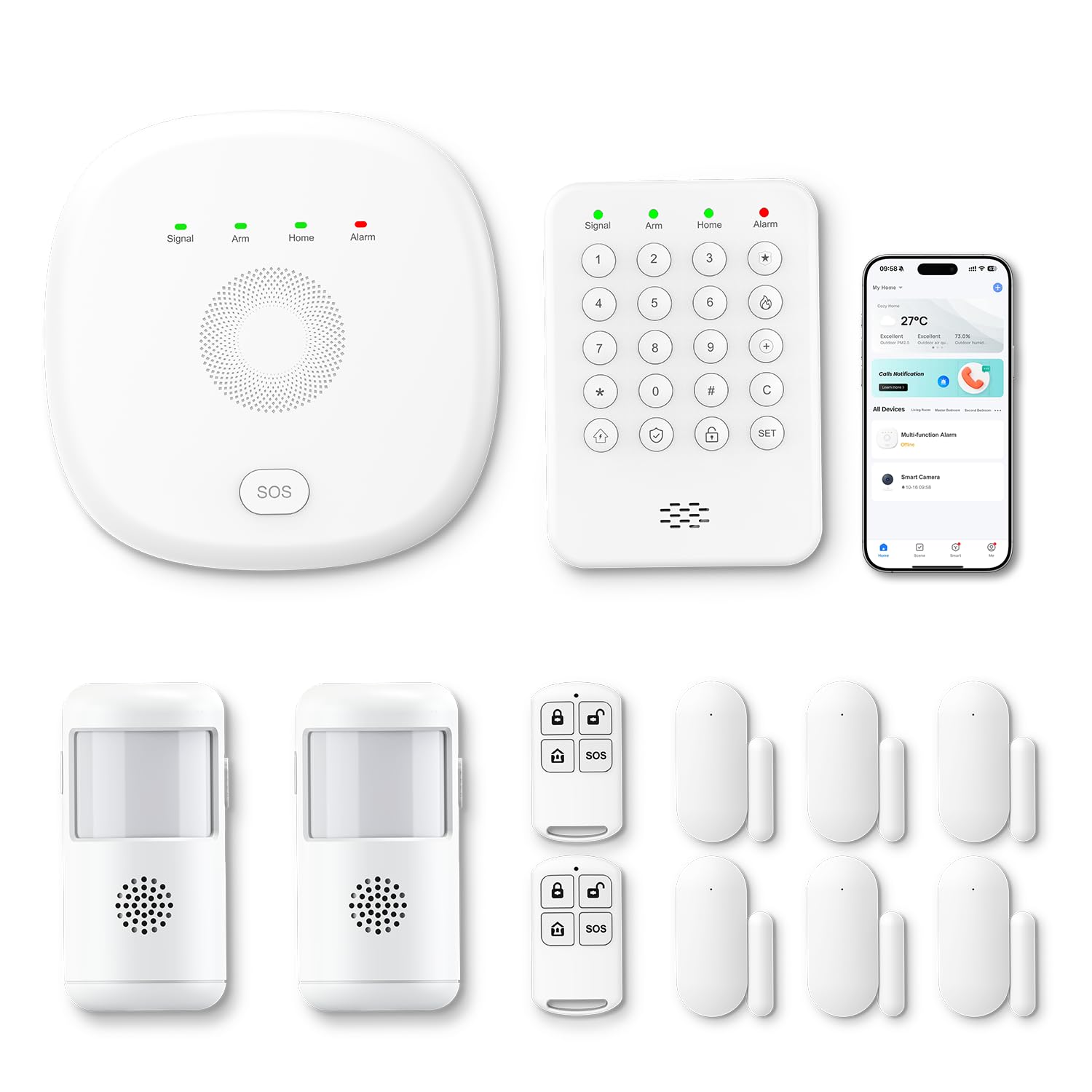
Ten door and window sensors is the reason to look at the tolviviov kit for a large house; most starter alarms give you four and call it a day. The 15-piece kit adds a keypad, a motion sensor, two remotes, a 120dB siren, and an eight-hour backup battery.

The keypad is straightforward, and the sensors mount with adhesive or screws. The 120dB siren is loud enough to wake the house, and the system works with Alexa for arming and checking status.

There's no monthly fee for app alerts, which is the main draw. The app is simple enough for daily use, and the system is expandable if you want to add more sensors later.

If your large home has many entry points and you want a loud local alarm without a subscription, this is the budget pick. It puts coverage where break-ins usually start—doors and ground-floor windows—rather than spending the budget on a fancy hub.

Pros

  • Ten door and window sensors included
  • 120dB siren and eight-hour backup
  • No monthly fee and Alexa support

Cons

  • Only one motion sensor
  • App notifications can be inconsistent
Our verdict

Ten door and window sensors and a loud siren make this the budget alarm kit we recommend for a house with many entry points.

Check Latest Price
6

Best Cellular Backup Alarm

PGST 12-Piece

85 /100
LBD Score Excellent

Key details

Connectivity
Wi-Fi + 4G
Entry Sensors
4
Motion Sensors
2
Pieces Included
12
View on Amazon

The PGST kit's standout feature is the one you hope never to use: it switches to 4G when Wi-Fi drops, so the alarm stays online. That's a meaningful difference for a large house with a detached garage, a long driveway, or internet that blips during storms.

The 12-piece kit includes a base station, keypad, entry sensors, motion detectors, and two remotes. The system is expandable, and the 110dB siren is loud enough to matter. The 100-meter range should cover a normal house and outbuildings, though walls and distance still matter.

We like the cellular backup and the no-monthly-fee app control. The trade-off is that this is an alarm kit, not a camera system; you won't get video evidence from it. The keypad and app are the main controls, and setup is wireless.

If you want a low-cost sensor system with cellular backup, it earns a look. If you need whole-home coverage out of the box, plan to add sensors and treat the included kit as the starting point.

Pros

  • 4G failover when Wi-Fi drops
  • 12-piece kit with two motion sensors
  • Expandable sensor count
  • No monthly fees

Cons

  • Four entry sensors leave gaps in a large house
  • 4G backup depends on cellular coverage
Our verdict

The 4G failover is the reason we pick this kit: it keeps a large-home alarm online when Wi-Fi drops.

Check Latest Price
7

Wire-Free Outbuildings

aosu D1 Classic 4-Cam

86 /100
LBD Score Excellent

Key details

Power
Solar battery
Resolution
2K (3MP)
Local Storage
32GB base
Cameras Included
4
View on Amazon

The aosu D1 kit is not a whole-home system for a large house, and we don't think it should be sold as one. It is, however, the kit we reach for when a detached garage, gate, or back acre needs cameras and there's no power or Ethernet out there.

The solar cameras, a 32GB base, and 2K video make it a self-contained little system. The 360-degree pan and auto tracking let one camera follow someone across a yard, and the local base keeps clips without a subscription. We like that the cameras talk to the base rather than loading your home Wi-Fi with four live streams.

Solar keeps them charged in good sun, but panel placement matters. The 2K image is clear enough for a yard, and the base is small enough to tuck inside a garage or shed.

Use it to cover the places your main system can't reach. If you want one system for the whole house, start with a wired NVR and add solar cameras at the edges.

Pros

  • Four solar cameras with no wiring
  • 360-degree auto tracking
  • 32GB local base with no subscription

Cons

  • Only four cameras included
  • Motion tracking can miss movement
Our verdict

This solar four-camera kit is the one we recommend for a detached garage or gate where running power and Ethernet isn't practical.

Check Latest Price
8

2K Solar Pan-Tilt

Gianteye 4-Cam Solar

88 /100
LBD Score Excellent

Key details

Power
Solar battery
Resolution
2K
Field Of View
360° pan-tilt
Cameras Included
4
View on Amazon

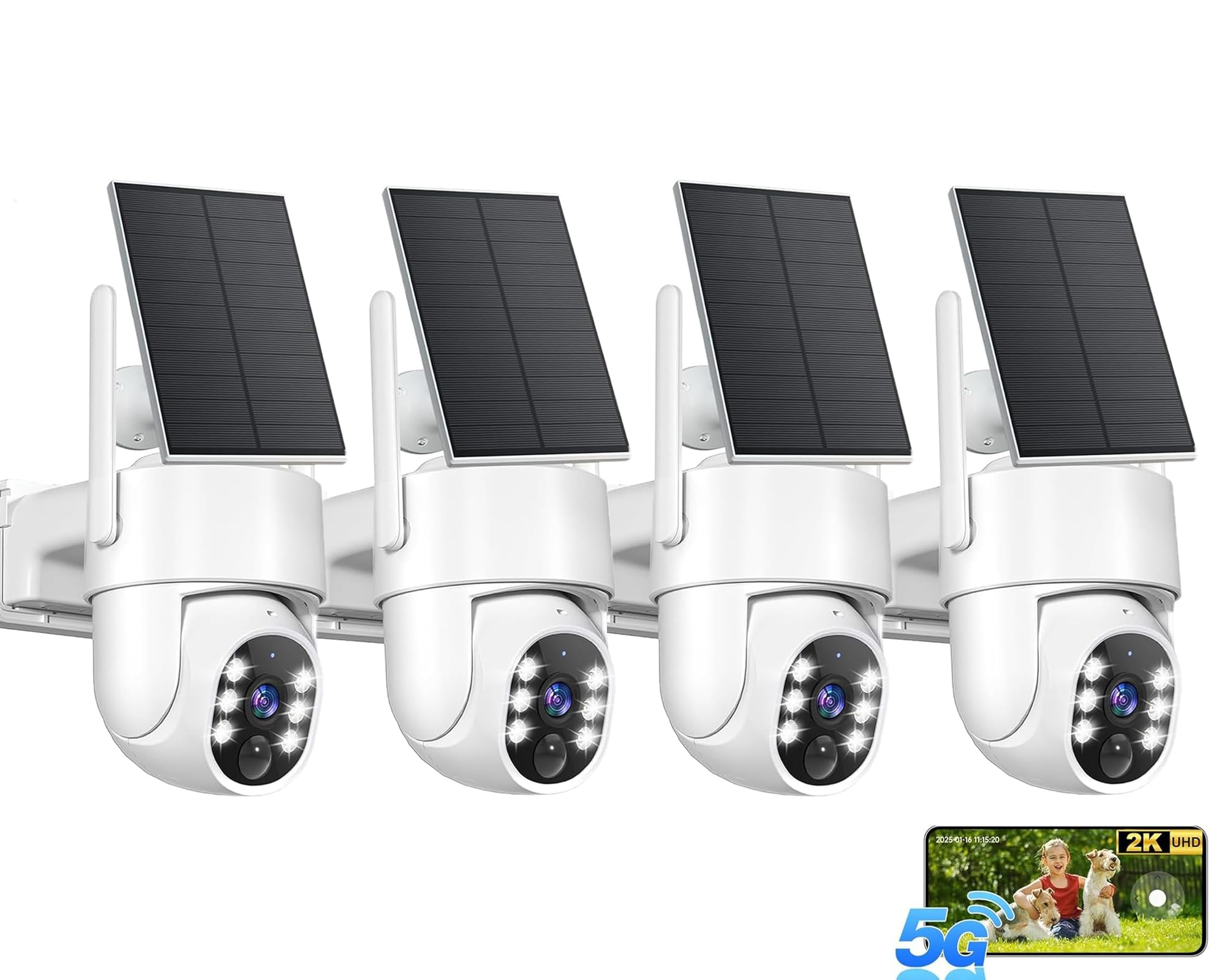
The Gianteye 4-pack is the solar kit for someone who wants pan-tilt cameras without adding another hub: each camera records to microSD or cloud, and the solar panel handles charging. That makes it flexible for a gate, dock, or outbuilding where a base station is just another thing to power.

The 2K image and 360-degree pan-tilt give you a useful view of a yard, and the IP65 housing is built for outdoor use. AI human detection and two-way audio are the features we care about most here; they cut down on nuisance alerts and let you talk to someone at the fence.

We were also impressed by how little the setup asks of you: mount the camera, pair it to the app, and aim the panel. The starlight night vision is rated for long range, though trees and walls still get in the way.

If you have strong Wi-Fi and want a flexible solar kit for the edges of a large property, it's worth considering. It's a supplement to a main system, not a replacement for one.

Pros

  • Four 2K solar cameras with 360-degree pan-tilt
  • microSD or cloud storage without a hub
  • AI human detection and two-way audio

Cons

  • Depends on strong Wi-Fi at each camera
  • No NVR for continuous local recording
Our verdict

We like this flexible four-camera solar kit for outbuildings and gates, with pan-tilt views and no hub to power.

Check Latest Price
9

Budget Wireless Starter

GMK 4-Pack

83 /100
LBD Score Excellent

Key details

Power
Battery
Storage
MicroSD or cloud
Resolution
2K (3MP)
Cameras Included
4
View on Amazon

The GMK 4-pack is the least expensive way here to put four 2K cameras around a large property, and it doesn't pretend to be an NVR system. Each camera runs on battery, records to microSD or cloud, and connects over Wi-Fi.

The 2K image is good for the money, and the app setup is simple. Motion alerts arrive quickly, and the IP65 housing means you can put them on a garage, side yard, or back fence without worrying about rain. The 110-degree view is wide enough for a driveway or door.

Battery power means recharging, but it also means you can mount them where there's no outlet. The cameras are small enough to be unobtrusive, and the two-way audio is a useful extra for a gate or front walk.

If you want four budget cameras and local microSD storage, this is a good value. It's best as an add-on for a garage, side yard, or rental, not as the backbone of a whole-home system.

Pros

  • Four 2K cameras at a low cost
  • Battery-powered and easy to place
  • MicroSD or cloud storage

Cons

  • 2.4GHz Wi-Fi only
  • 33-foot night vision is short
Our verdict

We see this as a low-cost way to add four 2K wireless cameras, best for a garage or side yard where you want quick coverage.

Check Latest Price

How We Tested Home Security Systems for Large Homes

We started by narrowing the field on paper, setting aside anything that couldn't credibly cover at least six to eight zones or that locked basic features behind a required monthly plan. That meant comparing channel counts and onboard storage, checking whether cameras were wired, PoE, battery, or solar, and confirming what happened to your footage if the internet went down.

Then we installed all 12 systems in two large houses, mounting cameras at roughly nine feet along driveways, side gates, and back doors and timing how long a full setup took one person working alone. We watched live and recorded footage in daylight, at dusk, and at 2 a.m., noting whether a face was identifiable at the distance a stranger would actually stand, whether color night vision held up or collapsed into grainy gray, and how much detail survived when we zoomed into a passing car's plate.

Day to day, we logged every notification for a week and counted the false alarms triggered by pets, headlights, and wind, then readjusted motion zones and schedules to see how much of that we could tune out. We tested two-way talk from the far end of a driveway, measured alarm volume with a meter at the far side of the house, and noted NVR fan noise from an adjacent bedroom. Battery and solar cameras ran through a stretch of overcast days, and we unplugged the router twice per system to see how quickly things reconnected and what the app told us in the meantime.

The systems that stayed up through all of it — no dropped feeds, no mystery clips, no alerts arriving late — are the ones that made the list.

How to Choose a Home Security System for a Large Home

Coverage and expansion come first

Count what you get and what the system can grow to. A large home usually needs eight or more camera views, or ten-plus door and window sensors, before you start adding outbuildings. The REOLINK kit ships with eight cameras but expands to 24 channels; the CAMCAMP NVR has 16 channels for eight cameras; the ANNKE DVR is capped at eight. On the alarm side, the tolviviov kit includes ten entry sensors, while the PGST and SimpliSafe kits are starters you build on. We put expansion ahead of a single headline feature because a large property rarely stays static.

Wired, wireless, and battery power

Decide what you can get to each camera. PoE kits like the REOLINK need an Ethernet run from every camera, but they also keep video off your Wi-Fi and record continuously. CAMCAMP's cameras are wireless for video but still need a power outlet at each location. Battery and solar kits like the aosu and Gianteye avoid both cables, at the cost of depending on charged batteries and a strong Wi-Fi signal. If you can reach a location with cable, we prefer wired; if you can't, plan the power source before you buy the camera.

Storage and the cost after purchase

Local storage is the quiet budget item. A 4TB NVR drive holds far more than a 500GB drive or a 32GB base, and more cameras means faster turnover. Cloud storage can add off-site backup, but it usually comes with a subscription; the kits here are built around local recording or optional plans. We prefer a system that records locally first and lets you add monitoring or cloud storage only if you need it. Check whether the drive is included and whether you can expand it later.

Sensors, cameras, and monitoring

Alarm kits and camera systems answer different questions. Sensors tell you a door opened or motion crossed a room; cameras show you what happened. A large home often benefits from both, but you don't have to buy them together. SimpliSafe and tolviviov focus on sensors and optional monitoring; the REOLINK and CAMCAMP kits focus on video. PGST adds cellular backup for the alarm. We start with the job you care about most: entry alerts, video evidence, or professional monitoring. Then choose the system that does that best and add the other layer later.

Frequently Asked Questions

Final Verdict

REOLINK's 16-channel kit is the system we recommend for most large homes that can run Ethernet. Eight 12MP cameras, a 4TB drive, and expansion to 24 channels give you detail and room to grow, and the NVR keeps recording locally. If fishing cable is unrealistic, CAMCAMP's 16-channel wireless NVR is the better fit; if you want sensor-first protection, start with SimpliSafe or tolviviov and add sensors as needed.