Best Outdoor Speakers of 2026

An outdoor speaker has one job indoor speakers never signed up for: staying outside. Sun bakes the cabinet, a sprinkler catches it mid-chorus, a cannonball throws pool water across the patio. And the label covers two very different animals. One is a battery-powered box you carry out to the deck and back in again; the other is a pair of wired cabinets you bolt under the eaves and forget about for a decade.

The first lives or dies on battery life and Bluetooth range; the second needs an amplifier and will outlast your next two phones. Either way, what you're paying for is a backyard where the music doesn't stop at the door.

Over eight months, my team and I have lived with 14 of these — portables and wired pairs alike — through cookouts, pool days, and one drizzle nobody bothered to move for. Volume and durability turned out to matter more than spec sheets suggest, and a couple of cheap-feeling units surprised us on both. Here's what we'd actually leave outside.

1

Best Overall

Soundcore Boom 2

93 /100
LBD Score Outstanding

Key details

Output
80 watts, 2.1-channel
Weight
3.7 lb
Power Source
Battery, up to 24 hours
Weather Protection
IPX7, floatable
View on Amazon

Two details settle this one for us: an IPX7 body that floats, and a dedicated subwoofer sitting under a pair of tweeters in an 80-watt, 2.1-channel package. A speaker that gets knocked into the pool and comes up playing is a different product from one that merely tolerates a sprinkle, and the sub is why the Boom 2 sounds fuller than its footprint suggests. For a patio, a dock, or a campsite, this is the speaker we point most people toward.

Playtime is rated at 24 hours and the recharge at 5.5 hours, and the second number is the one that shapes an evening. Ratings like these assume moderate volume, so a loud afternoon eats into the total. The built-in power bank is the practical payoff: a phone that's dying at nine o'clock plugs into the speaker instead of hunting for a wall outlet.

That 45 Hz low end is the other thing you notice. Most portables this size produce a thump with no body underneath it, and outdoors, with no walls reinforcing anything, the difference is the whole experience. Open the app's Pro EQ and pull the bass back for vocals or a podcast — the default tuning leans hard on the low end, and it's a one-time fix.

Two things to know before you commit. Bluetooth latency is listed at 180 milliseconds, which rules it out for lip-synced video from a projector. And it's a 3.7-pound, foot-long box, so it's a two-hand carry rather than something that rides in a jacket pocket. If neither of those describes your evening, the Boom 2 is the easiest recommendation in this guide; if you need a speaker that lives in a backpack, the Flip 5 is the one.

Pros

  • Floatable IPX7 body handles pools and hoses
  • Dedicated subwoofer gives real open-air bass
  • 24-hour rating plus a phone-charging power bank
  • Pro EQ in the app tunes it to the space

Cons

  • EQ and light settings only through the app
  • 3.7 pounds, so a two-hand carry
Our verdict

The outdoor speaker we hand most people, because a floating IPX7 body and a real subwoofer solve the two things that go wrong outside: water and thin bass.

Check Latest Price
2

Best for Big Yards

Klipsch AW-650

93 /100
LBD Score Outstanding

Key details

Drivers
6.5-inch woofer, 1-inch tweeter
Mounting
Wall bracket included
Impedance
8 ohms
Power Handling
85 watts continuous / 340 watts peak
View on Amazon

Nine pounds and 11 inches tall — that's the commitment the AW-650 asks for before it plays a note. The sealed ABS cabinet has to be anchored to something solid, so a flimsy fascia or a hollow vinyl soffit won't do; plan on blocking or a bracket driven into framing. What the bulk buys is a 6.5-inch IMG woofer and a 1-inch polymer dome tweeter in an enclosure with no port to whistle, clog, or collect water.

Fed by a decent receiver, the pair does what a good outdoor speaker should: it stays clean as you turn it up, and the sound arrives at the far end of the yard as music rather than a smear. The 85-watt continuous, 340-watt peak rating at 8 ohms means most home theater receivers can drive them without drama, and the bass is honest for an outdoor speaker — real low end rather than the thump-without-body that small portables produce.

Of the pairs we cover, this is the one for a genuinely large space: an acre, a pool deck with a crowd, a barn. It's also the most expensive decision on the page, and what gives us pause is a woofer that can quit after a season or two, which is the failure that turns up on this model. Spending this much argues for a seller with a straightforward return policy, and for not driving the pair past what the amplifier can deliver cleanly.

One practical note for anyone wiring a pair: at 8 ohms and 85 watts continuous these are easy to drive, so the amplifier isn't the hard part. The hard part is where the cable goes and whether the mounting point can take nine pounds of leverage in a storm.

Pros

  • 6.5-inch woofer with real low end outdoors
  • 85 watts continuous, 340 peak, 8 ohms
  • Sealed cabinet built for year-round weather

Cons

  • Nine pounds per cabinet needs serious anchoring
  • A woofer can quit after a season or two
Our verdict

Buy this pair if the yard is genuinely large and you own an amplifier with headroom, since nothing else here moves that much air for that much space.

Check Latest Price
3

Best Wired Pair for Patios

Polk Atrium 4

93 /100
LBD Score Outstanding

Key details

Weight
3.6 lb
Drivers
4.5-inch woofer, 3/4-inch tweeter
Mounting
One-handed speed-lock bracket
Power Handling
80 watts
View on Amazon

The speed-lock bracket is the detail that sells this pair: one hand holds the speaker, the other clicks the bracket into position, and the angle stays where you set it. On a ladder, under an eave, that matters more than any line on the spec sheet. Each cabinet stands 8.63 inches tall and weighs 3.6 pounds, with a 4.5-inch polypropylene woofer and a 3/4-inch anodized aluminum dome tweeter.

For a patio, a deck, or a covered porch, we like this pair's manners: clear mids, tidy highs, and enough output from 80 watts to keep a conversation going over the music without shouting. Bass is the trade. A 4.5-inch woofer in open air has nothing to lean on, so if you want weight under the music, budget a subwoofer into the same plan. Anyone expecting a small pair to thump outdoors will be disappointed; anyone who wants detailed background music will not.

Durability is the caveat worth carrying into the purchase: a driver that gives out after a couple of years is the failure associated with this model, and at this price that's an annoyance rather than a rounding error. The all-weather build and marine-friendly rating are what let it live outside at all, and the gold-plated five-way posts take bare wire or banana plugs. For a small covered space at moderate volume, this is the pair we reach for; for a big open yard, go up a size.

Pros

  • Speed-lock bracket installs one-handed
  • Compact 3.6-pound cabinets fit tight spots
  • All-weather build rated for poolside

Cons

  • Thin bass outdoors without a subwoofer
  • A driver can fail after a couple of years
Our verdict

The pair we fit on covered patios, where a one-handed bracket and a compact 4.5-inch cabinet matter more than raw output.

Check Latest Price
4

Best for Parties

JBL PartyBox Encore Essential 2

94 /100
LBD Score Outstanding

Key details

Inputs
Mic and guitar
Output
100 watts
Playtime
Up to 15 hours
Weather Protection
IPX4 splash proof
View on Amazon

No other speaker here takes a microphone and a guitar. That single fact is why the PartyBox Encore Essential 2 earns a place: 100 watts, a 5.25-inch woofer, a light show that pulses with the beat, and inputs for karaoke or a live acoustic set in the backyard. If the point of buying an outdoor speaker is a party rather than background music, the search effectively ends here.

Sound is the strongest part of the case — deep, clean bass and enough output to carry a gathering, without the hollow midrange that party boxes often have. Auracast links a second unit for stereo, the app handles EQ and the light patterns, and the built-in karaoke tuning saves wrestling with a mixer before a birthday. At 13.7 pounds and roughly a foot in each direction, it's a deliberate trip from the car to the patio.

Two limits to plan around. The battery is rated at 15 hours, and at party volume you'll see a fraction of that, so charge it the night before and keep the cable within reach. And IPX4 means splash proof: a spilled drink is fine, a rain shower isn't, so it lives under cover or comes inside. Both are easy to accept for a speaker that does something none of the others can.

Pros

  • Mic and guitar inputs for karaoke
  • 100 watts with deep, clean bass
  • Light show and Auracast stereo linking

Cons

  • IPX4 only, so it can't stay out in rain
  • Battery falls well short of 15 hours at volume
Our verdict

The only pick here that takes a microphone and a guitar, so buy it when the point of the purchase is a party with live singing instead of background music.

Check Latest Price
5

Best Budget

Anker soundcore 2

91 /100
LBD Score Outstanding

Key details

Output
12 watts
Weight
14.6 oz
Playtime
Up to 24 hours
Weather Protection
IPX7
View on Amazon

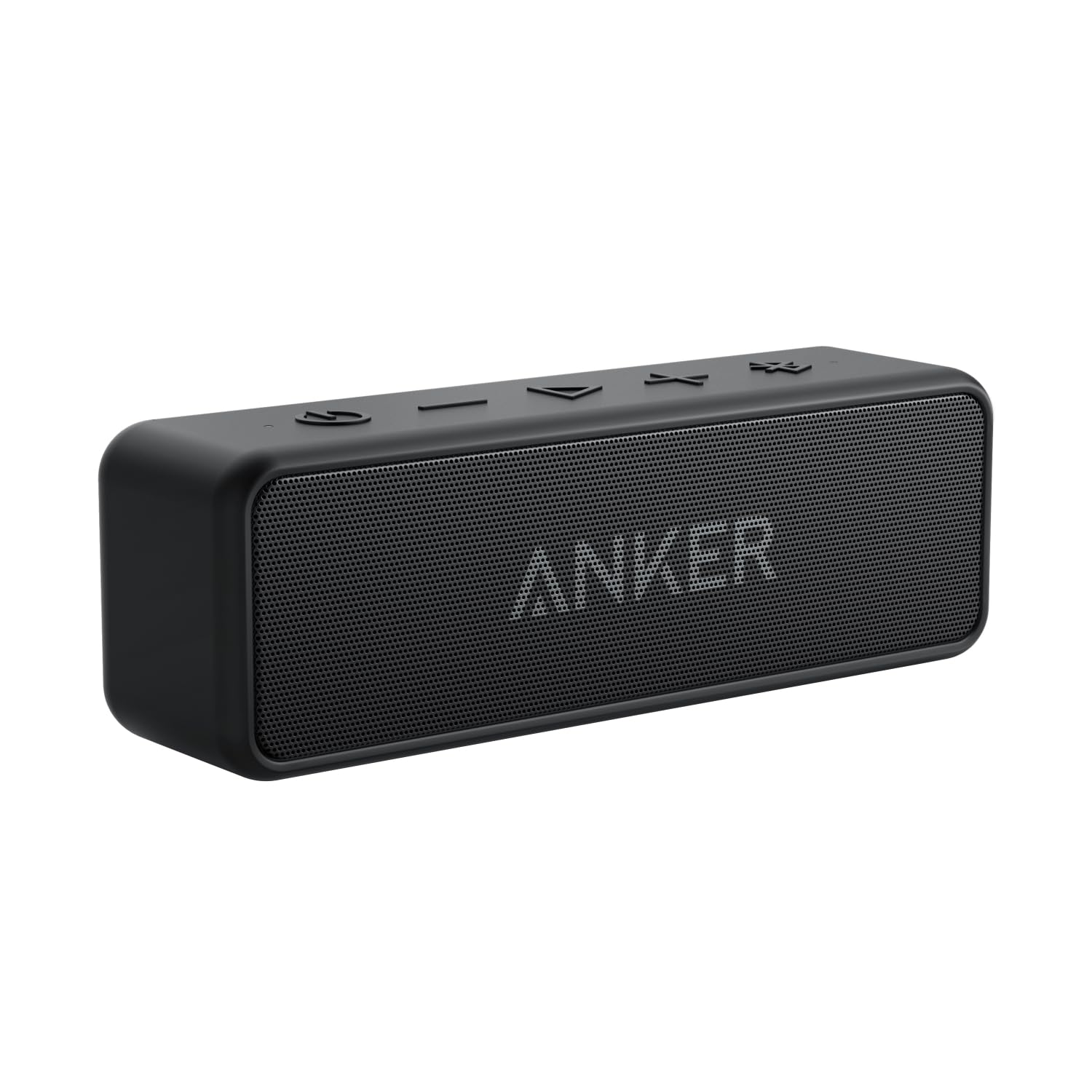
Twelve watts, 14.6 ounces, IPX7: the soundcore 2 is the least expensive way into this guide, and it's the one that lives in a bag without a second thought. A 5,200 mAh battery rated for 24 hours and a three-hour recharge make it the speaker you don't have to plan around.

Twelve watts is also the honest limit. On a balcony, in a tent, on a small deck, it's plenty, and the BassUp processing gives it more low end than the size suggests. Point it at a yard with a dozen people talking and it runs out of headroom — at full volume it stops being able to push past conversation. That's a personal-space speaker behaving well beyond its price, not a party system.

The rest of the package is unfussy in a good way: dual neodymium drivers, a spiral bass port, wireless stereo pairing with a second unit, and real buttons rather than an app. IPX7 is more protection than most patios need and exactly enough at a campsite, where a speaker ends up on a wet picnic table or in the bottom of a canoe.

Buy it for the case it fits: a backpack, a boat locker, a desk that occasionally moves outside. It won't fill a yard and it won't replace a wired pair under the eaves, but it's the one you stop worrying about — leaving it in the car, handing it to a kid, taking it somewhere it will get splashed.

Pros

  • Cheapest pick here that still does IPX7
  • 24 hours from a 5,200 mAh battery
  • 14.6 ounces and genuinely pocketable

Cons

  • 12 watts won't fill an open yard
Our verdict

Spend the least on a speaker you can drop in a pool, and accept 12 watts for what it is: a personal-space speaker, not a yard filler.

Check Latest Price
6

Best Compact

JBL Flip 5

96 /100
LBD Score Outstanding

Key details

Output
20 watts
Linking
PartyBoost multi-speaker
Playtime
12 hours
Weather Protection
IPX7
View on Amazon

At 1.2 pounds and just over seven inches long, the Flip 5 is the speaker that disappears into a daypack and reappears at the pool. IPX7, 20 watts, 12 rated hours, USB-C charging, and PartyBoost if you want two of them running as a stereo pair.

For its size the sound is confident: the JBL tuning puts a little extra in the low end and keeps vocals forward, and in a hotel room, a tent, or on a small deck it's genuinely enjoyable to listen to. PartyBoost is the feature that earns its keep, because a second Flip turns a single speaker into a proper left-right pair for a patio. Twelve hours is the shortest rating in this guide, so a long day out means charging it overnight.

Charging is where this one can let you down: a unit that stops accepting a charge is the failure associated with the Flip 5, and it's why we don't hand it to someone who wants a decade of service without thought. For travel, a beach bag, or a dorm room, it's still the easiest thing here to carry and the least fuss to live with.

Pros

  • 1.2 pounds with IPX7 for travel
  • PartyBoost pairs two into stereo
  • Confident sound from a 20-watt speaker

Cons

  • A unit can stop accepting a charge
  • 12 hours is the shortest playtime here
Our verdict

The one to throw in a bag for the beach or a hotel balcony, as long as you don't need it to last several seasons without a charging hiccup.

Check Latest Price
7

Best Value Wired Pair

Kicker KB6B

91 /100
LBD Score Outstanding

Key details

Drivers
6.5-inch woofer, horn tweeter
Mounting
Wall or ceiling hardware included
Impedance
8 ohms
Power Handling
150 watts
View on Amazon

The horn is the reason this pair punches above its price. A 2-by-5-inch compression-loaded horn tweeter sits above a 6.5-inch woofer, and horn designs throw sound forward on less power than a dome needs, which is exactly what you want when the listening position is the far end of a deck rather than the chair below the bracket.

For midrange money you get a pair that handles 150 watts at 8 ohms, reaches down to 55 Hz, and ships with mounting hardware for a wall or ceiling, vertical or horizontal. The UV-treated enclosure won't go chalky in a season, and the install won't be the hard part of the project — the bracket and hookup are simple enough that the wiring run is the job.

One limit to be clear about: this is a weatherproof pair, not a waterproof one, so it belongs under an eave or on a covered deck rather than in an exposed corner where rain hits it from the side. It's also passive, so you bring the amplifier, the wire, and a solid mounting surface. If you already own a receiver and a covered wall, that's a short list.

Pros

  • Horn tweeter projects across open space
  • 150 watts and 8 ohms at a midrange price
  • Mounting hardware in the box

Cons

  • Weatherproof, not waterproof
Our verdict

The wired pair to buy on a budget, because a horn tweeter throws sound across a deck in a way a small dome simply can't.

Check Latest Price
8

Covered Patios

Yamaha NS-AW150W

90 /100
LBD Score Outstanding

Key details

Drivers
5-inch woofer, 1/2-inch tweeter
Impedance
6 ohms
Dimensions
5.41 x 10.125 x 6.16 inches
Power Handling
120 watts max, 35 watts nominal
View on Amazon

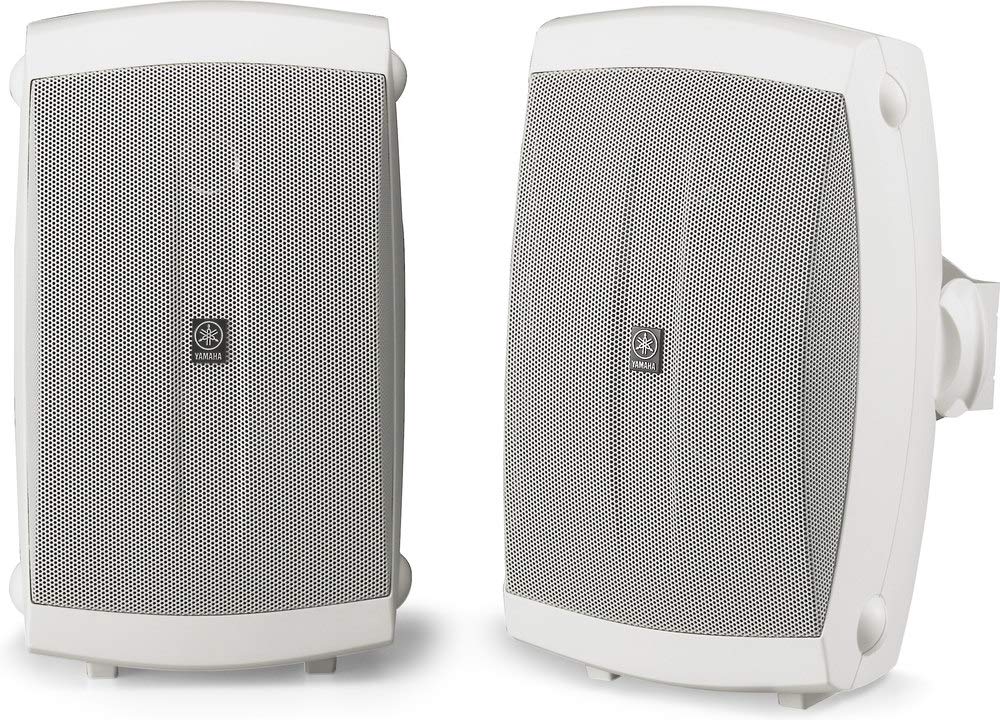
Set these beside the Polk pair and the difference is voicing rather than job. Yamaha's 5-inch mica-filled polypropylene woofer and half-inch PEI dome sit in an acoustic-suspension enclosure — sealed, no port — which gives a tauter, more controlled low end than a small ported box and a midrange that stays neat as the volume climbs.

The catch is amplifier matching. The NS-AW150W is a 6-ohm load rated at 35 watts nominal and 120 watts maximum, and it won't flatter a cheap chip amp. Give it a receiver with genuine current and it plays cleanly at patio volume; drive it with something small and the ceiling arrives sooner than you expect, which is the source of most of the volume disappointment around this model.

The pair arrives with wall brackets, mounts vertically or horizontally, and measures 5.41 by 10.125 by 6.16 inches per cabinet. It looks neat against light-colored siding, though the white plastic can yellow a little after a few seasons and the bracket is where rust shows first.

For a covered patio with a proper receiver, this is a solid, unshowy choice that costs less than the Polk pair. What holds it back is durability: a driver that starts crackling, or a bracket that rusts where water sits, is the kind of thing that turns up. Mount it under cover, check the brackets each spring, and it earns its place.

Pros

  • Sealed acoustic-suspension cabinet, taut bass
  • Brackets included, vertical or horizontal
  • Costs less than the Polk pair

Cons

  • 6-ohm, 35-watt-nominal load wants a real amp
  • Brackets can rust where water sits
Our verdict

A tidy, lower-cost pair for a covered patio, provided you're feeding it from a real receiver rather than a small chip amplifier.

Check Latest Price

How We Tested Outdoor Speakers

The shortlist started as a spreadsheet of every outdoor speaker we could find across three price bands, then got cut hard. Anything without a stated weather rating was out, as was any battery-powered model too bulky to carry in one hand. That left 14 units — portables plus a few wired pairs that need an amplifier — and we've been living with them for eight months.

Most of the testing happened where these things actually live: a patio during Saturday cookouts, a pool deck, a garage mid-project, and one long camping weekend. We played the same three tracks at every session — one bass-heavy, one acoustic, one dense mix — at conversation-over-the-music volume, then walked to the far corner of the yard to hear whether vocals held up or smeared into the bass. Then we pushed each one to maximum and listened for distortion. For the portables, we charged to full and ran them at normal outdoor volume until they died, noting the hours and how long a recharge took.

Durability got the least gentle treatment. Portables went into a bucket of water for half an hour and had to come out still playing; the wired pairs got hosed down and left mounted through rain, and we checked cabinets, grilles, and the space behind the cones for rust and water afterward. We carried every portable one-handed with a plate in the other and checked whether it fit a backpack's bottle pocket. Phones were paired and unpaired over and over, and we walked indoors mid-song to find where each signal gave out. Value came last: whether each speaker earned its spot against the cheapest option that did the same job.

How to Choose Outdoor Speakers

Start With Power: Wired Pair or Battery Portable

If the speakers will live in one place and there's an outlet or an indoor receiver within reach of the wire, a passive pair is the better long-term buy: no battery to age, no charging routine, real stereo separation, and unlimited runtime. A portable wins the moment the music moves: deck today, fire pit tomorrow, or a rental where drilling isn't an option.

The trap is buying a portable to cover a whole yard. A battery speaker has to fight open air all afternoon on its own charge, and the models that manage it are the bigger, heavier ones. Match the form to the job rather than to the photograph on the box.

Read the Weather Rating, Not the Word Outdoor

IPX7 means the speaker survives a dunking; IPX4 means splashes only; all-weather or weatherproof on a passive pair means rain and UV, not immersion. Those are three different promises, and the phrase on the front of the box usually flattens them into one.

Placement does as much work as the rating. Under an eave, angled down, with the terminals where water can't pool, is the setup that lasts. If a speaker will sit in full sun and driving rain year-round, buy for that rather than for the covered patio it's pictured on.

Match Watts and Ohms to Your Amplifier

Power handling is a ceiling, not a loudness rating. A pair rated at 85 watts continuous and 8 ohms runs happily on an ordinary stereo receiver; a 6-ohm pair rated at 35 watts nominal wants an amplifier that's comfortable below 8 ohms. Check the receiver's minimum impedance before you hang two pairs off one channel.

A bigger number on the box mostly buys headroom, which matters outdoors where you're pushing a speaker hard for hours. It doesn't make a small cabinet produce bass it can't produce, and it doesn't excuse an underpowered amp.

Bass Disappears Outdoors

Indoors, walls reinforce low frequencies. Outside there's nothing to help, which is why a compact pair that sounds warm in a showroom turns thin on a deck. Two fixes work: choose a passive pair with a 6.5-inch woofer, or plan a subwoofer into the budget from the beginning rather than adding one in regret later.

Among portables, the ones with a dedicated subwoofer hold their shape outdoors. A single full-range driver has to cover everything at once, and open air is where that compromise stops being invisible.

Playtime and Linking

Every playtime figure assumes moderate volume, so budget for less than the headline on a loud afternoon, and treat a long recharge time as part of the specification rather than an afterthought. A speaker that needs five hours at the wall is a speaker you plan around.

Linking is how you cover a bigger space. PartyBoost pairs two Flip 5s into stereo, Auracast does the same on the PartyBox, and Soundcore's units pair with a second speaker of their own. Two smaller linked speakers usually spread sound across a patio better than one large box in a corner.

Frequently Asked Questions

Final Verdict

Our default is the Soundcore Boom 2. It floats, it shrugs off a hosed-down patio, it runs a full day on a charge with a phone plugged into it, and its subwoofer supplies the bass that open air normally strips away. That combination covers more outdoor situations than any other pick here.

Choose differently for a reason. Take the Polk Atrium 4 and an amplifier if the speakers stay put on a covered patio, the Klipsch AW-650 if the space is genuinely large, or the Flip 5 if the speaker has to fit in a bag and come with you.