Best Portable Fish Finders of 2026

Sonar is a simple idea wearing a complicated menu: a pulse of sound goes down and the echo returns depth, bottom composition, and the marks that might be fish. Portable units differ mainly in how that signal reaches your eyes — a castable one ties to a rod and reads on your phone, while a handheld keeps its own screen and a cable to a puck you drop over the side. Castable units reach water you can't paddle to, but your phone's battery becomes the fish finder's battery.

I've fished from a kayak and off a bucket on the ice for years, mostly blind. This past six months my team and I have run 12 portable finders through both, weighing accuracy, battery life, and value, plus how each behaved on ice — and GPS turned out to be the feature people skip and then can't live without.

Battery and connectivity are where cheaper models fall apart: an app that drops at 80 feet turns a fish finder into a bobber. The castable sonars, handhelds, and ice-ready setups below all earned their spot by giving us a believable number on the first try.

1

Best Overall

Garmin Striker 4 Portable Kit

93 /100
LBD Score Outstanding

Key details

Sonar
CHIRP with flasher mode
Display Size
3.5 in
Maximum Depth
1,600 ft freshwater; 750 ft saltwater
Mounts Included
Transom, motor, and kayak in-hull
View on Amazon

Everything needed to run real sonar — the 3.5-inch display, the transducer, a rechargeable battery, the power cable, a transom bracket, and a foam in-hull mount for a kayak — travels in one soft case. We have carried that case to a launch with a rod in the other hand, and that is the whole argument for this kit: it turns a proper CHIRP sounder into something that fits in a bucket and comes out every weekend.

On the water it behaves like a boat unit that happens to be small. CHIRP draws clean fish arches instead of blobs, and the built-in flasher is the mode we use most in winter, because your jig and any fish rising to it sit in the same column. The depth ceiling — 1,600 feet in freshwater, 750 in salt — is far past anything a kayak or dock angler needs, so a blank screen is one problem you can stop worrying about.

Two things to know before you order. The GPS is a waypoint plotter rather than a chartplotter: you can mark a brush pile and return to it, but there are no built-in maps, so bring your own knowledge of the lake or keep a phone handy. The manual is also thin. We spent an evening poking through menus to find the flasher and the sensitivity setting, and that is time worth budgeting at home rather than at dawn.

One packing detail: the head unit can pop off its tilt mount in transit. It clicks back on in a second, but on a hike-in trip we pull the display and drop it in the case pocket rather than trusting the cradle. This is the most expensive pick here, and it is also the only one that covers ice, kayak, and a friend's boat without a second purchase.

Pros

  • CHIRP sonar plus a flasher for ice
  • Battery, case, and kayak in-hull mount included
  • Reads to 1,600 ft in freshwater
  • Clear graphics on the 3.5-inch screen

Cons

  • No built-in charts, just a waypoint plotter
  • Setup instructions are thin
Our verdict

If you want one unit that works on a kayak, over an ice hole, and off a dock, we think the Garmin Striker 4 Portable Kit is the one to buy.
Check Latest Price
2

Best for Mapping

Deeper PRO+ 2

83 /100
LBD Score Excellent

Key details

Weight
3.2 oz
Mapping
Built-in GPS, bathymetric maps
Maximum Depth
330 ft
Target Separation
0.4 in narrow beam
View on Amazon

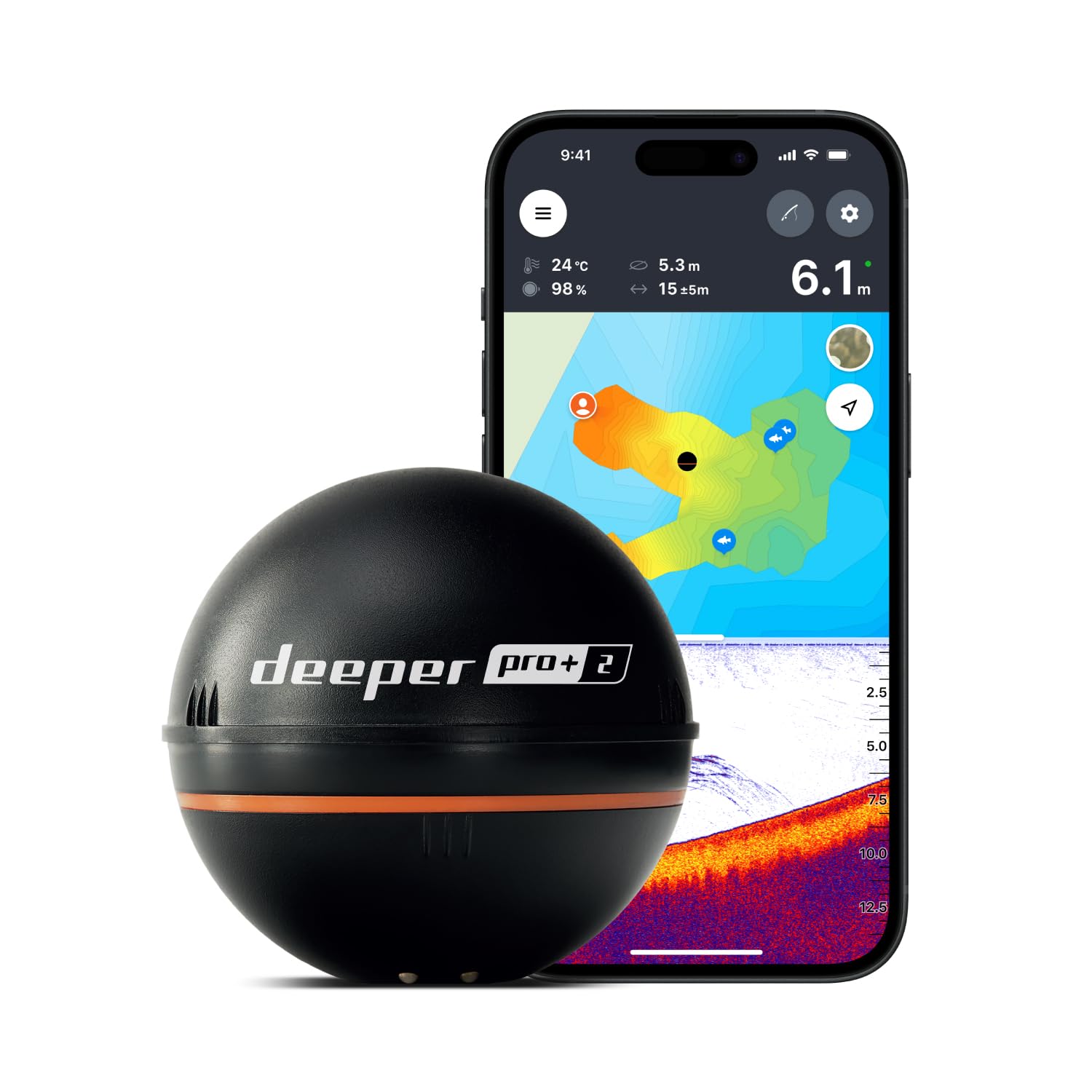
At 3.2 ounces, the PRO+ 2 is lighter than plenty of the lures it will help you find, which is the practical reason we cast it on a normal rod instead of the broomstick some castable sonars demand. It floats, it charges over USB-C, and it talks to your phone over its own Wi-Fi, so a lake with no bars is not a problem.

What separates it from the other castables here is the mapping. The built-in GPS logs depth on every retrieve and turns those passes into bathymetric maps inside the Fish Deeper app, so a morning of blind casting becomes a contour map you keep. Three beam widths do the rest: the narrow beam's 0.4-inch target separation splits fish from structure, and the wide beam covers water fast when you are scanning rather than studying.

The link is the thing to manage. It holds close in and thins out on long casts into open water, so we plan on keeping the sensor inside a comfortable retrieve and reeling it back to reacquire rather than treating a cast and a connection as the same thing.

It is also the pick here that assumes a phone and an app, and the returns reward patience: cast, reel, look, cast again. Where the water is new and you plan to come back, that loop pays for itself. Where it is not, a plain depth number costs less.

Pros

  • Built-in GPS builds bathymetric maps
  • Casts on ordinary tackle at 3.2 oz
  • Three beams, 0.4-inch target separation
  • Own Wi-Fi, no cell signal needed

Cons

  • Pro mapping features need a subscription
Our verdict

We reach for the Deeper PRO+ 2 when the water is new: cast it, watch the app, and you own the lake's contours by the end of the day.

Check Latest Price
3

Best Phone-Based Sonar

Garmin Striker Cast

88 /100
LBD Score Excellent

Key details

Maps
Quickdraw Community, 1 ft contours
Weight
2.65 oz
Sonar Modes
2-D and ice flasher
Wireless Range
Up to 200 ft
View on Amazon

Making your phone the screen is either the whole appeal of a castable sonar or the reason to skip it, and the Striker Cast makes the best case for the phone we have used: the free app pairs in minutes, the display is the one already in your pocket, and the puck itself weighs 75 grams, so it goes out on a normal rod with the included 20-foot tether tied off.

The sonar is honest 2-D with an ice flasher mode, and the Quickdraw Community layers put contour maps down to a foot on water somebody has already mapped. From a dock or a kayak seat, that answers the two questions that matter — how deep, and what is down there — without a second device in the bag.

Expect the link to hold inside 50 feet and thin out somewhere past 60, well short of the 200 feet on the box, so plan casts to water you could reach anyway. A few hours of screen-on app use also takes a real bite out of a phone, so a power bank earns its place in the bag. Water under about three feet is not its setting either; the returns get muddy.

Keep it on a dedicated rod with heavy braid if you can. The cast is more controllable, the tether has something to pull against, and you are not retying your good rod every time you want a depth number.

Pros

  • 75 g casts on a normal rod
  • Free app with Quickdraw contour maps
  • 2-D sonar and an ice flasher
  • 20-foot tether included

Cons

  • Nothing works without a phone and the app
Our verdict

Buy the Striker Cast if your phone is already your screen and you want Garmin's one-foot contours — just plan your casts inside 60 feet.

Check Latest Price
4

Best Big Screen in a Kit

Humminbird PiranhaMAX 4 Portable

86 /100
LBD Score Excellent

Key details

Sonar
Dual beam
Weight
2.5 lb
Battery
7 Ah with wall charger
Display Size
4.3 in color
View on Amazon

No phone, no app, no pairing: the PiranhaMAX 4 kit is a 4.3-inch color screen in a soft-sided case with a 7 amp-hour battery and a wall charger, and at 4.3 inches it is as large as any display in this group. That matters more on the water than it does on a spec sheet — it is the screen we can read without cupping a hand over it.

Dual beam is the feature we use most. The narrow setting picks detail out of a brush pile; the wide setting covers water when you are hunting rather than studying. The tilt-and-swivel mount angles the screen toward a kayak seat, and the case swallows the battery, charger, and transducer with room to spare.

The suction-cup transducer bracket is the weak link, and it is the one thing to plan around: on a moving boat or a long paddle it lets go, so we run the transducer on a fixed bracket and keep the cup for a quick session off a dock. Set up that way, this is the kit we take when the trip is long and the outlet is far — a charged 7 amp-hour battery is the reason it suits a week with no power.

The rest is ordinary in the best sense: press a button, see the bottom, mark a waypoint, move on. For a fly-in, a houseboat week, or a boat you do not want to wire, that simplicity is the whole product.

Pros

  • 4.3-inch color screen
  • Dual beam sonar
  • 7 Ah battery and carry case included
  • Tilt and swivel mount

Cons

  • Kit weighs 2.5 lb before the transducer
Our verdict

The PiranhaMAX 4 kit is what we hand anyone who wants the clearest screen of the kits here: 4.3 inches of color in a case you can zip shut.

Check Latest Price
5

Best Long-Range Wireless

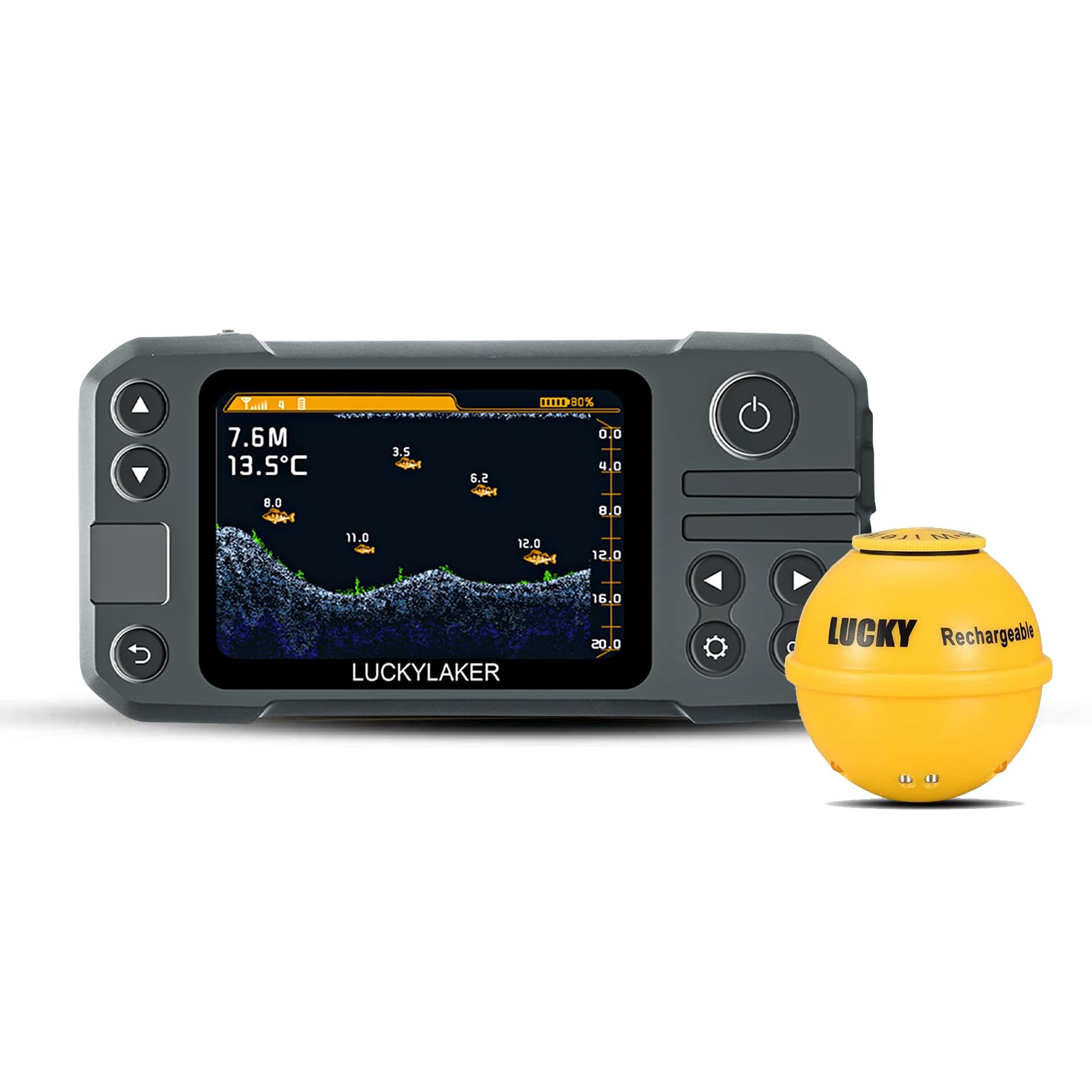
LUCKY MT-202

82 /100
LBD Score Excellent

Key details

Weight
1.54 lb
Display Size
3.5 in
Maximum Depth
147 ft
Wireless Range
853 ft
View on Amazon

Eight hundred and fifty-three feet is the number LUCKY prints on the box, and if you fish from a bank and want to read water you cannot cast to, that is the number that matters. The sensor floats, the display is a 3.5-inch horizontal LCD, and together they weigh less than a one-liter bottle, so the whole thing goes in a jacket pocket.

A long link only helps if the screen keeps up, and this is where the MT-202 earns its place: fish icons arrive with depth numbers beside them, so you read a position rather than guess at a blob. The horizontal shape gives those numbers room, which sounds like a small thing until you are squinting into glare.

The rechargeable sensor is the thing to manage. Performance fades as the charge drops, so we top it up the night before rather than trusting a half-full indicator, and we switch it off as soon as it comes out of the water. A spare battery pack in the tackle bag costs little and turns a short session into a long one.

Range is the reason to pick it over the cheaper castables: with the sensor a couple hundred feet out you are still reading depth under water no rod can reach. That is a specific kind of fishing — bank, dock, big flats — and outside it, the MT-202 has less to say.

Pros

  • 3.5-inch screen with fish depth numbers
  • 853 ft listed wireless range
  • Floating sensor
  • Pocket-sized at 0.7 kg

Cons

  • 147 ft depth ceiling rules out big reservoirs
Our verdict

We like the MT-202 for bank and dock fishing where the sensor needs to sit far from you, and its 853-foot listed range is the longest here.

Check Latest Price
6

Best Wired Option

Venterior VT-FF001

82 /100
LBD Score Excellent

Key details

Weight
1.85 lb
Display Size
4.3 in
Sensor Cable
25 ft
Maximum Depth
328 ft
View on Amazon

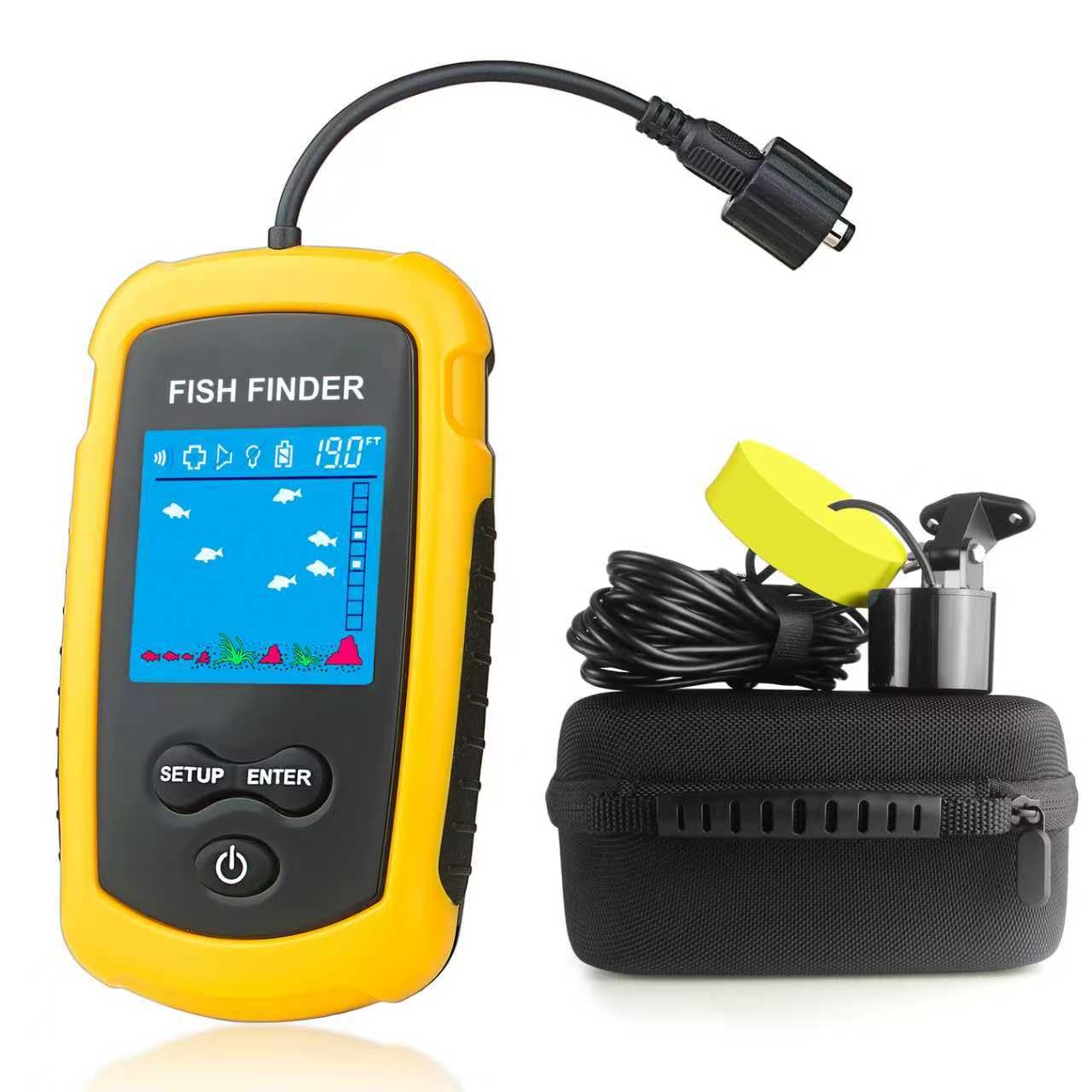
If you have watched a wireless sensor go quiet mid-drift, the appeal of a cable is obvious. The VT-FF001 runs a 25-foot lead from the sensor to a 4.3-inch display, so there is nothing to pair and nothing to lose over the side: drop the transducer, tie off, and read.

Depth runs from about three feet down to a listed 328 feet, and the 45-degree beam is narrow enough to keep a reading tidy in wind. We like the neck strap more than we expected — on a kayak both hands are busy, and a display hanging at chest height is one you actually glance at. The water-resistant bag takes the splash.

You fish within 25 feet of the sensor, which is the point rather than a flaw: this reads the water under your boat, not the far bank. Learning it takes a couple of trips. Depth is the reliable number; fish detail comes as size classes and position rather than species, and the icons need interpreting around weed and hard bottom. We treat it as a depth-and-structure tool first and a fish finder second.

What it will not do is show you the ledge 40 feet to your left. That is what the castable picks here are for, and knowing which of those two you want is most of this decision.

Pros

  • 4.3-inch display with a neck strap
  • 25 ft cable, nothing to pair
  • Reads to a listed 328 ft
  • Two-year warranty

Cons

  • Cable keeps the sensor within 25 ft of you
Our verdict

If charging a sensor sounds like one more chore, the VT-FF001's 25-foot cable and 4.3-inch screen make it the simplest unit here to live with.

Check Latest Price
7

Budget Wireless

DANOPLUS DP-104

84 /100
LBD Score Excellent

Key details

Weight
5.28 oz
Beam Angle
90 degrees
Display Size
2.4 in color
Maximum Depth
147 ft
View on Amazon

There is a light in the DANOPLUS sensor that switches on when it hits the water. The pitch is that it attracts fish; we treat it as a marker that confirms the sensor is live and shows where it is floating after a cast, which is genuinely useful at dusk.

The beam is the widest here at 90 degrees, so the sensor covers a big circle of bottom in shallow water — good for finding the edge of a weed bed in eight feet, less good for picking one fish out of a school. Depth tops out at 147 feet, and the 2.4-inch color screen carries depth, water temperature, fish size icons, and bottom composition.

Small body, too: 5.28 ounces, and the display slides into a jacket pocket beside a phone. The sensor charges over USB, so there are no disposables to buy, though we check that the light is off after a session — a sensor that stays lit out of water is flat the next morning. Fish passing under the beam set off an alarm, which we use as a nudge to look down rather than as a strike signal.

What we keep coming back to is how little fuss there is. Drop the sensor, turn on the display, read a depth and a temperature, and get back to fishing. That is the job we hand it, and on ponds, small lakes, and ice it does that job without asking for much.

Pros

  • 90-degree beam covers a wide circle
  • Color screen with fish alarm
  • Rechargeable USB sensor

Cons

  • 2.4-inch screen is small for detail
  • Weed and brush register as fish
Our verdict

The DANOPLUS is the budget wireless unit we point first-time kayak anglers to, as long as shallow water and a small screen suit their pond.

Check Latest Price
8

Cheapest Handheld

Yoocylii Portable Fish Finder

81 /100
LBD Score Excellent

Key details

Beam Angle
45 degrees
Display Size
4.6 cm
Maximum Depth
328 ft
Sonar Frequency
200 kHz
View on Amazon

This is the least expensive route onto this list, and what it buys is a depth sounder with fish icons rather than a sonar picture. The display is 4.6 centimeters across, the beam is 45 degrees, and the sensor reads from about three feet down to a claimed 328 feet.

For pond and small-lake fishing it covers the two jobs that matter: how deep the water is, and whether something is passing under the transducer, with bottom type shown as sand, rock, or weed. The neck strap means you can paddle and glance down, and the whole thing stows in a tackle box.

Legibility is the compromise. At 4.6 centimeters across, the depth number is the only thing you read at a glance; fish size and bottom type take a second look, and bright light makes that second look longer. The numbers also come with opinions — over grass it showed fish where the pricier units here showed weed.

We kept it in the boat as a spare and stopped resenting it. As a primary unit for serious water it is thin; as a second finder for a kid, a kayak, or the tackle box that lives in the truck, the trade is fair.

Pros

  • Lowest-priced unit in this group
  • Claims 328 ft of depth range
  • Neck strap and small body
  • Shows bottom type

Cons

  • 4.6 cm display is small for detail
Our verdict

For a spare that lives in the tackle box or a first finder for a kid, the Yoocylii is cheap enough to try and honest about what it is.

Check Latest Price

How We Tested Portable Fish Finders

We started from a longer list of roughly 30 finders pulled from manufacturer specs and buyer reviews, then narrowed it by how each one is actually meant to be used: castable units for shore and kayak anglers, handhelds with their own display, and a few kits that bundle a screen, mount, and battery. Anything requiring a permanent transom install was out — that's a different product — and so was anything whose claimed depth range looked unrealistic for the inland water most people fish. Twelve made the cut, and they ran for six months, from the first open-water weekends into early ice.

Testing happened where these units live: a two-person kayak on a local reservoir, a rented aluminum boat, a dock at dawn, and a shallow bay once it froze over. On open water we dropped each transducer in the same spot and checked its depth reading against a marked line, then paddled or idled across the same sunken brush pile to see whether it came back as structure, as a smear, or as nothing at all. Fish tracking got the same treatment, with notes on whether marks held steady as we moved or blinked in and out.

Battery life was timed rather than estimated: each unit ran a full session at high brightness and we logged where it quit. Screens were read at noon in direct sun and again under a headlamp after dark. On the castable models we threw from the dock, timed how long the app took to reconnect at distance, and counted the drops. GPS was tested by marking a waypoint and following it back. Portability meant packing each unit into a daypack and setting it up with cold, gloved hands on the ice. The ones on this list are the ones that powered on and gave us a number on the first try, every trip.

How to Choose a Portable Fish Finder

Decide how the sonar reaches the water

Three designs cover almost everything. A castable puck — the Deeper PRO+ 2 and the Striker Cast — goes out on your line and streams to a phone. A wireless sensor with its own handheld display, like the LUCKY MT-202, keeps your phone in your pocket. A wired transducer on a cable, like the Venterior VT-FF001, trades casting distance for a link that cannot drop. The kit route, which is what the Garmin Striker 4 and the PiranhaMAX 4 take, puts a real sonar head, a battery, and mounting hardware in one bag.

The trap is assuming portable means castable. A kit with a transom bracket reads from the boat and reads well, but it wants a solid surface and moving water; a puck reads wherever it lands. Pick the deployment you will repeat most weekends, not the one with the longest feature list.

A phone screen or a dedicated display?

Your phone gives you the biggest, sharpest picture available and costs nothing extra, which is why both Garmin and Deeper lean on apps. It also means screen-on hours on a battery that has to last the day, and a link that can thin out when you cast past it. A dedicated display starts instantly, works without a phone, and is usually easier to read in direct sun.

We keep a power bank in the bag on phone-based days and treat the dedicated units as the low-drama option. If you fish alone in a kayak and answer one call an hour anyway, the app route is fine; if your phone is your camera, your map, and your ride home, a screen in the case is worth the bulk.

Match depth and beam to the water you fish

Depth ceilings in this group run from 147 feet on the DANOPLUS and the MT-202 to 1,600 feet on the Striker 4. The number that matters is the depth of your lake, not the biggest figure on the shelf, and the listed ceiling assumes clean water — weed and soft bottom eat into it.

Beam angle decides what you see. A 45-degree beam puts more energy into a smaller circle and separates fish from structure better; a 90-degree beam like the DANOPLUS covers a wide shallow circle and blurs detail. Weedy flats and pond edges reward the wide beam, ledges and deep basins the narrow one.

Plan the power, not just the runtime

Three power plans show up here: a rechargeable sensor that charges over USB (Deeper, Striker Cast, DANOPLUS, MT-202), a handheld that runs on its own batteries (VT-FF001, Yoocylii), and a kit with a 7 amp-hour battery and a wall charger (PiranhaMAX 4). Rechargeable is the least expensive to run and the most dependent on remembering a cable. The kit battery is the one for a week with no outlet.

Before you buy, count the charging sessions in your average trip. A day trip wants a topped-up sensor and nothing else; a fly-in or a houseboat week wants amp hours you can see.

Pack the weight you will actually carry

The Striker Cast puck weighs 75 grams and the Deeper 3.2 ounces, so either disappears into a jacket. The PiranhaMAX 4 kit runs 2.5 pounds before you add the transducer — still one hand, no longer one pocket. If you hike in, count the battery as part of the kit and decide whether the case earns its space; if you fish from a dock with a cart, weight stops mattering and screen size starts.

Frequently Asked Questions

Final Verdict

After a season of moving units between a kayak, an ice bucket, and a dock, the Garmin Striker 4 Portable Kit is the one that stays in the truck. It is a real sonar head with CHIRP, a flasher, a rechargeable battery, and a kayak mount, all in a bag you can carry in one hand, and that breadth is what earns the extra money.

If you want to leave the dedicated unit at home, the Striker Cast puts 75 grams of sonar on the phone in your pocket. If mapping unfamiliar water is the point of the trip, take the Deeper PRO+ 2 and come home with contours.