Best RC Car Chargers of 2026

It's the least glamorous thing you'll buy for an RC car, and it's the piece that touches every battery pack you own. The charger that comes in the box is usually a wall wart with one blinking light: it pushes current into the pack and hopes. A real charger reads each cell separately, tapers the current as the voltage climbs, and stops when the pack is genuinely full.

I've cooked packs with cheap chargers, so over the past six months my team and I have run 12 chargers on our own batteries — garage bench overnight, track days, backyard after work. The biggest number printed on the front matters less than you'd think: a 12-amp unit only saves time if your packs and power supply can handle it. The quiet dealbreaker is plugs — Tamiya, Deans, XT60, alligator clips — so buy for the fleet you own.

We also watched the unglamorous stuff: fan noise at full tilt, balancing accuracy, and whether the most expensive unit was really the fastest. The picks below sort by chemistry, budget, and how much charging you actually do.

1

Best Overall

Venom Power Pro Duo

90 /100
LBD Score Outstanding

Key details

Output
2 x 80W
Battery Types
LiPo, LiHV, Li-ion, LiFe, NiMH, NiCD, Pb
Included Leads
8 leads
Charging Channels
2
View on Amazon

Two independent 80W channels are the reason the Venom Power Pro Duo earns the top spot. You can put a 2S LiPo on one side and a NiMH trail-truck pack on the other, set each current separately, and let both finish without babysitting a switch. The eight included lead types cover the connectors most RC cars arrive with, from Tamiya to XT60 and EC5. That mix is what we want on a bench that serves more than one vehicle.

The Pro Duo also covers the modes that keep LiPo packs healthy: balance charge, fast charge, discharge, cycling, storage, and a battery meter. We recommend it first for a mixed fleet or a two-car household because it replaces two single-channel boxes and a pile of adapters. It is not the simplest charger here, but the menus are manageable, and the LCD shows enough to tell what each channel is doing. For a first hobby charger, that visibility is worth more than a slightly higher wattage.

The practical catch is the lead bundle: eight connector types does not mean two complete sets of charging wires. If you routinely charge two packs with the same plug, buy a second lead before your first track day. The 2-pound frame and handle make it easy to move around the house, but the 120V AC input keeps it near an outlet. Those are small trade-offs for a charger that handles almost any pack you bring home.

Pros

  • Two independent 80W channels
  • Broad LiPo and NiMH support
  • Eight connector lead types
  • Balance, storage, and discharge modes

Cons

  • Only one lead set per connector
  • AC outlet required
Our verdict

Our top pick for mixed collections: two 80W channels and broad chemistry support make it the charger we reach for first.

Check Latest Price
2

Best for Traxxas Owners

Traxxas EZ-Peak Plus 4-Amp

92 /100
LBD Score Outstanding

Key details

Output
4A
Connector
Traxxas iD
Battery Types
5-8 cell NiMH; 2S-3S LiPo
Storage Charge
Yes
View on Amazon

The one-button iD handshake is the whole reason to consider the Traxxas EZ-Peak Plus. Clip in a Traxxas iD pack, press the button, and the charger sets the current and cell count itself. For a Traxxas owner who wants to stop reading manuals, that is a genuinely useful kind of fast. The same button also starts a storage charge, which is the setting we care about when a LiPo pack will sit for a while.

On paper, 4 amps is modest next to the 12-amp Traxxas charger here, but it is enough to turn around a 5- to 8-cell NiMH pack or a 2S or 3S LiPo between runs. The charger also has Advanced Mode and integrated balance ports for conventional LiPo packs, so it is not completely locked to Traxxas batteries. You do give up the one-button convenience with those packs: current, cell count, and chemistry become your job.

The fan is the one thing we minded. It runs loud enough to notice when the charger is working hard, and it is the reason this one stays in the garage rather than on a desk. If your fleet is all Traxxas and you want the simplest possible charge, the noise is easy to live with. If you split time between several battery brands, the manual setup and the 2S-3S ceiling make the Venom or HTRC a better fit.

Pros

  • One-button iD setup
  • Charges 5-8 cell NiMH and 2S-3S LiPo
  • Manual balance ports for other LiPos
  • Storage charge mode

Cons

  • iD convenience is Traxxas-only
  • No 4S LiPo support
Our verdict

The easiest charger for a Traxxas owner, with manual balance ports for other LiPos and a compact 4-amp footprint.

Check Latest Price
3

Best Budget NiMH Charger

Tenergy 7.2V-12V NiMH Charger

91 /100
LBD Score Outstanding

Key details

Battery Types
7.2V-12V NiMH/NiCd
Output Current
0.9A or 1.8A
Included Adapters
Tamiya, mini Tamiya, alligator clips
Temperature Probe
Yes
View on Amazon

A small current switch on the side of the Tenergy RC Pack Charger does more for daily use than a screen would. Flip it to 0.9A for a 900-1800mAh pack, or 1.8A for a 1800-5000mAh pack, and the charger handles 7.2V, 8.4V, 9.6V, 10.8V, and 12V NiMH or NiCd packs. The included temperature probe clips to the pack and cuts the charge if things get too warm, which is a real comfort on a charger this simple.

The adapter bundle is the other practical part. You get a standard Tamiya lead plus standard-to-mini Tamiya and standard-to-alligator clip adapters, which covers a lot of ready-to-run cars and airsoft packs without a separate shopping trip. The two-color LED is basic: red while charging, green when done. We like that it does not pretend to be a lab instrument. It charges, it stops, and it tells you the essentials.

We recommend this as the budget NiMH charger for a car that does not use LiPo. It is also a sensible second charger for a child's RC toy because the current is selectable and the temperature probe adds a layer of protection. The limitation is chemistry: this is NiMH and NiCd only, so it cannot help with a LiPo pack. If you are moving to LiPo, put the money toward a balance charger instead of adding another wall unit.

Pros

  • Selectable 0.9A/1.8A output
  • Temperature probe
  • Covers 7.2V-12V NiMH/NiCd
  • Tamiya and alligator adapters

Cons

  • NiMH/NiCd only
  • No digital display
Our verdict

The best budget NiMH charger here: selectable current, a temperature probe, and adapters for most packs, as long as you don't need LiPo.

Check Latest Price
4

Best High-Power Single Charger

HTRC 150W 10A Charger

89 /100
LBD Score Excellent

Key details

Input
AC 100-240V; DC 11-18V
Output
150W, 10A
Connectors
Tamiya, JST, T-plug, EC3, TRX, Deans
Battery Types
1S-6S LiPo; 1-15S NiMH/NiCd
View on Amazon

The 150W, 10-amp output is the headline, and it is the reason this HTRC earns a place for larger packs. It supports 1S-6S LiPo, 1S-6S LiFe and Li-ion, 1-15S NiMH and NiCd, and 2-20V Pb, with charge, balance, discharge, storage, and battery-meter modes. We recommend it when you want one pack to refill quickly and do not need a second channel. The terminal voltage control is a useful extra for tweaking a charge profile.

The AC/DC input is the detail that makes it more than a bench box. At home you plug into a wall outlet; at the field you can run it from a 11-18V DC source, such as a car battery. The connector set covers Tamiya, mini Tamiya, JST, T-plug, EC3, TRX, and Deans, so most packs have a path to the charger without an adapter hunt. That flexibility is what we look for in a single-channel charger that might travel.

The trade-off is right in the name: one channel. If you routinely bring two packs to the track, the Venom's second 80W channel saves more time than the extra watts here. The HTRC is the better pick when your sessions center on one large pack at a time, or when you want a faster single charger without a dual-channel footprint. It is a focused tool, not a bench-wide replacement.

Pros

  • 150W, 10A output
  • AC and DC input
  • Wide chemistry support
  • Battery meter and terminal voltage control

Cons

  • One charging channel only
Our verdict

The fastest single-channel charger here for large packs, with AC/DC input that makes it useful at the track.

Check Latest Price
5

Best Fast Charger for Traxxas

Traxxas EZ-Peak Live 12-Amp

91 /100
LBD Score Outstanding

Key details

App
EZ-Peak Live
Output
100W, 12A
Connector
Traxxas iD
Battery Types
5-8 cell NiMH; 2S-4S LiPo
View on Amazon

Bluetooth app control is what separates the Traxxas EZ-Peak Live from the rest of the Traxxas line. The charger itself has an LED progress bar and audible alerts, but the phone app supplies the digital dashboard: charge status, settings, and a clear view of what the pack is doing from across the room. For a Traxxas owner with a 4S LiPo, that is a genuinely useful upgrade over squinting at a small screen.

The 100W, 12-amp output is the other half of the story. It charges 5-8 cell NiMH and 2S, 3S, or 4S LiPo packs, and the iD system sets the important parameters when you use a Traxxas iD battery. The app can also handle non-Traxxas packs if you have the right adapter, though the one-button simplicity is reserved for iD batteries. We like that the charger keeps its own LED status when the phone is not in hand.

This is a premium single-channel charger, and the price buys speed and information rather than extra ports. If you already own a Traxxas 4S vehicle and want to see charge progress while you work on the car, the Live makes sense. If your packs are 2S or 3S, the 4-amp EZ-Peak Plus is the better value and the simpler box.

Our reservation is the phone dependency. The app is well executed, but it adds a device to manage, and the charger is at its best when you stay inside the Traxxas ecosystem. We recommend it for the Traxxas owner who wants the fastest charge here and does not mind paying for the app view. For everyone else, a dual-channel charger covers more packs for the same kind of money.

Pros

  • 100W, 12A output
  • Supports 4S LiPo
  • Traxxas iD one-button setup
  • Bluetooth app monitoring

Cons

  • Premium price
  • Phone app adds a device to manage
Our verdict

The fastest Traxxas charger here, with a phone dashboard that makes 4S charging easy to monitor.

Check Latest Price
6

Simple NiMH Charging

Tenergy 8.4V-9.6V Smart Charger

93 /100
LBD Score Outstanding

Key details

Connector
Standard Tamiya
Charge Time
5 hours
Battery Types
NiMH, 600-2500mAh
Output Voltage
8.4V-9.6V
View on Amazon

A five-hour charge time sounds like a step backward until you see the job this Tenergy is built for. It is a wall-plug smart charger for 8.4V and 9.6V NiMH packs in the 600-2500mAh range, with a standard Tamiya connector and a simple red-green LED. There is no menu, no current setting, and no separate power supply to lose. You plug the pack in and come back later.

We recommend it as a cheap, no-menu charger for a 7- or 8-cell NiMH car, especially one that gets charged overnight. The five-hour rate is gentle, which is fine for a toy-grade pack that is not in a hurry. It is also a sensible backup for a Tamiya-equipped car when the main charger is busy. The trade-off is that it only serves the voltage range on the label.

That narrow range is the limitation. It is not for LiPo, not for 7.2V packs, and not for high-capacity packs outside 600-2500mAh. If your car uses a 9.6V NiMH pack and you want the simplest possible charge, this is a good fit. If you are unsure about chemistry or plan to move to LiPo, spend the money on a charger that names those packs instead.

Pros

  • Simple wall-plug design
  • Charges 8.4V-9.6V NiMH packs
  • LED status
  • Low cost

Cons

  • NiMH only
  • Five-hour charge time
Our verdict

The best simple wall charger for 8.4V-9.6V NiMH packs, with a gentle five-hour rate and no menus to learn.

Check Latest Price
7

Low-Cost NiMH Charging

HTRC 2-8S NiMH Charger

88 /100
LBD Score Excellent

Key details

Input
100-240V AC
Output
20W, 1A/2A
Connectors
Standard Tamiya, mini Tamiya, alligator clips
Battery Types
2-8S NiMH/NiCd
View on Amazon

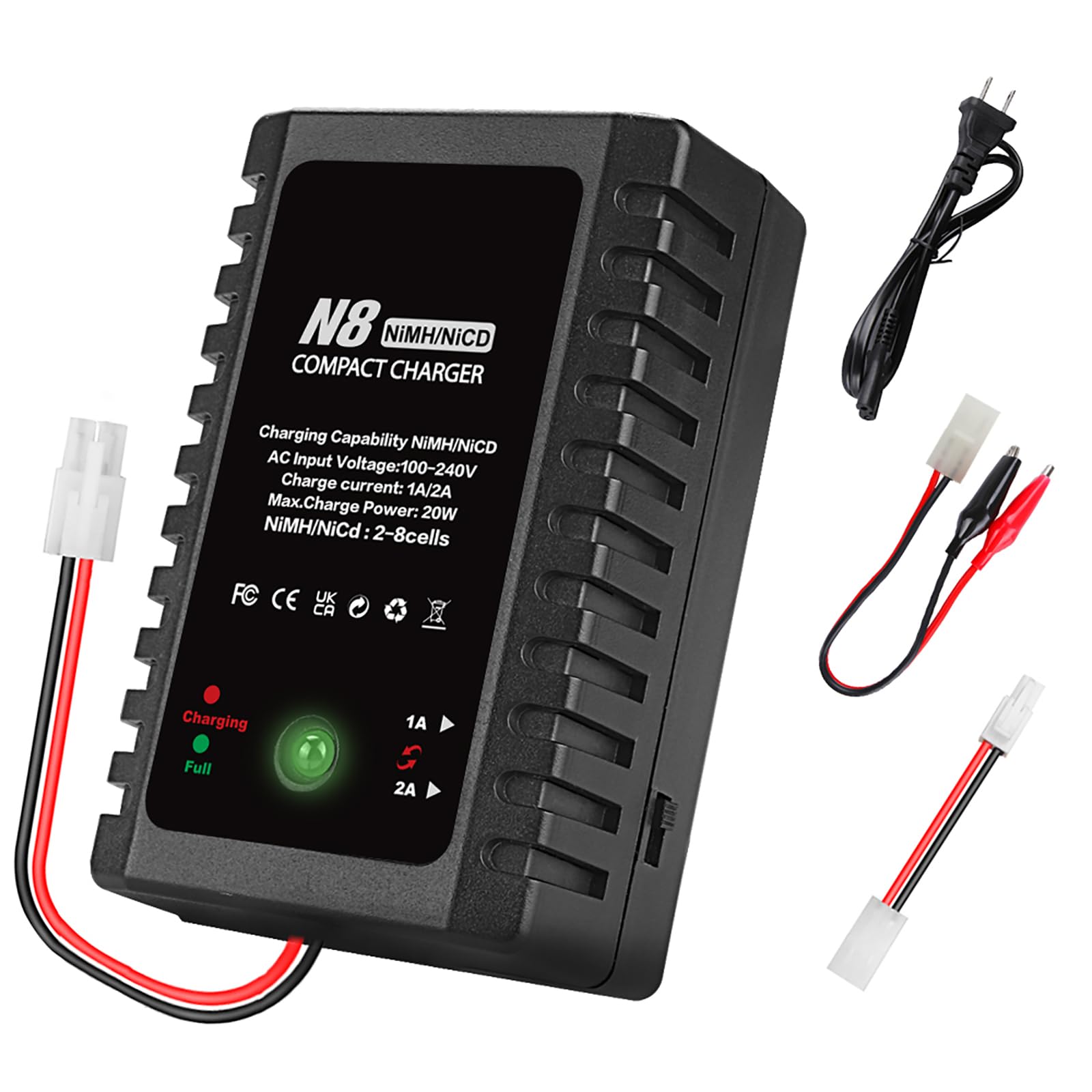
The low price and 2-8 cell range are what make this HTRC worth a look. It is a 20W wall charger for 2.4V-9.6V NiMH and NiCd packs, with a switch for 1A or 2A and a standard Tamiya connector. The box also includes a standard-to-mini Tamiya cable and a standard-to-alligator clip cable, so it reaches more packs than the plug on the charger alone suggests.

The two current settings are the useful part. Use 1A for small packs and 2A for larger ones that can take it, and the two-color LED tells you red for charging and green for done. We like it as a backup charger for a child's RC car or a second charger for a NiMH-only fleet. It is not a charger you buy for a LiPo car, and it is not trying to be.

We recommend it for the shopper who wants the lowest-cost way to keep 2-8 cell NiMH packs running. The lack of a display is the main trade-off: you get a status light, not a voltage readout, so you need to trust the pack and the charger's shutoff. If you want to see cell voltages or charge a LiPo pack, the HTRC 150W or the Venom Pro Duo is the better step up.

Pros

  • Low-cost 20W charger
  • 2-8 cell NiMH/NiCd range
  • Selectable 1A/2A output
  • Includes Tamiya and alligator adapters

Cons

  • NiMH/NiCd only
  • No display
Our verdict

The best low-cost wall charger here for 2-8 cell NiMH packs, with selectable current and adapters for common plugs.

Check Latest Price

How We Tested RC Car Chargers

We built the shortlist from hobby forums, club recommendations, and retailer listings, keeping any charger that supported more than one battery chemistry and had a balance port. Anything with a single fixed lead was cut, since it locks you into one pack type. That left 12 chargers spanning the range most people actually shop.

We ran all 12 for six months, mostly on the garage bench but also at track days and in the backyard after work. Every charger did the same timed job: bring a 2S 5000mAh LiPo from storage voltage to full at its maximum rate, then again at 1C, with notes on how long each took and how warm the pack came off.

Ease of use we tested by handing the charger to someone who had never touched it and timing how long it took them to pick a chemistry and set a current; menus that sent them to the manual counted against a charger. On the app-connected models, I walked to the far end of the garage to see whether the link held while a pack charged.

Battery health got its own pass. After every charge I checked cell voltages against a meter to see how close the balancer actually got, and I ran storage mode to confirm it landed near 3.8 volts per cell instead of overshooting. Noise was measured in the least scientific way possible — standing beside it in a quiet garage at night — and durability came from real use, with chargers riding in toolbags, sitting in a hot car, and getting plugged in dozens of times a week. Reliability meant watching for missed cutoffs and hot connectors over the full six months.

How to Choose an Rc Car Charger

Start With Chemistry and Cell Count

A NiMH pack and a LiPo pack are not interchangeable at the charger. NiMH wall units like the Tenergy 8.4V-9.6V charger are simple and inexpensive, but they only serve the packs named on the label. A hobby charger such as the Venom Pro Duo or HTRC 150W covers LiPo, LiFe, Li-ion, NiMH, and Pb, so it can follow you to the next car.

Read the pack label for chemistry, voltage, and cell count before you shop. If the label says 2S LiPo, you need a charger that explicitly supports 2S lithium, not a NiMH wall unit with a Tamiya plug. The trap is a charger sold as universal that lists only NiMH in the fine print. We prioritize a charger that names your chemistry over one that claims to do everything.

Match Power and Channels to Your Routine

Charge power sets the ceiling on how fast a pack can refill. A 4-amp charger is fine for a single 2S or 3S pack; a 150W, 10-amp unit cuts time on larger 4S packs, but only if the pack can accept that current. Two channels matter more than raw wattage when you run two cars: the Venom Pro Duo can charge a LiPo and a NiMH pack at once, each on its own settings.

The trap is buying the highest amp number without checking the pack's recommended charge rate. We look for a charger that lets us lower the current, not just one that advertises a big peak.

Count the Leads and Connectors

A charger is only as useful as the plug that reaches your pack. Tamiya is common on ready-to-run NiMH cars; Traxxas iD packs use their own connector; LiPo packs often use XT60, EC3, Deans, or EC5. The Venom Pro Duo includes eight lead types, but only one set of charging wires, so two identical packs need a second lead. The Traxxas EZ-Peak Plus is the easiest match for a Traxxas owner because the iD plug does the setup.

The trap is assuming a dual charger includes two complete lead sets. Count the leads you need for the packs you actually own, and add a spare if you plan to charge two of the same connector.

Look for Balance and Storage Modes

If you run LiPo, balance charging is not optional: it keeps individual cells from drifting apart, and storage mode brings a pack down to a safer resting voltage when the car sits for a week. The Venom Pro Duo and HTRC 150W both list balance, discharge, and storage modes; the simple Tenergy wall chargers do not.

The trap is a charger marked balance that does not include the right balance board or lead for your pack. Check the balance port and the included adapter before you buy. We prefer a 50W charger with proper balance and storage to a 100W unit that only does a crude charge.

Decide Where You Will Charge

Bench charging and field charging ask for different boxes. The Venom Pro Duo is a 2-pound unit with a handle, but its 120V AC input ties it to an outlet. The HTRC 150W adds a DC input, so it can run from a car battery at the track. The Traxxas EZ-Peak Live puts the display on your phone, which is handy at a bench but adds a device to manage.

The trap is reading portable as cordless: a handle and a compact frame do not mean the charger runs from a battery. Decide whether the charger lives on a workbench or comes to the track, then check the input and the fan noise before you commit.

Frequently Asked Questions

Final Verdict

The Venom Power Pro Duo is the charger we recommend first for most RC car owners with more than one pack: two independent 80W channels, broad chemistry support, and eight lead types make it the most useful box here. If your fleet is all Traxxas, the EZ-Peak Plus 4-amp is simpler and less expensive, and the Tenergy 7.2V-12V unit is the budget choice for NiMH-only cars.

Buy the Venom if you want one charger to cover mixed packs; buy the Traxxas if convenience inside the Traxxas ecosystem matters more than flexibility.