Best Stereo Amplifiers of 2026

The wattage number on the box is the easiest thing to compare and the least useful. I've heard a modest amp walk all over a bigger one, and I've heard generous specs turn to mush the moment a real bass line showed up. What separates a good stereo amplifier from a disappointing one is how it behaves when nobody's watching: at whisper volume on a Sunday morning, with speakers fussier than the spec sheet assumes.

My team and I have spent eight months living with 11 amplifiers, from palm-sized desktop units to full-size integrateds with phono stages and onboard DACs, and the differences never showed up in the marketing copy. They showed up in how the volume knob felt, whether Bluetooth held a connection through a wall, and whether the amp hissed at idle.

The first thing to get right is which inputs you'll actually use: if you don't own a turntable, don't pay for a phono stage. Below are the amps we'd buy for a desk, a living room, and a first real hi-fi setup.

1

Best Overall

Denon PMA-600NE

90 /100
LBD Score Outstanding

Key details

DAC
Built-in
Inputs
2 optical, 1 coaxial, phono, Bluetooth
Dimensions
17.1 x 12.1 x 4.76 in
Power Output
70W x 2 at 4 ohms
View on Amazon

The Denon PMA-600NE has a feature we wish more amps advertised: an analog mode that shuts down its digital circuits. For a turntable, that means you can keep the signal path simple instead of running vinyl through a DAC and Bluetooth stage you are not using. We think that focus is why it earns the top spot here: it handles a record player, a TV, and a phone without making you choose one flavor of listening.

The connections cover the modern mixed system. There are two optical inputs and one coaxial for a TV or CD player, a phono stage for a turntable, and Bluetooth for casual streaming. Denon rates the amp at 70 watts per channel into 4 ohms, which is enough for most bookshelf speakers and smaller towers in a normal room. The built-in DAC also means one box takes care of digital sources that otherwise need a separate converter.

The slim 4.76-inch chassis is easier to fit on a media shelf than a full-size receiver, and the three-year warranty is longer than most here. We also appreciate that the subwoofer output makes a 2.1 system easy to add later. If you want one amp for vinyl, TV, and Bluetooth, this is the one we point to first.

Pros

  • Analog mode simplifies vinyl playback
  • Built-in DAC and phono stage
  • Bluetooth and subwoofer output
  • 70W per channel into 4 ohms

Cons

  • Volume control lacks fine adjustment
Our verdict

The Denon PMA-600NE is our best overall pick for a mixed vinyl, TV, and Bluetooth system, with a built-in DAC, phono stage, and analog mode in a slim chassis.

Check Latest Price
2

Best for Turntables and TV

Yamaha A-S301

89 /100
LBD Score Excellent

Key details

Phono Input
Yes
Power Output
60W x 2
Digital Inputs
Optical and coaxial
Subwoofer Output
Yes
View on Amazon

A 60-watt integrated amp can look modest next to the 100-watt models here, but the Yamaha A-S301 is the one we recommend when the budget is tight. It puts the money into a clean phono stage, optical and coaxial digital inputs, and a subwoofer output, which covers a turntable, a TV, and a pair of bookshelf speakers without a separate DAC.

The variable loudness control is the detail we appreciate most. Instead of an on/off button, it lets you dial in bass and treble compensation at low volume, which is useful for late-night listening when a normal loudness boost is too heavy. We also like that Yamaha gives you A and B speaker switching, so a second pair in another room is possible without a switcher.

The A-S301 is the simplest amp here to live with: a clean front panel, a useful remote, and no menus to learn. If your phone is the main source, the Denon or Fosi is easier; if your music lives on a computer, the A-S801 is the better Yamaha. For a turntable-and-TV system, it is the sweet spot in this group.

Pros

  • Phono stage and optical/coaxial inputs
  • Variable loudness control
  • Subwoofer output
  • A/B speaker switching

Cons

  • No Bluetooth built in
Our verdict

We recommend the Yamaha A-S301 for a turntable-and-TV system when you do not need Bluetooth, thanks to its phono stage, digital inputs, and useful loudness control.

Check Latest Price
3

Best Budget Mini

Fosi Audio BT20A Pro

90 /100
LBD Score Outstanding

Key details

Inputs
Bluetooth 5.0 and RCA
Op-amps
Replaceable
Power Output
300W x 2 claimed
Tone Controls
Bass and treble
View on Amazon

The BT20A Pro is small enough to sit on a speaker or disappear on a shelf, and that is the point: it turns a pair of passive patio speakers into a Bluetooth system without a full-size receiver. At roughly the size of a paperback, it is the easiest amp here to move between a garage, a desk, and a backyard.

We like the bass and treble controls because they let you tame a bright outdoor speaker without opening an app. The replaceable op-amps are a nice touch for tinkerers, though most people will never use them. Bluetooth 5.0 is simple to pair, and the 32V/5A supply gives it more headroom than the cheapest minis.

The catch is that this is a bare-bones amp, so it suits a phone-and-speakers setup rather than a turntable or TV. For a patio, a garage, or a first stereo, it is the best value in this group. We keep coming back to it because it does the simple job without asking for a rack.

Pros

  • Small enough to hide on a shelf
  • Bluetooth 5.0 and RCA inputs
  • Bass and treble controls
  • Replaceable op-amps

Cons

  • No phono or digital inputs
Our verdict

We think the Fosi BT20A Pro is the best budget mini here for patio or garage speakers, as long as you do not need a phono stage or digital inputs.

Check Latest Price
4

Best Tube Hybrid

Dayton Audio HTA200

89 /100
LBD Score Excellent

Key details

Inputs
Bluetooth 5.0, USB DAC, optical, coaxial, phono
Tube Stage
Hybrid tube preamp
Power Output
100W x 2 at 4 ohms
Subwoofer Output
Yes
View on Amazon

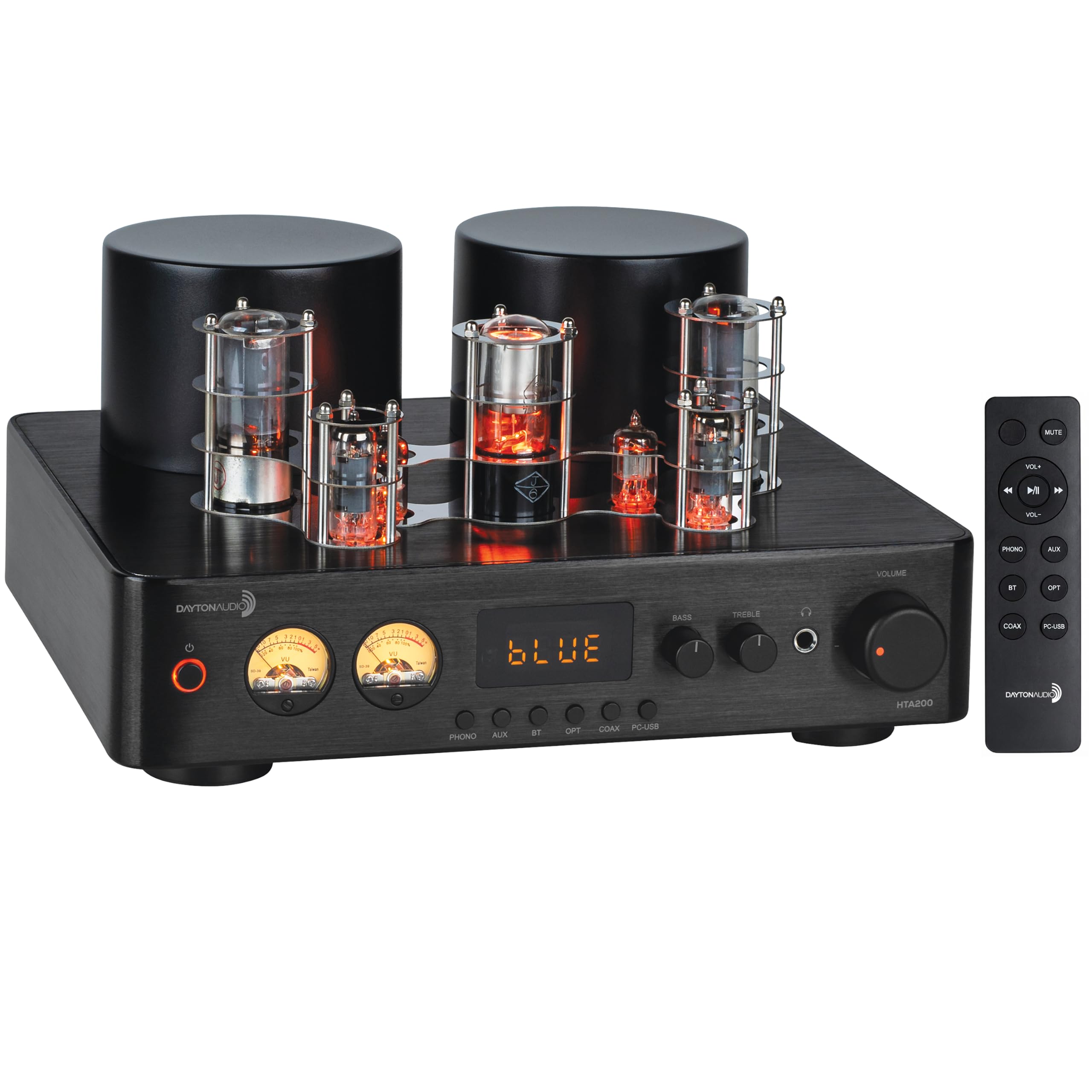
The HTA200 is the only amp here with glowing tubes on the front, and that is not just decoration: the tube preamp stage gives it a warmer, richer character than the Class D minis. We think that makes it the pick for anyone who wants a system that feels like a piece of furniture rather than a black box.

It is also the most flexible amp in this group for sources. There is Bluetooth 5.0, a USB DAC for a computer, optical and coaxial inputs for a TV or CD player, a phono stage for a turntable, and a subwoofer output for a 2.1 system. Dayton rates it at 100 watts per channel into 4 ohms, which is enough for the bookshelf and small tower speakers most people pair with an amp at this level.

The exposed tubes are the trade-off: they look great, but you need to leave clearance above the chassis and keep curious hands away. If you want tube flavor without giving up digital inputs, this is the one we choose.

Pros

  • Tube preamp adds warmth
  • USB DAC, optical, coaxial, and phono inputs
  • 100W per channel into 4 ohms
  • Subwoofer and headphone outputs

Cons

  • Remote control can be unreliable
Our verdict

We choose the Dayton HTA200 when you want tube warmth and a full set of modern inputs in one distinctive chassis.

Check Latest Price
5

Best for High-Res USB

Yamaha A-S801

89 /100
LBD Score Excellent

Key details

USB DAC
DSD 5.6 MHz, PCM 384 kHz/32-bit
Phono Input
Yes
Power Output
100W x 2
Digital Inputs
Optical and coaxial
View on Amazon

The A-S801 is the Yamaha for a desk with a computer and a growing pile of high-resolution files. Its USB DAC handles DSD 5.6 MHz and PCM up to 384 kHz/32-bit, so you can plug a laptop straight into the amp and skip a separate converter. The same optical and coaxial inputs handle a TV or CD player, and there is a phono stage for a turntable.

The extra power is the other reason to step up. Yamaha rates it at 100 watts per channel, and the 26.7-pound chassis has the heatsinks and capacitors to back that up. We think it sounds composed at low volume, where cheaper amps can lose detail, and it has enough headroom for small tower speakers in a medium room.

The A-S801 is the best high-res desktop amp in this group. It rewards a dedicated listening setup, and it has the inputs to stay there for years.

Pros

  • USB DAC supports DSD and high-res PCM
  • 100W per channel
  • Phono and digital inputs
  • Heavy chassis with upgraded power supply

Cons

  • No Bluetooth or network streaming
Our verdict

We recommend the Yamaha A-S801 for a high-res desktop system, where its USB DAC and 100 watts per channel justify the step up in size and cost.

Check Latest Price
6

Balanced Desktop Setup

Fosi Audio ZA3

89 /100
LBD Score Excellent

Key details

Modes
Stereo and mono
Inputs
Balanced XLR/TRS and RCA
Power Output
235W max
Power Supply
48V/5A
View on Amazon

The ZA3 is the odd one out here: a mini amp with a balanced XLR/TRS input and a switch that turns it into a mono block. That makes it useful in a desktop studio or a rack where long cable runs and hum are more of a concern than Bluetooth convenience.

We like the 48V/5A supply and the TPA3255 chip because they give this tiny box more clean headroom than its size suggests. Fosi also lets you roll op-amps, which is a rabbit hole for tinkerers but a genuine way to tweak the sound. The fit and finish is better than the price suggests, and it runs cool enough to tuck under a monitor.

The trade-off is that the ZA3 is not a living-room hub. It is happiest on a desk or in a small rack, where its balanced input and mono switch make sense. For a compact balanced desktop or a mono subwoofer amp, it is the most interesting pick in this group.

Pros

  • Balanced XLR/TRS and RCA inputs
  • Stereo and mono modes
  • 48V/5A supply for clean headroom
  • Replaceable op-amps and cool-running chassis

Cons

  • No Bluetooth, phono, or optical inputs
  • Power button requires a long press
Our verdict

We like the Fosi ZA3 for a compact balanced desktop or mono setup, where its small chassis and 48V supply do the heavy lifting.

Check Latest Price

How We Chose and Tested the Best Stereo Amplifiers

We started with roughly 40 amplifiers and narrowed by spec: power ratings at 8 and 4 ohms, a genuine phono stage versus a bare line input, onboard DAC connections, a subwoofer output, and whether a remote came in the box. That left 11 units, from compact desktop amps to full-size integrateds, each used for at least two weeks.

Every amp spent its time in two setups: a desk with bookshelf speakers and a living room with floorstanders. Sources were a turntable, a phone over Bluetooth, and a TV through an optical cable. We played the same handful of tracks on each, including a bass-heavy soul record, a solo piano piece, and a badly mastered streaming single, because that last one is where cheap amplification gives itself away.

Noise came first: volume all the way down, ear near the tweeter, listening for hiss or transformer hum. We crept the volume knob up in small steps to see whether both channels arrived evenly or one speaker jumped ahead. Bluetooth got the walk-into-the-next-room test, and remotes were used from the couch in the dark to see whether the volume buttons were findable by feel. Each amp ran two hours straight, then we put a hand on the case.

Tone and balance controls we judged by whether they were useful and whether they could be switched out of the signal path. Reliability surfaced over time rather than on day one, so we kept notes across the months on scratchy volume pots, inputs that stopped switching, and channels that cut out. Value we tallied at the end, comparing what each amp built in against what you'd spend adding a phono stage or DAC separately.

How to Choose a Stereo Amplifier

Match Continuous Power to Your Speakers

Start with the power rating into the impedance your speakers actually present. A 60-watt amp into 8 ohms can be plenty for a sensitive bookshelf speaker, while a 4-ohm tower with low sensitivity needs more current. Treat a big peak-power number as a headline, not a guarantee.

We look for a continuous rating at 4 or 8 ohms and a speaker-load range, then compare that with the speaker's nominal impedance. If you already own the speakers, check their sensitivity and impedance before you fall for wattage. If you are buying both, choose the speakers first; they shape the sound more than the amp's last few watts.

Count Your Sources, Then Pick the Inputs

A turntable needs a phono stage, a TV usually needs optical or coaxial, and a computer may need USB. Bluetooth is convenient for casual listening, but it is not a substitute for a wired digital input if you care about timing and detail.

List every source you plan to connect before you shop. If you have a turntable and no phono preamp, either buy an amp with a phono stage or budget for a separate one. If your TV is the hub, make sure the amp has an optical or coaxial input it can decode.

Decide Between Full-Size and Mini

Full-size integrated amps give you more inputs, bigger power supplies, and room for a proper phono stage. Mini Class D amps take up almost no shelf space and can sound remarkably clean, but they usually trim the input count and the control layout.

Measure the shelf depth and leave ventilation around whichever you choose. A slim amp like the Denon fits a media console more easily than a full-size receiver, while a mini like the Fosi BT20A Pro can sit on a speaker or hide behind a monitor. Do not stack a tube hybrid in a closed cabinet; the HTA200 needs air around its tubes.

Budget for the Whole System, Not Just the Amp

The amplifier is one part of the cost. Add speaker cable, a phono preamp if the amp lacks one, and a streamer or Bluetooth receiver if you want wireless. A budget mini amp plus a separate phono stage can cost more than a midrange integrated with both built in.

We prefer to put money into the features you will use every day: enough inputs, a volume control that feels right, and a remote you can live with. Fancy meters and tube glow are nice, but they should not come at the expense of the connections your system needs.

Frequently Asked Questions

Final Verdict

Buy the Denon PMA-600NE if you want one amp for vinyl, TV, and Bluetooth; its analog mode, phono stage, and built-in DAC make it the best all-rounder here. If you do not need Bluetooth, the Yamaha A-S301 is the cleaner budget choice for a turntable and TV.

For a patio or garage system, the Fosi BT20A Pro is the one we reach for when space and cost matter most. And if your listening is built around high-resolution files on a computer, step up to the Yamaha A-S801.