Best Studio Monitor Stands of 2026

A studio monitor stand has two jobs: bring the tweeter to ear height, and stop the cabinet from feeding vibration into the desk or floor. Cheap stands often manage the first and fluff the second, which is why so many home setups sound muddy in the low mids. I mixed for two years with my speakers on a stack of textbooks, so I know that sound. Over the past eight months, we've lived with 12 pairs.

Choosing between a clamp-on platform and a floor stand is really a question about your room. Clamps free up desk space and put the speaker right at your ears; floor stands with spikes or rubber bases decouple better and give you more height to play with. What surprised me was the hardware — a stand that wobbles when you type, a collar that slips under a heavy monitor, or a box of bolts that doesn't line up with the holes undoes the whole design. Every pick below held a speaker still at ear height.

1

Best Overall

Pyle PSTND32 Speaker Stands

94 /100
LBD Score Outstanding

Key details

Base
Folding tripod
Top Plate
8.9 × 8.9 in
Height Range
34 to 53 in
Load Capacity
90 lb per stand
View on Amazon

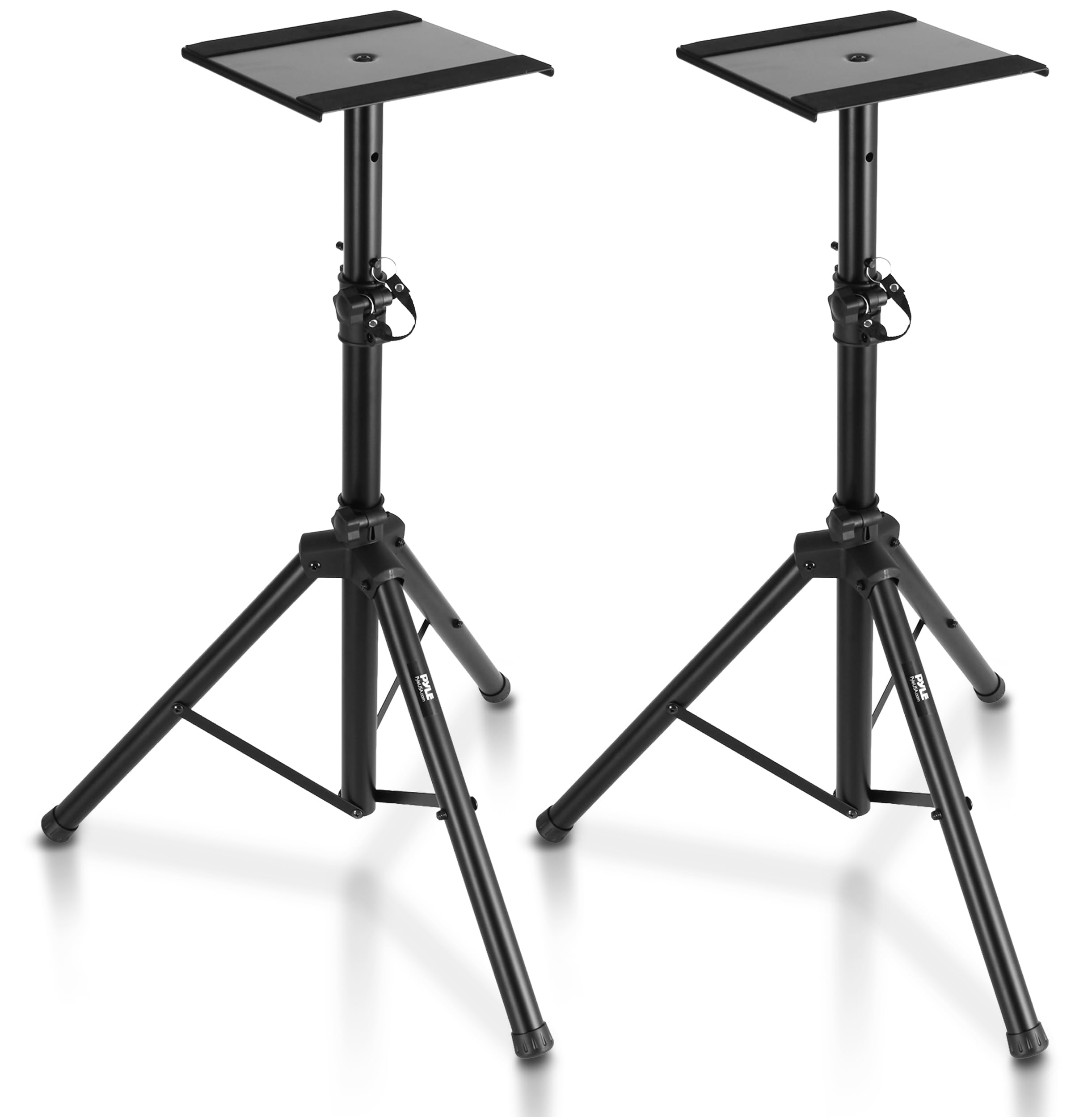
Two numbers explain why the Pyle PSTND32 is the pair we recommend first. Each stand is rated to 90 pounds, as much as anything in this guide, and the column reaches 53 inches, high enough to put a tweeter at ear height whether you mix sitting or standing. It also happens to be the least expensive floor stand here, which is not a combination you find in one box very often.

What surprised us is how much of that steadiness comes from the base. The tripod legs are joined by a center brace, and a locking ring lets you spread or narrow the footprint to suit the corner you have, wide on a bare floor or tucked in beside a desk. Spikes bite into carpet; the rubber feet protect a wood floor. Set at desk height, the stand felt planted, and desk height is where most home setups will leave it.

Height is held by a pin through the column rather than a friction collar, so a setting does not creep over a long session. In exchange the legs fold, and the pair lies flat enough to carry to a session, which none of the fixed-base stands here manage.

The plate is 8.9 inches square with a 2 mm anti-slip pad, which suits most five- and eight-inch nearfields. A cabinet much deeper than that will overhang front and back, which is fine as long as the weight sits centered over the column. Nothing about the stand calls attention to itself, and after a few weeks that is the quality we appreciated most.

Pros

  • 90 pounds of capacity per stand
  • Pin-locked height from 34 to 53 inches
  • Folds flat for transport
  • Least expensive floor pair here

Cons

  • Height adjusts in steps rather than steplessly
Our verdict

Buy this pair if you want a floor stand that holds a heavy monitor at ear height for the least money here; nothing else in this guide combines that capacity and range.

Check Latest Price
2

Best Budget Desktop Stands

Vondynote Desktop Clamp Stands

91 /100
LBD Score Outstanding

Key details

Mount
Desk clamp
Top Plate
9 × 9 in
Height Range
9 to 14 in
Load Capacity
50 lb per stand
View on Amazon

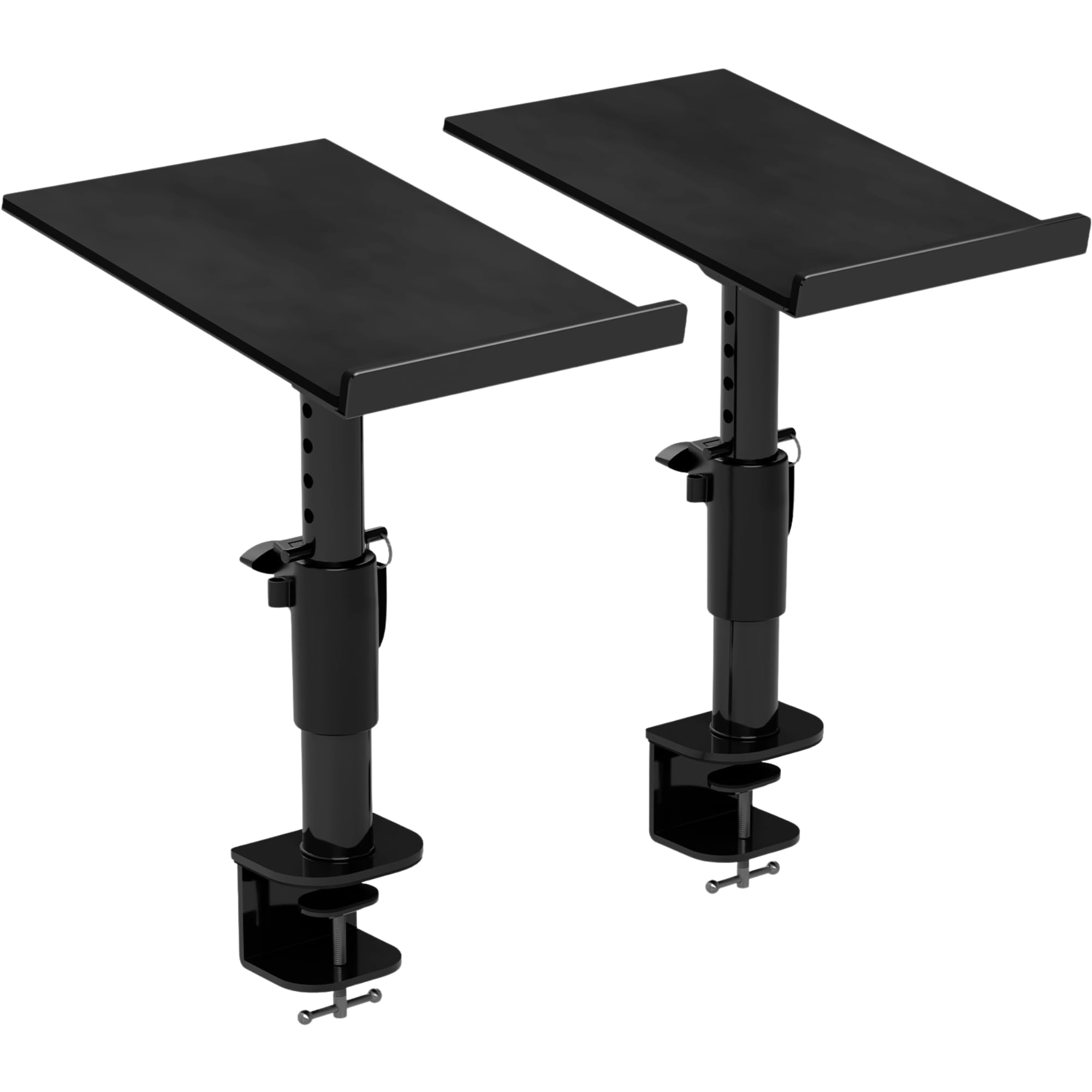
Nothing on the desktop but the jaw of a clamp: that is what the Vondynote pair leaves behind after it lifts a monitor 9 to 14 inches off the surface. The desk you get back is the real purchase here, and this set costs less than any other pair we recommend.

Four drilled positions, at 9, 10.6, 12.3 and 14 inches, are held by a knob and a security pin. That sounds crude next to a stepless column until you use it: you find the hole that puts the tweeter level with your ears, tighten once, and the setting stays put. The jaws are 5 mm thick with a 3 mm EVA pad, so a desk edge comes out unmarked and the clamp does not flex under a heavy cabinet.

Fifty pounds per stand leaves room for an eight-inch nearfield, and the 9-inch plate takes most cabinets without much overhang. Where it gives ground to a floor stand is reach: the speaker sits above the clamp, close to the desk edge, so on a shallow desk the plate ends up near the front lip. Nothing about the setup is permanent, though. Loosen the knob and the pair moves to another desk in a minute, which is why these are the stands we hand to someone mixing in a spare room.

Pros

  • Frees the entire desktop
  • 50 pounds of capacity per stand
  • Four secure pin-locked heights
  • Lowest-priced pair in this guide

Cons

No notable drawbacks to flag.

Our verdict

For a desk-bound setup with no floor to spare, this pair puts the monitors at ear height and hands the desktop back for less than anything else here.

Check Latest Price
3

Best for Angled Desktop Placement

Gator Frameworks Desktop Clamp-On

91 /100
LBD Score Outstanding

Key details

Tilt
0 to 15 degrees
Top Plate
9 × 12 in
Height Range
10.1 to 13.5 in
Load Capacity
60 lb per stand
View on Amazon

A monitor sitting high on a clamp stand fires over your head unless the plate can angle down. Gator's pair tilts through 15 degrees, enough to aim a tweeter at your ears from a raised shelf without shimming the cabinet with foam.

We think the tilt is the reason to pay for this pair, and it comes with a condition: the plate only angles usefully with the monitor sitting long-ways, so a speaker you want on its side will not tip the way you pictured. Beyond that, the money buys a 12-inch-deep platform, 60 pounds of capacity per stand and a three-year warranty, the longest cover on any clamp stand here.

Height runs 10.1 to 13.5 inches, the plate is lined with EVA, and the clamp holds a desk edge firmly enough that a heavy cabinet does not sag forward. It does sit proud of the edge, so a desk pushed flat against a wall needs clearance behind it or a different stand. Depth is where this platform beats the cheaper clamps: a deep cabinet sits fully on it instead of hanging over the front.

Pros

  • 0 to 15 degrees of aim
  • 12-inch-deep EVA-lined plate
  • Three-year warranty
  • 60 pounds per stand

Cons

  • Tilt works only with the monitor mounted long-ways
Our verdict

Worth the premium if your monitors sit high on a clamp and need to aim down at you, provided your cabinets can mount long-ways on the plate.

Check Latest Price
4

Best for Low Listening Positions

AxcessAbles SMS-101

91 /100
LBD Score Outstanding

Key details

Base
17.5 in triangle
Top Plate
9 × 9 in
Height Range
26 to 46 in
Load Capacity
80 lb per stand
View on Amazon

Twenty-six inches is the number that earns the AxcessAbles SMS-101 its place. No other floor stand here goes that low, which matters if you work at a low desk, mix from a couch, or want a monitor tucked under a window sill. Most floor stands start around 33 inches and never cover that ground.

The other end stops at 46 inches, so seated ear height fits inside the range and standing height does not. The tray is 9 inches square, the triangular base spreads to roughly 17.5 inches a side, and the frame is steel with plastic only in the knobs and pads. Each stand is rated to 80 pounds, more than most nearfields will ever ask for.

Assembly is a handful of bolts with minimal instructions; the parts are obvious enough that we did not need more, though a first-timer may want the diagram open. The pads in the box are thin, and AxcessAbles itself suggests adding proper isolation pads. We agree, and a set of foam pads under the cabinet does more for the low end than the stock pads manage.

What we like most is the collar-style height adjustment, which lets you slide a half inch and tighten instead of hunting for a pin hole. What to plan around is the base: it takes up more floor in the room than the product photos suggest, and in a small studio it will claim space you were counting on. If your listening position is low, no other stand here solves it as simply.

Pros

  • Drops to 26 inches
  • 80 pounds of capacity per stand
  • Collar-style height adjustment
  • Steel build with minimal plastic

Cons

  • Base spreads wider than the photos suggest
Our verdict

The pick for a low listening position: no other floor stand here reaches down to 26 inches, and the steel frame carries 80 pounds per side.

Check Latest Price
5

Best for Cable Management

Vondynote Floor Stands

88 /100
LBD Score Excellent

Key details

Top Plate
9 × 9 in
Height Range
33 to 51 in
Cable Routing
1.38 × 0.98 in wire hole
Load Capacity
88 lb per stand
View on Amazon

A speaker cable running down the outside of a stand is the detail that makes a studio look unfinished. Vondynote's floor pair puts a 1.38 by 0.98 inch hole in the platform so the cable drops inside the column and reappears at the base, one wire you stop noticing.

The base is not a tripod. It is a cross of square steel tube, 13.5 inches on a side, which slides into a corner more obligingly than the 17- and 18-inch triangles here. Each of the four feet threads up and down, so an uneven floor stops being a problem.

Height spans 33 to 51 inches, held by a knob and a pin, and the 9-inch platform carries a 2 mm EVA pad. At 88 pounds per stand it takes an eight-inch nearfield with headroom to spare. Two sets of feet come in the box: rubber for wood and tile, metal spikes for carpet.

We like that none of this is dressed up as a premium product. It is plain black steel, it assembles with the hardware supplied, and it disappears behind the speakers, which is the highest compliment a stand can get. Against the Pyle it gives up two inches at the top of the range; what it returns is a tidier room. If your studio doubles as a living room, that is the trade worth making.

Pros

  • Cable routed inside the column
  • Compact 13.5-inch cross base
  • Leveling feet
  • 88 pounds per stand

Cons

  • 51-inch maximum is short for standing height
Our verdict

A tidy floor stand for a room that doubles as a living space: the cable disappears inside the column and the cross base tucks into a corner.

Check Latest Price
6

Desks That Move

Liquid Stands MS112

91 /100
LBD Score Outstanding

Key details

Plate Size
9 × 12.5 in
Height Range
9.5 to 13.5 in
Load Capacity
65 lb per stand
Desk Thickness
0.5 to 2 in
View on Amazon

Four small lips decide how the Liquid Stands pair works. Bolt them on and the plate becomes a tray that stops a monitor sliding forward; leave them off and you have a flat 12.5 by 9 inch platform under a 6 mm pad. Configure the plate vertically and the same stand holds a monitor turned on its side.

The clamp spans desktops from half an inch to two inches thick, and the stand goes together without tools. Height adjusts between 9.5 and 13.5 inches. Sixty-five pounds per stand covers any nearfield you would put on a desk, and the ten-year warranty is the longest coverage on this page.

What holds it back in our ranking is positioning rather than build. The mount needs a little clearance behind the desk edge, so a desk pushed flat to a wall is out, and the arm keeps the speaker near the front of the surface instead of letting it slide inward, the opposite of what you want on a deep desk. Where it earns its price is a rig that moves: the pair clamps on, comes off and goes back without tools or marks.

Pros

  • Plates reconfigure as tray or flat
  • 65 pounds per stand
  • Ten-year warranty
  • Fits desks 0.5 to 2 inches thick

Cons

  • Needs clearance behind the desk edge
Our verdict

Choose these for a booth or a keyboard rig that moves: the plates reconfigure without tools, the clamp comes off clean, and the warranty runs ten years.

Check Latest Price
7

Tall Listening Positions

On-Stage SMS6600-P

79 /100
LBD Score Very Good

Key details

Base
18 in plate
Weight
24.1 lb
Height Range
36.5 to 54 in
Load Capacity
90 lb per stand
View on Amazon

Heavy is the point with the On-Stage SMS6600-P: 24.1 pounds, the most of any stand here, on an 18-inch base plate. That mass is what keeps a stand from walking across a wood floor when the bass lands, and the column locks with both a knob and a pin.

Height runs 36.5 to 54 inches, the top of this guide, and each stand carries 90 pounds. That pair of figures suits a narrow set of rooms: monitors at standing height, an unusually tall desk, or a stage where the speakers have to clear a crowd. Seated mixing at a normal desk does not need it.

We rank it behind floor stands that cost less because you are paying a premium for height and mass you may not need; the Pyle and Vondynote pairs cover seated ear height for a good deal less. If your monitors genuinely live above 50 inches, though, this is the one that gets them there without the column flexing under the load.

The footprint is what to settle before ordering. Eighteen inches per stand is a lot of floor, and at this weight the pair is meant to be set up once and left alone. In a room where things get knocked, that width is exactly the reason to choose it: a plate that broad is harder to tip than the narrow tripods here, and the rubber feet keep the steel off a wood floor.

Pros

  • Reaches 54 inches
  • 90 pounds per stand
  • Heaviest stand in this set
  • Knob plus locking pin

Cons

  • Large floor footprint for a small room
Our verdict

The stand for monitors that live above 50 inches: heavy, wide-based and pin-locked, as long as you have the floor and the budget for it.

Check Latest Price
8

Budget Floor Setups

Rockville RVSM1

89 /100
LBD Score Excellent

Key details

Base
17.7 in tripod
Top Plate
9.05 × 9.45 in
Height Range
33 to 45 in
View on Amazon

Rockville's RVSM1 is the pair we point to when the budget is tight and the monitors are modest. It spans 33 to 45 inches, its plate measures 9.05 by 9.45 inches, and it locks with a nylon clutch plus a safety pin, a smoother height change than the pin-only columns on some stands here.

Stability is where it gives ground. On a level floor at low or mid height the triple-reinforced 17.7-inch base is fine; pushed toward 45 inches with a heavy cabinet, the stand gets top-heavy and a knock will set it moving. Keep it as low as your ears allow, put the rubber feet on a hard floor, and keep it out of a walkway.

The pad turned out to matter more than we expected. EVA foam on the plate grips a cabinet and damps the ring you get from bare metal, so a monitor with a lively cabinet sounds tidier on this stand than its place in this guide suggests. Assembly is a handful of bolts, and the box includes a choice of feet for carpet or hard flooring.

Pros

  • EVA-padded plate damps cabinet ring
  • Nylon clutch plus safety pin
  • Feet for carpet or hard floors

Cons

  • Gets top-heavy near its 45-inch maximum
Our verdict

A budget floor pair that behaves at low and mid height; keep it short and out of walkways and the EVA pad does more than the price suggests.

Check Latest Price

How We Tested Studio Monitor Stands

We started by collecting every stand we could find that published a height range, a weight capacity, and a top plate big enough for an 8-inch monitor, then cut anything that couldn't reach ear height from a standard desk or that topped out at a weight a single monitor would strain. Twelve pairs survived, and we spent eight months with them across two working setups: a spare-bedroom desk and a converted garage, with the clamp models sharing one desk and the floor models trading places on carpet and hardwood.

Assembly came first, and I did it alone with only the hardware in the box — timing each build, noting missing or mismatched bolts, and flagging the stands that needed a second person to hold a column steady. Then came the load test: a monitor on the plate, my hands on the keyboard, and a deliberate knock to the desk to see how much the speaker moved.

Adjustability got checked with weight already on the stand, since a collar that slides under a heavy cabinet is useless in practice; I also ran each one through its full tilt range to see whether the angle held. On carpet and on hardwood I compared rubber feet against floor spikes, and I routed speaker cable through any built-in management to see whether it hid the run or just pinched it. Isolation pads were judged by whether they sat flat under the cabinet without the speaker rocking.

Value came last: what the stand was actually made of, how the welds and clamps looked after eight months of being moved and re-tightened, and whether the money went into metal or into packaging.

How to Choose Studio Monitor Stands

Floor stands or desk clamps

A floor stand frees the desktop completely and sets monitor height independently of the furniture, so you can move the desk and leave the speakers where they are. A clamp pair does the opposite: it uses the desk as its foundation, puts the speaker above the work surface and claims no floor at all. In a small room the clamp wins on space. If your desk is a fixed piece you cannot shift, the floor stand wins on freedom.

The ranges tell you which rooms each type serves. Our floor picks run from 26 to 54 inches off the ground; the clamp pairs lift a speaker 9 to 15 inches above the desk. If neither number can land the tweeter at your ears, you are looking at the wrong type, not the wrong model.

The height that actually matters

Set the height by your ears, not by the furniture. Sit where you mix, have someone measure from the floor to your ear canal while you are in your normal working posture, then treat that number as the target for the tweeter rather than the top of the cabinet. Most floor stands here cover 33 to 53 inches, which brackets a seated position at a standard desk; the pair that drops to 26 inches exists for couches, low desks and window sills.

Write the measurement down before you shop. A stand that tops out four inches below your ear height will have you slouching or tilting the cabinet, and no amount of foam will fix the geometry.

Capacity and plate size

Every stand in this category is rated per stand, not per pair, so compare that figure with one monitor, not two. Capacities here run from 50 pounds on the smallest clamp to 90 on the heaviest floor stands, and a five-inch nearfield asks far less of a stand than an eight-inch one. Buy headroom rather than a number that matches your monitor exactly; the extra capacity is really extra stiffness.

Plate size decides as much as capacity. Nine inches square is the norm, and a deeper cabinet will overhang front and back, which is harmless as long as the weight sits centered over the column. A cabinet wider than the plate is a different problem: the load moves to the edges the moment the speaker is nudged, and the stand starts to feel top-heavy.

Bases, feet and cable routing

Tripods spread in a triangle, cross bases sit in a square, and the widest plate here is 18 inches across. The more floor a base claims, the harder it is to knock over, which is why the heaviest stand in the guide is also the most planted and the least welcome in a small room. Spikes belong on carpet, rubber feet on wood and tile, and several pairs ship both.

Look for a wire hole if the room is visible when you are not working. It lets the cable drop inside the column instead of running down the outside, and it is the difference between a stand that disappears and one you keep noticing.

Frequently Asked Questions

Final Verdict

The Pyle PSTND32 earns the top spot on the two things that decide a floor stand: 90 pounds of capacity per stand and a pin-locked column that spans 34 to 53 inches, for less than any other floor pair here. If the desktop is the problem and there is an edge to clamp, the Vondynote clamp pair lifts the monitors for the smallest outlay in this guide. And if you mix from a couch or a very low desk, the AxcessAbles SMS-101 goes down to 26 inches when nothing else will.