Best USB-C Portable Chargers of 2026

A dead phone at four in the afternoon is a small crisis with a long tail: no boarding pass, no map, no way to tell the person waiting for you where you are. A power bank is the obvious fix, though the numbers on the box tell you less than you'd think. Capacity is rated, not delivered, wattage matters as much as capacity, and the cable you left at home matters more than both.

I've kept one in every bag since a dead-battery evening at an airport gate, and my team has now spent six months with 12 of them — on commutes, in carry-ons, through long days when the outlet was three seats away. The pattern wasn't about raw capacity. The ones I reached for had a built-in cable, a size I forgot in a jacket pocket, and honest speed with two devices plugged in.

Worth knowing before you shop: airlines generally cap carry-on batteries near 100 watt-hours, and a big bank that charges slowly is worse than a small one that doesn't. The picks below run from pocket-sized to laptop-class, so start with how you actually travel.

1

Best Overall

INIU 10,000mAh 45W Power Bank

89 /100
LBD Score Excellent

Key details

Ports
Two USB-C, one USB-A
Weight
6.42 oz
Capacity
10,000 mAh
Max Output
45W
View on Amazon

The cable on our top pick comes off. That reads like a footnote until a built-in cable frays at the strain relief and turns a perfectly good power bank into a paperweight; INIU's 0.4-foot braided USB-C cord unclips, so the part that wears out is the part you can swap. The rest of the package is why we name it first: 45W of output from a body half an inch thick and 182 grams, with two USB-C ports and a USB-A.

Forty-five watts is more than most phones will draw, and the headroom is the point. INIU's figures put an iPhone 17 Pro Max at 76% or an iPad Pro at 60% after half an hour, so the same brick that tops up your phone at lunch can push a tablet through a long flight. Three ports is generous at this size, phone and earbuds at once with no swapping, and the cable loops into a lanyard so the bank rides on the outside of a daypack instead of burrowing into the lining.

One thing to know before ordering is longevity. A share of these stop accepting a charge after a few months, which is the gamble with a bank this small and this inexpensive. The three-year warranty is the longest here and covers that better than most, and buying from a seller with painless returns costs you nothing.

Pros

  • 45W output from a 182 g bank
  • Detachable cable you can replace
  • Two USB-C ports plus USB-A
  • Three-year warranty

Cons

  • Short 0.4 ft cable limits reach
Our verdict

We recommend the P41 to almost anyone: 45W output, two USB-C ports, and a replaceable cable in a bank slim enough to forget you packed.

Check Latest Price
2

Best All-In-One

Anker Nano 3-in-1 10,000mAh

92 /100
LBD Score Outstanding

Key details

Weight
8.82 oz
Built-in
USB-C cable and wall plug
Capacity
10,000 mAh
Max Output
30W
View on Amazon

Most power banks are one more item on the packing list. This one takes something off it. The Anker Nano 3-in-1 hides a foldable wall plug and a built-in USB-C cable inside a 10,000mAh battery, so the charger you normally bring for the hotel room stays home: plug the bank into the wall and it refills at 30W while passing power through to whatever is connected.

Thirty watts in both directions is what makes the arrangement more than a gimmick. Recharging is usually the slow, annoying half of owning a bank; this one fills while you are getting ready in the morning, and the same output will run an iPad or a thin laptop at a useful trickle. We took it on a two-night trip with no other charger and did not miss one. What it will not do is carry a heavy day: Anker's own figure is about two iPhone 15 Pro charges, and maps, camera, and hotspot will eat most of one.

There is some risk in the compactness. Some units stop charging within a few months, and a built-in cable is always the part that fails first. In a travel pouch rather than a pocket, we accept both for the outlet it saves us.

Pros

  • Wall plug, cable, and battery in one
  • 30W in both directions
  • About two iPhone 15 Pro charges

Cons

  • Dense 8.82 oz body for its capacity
  • Only 18 months of warranty
Our verdict

Buy this if you want one thing in the bag: a battery, a 30W wall charger, and a cable in a single 8.8-ounce block.

Check Latest Price
3

Best for Long Trips

Anker Zolo 20,000mAh 45W

90 /100
LBD Score Outstanding

Key details

Weight
12.9 oz
Capacity
20,000 mAh
Max Output
45W
Built-in Cables
Two USB-C
View on Amazon

Where the all-in-one pick above replaces a wall charger, this one replaces the argument over who gets the outlet. The Zolo 20K carries 20,000mAh, puts out 45W, and has two built-in USB-C cables plus a USB-C port and a USB-A port: four devices drawing at once from something the size of a paperback.

Capacity is the reason to carry it. Anker's figure is four full iPhone 16 charges, which covers a long travel day, a festival, or a weekend where nobody is near an outlet and every phone is dying at dinner. Forty-five watts means a tablet or a thin laptop can draw something useful instead of a trickle, and the two cables mean you and a friend can charge without unpacking anything.

At 365 grams it is a bag charger rather than a pocket one: in a backpack it disappears, in a jacket pocket it drags the whole side down. That is the price of a weekend's worth of power in something that still fits beside a laptop. We take it when the answer to how long we are out is all weekend, and leave it home on ordinary days.

Pros

  • Charges four devices at once
  • 45W output for phones and tablets
  • About four iPhone 16 charges

Cons

  • Built-in cables cannot be replaced
Our verdict

For a long trip with two people, this is the bank we hand over: 20,000mAh, 45W, and built-in cables so nobody hunts for a cord.

Check Latest Price
4

Best for Pockets

HETP 5,200mAh 2-Pack

88 /100
LBD Score Excellent

Key details

Weight
3.49 oz
Built-in
USB-C connector
Capacity
5,200 mAh each
Quantity
Two per pack
View on Amazon

Two tiny banks instead of one big one is the pitch, and it works better than it sounds. Each HETP unit is a 5,200mAh block the size of a lipstick, 99 grams, with a USB-C plug built into the body: nothing to connect and nothing to lose, plus a second unit for the bag you are not carrying today.

What that buys is about one full phone charge, which is the honest way to read 5,200mAh. It is a top-up for the evening the phone hits 4%, not a weekend reserve, and the LCD showing an exact percentage beats the four unlabeled dots on most cheap banks: you know whether it is worth taking before you walk out the door. Speed is modest next to the 45W picks, so expect a slow climb with the screen on.

We minded the plug more than the capacity. Because the connector does not fold, the bank hangs off the bottom of the phone while it charges, which makes texting awkward and speaker calls impossible. On a walk with the phone in a bag, that stops mattering.

Pros

  • Two chargers in every pack
  • Built-in USB-C plug, no cable
  • Exact percentage readout

Cons

  • Thick phone cases can block the connector
Our verdict

We keep a pair of these for the two bags we actually carry: about a charge each, no cable, 99 grams.

Check Latest Price
5

Best for Laptops

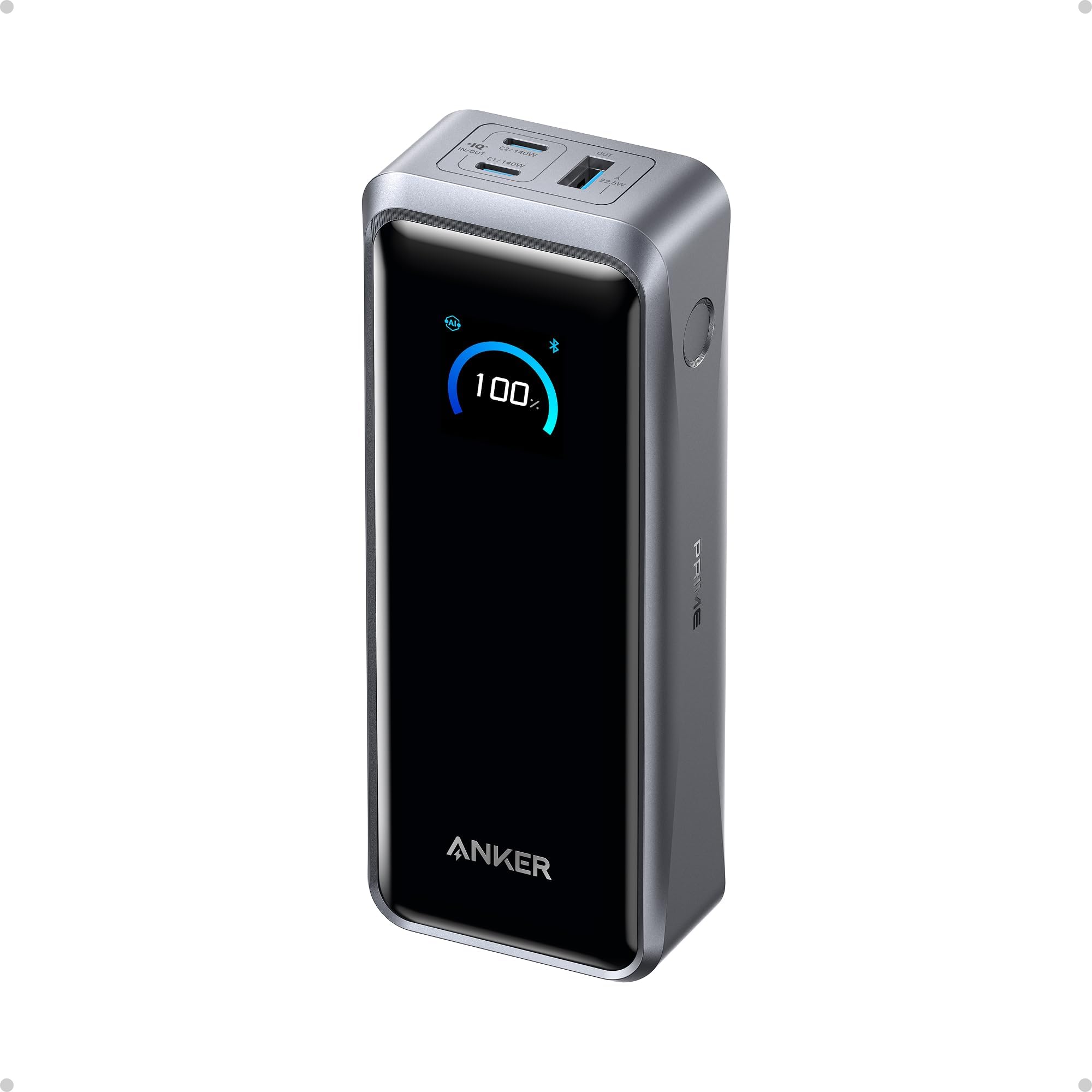
Anker Prime 26,250mAh 300W

91 /100
LBD Score Outstanding

Key details

Weight
1.32 lb
Capacity
26,250 mAh (99.75Wh)
Recharge
50% in 13 min
Max Output
300W total, 140W per port
View on Amazon

The Anker Prime is the outlier here in every direction: 26,250mAh, 300W across two USB-C ports and a USB-A, 600 grams, and a price that makes the rest of these look like stocking stuffers. It is not competing with a phone bank. It is competing with the outlet you cannot find.

What the money buys is a laptop that keeps working. A single USB-C port delivers 140W, enough to run a 14-inch MacBook Pro at speed rather than watch it drain, and two of them can run side by side. The dual-port input is the part we appreciate more day to day: half a charge in thirteen minutes means the bank itself stops being an overnight project, and the display reports level and wattage so you can see what each port is doing.

Is it worth it? If portable means a laptop comes with you, yes: nothing else here will run one at full speed and refill before your next meeting. If it does not, this is a great deal of bank for a phone that a 45W model fills just as quickly.

Pros

  • 140W from one USB-C port
  • Half a charge in 13 minutes
  • 99.75Wh stays under airline limits
  • Display and app control

Cons

  • Charging base sold separately
  • 600 g makes it a bag item only
Our verdict

The one we take when a laptop comes along: 140W from a single port and a 13-minute half recharge, if you can live with 600 grams and the price.

Check Latest Price

How We Tested 12 USB-C Portable Chargers

We started with spec sheets: wattage over USB-C, rated capacity, port count, and whether the cable is built in or one more thing to remember. Anything that couldn't push a meaningful charge to a modern phone got cut, as did packs whose specs didn't justify what they cost. From the survivors we bought 12 and used them as our only backup power for six months.

Testing looked like ordinary days. I timed how long each bank took to bring a dead phone to 50 percent and then to full, and kept charging until the bank shut itself off so I could count actual charges instead of trusting the rated figure. On a four-hour flight and a two-day trip I carried two at a time, one in a jacket pocket and one in a tote, to see which size I stopped noticing. I also plugged a laptop, a phone, and earbuds into the multi-port models at once to watch whether speeds held or everything slowed to a trickle.

Durability got handled the way bags handle it: each one rode in a tote with keys and a water bottle, took a drop from counter height onto tile, and sat untouched in a drawer for a month so I could see how much charge it lost. I noted which ran warm under load, whether built-in cables stayed put in their channels or flopped loose, and whether port housings loosened after weeks of daily plugging.

We weighed value last, on cost per usable charge rather than cost per rated milliamp-hour, and asked one last question of each: after six months, would I pack it again? The ones below are the ones I did.

How to Choose a Usb-C Portable Charger

Buy Wattage for the Device in Your Pocket

The device sets the ceiling, not the bank. A recent iPhone tops out around 27W and most Galaxy phones a little higher, so a 45W brick and a 300W brick fill them at exactly the same speed; the extra output only exists for something bigger. Match the bank to the hungriest thing you carry. Thirty watts covers phones and earbuds comfortably, and 45W gives a tablet the headroom it wants. Paying for wattage your phone cannot accept is the most common way to overspend here.

Read Capacity as Charges, Not Milliamp-Hours

Every bank loses energy converting its cells to USB-C, so the usable figure is always lower than the label. As a rule of thumb, 5,000mAh is about one phone charge, 10,000mAh about two, and 20,000mAh about four. That is why the big numbers are travel numbers and the small ones are handbag numbers. Count the charges you actually need between outlets; the capacity you buy just in case is weight you carry every day.

Decide Whether the Cable Should Be Built In

A built-in cable is why you stop hunting for a cord, and it is also the first part to fail, because the strain relief at the connector takes every bend. Our top pick sidesteps that with a detachable cable, so a worn cord is a cheap replacement rather than a dead bank. If you know you will forget a cable, buy one with it attached. If you want the bank to survive, buy one that lets you swap the cord.

Let Weight Decide Where It Lives

Roughly speaking, a bank under 200 grams disappears into a jacket pocket, 250 to 365 grams wants a bag, and anything near 600 grams is a laptop accessory that lives in a backpack. Dimensions matter as much as the number. A plug-in mini bank hangs off the bottom of the phone while it charges, which is fine for a five-minute top-up and awkward for a phone call.

Frequently Asked Questions

Final Verdict

The INIU P41 is the bank we point most people to. Forty-five watts, two USB-C ports, a replaceable cable, and 182 grams is a combination no other bank here puts together, and the three-year warranty covers the one thing that tends to go wrong with small batteries.

If carrying one gadget instead of three appeals, the Anker Nano 3-in-1 earns its extra density. If a laptop is coming with you, the Anker Prime is the only pick here that will keep it running.