Best Workout Earbuds of 2026

One of my earbuds skittered across the gym floor mid-set once, and I spent ten minutes crawling around the squat rack. That's when workout earbuds stop being an accessory and become equipment. The catch is the trade-off: the hooks and wings that keep a bud locked in often ache after forty minutes, so you're choosing between a set that falls out and one you want to tear out.

We've spent six months with 12 pairs — treadmill intervals, humid outdoor runs, a lot of sweaty-handed reinsertion. What separated them was rarely the number on the box. It was whether the hook bent to my ear instead of the other way around, whether the case survived a gym bag, and whether the battery claim held up over an honest training week.

Worth knowing before you scroll: those big playtime numbers usually count the charging case, so a set advertised at 48 hours may give you seven or eight per charge. The picks below span hook styles, open-ear designs, and price points.

1

Best Overall

Soundcore Sport X20

84 /100
LBD Score Excellent

Key details

Noise Cancelling
Active noise cancelling
Battery With Case
48 hours
Ear Hook Adjustment
Rotates up to 30 degrees, extends 4mm
Water And Dust Rating
IP68
View on Amazon

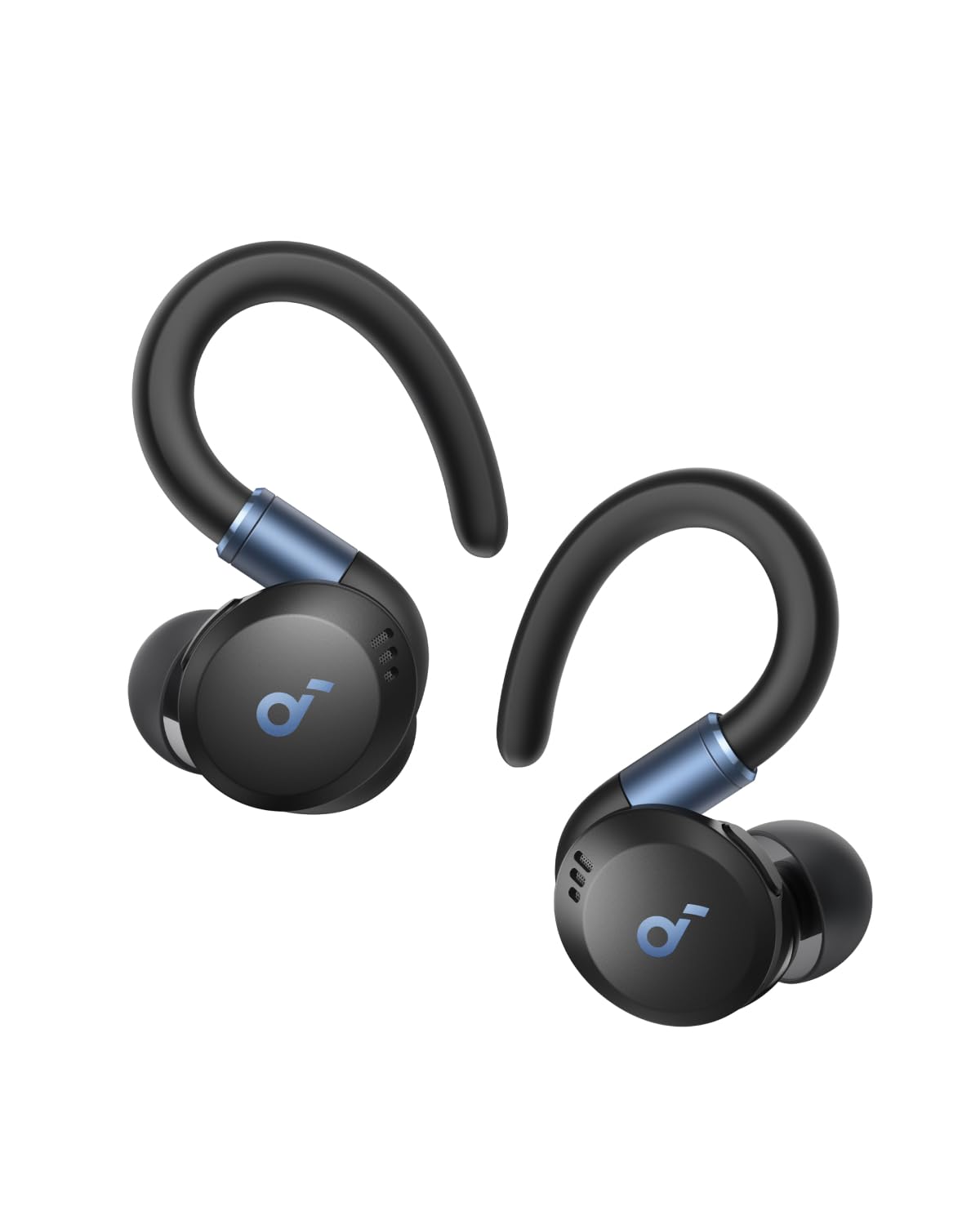
Two figures set these apart in this group: IP68 and 30 degrees. The first is the toughest dust and water rating we cover here, and it protects the buds themselves rather than just the case. The second is how far each ear hook rotates, on top of roughly 4mm of extension, so the driver can be aimed into your ear canal instead of landing wherever a fixed shape puts it.

That adjustability is what we noticed first in a gym. Hook buds usually give you one shape and a few tips; here you set the angle once, and the bud stops shifting when you move from the bench to the treadmill. We think it is the most complete training earbud in this set, and the reason is dull — fewer compromises. Fit is handled, water is handled, and the noise cancelling is strong enough to take the edge off a weight room.

Bass leads the tuning, as you would expect from 11mm drivers with Anker's BassUp processing, and the app's EQ presets plus the HearID test let you pull the mids back up if you want something flatter. Battery runs about 12 hours in the buds and 48 with the case, which is more than a week of hour-long sessions between charges.

Two practical notes before you commit. The controls are touch-based, and a wet fingertip does not always register cleanly, where a physical button would. And if your runs share a road with traffic, this sealed, noise-cancelling fit is the wrong tool entirely — the open-ear V20i on this list is the answer to that.

Pros

  • IP68 dust and water protection, the highest here
  • Hooks rotate and extend to fit different ears
  • 48 hours total with the charging case
  • Noise cancelling that handles a loud gym

Cons

  • A bud can stop working within a few months
Our verdict

We recommend these to anyone who sweats hard: the best water and dust protection here, hooks that adjust to your ears, and noise cancelling that holds up in a loud gym.

Check Latest Price
2

Best for Heart-Rate Tracking

Beats Powerbeats Pro 2

84 /100
LBD Score Excellent

Key details

Chip
Apple H2
Heart Rate
In-ear sensors, 100+ readings per second
Noise Cancelling
Active, with transparency
Battery With Case
Up to 45 hours
View on Amazon

A heart-rate sensor in an earbud sounds like a gimmick until you stop strapping on a chest strap. Beats reads your pulse from the ear more than 100 times a second, on iPhone and Android alike, and a few sessions in we stopped thinking about the strap at all. That sensor is why these are on the list; the rest is a well-sorted pair of hook buds.

Fit is the variable to work on. The hook anchors the bud, but the seal comes from the tip, and a shallow seal makes any noise cancelling feel weak — that is a mechanism of the design, not a quirk of this model. Work through the tip sizes before judging them. The gap between a good seal and a poor one is wider than the gap between cancelling on and cancelling off.

Forty-five hours with the case is genuinely a week of training, the H2 chip brings one-touch pairing, automatic switching, and hands-free Siri on Apple devices, and Android gets the full feature set rather than a stripped version. That last part matters if you are not in Apple's ecosystem, because the heart-rate data and the app work either way.

Pros

  • In-ear heart-rate tracking with no chest strap
  • 45 hours total with the charging case
  • Apple H2 chip with one-touch pairing
  • Earhooks that stay put through hard efforts

Cons

  • Static and pairing dropouts can develop over months
Our verdict

We rate these highest for anyone chasing heart-rate data without a strap: no other pick here reads your pulse, and the hooks hold through sprints.

Check Latest Price
3

Best Budget

bmani T16

88 /100
LBD Score Excellent

Key details

Drivers
10mm dynamic
Controls
Physical buttons
Ear Hooks
Adjustable over-ear hooks
Battery With Case
80 hours
View on Amazon

Eighty hours is the kind of claim that usually means standby time. Here it mostly holds: we treated the case as a weekly charge rather than a nightly one, and the dual LED display on the lid kept us honest about what was left. A bud runs a long session on its own charge before it ever sees the case again.

Comfort is where these quietly win. The hook is soft enough to settle rather than clamp, the buds sit lightly, and the adjustable arm lets you drop the driver closer to the canal when the seal feels loose. It is the pair we hand to someone who has decided that earbuds never stay in.

So it is a budget earbud that behaves like a more considered one, with two things to accept. The sweat protection is described only as water resistant, with no IP number published, so there is nothing to check it against. And the cradle is fussy: seat both buds squarely and glance at the display before you zip the bag, or one arrives flat at the next session.

Pros

  • 80 hours total from the charging case
  • Adjustable over-ear hooks that stay put
  • Physical buttons instead of touch controls
  • Comfortable enough for long sessions

Cons

  • No published IP rating for sweat
  • A bud can stop holding a charge within months
Our verdict

For long stretches between chargers, we have not found better value here: the case carries 80 hours and the hooks sit lightly on the ear.

Check Latest Price
4

Best Open-Ear

Soundcore V20i

89 /100
LBD Score Excellent

Key details

Design
Open-ear hooks
Bluetooth
5.4 with multipoint
Battery With Case
36 hours
Water And Dust Rating
IP55
View on Amazon

Open-ear buds answer a different question: not how much noise you can block, but whether you can hear the car behind you. The V20i hangs a 16mm driver outside the ear canal on a hook with four rotation positions, so the music goes in and the world stays audible. IP55 covers sweat and rain, and Bluetooth 5.4 with multipoint keeps a phone and a laptop connected at once.

We reach for these on roads, and for anyone whose ears ache after an hour of silicone. What they will not do is isolate: a loud gym or a train carriage sits right on top of your podcast, and there is no noise cancelling to switch on. The big driver gives some low end, but it is a companionable sound rather than a motivating one. If your training happens indoors, our top pick is the better tool; on a sidewalk, this is the one.

Pros

  • Keeps traffic and training partners audible
  • IP55 sweat and rain protection
  • 36 hours total with the charging case
  • Four hook positions to dial in fit

Cons

  • No isolation, so loud gyms swamp the music
  • Hook pressure can ache over a long day
Our verdict

We hand these to road runners: the driver sits outside your ear canal, so traffic and training partners stay audible while the music plays.

Check Latest Price
5

Best Water Protection

JBL Endurance Race 2

81 /100
LBD Score Excellent

Key details

Fit
Twistlock wing enhancer
Noise Cancelling
ANC with Smart Ambient
Battery With Case
48 hours
Water And Dust Rating
IP68
View on Amazon

The nearest alternative to our top pick is this JBL, and the trade is easy to state: you swap the rotating hook for a twist-to-lock wing, which some ears hold onto more comfortably and which sits flatter against the head.

IP68 is the headline — full dust protection and water protection, the same rating as our top pick. JBL's own instructions add a caveat worth repeating: dry the buds and the case before charging. That is the price of a tight seal. Water that goes in with the bud has nowhere to drain, and wet contacts will not charge.

Sound is loud and bass-led, and Sports Mode pushes the low end harder for training. The noise cancelling is the softer part of the package — it dulls a gym without erasing it, and it only works as well as the seal underneath it. Twelve hours in the buds and 48 with the case means charging is a weekend chore rather than a nightly one.

Where it lands for us: this is the pair for soaking-wet sessions, where the seal matters more than the playlist. The wing takes a couple of attempts to seat — twist until it locks, then cup your ears to check the seal before you start moving. Once it is set, it does not budge.

Pros

  • IP68 dust and water protection
  • Noise cancelling with Smart Ambient
  • 48 hours total with the case
  • Twistlock wing keeps a stable seal

Cons

  • Bluetooth dropouts can break up a session
Our verdict

We point to these for the wettest sessions: IP68 covers dust and water, and the Twistlock wing holds a seal that noise cancelling can work with.

Check Latest Price
6

Cheap Gym Backup

HAOYUYAN BX17

90 /100
LBD Score Outstanding

Key details

Drivers
14.3mm dynamic
Controls
Physical buttons
Water Rating
IPX7
Battery With Case
80 hours
View on Amazon

Buttons are the whole argument for these, and it is a better argument than it sounds. A physical button works through a wet hand, a hoodie sleeve, or a glove, while a touch panel asks for precision at the exact moment you have none. Add IPX7 and a case that runs for weeks and you have a pair we are happy to leave at the bottom of a gym bag.

Sound is the surprise. A 14.3mm driver gives these more low end than a pair this simple has any right to, and it stays clear at volume. The noise cancelling in the name is environmental cancellation for calls, not ANC for your ears — it will not quiet a gym, and the far end of a call is the shakiest part of the package. Note too that IPX7 covers water only, with no dust rating.

Pros

  • Physical buttons work with wet or gloved hands
  • IPX7 water protection
  • 80 hours from the charging case
  • Strong bass from 14.3mm drivers

Cons

  • No active noise cancelling despite the name
  • IPX7 covers water but not dust
Our verdict

We keep a pair of these in a gym bag as a spare: real buttons, an IPX7 shell, and a case that goes weeks between charges.

Check Latest Price
7

Small Ears

JLab Go Sport+

82 /100
LBD Score Excellent

Key details

Charging
USB cable built into case
Warranty
Two years
Battery With Case
35 hours
Water And Dust Rating
IP55
View on Amazon

The charging cable lives inside the case. That reads like a footnote until you are packing for a trip and every other pair on this list needs its own cord; JLab's answer is that the case is the charger.

The hook is sized for small ears, which is the specific reason this pair is here — ears that swallow a standard bud have few options. IP55 covers sweat and dust without promising a dunking, and dual connect lets either bud work on its own when you want one ear free.

Three EQ presets, a Be Aware mode, and remappable touch controls live in the JLab app, and the warranty runs two years, longer than most here. Nine-plus hours per bud and around 35 with the case means charging is a weekend chore.

Our take: buy these if small ears are the problem you are solving. The hook fits where others slide out, the case carries its own cable, and the two-year coverage softens the risk. The sound will not impress anyone — serviceable and a little thin — and that is the honest limit of the trade.

Pros

  • USB cable built into the case
  • Hook sized for smaller ears
  • Nine-plus hours per bud, 35 with the case
  • Two-year warranty

Cons

  • Bluetooth drops out more than it should
  • Buds can stop working within months
Our verdict

We point small-eared runners here: the hook is sized to fit where others slide out, and the case carries its own charging cable.

Check Latest Price
8

Spec-Heavy Sessions

GOLREX T59

92 /100
LBD Score Outstanding

Key details

Drivers
13mm dynamic
Charging
Wireless charging case
Noise Cancelling
Hybrid ANC, blocks up to 95% of noise
Battery With Case
80 hours
View on Amazon

On paper this is the most loaded pair in the group: hybrid noise cancelling rated to block up to 95% of ambient noise, 13mm drivers, 80 hours with the case, a wireless charging case, and physical buttons instead of a touch panel.

In use, the buttons are the part we appreciated most — you can change volume through a jacket without looking — and the transparency mode makes a coach or a crossing signal audible without pulling a bud out. The 80-hour case is real in the sense that you will misplace the charger long before you drain it. Treat the cancellation figure as marketing: expect solid dulling of gym noise rather than silence.

What holds it out of the top tier is time. This is a new model from a small brand, and we can tell you how it behaves now, not how it behaves in year two. If the feature list is what you are after — and noise cancelling plus real buttons is a rare combination on this list — it is worth a look, with the caveat that the sweat protection carries no published IP rating.

Pros

  • Hybrid ANC with a transparency mode
  • Physical buttons instead of touch
  • 80 hours with the charging case
  • 13mm drivers and a wireless charging case

Cons

  • No published IP rating for sweat
  • New model with no track record to check
Our verdict

We like the hardware here: hybrid noise cancelling, real buttons, and 80 hours, in a pair that has not been around long enough to prove itself.

Check Latest Price

How We Tested Workout Earbuds

We started by gathering every fitness-focused pair we could find with a stated sweat or water rating and some kind of hook, wing, or open-ear design, then cut the list by reading reviews for the failure patterns people actually complain about: one bud dying, cases that stop charging, connections that drop the moment a phone goes into a pocket. From that pool we bought 12 pairs across price bands and lived with them for six months.

Testing happened where these things actually live: treadmill intervals, weight-room sessions, outdoor runs in sticky weather, a spin class or two, and the walk to the car afterward. I shook my head hard after seating each pair, sprinted a short stretch, and took them out and put them back in with sweaty hands to see whether the hooks stayed grippy. Every pair also went through at least one session past the four-hour mark to check how comfort and battery held up together.

Battery was timed, not trusted: I ran each set at a fixed volume until it died, then timed the recharge in the case. I walked a floor away from my phone to find where the connection broke, took calls from a windy corner, and ran noise-cancelling and awareness modes in a loud weight room and on a busy street to hear whether they muffled the room or mangled the music. Sound was judged on the same handful of tracks, quiet and loud, to see which held their shape when pushed.

Cases spent a week loose in a gym bag to check whether the lid stayed shut and the LED readout still told the truth, and each set got wiped down after sweaty sessions so we could watch the mesh and charging pins for corrosion. Anything that rattled, fogged, or dropped a connection after a few weeks was marked down for reliability, however good it sounded on day one.

How to Choose Workout Earbuds

Hooks, wings, and the shape of your ear

Retention comes in three flavors here. An ear hook wraps behind the ear and is the most secure option for running, especially if your ear canal is shallow; the trade is bulk, and sometimes pressure behind the ear after a few hours. A wing or fin tucks into the fold of your ear and holds a seal with less hardware, which suits smaller ears and anyone who wears glasses. Twist-lock designs land in between, gripping the canal and the outer bowl at once.

Choose the retention to suit the activity rather than the spec sheet. Lifting and cycling are forgiving, so a plain in-ear with a good tip is fine. Running and anything overhead want a hook or a wing. If earbuds have let you down before, look for adjustment: the rotating, extending hooks on the Soundcore Sport X20 exist because one fixed angle does not fit every ear.

What the IP rating really tells you

An IP rating has two digits. The first is dust, the second is water, and an X means that half was not claimed — so IPX7 says something about water and nothing about dust, IP55 covers dust and splashing, and IP68 covers both at a higher level. Sweat behaves more like a splash than a dunking, but salt plus repetition does more damage than the number suggests.

Noise cancelling or awareness: pick by where you train

Noise cancelling is a gym feature. It mutes the dropped weights, the treadmill whine, and the conversation two machines over, and it lets you listen at a lower volume, which is kinder to your ears over years. On a road or a bike path, the same feature is a hazard.

If your miles happen near traffic, an open-ear design or a transparency mode is the safer call. The Soundcore V20i never plugs the canal at all, and every noise-cancelling model here has a mode that pipes the outside in. Use it — you should be able to hear a car door open behind you.

Battery totals, and the number that matters in month three

Case totals are the marketing number; per-bud runtime is what you live on. Eight to twelve hours in the buds covers a normal training week, so the big case figures mostly buy a reprieve from charging rather than a different week. A case that fits in a pocket beats one that lives in a drawer.

The harder question is longevity, and it is where this category is weakest. Buds die one at a time, often the left, a few months into sweat exposure — so the warranty is a feature, not paperwork. Two years from JLab, 18 months from Soundcore, a year from JBL: those numbers say something about how long the maker expects its own product to last. Register the pair when it arrives.

Frequently Asked Questions

Final Verdict

Eight pairs in, the Soundcore Sport X20 is still the one we hand to most people: IP68 protection, hooks that adjust to the ear in front of you, noise cancelling that earns its place in a gym, and 48 hours in the case. Nothing else here covers more of the training week with fewer compromises.

Two exceptions are worth naming. If you want heart-rate data without a strap, the Beats Powerbeats Pro 2 is the only pick that reads your pulse, at a premium. And if your runs happen on open roads, take the Soundcore V20i instead — hearing the traffic matters more than hearing the bass.