Best 3D Printing Resin of 2026

The first time I watched a resin printer lift a miniature off the build plate, I got it: layer lines vanish, tiny text stays legible, detail that filament blurs into mush comes out sharp. What the photos don't show is the tradeoff — plenty of these resins are brittle enough to snap at the ankle, and some smell like a chemical spill the second you lift the lid.

Over the past six months, my team and I ran 12 resins through the same printers, from standard formulas to the tougher ABS-like ones that promise to bend instead of crack. The gap between a good bottle and a cheap one shows up fast, and it has almost nothing to do with which printer you own. Two things I didn't appreciate before: fast-curing formulas cut hours off a plate of small parts, and low-shrinkage resin is what keeps a multi-part model's joints actually fitting.

Color matters more than most first-time buyers expect. Gray forgives layer lines and photographs well, but a clear or heavily pigmented bottle can drift after a few days in window light and leave you with a print that no longer matches the last one. The picks below cover detail chasers, people tired of reprinting broken parts, and anyone who prints enough to buy in bulk.

1

Best Overall

Siraya Tech Fast ABS-Like

94 /100
LBD Score Outstanding

Key details

Color
Grey
Net Weight
2.2 lb
Resin Type
ABS-like
Wavelength
405 nm
View on Amazon

A resin proves itself the first time a finished miniature goes off the edge of the desk. Most of the parts we printed in Siraya Tech Fast survived knocks that would have chipped a standard resin, and the ones that failed failed at a thin protrusion rather than at the body of the model. That gap between snapping and bending is the reason this bottle is our top pick: it holds fine detail like a standard formula and then behaves like something engineered to be picked up.

Detail is where we expected a compromise and did not find one. Face features on a 28 mm figure, the teeth on a small gear, and the bevel on a base edge all came out clean, and the dark grey shows what you printed without the washout you get from white. Siraya rates it for 405 nm LCD and DLP machines and lists it as 8K capable, which matched what we saw on a higher-resolution printer: our layer height was the limiting factor, not the resin.

Nothing here is indestructible. Long thin protrusions — blades, antennas, the barrel of a rifle — still break if you catch them, and supports can need a firm twist rather than the easy snap you get from a soft standard resin. Those are the edges of what this formula does, and knowing them is the difference between a repair and a reprint. For everything else on a gaming table, this is the bottle we keep loaded.

Pros

  • Bends instead of shattering when dropped
  • Sharp detail on small features
  • Low odor while printing
  • Runs on any 405 nm printer

Cons

  • Highest cost per bottle here
Our verdict

Our pick for anyone printing miniatures or parts that get handled: it keeps the detail you want and bends where standard resin snaps.
Check Latest Price
2

Best for Functional Parts

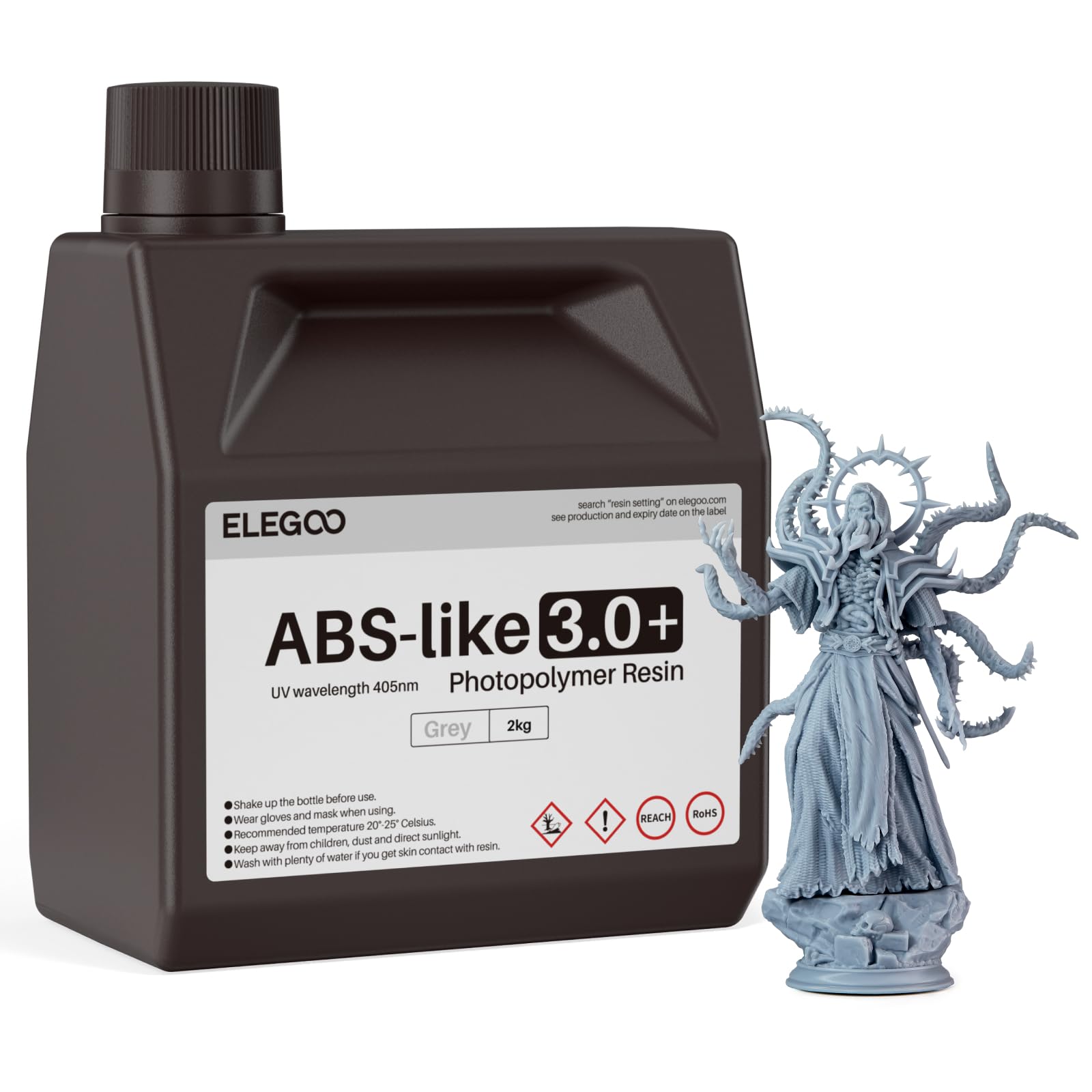
ELEGOO ABS-Like 3.0+

93 /100
LBD Score Outstanding

Key details

Color
Grey
Net Weight
4.41 lb
Resin Type
ABS-like
Heat Resistance
Up to 55°C
View on Amazon

The number that separates this bottle from the rest of the shelf is 55°C. ELEGOO rates the ABS-Like 3.0+ to keep its physical shape and mechanical properties at that temperature, which is the difference between a printed bracket that survives a summer afternoon in a parked car and one that sags into a comma.

That rating is why we load it for functional work: replacement knobs, jigs, corner brackets, and the small printed clips that hold a shelf together. Parts take a drill and a thread without crumbling, and impact resistance is the quality you notice when something gets dropped on a garage floor rather than set down on a desk. The two-kilo bottle is the practical half of the pitch — a run of brackets does not leave you reordering mid-project.

Printing it is uneventful in the way you want. Fluidity is good, so it drains off the model quickly, layer detail holds, and the smell is milder than we expected from an ABS-like. The cured surface is a flat grey that takes primer without beading, which saves a sanding pass on anything headed for paint.

Pros

  • Holds its shape up to 55°C
  • Takes drilling and threading
  • Low odor for an ABS-like
  • Two kilos in one order

Cons

  • Fine details can still crack
  • Costs more per gram than standard resin
Our verdict

Buy it when your prints have to carry load or sit in the heat; the 55°C rating and impact resistance suit brackets, jigs, and replacement parts.

Check Latest Price
3

Best Bulk Value

ANYCUBIC Standard 4-Pack

95 /100
LBD Score Outstanding

Key details

Color
Grey
Net Weight
4 kg (4 x 1 kg)
Resin Type
Standard
Wavelength
405 nm
View on Amazon

Four bottles is a storage decision as much as a purchase. The bundle puts four kilos of grey standard resin on your shelf, and if you print most weekends that is the point: the exposure settings you dial in on the first bottle still hold on the fourth, so batch after batch comes out the same.

What you are buying is predictability. Detail is good — clean edges on terrain, sharp text on bases — and shrink is low enough that parts designed to slot together still fit after curing. It runs on 405 nm LCD and DLP machines, and it behaved on a printer of ours that has never liked unfamiliar resins. Standard resin settles, so shake each bottle before topping the vat; the bottom of a jug pours darker than the top.

The judgment is simple. If you go through a bottle every month or two, this is the cheapest way to keep the printer fed and the least fussy thing to live with, because one working profile covers the whole box. If you print a miniature a week, four kilos is a lot of shelf space to give up for a single shade of grey.

Pros

  • Lowest cost per liter here
  • Consistent settings across four bottles
  • Low shrink keeps fitted parts aligned

Cons

  • Brittle in thin sections
  • Cured grey can shift yellow-orange
Our verdict

Four kilos of predictable grey at the lowest cost per liter here — the smart buy if your printer runs most weekends.

Check Latest Price
4

Best Budget Tough Resin

SUNLU ABS-Like 2 kg

91 /100
LBD Score Outstanding

Key details

Color
Grey
Net Weight
4.41 lb
Resin Type
ABS-like
Wavelength
405 nm
View on Amazon

Per gram, this is the least expensive way into a tough resin on this list. Two kilos of ABS-like for less than the other ABS-like bottle here means you can print big, hollow, or experimental pieces without flinching at the cost of a failed one, and terrain and vehicle shells are exactly where a cheap tough resin earns its keep.

We have been happy with how it behaves: it prints clean at modest exposure, parts flex before they fail, and the cured surface is a matte grey that hides layer lines better than a glossier standard formula. It is not as crisp as our top pick on the smallest details — faces on a 28 mm figure soften slightly — but nothing you would notice on a building, a tank hull, or a replacement part.

The catch is the bottle itself. Two kilos is heavy to pour from once it is half empty, and a wide-mouth jug sitting in a bright room is not where resin keeps best. Decant into a smaller amber bottle for daily fills, and keep the rest sealed and out of the light.

Pros

  • Flexes instead of snapping
  • Lowest cost per gram of the ABS-likes
  • Prints clean with little dialing in

Cons

  • Softens the smallest details
Our verdict

Two kilos of bend-before-break resin that undercuts every other tough formula here, and the cheapest entry into ABS-like printing.

Check Latest Price
5

Best Clear Resin

ANYCUBIC Upgraded Standard Clear

93 /100
LBD Score Outstanding

Key details

Color
Clear
Net Weight
2.2 lb
Resin Type
Standard
Wavelength
405 nm
View on Amazon

Some prints only work in clear — light pipes, lenses, a window in a model building, anything where the point is that light passes through. ANYCUBIC's clear is the bottle we reach for there, and it runs at the same 405 nm settings as the greys, so you are not relearning your printer to use it.

The detail holds up better than we expected from a clear formula: fine edges stay sharp and the resin drains from hollow sections quickly, which matters when you are cleaning a part you cannot see inside. Straight off the plate it is cloudy, and that is normal. The glassy look comes from wet-sanding through a couple of grits, so clear resin charges you in labor what it gives you in appearance.

We keep it for pieces where transparency is the whole point. Clear also shows every scratch and fingerprint once it is polished, so a part that will be handled rather than displayed belongs in grey, and the yellowing that follows a long cure is easier to avoid in short passes with a check between them.

Pros

  • Polishes to a glassy, transparent finish
  • Holds detail as well as the greys
  • Drains quickly from hollow parts

Cons

  • Yellows if over-cured
  • Brittle in thin sections
Our verdict

The clear resin to buy when a print has to let light through; it holds detail and polishes up glassy, as long as you watch the cure.

Check Latest Price
6

Best for Beginners

ELEGOO Standard Grey

95 /100
LBD Score Outstanding

Key details

Color
Grey
Resin Type
Standard
Wavelength
405 nm
View on Amazon

The reason we start beginners here is not on the label. ELEGOO's standard grey is the resin a lot of painters learned on, so recommended exposure settings for almost any LCD or DLP machine are a search away, and our first print on a borrowed profile came off the plate clean with nothing to troubleshoot.

That combination — inexpensive, widely documented, predictable — is what makes it a genuine recommendation rather than a default. Detail is good for a standard formula: fine text on a base, small mechanical features, and thin edges all came out crisp. It also tolerates a cool workshop, though below the mid-60s you want a touch more exposure per layer.

The other thing we appreciate is the finish. A matte mid-grey photographs honestly, hides layer lines better than white, and takes primer without beading, which is why so many painting tutorials are written around it. Buy it for display pieces, gaming minis that live in a case, and prototypes where the shape is the thing you are checking.

Pros

  • Crisp detail on display minis
  • Widely published exposure settings
  • Low shrink keeps fitted parts aligned

Cons

  • Brittle once fully cured
Our verdict

The safest first bottle for a new resin printer: cheap, predictable, and documented to death, with detail that stands up on display minis.

Check Latest Price
7

Calibration and Terrain

SUNLU Standard Grey

90 /100
LBD Score Outstanding

Key details

Color
Grey
Net Weight
2.2 lb
Resin Type
Standard
Wavelength
395-405 nm
View on Amazon

There is one job this bottle does better than anything else here: it is the cheap one. Keep a kilo on the shelf for exposure tests, base toppers, and scatter terrain, and a failed print costs you a little material and a few minutes instead of an evening's worth of resin.

It prints like a standard resin should at recommended settings — crisp edges, low shrink, and a hard, smooth surface that takes paint well. The 395-405 nm rating means it covers older machines whose light source sits slightly below 405 nm, and it worked on everything we put it in without a special profile.

Smell is the other thing to know. This is not the low-odor option in this group, and in a small room without airflow it makes itself known, so give it a window, a filter, or a garage. That is a placement question, not a reason to avoid it.

Our use for it is unglamorous and steady: calibration prints, unit bases, dungeon walls, and the projects where the model matters more than the material. When a print needs to survive handling, spend the difference and buy an ABS-like instead — that is the honest split.

Pros

  • Cheapest bottle in this group
  • Crisp prints at recommended settings
  • Hard, smooth surface takes paint
  • Covers 395-405 nm machines

Cons

  • Brittle for parts you will handle
Our verdict

The inexpensive bottle to keep for calibration prints, bases, and terrain, where toughness matters less than what each print costs.

Check Latest Price

How We Tested a Dozen Resins Over Six Months

To build the shortlist, we pulled roughly 30 resins sold in one- and two-kilogram bottles, then dropped anything that didn't list a 405nm cure wavelength or that buyers repeatedly flagged for failed prints. Price per gram, bottle size, and whether the maker publishes cure and shrinkage information narrowed it to 12 bottles, standard and ABS-like alike.

Every resin printed the same test plate: a small figure with a thin blade and a fine cloak edge, a snap-fit box with a tiny peg, and a flat tile of micro text. We printed each one three times across two machines to see whether a good first result was luck or the formula. We timed full-plate cures, sniffed each bottle at opening and again an hour into a print, and scraped every part off the build plate by hand to feel whether adhesion was firm enough to hold a tall print or so aggressive that parts chipped coming off.

After washing and curing per each maker's instructions, thin parts got dropped onto concrete from counter height; the brittle ones shattered, the ABS-like ones bent and scuffed. Sample tiles sat in a sunny window for two weeks so shifts in color were obvious, and we weighed how much resin each plate actually consumed so our value notes reflect the real cost per finished part, not just the price on the bottle.

How to Choose 3D Printing Resin

Start with the type, not the brand

Standard resin gives you the sharpest detail for the money and cures hard and brittle — right for miniatures that live in a display case, wrong for a clip that has to flex. ABS-like formulas trade a little crispness for parts that bend before they break, which is why they dominate anything handled. High-precision and 8K-labeled standard resins are still standard at heart: blended for finer pixels, not for toughness. ELEGOO's ABS-Like 3.0+ pushes the same idea toward heat, rated to hold its shape to 55°C for parts that sit in a car. Water-washable formulas skip the alcohol, but commit a vat only after you have checked the maker's settings for your machine.

Detail is set by your printer as much as the bottle

The word 8K on a label describes the printers a resin was blended for, not a promise of finer detail. Your screen's pixel size and your layer height set the ceiling, and a good standard resin printed thin will out-detail a premium one printed thick. Color matters more than most shoppers expect: grey shows fine features and photographs honestly, which is why so many painting guides are built around ELEGOO's grey, while clear and white wash out detail under a desk lamp and hide it entirely in a photograph. For miniature faces, spend on the printer and the layer height before you spend on the resin.

Where you print decides the smell and wash question

Every resin here smells; what changes is how much, and whether your room can absorb it. A garage, a spare room with a window and a fan, or an enclosure with a carbon filter does more for the experience than any formula choice. For washing, budget for isopropyl alcohol and two containers — a dirty first rinse and a clean second — or choose a water-washable resin and skip the alcohol altogether. Gloves and eye protection are not optional with any of them, and neither is keeping the wash station away from anything you eat off.

Match the bottle to how often you print

Resin settles and pigments separate, so a bottle that sits half full for months needs a good shake before every pour and stores best cool and dark. Buy 1 kg if you print occasionally or want to test a formula; buy 2 kg or a four-pack like the ANYCUBIC bundle if the printer runs most weekends, because identical bottles remove one variable from your settings. Compare cost per gram rather than the sticker on the bottle, and remember that a big jug you cannot store properly is worse value than two small ones you can.

Frequently Asked Questions

Final Verdict

Siraya Tech Fast is the bottle to buy first. It prints detail as well as the standard resins here, and the parts survive being handled — the compromise most of us are making every time we hit print. If your parts see heat or real load, ELEGOO's ABS-Like 3.0+ is the tougher answer. And if you go through resin fast, the ANYCUBIC four-pack keeps the printer fed at the lowest cost per liter in this group.