Best ABS Filament of 2026

ABS has a well-earned reputation: parts come out tough, heat-resistant, and ready for a dashboard or a garage shelf, but the filament warps, smells, and lifts a corner at hour six of a nine-hour print. I've scrapped more ABS than I'd like to admit. What separates a spool you finish from one that ends up in a drawer isn't the plastic — it's consistency.

My team spent four months running 16 spools through three printers — one in a garage, one in a basement enclosure, one on a spare-room desk — and the spread was wider than I expected. The spec most people skip is diameter tolerance; a spool that swings a couple hundredths of a millimeter still prints, just a little differently every day, and that's what kills an overnight job.

Bed adhesion, warping, brittleness, and how evenly a spool winds matter more than color for functional parts — until you need two brackets to match. The picks below held up for a full kilogram, and a few are simply the better deal per gram.

1

Best Overall

Polymaker ABS Filament

90 /100
LBD Score Outstanding

Key details

Diameter
1.75 mm
Material
ABS
Filament Weight
2.2 lb
Dimensional Accuracy
±0.03 mm
View on Amazon

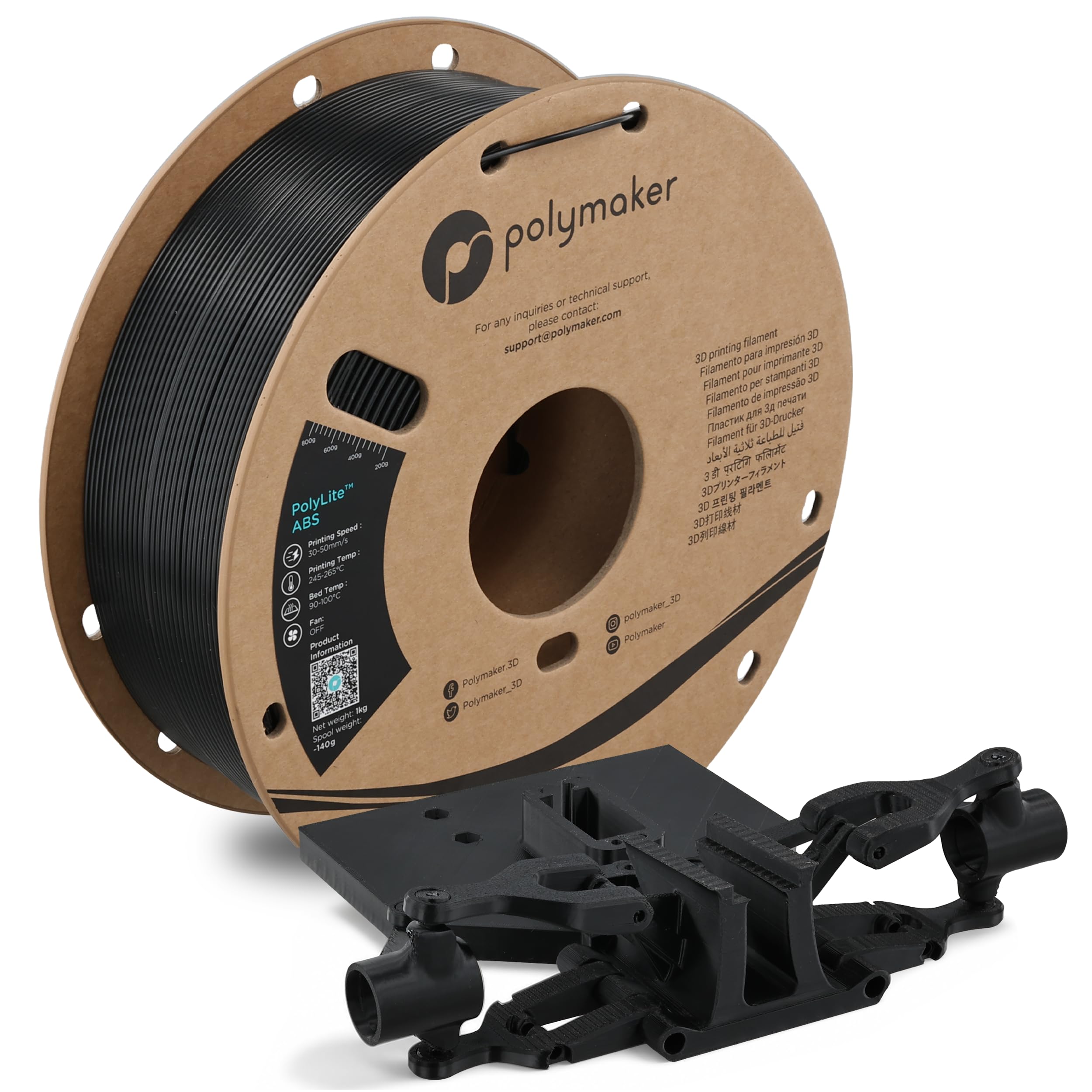
The low-odor ABS formulation is the first thing we notice about Polymaker's black spool, and it is the reason this is our default pick for functional parts. The 1.75 mm filament is wound on a 1 kg spool with a ±0.03 mm dimensional tolerance, and Polymaker builds it for heat resistance and impact strength rather than decorative prints. We like that combination because it matches what most people actually want from ABS: a part that survives a hot enclosure, a dropped tool, or a snug mechanical fit without turning into a warped conversation piece.

Printing it is still ABS printing. Polymaker calls for a 245–265°C nozzle, a 90–100°C bed, and the cooling fan off, and an enclosure is the sensible way to hold those conditions. We paid close attention to bed adhesion because that is where ABS spools separate; this one rewards a clean, hot surface and a brim on tall parts. The black color is the right kind of boring for brackets, jigs, and replacement parts.

The ±0.03 mm tolerance is the detail we appreciate most when two printed pieces have to mate, and black is the one we keep on the shelf for that reason. Polymaker sells enough colors to make the spool useful beyond utility prints, but the tight fit is what earns it the default spot.

Pros

  • Low-odor ABS resin
  • ±0.03 mm dimensional tolerance
  • Heat- and impact-resistant parts
  • Standard 1 kg spool

Cons

  • Spool can tangle if tension slackens
  • Not the lowest-cost spool
Our verdict

For most ABS buyers, this is the spool we recommend first: a low-odor, dimensionally consistent 1 kg roll that handles heat and impact without demanding special handling beyond the enclosure ABS already needs.
Check Latest Price
2

Best for Easy Single-Spool Printing

ELEGOO ABS Filament

92 /100
LBD Score Outstanding

Key details

Diameter
1.75 mm
Material
ABS
Filament Weight
2.2 lb
Heat Resistance
Up to 85°C
View on Amazon

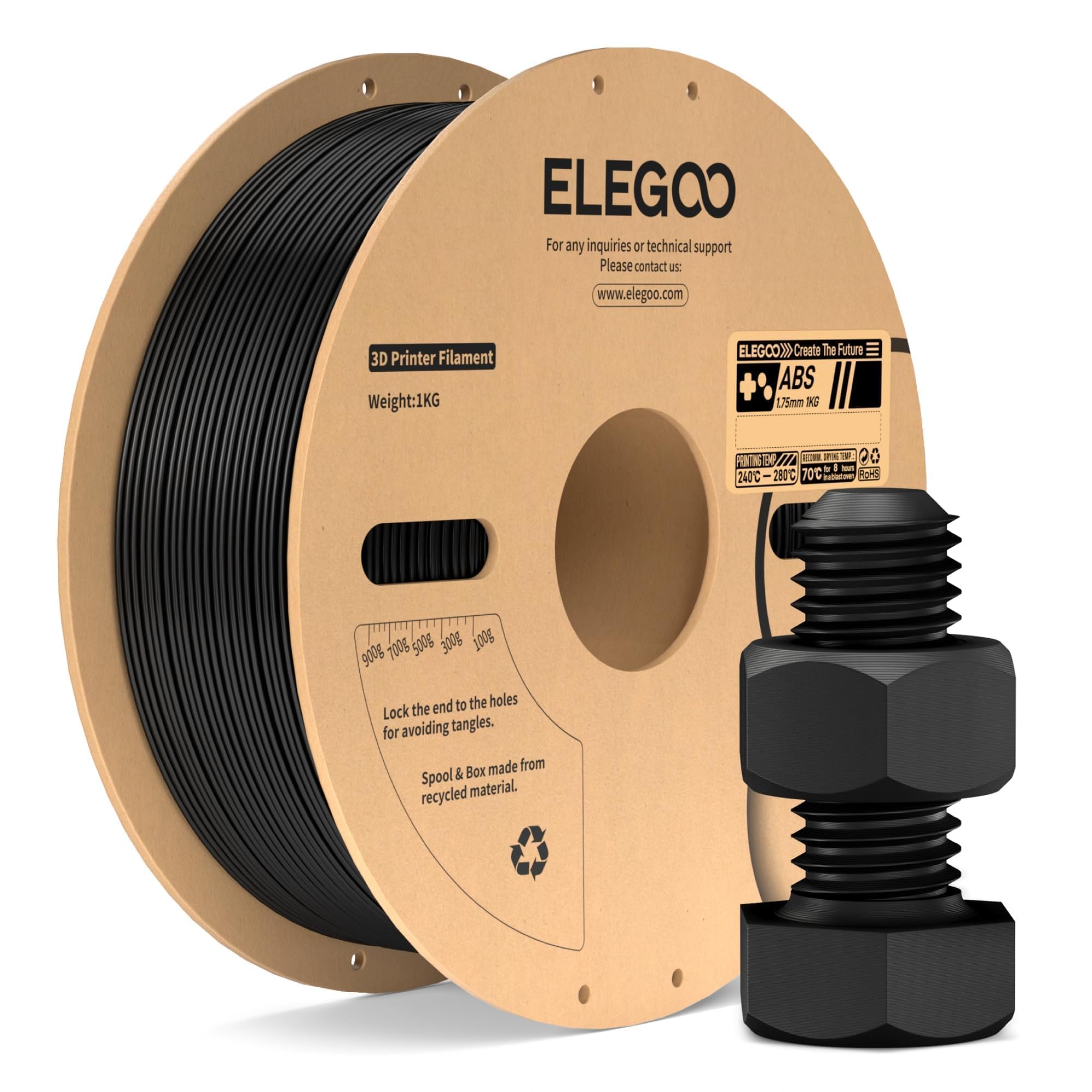
ELEGOO's black ABS is the spool we reach for when the job is simple: a bracket, a housing, a replacement latch, and no appetite for a long tuning session. It is a 1 kg, 1.75 mm roll with impact resistance and heat and water resistance rated to 85°C, and the vacuum-sealed packaging keeps it dry until you open it. We like that it does not pretend to be a specialty filament; it is a straightforward ABS for a printer that can hold heat.

The print results we see are clean and consistent, and the spool feeds without drama on the printers it is meant for. We still run a test cube and a small overhang test before a long print, because every ABS profile is a little different.

Compared with Polymaker, ELEGOO gives up the low-odor resin and the published ±0.03 mm tolerance, but it keeps the decision simple and the price lower. The black finish is uniform and practical, and the 1 kg spool stores easily. That is enough for a spool that is meant to disappear into the work.

Pros

  • Impact-resistant, heat-resistant prints
  • Vacuum-sealed 1 kg spool
  • Simple single-spool ABS
  • Consistent feeding

Cons

  • Enclosure required for best results
Our verdict

A clean, simple ABS spool for enclosed printers, ELEGOO is the pick when you want solid functional parts without paying for specialty color or high-speed tuning.

Check Latest Price
3

Best Bulk High-Speed Kit

SUNLU High Speed ABS 4KG

91 /100
LBD Score Outstanding

Key details

Diameter
1.75 mm
Heat Distortion
91°C
Max Print Speed
350 mm/s
Total Filament Weight
8.82 lb
View on Amazon

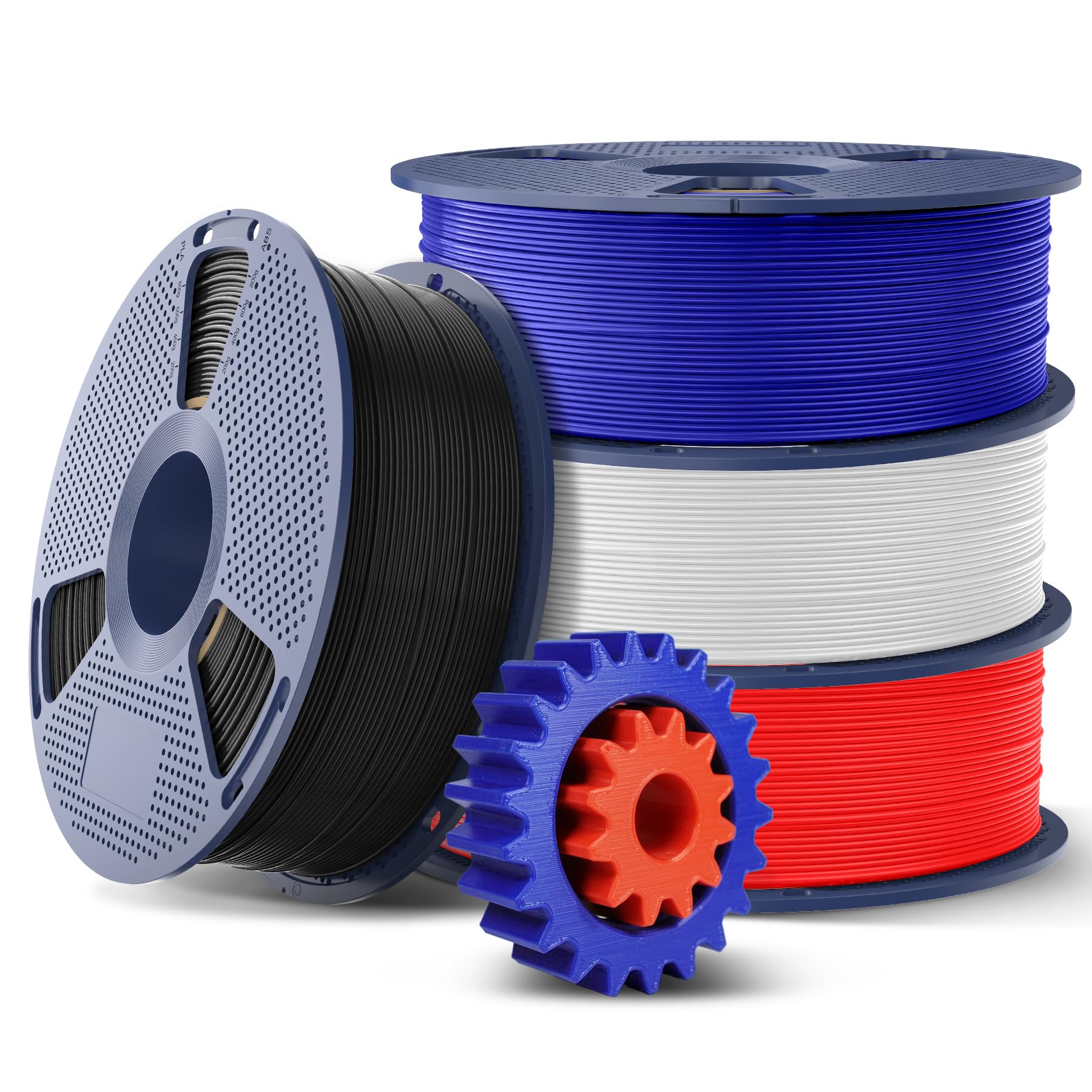
Four spools in one box is the reason this SUNLU kit exists, and the mix is more useful than a single-color bulk pack. You get 1 kg each of black, white, Klein blue, and red, all in 1.75 mm high-speed ABS with a 350 mm/s speed rating and a 91°C heat distortion temperature. We like the color spread for accent parts and for keeping one spool loaded while another is in the dryer.

The high-speed claim is the part we treat carefully. A 350 mm/s rating is a ceiling, not a promise that every printer will hold quality at that speed; the profile still has to be tuned, and the chamber still has to stay warm. What we appreciate is the practicality of the kit: four colors, one order, and enough filament to run several projects before you reorder. The finish is a little shinier than a matte ABS, which suits brackets and widgets but is not the look for a stealthy enclosure.

The trade-off is commitment. Four kilograms is a lot of storage if you print one color and occasionally, and the high-speed formula is wasted on a printer that runs standard ABS speeds. For a busy bench, though, the per-spool value is the point, and the 91°C heat distortion gives you headroom for mounts and parts that see warm air.

Pros

  • Four 1 kg spools in one pack
  • 350 mm/s speed rating
  • 91°C heat distortion
  • Useful color mix

Cons

  • Higher upfront cost than a single spool
Our verdict

Buy the SUNLU high-speed kit if you want a bench full of ABS colors and a spool that can keep up with a fast printer; for one-off jobs, a single roll makes more sense.

Check Latest Price
4

Best Glossy Finish

OVERTURE ABS Filament

89 /100
LBD Score Excellent

Key details

Finish
Glossy
Diameter
1.75 mm
Filament Weight
2.2 lb
Dimensional Accuracy
±0.02 mm
View on Amazon

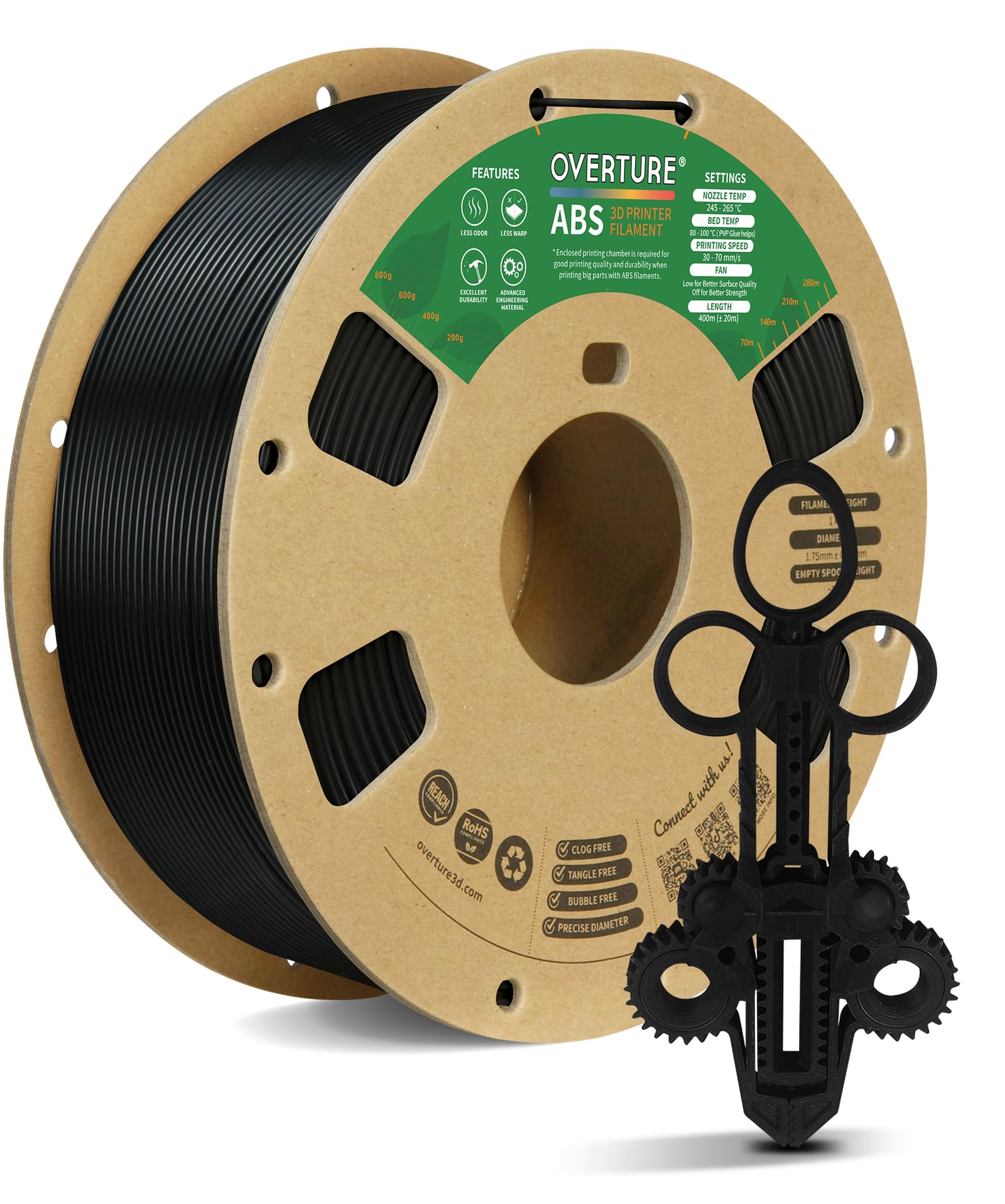
The glossy finish is what separates OVERTURE's black ABS from the matte-black spools that dominate this group. It is a 1 kg, 1.75 mm roll with a ±0.02 mm dimensional tolerance, and OVERTURE builds the spool with a grid layout and a clear length scale so you can see how much is left. We appreciate that small bit of organization; it makes the spool easier to manage in a cabinet full of half-used rolls.

The filament is aimed at smooth, professional-looking parts, and the low-warp claim is the one we check first because ABS is unforgiving on large footprints. It still wants a hot bed and a stable chamber, and the first layer is the part that needs attention. We treat the first layer as a tuning step rather than a set-and-forget.

Our verdict is that OVERTURE earns its place when the surface matters. The gloss gives a printed enclosure or display piece a more finished look, and the tight tolerance helps parts fit without a lot of sanding. It is not the budget pick, and it is not the one we choose for a rough prototype where the finish will be sanded away.

The spool's grid and scale are the details we keep coming back to, because they make a practical difference between prints. If you want ABS that looks a little more polished than the usual utility black, this is the one we reach for.

Pros

  • Glossy, professional finish
  • ±0.02 mm tolerance
  • Spool has a length scale
  • Grid-wound spool

Cons

  • Can tangle if tension slackens
Our verdict

Choose OVERTURE when the surface finish matters as much as the mechanical properties; it gives ABS parts a glossier, more finished look without giving up the usual heat resistance.

Check Latest Price
5

Best Specialty Color

FLASHFORGE ABS Pro Filament

88 /100
LBD Score Excellent

Key details

Diameter
1.75 mm
Filament Weight
2.2 lb
Heat Deformation
Below 90°C
Dimensional Accuracy
±0.02 mm
View on Amazon

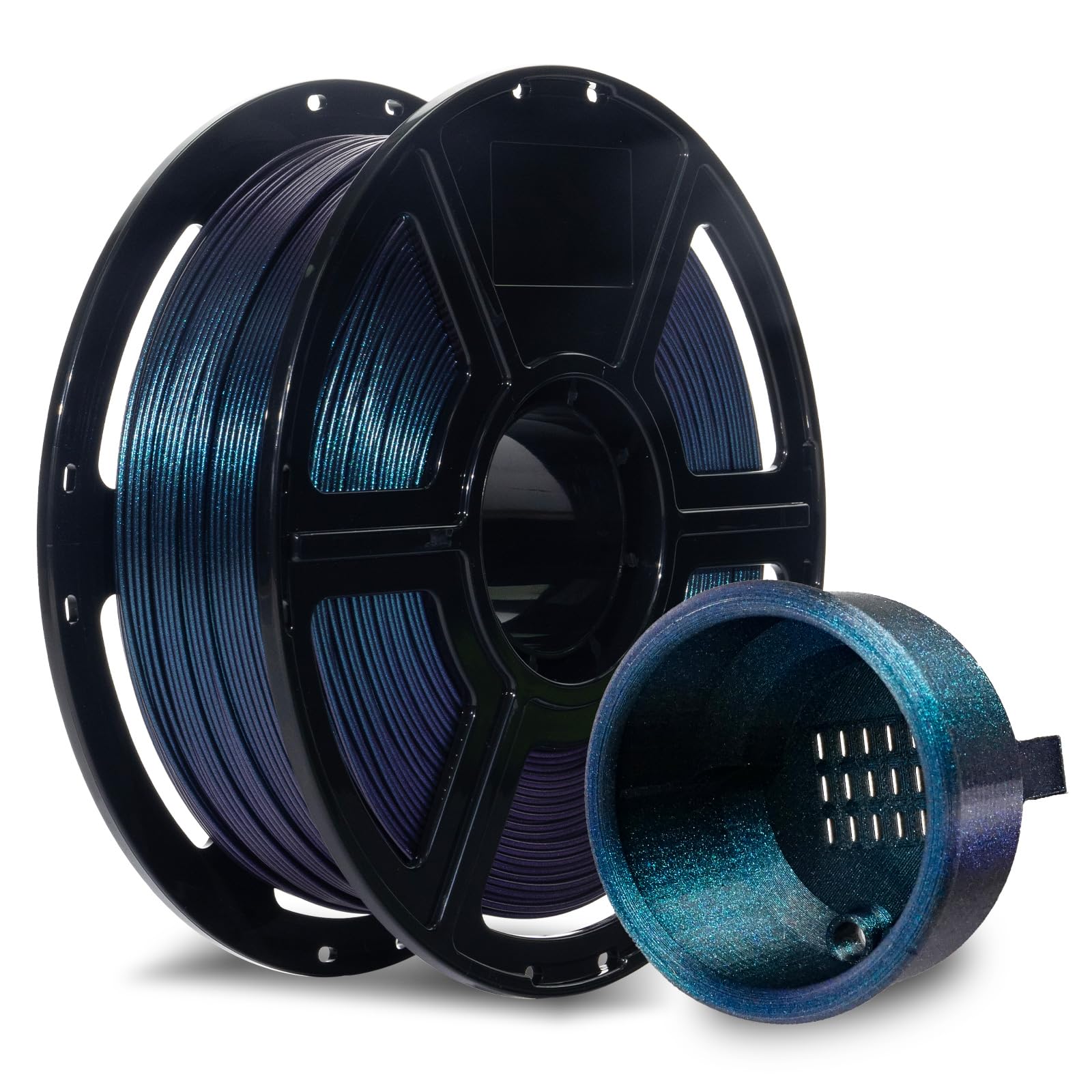
Burnt Titanium is not a color you buy by accident. FLASHFORGE's ABS Pro is a 1 kg, 1.75 mm spool with a ±0.02 mm tolerance and a heat deformation temperature below 90°C, and the chameleon pigment shifts with light and angle. We like that the finish is not the only story: the ABS Pro formula is pitched at lower warping and cracking than standard ABS, which makes it more useful for large parts than a pure novelty color.

The lower-warp claim is the one we watch on a big print. ABS Pro is still ABS, so an enclosure and a hot bed remain part of the job, and the results on brittleness and adhesion are mixed enough that we dry the spool and run a test print before committing a long job. The color is beautiful, but it does not exempt you from the usual ABS rules.

The trade-off is breadth: this is a specialty spool, not the one you buy for every black bracket. The color and ABS Pro formulation are what earn it a place; a plain utility spool still makes more sense for rough prototypes.

Our verdict is that FLASHFORGE ABS Pro is the fun spool in a practical lineup. It gives a functional part a finish worth showing off, and the lower-warp formula makes it a better fit for large brackets than a standard ABS. The color shift is the detail that makes the spool memorable; the ABS Pro formula is what makes it useful.

Pros

  • Color-changing Burnt Titanium finish
  • Lower-warp ABS Pro formula
  • ±0.02 mm tolerance
  • Good for large functional parts

Cons

  • Premium price for a specialty color
Our verdict

FLASHFORGE ABS Pro is for the print you want to look at as well as use; the chameleon finish and lower-warp formula justify the premium when standard black will not do.

Check Latest Price
6

Best Refill for Bambu Lab AMS

Bambu Lab ABS Refill

88 /100
LBD Score Excellent

Key details

Diameter
1.75 mm
Tolerance
±0.03 mm
Spool Type
Refill
Filament Weight
2.2 lb
View on Amazon

The refill format is the whole point: no new spool, just filament for the AMS. Bambu Lab's ABS comes as a 1 kg, 1.75 mm refill with a ±0.03 mm tolerance, and it is formulated for high strength, heat resistance, and low warp. We like the storage math as much as the material; a stack of refills takes less room than a stack of spools.

It is optimized for Bambu Lab printers and high-temp FDM machines, and the refill is meant to go onto a reusable spool. That makes it a poor fit if you do not already run that ecosystem, because the hardware is part of the product. The filament is vacuum-sealed and labeled for AMS, which is the detail that matters when you are loading a multi-material unit.

Our verdict is that this is the tidy choice for Bambu Lab owners who want a low-warp engineering ABS without adding empty spools to the shelf. The ±0.03 mm tolerance and heat resistance are solid for functional parts, and the refill is the reason to choose it over a generic 1 kg roll. If you are not on a Bambu Lab printer, the refill convenience turns into an extra step.

The black color is the practical default for mechanical parts, and the refill is the one pick here that saves storage space before it saves money. That is a different kind of value, and the refill is the only pick here that changes your shelf space.

Pros

  • Refill format cuts spool waste
  • ±0.03 mm tolerance
  • Low-warp ABS for engineering parts
  • AMS-ready labeling

Cons

  • Higher cost than budget single spools
Our verdict

Bambu Lab owners with a reusable spool get a tidy, low-warp ABS refill that feeds the AMS without another empty spool in the bin.

Check Latest Price
7

Best for Creality Printers

Creality ABS Filament

92 /100
LBD Score Outstanding

Key details

Color
Black
Diameter
1.75 mm
Filament Weight
2.2 lb
Dimensional Accuracy
±0.02 mm
View on Amazon

Creality's own ABS is the obvious first stop for a Creality printer, and the 1 kg black spool keeps the decision simple. It is 1.75 mm filament with a ±0.02 mm dimensional tolerance, impact and heat resistance, and a formulation Creality says reduces warping and splitting on large parts. We like that the spool is a known quantity for the company's own machines; the profile is one less variable.

Our take is that this is a dependable general-purpose ABS. The print quality is strong on the right profile, but bed adhesion and warping are the areas that need attention; a brim and a hot, clean bed do more for this spool than a fancy slicer trick. Creality calls it odorless, which we read as a marketing claim rather than a license to print in a bedroom. Ventilation still matters.

The 12-month support and the familiar black finish are practical touches, and the ±0.02 mm tolerance is tighter than some premium spools here. We keep it in the cabinet for Creality projects and for any printer that already has a good ABS profile.

Pros

  • ±0.02 mm dimensional accuracy
  • Good impact and heat resistance
  • Familiar Creality profile
  • 12-month support

Cons

  • Not a high-speed formula
Our verdict

For Creality owners, this is the low-friction ABS choice: a dimensionally accurate black spool with a familiar profile and enough heat resistance for functional parts.

Check Latest Price
8

Budget Single Spools

SUNLU ABS Filament 1KG

88 /100
LBD Score Excellent

Key details

Color
Black
Diameter
1.75 mm
Material
ABS
Filament Weight
2.2 lb
View on Amazon

The lowest price in this group buys you a lot of filament and a few compromises. SUNLU's standard ABS is a 1 kg, 1.75 mm black spool with a 250–260°C nozzle recommendation, an 80–100°C bed, and a 40–60 mm/s speed range. We like it for the jobs where a failed print is annoying but not expensive: prototypes, jigs, shop fixtures, and parts that will be sanded or acetone-smoothed.

The material can print well, and the acetone-smoothed finish is one of its better tricks. But quality and brittleness are the areas where this spool is less consistent than the picks above; we dry it and run a small test before a long print. The 40–60 mm/s range is old-school ABS pace, not a high-speed profile.

That is the trade-off: you save money and get a widely used spool, but you accept more variability and a slower print. For a hobbyist burning through prototypes, that can be the right bargain. For a customer-facing part or a long unattended print, the safer spools in this group are worth the extra spend.

Our verdict is that SUNLU's standard ABS is the budget spool we keep for rough functional parts and experiments, not the one we trust for a critical print. It earns a place because it is cheap, available, and good enough for a lot of shop work. It does not earn the top spot because consistency is the thing ABS demands most.

Pros

  • Low-cost single spool
  • Good for prototypes and jigs
  • Acetone-smoothable finish
  • Standard 1 kg spool

Cons

  • Can tangle if tension is not managed
Our verdict

SUNLU's standard ABS is the budget spool we keep for prototypes and rough functional parts; it is not the one we trust for a long, critical print.

Check Latest Price

How We Tested 16 Spools of ABS Filament

The shortlist started on paper. We looked for 1-kilogram spools that publish a diameter tolerance, list a clear print temperature, and claim some heat resistance, then cut anything that only came in novelty colors or had no spec sheet at all. From dozens of candidates, 16 spools made the cut, and each ran on the same three printers over four months: a garage machine, a basement printer in an enclosure, and a desk setup in a spare room.

Diameter was the first thing we checked, because it's the quietest failure: calipers on the filament at the start, middle, and end of each spool, noting whether the numbers drifted. Bed adhesion came next — a 120-millimeter flat panel printed on glass with glue stick, with the gap under each corner measured after it cooled. Then a calibration cube for dimensional accuracy, and a bracket clamped in a vise to see whether it broke between layers or through them.

Heat and brittleness got their own tests. Finished parts sat on a dashboard through an afternoon and on a garage shelf for a week, and we noted any softening at the edges. Bending a length of filament into a loop told us how brittle a spool was before it ever reached the nozzle. We also printed in a small closed room to judge odor, ran the same model in several colors to compare, and logged every tangle during multi-hour overnight jobs.

Value got the last word: each spool was weighed on a kitchen scale against what the listing promised, then priced per gram. The spools that made the cut behaved the same on the last hundred grams as they did on the first.

How to Choose Abs Filament

Check your printer before the spool

ABS is not a drop-in material for every open-frame printer. It wants a hot bed, a stable chamber, and as little cooling as your part can tolerate; the Polymaker spool, for example, calls for a 90–100°C bed and the fan off. If your printer's bed tops out below that, or the chamber is open to a cold room, expect warping to be the limiting factor rather than the filament brand. A quick check of your bed's maximum temperature and whether you can enclose the printer is more useful than another spec sheet.

Treat warping and adhesion as the main test

ABS+ and ABS Pro labels are not a promise that warping disappears; they describe formulations that reduce it. Large parts still benefit from a brim, a clean bed, and a chamber that stays warm through the print. We look for a spool with a tight diameter tolerance and a consistent wind because a good first layer is easier to repeat when the filament feeds evenly. If a spool is brittle or tangled, dry it and check the spool path before blaming the profile.

Match the spool to your feed system

A 1 kg spool is the safe default for most printers, but not every 1 kg spool fits every multi-material system. Bambu Lab's refill is the clear example: it is designed to drop onto a reusable spool and feed the AMS, while a generic spool with a different hub or a rough edge can bind. Check the spool diameter, the hub, and whether your feeder pulls from the side or the center. The cheapest spool is no bargain if it will not rotate cleanly.

Choose speed and finish on purpose

High-speed ABS formulations such as SUNLU's 350 mm/s kit and Creality's Hyper ABS are tuned for faster flow, but the printer still needs to hold temperature and the profile still needs tuning. Standard ABS at 40–60 mm/s is not a failure; it is the right pace for a spool that is not marketed as high-speed. Color is the other deliberate choice: a chameleon finish like FLASHFORGE's Burnt Titanium is fun on a display part, while black remains the practical choice for brackets and enclosures.

Plan for moisture

ABS absorbs moisture, and a wet spool prints rough, pops, and loses layer strength. Dry filament before a long functional print, then store it sealed with desiccant. A dryer that reaches 70°C is useful because that is the range Polymaker specifies for moisture recovery; a food dehydrator that tops out lower may not be enough. This is also why vacuum-sealed packaging matters, but it only protects the spool until you open it.

Frequently Asked Questions

Final Verdict

Polymaker ABS is the spool we recommend first for most buyers. Its low-odor resin, ±0.03 mm tolerance, and heat-resistant formulation make it a sensible default for functional parts, and it asks for the same enclosure and hot bed that any ABS print needs. If your printer is a Bambu Lab with an AMS, the Bambu refill is the cleaner fit; if you want a cheap spool for prototypes, SUNLU's standard ABS is the budget choice. Neither changes the main call: start with Polymaker unless your feed system or budget points elsewhere.