Best Binoculars for Concerts of 2026

The house lights drop, the crowd stands, and the singer you paid a small fortune to see is a speck near the ceiling. That's when most of us start thinking about binoculars — and when we discover the pair in the closet is too bulky for bag check or too dim once the stage goes dark. A good concert pair closes that distance without eating pocket space and stays bright in a room lit mostly by stage lights.

Three months, 16 compact pairs, and a lot of nights out — arena shows, dark theaters, an outdoor amphitheater. The thing nobody tells a first-time buyer: bigger magnification isn't automatically better. A 12x pair pulls the performer closer but narrows the field of view, making them harder to track across the stage — and brightness falls off fast when the lights go down. The picks below are the ones we'd hand a friend at the doors.

1

Best Overall

Hontry 8111

91 /100
LBD Score Outstanding

Key details

Weight
9.6 oz
Magnification
10x
Objective Lens
25 mm
Interpupillary Fit
60–75 mm
View on Amazon

For most concert seats, 10x is the number we keep coming back to: it pulls the performer closer than an 8x pair without the jitter that creeps into 12x. The Hontry 8111 is the binocular we recommend first. At 0.6 pounds, it disappears into a jacket pocket, and the 25 mm objective is bright enough for a lit stage or a house that dims between songs.

The fit is what makes it a shared pair. Interpupillary distance adjusts from 60 to 75 mm, so it spans kids and most adults, and the center-focus wheel is easy to find without looking down. In our testing, the view came up clear and stayed usable as we passed the pair along a row. The listed field of view is 362 feet, which is wide enough to find the stage before the lights drop.

A 25 mm lens has limits once the arena goes dark. It is fine for a spotlighted singer, less so for detail in a blackout scene. We still prefer it to a 12x because a steady view is worth more than extra power at most distances. The waterproof body and three-year warranty also make it the pair we worry about least when it is rattling around in a bag.

Pros

  • 10x reach with a steadier view than 12x
  • 9.6-ounce body slips into a jacket pocket
  • Wide 60–75 mm interpupillary fit
  • Waterproof body and three-year warranty

Cons

  • Short 10 mm eye relief can crowd glasses
Our verdict

We recommend the Hontry 8111 as the default concert binocular: its 10x view reaches across an arena without the shake of 12x, and it stays light enough to carry all night.

Check Latest Price
2

Best for Glasses Wearers

Occer 12x25

89 /100
LBD Score Excellent

Key details

Weight
13.8 oz
Eye Relief
20 mm
Magnification
12x
Objective Lens
25 mm
View on Amazon

The first thing we check on a concert binocular is whether it will work with glasses, and the Occer makes that easy: the rubber eyecups pull down, and the 20 mm eye relief leaves room for frames. The large eyepieces give you more surface to settle against your brow, which helps when the lights are low and you are trying to hold a position.

For us, that combination is the reason to choose it over our top pick. The 12x view brings a distant balcony seat closer, and the BAK4 prisms with fully multi-coated lenses keep the image usable under stage lighting. It is not a subtle step up in power; it is the pair to take when the seat is genuinely far away.

The 12x view is less forgiving of hand movement than an 8x, so we brace our elbows on the seat arms and use the large eyecups as a contact point. That is the price of the extra reach, and it is a fair one if you are watching a performer rather than scanning a whole stage.

The eyecups and diopter are straightforward to set, and the waterproof body is reassuring if you get caught in the rain on the walk in. If your seat is far and your glasses stay on, this is the pair that makes the extra reach feel worth the fuss.

Pros

  • 20 mm eye relief works with glasses
  • Large eyepieces settle comfortably against the brow
  • 12x pulls distant seats closer
  • Waterproof body for travel

Cons

  • Heavier than the pocket 8x models here
Our verdict

We point glasses wearers to the Occer when they need 12x reach: 20 mm of eye relief and large eyecups make back-row seats usable without removing your frames.

Check Latest Price
3

Best for Dim Arenas

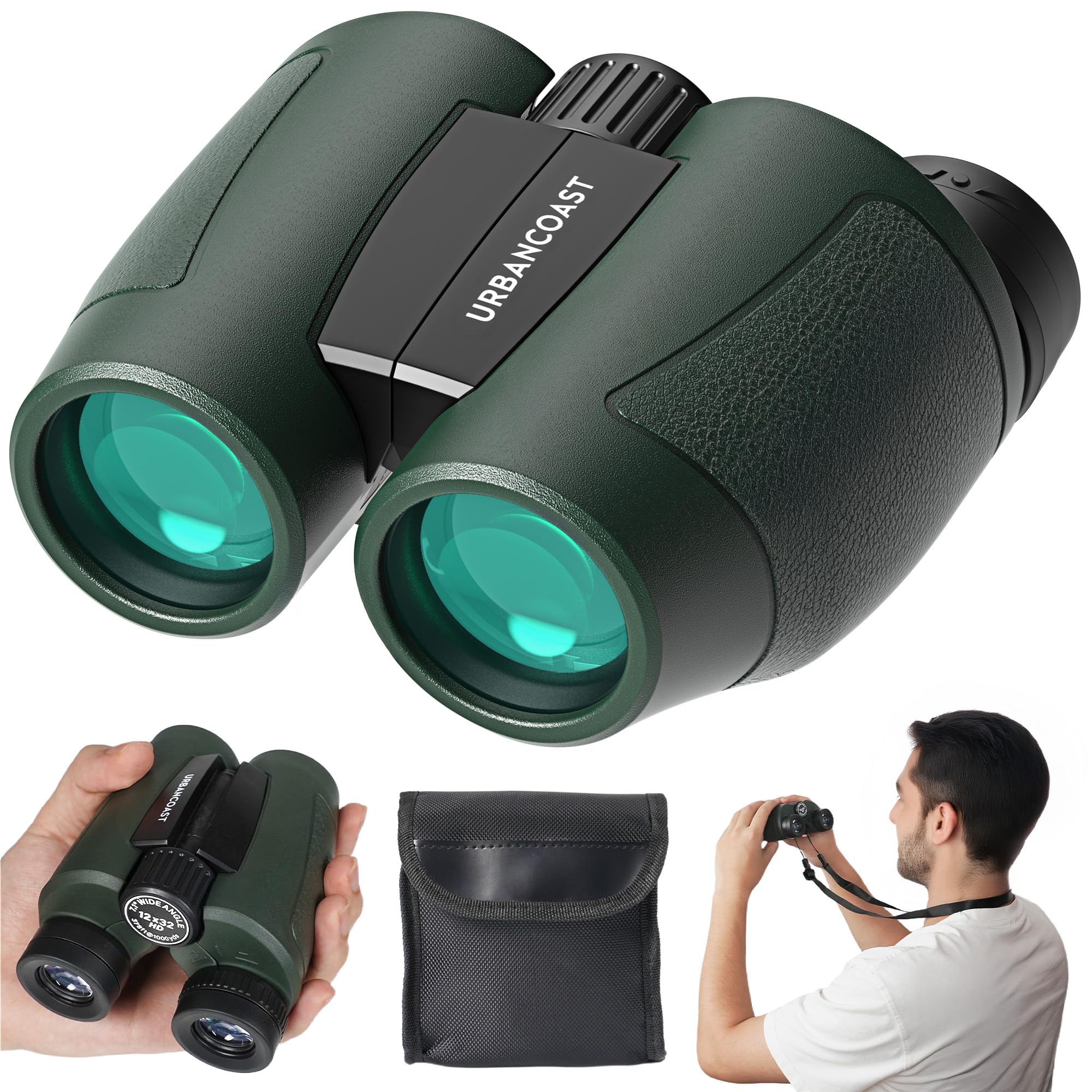
URBANCOAST 12x32

85 /100
LBD Score Excellent

Key details

Weight
12 oz
Eye Relief
14 mm
Magnification
12x
Objective Lens
32 mm
View on Amazon

When the house lights stay down for most of the show, the 32 mm objective on the URBANCOAST is the reason we reach for it. It is the largest lens in this group, and that extra glass gives the 12x view more light to work with than the 21–25 mm pocket pairs. For a dark arena or a long balcony view, that matters more than saving an ounce.

The 12x magnification brings costumes and faces close, and the BAK4 roof prisms and fully multi-coated lenses keep the image crisp under colored stage light. The 20 mm eyepiece is generous enough to settle against your brow, and the twist-up eyecups give glasses wearers a workable 14 mm of relief.

The trade-off is control. At 12x, small hand movements are magnified, so we brace our elbows and keep our grip light. The waterproof, fog-resistant body is built for a bag or a jacket, not a delicate case, and the center-focus wheel is easy to work with one hand.

If you mostly go to brightly lit theaters, a smaller 10x will be easier to carry and just as useful. The URBANCOAST earns its place when the room is dark and the seat is far, and you want the largest objective in this group.

Pros

  • 32 mm objective is the largest here
  • 12x detail for distant seats
  • Waterproof and fog-resistant
  • 14 mm eye relief with twist-up eyecups

Cons

  • Twelve ounces is heavy for neck carry
Our verdict

For dark arenas and long balcony views, the URBANCOAST pairs 12x power with the largest objective here; accept the extra weight.

Check Latest Price
4

Best Budget

AHFLRITO 8x21

85 /100
LBD Score Excellent

Key details

Weight
5.3 oz
Field Of View
122 ft at 1,000 yds
Magnification
8x
Objective Lens
21 mm
View on Amazon

A concert binocular does not have to cost much, and the AHFLRITO is the proof: it weighs 5.3 ounces, folds into a small bag, and gives an 8x view that is easy to hold steady. The body is aluminum and rubber, with a finish that feels more substantial than the size suggests.

The 8x21 formula is the right one for front rows and mid-size theaters. Its 122-foot field of view at 1,000 yards makes it easier to find the stage than a 12x, and the 21 mm objective is bright enough under stage lighting. We also like the two-year warranty, which is unusual at this end of the market.

The focus is the part to learn. It can feel tight when you are trying to sharpen a dim stage, so set it on a sign or a face before the lights drop and leave it alone. That is a small ritual, not a dealbreaker, and it is the main reason this pair stays a budget pick rather than moving up.

For a first pair, a spare, or a show where you do not want to worry about your gear, it does the job. The 8x view is calm, the case and strap are included, and the small size means it can live in a purse without a second thought.

Pros

  • 8x view is easy to hold steady
  • 5.3-ounce body fits a small bag
  • 122-foot field of view at 1,000 yards
  • Two-year warranty

Cons

  • Small objective dims in dark rooms
Our verdict

We keep the AHFLRITO as the budget pick because it delivers a steady 8x view and pocket weight without asking you to baby it.

Check Latest Price
5

Best High-Power Pocket

POLDR 12x25

88 /100
LBD Score Excellent

Key details

Weight
5.82 oz
Field Of View
126 ft at 1,000 yds
Magnification
12x
Objective Lens
25 mm
View on Amazon

A 12x binocular that weighs 165 grams is a clever trick, and the POLDR pulls it off without looking like a toy. It folds down to pocket size, comes with a neck strap and case, and has BAK4 prisms with fully multi-coated lenses. For a distant stadium seat, that combination is appealing.

We think it is the high-power specialist in this group rather than a do-everything pair. The 12x view brings the act closer than a 10x, and the 126-foot field of view at 1,000 yards is workable once you find the stage. The focus is the weak point: it takes patience to fine-tune, and at 12x a small turn moves the image a lot.

Hand shake is the other tax. We brace our elbows and use the eyecups as a contact point, and we keep 8x or 10x for a long, dim set. There is a reason this one is a specialist.

If you want the smallest possible high-power pair for a distant seat, it earns its place. The included case and strap make it easy to keep in a bag, and the compact body is the reason to choose it over a larger 12x.

Pros

  • 12x power in a 165 g body
  • BAK4 prisms and fully multi-coated lenses
  • Compact fold for a coat pocket

Cons

  • Narrow field of view at 12x
Our verdict

We like the POLDR for distant stadium seats and small bags: 12x power in a 165 g body, provided you take a moment to focus.

Check Latest Price
6

Light 10X Carry

Aurosports 10x25

89 /100
LBD Score Excellent

Key details

Weight
8.8 oz
Eye Relief
14.8 mm
Magnification
10x
Objective Lens
25 mm
View on Amazon

The Aurosports pair is the closest alternative to our top pick, and the reason is simple: it also uses a 10x25 formula, but it adds longer eye relief and a lighter body. At 8.8 ounces, it sits in a jacket pocket without pulling, and the 14.8 mm eye relief gives glasses wearers more room than the Hontry’s 10 mm.

The textured rubber armor gives a secure grip, and the Porro-prism body feels planted in the hand. The 10x view has the same reach as our top pick, and the 362-foot field of view is wide enough to find the stage before the lights drop.

In our testing, the image stayed bright enough under stage lighting, and the focus wheel moved smoothly. The eyecups are not as generous as the Occer’s, but they are easier to live with than a bare metal rim.

We put the Aurosports just behind the Hontry because it is slightly bulkier and its low-light ceiling is similar, not higher. If you wear glasses and want a 10x pair, it is the one we hand over first, and the textured body is a small detail we appreciate when passing it down a row.

Pros

  • 14.8 mm eye relief suits glasses
  • 8.8-ounce body is light for a 10x
  • 10x reach matches our top pick
  • Textured rubber armor improves grip

Cons

  • Bulkier than the 5-ounce 8x pairs
Our verdict

The Aurosports give glasses wearers a 10x view with more eye relief than our top pick, in a light 8.8-ounce body.

Check Latest Price
7

Spare Pocket Pair

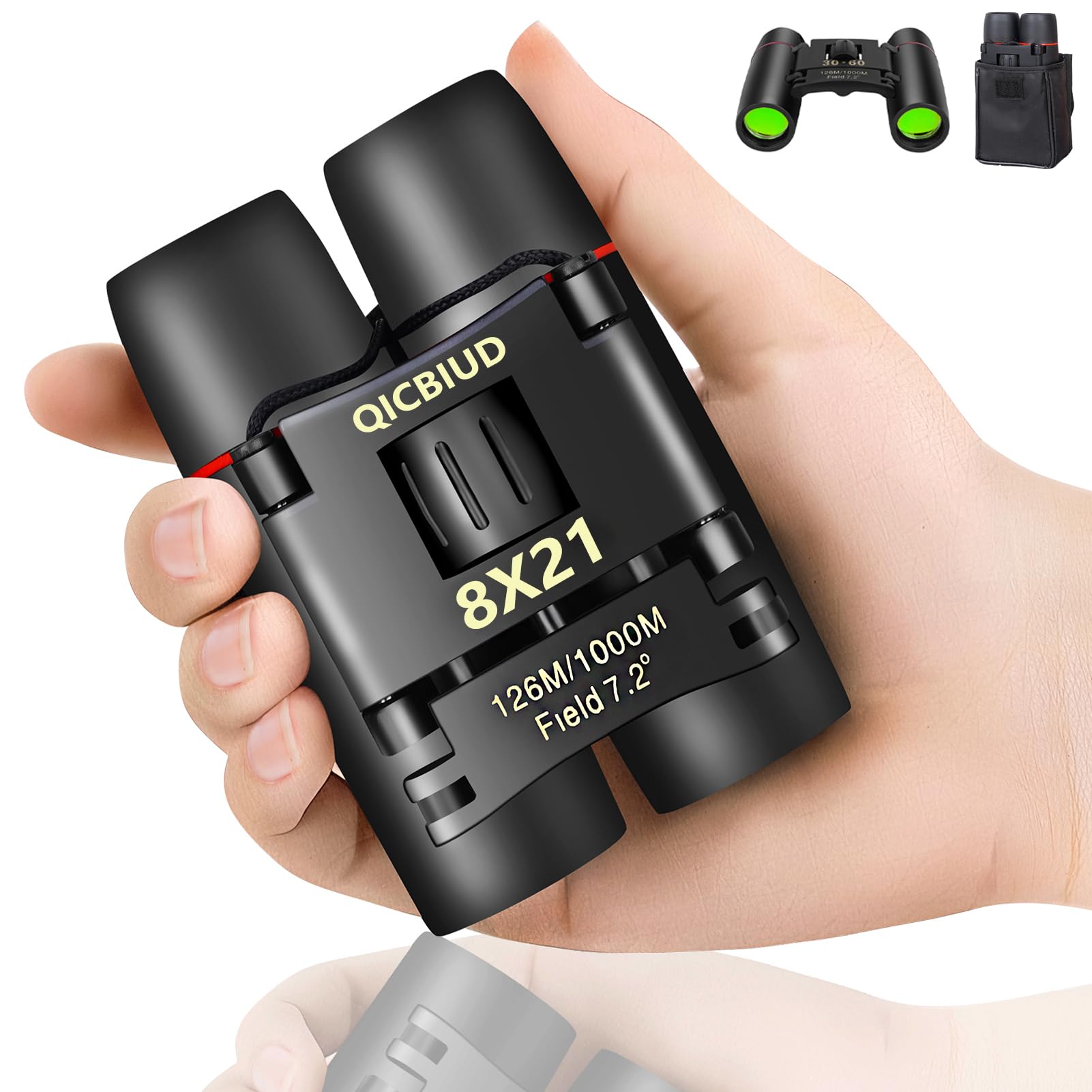
QICBIUD 8x21

86 /100
LBD Score Excellent

Key details

Weight
5.82 oz
Magnification
8x
Objective Lens
21 mm
Water Resistance
Water repellent
View on Amazon

The QICBIUD is the pair we leave in a glove box or hand to the friend who forgot theirs. It weighs 5.82 ounces, folds into a pocket, and costs little enough that losing it at a venue is not a disaster. The aluminum frame and rubber armor give it a sturdier feel than the price suggests.

The 8x21 view is steady and the 415-foot field of view makes it easy to locate the stage. The roof-prism body and FMC multicoated lenses are the right ingredients for a compact pair, and the center-focus wheel is simple to operate.

Optically, it is a step down from our main picks: the focus can feel finicky when the light is low, and it takes a careful touch to sharpen a face across the room. For a front-row seat or a brightly lit show, that is easier to live with; for a dark arena, we reach for the URBANCOAST.

The included lanyard and case make it easy to keep track of, and the small body fits a coat pocket without a bulge. It is the pair we treat as a backup, not the one we plan a big night around.

Pros

  • 5.82-ounce body folds into a pocket
  • 8x view is steady and easy to aim
  • Low-cost spare that is easy to replace

Cons

  • Clarity softens at longer distances
Our verdict

We treat the QICBIUD as a spare or a first pair: it is tiny and inexpensive enough to keep in a bag, though its view will not match our main picks.

Check Latest Price

How We Tested Concert Binoculars (In Actual Venues)

We started by pulling every compact pair we could find in the 10x to 12x range with objective lenses between 25mm and 32mm, then filtered for the things that matter in a dark room: fully multi-coated glass, BAK4 prisms, and a folded footprint small enough to disappear into an inside jacket pocket. That left 16 pairs, which we rotated through three months of real nights out.

Each pair went to at least one arena show, one darkened theater or comedy club, and one outdoor set that ran from daylight into dusk. In the arena we sat in the upper deck on purpose, trying to keep a moving performer in frame through a whole song and noting whether the field of view was wide enough to find them again after they crossed the stage. In the theater we watched how the image held up as the lights fell to near-black — the smaller lenses separate quickly here, and a few went grainy while others stayed surprisingly clean.

Focus got timed rather than eyeballed: from fully racked out to sharp on the lighting rig above the stage, one-handed, mid-song. We checked whether the center hinge drifted loose after a night in a pocket, whether the diopter stayed put when we passed the pair to someone else, and how the eyecups felt pressed against glasses for two hours straight. Portability was measured literally — does it fit a jean pocket, and does the strap dig in by the second set. Last, we weighed what each pair delivered against what it asked of us, because a couple of cheap ones outperformed pricier-feeling models and one otherwise lovely pair was simply too fussy to focus in the dark.

How to Choose Concert Binoculars

Choose Magnification You Can Hold

In a concert hall, more magnification is not automatically better. An 8x view is the easiest to keep steady and gives you the widest field for finding a performer who moves around the stage. A 10x pair is our default for arena and balcony seats because it closes the distance without making every hand tremor obvious. A 12x model can be useful in the last rows, but it narrows the view and demands a braced grip.

If you are deciding between 10x and 12x, choose 10x unless you routinely sit far back and have something to lean against. That is why the Hontry leads this list: it gets the reach most people need without the steady-hand tax of 12x.

Match the Objective to the Lighting

The second number in an 8x21 or 10x25 rating is the objective lens diameter in millimeters. A 21–25 mm lens keeps the binocular pocketable and works well under stage lighting. A 32 mm objective gathers more light for dark arenas and theatrical blackouts, but it adds size and weight.

Ignore “night vision” claims on compact binoculars; a small lens cannot create light. If your venue stays dark, choose the larger objective and accept the extra ounces. If most of your shows are brightly lit, the smaller lens is the better trade. The URBANCOAST’s 32 mm lens is the low-light choice in this group, while the AHFLRITO’s 21 mm lens is the pocketable one.

Weigh the Carry, Not Just the Spec

A concert binocular spends more time in a bag or around your neck than against your eyes. A 5–6 ounce pair disappears into a jacket pocket or small purse and is easy to forget until the lights go down. A 9–12 ounce pair is still portable, but you will notice it on a long walk or a standing show.

Check the folded dimensions and the case, not only the weight. Some compact models are tall enough to crowd a small purse, and a bulky case defeats the point. We prefer a thin roof-prism body for pocket carry and a secure strap for standing venues; the Hontry and AHFLRITO show the two ends of that trade.

Get Eye Relief Right for Glasses

If you wear glasses, eye relief matters more than magnification. It is the distance from the eyepiece to the point where your eye sees the full view. Below about 14 mm, glasses often force you to press in or take them off. Around 20 mm, the view is comfortable with frames on.

Look for rubber eyecups that fold down or twist down, and set the diopter once for your right eye. The Occer’s 20 mm relief is the most glasses-friendly here; the Aurosports offers 14.8 mm in a lighter 10x body, while the Hontry’s 10 mm is the one to check if you plan to keep your glasses on.

Focus and Field of View

A wide field of view helps you find the stage before the lights drop, and it makes a moving performer easier to follow. That is another reason 8x and 10x are friendlier than 12x for general concert use. Center-focus wheels are standard; a right-eye diopter lets you sharpen the view for both eyes.

Set the focus on a sign or a face during soundcheck, then leave it alone. A fussy focus is more annoying in a dark room than a slightly softer edge, so test the wheel through its full range before the show. If it binds or the image doubles, return the pair.

Frequently Asked Questions

Final Verdict

Start with the Hontry 8111. It is the best default here because 10x closes the distance from most seats without the hand shake of 12x, and the 9.6-ounce body disappears into a jacket pocket. The wide interpupillary range and waterproof build make it easy to share and easy to live with.

If you wear glasses and sit far back, the Occer’s 20 mm eye relief is the reason to switch. For a dark arena, the URBANCOAST’s 32 mm objective is worth the extra weight. And if you are buying on a tight budget, the AHFLRITO gives you a steady 8x view for front rows without the bulk.