Best Bookshelf Speakers of 2026

Bookshelf speakers come in two families, and which one you need decides your shopping list. Powered pairs have the amplifier built in: plug them in, pair your phone over Bluetooth, and you're listening. Passive pairs stay silent until you add a receiver or amp. Either way the payoff is the same — real stereo separation and a warmth a soundbar under the TV can't fake.

I've lived with a dozen pairs for six months, shuffling them between my living room, my desk, and the TV stand, and one thing keeps surprising me: placement does as much work as the speaker itself. A rear-ported cabinet shoved against the wall sounds boomy and cheap; give it a few inches of air and the same pair opens up.

Looks matter more here than with most electronics, since these sit out in the open, and a decent wood veneer earns its keep. A remote or an app-based equalizer is the other quiet luxury — the difference between leaning over to nudge the volume and doing it from the couch. Both kinds of shopper are covered below.

1

Best Overall

Edifier R1280DBs

93 /100
LBD Score Outstanding

Key details

Design
Powered 2-way
Inputs
Bluetooth 5.0, optical, coaxial, RCA
Amplifier Power
42W RMS
Subwoofer Output
Yes
View on Amazon

Buying a receiver is the part of a bookshelf-speaker system most people do not want to think about, and the Edifier R1280DBs is the pair we reach for when that is the case. It is powered, so the amplifier is built into one cabinet, and it covers the inputs most homes actually use: optical and coaxial for a TV or computer, Bluetooth 5.0 for a phone, and RCA for a turntable with its own phono stage. At 42W RMS with a 4-inch woofer, it will not pressurize a big room, but for a desk, bedroom, or modest living room it is the easiest recommendation in this group.

The side-panel knobs for volume, bass, and treble are more useful than they sound: they make small adjustments quick and physical. Setup is genuinely quick, with one active cabinet, one passive, a supplied speaker cable, and a power cord. The subwoofer output is the detail that makes it a long-term buy; if the 4-inch driver runs out of low-end for movies, you can add a sub without replacing the pair.

If you already own a good receiver, the Polk Monitor XT15 gives you more speaker for the money. But for most people starting from a phone, a TV, and no rack of components, the Edifier is the one we plug in and forget about. It is the pair that makes the least fuss between you and the music.

Pros

  • Built-in amplifier removes the receiver
  • Optical, coaxial, Bluetooth, and RCA inputs
  • Subwoofer output supports an easy upgrade
  • Compact 4-inch cabinet fits a desk

Cons

  • Remote can be finicky
Our verdict

We recommend the R1280DBs to anyone who wants better TV and music sound without buying a receiver; its optical, Bluetooth, and sub out cover the basics.

Check Latest Price
2

Best Passive for Receiver Owners

Polk Monitor XT15

94 /100
LBD Score Outstanding

Key details

Design
Passive 2-way
Woofer
5.25-inch
Mounting
Wall-mountable
Impedance
4/8 ohms
View on Amazon

The Polk Monitor XT15 is a passive pair, which means the box contains two speakers and no amplifier. That is not a drawback if you already have a receiver or a small integrated amp; it is the reason the pair can put more of its cost into drivers and cabinet. The 5.25-inch woofer and 1-inch Terylene tweeter are arranged in a compact, wall-mountable cabinet, and Polk rates the speaker at 4 and 8 ohms, so it will work with a wide range of receivers.

What we noticed first was how much bass the XT15 produces for its size. In a small room, with a receiver doing the work, it has enough low-end weight to make music feel grounded without a sub, and it stays composed when the volume comes up. The trade-off is treble that can lean forward on bright recordings. For a receiver-based music and movie system, this is the passive pair we recommend first.

The cabinet is about 10.6 inches tall and 6.5 inches deep, so it fits a bookshelf but still needs a little breathing room. The wall-mount option is the detail that makes it easy to use as a surround pair later, when the speakers often end up above ear height.

Pros

  • Strong bass from a 5.25-inch woofer
  • 4/8-ohm flexibility suits many receivers
  • Compact wall-mountable cabinet
  • Clear sound for movies and music

Cons

  • Treble can sound forward
Our verdict

For a receiver-based system, we think the Polk Monitor XT15 is the passive pair to beat here, thanks to its 5.25-inch woofer and flexible 4/8-ohm load.

Check Latest Price
3

Best Premium

Klipsch RP-600M II

93 /100
LBD Score Outstanding

Key details

Horn
90° x 90° Tractrix
Design
Passive 2-way
Woofer
6.5-inch
Impedance
8 ohms
View on Amazon

The RP-600M II is the biggest pair here, and the 15.75-inch height and 18-pound cabinet are the first thing you notice when you lift one out of the box. That size is not accidental: the 6.5-inch cerametallic woofer and the 90-degree by 90-degree Tractrix horn need room to do their work, and the result is a speaker that moves a lot of air for a bookshelf model.

The horn is the defining part of the sound. Vocals and movie dialogue come through with a lot of presence, and the speaker can swing from quiet to loud without sounding strained. It is not the most laid-back speaker in this group; if you want a warm, forgiving presentation, the Polk XT15 is the easier listen.

We think the RP-600M II earns its premium place for a larger room or a dedicated movie setup. The 8-ohm load and 400W power handling give it headroom with a capable receiver, and the bass has enough weight that a subwoofer feels optional for music. It also has a 5-year warranty and a solid cabinet, which matters when you are spending this much.

The catch is placement. At 13 inches deep and nearly 16 inches tall, it needs a sturdy stand or a deep shelf, and the horn is directional enough that you want to aim it toward the seat. If your room is small or your shelf is shallow, the Klipsch R-41M is the more sensible compact alternative.

Pros

  • Horn-loaded 6.5-inch driver for dynamics
  • 8-ohm load and 400W handling
  • Solid cabinet with 5-year warranty
  • Strong bass for music without a sub

Cons

  • Large, heavy cabinet needs sturdy placement
Our verdict

We keep the RP-600M II for the buyer with a larger room and a capable receiver who wants horn-loaded dynamics and does not mind a big cabinet.

Check Latest Price
4

Best Step-Up Powered

Edifier R1700BTs

92 /100
LBD Score Outstanding

Key details

Design
Powered 2-way
Wireless
Bluetooth 5.0 with aptX HD
Amplifier Power
66W RMS
Subwoofer Output
Yes
View on Amazon

The R1700BTs is the more powerful Edifier in this guide: 66W RMS against the 42W of the R1280DBs, with the same 4-inch woofer but a larger cabinet and a 19mm silk-dome tweeter. The extra power is not just a number on the box; it gives the pair more headroom for a living room or a desk where you like to listen at a healthy volume.

Inputs are generous: Bluetooth 5.0 with aptX HD, dual RCA, and a subwoofer output with auto crossover. The wood finish looks more expensive than the price tier suggests, and the side-panel knobs keep volume and tone within reach. The RCA and Bluetooth inputs cover the everyday sources without asking you to add a receiver.

The 4-inch driver still has limits. Bass is fuller than the smaller Edifier, but it is not a substitute for a subwoofer, and the sub out is the upgrade path. The cabinet is larger than the R1280DBs, so measure the shelf before you commit.

We think the R1700BTs is the better choice than the R1280DBs when your room is larger or you listen louder; the extra power and aptX HD are worth the step up. If you mainly need a TV speaker, the ULTIMEA's HDMI ARC is more convenient, but for music from a phone or a turntable, this Edifier is the more satisfying powered pair.

Pros

  • 66W RMS gives more headroom
  • Bluetooth 5.0 with aptX HD
  • Subwoofer output with auto crossover
  • Attractive wood finish

Cons

  • Remote can be finicky
Our verdict

When the R1280DBs feels short on power, we step up to the R1700BTs: 66W RMS, aptX HD, and a sub out make it the stronger larger-room powered pair.

Check Latest Price
5

Best Compact Passive

Klipsch R-41M

95 /100
LBD Score Outstanding

Key details

Design
Passive 2-way
Woofer
4-inch
Impedance
8 ohms
Sensitivity
90 dB
View on Amazon

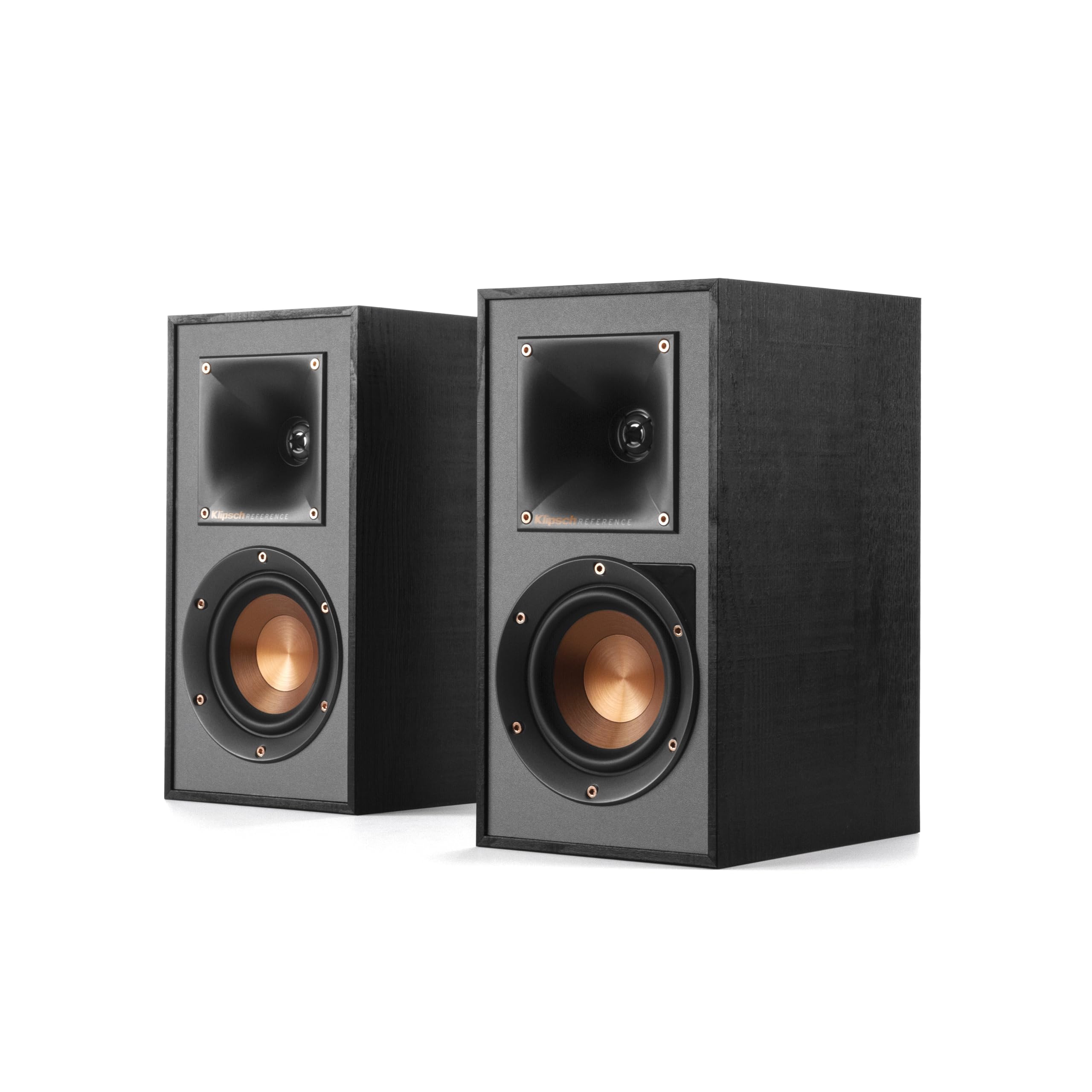
The R-41M is the pair to choose when the shelf is shallow and the room is small. Its 4-inch woofer and 5.75-inch-wide cabinet take up hardly any space, and the 90 dB sensitivity means a modest receiver can drive it to satisfying volume. We think that combination makes it the best compact passive speaker in this group, especially for a desk, a bedroom, or surround channels where a bigger cabinet will not fit.

The Klipsch horn is doing a lot of the character here. Dialogue and acoustic music come through crisply, and the copper woofer gives the pair a look that stands out with the grilles off. The trade-off is that the 4-inch driver will not deliver the low-end weight of the Polk XT15, so a subwoofer is the natural next step for movies. The small cabinet also means it can disappear on a shelf, which is exactly what a surround setup wants. It is not a speaker for a big, bass-heavy room; it is the one for a tight setup that still wants detail and a little bite.

Pros

  • Compact cabinet fits shallow shelves
  • 90 dB sensitivity suits modest amplifiers
  • Crisp, detailed Klipsch horn sound
  • Copper woofer stands out visually

Cons

  • 4-inch woofer limits deep bass
Our verdict

We point small-room listeners to the R-41M: its compact cabinet and 90 dB sensitivity make it easy to fit and easy to drive.

Check Latest Price
6

First Passive System

Dayton Audio Classic B65

83 /100
LBD Score Excellent

Key details

Design
Passive 2-way
Woofer
6.5-inch
Impedance
6 ohms
Power Handling
60W RMS
View on Amazon

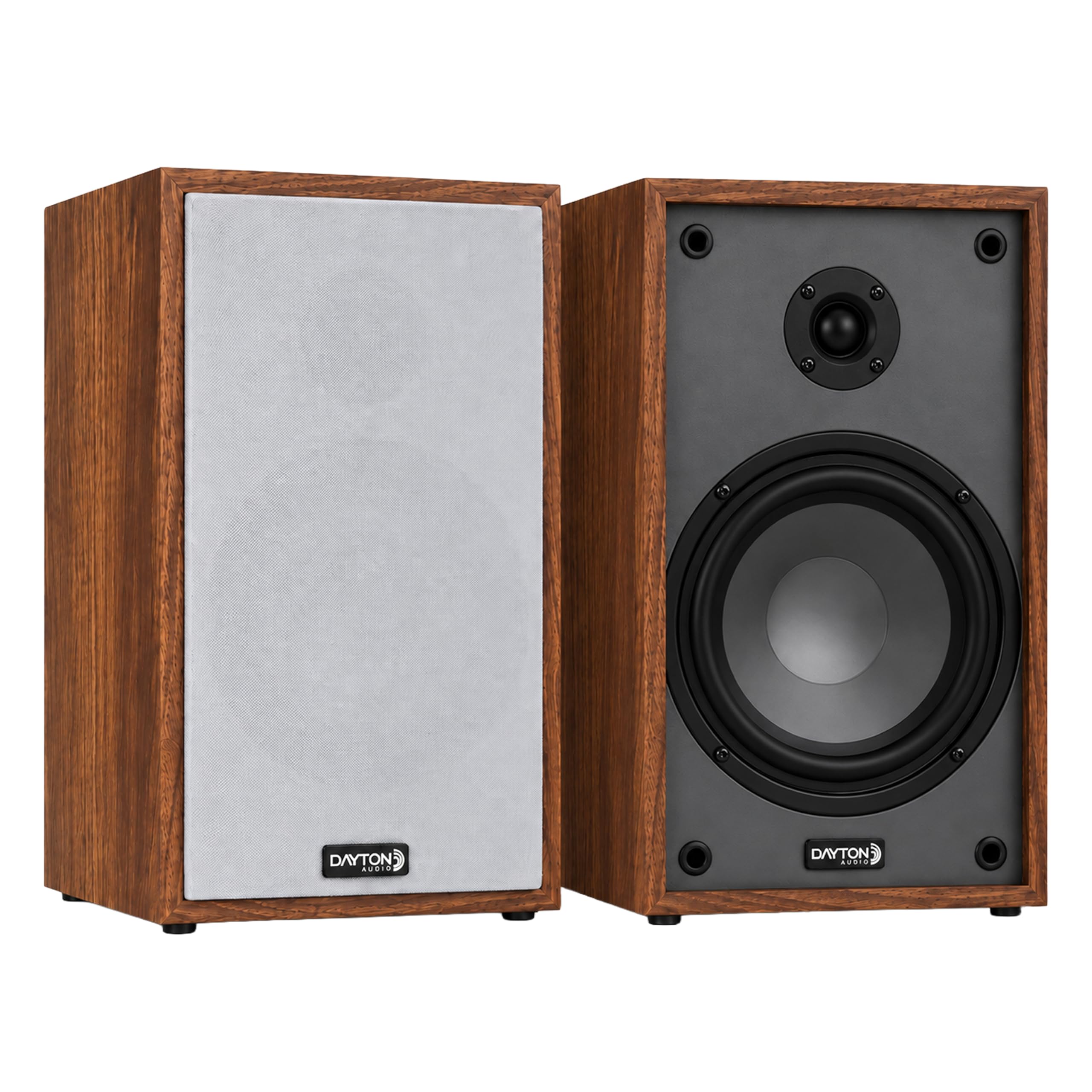
The Classic B65 puts a 6.5-inch woofer in a cabinet that costs less than most of the powered pairs here. That is the whole pitch: a bigger driver and a wood-veneer box for a budget price, with a 1-inch soft-dome tweeter and a 6-ohm load. It is passive, so you need an amplifier or receiver, but the parts you are paying for are the parts that make sound.

We were surprised by how much low-end this pair gives you for the money. The 6.5-inch woofer has enough weight to make acoustic bass and kick drums feel solid, and the soft-dome tweeter keeps the top end from turning harsh. It is not the last word in detail, and the 6-ohm impedance means you should check that your receiver is comfortable with it, but for a first passive system or a garage setup, it earns its place.

The wood veneer is a nice change from black boxes, and the keyhole mounts make wall placement possible. The cabinet is 13 inches tall, so it still needs a real shelf or a stand rather than a narrow ledge. If you already have a receiver and want the most bass for the least money, this is the one we point to; if you want a more compact passive pair, the Klipsch R-41M is the better fit.

Pros

  • 6.5-inch woofer gives strong low-end
  • Soft-dome tweeter keeps treble composed
  • Wood veneer cabinet looks better than budget norm
  • Wall-mountable keyhole design

Cons

  • 6-ohm load needs a compatible receiver
Our verdict

We like the Classic B65 as a first passive pair because its 6.5-inch woofer delivers useful bass at the budget end of this group.

Check Latest Price
7

Detailed Music

Sony SS-CS5M2

90 /100
LBD Score Outstanding

Key details

Design
Passive 3-way
Woofer
5.12-inch
Tweeter
0.98-inch
Impedance
6 ohms
View on Amazon

The SS-CS5M2 is a three-way design, which is unusual at this size: a 5.12-inch woofer, a dedicated midrange, and a high-precision tweeter with a wide-dispersion super tweeter above it. The extra driver is the reason to look at this Sony instead of a simpler two-way. It gives voices and strings their own space, and the speaker can reveal detail in a recording without sounding like it is highlighting one narrow band.

The cabinet is compact at 13.2 inches tall and 8.7 inches deep, but it is still a passive speaker that wants a receiver. The 6-ohm impedance is worth checking against your amp's rating. With a decent receiver, the Sony produces a wide, stable image and enough bass to stand on its own for music; it is not a movie-thumper without a sub, but it is more about nuance than volume.

We think the Sony is the pick for a listener who cares about detail and has a small room. The three-way arrangement makes instruments easier to follow, and the super tweeter gives the top end a sense of air that the simpler two-ways here do not match. It is not the easiest speaker to place, so give it some space and aim it toward the seat, but the payoff is a more layered soundstage.

If you want more bass for the same kind of money, the Polk XT15 is the better choice; if you want a powered all-in-one, the Edifier R1280DBs is simpler. The Sony is for the buyer who already has amplification and wants the most detail from a compact pair, but it rewards a careful setup more than any other passive pair here.

Pros

  • Three-way design with dedicated midrange
  • Wide-dispersion super tweeter
  • Compact 5.12-inch cabinet
  • Detailed, layered sound

Cons

  • 6-ohm load needs a compatible amplifier
Our verdict

We choose the SS-CS5M2 for detail-first listeners with a receiver and a small room; the three-way design separates instruments in a way the two-ways here do not.

Check Latest Price
8

TV-First Setups

ULTIMEA BS-3

86 /100
LBD Score Excellent

Key details

Design
Powered 3-way
TV Input
HDMI ARC
Amplifier Power
70W RMS
Subwoofer Output
Yes
View on Amazon

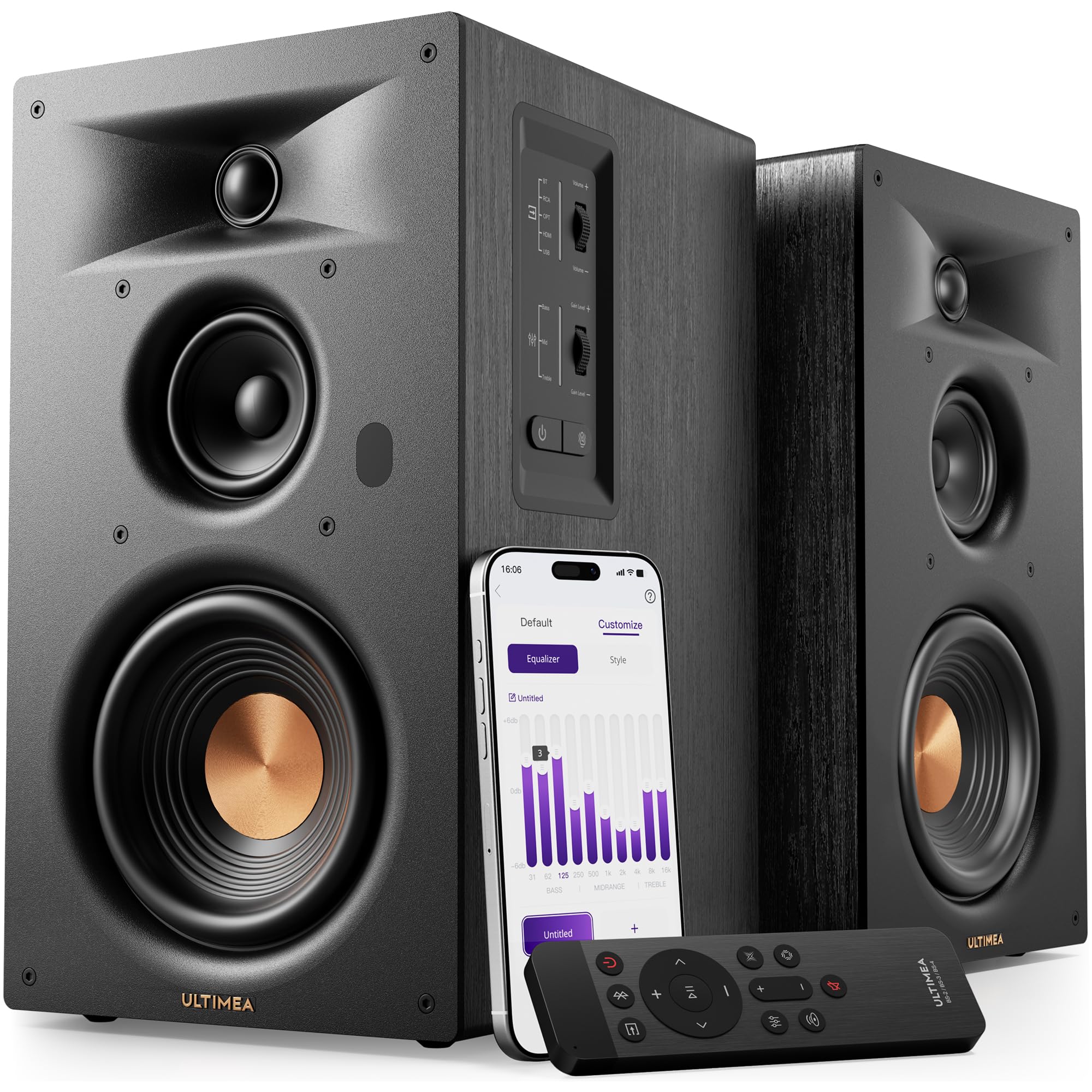
The BS-3 has the connection most powered bookshelf speakers here lack: HDMI ARC. That single port is why it belongs in a TV-first setup. Plug it into a compatible TV and the speaker takes the TV's audio over one cable, with the TV remote handling volume in the usual way. It also has optical, USB, RCA, and Bluetooth 6.0, so a phone or turntable can join in, and the 70W RMS amplifier drives a 5.25-inch woofer with a dedicated midrange and tweeter.

The three-way design gives the BS-3 a more separated sound than the smaller powered pairs. Dialogue is easy to follow, and the 5.25-inch woofer has enough output to fill a living room without a sub for most TV shows. The sub output is there when you want more punch for movies. The app EQ is useful if you want to tune the response, though it is not required for everyday listening.

The cabinet is 13.15 inches tall and 9.17 inches deep, so it needs a real shelf or stand, and the 19-pound weight means you want a solid surface. The no-grille look is sharp if you like seeing the drivers, though it leaves them exposed.

We think the BS-3 is the best choice here for a TV-first system where you do not want a receiver. Its HDMI ARC, three-way driver array, and sub out make it more flexible than a soundbar for music, and the 70W amplifier has enough headroom for a medium room. If your priority is stereo music rather than TV, the Edifier R1700BTs is the more polished powered pair.

Pros

  • HDMI ARC simplifies TV connection
  • Three-way powered design with 5.25-inch woofer
  • 70W RMS and subwoofer output
  • Bluetooth 6.0 and multiple wired inputs

Cons

  • App EQ requires an account
  • Large, heavy cabinet for a bookshelf
Our verdict

For a TV-first system, the BS-3 is our pick: HDMI ARC and a 3-way powered design make it a receiver-free upgrade.

Check Latest Price

How We Tested a Dozen Pairs of Bookshelf Speakers

We started by gathering every pair a real person might buy as their first or only set of speakers, then filtered by power type, inputs, driver size, and what comes in the box until we had a shortlist of 12. Those 12 pairs spent six months moving through my living room, my home office, and a TV stand in the den — no showroom, no switching rig, just the spots where speakers actually end up.

Each pair got at least two weeks in the living room, first on stands about eight feet apart and then again pushed back against the wall, because the distance to that wall changes the bass more than any spec sheet does. We played the same handful of albums, a couple of movie scenes, and a podcast recorded in a small room, then moved the pair to the desk for nearfield listening at arm's length.

We turned the volume up until the sound hardened or the cabinet started to buzz and noted where that point landed. A slow frequency sweep showed us where the low end fell away, which told us more about real-world bass than the rated range. We paired a phone over Bluetooth from two rooms away and walked around with it in a pocket to see whether the signal held, and on pairs with a remote or an app equalizer we made the adjustments ourselves and judged whether the changes were worth the trouble.

Since value and build were on our minds constantly, we tallied what arrived in each box — cables, remotes, grilles — and lived with the finishes long enough to see how they collected dust and fingerprints. The pairs that held up are the ones below.

How to Choose Bookshelf Speakers

Powered or Passive: Start With What You Already Own

Powered pairs, like the Edifier R1280DBs, hide the amplifier in one cabinet and accept a phone, TV, or turntable directly. They are the simpler buy for a desk or living room with no hi-fi rack. Passive pairs, like the Polk Monitor XT15, need a receiver or integrated amp, but they let you choose the electronics and often put more money into the cabinet and drivers. If you already own a receiver you like, stay passive; if you do not, price the receiver into the decision before you fall for a passive pair.

Inputs Matter More Than the Spec Sheet

Bluetooth is convenient for a phone, but it is not the best way to connect a TV if you care about keeping audio and picture together. Look for optical or HDMI ARC on a powered pair; HDMI ARC can let the TV remote control volume and switch the speaker on with the TV, while optical is a dependable fallback. For a turntable, check for an RCA input and a phono preamp, either in the turntable or in the speaker. A subwoofer output is the other input worth paying for: it lets a compact pair grow into a fuller system later.

Match the Cabinet to the Shelf, and the Woofer to the Room

Measure the shelf before you fall for a driver size. A 4-inch pair like the Klipsch R-41M can sit on a shallow ledge, while a 6.5-inch model like the Klipsch RP-600M II needs a deep, sturdy stand. Bigger woofers generally move more air and produce more bass, but they also need more space around them and a listener farther back. In a small room, a compact 4- or 5.25-inch pair plus a subwoofer often makes more sense than a large pair crammed onto a shelf.

Amplifier Matching: Impedance, Power, and Headroom

An 8-ohm speaker is the safe default for most receivers; 6-ohm models like the Dayton B65 and Sony SS-CS5M2 need a receiver rated for that load, and 4-ohm models ask for more current. The Polk XT15's 4/8-ohm rating gives you flexibility. Power handling is not a target; it is a ceiling. A high-sensitivity speaker such as the Klipsch R-41M can play loudly on modest power, while a low-sensitivity pair needs more clean watts. Match the amplifier to the room, not to the biggest number on the box.

Controls, Remotes, and the Subwoofer Question

Powered pairs put volume, input, and tone controls on one cabinet, which is convenient until the remote goes missing. Check whether the controls are reachable on the speaker itself; side-panel knobs are easier to live with than a menu. The subwoofer question is really a room question: a 4-inch woofer can sound full at a desk, but it will not pressurize a living room for movies. A subwoofer output on a powered pair, or a receiver's bass management on a passive one, gives you a clean upgrade path.

Frequently Asked Questions

Final Verdict

For most people, the Edifier R1280DBs is the pair to buy: it has the amplifier, the TV-friendly optical input, Bluetooth, and a subwoofer output, so it works before you own a receiver. If you already have a receiver, the Polk Monitor XT15 is the better passive choice, with more bass than its size suggests. Step up to the Klipsch RP-600M II only if you have a larger room and want a more dynamic, horn-loaded sound.