Best DJ Speakers of 2026

A speaker for a gig has one job, and it isn't sounding good in a quiet room — it's staying loud, clean, and connected in hour four, when the floor is full and sticky. I've watched a borrowed setup cut out mid-toast, and a battery meter vanish halfway through a set. What you're paying for is headroom, a signal that holds, and a box you can carry alone. Over the past six months, my team and I ran 12 powered speakers through backyard parties, a basement rehearsal room, and a rented hall for a friend's reception.

Two things surprise first-time buyers: wattage is a marketing number, not a volume guarantee, and wireless stereo pairing — two speakers, no cable stretched across the dance floor — changes a room more than any spec sheet suggests.

Below are the ones we'd plug in again, sorted by the job you need done: the small-room workhorse, the one that rides in the trunk, and the one that fills a hall.

1

Best Overall

ALTO TS415

88 /100
LBD Score Excellent

Key details

Power
2,500W peak
Inputs
2 XLR/1/4-inch combo, Bluetooth
Weight
45.9 lb
Woofer
15 inches
View on Amazon

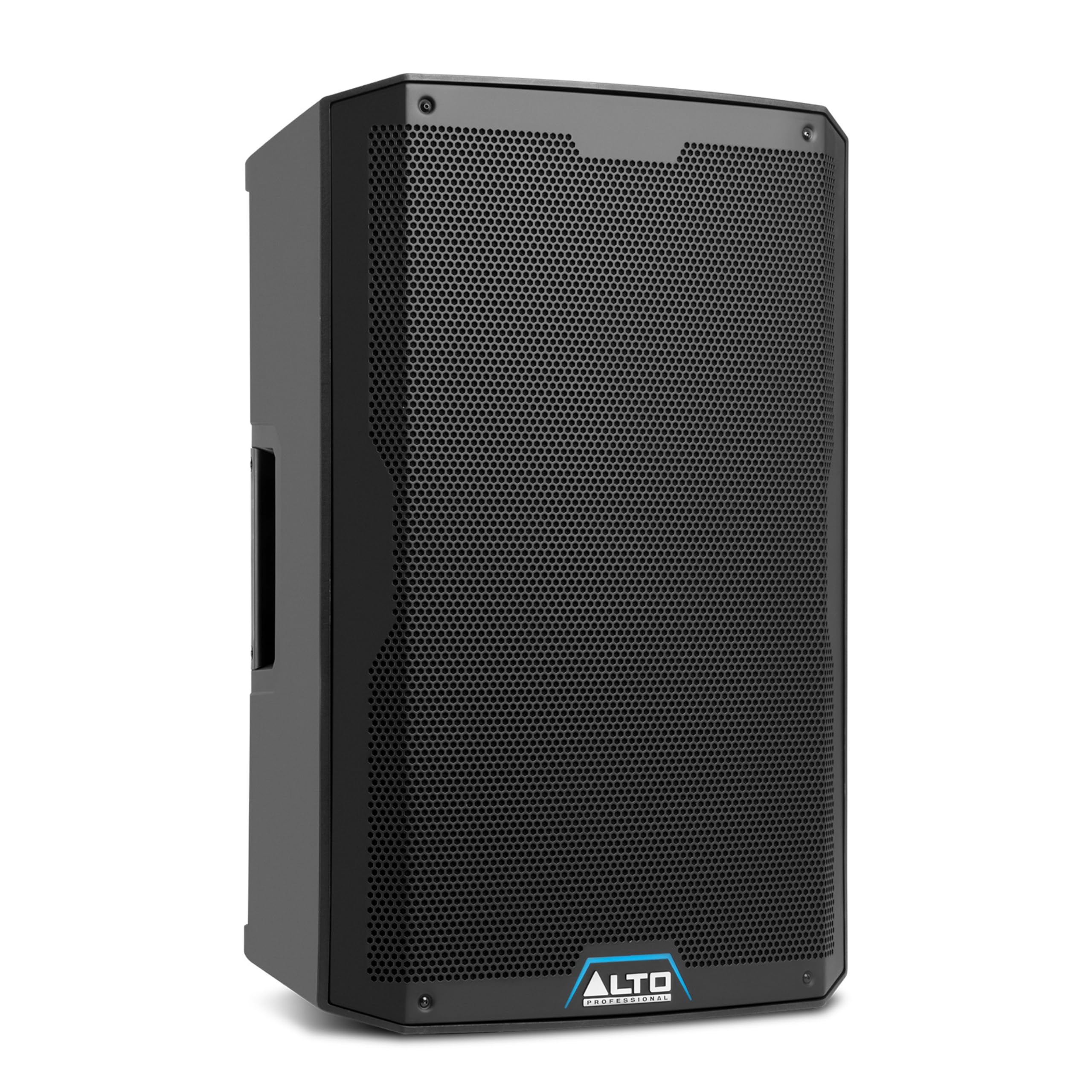
The 15-inch driver and 2,500-watt peak rating are what get your attention, but the feature that makes the TS415 feel DJ-ready is the three-channel mixer. You can leave a mic on one channel, run a controller or laptop into a combo input, and still stream a request over Bluetooth without repatching. We also like that the ALTO app puts EQ and speaker modes on your phone; trimming boom from a corner is a thumb tap, not a reach behind the cabinet.

That mix of inputs and control is why it is our top pick for mobile DJs. The 15-inch woofer gives it the low-end weight a party needs, and the peak rating leaves headroom for a medium room, though we read wattage as a ceiling rather than a promise. Wireless stereo linking is the other useful bit: two TS415s can run as a stereo pair without a cable between them. Against the JBL, it gives up some pro-brand polish, but it answers with more rated power and app control.

The cabinet is 20.8 kg, so it is a two-hand lift onto a stand, and a cart makes load-in easier. We also like the wedge and flown options: it can work as a floor monitor or hang in a small install. What settled it for us is how little extra gear it needs. One speaker can cover a mic, a music source, and a Bluetooth request, which is the difference between a speaker and a small PA.

Pros

  • High output from a 15-inch woofer
  • Three-channel mixer handles mic and music
  • App EQ and wireless stereo linking
  • Wedge, stand, and flown placement

Cons

  • No battery power
Our verdict

We make the TS415 our top pick because it combines 15-inch output, a useful three-channel mixer, and wireless linking in one cabinet.

Check Latest Price
2

Best for Pro Gigs

JBL EON715

89 /100
LBD Score Excellent

Key details

Power
1,300W
Weight
46.5 lb
Woofer
15 inches
Connectivity
Bluetooth 5.0
View on Amazon

The EON715 is the premium pick here, and the first thing we noticed is how much speaker JBL packs into a box that still has two sensible carry handles. The 15-inch woofer and 1,300-watt rating give it plenty of output, while the three-channel digital mixer and backlit LCD make it feel like a small console bolted to the back. We recommend it when you want a known pro-audio cabinet and a simple, rugged layout rather than the lowest price.

JBL's waveguide is the part that matters in a room. It spreads sound wide enough that we did not have to aim the cabinet like a spotlight, and the bass has real weight for a single 15-inch box. Bluetooth 5.0 streaming and the JBL Pro Connect app add convenience for walk-in music, though we still prefer a wired controller input for the main set. The 46.5-pound weight is the tax you pay for that cabinet; it is a two-hand lift and needs a stand rated for the load.

The JBL is the more conservative buy: a straightforward pro cabinet with a strong build story. It costs more than the ALTO, and you can spend less and still get loud. But if your gigs are regular and you want a cabinet that feels sorted from the first setup, the EON715 earns the upgrade. The backlit LCD is more useful than it sounds when you are making a quick change in a dark room.

Pros

  • Wide waveguide coverage
  • Three-channel digital mixer
  • Bluetooth 5.0 and app control
  • Solid pro-style cabinet

Cons

  • No battery power
Our verdict

For regular gigs where a sturdy pro-grade cabinet and wide coverage matter more than battery power, the EON715 is the one we trust.

Check Latest Price
3

Best Portable Battery Pick

Bose S1 Pro+

91 /100
LBD Score Outstanding

Key details

Power
150W
Weight
14.4 lb
Battery
Up to 11 hours
Channels
3-channel mixer
View on Amazon

The S1 Pro+ leads with its battery and 14.4-pound carry weight, and that is exactly why we reach for it when the gig is a ceremony, a patio set, or a small room where running a power cable is the annoying part. It is light enough to carry in one hand, and the rechargeable battery is rated for up to 11 hours. The four positions, including upright, tilted back, horizontal, or on a stand, are not a gimmick; the tilt-back angle aims sound at a seated crowd without a stand.

The integrated three-channel mixer is the practical bit for DJs who also make announcements. You get two channels for mics or instruments and one for music, and the back panel stays simple enough to set up without a manual. Bluetooth is here too, though we treat it as a convenience for setup music rather than the main feed. The 150-watt output is enough for a small party, but it is not a club system; a 15-inch cabinet will move more air and play louder outdoors.

What makes the Bose worth its premium is the speed of setup. We can carry it, tilt it back, pair a phone, and be playing in less time than it takes to run a cable to a bigger speaker. The catch is scale: for a packed room or a bass-heavy DJ set, you will want the ALTO or JBL. For a portable side rig or a ceremony, the Bose is the one that gets packed first. The built-in handle is the reason the 14.4 pounds feels manageable on a short walk.

Pros

  • Up to 11 hours of battery
  • 14.4-pound carry weight
  • Four placement positions
  • Three-channel mixer

Cons

  • Wireless transmitters sold separately
Our verdict

We keep the S1 Pro+ for ceremonies and patio sets: battery power, low weight, and fast setup make it the portable specialist here.

Check Latest Price
4

Best Budget Pair

PRORECK Dance 12

90 /100
LBD Score Outstanding

Key details

Power
150W RMS, 1,000W peak
Woofer
12 inches
Connectivity
Bluetooth, USB
Package Weight
60 lb
View on Amazon

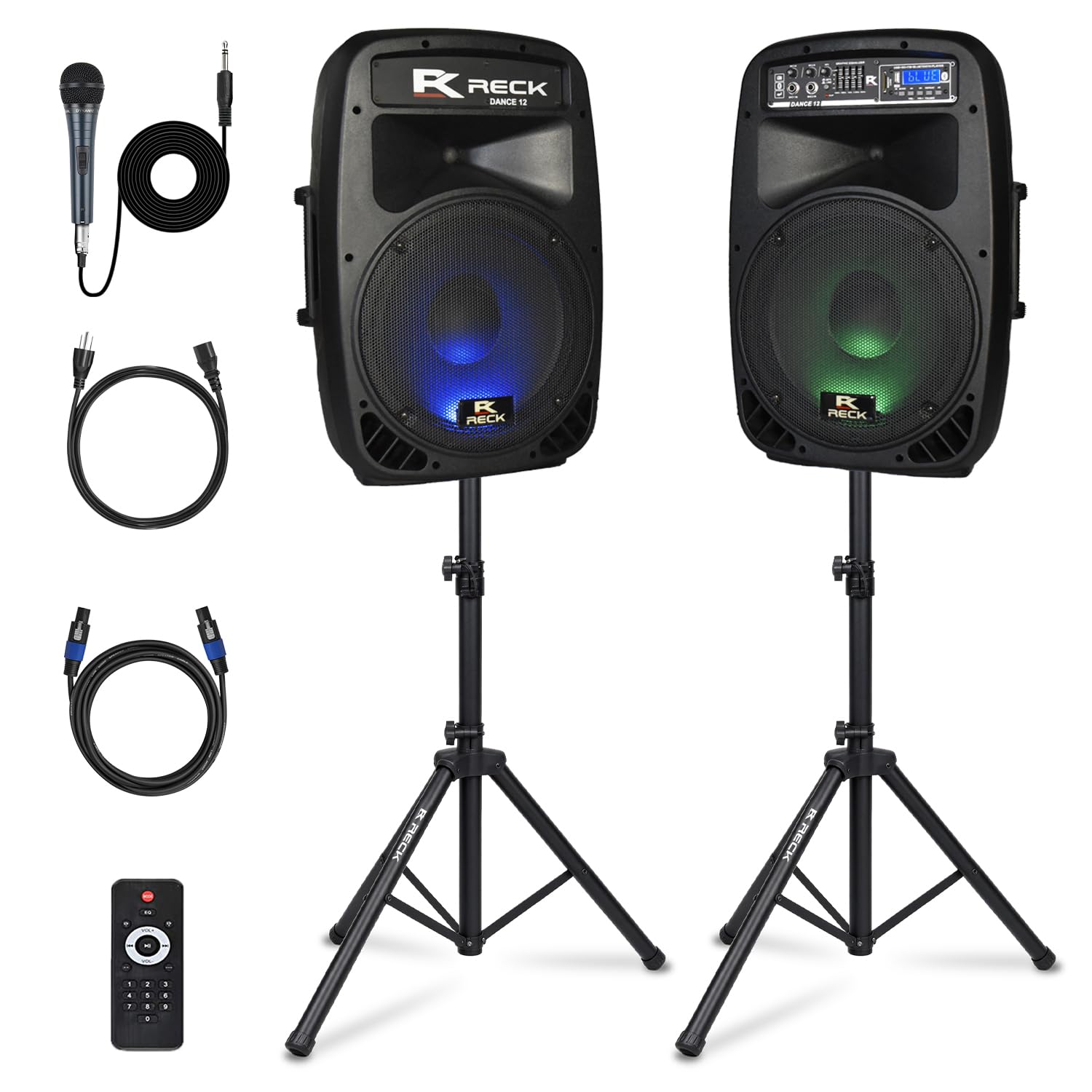
The Dance 12 is sold as a package: an active 12-inch speaker, a passive partner, two stands, a wired mic, a speakon cable, and a remote. That completeness is the appeal for a first party rig; you can unpack it, put the speakers on stands, and run music from a phone without buying a mixer. The 30-foot speakon cable is the unsung part; it lets you place the passive cabinet across a room instead of stacking both boxes together.

For small parties and meetings, this is a lot of system for the money. The 12-inch woofer and 1,000-watt peak rating give it enough volume for a backyard or a rented hall, and Bluetooth pairing is quick. The 150-watt RMS figure is the more honest guide to its clean output, so treat it as a small-to-medium-room pair rather than a club rig. It filled the rooms we used it in, but we kept it within its comfort zone.

The controls are basic but usable: mic and line inputs, a master volume, and separate bass and treble. The remote is handy for volume from across the room. The 60-pound package is a two-trip load-in, and the stands are starter parts rather than pro hardware. Still, for a wedding, a family party, or a small meeting where one person is running the music, the included stands and cable remove a lot of friction. We like it most as a complete starter system rather than a speaker you will build around later.

Pros

  • Complete pair with stands and mic
  • 12-inch woofer and 1,000W peak
  • 30-foot speakon cable
  • Bluetooth, USB, SD, and remote

Cons

  • No XLR inputs
Our verdict

A complete first party system for small events, the Dance 12 is the pair we suggest when the budget has to cover speakers and stands.

Check Latest Price
5

Compact Setups

ALTO TX408

91 /100
LBD Score Outstanding

Key details

Mixer
2-channel
Power
350W
Weight
13 lb
Woofer
8 inches
View on Amazon

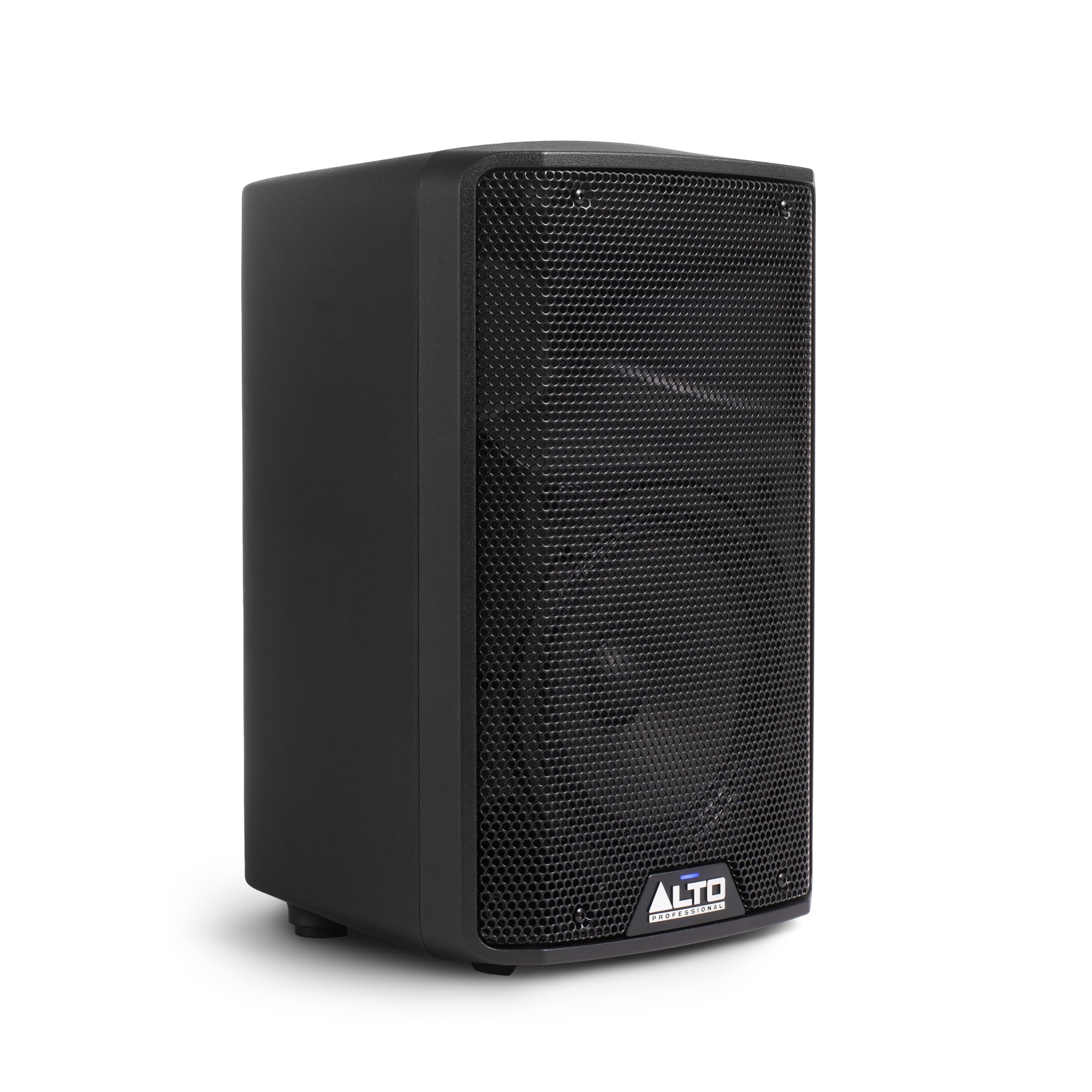
The TX408 is the smallest powered cabinet here, and that is exactly why we like it. An 8-inch woofer in a 5.9 kg box is easy to carry with one hand and easy to tuck into a corner, and the 350-watt amplifier gives it more output than its size suggests. We recommend it for small rooms, DJ practice, and stage monitoring rather than a main party rig.

The wedge-monitor shape is the surprise. It can sit on the floor as a monitor for a band or a DJ, and the 2-channel mixer handles a mic and a line source without a separate box. Bluetooth with true wireless stereo means two TX408s can pair for a wider spread. The sound is clear and forward, but the 8-inch woofer runs out of low end before a 12- or 15-inch cabinet does. If you need bass you can feel, plan on a sub or a bigger top.

Against the bigger ALTO, the TX408 gives up scale and low-end weight, not usability. It is the one we grab for a small patio, a gym class, or a booth where a full-size speaker would be in the way. The plastic enclosure keeps the weight down, and the 36 mm pole socket means it can still go on a stand when you want it at ear height. For the money, it is the least fussy way into a powered PA. The 75-foot Bluetooth range is generous for a speaker this small, too.

Pros

  • Light 5.9 kg cabinet
  • 350W bi-amplified output
  • Wedge monitor and pole mount
  • TWS Bluetooth pairing

Cons

  • Corded only
Our verdict

Our pick for small rooms and stage monitoring, the TX408 trades deep bass for a light cabinet and a useful wedge shape.

Check Latest Price
6

Tight Budgets

Rockville BPA10

88 /100
LBD Score Excellent

Key details

Power
400W peak, 100W RMS
Inputs
XLR, 1/4-inch, RCA, aux
Weight
18.5 lb
Woofer
10 inches
View on Amazon

The BPA10 is the budget single-speaker option, and it makes a case for itself with connectivity. You get XLR, 1/4-inch, RCA, and 1/8-inch aux inputs, plus an XLR line output for chaining a second speaker. That is more flexible than most budget cabinets, and it means a mic, a phone, and a second BPA10 can all share the back panel without a mixer.

The 10-inch woofer and 100-watt RMS rating put it in small-room territory. It has a solid bass punch for its size, and the 18.5-pound cabinet is easy to carry and stand-mount. We like the flyable design and the 45-degree waveguide, which help it cover a room from a wall or a stand. It will not deliver subsonic bass or club volume, but it is a useful problem-solver for a booth, a small party, or a backup speaker.

The weak spot is the remote. It is the kind of accessory you use once and then leave in the box, and it does not change the fact that the speaker itself is the reason to buy. What keeps it on the list is the input flexibility at the price. If you need one small speaker that can take a mic and a music source without extra gear, the BPA10 is a practical pick; for a main DJ rig, step up to the ALTO or JBL. The XLR output is the detail that makes a second cabinet an easy add later.

Pros

  • Flexible XLR/1/4-inch/RCA inputs
  • XLR output for chaining
  • Light 18.5-pound cabinet
  • Flyable and stand-mountable

Cons

  • Durability is a question mark for weekly gigs
Our verdict

On a tight budget, the BPA10 earns our nod for a small room because its flexible inputs and light cabinet do the basics without extra gear.

Check Latest Price

How We Tested These DJ Speakers

We started by pulling every powered speaker in the portable and semi-portable range, then cut by cabinet size, weight, input complement, whether one person could carry it, and what the price actually bought. About 30 models filtered down to 12 that we used ourselves, not loaners returned after a week.

Testing ran six months, mostly on weekends and after work. Each speaker went to a backyard birthday, a basement rehearsal room shared with a three-piece band, and a rented hall for a friend's reception, plus a couple of loud, crowded patios. We timed setup solo, from trunk to first note, and noted who could manage stairs and a narrow doorway in one trip.

For sound, the same three tracks went through every unit — bass-heavy, vocal-forward, and a compressed pop file that punishes sloppy processing — while we walked the room at three distances, listening for whether the highs stayed clean at volume and whether the low end held together or turned to mush. Each one got pushed to its limit light at least once to hear how it clipped.

Bluetooth got its own scrutiny: pairing from a phone at 10, 30, and 50 feet with a wall in between, walking out of range to see whether it dropped or stuttered, and whether it reconnected on its own. We also paired matching speakers wirelessly across a room and ran long XLR and quarter-inch cables back to a mixer to see if the included cabling reached anywhere useful. Battery models were drained flat twice at moderate volume. Durability was six months of trunk loading, one rained-on load-in, and a close look at grilles, corners, and knobs.

How to Choose Dj Speakers

Match power to the room, not the badge

Peak wattage sells speakers, but RMS or continuous power is the number that tells you how much clean output a cabinet can sustain. A 1,000-watt peak pair with a 150-watt RMS rating is a small-to-medium-room system, not a club rig; a 2,500-watt peak 15-inch cabinet has more headroom, but it still has limits. For a standing party of 100, we start with two 12- or 15-inch tops on stands. An 8-inch cabinet is better as a monitor or for a small patio.

Check the mixer and inputs before Bluetooth

Bluetooth is useful for setup music and requests, but we keep the main DJ feed on a cable because wireless can drop or add latency. Look for at least two channels, XLR/TRS combo inputs, and a line output for linking. True wireless stereo is handy when you want two speakers apart without a cable between them. A budget cabinet with only RCA or aux inputs can work, but you may need adapters and you give up a balanced connection.

Plan the lift, the stand, and the power

A 15-inch cabinet often lands between 45 and 60 pounds, while an 8-inch can be around 13 pounds. Check the weight and handles before you fall for a spec sheet; a cabinet that is easy for two people is not automatically easy for one. Use stands rated for the load, and choose a pole socket, wedge angle, or flown option that matches your room. Battery power buys convenience for ceremonies and patios, but it adds cost and limits output.

Budget for the weak links

Complete packages with stands, a mic, and a cable are a fast way into a party rig, but the accessories are usually where the corners get cut. We treat included mics and stands as starter parts, not long-term pro gear. For weekly gigs, spend more on the cabinet and protection than on lights and a remote. A simple cover, a cart, and a speaker with sensible limiting will do more for reliability than another LED mode.

Frequently Asked Questions

Final Verdict

For most mobile DJs, the ALTO TS415 is the speaker to buy first. It has the 15-inch output, three-channel mixer, app EQ, and wireless stereo linking that make a small rig easy to run, and it leaves room in the budget for stands and cables. The JBL EON715 is the upgrade for a more pro-grade cabinet; the Bose S1 Pro+ is the specialist for battery-powered ceremonies and patios. Start with the ALTO, then add the speaker that matches the gigs you actually book.