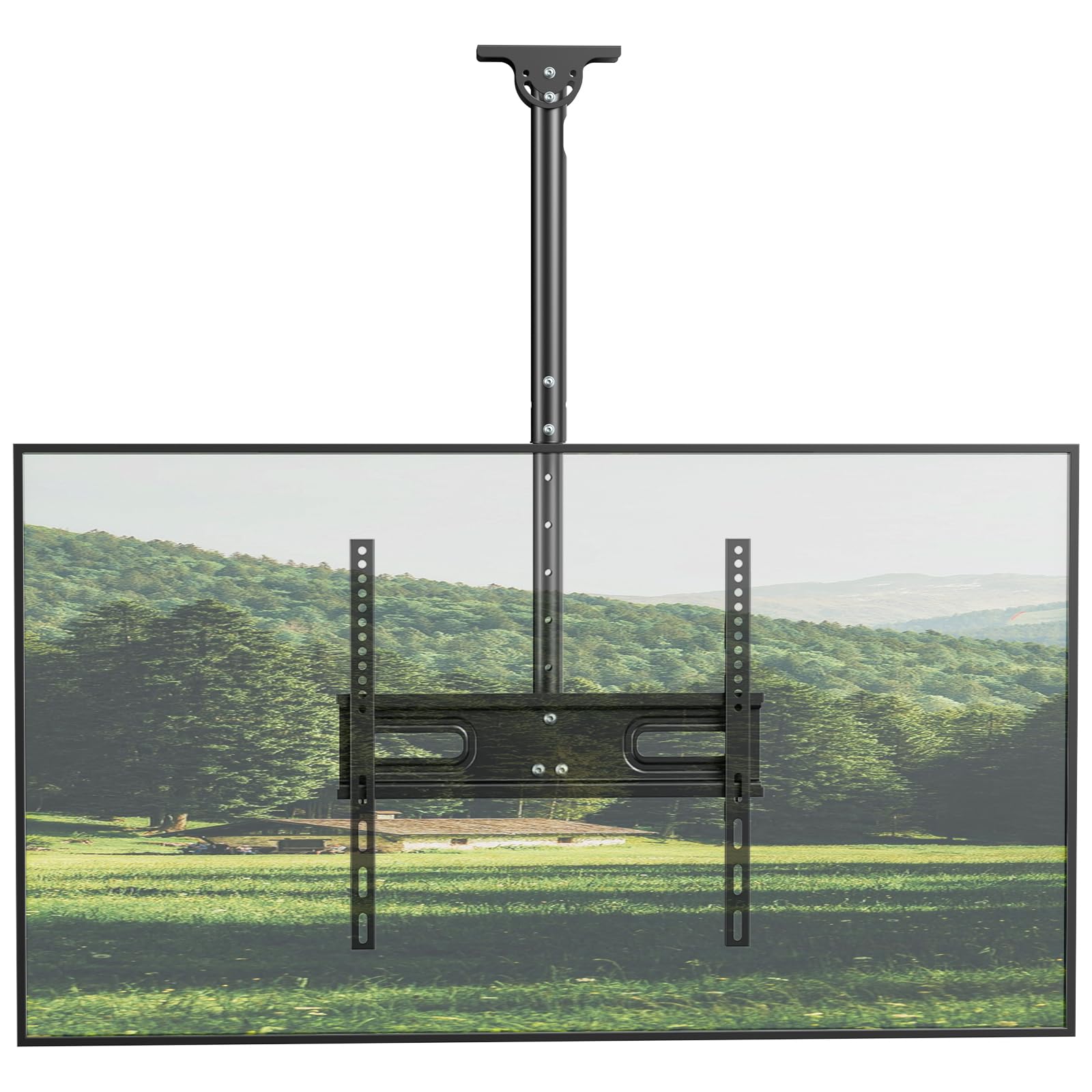
Best Ceiling TV Mounts of 2026

A TV hanging from the ceiling asks for a kind of trust a wall mount never does. I hear the same question every time someone sees one: will that thing actually hold? It will, provided the bracket is rated well past your screen's weight and the lag bolts land in something solid. What you get in exchange is floor space and the walls you don't have — the middle of a home gym, a gazebo, a vaulted room with no stud at eye level, the foot of a bed where a dresser won't fit.

We've had nine of these mounts up for five months, swinging screens between the sofa and the treadmill, and the differences show up in the places the listings stay quiet about. Pole length matters more than screen size, for one thing: a short pole hangs a big TV at forehead height, while a long one turns a modest screen into something you duck around. VESA range and the hardware in the box decide whether install day takes twenty minutes or two trips to the hardware store, and the ceiling you're bolting into decides whether the bracket can sit level at all.

Every mount below held its TV without sagging. What separates them is how they felt getting there — and how often you have to think about them afterward.

1

Best Overall

WALI CM2665

95 /100
LBD Score Outstanding

Key details

VESA
Up to 400×400 mm
Holds Up To
110 lb
Fits Screens
26–65 in
Height Range
21.4–30.3 in
View on Amazon

The 26-to-65-inch range is the sensible center of this category, and this WALI is the mount we recommend for it. The pole adjusts from 21.4 to 30.3 inches from the ceiling to the center of the mounting plate, which covers most standard rooms, and the 110-pound rating leaves room for a normal 65-inch set. The 360-degree swivel is what makes it useful rather than merely adequate: you can point the screen toward the couch, the kitchen, or a chair at the side of the room without moving the pole. We also like the 2-inch height steps, because ceiling joists rarely land exactly where you want them.

What holds it back is the drop. At 30.3 inches, the pole runs out of length in a tall room, and a high ceiling will leave the screen above eye level. That is not a flaw for a standard eight- or nine-foot room, but it is the reason the long-arm WALI exists. Cable routing through the center tube is another practical touch: it keeps the install looking deliberate, which matters when the mount is visible from the couch.

We kept coming back to this one as the baseline because it does the boring parts well. The bracket is simple, the motion is easy to understand, and the TV plate has enough tilt to deal with glare without becoming fussy. If your room is ordinary and your TV is in the 26-to-65-inch window, start here.

Pros

  • Fits most 26–65-inch TVs
  • 110-pound capacity
  • 360° swivel and tilt
  • 2-inch height steps

Cons

  • Hardware may need supplementing for some TVs
Our verdict

For most standard rooms and 26-to-65-inch TVs, this is the ceiling mount we recommend first.

Check Latest Price
2

Best for High Ceilings

WALI CM2665XL

95 /100
LBD Score Outstanding

Key details

VESA
Up to 400×400 mm
Holds Up To
110 lb
Fits Screens
26–65 in
Height Range
19.4–58 in
View on Amazon

The first thing to check on a high ceiling is the drop, and this WALI stretches from 19.4 inches all the way to 58 inches from the ceiling to the mounting plate. That is the longest pole here by a wide margin, and it changes which rooms a ceiling mount can serve: a two-story entry, a gym with a tall ceiling, or a patio with a high beam no longer forces the screen into the rafters. The rest is the familiar WALI formula—26-to-65-inch fit, 110-pound capacity, 360-degree swivel, and tilt for glare.

We like it for the rooms where a standard 30-inch pole simply runs out of length. The trade-off is that a long pole gives the TV more leverage, so the ceiling attachment and the TV's weight matter more, not less. Stay within the 110-pound rating and use the joist hardware properly. The pole is visible for its full length, which is the point, but it makes cable management more important; run the cables through the tube before you hang the screen.

The hardware and motion are the same as the standard WALI, so you are paying for pole length rather than a different bracket. In a tall room, that is the right thing to pay for. The pole is the product, and that is fine.

Pros

  • 58-inch maximum drop
  • 110-pound capacity
  • 360° swivel and tilt
  • Cable management through the pole

Cons

  • 65-inch screen limit rules out larger TVs
Our verdict

Choose this when the ceiling is high enough that a standard 30-inch pole leaves the screen above eye level.

Check Latest Price
3

Best for Vaulted Ceilings

VIVO VC86-3

86 /100
LBD Score Excellent

Key details

VESA
Up to 600×400 mm
Holds Up To
132 lb
Fits Screens
43–86 in
Height Range
30.5–36.6 in
View on Amazon

The bracket on the VIVO VC86-3 tilts through 90 degrees, which is the detail that makes a vaulted ceiling behave more like a flat one. Instead of hanging from a single joist and hoping the angle works out, the base can follow the slope, then the screen plate levels the TV. The 43-to-86-inch range and the 132-pound rating make it a large-screen mount rather than a one-size bracket, and the 30.5-to-36.6-inch drop is long enough for a high room without turning into a mast.

A 360-degree swivel and +15/-10-degree tilt give you the aiming range, and the steel-and-aluminum frame feels appropriately serious for an 85-inch TV. The 3-foot pole is a useful middle ground: it gets the TV down into the room without making the mount the first thing you see. The flat-or-sloped bracket is the part that justifies the price over a basic pole mount.

We recommend it for vaulted ceilings and big screens because those two jobs are where the usual ceiling mount gets awkward. If your ceiling is flat and your TV is smaller, you are paying for slope hardware you do not need. If your ceiling is pitched, that hardware is the reason to choose it. It is a specialist, not the default.

Pros

  • 90° bracket tilt for sloped ceilings
  • 43–86-inch range and 132-pound rating
  • 360° swivel and +15/-10° tilt
  • 3-foot pole balances height and sightline

Cons

  • Pole may be short for very tall rooms
Our verdict

This is the pick for a vaulted ceiling or a screen up to 86 inches, where the bracket angle matters as much as the pole.

Check Latest Price
4

Best for Tricky Joists

Mount-It! MI-511

89 /100
LBD Score Excellent

Key details

Holds Up To
99 lb
Fits Screens
32–65 in
Height Range
20.3–30.2 in
Base Rotation
120°
View on Amazon

Most ceiling mounts assume the joist runs the way you want it to; this one gives you 120 degrees of base rotation when it does not. The MI-511 also handles 90-degree joist configurations, which is the difference between a clean install and a bracket hanging off a shimmed block. The 32-to-65-inch range and 99-pound capacity put it in the same general class as the standard WALI, but the base is the reason to look at it.

We like the six-position pole, which spans 20.3 to 30.2 inches, because it gives you a little more tuning than a two-position mount. The 360-degree swivel and +5/-15-degree tilt are standard full-motion fare, but they are enough to aim the screen from a couch, a bar stool, or a kitchen island. The 120-degree base rotation is the unusual part, and it is worth paying attention to if your ceiling framing is not square to the room.

It is also one of the cleaner-looking mounts here: the pole is simple, the plate sits close to the screen, and the cable route is built into the tube. If your joists are the problem, this is the one we point to.

Pros

  • 120° base rotation for awkward joists
  • Works with 90° joist layouts
  • Six-position pole from 20.3 to 30.2 inches
  • Lifetime warranty

Cons

  • 99-pound capacity is tight for heavy older TVs
Our verdict

If your ceiling joists run the wrong way, this mount's rotating base solves a problem the others do not.

Check Latest Price
5

Best for Covered Patios

PERLESMITH PSCM2

95 /100
LBD Score Outstanding

Key details

VESA
Up to 400×400 mm
Holds Up To
110 lb
Fits Screens
26–65 in
Height Range
20.47–29.92 in
View on Amazon

A covered patio is a brutal place for a television, which is why the mounts that get used there tend to be simple and overbuilt. The PERLESMITH PSCM2 fits that brief: a steel pole, a 110-pound rating, 26-to-65-inch compatibility, and a 10-year warranty. It is not the longest or the most clever mount here, but it is the one we reach for when the TV is going under a porch roof and the install needs to be straightforward.

The height range runs from 20.47 to 29.92 inches, and the 360-degree swivel plus +5/-15-degree tilt let you aim the screen without getting on a ladder every time. We appreciate that the center tube hides the cables, because an outdoor mount with a loop of HDMI hanging off it looks temporary. The 10-year warranty is also longer than most, which is meaningful for a mount that will sit in heat and humidity.

The proportions are right for a normal-height covered patio, and the 10-year warranty is the sort of thing you want on a mount that stays outside. It is a sensible, unfussy choice for a second TV outdoors.

Pros

  • 26–65-inch fit and 110-pound capacity
  • 20.47–29.92-inch height range
  • 360° swivel and tilt
  • 10-year warranty

Cons

  • Short pole leaves high patio beams out
Our verdict

For a covered patio or a straightforward outdoor room, this simple 110-pound mount is the one we reach for.

Check Latest Price
6

Large Sloped Rooms

IMtKotW 43-86

89 /100
LBD Score Excellent

Key details

VESA
Up to 600×400 mm
Holds Up To
132 lb
Fits Screens
43–86 in
Height Range
19.1–36.4 in
View on Amazon

At 19.1 to 36.4 inches of drop, the IMtKotW covers more vertical ground than any other mount here, and it does it with a 43-to-86-inch screen range. That combination is unusual: most large-screen mounts pick a height and stay there, while this one can hang low in a media room or high in a room with a pitched roof. The 132-pound rating and 600x400mm VESA support put it in the same weight class as the VIVO.

The tilt range goes from 0 to -25 degrees, which is more downward aim than most of the competition. That matters for a screen mounted above a bed or a bar, where you are looking up from a reclined position. The 360-degree swivel lets you move the screen around the room, and the pole has enough adjustment to correct a ceiling that is not exactly where you expected.

The swivel is also the weak point: it can be stiff enough that moving the TV takes two hands and a deliberate push. That is not a reason to avoid the mount for a fixed viewing position, but it is a reason to set the angle once and leave it. For a large TV on a sloped ceiling where you want a wide height range, this is a strong alternative to the VIVO; for a room where the TV gets moved every day, the stiffness is the thing that sends us back to a smoother mount.

Pros

  • 19.1–36.4-inch height range
  • 43–86-inch fit and 132-pound rating
  • 0 to -25° tilt for high viewing positions
  • 600×400mm VESA support

Cons

  • Tilt bolt can strip if overtightened
Our verdict

A wide-height large-screen mount for a sloped room, as long as you can live with a swivel that takes some effort.

Check Latest Price
7

Simple Budget Setups

USX STAR SAS202

92 /100
LBD Score Outstanding

Key details

VESA
50×50–400×400 mm
Holds Up To
110 lb
Fits Screens
26–65 in
Height Range
21.14–29.02 in
View on Amazon

There is a version of this purchase that does not need a long pole, a sloped-ceiling bracket, or a 90-inch screen. The USX STAR SAS202 is for that version: a 26-to-65-inch mount with a 110-pound rating, a 21.14-to-29.02-inch height range, and a standard full-motion head. It is the kind of mount that disappears into the room once it is up, which is exactly what most people want.

The 21.14-inch starting height is useful in a room where you want the screen closer to the ceiling, and the 360-degree swivel and 15-degree tilt are enough to aim the TV. The cable holes in the bracket plate make it easier to keep the back of the screen tidy. We also like that the VESA range starts at 50x50mm, which covers some smaller monitors that the bigger mounts leave out.

The 50x50mm VESA start is a genuine plus for a small monitor, and the cable holes are a small convenience we noticed right away. The mount is still a 26-to-65-inch bracket at heart, so it will not help if you are hanging a 75-inch screen.

We keep it as an also-consider because the WALI is the safer default for the same basic job, but the USX makes sense if the shorter drop fits your room and you want a plain, budget mount. It is not the one to choose for a large TV or a vaulted ceiling.

Pros

  • 110-pound rating for a budget mount
  • 360° swivel and 15° tilt
  • VESA starts at 50×50mm
  • Cable holes in the bracket plate

Cons

  • 29.02-inch maximum drop is short for high ceilings
Our verdict

A plain, capable mount for a standard room, though the shorter drop limits it under a high ceiling.

Check Latest Price
8

Lower Ceilings

Putilsen S65

91 /100
LBD Score Outstanding

Key details

VESA
Up to 400×400 mm
Holds Up To
99 lb
Fits Screens
26–65 in
Height Range
20.3–26.2 in
View on Amazon

Short poles are not a compromise for every room; in a basement or a low sunroom, less drop is exactly what keeps the screen at eye level. The Putilsen FYDPM-CTM-S65 runs from 20.3 to 26.2 inches, which is the shortest range here, and that is the point. It fits 26-to-65-inch TVs up to 99 pounds and uses up to a 400x400mm VESA pattern, so it covers the common sizes without turning the ceiling into a hardware project.

The full-motion head gives you 360-degree swivel and a 25-degree tilt, and the hollow pole hides the cables. We like it for small rooms because the shorter pole keeps the TV from dominating the space; a long drop in a low room just puts the screen in your line of sight. The steel frame is rated to 99 pounds and feels appropriately solid for that limit.

The limit is the ceiling height itself: if your room is taller than the 26.2-inch maximum drop, this mount will leave the TV too high, and no amount of tilt fixes that. That is not a defect in a low room, but it is the reason to measure before you buy.

We recommend it for basements, sunrooms, and small spaces where the screen needs to stay close to the ceiling. For a standard or high ceiling, the WALI or the long-arm version is the better starting point.

Pros

  • 20.3–26.2-inch drop suits low rooms
  • 360° swivel and 25° tilt
  • 99-pound capacity
  • Hollow pole hides cables

Cons

  • 99-pound rating is the lowest in this group
Our verdict

A short-pole mount for basements and small rooms, where keeping the TV close to the ceiling is the goal.

Check Latest Price

How We Tested Ceiling TV Mounts

We began with a shortlist of roughly 30 ceiling mounts and cut it down by reading spec sheets rather than star ratings: VESA range, weight capacity, pole length, and whether the bracket was built for a flat ceiling only or could be angled to suit a pitched or vaulted roof. Price factored in mainly as a question of what came in the box, since a mount that ships without the right lag bolts isn't a bargain. That left nine mounts, from compact 26-inch brackets to long-arm models rated for an 86-inch screen.

Each one went up in a real room and stayed there for five months: over a bed in a spare bedroom, in a garage gym, on a covered patio, and under a vaulted ceiling where no wall was usable. We installed every mount ourselves, timing the job, counting trips to the hardware store, and checking whether the included bolts lined up with standard joist spacing. On sloped ceilings we noted whether the bracket could be leveled independently of the pole, and whether the mount arrived with the right anchors for wood, concrete, or both.

With a TV hanging, we pushed and pulled at the corners of the screen, then marked every bolt with a paint pen and re-checked those marks at 30 and 90 days for loosening or droop. We swung each mount through its full arc and let go mid-swing to see whether the screen stayed put or drifted back on its own. Height changes were made with the TV already mounted, because that's when you actually do it, and we recorded whether it took one person or two.

The mounts that scored highest were the ones we stopped noticing.

How to Choose a Ceiling Tv Mount

Start with VESA and weight, not screen size

Screen-size ranges are a rough guide; the VESA pattern and the TV's actual weight are the gates. A 65-inch TV can weigh less than a 55-inch older set, and a bracket rated for 110 pounds is not the same as one rated for 99. Check the four-hole pattern on the back of the TV and the weight in the manual before you compare mounts.

If the TV is near the top of the range, move up to a heavier-duty bracket rather than assuming the size label covers you. The WALI CM2665 and PERLESMITH PSCM2 both fit 26-to-65-inch sets at 110 pounds, which covers a lot of living-room TVs; the 99-pound mounts are the ones to check against a heavier panel.

Measure the drop you need, not just the ceiling height

Ceiling mounts list height from the ceiling to the center of the mounting plate, not to the bottom of the TV. Measure from the ceiling to where you want the center of the screen, then compare that number with the mount's range. A standard pole covers roughly 20 to 30 inches; a long-arm model like the WALI CM2665XL reaches 58 inches.

In a room with a 10-foot ceiling, the longer pole is often the difference between a comfortable screen and a TV in the rafters. In a low room, the opposite is true: a short pole keeps the screen from hanging into the seating area.

Match the bracket to the ceiling

Flat ceilings are the easy case; sloped and vaulted ceilings need a bracket that can tilt at the base. The VIVO VC86-3 tilts through 90 degrees for a pitched roof, while the Mount-It! MI-511 uses 120 degrees of base rotation to deal with joists that run across the room.

If you are not sure which way the joists run, find them before you order. A mount that cannot meet the ceiling at the right angle will fight you all the way through the install.

Choose motion for the room, not the spec sheet

360-degree swivel is common here, but it matters only if you watch from more than one seat. A fixed screen can use a simpler mount and put the money into weight capacity. Tilt is the feature that earns its keep: 15 degrees is enough for glare in a normal room, while a 25-degree downward tilt helps when the TV hangs above a bed or a bar.

If you will move the screen often, check that the swivel feels controlled rather than loose. A mount that swings freely is not always a better mount; it can be harder to keep the screen where you aimed it.

Plan the install and the cable route

Run cables through the pole before the TV goes up, because the center tube is much easier to use on the bench than overhead. Keep the TV's own screws and spacers; the mount kit may not cover every panel depth.

A second person is the right call for anything above 55 inches, not because the bracket is hard to assemble but because holding a TV overhead while you find the hook is a bad time.

Frequently Asked Questions

Final Verdict

We recommend the WALI CM2665 for most rooms. It fits the common 26-to-65-inch TV, holds 110 pounds, and has enough swivel and tilt to aim the screen without making the mount the center of attention. The deciding advantage is its balance: a standard room, a normal TV, and no specialized ceiling hardware.

If your ceiling is tall, the WALI CM2665XL adds the 58-inch drop you need. If the ceiling is vaulted or the screen is 86 inches, the VIVO VC86-3 is the better shape.