Best Coffee Scales of 2026

The most annoying thing about a bad coffee scale isn't that it's wrong — it's that it's slow. A scale that refreshes every second reads 32 grams while your shot has already passed 40, and by the time the number catches up you've blown past the recipe you spent a week dialing in. What you want is a fast readout, 0.1-gram resolution, auto-tare, and a timer you don't have to think about.

I've brewed on the same machine for years and burned through a drawer of scales that drifted, beeped at nothing, or died mid-shot. Over the past four months, my team and I weighed and re-weighed 14 of them across espresso, pour-over, and one over-measured batch of cookie dough. The surprise was accuracy: 0.1-gram resolution doesn't guarantee 0.1-gram precision, and plenty of these display that decimal while quietly wandering.

The spec nobody prints on the box is settle time — how fast the number stops moving once a portafilter lands on it. Footprint, battery life, and automatic timing all got the same scrutiny. Here's what held up.

1

Best Overall

Maestri House S1 Mini

89 /100
LBD Score Excellent

Key details

Battery
800 mAh, USB-C
Readout
0 oz
Capacity
4.41 lb
Footprint
3.74 x 3.93 x 0.75 in
View on Amazon

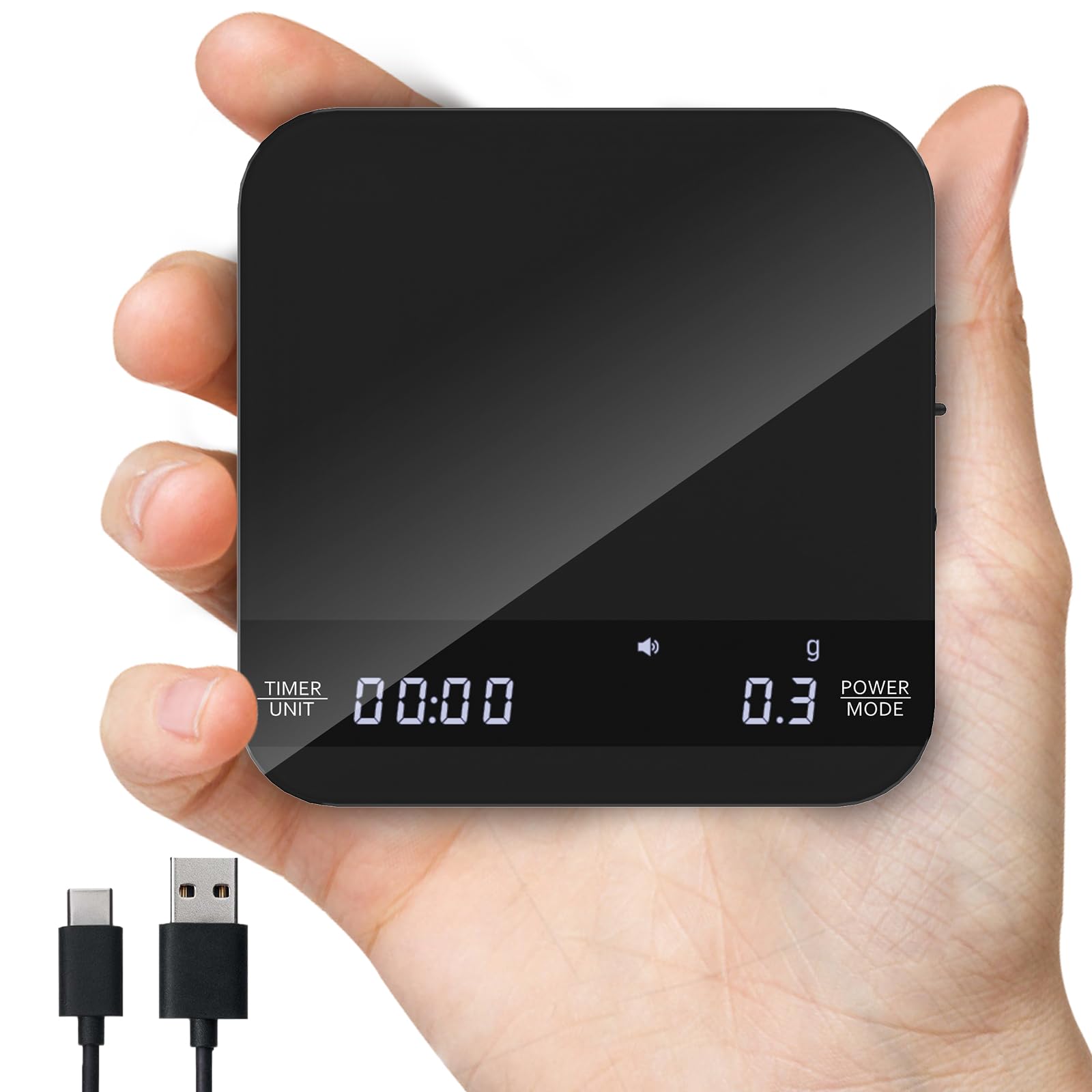
Clearance decides more coffee-scale purchases than precision does, and that is the first thing this one gets right. At 3.74 by 3.93 by 0.75 inches and 0.65 pounds, it drops onto a drip tray with room left for a shot glass, and it slid under the group head of the smallest machine we tested without fouling the portafilter. That is the advantage we keep coming back to: the scale can live where you brew instead of perching on the edge of the tray.

The rest holds up. The 0.1 g readout tracks in real time as a shot runs, 2 kg covers a full pour-over, and the two timing modes include an auto start that begins when coffee hits the cup, which is useful when both hands are on the kettle. There are no raised buttons either: the keys sit under the ABS surface, so grounds wipe away instead of collecting in a seam. What the top does not want is a rinse under the tap. A damp cloth is the right move.

USB-C charging through an 800 mAh battery means no drawer of AAAs, and the display lights through the top panel rather than sitting in a recess where dust gathers, a small thing on a bench where grounds go everywhere. What surprised us was how little it wanders between additions: set a cup down, tare, and the zero holds while you work.

Pros

  • Fits the tightest espresso clearances
  • Auto timer starts on first drops
  • USB-C rechargeable, no AAA supply
  • Sealed surface wipes clean

Cons

  • 3.74-inch top overhangs a Chemex base
  • Costs more than the budget minis here
Our verdict

The scale we recommend to most people: it fits where others do not, responds at 0.1 g, and starts timing when the coffee does.

Check Latest Price
2

Best for Pour-Over

TIMEMORE Basic 2.0

88 /100
LBD Score Excellent

Key details

Battery
1600 mAh, up to 10 hours
Readout
0 oz
Capacity
4.41 lb
Brew Aids
Flow rate and auto timer
View on Amazon

Pour-over is the one job where a scale can tell you something you cannot see, and the Basic 2.0 does it with a live flow-rate readout in grams per second. Watch it through a bloom and you can tell whether the pour is running heavy or starving the bed long before the cup is finished. It is the reason this is the scale we keep in the pour-over slot rather than the espresso one.

Everything around that readout is built for long sessions: 2 kg of capacity, an automatic timer that starts on the first drops, a backlit LCD that stays readable at an angle, and a 1600 mAh battery rated at about 10 hours. We charged it when it arrived and then stopped thinking about it, which is the nicest thing you can say about a rechargeable scale.

The acrylic top and the touch controls take some getting used to. A cup set down hard can register as a button press, and the surface shows smudges faster than glass does. Neither changes a brew, but both are why we treat it as a bench tool rather than something to knock around in a bag.

The fine end of the range is where it is least convincing: 0.1 g readings on small doses are the shakiest part of its performance, so if you dose single shots by the tenth of a gram, the S1 Mini is the steadier companion. For a Chemex, a V60 and a timer you actually watch, it earns its place.

Pros

  • Live flow-rate readout during the pour
  • Battery lasts months of brewing
  • Auto timer starts on its own

Cons

  • Priciest scale in this guide
  • Touch keys answer a brushed cup
Our verdict

Buy this if pour-over is your method and you want to see flow rate while you pour; it is the most capable brewer's tool here.

Check Latest Price
3

Best Large Platform

BAGAIL Coffee Scale SC01

89 /100
LBD Score Excellent

Key details

Battery
600 mAh, USB-C
Readout
0 oz
Capacity
6.61 lb
Footprint
6.7 x 5.1 x 1 in
View on Amazon

The removable silicone pad is what makes this scale easy to live with: it is waterproof, heat-resistant and non-slip, so a slopped kettle or a hot dripper lands on something you can lift off and wash instead of on the load cell. Under it sits a 6.7 by 5.1 inch platform that swallows a Chemex base or a big V60 without overhang.

At one inch tall it is not an espresso scale, and BAGAIL's own listing tells you to measure your machine's clearance before ordering. Take that seriously, because no cup position fixes an inch of body under a portafilter. For drip, French press and pour-over the height costs nothing, and the platform is a real advantage over the espresso-first scales here.

The 3 kg capacity and 0.1 g readout cover anything from a single dose to a full carafe, the timer runs in auto or manual mode and beeps on each minute, and the 600 mAh battery takes about three hours to charge before weeks of short daily sessions. Setup has one trap worth knowing: four rubber plugs under the weighing platform have to come out before first use, and the scale reads oddly until they do.

Pros

  • Wide platform takes a full-size dripper
  • Lift-off silicone pad is easy to wash
  • Auto and manual timer modes

Cons

  • Can start drifting after months of daily use
Our verdict

Our pick for pour-over and drip brewing, where its wide removable pad and low price matter more than espresso clearance.

Check Latest Price
4

Best Budget Espresso Scale

Greater Goods 750g Espresso Scale

93 /100
LBD Score Outstanding

Key details

Readout
0 oz
Capacity
1.65 lb
Footprint
5.7 x 3 x 0.7 in
Scale Weight
5.6 oz
View on Amazon

There is no timer here, and for a lot of espresso setups that is completely fine. It weighs to 0.1 g up to 750 g, responds fast enough to dose straight into a basket, and at 5.7 by 3 by 0.7 inches it disappears under a machine or into a utensil drawer. The lid is the clever part: it covers the stainless platform between uses, then flips into a tray that catches stray grounds and widens the surface when you need more room.

What it does well is the short list dosing actually requires, which is accuracy, immediate response and a tare you can hit without looking, and it delivers that near the bottom of this set's price range. The unit list gives away its ancestry: grains, carats, pennyweights and troy ounces sit alongside grams and ounces, more range than any coffee brewer needs and a fair hint at how fine the sensor is.

Pros

  • Fast 0.1 g response for dosing
  • Lid flips into a weighing tray
  • Slips under a machine or into a drawer

Cons

  • AAA batteries are a recurring cost
Our verdict

A no-timer dosing scale we keep recommending for espresso, because 0.1 g response and a flip-over tray cost very little here.

Check Latest Price
5

Best for Tight Clearance

MAXUS Espresso Scale

89 /100
LBD Score Excellent

Key details

Readout
0 oz
Capacity
2.2 lb
Footprint
4.87 x 2.87 x 0.75 in
Scale Weight
4.66 oz
View on Amazon

The display is the part we underrated. It is backlit, large and readable from above, which is where your eyes are when the scale is jammed under a group head and the numbers are pointing at the ceiling. At 4.87 by 2.87 inches and 0.75 inches tall it slides into gaps that stop most scales, and the detachable cover flips into a small tray for weighing beans.

The timer runs independently of the weighing, so you can start it with a finger while a shot pulls and let it keep counting after the cup comes off. The stainless platform wipes clean after a spill, and the whole thing weighs 132 g, which is why it lives in the drawer and comes out for every shot rather than staying on the counter.

Pros

  • Backlit display readable from above
  • Under three inches wide for tight gaps
  • Timer works separately from the weighing

Cons

  • 1 kg ceiling limits larger brews
  • Timer button can take a second press
Our verdict

The one we hand to anyone with a cramped machine: under three inches wide, backlit, and cheap enough to keep as a spare.

Check Latest Price
6

Best for Travel

OutIn Claro

91 /100
LBD Score Outstanding

Key details

Battery
Up to 400 brew cycles
Readout
0 oz
Capacity
4.41 lb
Footprint
11 x 11 x 2 cm
View on Amazon

This is the one that leaves the kitchen. It is 175 g and 11 cm across, round rather than square, and it ships with a waterproof, scratch-resistant case that has done its job next to a hand grinder in a packed bag. It is the scale we reach for when the brewing happens somewhere other than the counter.

The three modes do more than relabel a button. Manual is a plain scale, espresso mode tares and times the shot, and pour-over mode tracks the coffee weight and calculates the powder-to-water ratio as you go, which is genuinely useful when you are brewing away from your usual marks. The silicone mat takes splashes and heat, the screen sleeps after 120 seconds and wakes on touch, and OutIn rates the battery at up to 400 brewing cycles per charge.

The round top earns its shape: a server or a cup centers itself on it, and there are no corners for grounds to gather in. Whether it earns a place in your cupboard depends on how often the brewing leaves the counter, because a kitchen that never packs a bag gets the same work from the S1 Mini or the TIMEMORE.

Pros

  • 175 g body with a protective travel case
  • Pour-over mode works out the ratio
  • Up to 400 brews per charge

Cons

  • Costs more than the countertop picks
Our verdict

We take this one travelling: 175 grams, a case, and brew modes that do the ratio maths away from your usual setup.

Check Latest Price
7

Budget Brewing

ERAVSOW Coffee Scale

88 /100
LBD Score Excellent

Key details

Readout
0 oz
Capacity
4.41 lb
Footprint
4.1 x 4.1 x 0.72 in
Brew Modes
3 assist modes
View on Amazon

The feature sheet reads like the top pick's: 0.1 g resolution, 2 kg of capacity, three brewing modes including a flow-rate setting, USB-C charging, and a tempered-glass top under a removable silicone pad. The difference shows up in how it behaves rather than in what it lists.

Charge habits matter more than the headline figure. The 90-day number assumes roughly ten minutes of brewing a day, so a household pulling several shots and a pour-over will be reaching for the cable more often than that suggests; USB-C at least means it is the same cable as your phone. The display is bright and easy to read at an angle, and the pad lifts off for cleaning.

What we keep coming back to is value: three modes, a glass top and a rechargeable body at the budget end of this set. Treat the first week as a trial, weighing the same dose twice and watching whether the number repeats before you trust it with an expensive bag of beans.

Pros

  • Three brew modes including flow rate
  • Bright display and lift-off pad

Cons

  • Small-dose accuracy is inconsistent
  • Standby timeout cuts in after five minutes
Our verdict

Worth a look if the budget is tight and you want flow-rate modes, as long as you test its readings in the first week.

Check Latest Price

What We Measured on 14 Coffee Scales

We started by pulling every scale we could find that claimed 0.1-gram resolution, then filtered by the things that actually decide a purchase: capacity, footprint (does it clear a drip tray?), whether the timer runs automatically or needs a button press, and how it charges. That left 14 scales, which we rotated through four months of daily brewing.

Each one spent at least a week on my counter and a stretch with other testers, used the way anyone would use it — a 6 a.m. espresso on a machine with a cramped drip tray, weekend pour-overs with a gooseneck kettle, beans weighed straight into the bag, and a few rounds of baking that called for 300 grams of flour. We noted whether grams were the default or whether we had to cycle past ounces and milliliters every time we turned one on.

Every session opened with a 100-gram calibration weight: placed, removed, placed again, to see whether the scale returned to the same number or crept. We dosed beans a single gram apart to check it caught the difference, watched whether the readout kept climbing after we stopped pouring, and timed how long it took to settle once a loaded portafilter landed on the platform. Near the top of each one's capacity, we loaded it up and watched for drift.

Battery life was logged, not guessed — we wrote down the date of each charge and left two scales on overnight to see what that cost. We splashed them, wiped them, dropped one off the counter, and checked whether the silicone pads collected bean dust, then measured each scale's height against a real drip tray with a real cup on it.

How to Choose a Coffee Scale

Measure the gap before you compare specifications

Take the scale out of the equation and measure the space between the drip tray and the portafilter with the cup you actually use. That one number eliminates most of the field. The low-profile class sits around 0.7 to 0.75 inches, which is where the S1 Mini, the MAXUS and the ERAVSOW live; anything closer to an inch, like the BAGAIL, is a pour-over scale that happens to have a timer. A scale that does not fit lives in a drawer, whatever its resolution.

Match the platform to what sits on it

A shot glass needs almost nothing. A V60 needs the better part of five inches. A Chemex, or a bowl for weighing out a whole bag, needs more again. If you brew one method, buy for that method and accept the compromise elsewhere: the S1 Mini is espresso-first at 3.74 inches across, while the BAGAIL's 6.7 by 5.1 inch top swallows a big dripper. Brew both and you should choose the larger platform and check its height, because the wide scales here are also the tall ones.

Decide whether you want a timer and a flow readout

A timer is table stakes now, and the useful version starts itself when weight begins to change, so you are not hunting for a button with a kettle in your hand. A flow-rate readout goes further: it shows grams per second, so a stalled bed is visible while it is happening, and that is what the TIMEMORE and the ERAVSOW are selling. We think it earns its keep if pour-over is your main method and adds little if you mostly pull espresso, where the shot clock on the machine does the same job.

Weigh rechargeable against AAA

USB-C has become the default in this price range, and it means one less drawer of batteries, until the scale is flat and needs an hour on a cable before it can brew. A set of AAAs is a two-minute fix at the corner shop. The 750 g Greater Goods is the holdout in this guide, and we like it for a drawer scale used twice a day more than for a counter scale used ten times. Whichever you choose, keep a cable where you brew.

Protect the electronics, not the platform

What fails on a coffee scale is usually the electronics rather than the sensor: a spill down the side, steam from a machine parked beside it, or a battery that stops holding charge. Use the silicone pad or the lid, wipe rather than rinse, and do not store the scale on the drip tray. Register the warranty in the first week, because the failures that do show up tend to show up early.

Frequently Asked Questions

Final Verdict

The Maestri House S1 Mini is the scale we point most people to. It fits where the others cannot, reads in real time at 0.1 g, and starts its timer when the coffee does, so there is no button to find mid-pour.

Buy the TIMEMORE Basic 2.0 instead if pour-over is the method and you want flow-rate feedback while you pour. Buy the BAGAIL if your brewing happens in a Chemex or a French press and the clearance question never comes up.