Best Compact Binoculars of 2026

Every compact binocular makes a deal with you: shrink the glass until it disappears into a jacket pocket, and you give up light and snap that make a view worth stopping for. The trick is finding the pair that gives up the least — and that's rarely the one with the biggest number printed on the side.

I've kept a pair in the glovebox for years, and the cheap ones taught me fast that a stiff focus wheel and a gray, dim image cure you of birdwatching quicker than cold weather does. Over the past six months my team and I carried a dozen compacts through spring migration, a few minor-league ballgames, and one bitter whale watch.

What separated the good ones had little to do with magnification. It was how much brightness survived the small lenses, whether the eyecups and diopter adjusted far enough for glasses and narrow faces, and whether anything rattled loose after a season in a tote bag. Those are the things you notice every time you raise them.

1

Best Overall

Hontry 10x25 Binoculars

91 /100
LBD Score Outstanding

Key details

Weight
9.6 oz
Field Of View
362 feet at 1,000 yards
Magnification
10x25
Interpupillary Range
60–75 mm
View on Amazon

A compact 10x25 lives or dies on how easily you find your subject, and this one makes that easy: 362 feet of field at 1,000 yards is the widest of any 10x pair in this guide. That is what lets you pick a warbler out of a hedge on the first try instead of sweeping the branches, and it has become the number we check first when a new pair arrives.

Everything else is in proportion. It weighs 9.6 ounces, the interpupillary adjustment runs from 60 to 75 mm so the same pair fits a ten-year-old and a broad adult face, and the center-focus wheel falls under your index finger where it belongs. Three years of warranty is the longest of the budget picks here, which matters more than it sounds, because compacts get swung into car doors and set down on gravel.

One caveat for spectacles. The eye relief is 10 mm, which is tight against a lens; if you wear glasses all day, the Aurosports at 14.8 mm or the Occer at 20 mm are the kinder pairs. Ours rides in the car door pocket from March to November, and that is the best thing we can say about any binocular.

Pros

  • Widest field of view of the 10x pairs here
  • 9.6 ounces and pocket-sized
  • 60–75 mm IPD fits children and adults
  • Three-year warranty, longest of the budget picks

Cons

  • Goes dim in the last of the light
  • Fatter Porro body than folding roof prisms
Our verdict

For most people this is the compact to buy: the widest 10x view in the guide, 9.6 ounces in a pocket, and three years of cover.
Check Latest Price
2

Best Optics

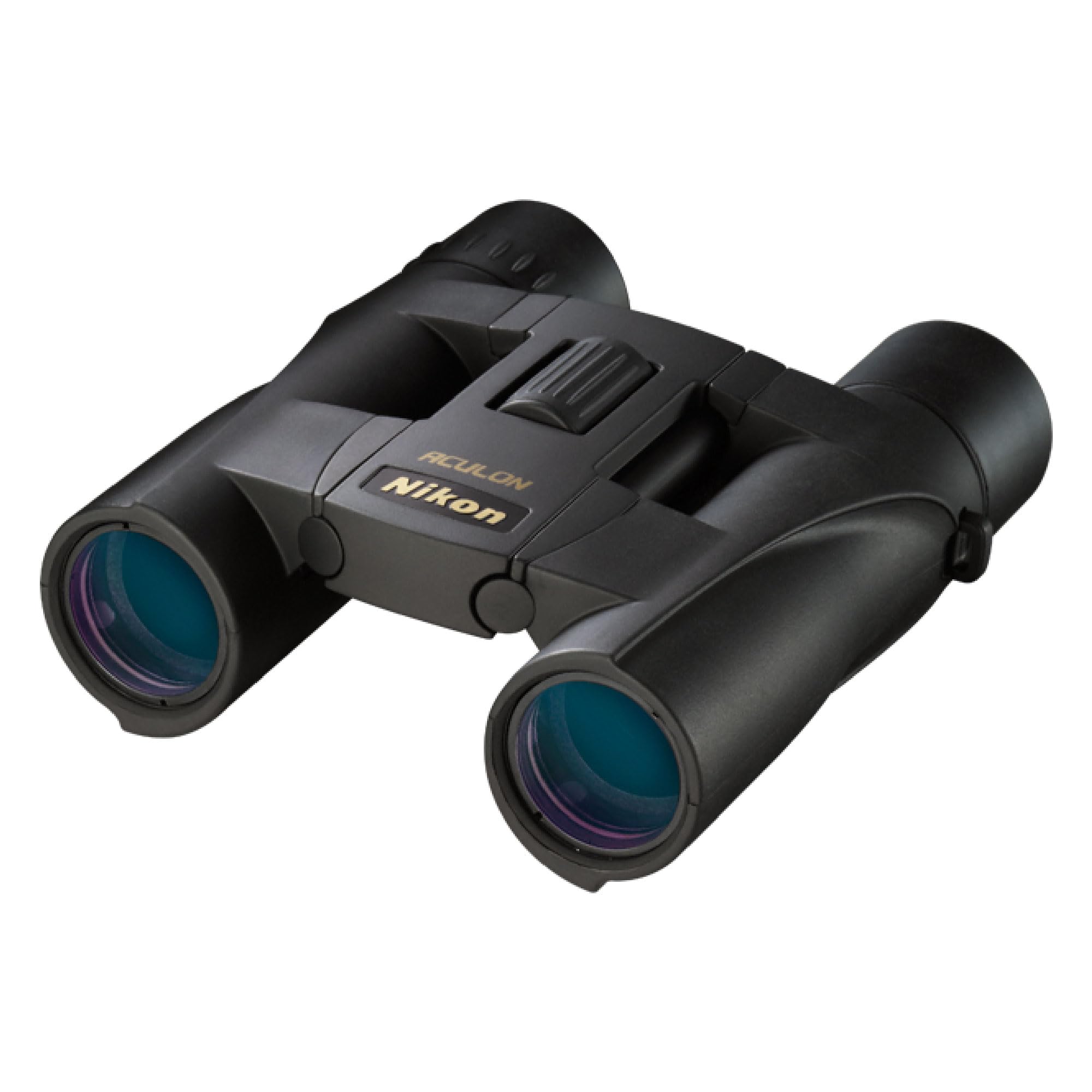
Nikon ACULON A30 10x25

91 /100
LBD Score Outstanding

Key details

Weight
9.76 oz
Eye Relief
10.6 mm
Prism Type
Roof prism, dual hinge
Magnification
10x25
View on Amazon

Put the ACULON A30 beside the Hontry and the case for spending more is visible in about ten seconds. The view stays sharp closer to the edge of the frame, the focus wheel moves with less stiction, and the body folds on its dual hinge into a package that lies flat in a jacket pocket instead of bulging.

What we kept coming back to is the focus. Birding is mostly a race, because you raise the glass, find the bird, and get a second before it moves, and a knob that travels from blur to sharp in one short twist is worth more than a fraction of a degree of field. At 9.76 ounces it is among the lightest 10x25s here, and it hangs quietly around your neck for a whole morning.

Whether it earns the premium comes down to frequency. Out most weekends, the difference in edge sharpness shows up the moment you stop staring at the middle of the frame. Out four times a year, take the Hontry and put the difference into a decent strap.

Pros

  • Sharper toward the edges than the budget picks
  • Smooth central focus that snaps in fast
  • Folds small on a dual hinge at 9.76 ounces

Cons

  • Tight 10.6 mm eye relief for glasses
Our verdict

The step-up pick for a regular birder: a cleaner edge, a quicker focus, and light enough to forget you are wearing it.

Check Latest Price
3

Best in Low Light

Vortex Vanquish 8x26

89 /100
LBD Score Excellent

Key details

Weight
12.7 oz
Exit Pupil
3.3 mm
Field Of View
352 feet at 1,000 yards
Magnification
8x26
View on Amazon

Twenty-six divided by eight is 3.3, and that number is the whole argument for the Vanquish. Exit pupil is the cone of light that reaches your eye, and 3.3 mm is the widest of any pair in this guide, wider than any of the 10x25s here and wide enough that the image keeps its color in the last half hour of daylight while the smaller pairs have gone grey.

It is also the most thoroughly sealed binocular of the group: nitrogen purged, o-ring sealed, waterproof and fogproof, with rubber armor that feels like it was specified for a truck bed. The warranty is unlimited, unconditional and lifetime, which for a pair that will live in a boat locker or a duck blind is most of what you are buying.

What you give up is reach and lightness. Eight power shows you less than ten, and 12.7 ounces is on the heavy side for a compact, so you feel it on a long walk. In exchange you get a steadier view and a body that shrugs off a knock. Ours lives by the back door from October, when the light starts to get interesting.

Pros

  • 3.3 mm exit pupil is the brightest view here
  • Waterproof, fogproof and shockproof
  • Unlimited, unconditional lifetime warranty
  • Steady 8x image with 15 mm eye relief

Cons

  • Heavy for a compact at 12.7 ounces
  • 8x gives up reach to the 10x pairs
Our verdict

Buy it if your good hours outdoors are dawn and dusk: the widest exit pupil here, sealed against weather, with lifetime cover.

Check Latest Price
4

Best Ultralight

Aurosports 10x25 Compact

89 /100
LBD Score Excellent

Key details

Weight
8.8 oz
Eye Relief
14.8 mm
Field Of View
362 feet at 1,000 yards
Magnification
10x25
View on Amazon

The pair you actually carry is the pair that gets used, and by weight this one wins: 8.8 ounces, lighter than every 10x25 here and lighter than everything in the guide except the two little 8x21s. On a long hike it stops being equipment and becomes something in your pocket you touch now and then to check it is still there.

We liked the armor more than we expected to. The textured rubber body does not slide in a sweaty hand, and the case has a belt loop so the binocular can ride on a hip instead of swinging from your neck all afternoon. The 362-foot field matches our top pick's, and 14.8 mm of eye relief is enough to use it with glasses on.

The 10x25 specification is the same as the Hontry's, so the optical gap between them is small; this is a handling decision more than a glass one. What the Aurosports buys you is 8.8 ounces on your chest and a body you can grab with wet hands.

Pros

  • Lightest 10x25 here at 8.8 ounces
  • Textured rubber armor holds in wet hands
  • 14.8 mm eye relief works with glasses
  • Wide 362-foot field of view

Cons

  • Splash resistant, not rated waterproof
  • One-year warranty is short
Our verdict

The lightest 10x25 in the guide and the one that ends up in a jacket pocket, with a grippy body and a wide, forgiving view.

Check Latest Price
5

Best High Magnification

Occer 12x25 Compact

89 /100
LBD Score Excellent

Key details

Weight
13.8 oz
Eye Relief
20 mm
Field Of View
273 feet at 1,000 yards
Magnification
12x25
View on Amazon

Twelve power is the reason to look at the Occer and the reason to think twice. Nothing else here magnifies more, and at a cruise-ship rail or an upper-deck stadium seat that extra reach is real: a bird on a distant rock or a number on a jersey comes up close enough to read.

The cost lands in the aiming. Twelve power magnifies every tremor in your hands, and a 2.5 mm exit pupil goes flat well before sunset does. We brace our elbows on a rail or a knee when we use it, and the difference is immediate, because with support this is a sharp, clean view that holds still long enough to enjoy.

What surprised us is how well it handles glasses. Twenty millimeters of eye relief is the most generous figure in this guide, and the rubber eyecups pull down so you can get your eye close to the lens. That number is worth quoting at anyone who tells you compacts are useless behind spectacles.

Pros

  • 12x is the most magnification here
  • 20 mm eye relief, the best for glasses
  • Rubber eyecups fold down easily

Cons

  • Narrowest field here at 273 feet
  • Heavy at 0.39 kg for its size
Our verdict

The most reach here for the least money, and the friendliest pair for glasses, as long as you can brace your elbows.

Check Latest Price
6

Serious Birding

Leupold BX-1 Rogue 10x25

92 /100
LBD Score Outstanding

Key details

Weight
12.6 oz
Eye Relief
15 mm
Field Of View
5.6 degrees
Magnification
10x25
View on Amazon

The Rogue is the heaviest 25 mm binocular in this guide at 12.64 ounces, and after a morning on a neck strap you understand why: there is more glass and more housing here than the size suggests. What that weight buys is the crispest 10x25 view we got in this set.

Clarity is the Rogue's case. The image is bright and clean, glare control holds up when you are looking toward a low sun, and 15 mm of eye relief means it works with glasses on. Leupold's inverted Porro design keeps the package short despite the weight, and the full lifetime guarantee is the kind you only appreciate after you have dropped something once.

Where it loses ground to the Nikon is in the pocket. A 5.6-degree field and 12.64 ounces make this the pair that travels in a case on a strap rather than the one stuffed into a jacket. Glass from one spot for an hour at a time and that is the right trade; walk all day and you want something lighter.

Pros

  • Clearest image of the 25 mm pairs here
  • 15 mm eye relief suits eyeglass wearers
  • Waterproof, fogproof and fully multi-coated
  • Full lifetime guarantee

Cons

  • Narrower 5.6-degree field of view
Our verdict

The sharpest 25 mm view we got in this set, if you can live with the heaviest body and a narrower window on the world.

Check Latest Price
7

Theater and Kids

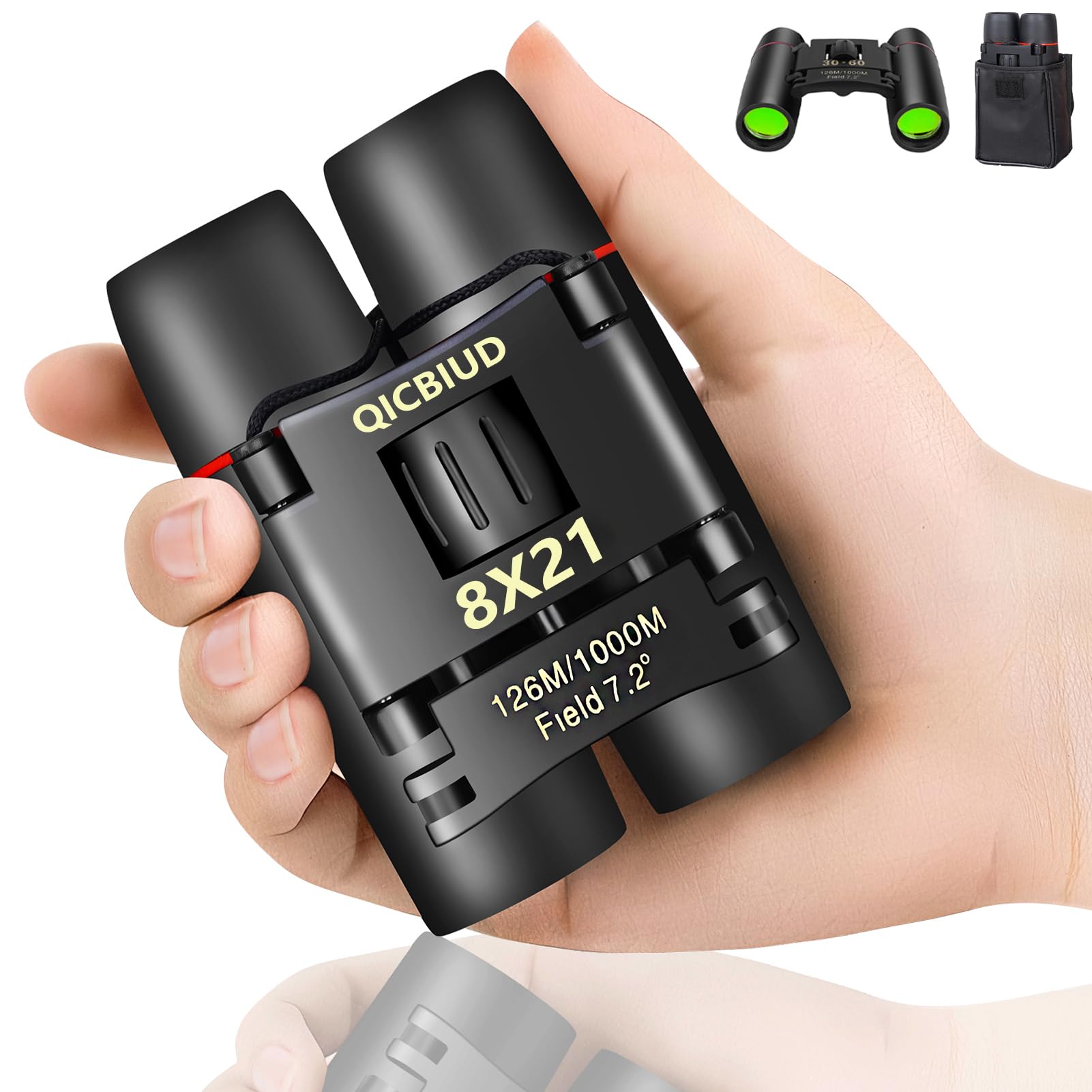
QICBIUD 8x21 Compact

86 /100
LBD Score Excellent

Key details

Body
Aluminum frame, rubber armor
Weight
5.82 oz
Field Of View
415 feet
Magnification
8x21
View on Amazon

For a balcony seat, a school play, or a kid's first pair, this is the one to hand over. It weighs 5.82 ounces, it has an aluminum frame under rubber armor rather than the bare plastic you expect at this level, and it disappears into a coat pocket along with the keys.

Eight power through 21 mm objectives gives a 415-foot field, the widest in this guide, which is exactly what you want indoors: a forgiving view that finds the stage without hunting for it. The kit arrives with a case and a lanyard, and the hinge closes far enough for small faces.

The focus wheel wants slow, small turns. Rush it and you will overshoot sharp, then hunt back for it, which is a small annoyance on a stage and a real one on a moving bird. That is the honest limit of this pair.

So we call it a specialty binocular rather than a starter birding one. If your viewing is indoors, close, and often shared with children, none of the trade-offs reach you; if you want one pair for everything, spend a little more on the Aurosports.

Pros

  • Widest field of view here at 415 feet
  • 5.82 ounces with a metal frame
  • Complete kit with case and lanyard

Cons

  • Soft image at longer distances
  • Focus needs slow, small adjustments
Our verdict

The pair for a balcony seat, a school play or a child's first binoculars, where a tiny body and a wide view matter more than reach.

Check Latest Price
8

Backup and Gifts

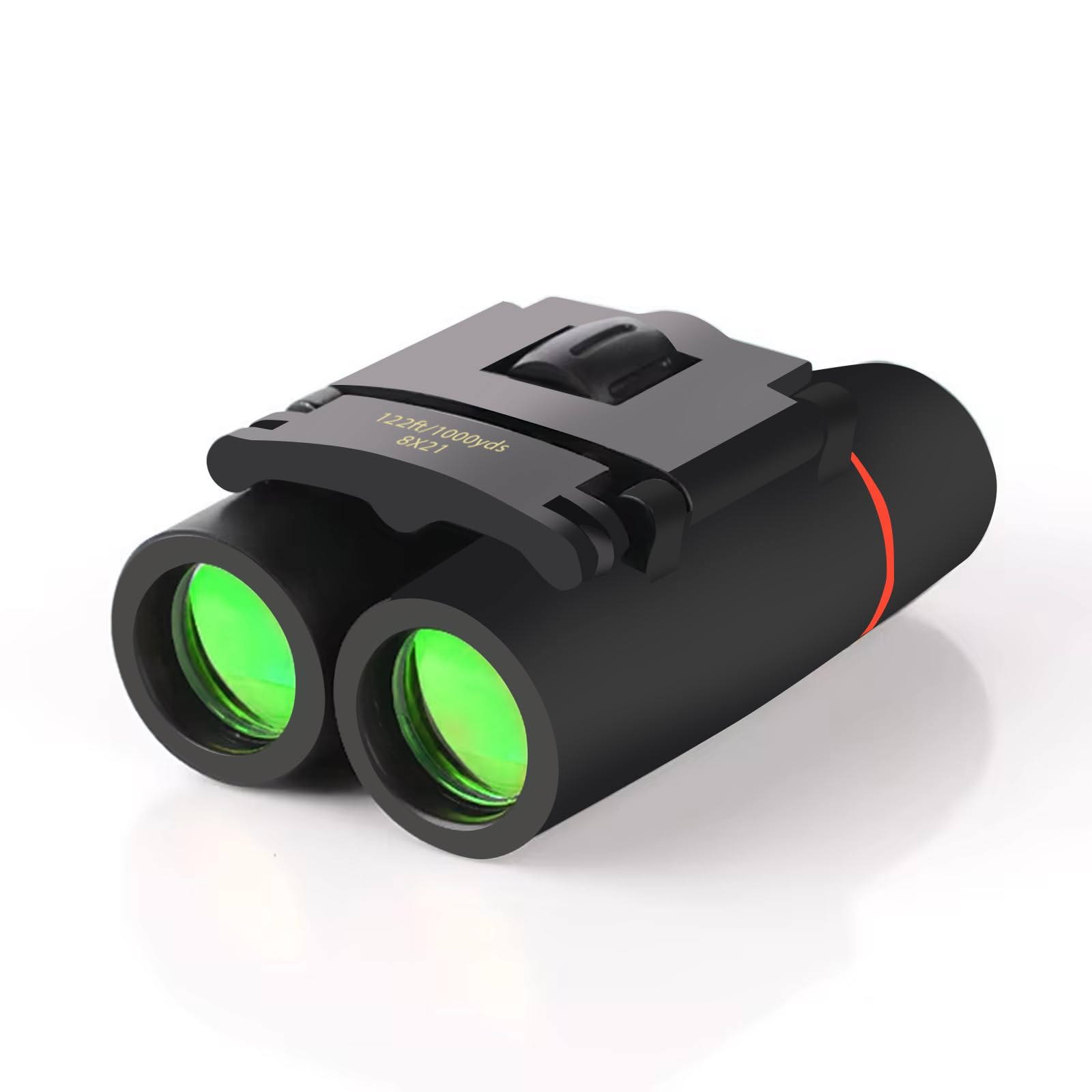
POXXU 8x21 Compact

84 /100
LBD Score Excellent

Key details

Weight
5.82 oz
Exit Pupil
2.63 mm
Field Of View
7.2 degrees
Magnification
8x21
View on Amazon

This is the least expensive binocular in the guide, and it is the one to buy for a glovebox, a boat bag, or a grandchild who has just learned to hold things up to their eyes.

For that money you get 8x21 optics, a 7.2-degree field, and a complete kit: strap, pouch, cleaning cloth, manual, box. At 165 g it is about the heft of a smartphone and one of the two lightest pairs here, and the wide field makes it easy for small hands to find a subject without a hunt.

The view is a daylight view. Twenty-one millimeters of glass does not gather much, so the picture flattens as the afternoon does, and that is true of every pair this size rather than a fault unique to this one.

Where it earns its place is as the second pair in the house. It is the one we reach for when the good glass is staying home, and for a kid, a kayak, or a dashboard that sums up the whole job.

Pros

  • Lowest-priced pair in the guide
  • 165 g, lighter than any 25 mm pair
  • Complete kit included
  • Wide 7.2-degree field for beginners

Cons

  • Splash resistant rather than waterproof
Our verdict

The cheapest pair worth owning: 165 grams of daylight binocular for a glovebox, a boat bag, or a grandchild's first look.

Check Latest Price

How We Tested a Dozen Compact Binoculars

We started with spec sheets, sorting the category by magnification and lens size — the 8x21 and 10x25 configurations that dominate it — then narrowed by prism type and lens coating, since those two lines tell you more about what you'll see than the magnification does. Listings with vague coating language or no eye relief figure got cut. From there we gathered a dozen pairs, from budget models up to a couple hundred dollars, including several reverse-porro designs, so we could judge whether spending more bought anything you could actually see.

Testing happened where people really use these: a backyard feeder at first light and again at last light, the cheap seats at a minor-league ballgame, a whale watch out of a cold harbor, and a few easy hikes. Each pair spent a week riding loose in a tote bag or jacket pocket, and we timed how long it took to unfold and focus one-handed, since that's the whole point of a compact.

At each stop we looked at the same things. A page of newsprint taped to a fence about fifty yards out got read through every pair; we checked the edges for blur and color fringing and counted how many turns of the focus wheel it took to snap in. We handed them to a glasses-wearer to see whether the eyecups and diopter had enough travel, dropped each one from waist height onto pavement, and shook it afterward listening for rattles. The question we kept returning to was whether the pricier pairs were genuinely sharper or just better finished — and in a few cases, they weren't.

How to Choose Compact Binoculars

What 8x21, 10x25, and 12x25 actually mean

The first number is magnification, the second is the objective lens diameter in millimeters, and between them they set everything else. Divide the second by the first and you get the exit pupil: 2.5 mm on a 10x25, 2.6 mm on an 8x21, 3.3 mm on the Vortex 8x26. That is the width of the light cone reaching your eye, and it is a fair proxy for how the view holds up as the afternoon ends.

Ten power is the balance most people can hold steady, which is why it dominates this list. Eight is steadier and brighter; twelve buys reach and charges you in field of view and shake. Whichever you choose, never point it at the sun.

Weight decides whether it leaves the house

The pairs here run from about 5.8 ounces to 12.7, and that spread matters more on an ordinary Tuesday than any optical difference. A light pair gets carried and used; a heavy one steadies the view and then reminds you about it after an hour on a strap. Body type is part of the same decision: a Porro prism like the Hontry's is wider front to back than the Nikon's folding roof prism at almost the same weight.

Decide which you will forgive, the bulk or the wobble, and the shortlist narrows quickly.

Field of view is how you find things

Field of view, quoted in feet at 1,000 yards, separates a pair that finds a bird from one that sweeps past it. The widest here is 415 feet on the little QICBIUD, the narrowest is 273 on the 12x Occer, and most of the 10x pairs sit around 360.

Wide fields flatter beginners and moving subjects; narrow ones suit a fixed target you already have in your sights. Choosing between two pairs at the same magnification, take the wider one.

Eye relief and eyeglasses

Eye relief is how far your eye needs to sit from the lens to see the whole field, and it is the first figure glasses wearers should check. Fifteen millimeters is comfortable behind spectacles; the 10 to 10.6 mm on the Hontry and the Nikon is tight, and the Occer's 20 mm is the most forgiving pair here.

Fold or twist the eyecups down when you wear glasses, then confirm you can see a full circle with no black edging. If you cannot, the binocular is wrong for your face whatever the numbers say.

Sealing, warranty, and the fine print

Waterproof and water resistant are not the same claim, and the gap between them is where cheap binoculars get returned. A nitrogen-purged, o-ring-sealed body like the Vortex's survives rain and will not fog inside when you walk from a cold car into a warm room; a water-resistant body shrugs off a splash and nothing more.

Warranty length follows the same logic: a year on the Aurosports and the POXXU, three on the Hontry, unlimited lifetime on the Vortex Vanquish and the Leupold. If the pair will live outdoors, pay for sealing and cover rather than another half-degree of field.

Frequently Asked Questions

Final Verdict

The Hontry 10x25 is the pair we tell most people to buy: the widest 10x view in this guide, 9.6 ounces in a jacket pocket, and three years of cover at the budget end of the list. Step up to the Nikon ACULON A30 if you bird most weekends and want a cleaner edge and a faster focus.

If your outings start before sunrise or run past sunset, the Vortex Vanquish's 3.3 mm exit pupil is the one figure that matters, and the extra weight is what you pay for it.