Best DECT Headsets of 2026

A DECT headset isn't a Bluetooth headset with a different label. It runs on its own dedicated radio band through a base plugged into your desk phone or computer, which is why it holds a clear call across a warehouse floor while your earbuds drop out at the kitchen door. The base does half the work, and most buyers ignore it.

I've spent years on the phone, and over the past six months my team and I have worn 12 DECT headsets through real workdays: back-to-back calls, video meetings, standing up mid-sentence to grab a file. We noted which left our ears sore by 3 p.m., which batteries survived a full day off the cradle, and which needed a manual to answer a call.

Without a remote answering cable, you're reaching for the desk phone every time it rings; without a visible mute light, coworkers walk up mid-presentation. Wearing style matters too — an earhook that feels fine for an hour can ache by the end of a shift. The picks below are the ones we stopped noticing — the highest compliment a work headset can earn.

1

Best Overall

Leitner LH570

83 /100
LBD Score Excellent

Key details

Warranty
5 years, full replacement
Talk Time
8 hours
Connects To
Desk phone and computer
Wireless Range
Up to 350 ft
View on Amazon

The LH570 has no Bluetooth, and Leitner says so at the top of its own listing: expecting Bluetooth is the most common reason the headset goes back. That is the right warning to lead with. If one headset has to cover a desk phone, a laptop and your cell phone, this is not it. If your day splits between a desk phone and a computer, the design is exactly right, and a button on the base moves you between the two.

Setup is the part we expected to cost an afternoon, and it does not: two cables, a base, and you are on a call. What this headset does best is the unglamorous part — people on the other end hear you clearly, the noise-cancelling microphone keeps an open office out of the conversation, and the 350 feet of DECT range covers a walk down the hall without a crackle. There is also a small indicator light on the earpiece that tells colleagues you are on a call, the same idea as the busylight on the Yealink models and just as useful in an open room.

The five-year full-replacement warranty is what settles it for us. Two years is the norm in this set, and a replacement beats a repair queue when the thing you talk for a living on stops working. Add compatibility with the major desk phone brands and with Teams on the computer side, and the higher price reads as insurance rather than markup.

Pros

  • Desk phone and computer on one base, one-button switching
  • Five-year full-replacement warranty
  • Setup is cables, not software configuration
  • Clear voice and strong microphone noise rejection

Cons

  • Single-ear design only, with no stereo version
  • Eight hours of talk time is mid-pack in this set
Our verdict

Buy this if your working day runs between a desk phone and a computer; it is the most complete, best-supported version of that headset here.
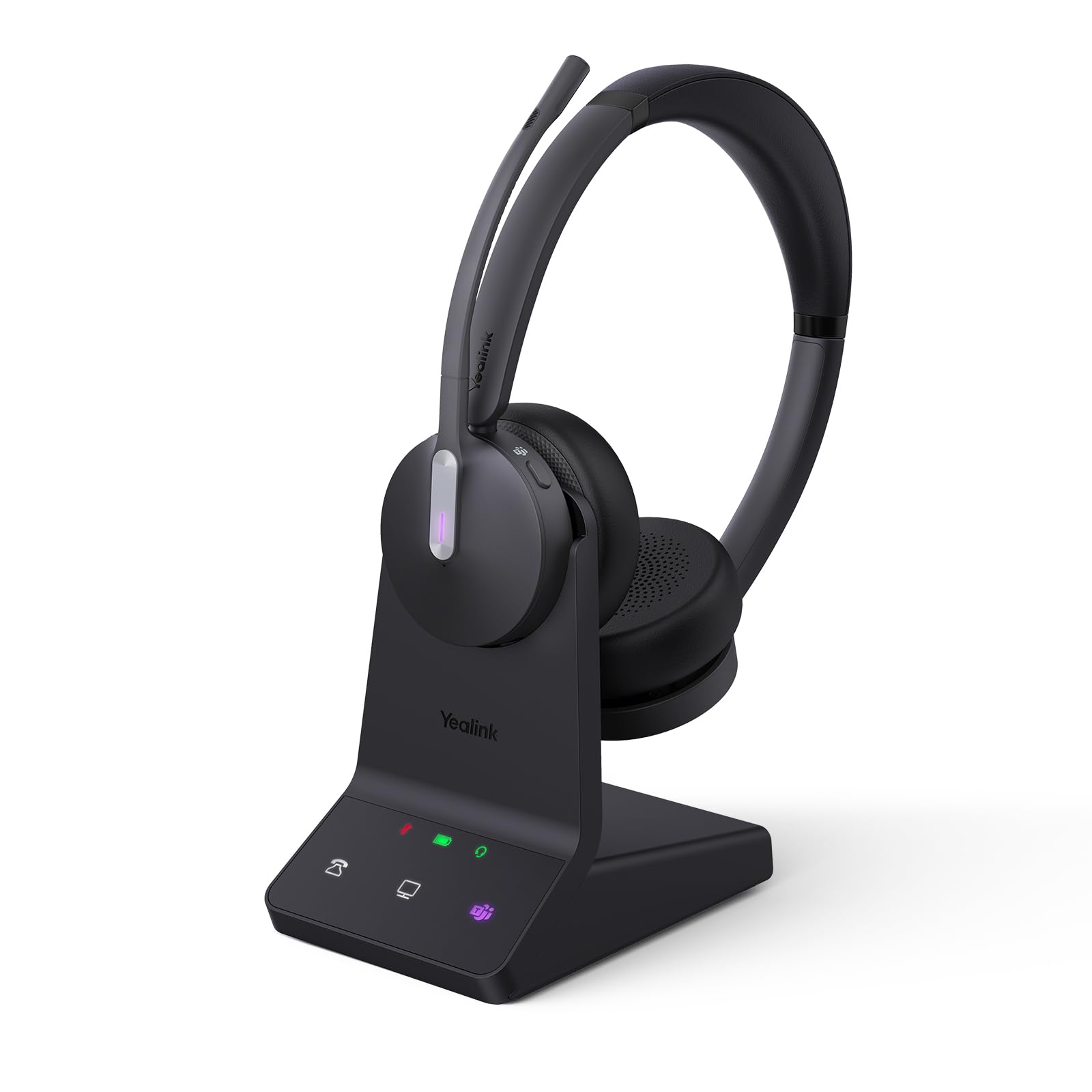
Check Latest Price
2

Best DECT Bluetooth Hybrid

Yealink WH64 Dual

80 /100
LBD Score Excellent

Key details

Range
Up to 606 ft
Battery
16 hours DECT, 32 hours Bluetooth
Wireless
DECT and Bluetooth 5
Wearing Style
Dual-ear stereo
View on Amazon

Six hundred and six feet is the range Yealink claims for the WH64, the longest figure in this set. What that buys is the walk to the printer, the stockroom or the far end of the floor without the call breaking up — the kind of thing you stop thinking about once it works.

Dual-mode is why this is our pick for hybrid work. DECT handles the desk phone and the computer; Bluetooth 5 takes your cell phone; and moving between them does not mean re-pairing. It is stereo as well, and we take a dual-ear headset over a mono earpiece in a loud office — the cups cut the room down, the DECT side runs 16 hours in stereo, and 32 hours of talk time in Bluetooth mode means it is not living on the charger.

The wrinkle is the laptop. Compatibility trouble clusters on Dell machines, so pair it with your own laptop inside the return window and test the microphone on a real call rather than a test tone. Everything else holds up: comfortable across a long shift, a busylight doing the do-not-disturb work, and a base whose touch controls are quicker than hunting for a button on the headset.

Pros

  • DECT and Bluetooth in one headset
  • Longest range here at 606 ft
  • 16 hours on DECT, 32 hours on Bluetooth
  • Stereo cups and comfortable over a long shift

Cons

  • Bluetooth reach is about 50 m, far short of the DECT figure
Our verdict

The one to buy if your calls land on a desk phone, a laptop and a cell phone, and you want the longest DECT reach of anything here.

Check Latest Price
3

Best Mono for Long Shifts

Yealink WH62 Mono

79 /100
LBD Score Very Good

Key details

Range
Up to 525 ft
Talk Time
13 hours
Connects To
IP phone and computer
Wearing Style
Mono on-ear
View on Amazon

Some jobs need an ear free. If colleagues appear at your desk while a customer is on the line, or you are listening for a door, a mono headset beats stereo — and the WH62 is the mono DECT headset we recommend first, with 13 hours of talk time, 525 feet of range, and Teams certification so the answer button does what it says.

The dual noise-cancelling microphones are what earn their keep. On a call from a room with other conversations going, your voice arrives without the room attached, and the busylight saves you from the tap on the shoulder. Connection is the thing to watch: when this one misbehaves, it is the microphone going dead until you re-seat the cable at the base, so keep the base somewhere you can reach without crawling under the desk.

Thirteen hours is the practical argument over the LH570 and the CS540: a shift plus overtime fits inside one charge, and a lunchtime top-up stops being mandatory. It is also among the least expensive routes into a certified DECT headset here, which is why it is the one we point at a first desk being set up from scratch.

Pros

  • Thirteen hours of talk time on a charge
  • 525 ft of DECT range
  • Teams certified with a busylight
  • Mono design keeps one ear on the room

Cons

  • No Bluetooth for a mobile phone
  • Voice-first audio, not a music headset
Our verdict

Buy it if people walk up to your desk mid-call and you need an ear free, as long as voice calls are all you ask of a headset.

Check Latest Price
4

Best for Multi-Device Desks

Jabra Engage 75 SE

79 /100
LBD Score Very Good

Key details

Range
Up to 490 ft
Devices
Up to 5 at once
Talk Time
13 hours
Wearing Style
Dual-ear over-ear
View on Amazon

Five devices is the number that separates the Engage 75 SE from everything else here. The WH64 keeps two in play; this one holds a desk phone, a softphone and a couple of mobiles at once, and whichever one rings lands in the same headset.

It is built like office equipment in the good sense — over-ear cups, a stainless steel and polycarbonate frame, a busylight that tells the room you are on a call, and 13 hours from a 90-minute charge. The 490 feet of range sits behind only the two Yealink picks, and it is more than a floor of cubicles asks for.

What you are paying for is device handling, not miracle audio. This is the headset for someone who takes a customer call on the desk phone, follows up on the softphone and then dials out from a mobile in the same hour. The noise-cancelling microphone is the part to temper expectations on: it is aimed at office chatter, and a dog barking two feet away is a different problem.

Pros

  • Up to five devices connected at once
  • Thirteen hours from a 90-minute charge
  • 490 ft range with a busylight
  • Clear call audio on a dual-ear over-ear build

Cons

  • Noise-cancelling mic is aimed at office chatter, not loud rooms
Our verdict

Worth it for someone juggling a desk phone, a softphone and a mobile at once, and overkill for a desk with one phone on it.

Check Latest Price
5

Desk Phones

Poly CS540 with HL10

86 /100
LBD Score Excellent

Key details

Range
Up to 400 ft
Talk Time
6 hours
Wearing Styles
Three, convertible
Remote Answering
HL10 handset lifter
View on Amazon

The HL10 is a small arm that physically lifts the handset off your desk phone when you press the button on the headset. Low-tech, slightly ridiculous, and the reason the CS540 works with desk phones that a USB headset cannot touch — no EHS cable, no compatibility chart, no IT ticket.

Reliability is the strongest case for it and one of the steadiest records in this set, which is why the design has stayed on desks for years. Setup reflects that: cable to the phone, lifter under the handset, and you are answering calls from the far end of the building. The 400 feet of range covers a warehouse or a large house without drama.

Wearing style is the part worth thinking about before you order. The earpiece-only setup suits some ears and not others, so the box also includes over-the-head and behind-the-head bands, and swapping takes about a minute. If earbuds have never stayed put for you, start with the headband and skip the experiment.

Pros

  • HL10 lifter brings remote answer to nearly any desk phone
  • 400 ft of roaming range
  • Three wearing styles in the box
  • One of the steadiest reliability records here

Cons

  • Desk phone only, with no computer connection
  • Six-hour talk time is the shortest in this set
Our verdict

The desk-phone headset to beat if there is no computer in your working day, and the wrong buy the moment a softphone appears.

Check Latest Price
6

Poly VVX Phones

INNOTALK Polycom Headset

80 /100
LBD Score Excellent

Key details

Range
300 ft
Talk Time
12 hours
Remote Answering
EHS cable included
Compatible Phones
Poly VVX and SoundPoint
View on Amazon

The bundle is the pitch, and it is the right one: a DECT headset plus the EHS cable that lets you answer and hang up on a Poly VVX phone without touching the handset. Buy a headset without that cable and you are still lifting the receiver, so the accessory is what turns the purchase into something you can actually work from.

Setup takes minutes. The cable goes into the phone's headset port, the base gets power, and the answer button works — that is the whole job, and it is the part this one gets right. Voice on the far end is clear enough for support calls, 12 hours of battery covers a shift, and the 300 feet of range is the shortest reach here but plenty for a single floor.

What it does not do is travel. For a Polycom desk that is staying put, this is the least fiddly way to walk the office without missing a call for the money. If there is a computer in the picture too, the LH570 covers both, at a higher price.

Pros

  • EHS cable included for remote answer and end
  • Quick setup on Poly VVX phones
  • Twelve hours of battery
  • 300 ft of roaming range

Cons

  • Poly desk phones only
Our verdict

Buy it only if the phone on your desk is a Poly VVX, where the bundled EHS cable makes it the least fiddly way to cut the cord.

Check Latest Price

How We Tested DECT Headsets

We started by narrowing the field to headsets that genuinely connect to a desk phone, not just a computer — a far shorter list than the shelf suggests. From there we filtered on whether the base supports remote answering through an EHS cable, whether the model comes in mono, stereo, or convertible, how it charges, and what each brand claims for range. That left 12 headsets, which we put into service for six months.

Setup came first: I timed how long it took from unboxing to a working dial tone, including whether the base recognized the desk phone on its own or needed the cable, and flagged anything that demanded a support call. For sound, I left myself voicemails on each one and played them back on studio headphones, then asked the person on the other end how I sounded on a quiet line versus with a keyboard clacking and a coworker talking behind me.

Comfort got judged the slow way — full eight-hour shifts, with notes on ear soreness, headband pressure, and how hot the earpads ran by midafternoon. I ran each battery flat off the cradle with a stopwatch, timed the recharge, and walked away from the base through doorways and around corners until the audio broke up. At the end, every headset went into a tote bag with a laptop and a water bottle, took a few knocks off a desk edge, and had its boom arm adjusted more times than I can count.

Value came last, and it decided more than one close call: an enormous range claim doesn't earn its price if you never leave your desk.

How to Choose a Dect Headset

Start with the base, not the earpiece

The part you wear is the visible half of a DECT system; the base is the half that decides whether it works. Desk phones connect through a handset-port cable, sometimes with an EHS cable or a mechanical lifter so the headset button can answer and hang up. Computers connect over USB. If your day splits between the two, buy a base that handles both and switches with a button, the way the LH570 does.

Check the seller's compatibility list against the exact model number on your phone before you order. If your phone is not on that list, it is not compatible, no matter how similar the brand looks.

DECT is not Bluetooth

This is the misunderstanding that gets headsets sent back. DECT is a dedicated radio link to a base station, which is why the range is measured in hundreds of feet and why audio stays steady when the office Wi-Fi is busy. It also means a plain DECT headset cannot pair with your cell phone at all.

If a mobile has to be in the mix, buy a dual-mode model — the WH64 Dual and the Engage 75 SE both add Bluetooth alongside DECT. If your working life is a desk phone and a computer, DECT-only is the simpler and usually cheaper buy.

Treat the range figure as a ceiling

Every range number here was measured in open air, and drywall, metal shelving and a couple of floors all eat into it. That is fine, because the practical question is narrower than the specification: where do you actually walk mid-call?

A kitchen, a hallway and the printer are all inside a hundred feet, and even the shortest reach here covers that comfortably. Pay for the big number only if you genuinely leave the floor, and otherwise put the difference into battery life or a better microphone.

Count your call hours before you count features

Talk time across this set runs from six hours to sixteen in DECT mode, and that gap matters more than most spec-sheet differences. Someone on back-to-back calls all day wants thirteen hours or better so the headset is not dying at four in the afternoon.

The base doubles as the charger, which only helps if you actually dock it between calls. Remember the batteries are not the kind you swap mid-shift: how long a headset stays useful is decided by the cell inside it and by what the warranty says about that cell.

Mono, stereo or convertible

Mono keeps one ear on the room, which is why it is still the default where people walk up to your desk; stereo cuts the room down and suits an open plan or a job where you are listening hard for detail. Convertible headsets put the choice in the box — the CS540 ships with earhook, headband and behind-the-head options.

If earbuds have never stayed in your ear, do not buy a headset that depends on one. Buy the one with a headband and skip the experiment entirely.

Frequently Asked Questions

Final Verdict

The Leitner LH570 is the headset we point most people at, because it covers the two things a working desk actually has — a phone and a computer — and backs that with a five-year replacement warranty nothing else here matches.

If a cell phone belongs in the mix, buy the Yealink WH64 Dual instead and test it on your own laptop inside the return window. And if the desk phone is the only device you will ever use, the CS540 and its lifter remain the simplest thing that works.