Best Electric Bikes for Kids of 2026

An electric bike hands a kid two things at once: a throttle and a consequence. That first twist gets a grin no pedal bike can produce, and it raises the only question that really matters — whether the brakes, the frame, and the rider are ready for it. Get it right and you have a kid who wants to be outside, moving at the speed the rest of the family is already moving.

We've spent five months with 12 of them and riders aged 3 to 11, on a driveway, a dead-end street, a park path, and one long-suffering strip of grass. Top speed isn't what separates the good ones — the lowest speed mode is. A gentle first gear and a limiter a parent can actually set beats three extra miles per hour every time, and a UL 2272 label on the battery and charger is the difference between a toy and a vehicle.

Every one also arrived flat-packed and got built on a Saturday morning, which is where the assembly notes below come from. Here's what held up to the grass, the curbs, and the kids.

1

Best Overall

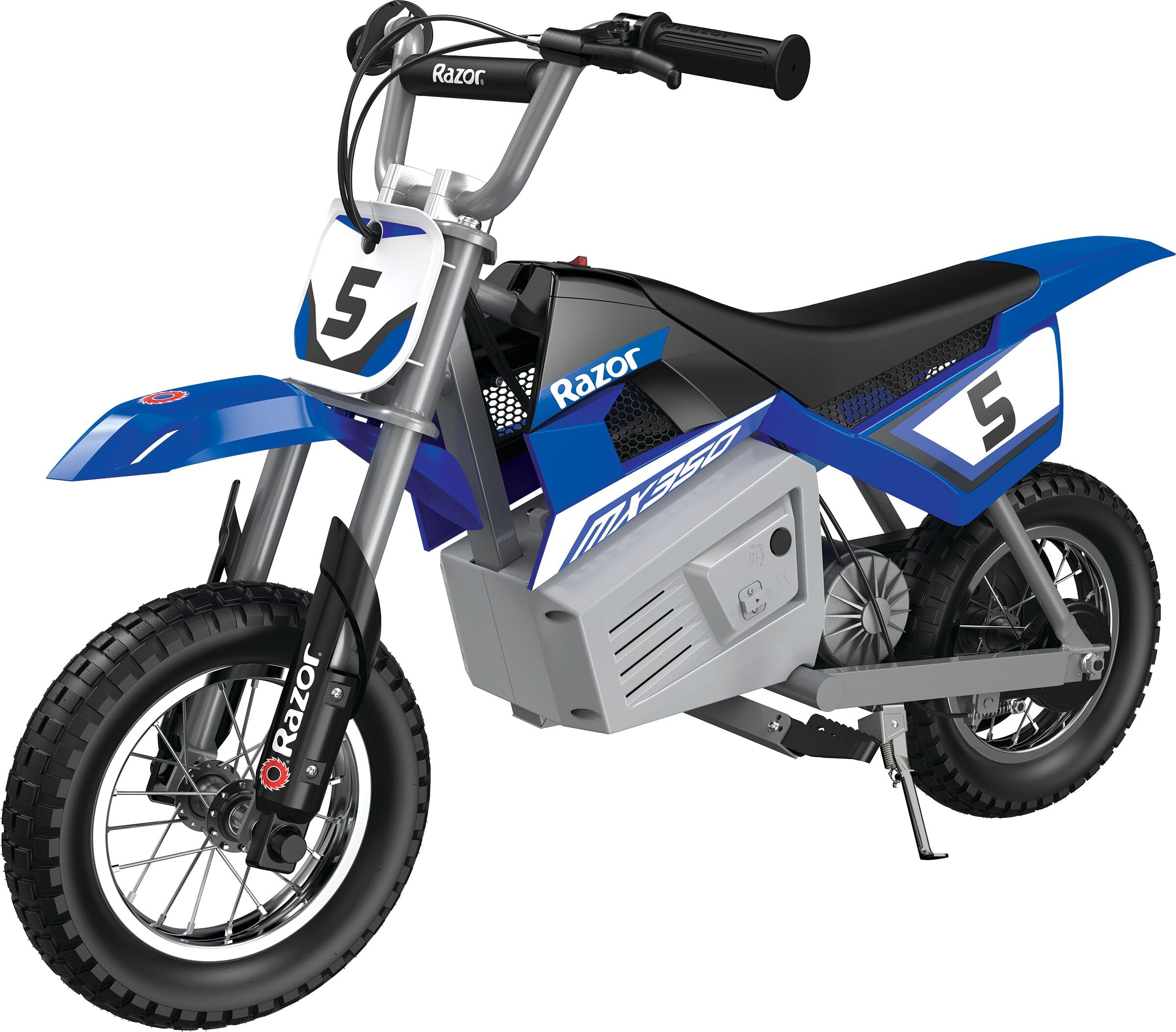
Razor Dirt Rocket MX350

93 /100
LBD Score Outstanding

Key details

Battery
24V sealed lead-acid
Top Speed
Up to 14 mph
Speed Settings
High/low switch
Max Rider Weight
200 lb
View on Amazon

The switch on the left bar is the most useful thing about the MX350. Flick it to low and the 14 mph high setting is off the table, which is the difference between handing a dirt bike to an 8-year-old who has never touched a throttle and handing one to the 11-year-old who has. That control is why this is our default pick: it is a real machine that can be dialed back. Around it sits a scaled-down motocross frame with 12-inch spoked wheels on pneumatic tires, adjustable riser bars, a retractable kickstand and a hand-operated rear brake.

The 200 lb rider limit is the number we keep coming back to. It is not a toy figure — a parent can take a turn, the bike survives a growth spurt, and two siblings of different sizes can share it. It also weighs about 55 lb, so it lives in the garage and goes into a truck bed with an adult lifting it, not a kid carrying it up the stairs.

The 24V pack is sealed lead-acid rather than lithium, and that shapes the weekly routine. You get up to 60 minutes in the low setting, and the bike wants to go back on the charger after a ride rather than be run flat and parked for a month. Charging discipline is the cheapest way to postpone the day the pack needs replacing.

Two practical notes from running it. It arrives set to the high setting, so flip the switch before your kid ever sees the bike. And the chain ships close to tension and then drifts — a slack chain is what jumps the sprocket on rough ground, so check it before a weekend rather than after a derailment.

Pros

  • High/low switch tames the 14 mph top speed
  • 200 lb limit spans siblings and adults
  • Motocross frame, spoked wheels, pneumatic tires
  • Up to 60 minutes in the low setting

Cons

  • Sealed lead-acid pack is heavy for its capacity
  • Frame runs small for riders near five feet
Our verdict

Our default for a reason: the high/low switch lets one bike suit a cautious 8-year-old and a confident 11-year-old, and the 200 lb limit means it lasts.

Check Latest Price
2

Best for Younger Riders

Hiboy DK1

83 /100
LBD Score Excellent

Key details

Battery
36V lithium
Top Speed
15.5 mph
Speed Modes
5, 7.5, 15.5 mph
Max Rider Weight
140 lb
View on Amazon

Three thumb-selected modes do the work here: 5, 7.5 and 15.5 mph. The slowest is slow enough that a five-year-old can learn throttle control in a driveway without the bike running away, and the top one is genuinely brisk for a 38 lb machine. Hiboy sells the DK1 for ages 3 to 10, which is a wide net, and the mode ladder is how that net holds — the bike changes as the rider does instead of being outgrown in a season.

What sold us is that ladder paired with a 36V lithium pack and a 140 lb rider ceiling. Lithium means no memory games and a pack that doesn't weigh the bike down, and the suspension — a hydraulic fork up front, a spring at the back — soaks up curb drops and gravel in a way the rigid bikes here don't. Assembly is short too, effectively bars and a front wheel, which matters on a birthday morning.

The range claim needs translating. Ninety minutes is measured with an 88 lb rider at 9.3 mph; a heavier kid on high mode will see considerably less. That is true of everything in this category rather than a knock on this bike, but it means planning rides in blocks and putting it back on the charger instead of expecting a whole afternoon out of it.

What is thinner is the hardware around the motor. The chain guard and the tires are the parts that give trouble first, and neither is expensive to replace if you can get them — so register the warranty, keep the manual, and order spares before you need them. The frame and the ride itself have held up.

Pros

  • Three modes starting at a genuine 5 mph
  • 36V lithium pack keeps the weight down
  • Hydraulic fork and rear spring suspension

Cons

  • Chain guard and tires wear before anything else
  • 38 lb is a lot for a small rider to pick up
Our verdict

Buy this if your rider is 5 to 9 and you want a genuine 5 mph starting mode, a lithium pack and real suspension instead of a rigid frame.

Check Latest Price
3

Best Electric Balance Bike

Hiboy BK1

82 /100
LBD Score Excellent

Key details

Battery
21.6V, up to 4.9 miles
Top Speed
9 mph
Speed Modes
5.6 and 9 mph
Max Rider Weight
77.2 lb
View on Amazon

The BK1 won't move until your kid pushes. Kick off the ground, get rolling, then press the throttle — and when the thumb comes off, the motor drops out. We think that sequencing is the whole reason this works for a three-year-old: it teaches balancing and coasting first, with the motor arriving as a reward rather than as a substitute for scooting.

Two numbers define it: 20 lb and 77 lb. The first is what a preschooler has to right after a tip-over, and it makes this the most manageable machine here for very small hands. The second is the rider ceiling, which puts it firmly in the small-kid lane rather than in hand-me-down territory for a second-grader. A 150W peak motor, a 9 mph top speed and 12-inch tires keep it in that lane, and we appreciated that the front brake is a real V-brake and the low mode sits at 5.6 mph.

Range is where to size expectations: about 4.9 miles, which is several laps of a park and a ride to the corner. A full charge takes three to four hours, and the IPX4 rating means a damp driveway is fine but standing water is not. There's no kickstand, so it rests against whatever is close by — and the thing to confirm in the first ten minutes is that it powers on and pulls, which is why we would buy it somewhere with a straightforward return.

Pros

  • Kick-off start teaches balance before throttle
  • 20 lb is manageable for a preschooler
  • Front V-brake and two low settings

Cons

  • Short 4.9-mile range limits longer outings
  • No kickstand for rest stops
Our verdict

This is the one we hand a preschooler: the motor only engages after a kick-off, so balance comes first and the throttle comes second.

Check Latest Price
4

Best Premium Balance Bike

STACYC 12eDRIVE

86 /100
LBD Score Excellent

Key details

Battery
2Ah, up to 60 min
Bike Weight
17 lb
Power Modes
3, plus motor-off
Max Rider Weight
75 lb
View on Amazon

The 12eDRIVE ships with a mode that turns the motor off completely, and that is where a family should start. Hand a three-year-old a 17 lb bike with a dead throttle, let them push and coast and work out leaning, then step up through the three power levels. It is the most thoughtful progression here.

A TIG-welded aluminum frame and a BMX-style fork are how it gets to 17 lb, and that lightness is the argument. A kid can pick it up; a parent can carry it under one arm along with everything else. There is a drum brake that is smooth for small hands, a battery that swaps with a quick-disconnect lever rather than a screwdriver, and coverage that runs five years on the frame and fork.

Runtime is quoted at up to 60 minutes from a 2Ah pack, with 30 to 60 minutes to charge, so a second pack is a realistic purchase for a long park day. The ceiling is 75 lb — roughly age five for most kids — which means this is a two- or three-year bike rather than something that gets handed down to a much older sibling.

Which brings us to the question everyone asks about this one: it is the most expensive bike in this guide by a wide margin. Our read is that the aluminum, the motor-off mode and the five-year frame warranty make the premium defensible if the bike will be ridden hard and then passed to a younger sibling. If it is a one-summer experiment for a four-year-old, the Hiboy BK1 does the essential job for far less.

Pros

  • Motor-off mode before any powered riding
  • 17 lb aluminum frame and BMX-style fork
  • Five-year frame and fork warranty

Cons

  • Highest price in this set by a wide margin
  • 75 lb ceiling means a short ownership window
Our verdict

Worth the premium if the bike will be ridden hard and passed down: 17 lb, a motor-off learning mode and five years of frame coverage.

Check Latest Price
5

Best for Neighborhood Rides

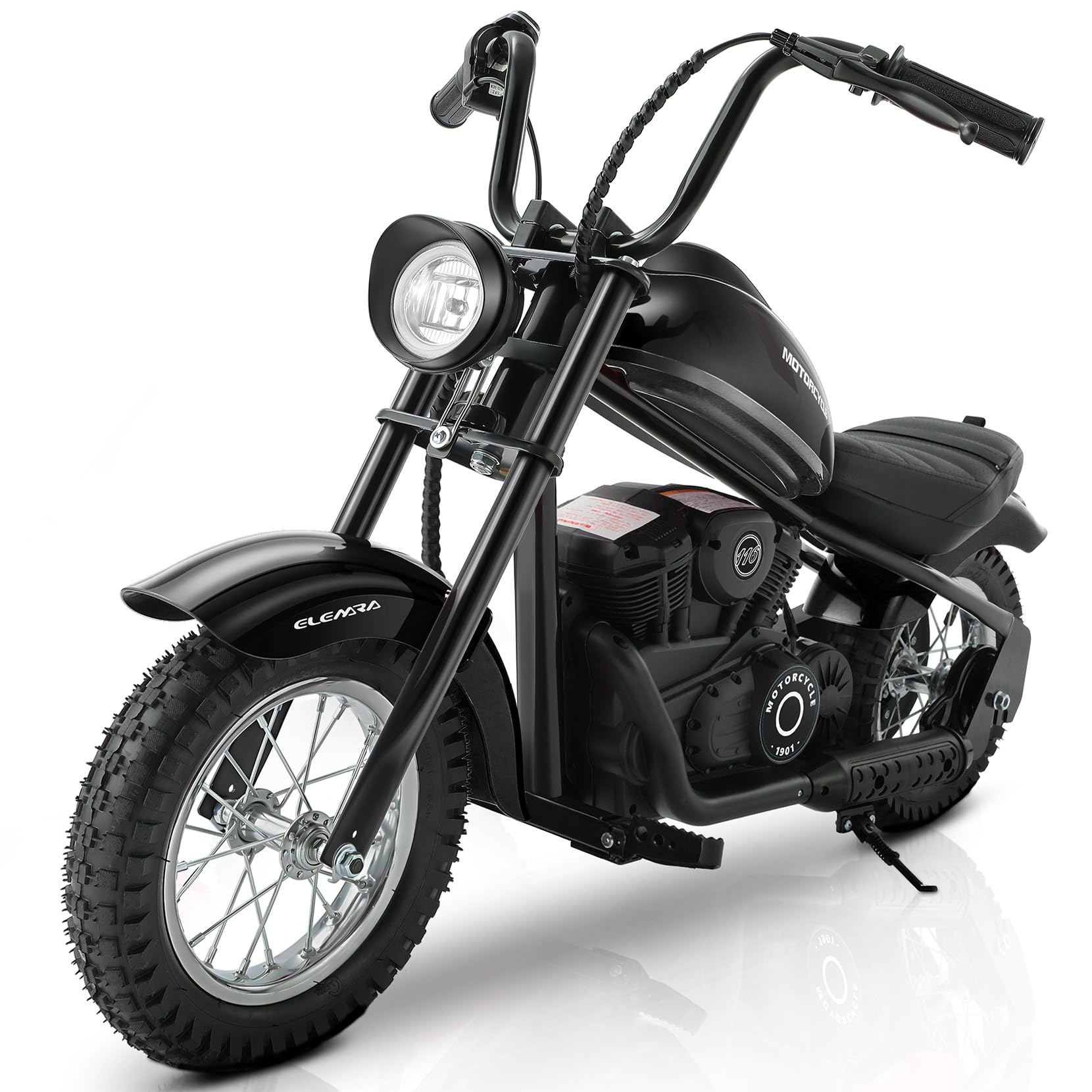
ELEMARA Electric Dirt Bike

88 /100
LBD Score Excellent

Key details

Tires
12 in air-filled
Max Range
10 miles
Top Speed
15 mph
Max Rider Weight
150 lb
View on Amazon

Think of this as a bigger, better-lit alternative to our top pick. The 48.7 lb is the first thing you notice — this is a bike that lives against a garage wall, not one a kid drags out of a shed — and what the weight buys is a 24V 250W chain-driven motor, 12-inch air-filled tires, spring shocks under the seat, LED lights and a power display.

Top speed is 15 mph with two settings, so there is a gentler option for the first week and a faster one after that. Range runs to about 10 miles, and the air-filled tires working with the rear springs take the sting out of roots and gravel in a way the rigid bikes here cannot.

The detail we did not expect to value as much as we did is the power display. Kids ride until the bike stops, and a visible gauge turns a dead battery into a two-bars-left warning, which is a better end to an afternoon than carrying a dead bike across a field. Add the lights and this is the most complete package here for neighborhood and park riding.

The trade-offs follow from the size. Nearly 50 lb is a load to lift into a trunk, and 15 mph on a bike this tall wants a rider who is already comfortable on two wheels rather than a first-timer. Two speeds and a hand brake is a simple, durable arrangement, but it is not the three-mode ladder that makes the Hiboy easier to hand to a smaller kid.

Pros

  • LED lights and a visible charge gauge
  • 10-mile range on 12-inch air-filled tires
  • Spring shocks soften gravel and roots
  • 150 lb limit covers a wide age spread

Cons

  • 48.7 lb to lift and store
  • Only two speeds, with no middle setting
Our verdict

Our pick for neighborhood miles: lights, a charge gauge, air tires and a 150 lb limit make it the easiest big-kid bike to live with.

Check Latest Price
6

Best Budget

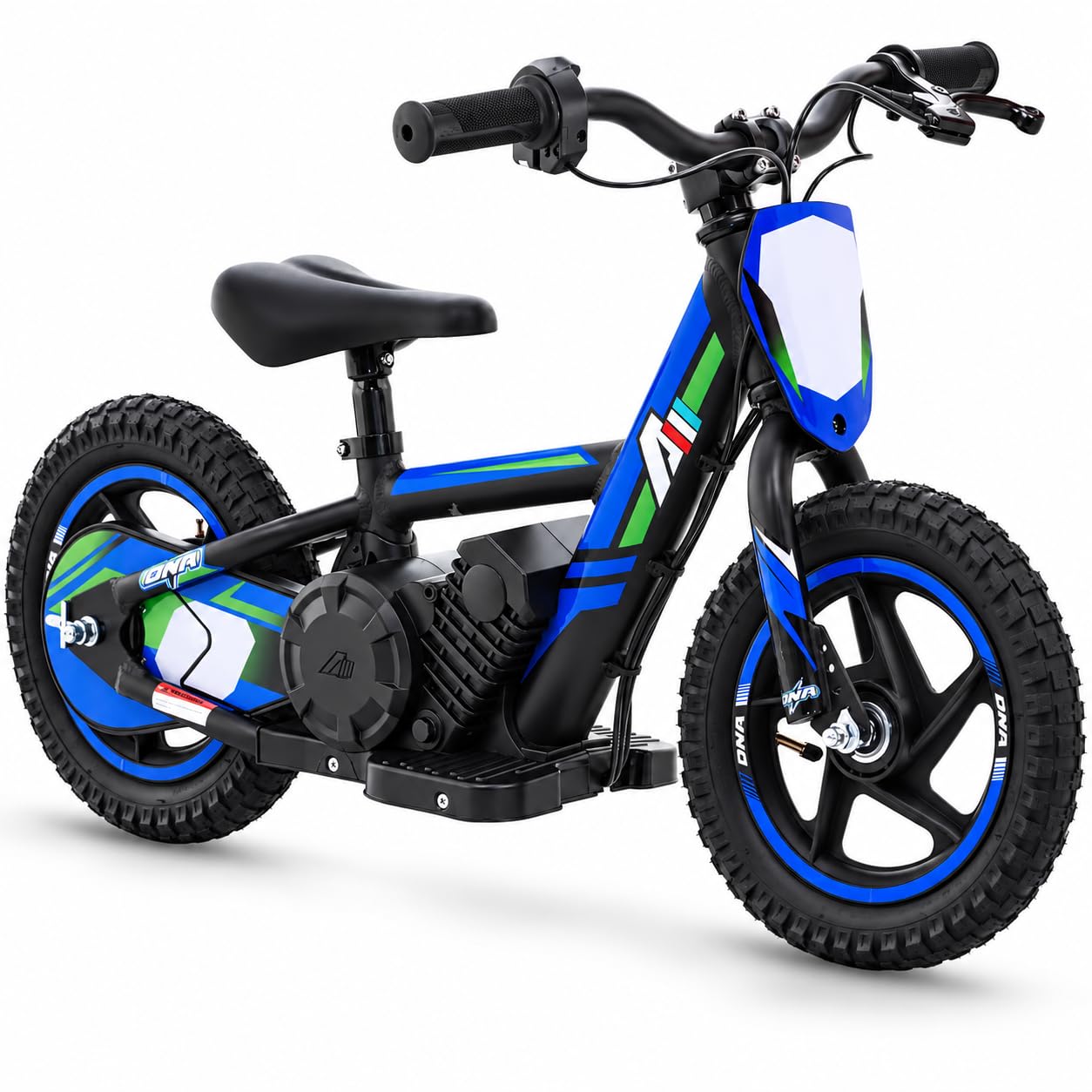
AIII Kids Electric Dirt Bike

83 /100
LBD Score Excellent

Key details

Tires
12 in inflatable
Battery
24V, removable
Top Speed
10 or 12 mph
Bike Weight
23.2 lb
View on Amazon

At 23.2 lb, this is the lightest full dirt bike in the group — light enough that a five-year-old can right it after a tumble, and light enough that you will actually put it in the back of the car. That is why it earns a place: nothing else here is this easy to live with at this size, and it does not feel like a cut-rate toy while doing it.

The listing spans two builds, and it is worth checking which one you are ordering: 170W with a 10 mph top speed for the younger end, or 340W and 12 mph. Either way you get a 24V 2.6Ah pack that comes out of the frame and charges indoors, which is a real convenience in a cold garage, plus 12-inch inflatable tires and a rear drum brake on a lever sized for small hands.

Claimed run time is 40 to 60 minutes. The seat height adjusts, which is the difference between a bike that fits this summer and one that still fits next summer, and assembly is short enough to finish on the morning of a birthday.

Two things to know before you order. The speed control is effectively two gears and the step between them is bigger than on the three-mode bikes here — the jump from walking pace to full speed happens all at once. And the battery is the part that can let you down, with packs that stop taking a charge being the failure to plan around; buy where returns are straightforward, and do not store it flat through the winter.

Pros

  • 23.2 lb
  • Battery comes out to charge indoors
  • Adjustable seat grows with the rider

Cons

  • Two speeds with a large step between
  • Battery can stop taking a charge
Our verdict

The lightest dirt bike here, with a battery you can carry indoors — the right first powered bike for a small rider who has to handle it alone.

Check Latest Price
7

Ages 3-8

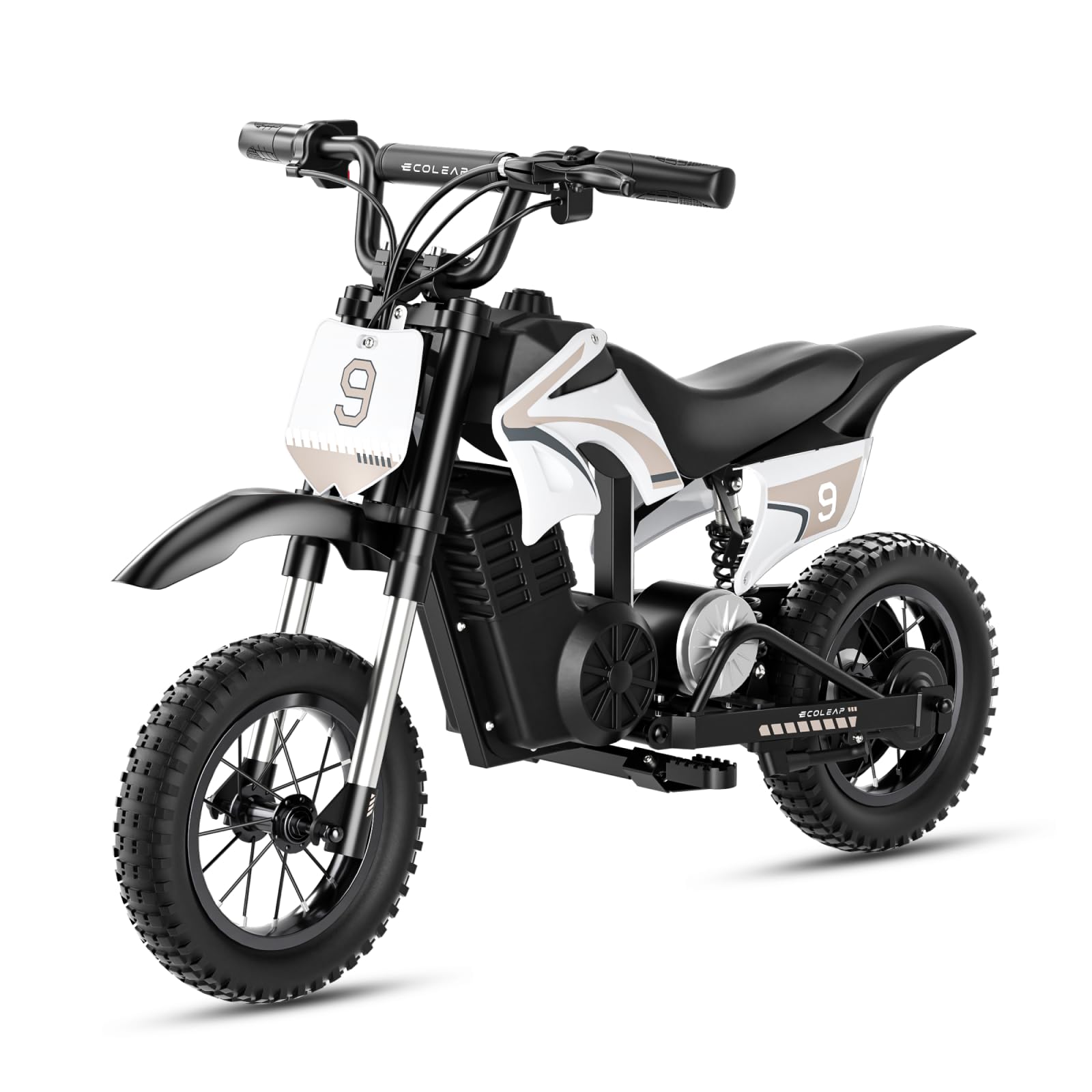
ECOLEAP K1

83 /100
LBD Score Excellent

Key details

Max Range
14 miles
Top Speed
16 mph
Certification
UL 2272
Max Rider Weight
176 lb
View on Amazon

The UL 2272 label is the sort of detail that never shows up in the product photos and matters more than the graphics. It certifies the electrical system — battery, charger, controller — and on a machine storing this much energy under a child, it is the first thing we look for. Only two bikes here carry it.

Behind the plastics is a 36V 5.2Ah lithium pack with a battery management system, a motor rated to a 700W peak, three speed modes topping out at 16 mph and a claimed 14 miles of range. The suspension is real rather than decorative: an inverted spring fork up front, a shock at the rear, and a parking brake on the lever. Rider ceiling is 176 lb and the age band runs 3 to 8.

Fit is where it earns attention. A 176 lb ceiling and a 3-to-8 age band mean a small five-year-old and a tall eight-year-old can share one machine, and the three modes give each of them a setting that is not frightening. Of everything here, this is the bike that handles a family with a wide spread of kids best.

The caveat is longevity at the back end. Tires, the chain and the front shock are the parts that come up as trouble, and a chain that jumps is the failure that shows up most often on an otherwise solid bike. Tensioning a chain is a maintenance job rather than a design flaw, but on a bike sold to families with young riders it is why this sits below the picks above.

Pros

  • UL 2272 certified electrical system
  • 176 lb ceiling and a 3-to-8 age band
  • Three modes topping out at 16 mph

Cons

  • Chain needs frequent retensioning
  • Tires and front shocks wear early
Our verdict

A certified electrical system and a 176 lb ceiling make this the family bike for a wide spread of kids, provided you will keep after the chain.

Check Latest Price
8

Ages 5-14

isinwheel A14

84 /100
LBD Score Excellent

Key details

Tires
14 in pneumatic
Max Range
14 miles
Top Speed
17 mph
Speed Modes
5, 8, 17 mph
View on Amazon

Fourteen-inch tires put this in a different class from the rest of the group. Everything else here rolls on twelves; the A14 rolls on pneumatic fourteens with deep tread, and with the front air fork and rear spring it is built for roots, gravel and uneven ground rather than a smooth driveway. It is also the fastest bike here, at 17 mph.

Three speeds — 5, 8 and 17 mph — give a rider somewhere to start, and the LCD shows which one is selected. Dual brakes pull it down from speed, and the battery is quoted at up to 14 miles or 88 minutes of riding, which is a genuine afternoon rather than a lap of the block.

Then there is the equipment list, which is longer than anything else here: a key start, a headlight, ambient lights that change color with the selected speed, and Bluetooth for music. Some of that is a gimmick and some of it is genuinely useful — a key start means the bike is not rideable by whoever finds it in the yard.

Our read is that this is the pick for a 10- to 14-year-old who has outgrown the smaller bikes and wants something that feels like equipment rather than a toy. The size and the tires are the argument. The 17 mph top speed is not, at least not for a first bike; that is a setting for a rider who has already spent a season on something slower.

Pros

  • 14-inch pneumatic tires handle rough ground
  • Three speeds from 5 to 17 mph
  • Dual brakes and dual suspension

Cons

  • 17 mph top speed suits experienced riders only
Our verdict

For a 10- to 14-year-old who has outgrown the small stuff, the 14-inch tires and three speeds make this the most capable bike here.

Check Latest Price

How We Tested the Best Electric Bikes for Kids

We started with a list of more than 40 kids' electric bikes and cut it down using things a parent can check: a UL 2272 listing for the battery and charger, a hand brake rather than a coaster brake, a seat that adjusts, and a published weight limit that matched the rider. That left 12, which we bought at retail so no one could send us a tuned-up demo. Testing ran five months, from spring into summer, with riders aged 3 to 11.

The bikes lived where kids actually ride: a driveway, a dead-end street, a park path, a grassy field behind the school, and one weekend at a campsite. One adult assembled each one from the box with a stopwatch running, and we counted missing tools, steps that contradicted the diagram, and whether the brakes needed adjusting before the first ride.

On pavement we ran every speed mode with a GPS app to see whether the limiter actually capped the bike or just softened it, then did standing starts and a short hill with two riders of different weights to feel where the motor bogged down. Batteries got a full charge and a run to cutoff, timed, then repeated charging over the months to watch for range dropping off. We also compared every bike against the tier below it, since some of the extra money in this category buys cosmetics rather than a better ride.

Durability testing was mostly choreographed abuse: curb drops, hard stops from top speed, bikes laid down in grass, and a weekly check of welds, chain slack, brake pads, and bolts. We measured seat height against each kid's inseam so we could tell which ones would survive a growth spurt. And we kept a running note of which bikes the kids asked for by name — enjoyment is hard to quantify, but a 7-year-old's request is decent evidence.

How to Choose an Electric Bike for Kids

Match the Rider Before the Spec Sheet

Rider ceilings in this group run from 75 lb to 200 lb, and that figure, not the age on the box, is what we shop by. Your child should get both feet flat on the ground at a standstill and reach the bars without stretching; a rider on tiptoe is a rider who goes over at the first stop.

The trap is buying big so it lasts. A 55 lb bike is a handful for a 45 lb kid, and a machine they are nervous about gets ridden twice and then parked. Buy for the next two years and trade up later — the MX350's 200 lb ceiling is the exception here, not the rule.

Speed Modes Matter More Than Top Speed

Every pick here limits speed in steps, and the low step is what makes the bike usable on day one. The Hiboy DK1 starts at 5 mph, the BK1 at 5.6, the MX350 on its low switch, while the two-gear bikes jump further between settings. A single 15 mph setting means a parent jogging alongside for a month.

So for a new rider we prioritise the number of settings over the top figure, and treat top speed as a third-season reward. The 17 mph isinwheel and the 16 mph ECOLEAP are not first bikes, however good they are for the rider who has already had a season.

Lithium or Sealed Lead-Acid?

The Razor MX350 runs a sealed lead-acid pack; everything else here runs lithium. Lead-acid is heavier for the same capacity, dislikes being stored flat, and ages faster. Lithium costs more up front, weighs less, and holds its charge between rides — and on a kids' bike, weight matters twice, once for the rider and once for whoever carries it back to the car.

The other trap is the runtime headline. A 90-minute claim measured with an 88 lb rider at 9.3 mph is not the number a heavier kid gets on high mode. Halve the figure, plan the outing around half, and put the bike on the charger after every ride rather than waiting for the pack to die.

Weight, Brakes, and the Ground You Ride On

Bike weight here runs from 17 lb to nearly 50, and it decides who can handle the machine unsupervised. Brakes matter just as much: drum and V-brakes on the small bikes, hand levers on the dirt bikes, dual brakes on the biggest. Small hands need a lever they can reach and squeeze, so test that before you admire the graphics.

Grass and slopes need torque and knobby, air-filled tires. A 24V bike with a 45 lb rider can bog down on a hill where it zips along the driveway, so if your yard isn't flat, prioritise tires and rider ceiling over top speed.

Frequently Asked Questions

Final Verdict

Buy the Razor MX350 unless something specific rules it out. The high/low switch lets you hand the same bike to a cautious 8-year-old and a confident 11-year-old, the 200 lb ceiling means it survives growth spurts and siblings, and it has the deepest track record of anything in this guide.

If your rider is 5 to 9 and you want a lithium pack with three genuinely distinct speeds, the Hiboy DK1 is the better fit. And for a 3- to 5-year-old, start on the Hiboy BK1 or the STACYC 12eDRIVE and let them learn to coast before they learn to throttle.