Best Electric Bikes for Hunting

The walk to a stand before daylight is the easy part. It's the trip back out — a quartered deer, a mile of logging road, a headlamp that's dimmer than you remember — that sends most hunters I know looking at electric bikes. My team and I have spent the past eight months riding six of them through spring scouting, muddy two-tracks, sandy field edges, and one early snow, and the good ones have less in common with a mountain bike than you'd expect. What a hunting e-bike actually fixes isn't the ride in; it's the haul out, done quietly and without a sweat trail you'll regret by mid-morning.

The spec that decides more than any other is weight — a bike you can't lift into a truck bed by yourself is a bike that stays home on the mornings that matter. We also looked at how much assembly each one really took, whether it was UL 2849 certified, and how far the battery genuinely went once the temperature dropped. Top speed is the number everyone asks about and the one you'll use least; it's the loaded, slow-speed pull up a wet grade that tells you what you bought.

1

Best Overall

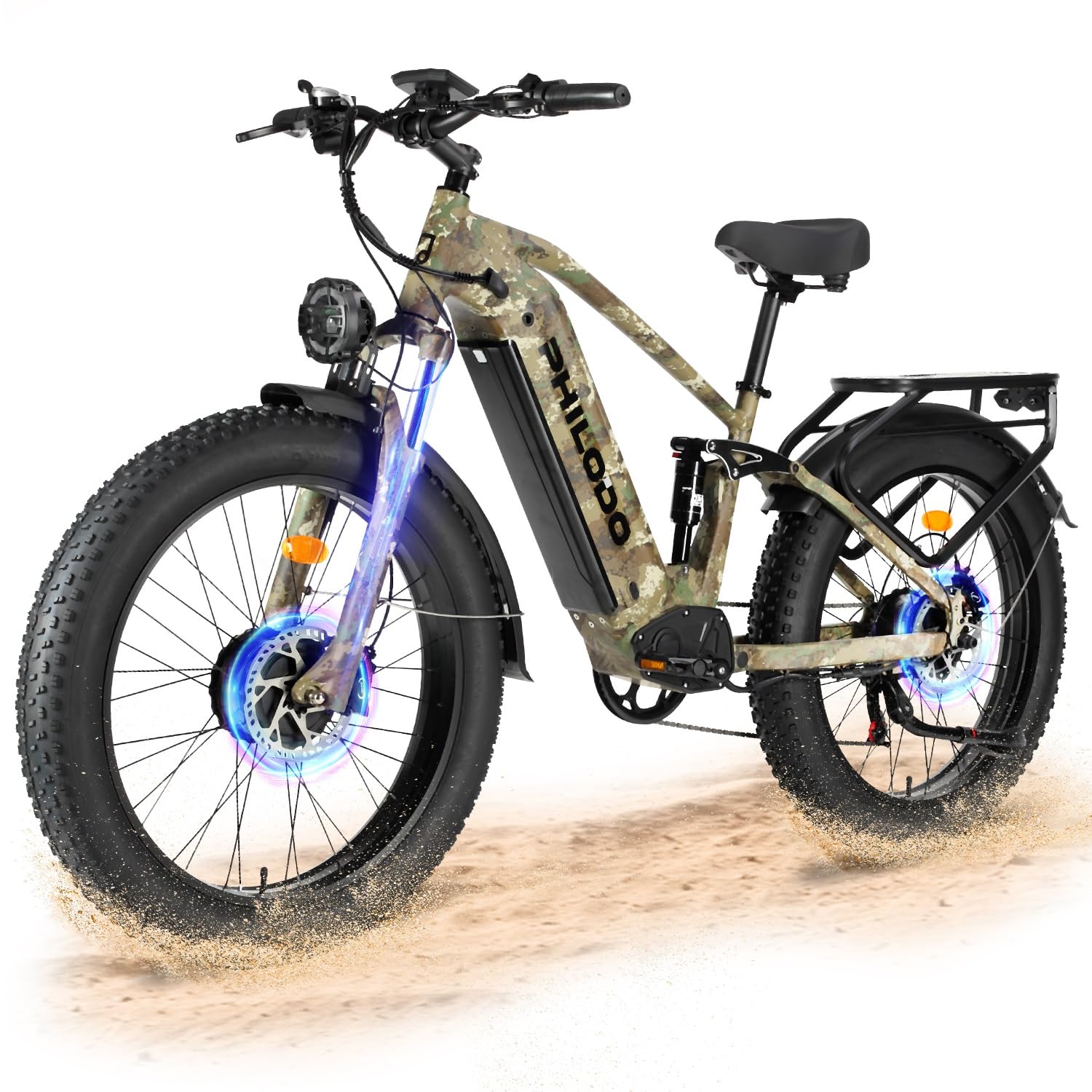
PHILODO Falcon

87 /100
LBD Score Excellent

Key details

Drive
Dual hub, two modes
Tires
26 x 4 in
Battery
60V 32Ah, 1,460Wh
Claimed Range
Up to 100 mi PAS
View on Amazon

Two hub motors and 1,460 watt-hours of battery are what put the Falcon at the top of this list. The 60V 32Ah pack is the largest here, and the front and rear motors run together or one at a time — the switch you want when a wet grass climb starts eating traction. The camo finish is a nice touch; the drivetrain is the reason to buy.

The rest of the bike is built for the same ground. You get 26-by-4-inch fat tires, a lockable and adjustable front fork, and an air shock at the rear, which is the piece we care about most on a long, seated grind into a stand. A 7-speed drivetrain and disc brakes round it out, and the aluminum frame keeps the whole thing from feeling like a farm implement.

Range needs translating. The claimed figure is up to 100 miles in pedal assist, with a much shorter number once both motors are working; a hunt rarely looks like either. Loaded, climbing, in soft ground, you'll live in the upper assist levels, so plan loops well short of the headline and charge at camp. The big pack is what buys you margin, and margin is the whole point of a hunting bike.

What we didn't expect to use as much is the walk setting. When a muddy stretch pushed us off the saddle on the way back to the truck, the bike still pulled its own weight while we pushed. It's the bike in this group we reach for when the ride in matters as much as the sit.

Pros

  • Two motors you can run together or separately
  • Biggest battery here, so more margin for load and cold
  • Adjustable rear air shock soaks up two-track washboard
  • Camo finish that doesn't announce itself on the walk in

Cons

  • Step-over frame needs a 5-foot-6 rider or taller
Our verdict

The bike we point long-approach hunters to: two motors for soft climbs, the biggest battery in this group, and a camo finish that doesn't announce you on the walk in.
Check Latest Price
2

Best for Hauling Gear

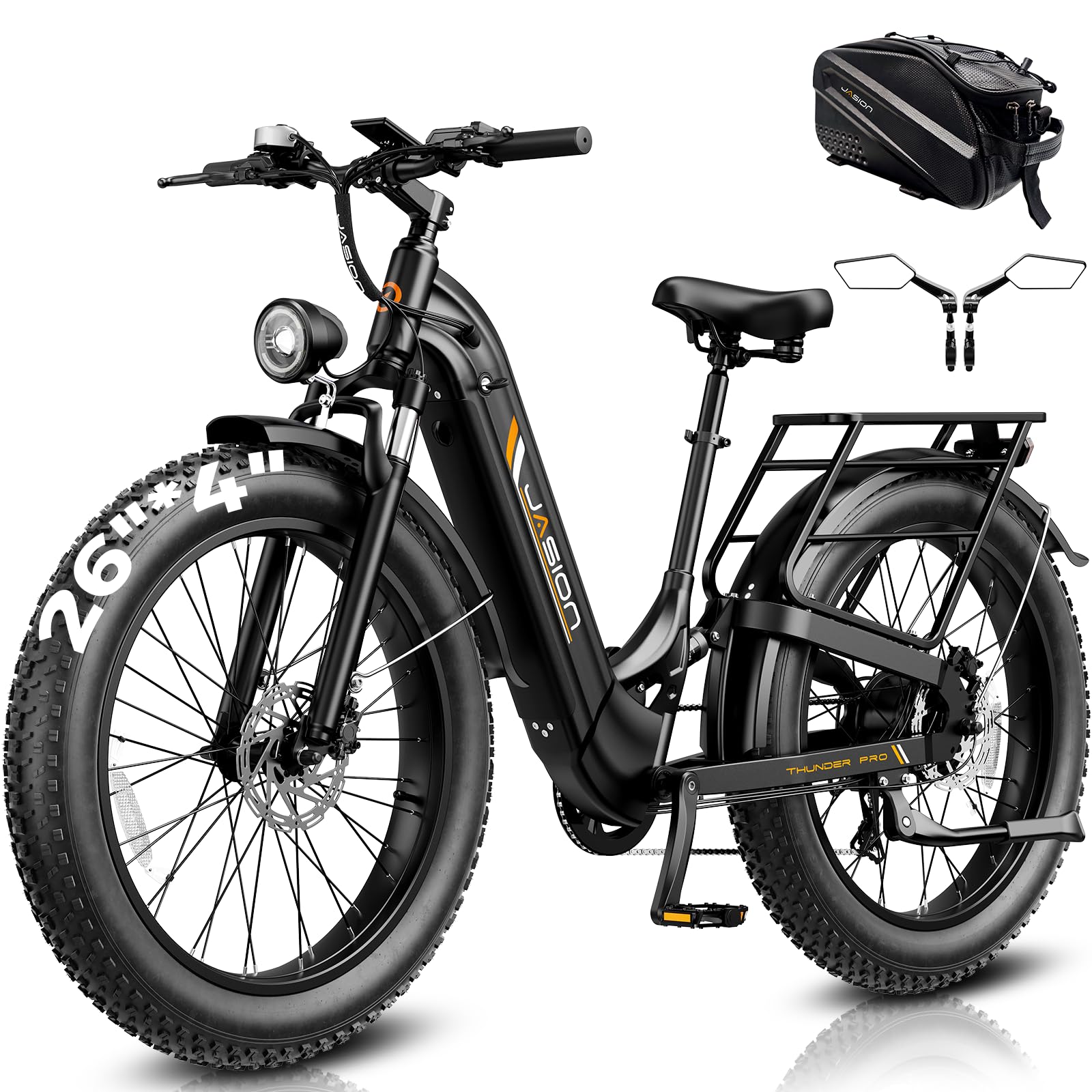
Jasion Thunder Pro ST

87 /100
LBD Score Excellent

Key details

Motor
2000W peak
Brakes
Hydraulic disc
Battery
52V 20Ah (1,040Wh)
Payload
500 lb
View on Amazon

Five hundred pounds is the number that separates the Thunder Pro ST from everything else here. That's the stated capacity, rider included, and it's why we point anyone carrying a stand, a pack, and game toward it. A rear rack, fenders, and integrated lights come standard, which turns a fat-tire e-bike into something that works for a living.

The rest of the spec sheet is competitive rather than class-leading: a 2000W peak motor, a 52V 20Ah battery with a 35-mile throttle figure alongside a much longer pedal-assist claim, and a top speed you won't often want on gravel. What we appreciate most is the hydraulic disc brakes. Once there's real weight aboard and the descent is loose, hydraulics are worth more than another few hundred watts, and the bike carries UL 2849 certification to go with them.

Assembly is an evening's job rather than ten minutes, which is normal for the category and still worth planning around. And the Falcon it isn't: you give up the second motor and the biggest pack in the group, and you get a rated payload, better brakes, and money back. If your season is a mile of farm road and a two-track to the gate, that's the smarter buy.

Pros

  • 500-pound payload with a rack included
  • Hydraulic disc brakes hold up under a load
  • Certified to UL 2849
  • Integrated lighting and fenders for riding in at dark

Cons

  • Rear shock is the soft link under a loaded rider
Our verdict

We recommend it to anyone hauling a stand, a pack, and a quartered deer: 500 pounds of rated capacity, hydraulic brakes, and UL 2849 for less than our top pick.

Check Latest Price
3

Best Step-Thru

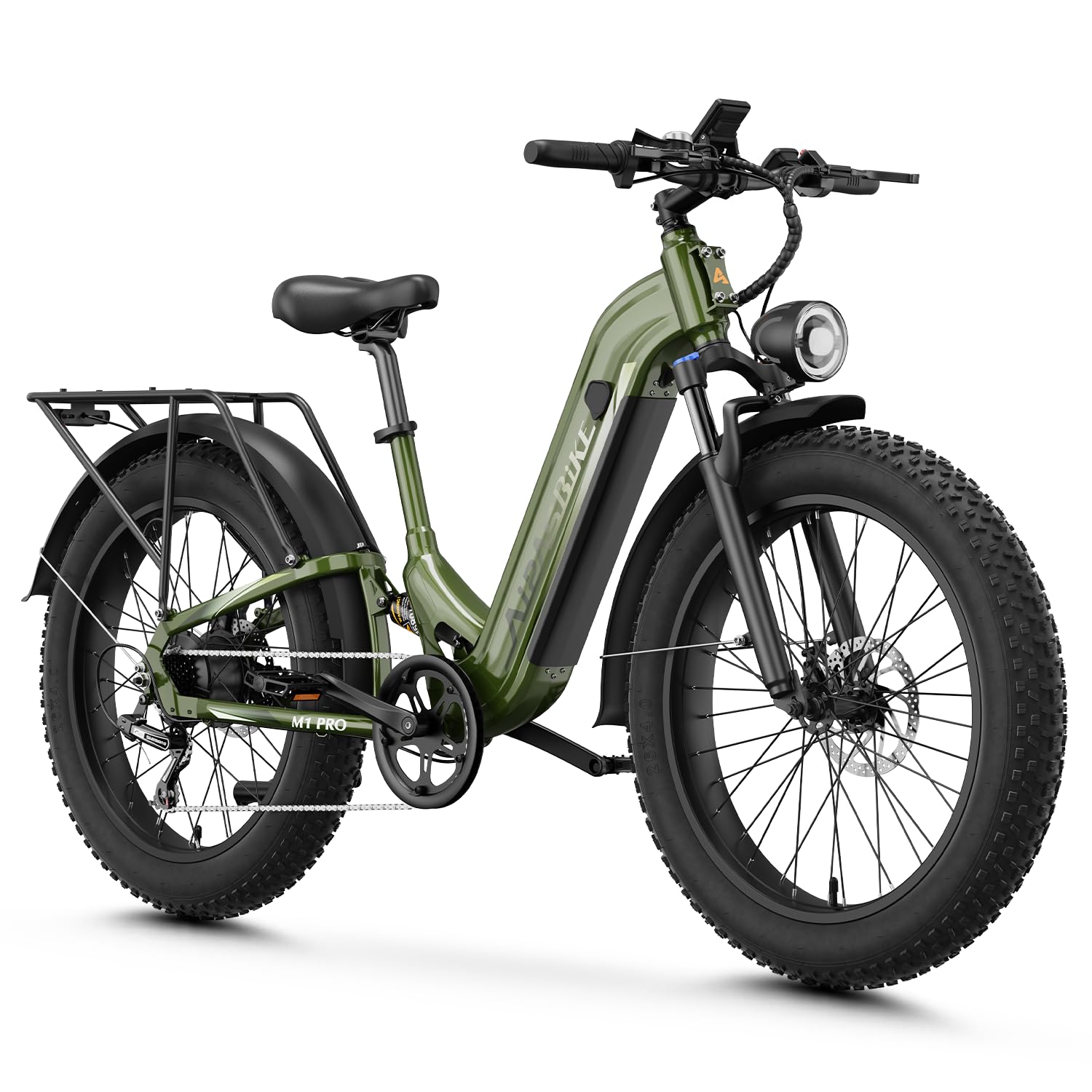
Aipas M1 Pro

86 /100
LBD Score Excellent

Key details

Frame
Step-thru
Motor
1800W peak, 110Nm
Weight
88 lb
Battery
48V 17.5Ah
View on Amazon

Think about the end of a cold sit: you're in layers, the bike is loaded, and you're on a muddy sidehill. The M1 Pro's step-through frame is the reason it's in this guide. You swing a leg through rather than over, and a loaded bike is far less likely to go down with you — which is worth more than a gram-counted frame on a morning like that.

The trail numbers hold up. An 1800W peak rear hub with 110 newton-meters of torque is the figure we watch, because torque is what walks a loaded bike up a rutted grade while top speed does nothing for you. A 48V 17.5Ah battery claims up to 85 miles in assist, and the 100mm fork plus rear shock take the chatter out of gravel roads and rooty approaches.

It's also a lot of bike. At 88 pounds it's the heaviest thing in this group, and the high-carbon steel frame is part of why it feels so planted at speed — and why a ramp earns its place in the truck. Loading alone is possible, but we'd rather...

Pros

  • Step-through frame mounts easily in layers
  • 110 newton-meters of torque for loaded climbs
  • Certified to UL 2849 through SGS
  • Dual suspension softens gravel and roots

Cons

  • Mechanical disc brakes need more lever effort
Our verdict

Our pick for hunters who prefer stepping through the frame in waders: 110 newton-meters of torque, a planted 88-pound build, and UL 2849 certification.

Check Latest Price
4

Best Budget

ESKUTE C300R-SO

85 /100
LBD Score Excellent

Key details

Battery
48V 20.8Ah
Gearing
8-speed
Claimed Range
Up to 86 mi (PAS 1)
Minimum Height
5 ft 4 in
View on Amazon

The cheapest bike in this group doesn't read like it. The C300R-SO runs 26-by-4-inch fat tires, full suspension, an 8-speed drivetrain, and a 48V 20.8Ah battery that lands near a kilowatt-hour, with an 86-mile assist claim attached. That's a spec sheet that usually asks more money, and it's why this one takes our budget slot.

The details that often get cut first are still here: a central display, fenders, a taillight, and an NFC card plus app unlock that saves you fumbling for a key with gloves on. The 8-speed gearing matters more than it sounds, because that extra ratio helps when you're pedaling an unpowered bike up a grade. With a 5-foot-4 minimum rider height, it also fits the widest range of people in this guide.

The pack is a heavy, awkward lift out of the frame, though it charges in place, so pulling it is optional — a genuine convenience at this end of the price range. Charge it where you store the bike and the weight of the battery stops being a daily problem.

Pros

  • 26-inch fat tires and full suspension at the lowest price here
  • 8-speed drivetrain adds a useful climbing gear
  • NFC card and app unlock work with gloves on
  • Charges in place, so the battery stays on the bike

Cons

  • 86-mile range figure assumes the lowest assist level
Our verdict

The budget choice: 26-inch fat tires, full suspension, an 8-speed drivetrain, and nearly a kilowatt-hour of battery for the least money here.

Check Latest Price
5

Folding Transport

Jasion X-Hunter

87 /100
LBD Score Excellent

Key details

Weight
71 lb
Wheels
20 x 4 in
Battery
48V 13Ah removable
Folded Size
33 x 16 x 30 in
View on Amazon

Twenty-inch wheels are the first thing to understand about the X-Hunter. They're fat — four inches wide — and with an 80mm air fork and a rear shock they soak up gravel roads and roots without complaint, but they don't float over sand or deep snow the way a 26-inch fat tire does, and they deflect more in ruts. For a hunting camp bike, that's the trade you're making.

What you get for it is the only folding frame in this guide. It collapses to 33 by 16 by 30 inches, small enough for a truck cab, a camper, or a closet at the cabin. The rest of the package holds up: a 1400W peak motor, a 48V 13Ah removable battery, 30 mph, 7-speed gearing, and suspension on both ends that makes a fire road comfortable.

Seventy-one pounds is the catch: folding is a two-person or once-a-season job, not a nightly routine. The 13Ah pack is small for a bike this size, too, so plan on charging after every long day rather than stretching a weekend out of one charge. Neither point disqualifies it. They just describe a bike that lives at camp and handles the gravel approach, not one you point at a bog.

Pros

  • Folds to 33 by 16 by 30 inches for a truck cab
  • Suspension on both ends for gravel and fire roads
  • 1400W peak motor with 7-speed gearing

Cons

  • Costs as much as our bigger-wheeled top pick
Our verdict

Buy it when the bike has to fold into a truck cab or a cabin closet; 20-inch wheels and 71 pounds keep it to camp roads and gravel.

Check Latest Price

How We Tested Hunting E-Bikes

We started with a few dozen e-bikes marketed for trails, farms, and hunting, then cut anything without fat tires, a suspension fork, and a battery we could pull out in the field for a swap or a charge in the truck. From that pool, six made the final cut, and we rode them for eight months, from late-spring scouting through the fall season.

Each bike arrived in a box, and one person assembled it alone in a garage with only the included tools while we timed it and noted where the instructions got vague. Every bike was weighed on the same scale, then lifted into and out of a pickup bed by one person; models that needed a ramp or a second set of hands got marked down, no matter how well they rode.

Field days started in the dark. We loaded each bike with a daypack, a stand, and roughly the weight of a quartered deer in a game sled on the rear rack, then rode gravel lanes, rutted two-tracks, and sand. We noted how hard each one pulled a loaded climb, how quickly it reached speed on a flat grade, whether the brakes held on a loaded descent, and how much motor noise carried in still morning air. Range was logged on cold starts — we recorded where the gauge actually dropped rather than trusting the claimed figure.

After every ride we checked bolt torque, welds, rack and accessory mounts, and whether the battery rattled in the frame, which is where build quality shows up long before anything breaks. At the end we set each bike's total cost against what it delivered: the battery capacity, the suspension travel you can feel, the brakes, the little hardware details. Value wasn't the cheapest bike in the group — it was the one that never gave us a reason to walk home.

How to Choose an Electric Hunting Bike

Torque and Drive Layout Matter More Than Top Speed

Peak wattage makes a good headline and a poor decision. What gets a loaded bike up a wet grade or across soft ground is torque at the wheel and how much of it reaches the dirt. A single rear hub motor handles farm roads, gravel, and gentle climbs fine, especially when you're pedaling with it.

If your ground is soft or steep, a dual-motor bike like our top pick lets you run both hubs for traction and drop to one when you want range. Test ride loaded, not empty — an e-bike that feels sprightly in a parking lot can feel gutless with a stand and a pack aboard.

Watt-Hours Tell You More Than Miles

Every listing quotes a range under ideal conditions: low assist, warm air, flat ground. Compare the battery instead. Volts times amp-hours gives watt-hours, and it tells you how much work the bike can do before the pack is empty. Three of the bikes here sit at or near 1,000, which is the figure to aim for if you want margin.

For an all-day hunt with a pack, treat any pedal-assist claim as roughly half, and decide in advance where you'll recharge — a cabin outlet beats a generator in the dark.

Fat Tires, Wheel Size, and Suspension

Four-inch tires are what let a bike run on sand, snow, and mud instead of cutting in, but width is only half of it. Twenty-six-inch fat tires roll over roots and float better than the 20-inch version on a folder, which is why we treat folding bikes as camp transport rather than backcountry rigs.

A real fork is the minimum for trail use. A rear shock is what saves your back on washboard two-tracks, and it's the difference between arriving at your spot fresh and arriving sore.

Weight, Payload, and Getting It to the Trailhead

Every bike in this guide is heavy, and you'll feel that at the tailgate rather than on the trail. Check your rack's per-bike weight rating before assuming it will carry an e-bike, and budget for a ramp if you load alone.

Payload ratings include the rider, so a 500-pound bike is carrying you plus your gear — not 500 pounds of gear. Keep loads low and centered over the rear wheel so the bike tracks straight on a loose climb.

Brakes, Certification, and Parts Support

Stopping power matters more with a stand on your back. Hydraulic discs give you more braking for less hand effort; mechanical discs are simpler to adjust yourself. Look for UL 2849 certification on the bike or battery — the Jasion Thunder Pro ST and the Aipas M1 Pro both carry it, and where a listing doesn't state it, ask before you buy.

Confirm the warranty length and that a replacement battery is actually available. An e-bike with no source for cells is a very heavy bicycle.

Frequently Asked Questions

Final Verdict

The Falcon earns the top spot because it's the only dual-motor bike in this group, and it pairs those motors with the biggest battery here — the combination that makes a long, soft, loaded approach possible. If your riding is mostly a farm road to a gate, the Thunder Pro ST's rated payload and hydraulic brakes make more sense for less money, and if mounting a loaded bike in waders is the sticking point, the Aipas step-through is the answer.

Pick the compromise you can live with — smaller wheels, a heavier frame, a shorter claimed range — and put the difference toward a rack rated for the weight and a second charger for camp.