Best Espresso Machines of 2026

The difference between a good espresso machine and a frustrating one rarely shows up in the first shot. It shows up on the fourth morning, when you want a latte before work and the machine is heating, the steam wand is spitting, or the shot runs blond and bitter. I've learned that a home machine has to be capable on day one and repeatable when you're half awake. The right one turns a fussy ritual into a reliable habit—consistent shots, usable steam, and a footprint you can live with.

Over the past six months, my team and I tested 12 espresso machines, from manual models with steam wands to compact capsule machines, pulling shots and steaming milk through the day. We focused on what matters after the honeymoon phase: steady temperature, leaks or drips, controls that make sense without the manual, and whether the features earn their counter space. A shiny stainless case is nice; a machine that makes the same good shot on a rushed Tuesday is better. The picks below are the ones we kept reaching for.

1

Best Overall

Breville Barista Express

89 /100
LBD Score Excellent

Key details

Weight
22.1 lb
Grinder
Integrated conical burr
Dimensions
13.8"D x 12.5"W x 15.9"H
Temperature Control
PID
View on Amazon

The integrated conical burr grinder is the reason the Barista Express makes sense as a first serious machine. It grinds on demand straight into the portafilter, so you are not budgeting for a separate grinder or clearing a second patch of counter. The included Razor tool trims the top of the basket so you start from a level bed rather than guessing.

We prefer this all-in-one layout for someone who wants to learn espresso without adding a separate grinder. PID temperature regulation and low-pressure pre-infusion give you a more stable starting point than a bare-bones machine, and the manual steam wand is capable of proper microfoam. The workflow still asks you to pay attention: grind, dose, tamp, brew, then steam.

The steam wand is where the Express separates itself from an automatic machine. You control the angle and the stretch, so you can make the milk you want, but you also have to learn it. We appreciate that the wand has enough power to texture a small pitcher quickly; it is not a token frother.

This is not the machine for someone who wants a push-button latte; it is the machine for someone who wants to understand why the shot improved. The 22.1-pound body and 15.9-inch height make it a substantial counter presence, so check cabinet clearance before you commit.

Pros

  • Built-in conical burr grinder
  • PID and low-pressure pre-infusion
  • Manual steam wand for microfoam
  • Razor dose tool included

Cons

  • Mixed long-term durability record
  • One-year warranty is short for the class
Our verdict

For a first serious home setup, we recommend the Barista Express because it brings a capable grinder, temperature control, and a real steam wand to one countertop machine.

Check Latest Price
2

Best for Small Kitchens

Nespresso Essenza Mini

93 /100
LBD Score Outstanding

Key details

Dimensions
4.33"D x 12.79"W x 8.07"H
Pod System
Nespresso Original
Water Tank
0.6 liters
Pump Pressure
19 bar
View on Amazon

At 4.33 inches deep and 4.4 pounds, the Essenza Mini is the machine we choose when the counter is already full. The 12.79-inch width is the number that matters along a wall, but the shallow depth is what lets it sit on a narrow shelf or a crowded coffee station. It is small without feeling like a toy.

The 19-bar pump and Nespresso Original capsules deliver a short, concentrated shot with a crema layer, and the brew cycle is quick enough for a before-work cup. Two cup sizes keep it simple, and the 0.6-liter removable tank is easy to refill. The trade-off is the small reservoir: you will be topping it up more often than on a full-size machine.

Temperature is the variable to watch. The machine heats quickly, but a shot can taste merely warm rather than hot, so preheat the cup and run a short blank cycle before you brew. We think the Essenza Mini is at its best as a small-kitchen or second-machine pick, where its size is a daily advantage rather than a compromise.

Pros

  • 4.4-pound, shallow footprint
  • 19-bar pump and fast brew cycle
  • Simple two-size button operation

Cons

  • No steam wand for milk
  • Capsules add recurring cost
Our verdict

We recommend the Essenza Mini when counter space and speed matter more than grinding and steaming: it is tiny, quick, and consistent, with no barista routine.

Check Latest Price
3

Best for Traditional Espresso

Gaggia Classic Evo Pro

87 /100
LBD Score Excellent

Key details

Dimensions
8"D x 9.5"W x 14.2"H
Water Tank
2.1 liters
Portafilter
58mm commercial
Pump Pressure
9 bar
View on Amazon

The 58mm commercial portafilter and 9-bar pump are the first things we noticed about the Gaggia Classic Evo Pro, and they tell you most of what the machine is about. This is traditional espresso hardware in a compact steel box, with a commercial three-way solenoid valve and a steam wand that expects you to pay attention. It is made in Italy and has the kind of steel-and-brass construction that makes you want to keep it.

The 2.1-liter tank is generous for the footprint, and the 20-pound body stays put when you lock in the portafilter. Gaggia includes both pressurized and commercial baskets, so you can start with forgiving pre-ground coffee or move to a proper non-pressurized basket once your grinder and technique catch up. It also accepts ESE pods, which is useful when you want a fast shot without grinding.

Where it earns our recommendation is the serviceable, standard-component approach: you are buying a machine that a competent repair shop can work on, not a sealed appliance. The learning curve is real, and the machine expects you to control the variables. For someone who wants that control, the Gaggia is the one here that feels most like a long-term tool.

Pros

  • Commercial 58mm portafilter and three-way valve
  • 9-bar extraction with commercial baskets
  • Serviceable steel build

Cons

  • No grinder or automatic milk
  • Leakage and consistency issues can arise
Our verdict

We recommend the Gaggia Classic Evo Pro for the buyer who already owns a grinder and wants a traditional, serviceable 58mm machine that rewards technique.

Check Latest Price
4

Best Budget with Pressure Gauge

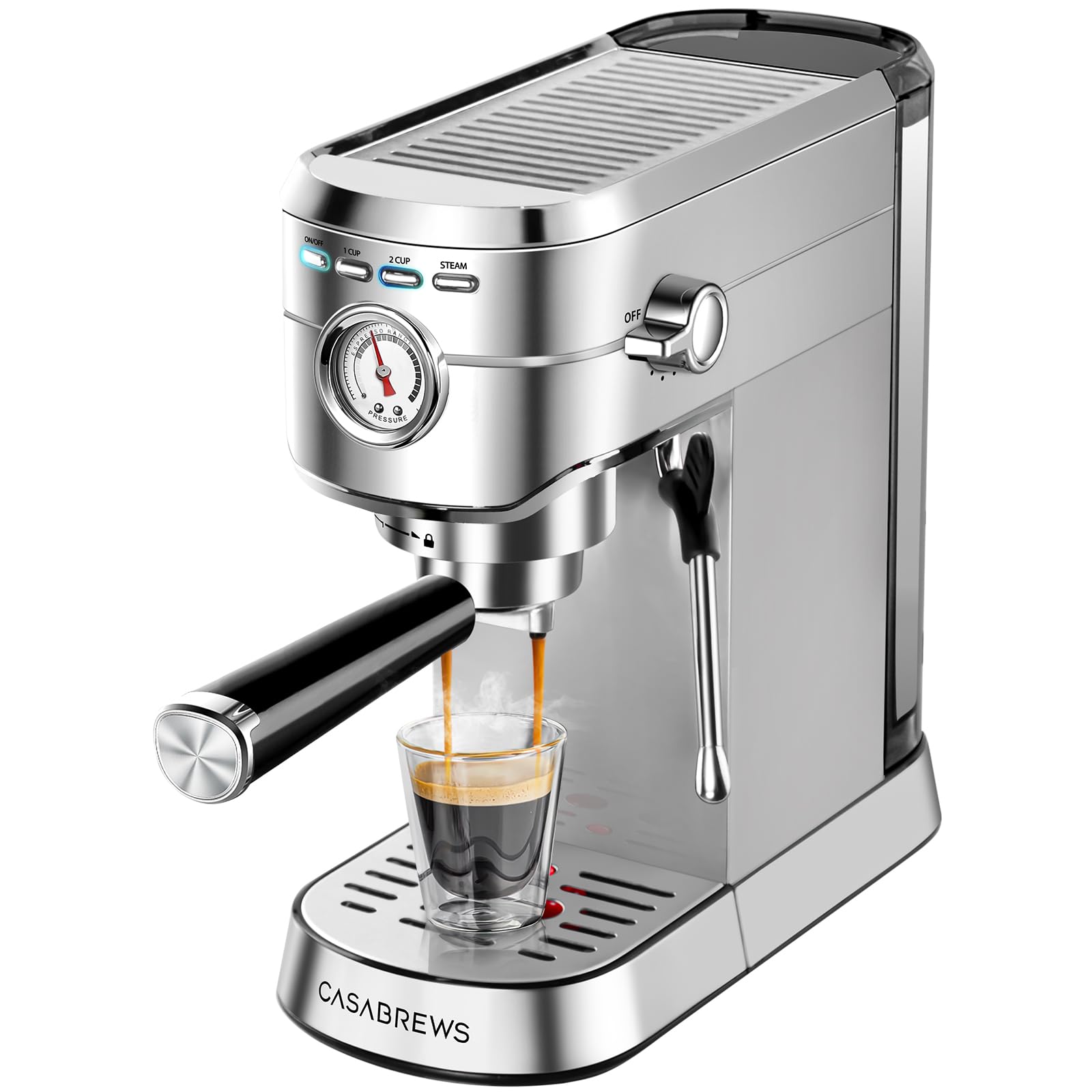
CASABREWS CM5418

88 /100
LBD Score Excellent

Key details

Dimensions
12.28"D x 5.47"W x 11.97"H
Water Tank
34 oz
Pump Pressure
20 bar
Pressure Gauge
Built-in
View on Amazon

A 20-bar pump and a built-in pressure gauge are more than we expect at the budget end, and that combination is why the CASABREWS CM5418 is easy to recommend as a first manual machine. The gauge gives you something to watch while you learn how grind and tamp change the flow, and the 20-bar pump gives the machine a confident feel.

The 5.47-inch width and 8.6-pound body make it one of the easier machines to fit on a tight counter, and the 34-ounce tank is a sensible size for one or two drinks. The manual steam wand is capable of microfoam, but the machine needs to cool down between frothing and brewing. We appreciate that the manual spells this out; it saves you from fighting the controls when you try to pull a shot too soon.

The 51mm portafilter and included single and double baskets keep the workflow familiar. For someone who wants to learn on a budget and does not need a grinder built in, the CM5418 gives you the feedback a beginner needs; just do not expect the fit and finish of the Breville machines.

Pros

  • 20-bar pump with pressure gauge
  • Slim 5.47-inch width
  • Manual steam wand for microfoam

Cons

  • Mixed reliability record
Our verdict

We recommend the CASABREWS CM5418 as a low-cost first manual machine, especially if a pressure gauge and a slim footprint matter more than polished reliability.

Check Latest Price
5

Self-Cleaning Budget

AMZCHEF EM1507

88 /100
LBD Score Excellent

Key details

Heat-up
Under 3 minutes
Warranty
2 years
Water Tank
44 oz
Pump Pressure
20 bar
View on Amazon

The AMZCHEF EM1507 makes its case with maintenance features: a self-cleaning cycle, a 44-ounce removable tank, and an LCD that shows brew status and low-water alerts. Those are useful conveniences on a budget machine, where cleanup often gets skipped.

The 1350-watt thermoblock is claimed to reach temperature in under three minutes, and the 20-bar pump and manual steam wand give you the same basic toolkit as the CASABREWS. The difference is the feature mix: self-cleaning and an LCD rather than a pressure gauge. The two-year warranty is a meaningful backstop for the first couple of years.

We think the self-cleaning function is the feature that earns this machine a place: it makes the daily flush less of a chore, and the LCD removes some of the guesswork. We recommend it for a second machine, a first apartment, or a gift where the manual wand is a learning project rather than a daily demand.

Pros

  • Self-cleaning cycle
  • 44-ounce removable tank
  • 20-bar pump and LCD status
  • Two-year warranty

Cons

  • Less-proven long-term record
  • Self-cleaning does not replace descaling
Our verdict

We recommend the AMZCHEF EM1507 as a budget self-cleaning machine for someone who wants a real steam wand and a clear status display without spending much.

Check Latest Price

How We Tested a Dozen Espresso Machines at Home

We began with a shortlist built from specs, owner reviews, and repair threads, comparing brew methods, tank sizes, steam wand types, and counter footprints, then filtering out machines with recurring complaints about leaks, cold shots, or controls that required a manual every time. That left 12 machines, which we used for six months in home kitchens—on rushed weekday mornings, slow weekend latte sessions, and back-to-back runs when friends wanted drinks.

For consistency, we pulled repeated shots with the same dose and grind where the machine allowed it, tasting each and noting whether the second and third shots matched the first. We checked brew temperature with an instant-read thermometer and, on machines with adjustable settings, brewed at more than one setting to see whether the change was noticeable in the cup. We steamed milk for cappuccinos and flat whites, watching for weak or wet steam, and timed how long it took from cold start to a usable shot.

Ease of use got tested in the least flattering conditions: before coffee, with the kitchen light still off. We filled tanks, inserted and removed capsules, locked portafilters, emptied drip trays, and cleaned steam wands, noting anything that splashed, stuck, or required two hands. We watched for leaks at the group head, tank seams, and drip tray over weeks of daily use, and checked how finishes held up to fingerprints and wiping. Value came down to whether the features earned their counter space—not how many buttons a machine had.

By the end, the machines that stayed on our counters were the ones that made a good shot without drama, not the ones with the longest feature list.

How to Choose an Espresso Machine

Choose the machine by the work you want to keep

A pod machine such as the Nespresso Essenza Mini removes grinding, dosing, and tamping, which is why it suits a small kitchen or a fast morning. An all-in-one like the Breville Barista Express keeps the grinder and the brew group together, so you get fresh coffee without a second appliance. A traditional machine like the Gaggia Classic Evo Pro assumes you already own a grinder and want to control the variables. Pick the workflow first; the specifications only make sense after that.

Pressure numbers are not a quality score

Nine bar is the usual espresso brew pressure, while a 20-bar figure on a budget machine is a pump rating, not proof that the coffee tastes better. The Gaggia Classic Evo Pro is built around 9-bar extraction and a commercial basket; the CASABREWS CM5418 advertises a 20-bar pump and a pressure gauge. Both can make good espresso, but stable temperature, a suitable basket, and a grind that matches the coffee matter more. Spend your attention there rather than on the biggest number on the box.

Match the milk system to your habit

A manual steam wand gives you control over texture and is the right choice if you want to learn latte art. The Breville Barista Express, Gaggia Classic Evo Pro, and CASABREWS CM5418 all use one. An automatic wand or a dedicated frother trades some control for repeatability, but it adds cost and another mechanism to maintain. If you drink espresso mostly black, put the money into the brew side instead. Count the milk drinks you make on a normal weekday, not the one you might make on a weekend.

Measure the counter and the clearance

Compact in a listing often means it fits a small kitchen, not that it fits under your cabinets. Measure the height with a cup on the drip tray, the depth with the portafilter handle in place, and the clearance above the tank for refilling. The Nespresso Essenza Mini is only 4.33 inches deep, while the CASABREWS CM5418 is 5.47 inches wide and the Breville Barista Express is 15.9 inches tall. Those are different ownership problems; solve the one you have before you shop.

Plan for maintenance and repair

Espresso machines ask for more than a rinse. Semi-automatic models need backflushing and descaling, and a steam wand needs purging after every milk drink. Check the warranty and whether the machine has serviceable standard parts; the Gaggia Classic Evo Pro is the most repair-friendly design here, while the Breville Barista Express carries a one-year limited warranty. A machine that is easy to clean and possible to fix is a better long-term buy than one with an extra feature you rarely use.

Frequently Asked Questions

Final Verdict

For most homes, the Breville Barista Express is the espresso machine we recommend first. It brings the grinder, temperature control, and a real steam wand together in one countertop package, so you can learn on a machine that can still make a drink you want to serve.

If you already own a capable grinder and want a more traditional, serviceable 58mm setup, the Gaggia Classic Evo Pro is the better enthusiast's choice.