Best Ethernet Cables of 2026

Ethernet is supposed to be the reliable choice, but the cable itself is usually the last thing anyone thinks about—until a game stutters, a video call freezes, or you're on your hands and knees tracing a black cord behind the drywall. I've done the late-night router swap and squinted at enough mystery cables to know the difference. What you want is simpler: a cord that clicks in, carries a clean signal, and is easy to route where you need it. A higher category number doesn't automatically make your internet faster; it raises the ceiling the cable can handle, while the connector and build quality decide whether you see that benefit.

Over the past six months, my team and I tested 12 ethernet cables in the setups where they actually live: short patch cables behind a home-office switch, flat cords under a living-room rug, and long runs to a bedroom TV and a gaming console. We compared speed, signal quality, functionality, ease of use, flat profile, length, and overall quality. The picks below earned a permanent spot.

1

Best Overall

Cable Matters Cat6 25 ft

96 /100
LBD Score Outstanding

Key details

Length
25 ft
Category
Cat 6
Bandwidth
550 MHz
Conductors
24 AWG bare copper
View on Amazon

Twenty-four-gauge bare copper is what settled this one for us. Plenty of inexpensive Cat6 is built on 30 or 32 AWG conductors, which is fine for a two-foot jumper and steadily less fine as a run stretches out or as something on the far end starts drawing power. Cable Matters uses the thicker wire, rates the cable to 550 MHz, and terminates it in gold-plated contacts with molded strain relief at both ends.

In the hand it's an unremarkable black round cable, and the detail we ended up appreciating is tiny: a plastic shell over the release tab that you squeeze to free the plug, so you aren't digging a fingernail into a crowded switch. The jacket stays flexible enough to push behind a desk without fighting you.

The round shape is the trade-off. It won't tuck against baseboard trim or slip under a door the way a flat cable will, so if the route crosses a room you look at, the Jadaol below solves a problem this one doesn't. Along a wall to a wall plate, that difference disappears completely.

What earns it the top spot is dull and worth saying plainly: nothing about it needs managing. It doesn't need clips, it doesn't need to be hidden, and it's rated well past anything a home router will push through it. When the network misbehaves, you can cross the cable off the list without testing anything.

Pros

  • 24 AWG bare copper holds up over distance and PoE
  • 550 MHz rating leaves headroom for 10-gigabit
  • Release shell makes unplugging from tight ports easy

Cons

  • Round jacket won't hide along trim like a flat cable
Our verdict

We recommend it as the default cable for any run that stays put: 24 AWG copper and a 550 MHz rating give it headroom the thin, flat cables here don't have.

Check Latest Price
2

Best for Hiding Along a Wall

Jadaol Flat Cat6 50 ft

95 /100
LBD Score Outstanding

Key details

Shape
Flat
Length
50 ft
Category
Cat 6
Bandwidth
250 MHz
View on Amazon

A 50-foot cable you can see is a 50-foot problem. The Jadaol is flat, white, and about as thick as a ribbon, which is why it's the one we hand over when a cable has to cross a room and nobody wants to look at it.

The flat profile is the whole design. It sits against a baseboard instead of bulging away from it, slips through a gap under a door, and runs behind the edge of a rug without leaving a ridge. Adhesive clips come in the box, which is the difference between a run that ends up tidy and one that ends up draped over a chair, and the white jacket disappears against trim and painted walls.

We reach for it when the run is visible and the point is to make it disappear, and we accept that it's a surface cable rather than a permanent one. Thirty-gauge copper is what makes the flat shape possible, and thin copper is the wrong thing to be asking for at the far end of a long camera run. Between a router and a console, a TV, or a desktop in the next room, it does the job without ever being noticed.

Pros

  • Flat white jacket disappears along baseboards and trim
  • Adhesive clips included for a tidy run
  • 50 ft covers a room-to-room run

Cons

  • 30 AWG conductors limit Power over Ethernet runs
  • Unshielded, so not for high-interference spaces
Our verdict

When the cable has to cross a room and stay out of sight, this flat 50-footer and its included clips are the answer we keep coming back to.

Check Latest Price
3

Best for a Gaming Desk

UGREEN Cat8 Braided 10 ft

95 /100
LBD Score Outstanding

Key details

Length
10 ft
Category
Cat 8
Bandwidth
2000 MHz
Shielding
F/FTP
View on Amazon

Cat 8 is mostly marketing on a home network, and this is the cable that makes the case anyway. Four individually foil-wrapped pairs sit under a cotton braid, which is the construction that helps when a cable runs past a monitor's power brick or a strip of adapters, and 26 AWG copper keeps it useful if the far end needs power as well as data.

We pick it for short, visible runs. Ten feet reaches from a console or a desktop to a wall jack or a router, the braid looks deliberate rather than like something that fell out of the box, and the plugs seat with a solid click. It's the rare cable here we notice for the right reasons, which is unusual for something whose whole job is to be forgotten.

The 40Gbps and 2000MHz on the label aren't why we recommend it, and no household router will feed them. You're paying for the build on a run you can see. If the run is long, gauge matters more than the category printed on the jacket.

Pros

  • Cotton braid resists kinks and looks the part
  • Foil-wrapped pairs help near power bricks and monitors
  • PoE supported at this length

Cons

  • Cat 8 speed ratings need gear you probably don't own
  • 10 ft limits it to short runs
Our verdict

This is the cable we pick when a short run to a console or desktop is on display, where the braided jacket and shielded pairs justify it more than the 40Gbps headline does.

Check Latest Price
4

Best for Long Runs

Ultra Clarity Cat6 100 ft

95 /100
LBD Score Outstanding

Key details

Length
100 ft
Category
Cat 6
Bandwidth
500 MHz
Conductors
24 AWG solid copper
View on Amazon

A hundred feet is where an inexpensive cable stops being a bargain. Anything can carry a gigabit across a desk; across an attic and down an exterior wall, resistance and crosstalk start to matter, and this is the one here we trust at that distance — 24 AWG solid copper, a PE cross separator holding the pairs apart, and a 500 MHz rating.

The jacket is CM grade and rated for indoor and outdoor use, so you can take it out through a wall and back in through a garage. It's unshielded, which means it wants to stay away from a long parallel run alongside mains wiring; the cross separator does the crosstalk work instead, and it does it without making the cable any harder to pull.

Two practical notes. Solid-core cable is meant to be installed once: run it, secure it, and leave it alone rather than coiling and uncoiling it. And a 100-foot run is miserable to redo, so confirm the link at full speed before the cable disappears behind drywall.

Pros

  • 24 AWG solid copper holds up over 100 ft
  • Rated for indoor and outdoor routing
  • Cross separator between pairs reduces crosstalk

Cons

  • May fail within the first year
Our verdict

For one long run through an attic, a garage, or an outbuilding, this is the cable here that makes the distance unremarkable.

Check Latest Price
5

Dense Patch Panels

Monoprice SlimRun Cat6A 1 ft 10-Pack

94 /100
LBD Score Outstanding

Key details

Length
1 ft
Category
Cat 6A
Bandwidth
550 MHz
Conductors
30 AWG pure copper
View on Amazon

Half the width of a standard patch cable is the entire point. These are 30 AWG Cat6A jumpers in a jacket Monoprice sizes at roughly half a normal Cat6A, and in a rack with a switch, a patch panel, and a wall of keystones, that difference is the difference between reading the port numbers and guessing at them.

Ten one-foot cables cover a panel-to-switch job neatly, the snagless boots keep the tabs intact while you route them through a cable manager, and the blue jacket makes a run easy to trace when you're standing behind the rack with a flashlight. They're rated to 550 MHz and 10-gigabit, which is more than most home racks will ever ask for.

We like them for dense, permanent rack work and not for anything you'll unplug every day. The narrow boot is harder to press in a crowded port than a full-size one, and 30 AWG wire doesn't take a hard yank. One foot is also one foot: measure from panel to switch before ordering, because there is no slack to give.

Pros

  • Half-width jacket frees space in a dense rack
  • Ten-pack covers a patch panel to switch run
  • Snagless narrow boot protects the release tab

Cons

  • Narrow boot is fiddly to press in crowded ports
  • Thin 30 AWG wire pulls out of the plug if snagged
Our verdict

For an overcrowded rack, these half-width Cat6A jumpers buy back space and keep a patch panel readable — a narrow job done well.

Check Latest Price
6

Tidy Rack Setups

10Gsupxsel Cat6 3 ft 10-Pack

94 /100
LBD Score Outstanding

Key details

Length
3 ft
Category
Cat 6
Bandwidth
550 MHz
Conductors
26 AWG pure copper
View on Amazon

A ten-pack is the cheapest way here to replace a drawer of mismatched cables with ten that match, and these are better than the money suggests: 26 AWG pure copper, a 550 MHz rating, snagless boots, and support for PoE and PoE+, so they'll do patch duty and they'll carry power to a camera at the end of a short run.

We use them for rack-to-switch and desk-to-wall-jack work, where three feet is exactly right and anything longer turns into a coil behind a cabinet. The limits are the obvious ones: three feet doesn't reach much else, and 26 AWG is thinner than the 24 AWG in our top pick, so a long powered pull is not the job for these. As a bundle of known-good cables that all behave the same, they're an easy yes.

Pros

  • Ten matched cables tidy a whole rack at once
  • 26 AWG pure copper with PoE and PoE+ support
  • Snagless boots come out of ports cleanly

Cons

  • 3 ft is too short for room-to-room runs
Our verdict

Ten matched three-foot cables are the fastest way to stop guessing which cable in the drawer is bad, and these are built better than that job requires.

Check Latest Price
7

Outdoor Short Runs

DbillionDa Cat8 6 ft

95 /100
LBD Score Outstanding

Key details

Length
6 ft
Category
Cat 8
Bandwidth
2000 MHz
Shielding
F/FTP
View on Amazon

The jacket is the reason to look at this one: UV-resistant PVC, rated waterproof, and built for direct burial, which is more than most cables on this page promise. Underneath are four foil-shielded pairs of 26 AWG oxygen-free copper, rated to 2000MHz and 40Gbps, with shielded RJ45 plugs at both ends.

We reach for it when the run leaves the house. A cable that goes from a garage to a shed, or along an exterior wall to a camera, has to survive sun and water in a way an indoor patch cable never has to, and this is the one here that's designed for it. It's also the least expensive of the Cat 8 cables in this group, which doesn't hurt for a link that's going to be outdoors.

The catch is the length. Six feet is a short hop whatever the category says, and six feet is the variant here, so measure the path and order the size that matches it. A stiff shielded cable also doesn't like a hard bend right at the plug, so leave a loop at each end and let the jacket carry the strain rather than the connector.

Pros

  • UV-resistant, waterproof jacket suits outdoor runs
  • Foil-shielded 26 AWG copper for a short tough link
  • Least expensive Cat 8 cable in this group

Cons

  • 6 ft is short for anything but a short hop
Our verdict

This is what we reach for when a short link has to live outdoors or in a garage, where a UV-resistant jacket and shielded pairs matter more than the speed rating.

Check Latest Price
8

Long Cat8 Runs

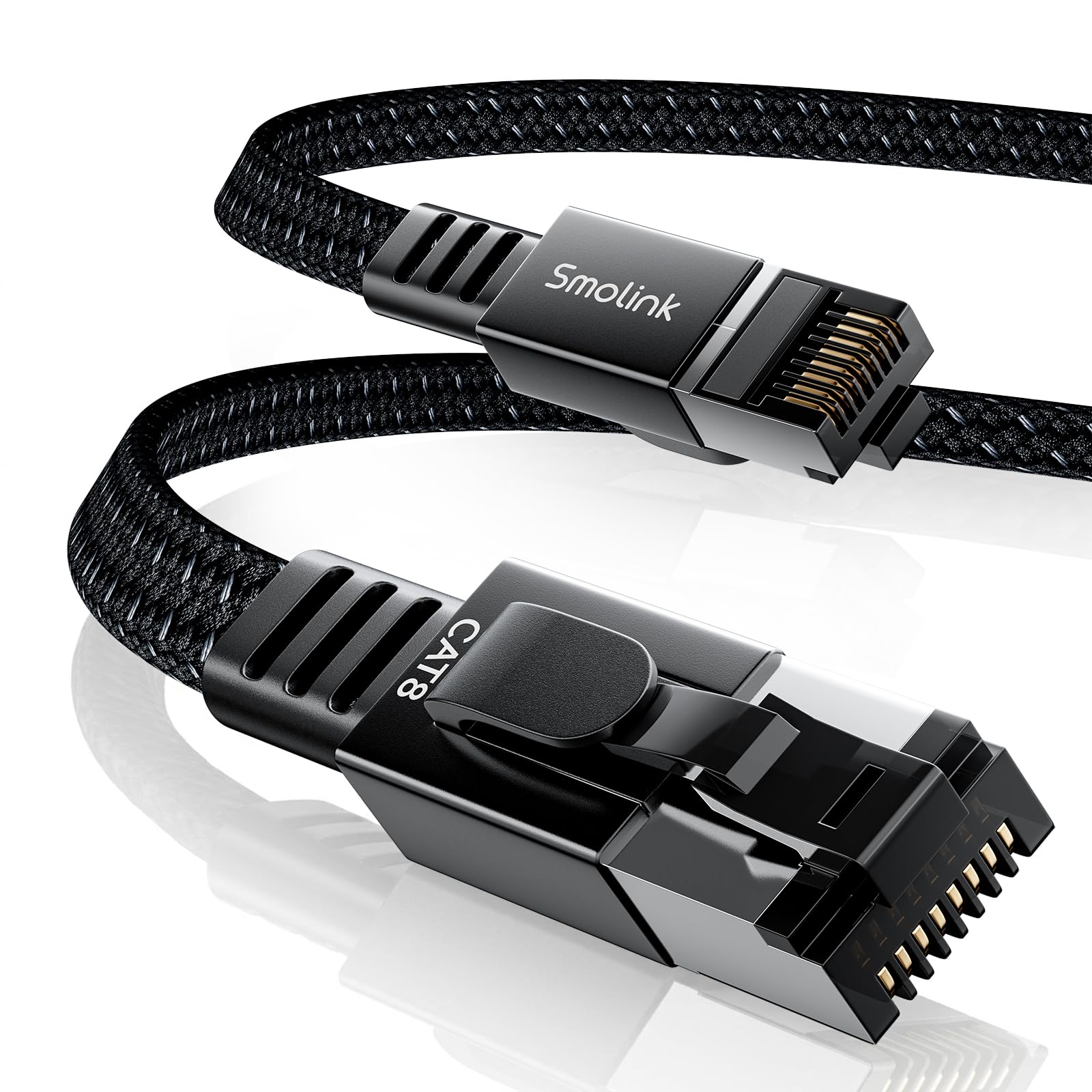
Smolink Cat8 50 ft

95 /100
LBD Score Outstanding

Key details

Length
50 ft
Category
Cat 8
Bandwidth
2000 MHz
Shielding
U/FTP
View on Amazon

Fifty feet of Cat 8 is a strange thing to sell, and this is the version of that idea we can actually justify. It's flat and nylon-braided, rated to 2000MHz and 40Gbps, with each of the four pairs wrapped in its own foil — construction you'd more often find on a short jumper than on a long run.

The flat shape is what makes the length usable. It runs along a baseboard or under the edge of a rug without the bulge a round cable leaves, and the braid keeps it looking like something you chose on purpose rather than something that came free with a router.

Where it gives ground is handling. Fifty feet of flat, foil-wrapped, braided cable is not the supple thing a two-foot jumper is, and pulling it around tight corners takes patience and a second pair of hands.

So it earns its place: the only 50-foot Cat 8 in this group, at close to the money of the flat Cat6, with shielding that's doing something rather than decorating the jacket. If you want the highest category on a long run, this is the one. If you want the easiest 50 feet to live with, the Jadaol is the calmer choice.

Pros

  • 50 ft of Cat 8 at close to flat Cat 6 money
  • Nylon braid over individually foil-wrapped pairs
  • Flat profile runs neatly along a wall

Cons

  • Can feel rigid to route at 50 ft
Our verdict

The only 50-foot Cat8 here, and the shielding is real: buy it if the run is long and you want the top category on the jacket.

Check Latest Price

How We Tested Ethernet Cables

We started by building a shortlist from the cables shoppers actually compare: Cat6, Cat6A, and Cat8; flat and round jackets; snagless and standard connectors; and lengths from one-foot patch cables to 100-foot runs. We filtered out listings that were vague about conductor material or that only made sense in one setup, then brought in 12 cables to test at home. We wanted a mix that could handle a switch, a desk, a living-room stream, and a long run to another room.

For six months, those cables lived where cables actually live: a bundle of short patch cables behind a home-office switch, a flat cable under a living-room rug, a run from the router to a gaming console, and one long pull to a bedroom TV. We plugged each into the same router and the same laptop or console, ran speed checks at the same time of day, and moved large files between two computers to watch for stalls or dropped links. We also wiggled every connector to see whether the clip held and checked long runs for signal quality when other cords and power cables were nearby.

Ease of use got judged with a stopwatch and a tape measure: how long it took to route a cable around a corner, through a desk grommet, or under a rug, and whether the connector snagged on the way. We flexed each jacket, looked for kinks, and noted whether the cable stayed flat where it was supposed to. Length mattered only if it was useful—short enough for a switch patch or long enough to reach the far room without slack coiled in a corner—and we counted a cable as functional only if it worked in the spot we bought it for.

How to Choose an Ethernet Cable

Match the Category to What Your Gear Can Feed

Cat5e carries a gigabit. Cat6 carries 10-gigabit over runs of roughly 55 meters and a gigabit far beyond that. Cat6A holds 10-gigabit across the full 100 meters. Cat8 is rated for much more, but only over short runs and only with matching hardware at both ends. Almost every home router and switch is a gigabit device, so the number printed on the jacket is rarely what limits your speed.

Buy Cat6 as the default. Step up to Cat6A if you are wiring inside walls and want the run to outlive the current hardware, and treat Cat8 as a short-run choice for a single desk or a rack.

Flat or Round: Follow the Route

A flat cable is a routing solution, not a performance upgrade. It sits against a baseboard, slips under a door, and vanishes under the edge of a rug, which is why the flat picks here are the ones we buy when the cable is going to be visible. The trade is conductor size: flat designs tend to use thinner wire, and thin wire is worse over distance and worse for Power over Ethernet.

Round cable is what belongs inside a wall, along a ceiling, or anywhere the run is long and permanent. Decide by the path, then by the spec sheet.

Gauge and Copper Are What You're Paying For

Two cables can both say Cat6 and behave differently. Look for bare or pure copper at 24 AWG for long or powered runs; 26 AWG is fine for a short jumper, and 30 AWG is fine for a foot or two inside a rack. Copper-clad aluminum is cheaper and lighter, and it is the wrong choice for PoE because it carries current less willingly and tolerates less bending.

If a camera or an access point is on the far end, we buy the thicker copper and stop thinking about it.

The Connector Is What Actually Fails

The plug is the part that breaks. A snagless boot keeps the release tab from snapping off when you drag a cable around a corner, which is why most of the cables here have one. The catch is that a heavily molded boot can be awkward to press in a crowded switch or a recessed jack, and the multi-packs with the narrowest boots are also the ones that fight you on removal. If you re-patch equipment often, favor a boot that leaves the tab reachable.

Length, and Where the Cable Has to Live

Measure the path, not the room: around the door frame, up and over, and back down, then leave a little slack at each end for a service loop. A run that goes outdoors or through a garage wants a UV-resistant jacket, since ordinary PVC stiffens in cold and doesn't enjoy sun.

Anything going into a wall should be treated as permanent. Install it once, confirm the link at full speed, then secure it and leave it alone.

Frequently Asked Questions

Final Verdict

The short answer is the Cable Matters 25-footer. It is built from the wire gauge that actually matters, the release shell makes it easy to pull from a crowded switch, and it does the ordinary job without asking for attention.

Buy the Jadaol instead when the cable crosses a room you look at, because flat and white genuinely disappears along trim. Go to the Ultra Clarity when the run is longer than a room, and to the Monoprice pack when the problem is a rack rather than a room.