Best Hair Dryers of 2026

A hair dryer has one job — get you out the door with dry hair — but the two things that make it fast work against each other. The airflow that cuts drying time is usually the same blast of heat that leaves fine hair static and curls undefined. The right dryer closes that gap: it gets you dry quickly without leaving your hair looking singed.

My team and I spent six months with 12 dryers, using them on real mornings — before work, after the gym, on second-day hair that only needed a refresh. What surprised me is how little the wattage number tells you. Most full-size dryers top out around the same 1875 watts because that's roughly all a standard outlet will give, so speed comes down to nozzle shape and how finely the heat and speed settings step down.

Attachments matter more than the packaging suggests, too. A concentrator is what actually aims air at your roots; a diffuser is the difference between defined curls and a frizz halo. Add weight and noise to the list if you dry long hair every day — a heavy dryer becomes a different appliance by minute twelve. The picks below are the ones that held up.

1

Best Overall

Conair InfinitiPRO 1875W

93 /100
LBD Score Outstanding

Key details

Motor
1875 W AC
Weight
1.46 lb
Attachments
Diffuser and concentrator
Heat And Speed
3 heat, 2 speed, true cold shot
View on Amazon

An AC motor is the reason this dryer leads our list. Cheaper dryers run DC motors, which cost less to build and move less air; the 1875-watt AC motor here is the part Conair spent money on, and it shows in the first minute — the airflow pushes hair aside instead of just warming it.

The rest of the package is unusually complete. Three heat and two speed settings, a true cold shot that cuts the heater rather than dropping the fan to low, a concentrator for smoothing and a diffuser for curls, and a removable lint filter — the one maintenance item that decides how long a dryer lives.

At 1.46 pounds it lands between the one-pound Remington and the 1.84-pound Revlon Turbo, which is the right place for something you hold overhead for ten minutes at a stretch. Longevity is the quiet argument for it, too: this is the only dryer in the group that hasn't built a reputation for quitting, and in a category where that's the main risk, it's worth paying for.

Pros

  • AC motor with the strongest airflow here
  • Diffuser and concentrator both included
  • True cold shot and removable lint filter
  • Comfortable 1.46-pound body

Cons

  • Top heat setting runs warm rather than hot
  • Loud, high-pitched fan at full speed
Our verdict

We recommend it for anyone who blow-dries most mornings: the AC motor moves the most air here, and the diffuser, concentrator, and true cold shot all come in the box.

Check Latest Price
2

Best Value

Remington Damage Protection

93 /100
LBD Score Outstanding

Key details

Power
1875 W
Weight
1 lb
Attachments
Diffuser and concentrator
Heat And Speed
3 heat, 2 speed
View on Amazon

Put the Remington beside our top pick and the two look almost identical on paper: 1875 watts, three heat and two speed settings, a diffuser, a concentrator, a cool shot. What changes is the weight — a pound against 1.46 — and the amount of money the dryer asks for. At a pound, this is the one you can hold up longer without thinking about it.

It dries well, just without the Conair's shove. What we liked most is the diffuser: on curls and waves it spreads the airflow enough to dry without blowing the pattern apart, and the concentrator takes over on smoothing days.

The filter is the detail that decides whether one of these lasts. It's removable, and Remington is direct about it — a clogged filter is what stops the dryer heating and powering on. Pull it and rinse it every few weeks and the dryer keeps the airflow, and the heat, it started with.

Pros

  • One pound, the lightest full-size here
  • Diffuser and concentrator both included
  • Three heat and two speed settings
  • Removable filter is easy to rinse

Cons

  • Top heat is mild for coarse hair
  • Buttons sit near the grip and get bumped
Our verdict

Our value pick: it matches the top pick's attachment list at a pound of weight, so we suggest it for anyone who wants a light dryer without paying for the motor upgrade.

Check Latest Price
3

Best for Thick Hair

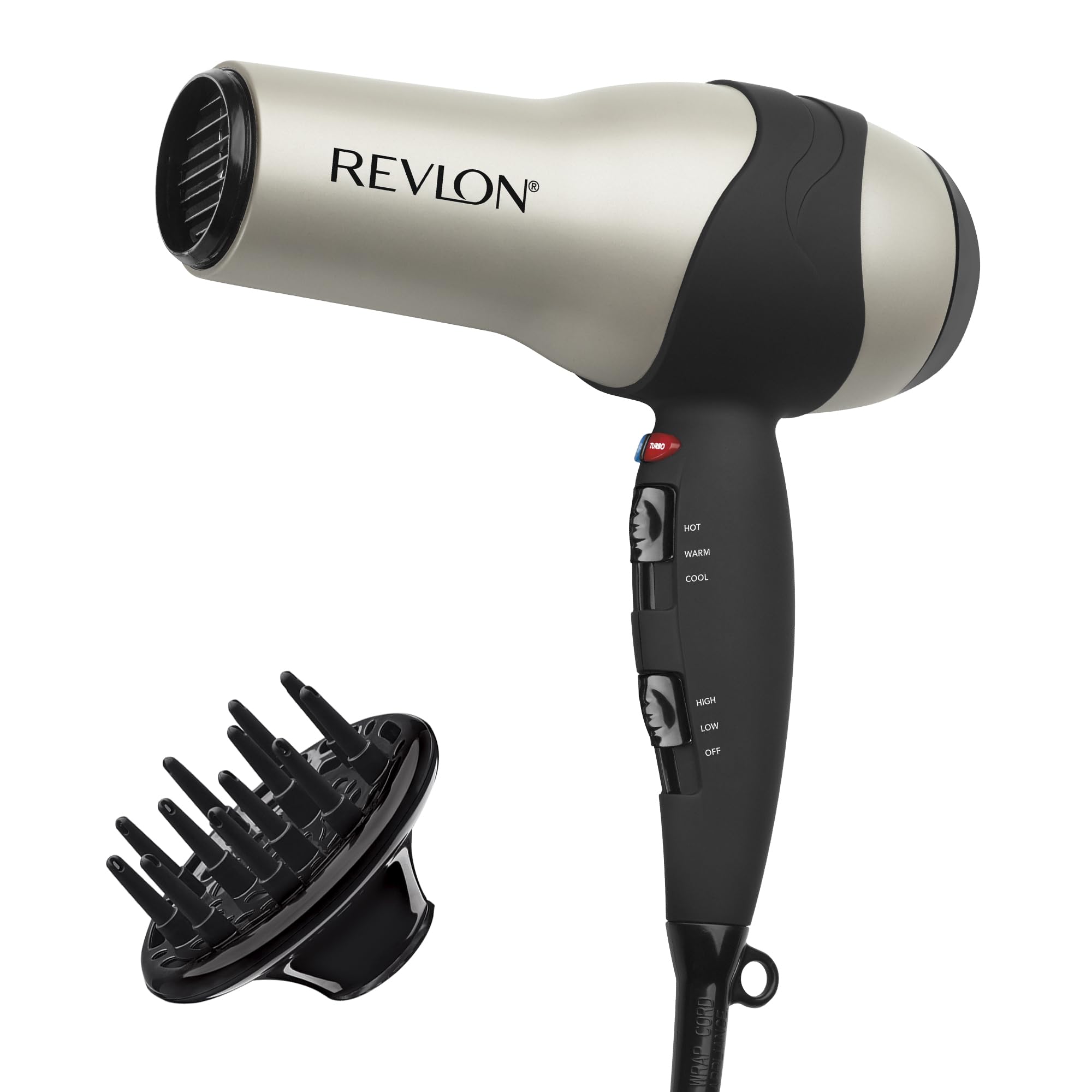
Revlon Turbo 1875W

93 /100
LBD Score Outstanding

Key details

Power
1875 W
Weight
1.84 lb
Airflow Boost
Turbo airflow button
Heat And Speed
3 heat, 2 speed, cool shot
View on Amazon

The Turbo has a button nothing else in this group has: press it and the fan steps up for a burst of extra airflow. Revlon's claim is up to 50% faster drying, which we can't verify, but the useful version of that button is narrower than the marketing — it's for the last two minutes on the dense section at the back of your head, not for the whole blow-dry.

Heat is where it quietly beats the more expensive dryers here. Three steps, and the top one gets genuinely hot, which is what thick, coarse, or water-holding hair needs to dry in a reasonable time. If your current dryer takes twenty minutes and leaves your shoulder aching, heat and airflow together are usually the missing pieces, and this one has both.

What isn't in the box matters as much as what is: no diffuser or concentrator among the listed contents, so curl-friendly drying means buying the Remington or the Conair instead. That leaves the Turbo as a straightforward strong-air, strong-heat dryer for dense hair — no accessories, no fuss.

Pros

  • Hottest top setting in this group
  • Turbo airflow button for stubborn sections
  • Three heat and two speed settings with cool shot

Cons

  • Heaviest here at 1.84 pounds
Our verdict

Buy it if your hair is thick and holds water — the hotter top setting and the turbo button make short work of dense sections, and we can live with the weight.

Check Latest Price
4

Second Bathroom

Conair Ionic 1875W

91 /100
LBD Score Outstanding

Key details

Power
1875 W
Weight
1.21 lb
Attachment
Concentrator
View on Amazon

There isn't much to this one, and we think that's the appeal: 1875 watts, a slider for heat and speed, a concentrator, and a 1.21-pound body. Nothing to configure, nothing loose to lose in a drawer.

Airflow is where the savings show. Fine and medium hair dry briskly; anything thick takes noticeably longer, so read this as a light-to-medium-hair dryer rather than a do-everything one. What it does have is a genuinely comfortable 1.21-pound body and controls simple enough to work without looking. It's the least expensive full-size dryer in this group, and that's the whole argument for a guest bath, a first apartment, or a bag that lives at the gym.

Pros

  • Least expensive full-size dryer here
  • Comfortable 1.21-pound body
  • Simple controls with no extra parts

Cons

  • Airflow is modest for thick hair
Our verdict

We suggest it as a second dryer: the cheapest full-size one here, light in the hand, and happiest on fine or medium hair that dries quickly.

Check Latest Price

How We Tested the Best Hair Dryers

To build the shortlist, I read through customer reviews and manufacturer specs for every full-size dryer I could find, then kept only the ones with at least two heat settings, two speeds, and a concentrator or diffuser in the box. From there we bought 12 that spanned what shoppers actually browse, from budget workhorses to mid-priced models making ceramic or ionic claims.

They lived where dryers live: on a bathroom shelf, in a gym bag, plugged in beside a mirror. For six months we used them on weekday mornings, on wet hair after workouts, and on weekend diffusing sessions. Every dryer got the same drying test — hair towel-dried to a consistent dampness, then timed at the highest heat and speed until it was dry to the touch, with notes on whether roots or ends dried first.

We weighed each one on a kitchen scale, then paid attention to what that number felt like at minute ten with an arm overhead. Noise got measured on a decibel meter at arm's length, though we also noted which ones made conversation impossible. To judge heat, we ran each on high for ten minutes and felt both the housing and the air at the nozzle, then tried the low setting on fine hair to see whether it was genuinely gentle or just less hot.

Attachments were snapped on and off repeatedly, then nudged sideways mid-style to see if they'd spin or drop off. Across the months we watched cords, filters, and button feel for wear, and compared photos of the same half-dried hair to see which dryers left the most frizz.

How to Choose a Hair Dryer

Look at the motor before the wattage

Two dryers can both claim 1875 watts and behave nothing alike, because watts measure power drawn, not air moved. An AC motor is the more expensive build: it drives the fan with more force, and it's the part makers credit with a longer service life. A DC motor is what sits inside most inexpensive dryers, and it weakens as it ages.

If the product page doesn't name the motor, assume DC. Our top pick is the only AC dryer in this group, and that single part is why it moves the most air.

Weight is a real specification

Hold a dryer at shoulder height for fifteen minutes and the gap between one pound and 1.84 pounds stops being a number on a page. Lighter isn't automatically better, though, because airflow costs motor and motor costs weight — the lightest dryer in a group is often the one that dries slowest.

Choose by how you dry. Sections, with the dryer set down between them, favor a heavier and stronger model; one long continuous pass favors something near a pound.

Heat: count the steps, not the degrees

Three heat settings and a cold shot are the useful minimum. You want a genuinely hot step for the first pass through wet hair and something cool to set the shape at the end. A cold-shot button that only slows the fan leaves the element warm; a true one cuts the heat, which is what closes the cuticle.

The other thing to weigh is what hot means on a given dryer. A mild top setting is comfortable on fine hair and frustrating on coarse hair, so match the dryer to your hair rather than to the label.

Attachments: diffuser, concentrator, or neither

A concentrator narrows the airflow so you can point it down the shaft of the hair; a diffuser spreads it so curls dry without being blasted apart. If you wear your hair curly or wavy, the diffuser is the attachment that decides whether a dryer is useful to you, so check the box before ordering. If you blow out straight, a concentrator does more for the finish than any coating claim.

Fit matters as much as type. A nozzle that only pushes on loosely is the one that ends up on the floor once the barrel warms.

Travel dryers: small, cheap, and short-lived

This is the category's soft spot. A folding travel dryer pairs a small motor with a hinge, and the compact models we compared all carried the same story of brief service lives. Buy one as a consumable rather than an heirloom, and don't expect full-size drying on thick hair.

Dual voltage means a switch, not a promise. Set it to the local voltage before you plug in, because a dryer left on 120 volts and fed 240 is the most common way these die abroad. A plug adapter changes the shape of the prongs; it does nothing about the voltage.

Frequently Asked Questions

Final Verdict

The Conair InfinitiPRO is the dryer we point most people to. The AC motor moves more air than anything else in this group, both attachments come in the box, and 1.46 pounds is comfortable through a full blow-dry; the one honest catch is a top setting that runs warm rather than hot.

If your hair is thick and holds water, the Revlon Turbo's hotter settings matter more than the Conair's airflow, even at 1.84 pounds. And if the price of either is more than you want to put into a hair dryer, the Remington does most of the same job at one pound.