Best Ventless Dryers for Apartments of 2026

Ventless dryers exist because a vent hose doesn't always. Instead of pushing damp air outside, they condense the moisture and drain it or collect it in a reservoir, so they can sit in a closet, a basement corner, an RV, or a dorm room. The tradeoff is honest: longer cycles, and heat that goes into the room around the machine.

I've done laundry in enough apartments without a dryer hookup to be skeptical of a one-pass dry. Over eight months, my team and I put nine compact and ventless dryers through real loads — towels, sheets, jeans, delicates, gym clothes — watching for what owners actually complain and rave about: drying performance, build quality, noise, heat, footprint, and value. We also checked whether the stainless steel drums and multi-mode controls on the spec sheets changed anything at all.

One thing first-timers get wrong: the capacity on the box isn't the load you'll dry in one cycle. Compact drums need room for clothes to tumble, or the middle stays damp through every mode. The picks below are the ones that got a real week's laundry dry without babysitting.

1

Best Overall

Effidry S3 Compact Dryer

85 /100
LBD Score Excellent

Key details

Weight
33 lb
Capacity
1.06 cubic feet
Dimensions
20.11"D x 16.81"W x 21.21"H
Drying Modes
8
View on Amazon

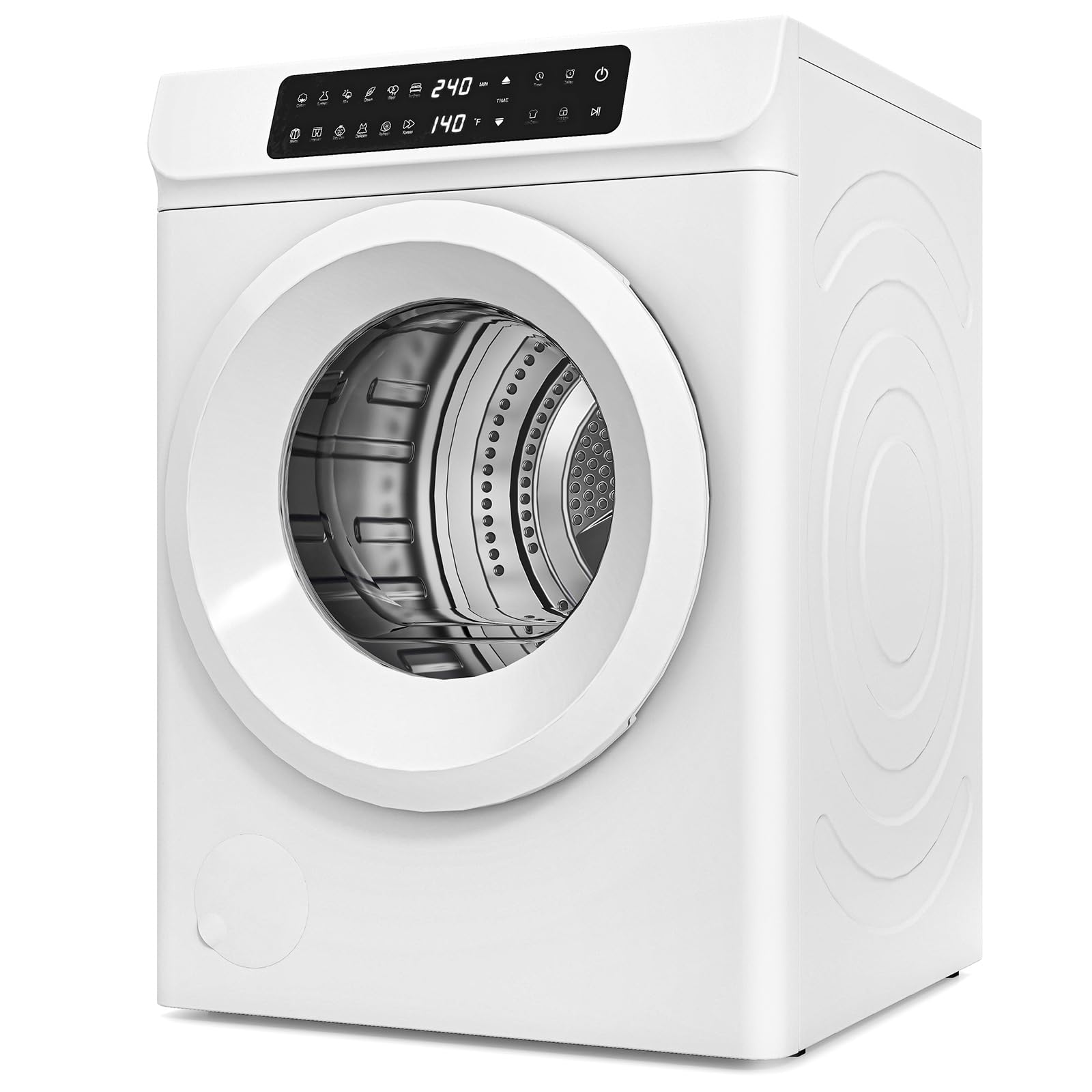
The reason this machine leads our list is simple: nothing has to go out a window. There's no exhaust hose, no drain line, and no installation step beyond plugging it into a standard outlet. Two variable-frequency motors turn the drum forward and back at matched speed so a small load doesn't clump into a ball, and two sets of fine filters catch what the tumbling shakes loose. In an apartment where the only available wall is inside a closet, that's the difference between owning a dryer and walking to the basement.

At 1.06 cubic feet and 33 pounds, this is the smallest machine here that still counts as a real dryer. It measures 20.11 inches deep and 16.81 wide, so it sits on a small table or a rolling cart, and one person can carry it up a flight of stairs. What that buys you is placement: a laundry corner in a studio, the end of a closet, the dead space beside a bathroom door.

The controls are the part we ended up appreciating most. One button starts a cycle, and temperature and humidity sensors decide when the clothes are finished rather than a timer running down. Eight modes cover cotton, wool, bedding and the rest, and a shoe rack comes in the box for things you don't want tumbling. It's a small heater moving air through a small drum, so give it time; the payoff is that it stops itself when the load is dry instead of scorching it.

Where it stops: a comforter, a week of towels, four people's jeans. Measure your usual load against 1.06 cubic feet before you order, because this is a machine for someone whose laundry is their own. If it isn't, the drum will be the first thing you outgrow.

Pros

  • Truly needs no vent or drain
  • 33 pounds, light enough to move alone
  • Sensors end the cycle on dryness
  • Two filter sets and a shoe rack included

Cons

  • 1.06 cubic feet suits one person only
Our verdict

For a one-person apartment, this is the one we recommend: it needs nothing but an outlet, and it handles a daily load without a vent, a drain, or a second thought.

Check Latest Price
2

Best for Two People

ROVSUN 2.6 Cu. Ft. Dryer

87 /100
LBD Score Excellent

Key details

Power
1400W
Weight
49 lb
Capacity
2.6 cubic feet
Controls
Normal, Eco, Auto
View on Amazon

One dial, three settings, and a stainless drum. The ROVSUN is the least complicated machine here, and after a run of touchscreens that reads as a feature rather than a shortfall. Turn the knob to Normal, Eco or Auto, set your time, and walk away. Nothing to pair, nothing to update, nothing to squint at in a dim laundry corner.

Quiet is what surprised us. A 2.6-cubic-foot drum on 1,400 watts has every reason to rattle, and this one hums along at a level you stop noticing from the next room. Heat is where results vary: a loosely packed load comes out dry and warm, a tightly packed one needs a second pass, so fill it about two-thirds and give it more time rather than running the cycle twice.

Two practical points. The knob means you set the minutes yourself, with no sensor deciding for you, and the cabinet wants 23.6 inches of width plus room for the door to swing. Get those right and 2.6 cubic feet takes a full basket of clothes, towels in pairs, jeans without a fight. In a fifth wheel or a basement corner, where the alternative is a laundromat trip, that trade is easy to take.

Pros

  • 2.6 cubic feet takes a full basket
  • Quiet enough for the next room
  • Three simple dial settings
  • 49 pounds with a compact footprint

Cons

  • You set the timer yourself, no dryness sensor
Our verdict

Our pick for two people: 2.6 cubic feet takes a real basket, the dial has nothing to learn, and it runs quiet enough that you forget it's on.

Check Latest Price
3

Largest Capacity

Auertech 3.6 Cu. Ft. Dryer

82 /100
LBD Score Excellent

Key details

Capacity
3.6 cubic feet
Warranty
90 days
Dimensions
22"D x 23"W x 30"H
Drying Modes
12
View on Amazon

3.6 cubic feet is the biggest drum in this group, and it changes what a compact dryer is for. This is the one that takes a comforter, a week of towels, or four people's clothes without splitting the load three ways. At 22 inches deep, 23 wide and 30 high it's still a machine you can tuck into a closet. It's just the closet you were going to use for something else.

The 160-degree door is the detail we didn't expect to care about. In a narrow laundry nook, a door that swings almost flat against the wall is the difference between loading comfortably and loading sideways. The lint filter sits where you can reach it without unplugging anything, and twelve modes run from cotton and synthetics to wool, with a delay start for off-peak hours.

What gives us pause is the warranty: 90 days, the shortest coverage here, on the priciest machine of the five. That's a short window for an appliance, and it's the line item that made us think twice. The counterweight is that a bigger drum means fewer cycles for the same laundry, and fewer cycles on any compact dryer is not a small thing. If you have the space and the load to justify it, the math works.

Pros

  • Largest drum here, takes a comforter
  • 160-degree door clears a narrow nook
  • Twelve modes plus a delay start
  • Filter reachable without moving the machine

Cons

  • 90-day warranty is the shortest here
Our verdict

Buy this when the drum decides it: 3.6 cubic feet swallows a comforter, and we think a family gets more from the capacity than it loses to the short warranty.

Check Latest Price
4

Best for Shoes and Boots

Auertech 2.8 Cu. Ft. Dryer

82 /100
LBD Score Excellent

Key details

Power
1400W, up to 140°F
Weight
52 lb
Capacity
2.8 cubic feet
Dimensions
19.5"D x 22.5"W x 27"H
View on Amazon

Wet sneakers are the reason to look at this one. A boot dryer attachment clips on and pushes warm air into shoes, boots and gloves while the drum handles everything else, and at 52 pounds with a 19.5-inch depth the machine fits where a full-size dryer never will. Eight modes cover cotton, bedding, wool and mixes, the stainless drum runs up to 140°F, and the window in the door lets you check a load without stopping it.

The 2.8-cubic-foot drum sits in the middle of this group: more than the 1.06-cubic-foot machines, less than the 3.6, and enough for a couple of towels or a few pairs of jeans at a time. What we noticed in daily use is how much the door defines the experience. The magnetic catch is strong enough that opening it takes a real pull, every single load, and that's the kind of small friction you can't design your way around once the machine is wedged in a corner.

Where it lands is a small household, a cabin, or a basement where the pipes already are: two people who generate a load a day and somehow always have something wet. The boot attachment is the reason to pick it over the ROVSUN at a similar size; the rest of the machine is straightforward and does what the panel promises.

Pros

  • Boot dryer attachment for shoes and gloves
  • Eight modes including wool and bedding
  • 52 pounds and 19.5 inches deep

Cons

  • Door magnet needs a firm pull every time
Our verdict

The shoe attachment is what sells us: a boot dryer and a clothes dryer in one 52-pound box, sized for a small household that keeps ending up with wet feet.

Check Latest Price
5

Travel and RVs

MOJOCO Portable Clothes Dryer

86 /100
LBD Score Excellent

Key details

Heating Power
600W
Folded Dimensions
8.7"D x 11.42"W x 4.53"H
Garments Per Cycle
Up to 9
View on Amazon

This isn't a tumble dryer, and it's worth being clear about that before anything else. The MOJOCO is a heated bag on a hook: a 600W blower and heating element hang inside a fabric enclosure, clothes hang inside it, and warm air moves through them. Folded down it measures 8.7 inches by 11.42 by 4.53, which is about the footprint of a hardback book.

Where it earns its place is the night before. A school uniform, a damp jacket, a run of socks and underwear on a camper trip: the jobs a drum dryer is absurd for and a radiator is too slow for. The timer is adjustable, it runs quiet enough to sit in a bedroom, and there's an overheat cutoff. We found the nine-garment figure optimistic once the clothes are thick.

What it won't do is a household's laundry. Nothing tumbles, so nothing gets knocked loose. Creases from a packed suitcase stay where they were, and a wet towel takes a long while in there. If your laundry is a basket a week, buy a drum. If it's a shirt and a pair of pants at ten at night, this is the thing you hang on the back of a door and forget about until you need it.

Pros

  • Folds flat enough for a suitcase
  • Hangs up to nine garments
  • Adjustable timer and quiet running
  • Overheat protection built in

Cons

  • No tumbling, so creases stay put
  • A few garments per cycle, not a load
Our verdict

For a suitcase, a camper, or one uniform the night before, this is the one we pack, as long as you don't expect it to keep up with a household's laundry.

Check Latest Price

How We Tested Ventless Dryers, Load by Load

We started by reading through owner reviews and spec sheets for compact electric dryers that run on a standard household circuit and need no ducting, then filtered by footprint, price tier, and control type. Nine made the cut. Testing ran eight months, from spring into fall, which meant the humidity in the room changed under us — useful, because these machines behave differently in a sticky July than in a dry October.

Each machine went into a real laundry rotation: a bathroom in a small apartment, a basement corner, and a borrowed RV for weekend trips. We washed the same loads and dried them — a week of towels, a set of queen sheets, five pairs of jeans, delicates in mesh bags, and damp gym clothes straight out of the bag. We timed every cycle, then checked the load by hand and with a moisture meter, feeling for cool damp patches in the middle of a bundle and along hems and waistbands. Anything that needed a second pass got logged as such.

For heat, we shot an infrared thermometer at the drum and door glass mid-cycle, then noted how warm the surrounding room got over two hours with the door shut. For noise, we stood three feet away with a decibel meter during the loudest stretch and asked whether you could hold a conversation or watch TV in the next room. Quality got a hands-on pass — door latches, drum seams, lint filters, knobs and touch panels — and we measured each unit's footprint and wheeled or carried it in and out of a closet to see how it handled.

Value came last: how much laundry each machine got through per cycle relative to what it cost, and whether the cheapest ones felt like a stopgap you'd replace in a year.

How to Choose a Ventless Dryer

Work Out Where the Moisture Goes

True ventless dryers, the condensing and heat-pump kind, pull moisture out of the air and send it to a reservoir or a drain, which is why they can sit in a closed closet. The compact 120V dryers here are simpler: they blow warm, damp air out of the cabinet. Some machines in this size class ship with a four-inch hose and an exhaust connector, which means they need a window after all. The ones in this guide don't, so the moisture lands in the room.

That isn't a dealbreaker, it's a placement decision. Crack a window, run a bathroom fan, or leave the laundry door open during a cycle and the room stays comfortable. The trap to avoid is assuming compact automatically means ventless. Check what's in the box before you buy, because a hose changes the installation entirely.

Size the Drum to Your Actual Load

A full-size dryer runs about 7 cubic feet. These run from just over 1 to 3.6, which is a real difference in what a load means: 1.06 cubic feet is a day's clothes for one person, 2.6 handles a basket, and 3.6 takes a comforter. Go by your bulkiest regular item rather than the average week, because bedding is what forces the decision.

There's a trap in the rated capacity too. Those numbers assume a loose fill, and a packed drum in a small machine dries unevenly no matter how long you leave it running. Two-thirds full is the working limit, so the usable capacity is smaller than the number on the label.

Plan for Noise and Longer Cycles

A 120V machine on 1,400 watts makes less heat than a 240V dryer, so cycles run longer. Budget for that before you conclude the machine isn't working. Dryness sensors earn their keep here, because they end the cycle on the load rather than the clock; with a manual timer, the judgement is yours.

Noise matters more than it does in a basement laundry room, because these machines live near where you sleep. Compact dryers vary a lot: some hum, some whine when the drum reverses. If the machine will sit within a few feet of a bedroom, treat noise as a specification worth checking, not an afterthought.

Check the Weight, the Footprint, and the Warranty

Everything in this group weighs between 33 and 52 pounds, which is one person's job to move but not something you want to shift every week. Depth ranges from around 17 to 23 inches, and the door needs room to swing. Measure the nook including the door before you commit to a spot.

Warranties run from 90 days to a year, and that spread matters more on a machine with a drum, a belt and a heating element than it does on a toaster. Read the coverage before you fall for the capacity.

Frequently Asked Questions

Final Verdict

Effidry's S3 is the pick for most people reading this, and it wins on the one thing that matters in a ventless dryer: it needs nothing but a wall outlet. If your laundry is one person's, that settles it.

Two situations change the answer. A couple or a small family should take the ROVSUN's 2.6 cubic feet and live with setting the timer by hand. And if a comforter has to go in the drum, the Auertech 3.6 is the only machine here big enough, as long as you're comfortable with 90 days of coverage.