Best Handheld Vacuums of 2026

A handheld vacuum earns its keep in the thirty seconds before guests arrive: cereal under the booster seat, a ring of pet hair on the armchair, sand worked into the car's floor mats. The catch is that the motor, battery, and dust bowl all have to shrink into something you can carry in one hand, and every model spends that limited space differently — some chase suction and quit early, others run long and barely lift a tumbleweed. We ran 12 of them through those messes over four months.

The number printed on the box tells you less than you'd think. What decides whether a handheld stays by the door or gets buried in a closet is whether the battery survives a full pass of the stairs, whether emptying the bowl dumps hair into the trash rather than back onto the rug, and whether the crevice tool is where you left it. Noise counts too: a vacuum loud enough to send the dog running is one you'll skip for the small jobs it was bought for.

The picks below are the ones that earned a spot by the door. A couple of cheap models embarrassed the expensive competition, which is its own kind of recommendation.

1

Best Overall

Bissell Pet Hair Eraser 2390A

93 /100
LBD Score Outstanding

Key details

Weight
3 lb
Runtime
17 minutes
Included Tools
Motorized brush, upholstery tool, crevice tool
Dustbin Capacity
0.18 gallons
View on Amazon

Pet hair on a couch cushion is where the Pet Hair Eraser makes its case. We ran the motorized brush over upholstery and car mats, and the bristles pulled embedded hair to the surface instead of letting the nozzle skate over it. The 0.18-gallon bin is big enough that a pass over a sofa does not send you to the trash every few minutes, and Bissell includes an upholstery tool and crevice tool for seams and seat rails. The motorized brush is the only powered pet tool among our picks, and it is the reason this vacuum earns its premium spot.

This is the handheld we recommend first for homes with pets. The 17-minute runtime is enough for a couch, stairs, and a car footwell before the battery goes back on the dock; that is more run time than the 11-minute Dustbuster gives you. The 14-volt lithium-ion battery keeps the brush moving, which is the part that matters on fabric.

What we did not get was a light vacuum. At three pounds, the Pet Hair Eraser is heavier than the 2.6-pound Dustbuster, and the heft shows up when you reach over a couch back or work under a dashboard. The motorized brush is the reason we put up with it.

Pros

  • Motorized brush lifts embedded pet hair
  • 17-minute runtime suits couch-and-car sessions
  • Large 0.18-gallon bin empties quickly
  • Three tools cover upholstery, crevices, and stairs

Cons

  • Eight-hour recharge is slow
Our verdict

We recommend the Bissell Pet Hair Eraser first for pet hair on upholstery, stairs, and car seats; its motorized brush does the work suction alone misses.
Check Latest Price
2

Best Value

BLACK+DECKER CHV1410L

89 /100
LBD Score Excellent

Key details

Weight
2.6 lb
Runtime
11 minutes
Cleaning Reach
Rotating slim nozzle
Dustbin Capacity
605 ml
View on Amazon

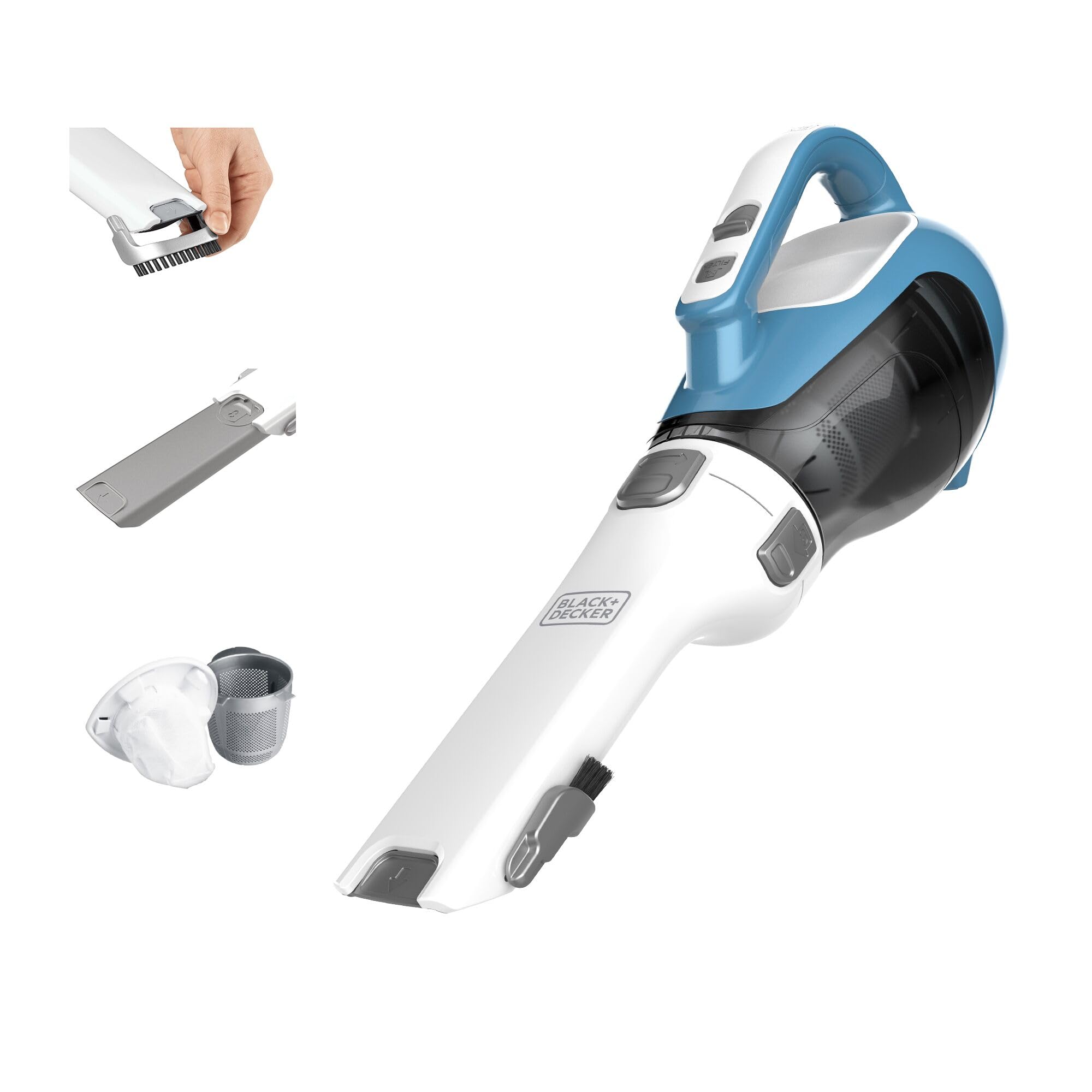
The 605 ml dust bowl is why the CHV1410L stays in our rotation for messes that are bigger than a sprinkle. It is a useful size for a car footwell or a set of stairs, and it means fewer trips to the trash than the smaller bins here. The rotating slim nozzle is the other practical bit: it angles into seat rails and stair risers without making you swap tools, and the flip-up brush is there for upholstery. This is the value pick in the group.

The 11-minute runtime is the number to respect. We got through a car footwell and a couch cushion before the battery started to fade, which is the kind of short, targeted work this vacuum is built for; a whole-car detail needs a plan or a second charge. The four-hour recharge is long enough that we put it back on the dock as soon as we finish. For quick jobs, that is a fair trade.

The rest is ordinary in a useful way. The bin empties without a lot of disassembly, the washable filter is easy to rinse, and the 16-volt motor has enough pull for crumbs and light pet hair. We did not expect this older design to feel as handy as it does, but the rotating nozzle is the detail that keeps it in the car.

Pros

  • Large 605 ml dust bowl
  • Rotating nozzle reaches tight spots
  • On-board crevice tool and flip-up brush
  • Strong 16V power for the size

Cons

  • Loud 78 dB operation
  • Charging stand takes some aiming
Our verdict

The BLACK+DECKER CHV1410L is the value pick in this group: its 605 ml bowl and rotating nozzle make quick car and stair cleanup easier, and we think the trade-offs are easy to live with.

Check Latest Price
3

Best for Car Interiors

BLACK+DECKER BDH2000L

89 /100
LBD Score Excellent

Key details

Weight
3.5 lb
Runtime
15 minutes
Voltage
20 volts
Included Tools
Extendable crevice tool, flip-up brush
View on Amazon

A seat rail is the sort of place where a short nozzle gives up, and the BDH2000L's extendable crevice tool is built for it. The 20-volt battery gives this Dustbuster more pull than the compact models, and the slim nozzle slides out to reach console gaps, booster-seat edges, and the space between the seats. The flip-up brush handles floor mats, and the 15-minute runtime covers a footwell-and-trunk pass. For car interiors, this is the one we reach for.

What we liked in use is the simplicity: one speed, a charging dock, and a nozzle that does not need to be swapped for the tight stuff. The 20V motor has enough pull that we did not have to go over the same mat repeatedly, which is not true of every handheld here. The dock keeps it upright in the garage, which we appreciated.

The trade-off is bulk. At 3.5 pounds, it is heavier than the Bissell and the 2.6-pound Dustbuster, and reaching under a dashboard or up to a headliner is a workout. For car cleaning, we still take the reach and power.

Pros

  • 20V power for mats and carpets
  • Extendable crevice tool reaches seat rails
  • Flip-up brush built in
  • 15-minute runtime

Cons

  • Loud 80 dB operation
  • Four-hour recharge is slow
Our verdict

When the mess is in a car footwell or along a seat rail, we reach for the BLACK+DECKER BDH2000L; its 20-volt power and extendable crevice tool outreach the compact Dustbuster.

Check Latest Price
4

Best Budget

Evekas Handheld Vacuum

93 /100
LBD Score Outstanding

Key details

Runtime
20 minutes
Charging
Type-C
Max Suction
9,000Pa
Dustbin Capacity
670 ml
View on Amazon

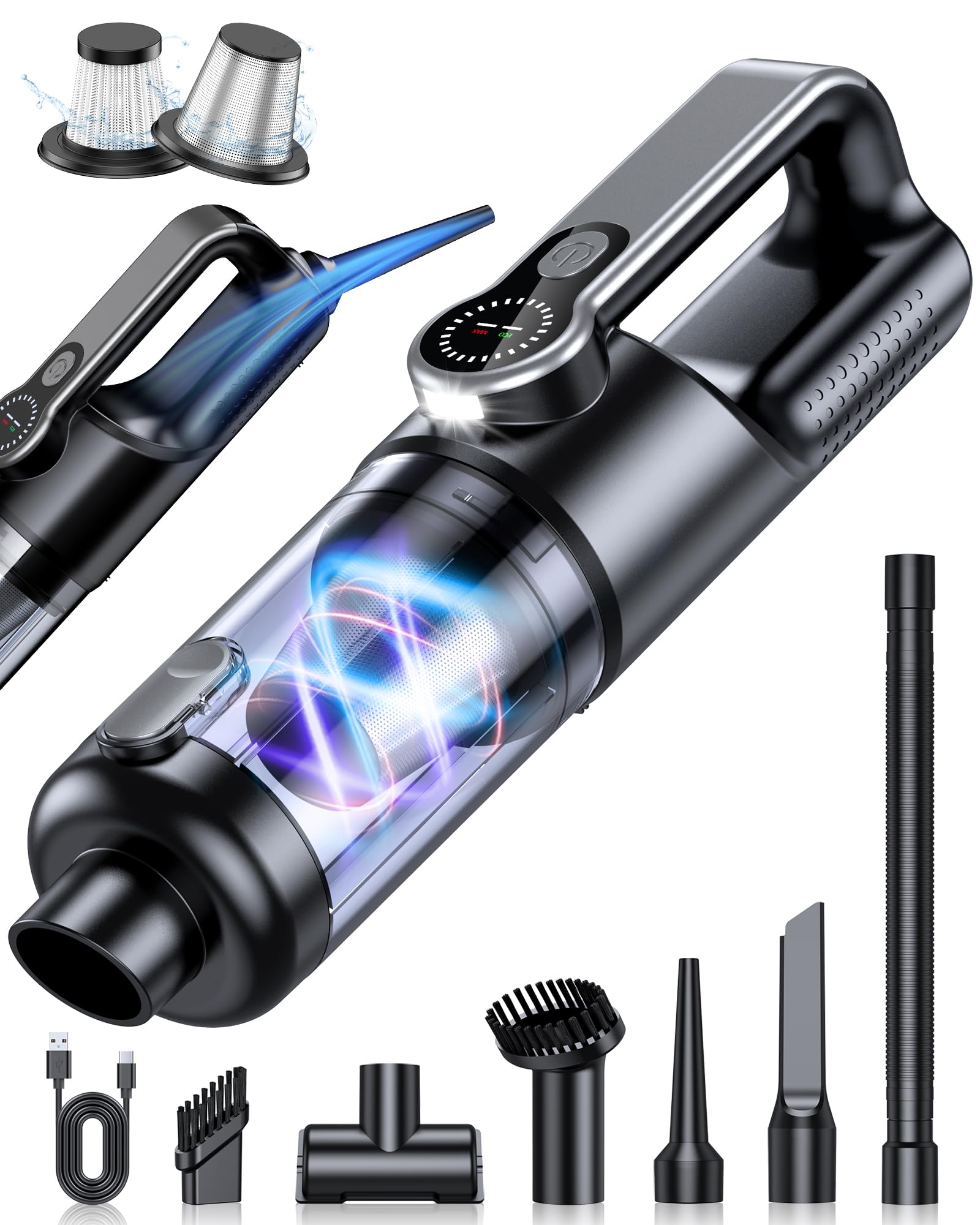
The Evekas looks like a spec-sheet overachiever: 9,000Pa in max mode, a 670 ml dustbin, a 6,000mAh battery, and Type-C charging. Those numbers are why it caught our attention in a category where small vacuums often ask for more money and give you a 10-minute run.

In use, the two modes make more sense than a single on/off switch. Max mode has the pull for crumbs and pet hair on a car seat; eco mode is the one we used for a lap of the kitchen floor and baseboards. The 670 ml bin is a big one for this class, which means fewer empties during a car cleanup, and the vacuum is light enough to hold one-handed while you chase a spill.

This is the pick for a tight budget or a second vacuum for the car. The listed runtime is 20 minutes, which is enough for a quick pass through a sedan or a kitchen; max mode will use it faster, so plan your route. We liked the Type-C charging because it means one less proprietary cable in the drawer. It is not the vacuum we choose for a whole-house deep clean, but that is not what it is for.

Pros

  • 9,000Pa max suction
  • 670 ml dustbin
  • Two suction modes
  • Type-C charging

Cons

  • No charging dock
Our verdict

A budget handheld can still be useful, and the Evekas is the one we point to for quick car and home messes; its 670 ml bin and two suction modes are a lot of vacuum for the money.

Check Latest Price
5

Vacuum and Blower

FAOGO 2-in-1 Handheld Vacuum

90 /100
LBD Score Outstanding

Key details

Runtime
30 minutes
Filtration
HEPA
Max Suction
36,000Pa
Dustbin Capacity
450 ml
View on Amazon

The blower mode is the feature that makes the FAOGO different from every other vacuum here. It reverses the airflow to push crumbs out of keyboard gaps, seat rails, and the corners of a car trunk, then switches back to vacuum them up. The built-in LED is a useful partner for that work because it lights the footwell or cabinet corner you are aiming at.

The vacuum side is no slouch on paper. FAOGO lists 36,000Pa in max mode and 18,000Pa in eco, with a brushless motor, a 450 ml bin, and a washable HEPA filter. We found the suction strongest on hard surfaces and mats, which is where a handheld spends most of its time.

The attachments are the usual mix of brush and nozzle tools, plus a flexible hose, and the whole thing is light enough to carry around the car. The 30-minute runtime is the longest claimed here, and the two modes let you choose between pull and duration. We did not have to swap tools as often as we expected.

This is the pick for someone who wants one tool for both vacuuming and blowing out tight spaces. We liked the blower more than we expected; it turned a seat-rail job into a two-step rather than a nozzle-swapping one. For a car or a desk drawer, that versatility is the reason it earns a spot.

Pros

  • 36,000Pa max suction
  • Blower mode for tight spaces
  • LED light
  • Washable HEPA filter

Cons

  • Small 450 ml bin
Our verdict

The FAOGO is the one we choose when a job needs both vacuuming and blowing, and its blower mode clears debris from crevices that a nozzle alone cannot reach.

Check Latest Price

How We Tested a Dozen Handheld Vacuums

We started by pulling every cordless handheld with a credible review record and a bowl you can empty without dismantling the machine, then narrowed by the things that actually vary from one to the next: bowl capacity, whether the charging dock holds the tool upright and keeps the attachments with it, which brushes and crevice tools ship in the box, and whether the battery is replaceable. From that pool we bought 12, from budget models up to the ones with brushless motors, and put them into four months of ordinary life.

They lived where handhelds really live: on a dock in a kitchen, on a shelf in a garage next to the cat litter, and in the trunk of a car with a shedding dog. Each week every unit ran the same circuit — a couch cushion dusted with a measured cup of rice and a pad of collected pet hair, the crevices of a car seat, stair treads, and a rubber floor mat. We recorded how much came up in a single pass, how many passes it took to leave the surface clean, and how the tool felt in one hand on the stairs, where an extra pound is noticeable.

For battery life, we ran each one wide open from a full charge until it quit, logged the minutes, and timed the recharge. Noise got a phone meter reading at arm's length, plus the far less scientific note of whether we could hold a conversation over it. After every run we emptied the bowl over the trash and wrote down whether hair fell out cleanly or had to be picked off the filter, and whether anything had wound around the brush. A few spent all four months in the garage, getting knocked off a shelf and left in the cold, to see how the housing and battery held up.

Value came last, and it was never the price tag. A mid-priced vacuum with a tool that stays clipped on and a bowl you can dump without touching the hair outperformed more than one spendier model.

How to Choose a Handheld Vacuum

Match Runtime to the Job

A handheld's runtime is a countdown, and the number on the box is usually measured in the lowest-power mode. Ten minutes is enough to clear a car footwell or a couch cushion; a full car interior or a set of stairs is a 15-to-20-minute job, and you should plan a recharge in the middle if your vacuum is at the short end. We treat the runtime figure as the first filter because a vacuum that dies halfway through a car cleanup is not saving you time. Recharge time matters just as much: a four-to-eight-hour charge turns a second pass into tomorrow's job, so put the vacuum back on the dock after every use.

Weigh the Vacuum Against the Reach

Handheld vacuums can be light enough to hold overhead or heavy enough to make you switch hands, and the difference shows up above shoulder height. A 3.5-pound vacuum is fine on floor mats and low furniture, but it drags when you reach over a couch back or under a dashboard. If most of your cleaning is overhead or up high, start with the lightest model that has the nozzle you need; if pet hair is the main job, accept the extra weight that comes with a motorized brush. We put more value on balance than on a tenth of a pound, because a top-heavy vacuum tires your wrist even when the total weight looks reasonable.

The Tools Decide Where It Works

A crevice tool is the difference between cleaning a seat rail and cleaning around it. Look for a narrow nozzle that reaches into console gaps, stair risers, and the space between seats; an extendable or rotating nozzle saves you from swapping tools mid-job. For pet hair, a motorized brush is worth more than a high suction number because it agitates the fibers. A flip-up brush is handy for upholstery and mats, but it is not a substitute for a powered pet tool. We reach for the tool that matches the mess first, then compare suction.

Bin Size, Filters, and Emptying

Dustbins in this group run from 450 ml to about 670 ml, with the Bissell's 0.18-gallon bin at the larger end. A bigger bin means fewer trips to the trash during a car cleanup; a small bin is fine for crumbs but fills fast when you are pulling pet hair out of a couch. Washable filters keep running costs down, but they have to dry completely before they go back in, or the motor pulls moisture and dust. We like a bin that empties without a lot of disassembly, because the vacuum you actually clean is the one that keeps its suction.

Plan for Noise and Charging

Handheld vacuums are loud, and the difference is not subtle: the Bissell lists 70 dB, while the Dustbusters list 78 to 80 dB. If you clean while someone is sleeping or on a call, the lower figure is worth having. Charging setup matters just as much. A dock keeps the vacuum ready by the door or in the garage; a cable-only model is more portable but easier to leave uncharged. We prefer a dock for a home vacuum and Type-C for one that lives in the car.

Frequently Asked Questions

Final Verdict

The Bissell Pet Hair Eraser is the handheld we recommend first. Its motorized brush pulls embedded pet hair out of upholstery and car seats, and the 17-minute runtime and 0.18-gallon bin are sized for a real spot-clean session rather than a single crumb. If your priority is a simpler tool for car footwells and stairs, the BLACK+DECKER CHV1410L is the better fit; its rotating nozzle and 605 ml bin are easier to live with than its age suggests.