Best Wet/Dry Vacuums of 2026

Last winter a supply line let go under my kitchen sink, and the only thing between me and a ruined floor was the wet/dry vac sitting in the garage. That's how most people end up shopping for one — not because they want a new tool, but because a water heater, a washing machine, or a bag of spilled potting soil made the decision for them. The right machine pulls standing water off a floor in one pass, switches over to dry debris without a fight, and doesn't tip onto its side when you drag it by the hose.

Over the past eight months, my team and I have run 12 of them through flooded basements, sawdust-covered garage floors, and the floor mats of some genuinely disgusting cars. The number printed on the box — peak horsepower — is a marketing figure rather than a measurement, so we mostly ignored it and timed the work instead. What actually separated these machines was how cleanly they moved between wet and dry, how far the hose reached before the tank came off its casters, and whether the attachments stayed seated when we yanked the hose around a corner. Corded, cordless, or bolted to the wall is the first real decision, and every one of those is a trade. Here's what held up.

1

Best Overall

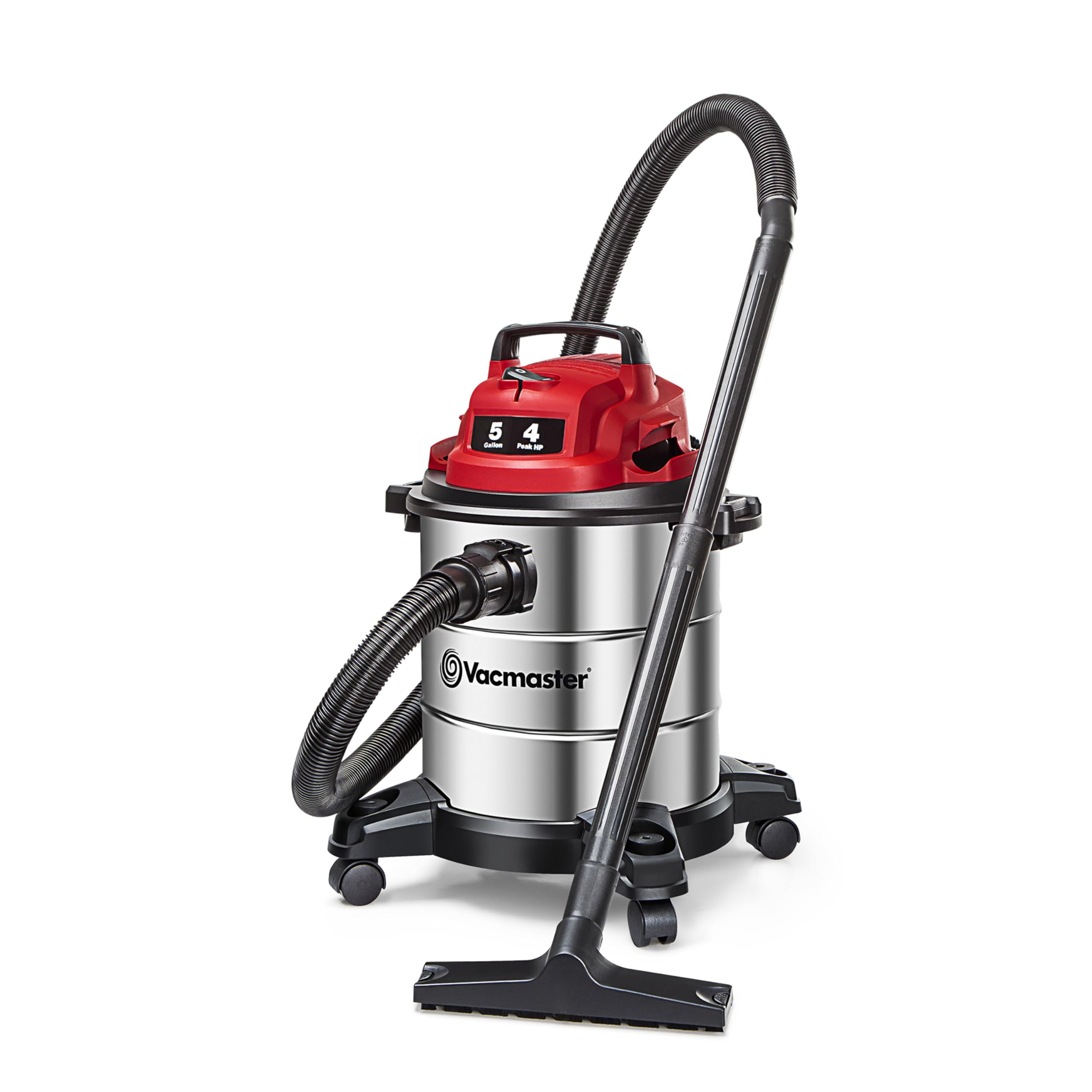
Vacmaster VOC508S

90 /100
LBD Score Outstanding

Key details

Motor
4 peak HP
Weight
11.7 lb
Airflow
135 air watts
Tank Capacity
5 gallons
View on Amazon

The Vacmaster VOC508S is the rare shop vac that does not feel like a permanent floor fixture. The 5-gallon tank is stainless steel, the body is listed at 5.3 kg, and the four wheels let it follow you around a car instead of being dragged by the hose. We noticed the difference most when lifting it onto a tailgate: it is heavy enough to feel substantial, not so heavy that you avoid taking it out of the garage.

We recommend it as our top pick because the numbers line up with the way most people clean. The 135 air-watt motor gives it more useful suction than the peak-horsepower badge suggests, and the 16-foot combined reach is enough to park the base in a doorway and work around a car or a small workshop. It is not the most powerful vac in this group, but it is the one we hand to someone who wants one machine for wet spills, sawdust, and car floors.

The stainless tank is more than a finish choice: it resists rust and wipes out cleanly after a wet pickup, and the smooth interior is easier to inspect for leftover debris. The six accessories cover the usual jobs, and the cartridge and foam filters let you switch between dry debris and water without improvising.

The 5-gallon tank also hits a useful middle: smaller than a full remodel vac, but large enough that a wet car floor or a pile of sawdust does not mean constant emptying. For a one-car garage, a basement, or a weekend project, that balance is the reason it stays by the door.

Pros

  • Light enough to lift and roll
  • 135 air watts for wet and dry pickup
  • Stainless tank resists rust
  • 16 feet of combined reach

Cons

  • Power cord is short for large garages
Our verdict

We recommend the Vacmaster VOC508S as our top pick for most garages and workshops: real suction, a stainless tank, and enough capacity for garage messes without the bulk.

Check Latest Price
2

Best Value Full-Size

Stanley SL18116P

93 /100
LBD Score Outstanding

Key details

Weight
13.4 lb
Tank Capacity
6 gallons
Cleaning Reach
16 feet
Maximum Suction
85 inches
View on Amazon

The Stanley SL18116P makes its case with capacity: a 6-gallon tank, a 4-peak-HP motor, and 16 feet of cleaning reach from a body that weighs 13.4 pounds. That is a lot of vacuum for a budget price, and the accessory kit is not an afterthought. You get three extension wands, a floor nozzle, a crevice tool, a gulper nozzle, a foam filter, and a reusable dry filter, plus a blower port.

The blower is the feature we appreciate most on a budget machine. After a dry pickup, it turns the same hose into a way to clear sawdust from a bench or leaves from a garage corner, which makes the vac useful beyond the floor. The 6-foot hose is flexible enough for car interiors, and the 10-foot cord adds reach without making the unit feel tethered to one outlet.

The Stanley earns its place because it covers the big jobs first: six gallons of capacity, enough suction for sawdust and wet debris, and a blower that earns its space. It is also light enough to carry by the handle when the wheels cannot get close to the mess. For a first shop vac or a backup for the garage, the capacity and reach do more for the money than a fancy housing.

Pros

  • Six-gallon tank at a budget price
  • 16 feet of reach with three wands
  • Blower adds a second job
  • Light 13.4-pound body

Cons

  • Durability is the weak spot
Our verdict

The Stanley SL18116P is our value pick: a six-gallon tank, long reach, and blower function for a modest outlay.

Check Latest Price
3

Best Quiet 6-Gallon

DeWalt DXV06P

95 /100
LBD Score Outstanding

Key details

Motor
4 HP
Weight
14.8 lb
Noise Level
77 dB
Tank Capacity
6 gallons
View on Amazon

The DeWalt DXV06P is the quiet one. Its 77 dB rating is quiet for a 6-gallon shop vac, and after a few minutes in a basement or garage, that is the difference between a vacuum you tolerate and one you use before the mess gets bad. We think it is the best 6-gallon choice here for anyone who works near the noise.

The 6-gallon poly tank and 4-HP motor give it enough capacity for a workshop floor, and the rubberized casters swivel smoothly enough to follow a car without scraping. The 10-foot cord with a cord wrap is a practical touch; it keeps the working radius useful without turning the back of the vac into a tangle.

The 7-foot, 1-7/8-inch hose is wider than the compact vacs here, so it moves sawdust and small debris with fewer stalls. The kit includes two extension wands, a cartridge filter, a dust bag, a floor nozzle, a utility nozzle, and a crevice nozzle. The dust bag is the detail we like for drywall dust: it keeps the tank cleaner and makes emptying less of a cloud.

Against the Stanley, this DeWalt gives up some raw suction on paper and asks for more money, but it makes up for it in noise and rolling manners. The casters are the part we keep coming back to; they make a full 6-gallon tank feel less like a bucket and more like a tool. For a basement shop or a garage where the vac stays out, that is the trade we make.

Pros

  • Quiet 77 dB operation
  • Smooth rubberized casters
  • 6-gallon tank with 10-foot cord
  • Dust bag for drywall cleanup

Cons

  • Durability is the open question
Our verdict

We think the DeWalt DXV06P is the quiet, smooth-rolling 6-gallon vac to choose for a basement workshop or garage.

Check Latest Price
4

Best Cordless

Milwaukee 0880-20

94 /100
LBD Score Outstanding

Key details

Weight
2.2 lb
Runtime
30 minutes
Tank Capacity
2 gallons
Battery Platform
18 volts
View on Amazon

The Milwaukee 0880-20 is not trying to replace a full-size shop vac. It is the cordless unit you grab for a car footwell, a workbench, or a small spill, and the tool-box shape makes that role obvious. The 2-gallon tank is compact, the 6-foot hose is enough to reach under a seat, and the whole thing is built to run on Milwaukee's 18V slide-on batteries.

We like it best for Milwaukee owners because the battery platform is the real value. If you already have 18V packs, the bare tool slots into your kit without a new charging system; if you do not, the battery and charger change the math. The suction is strong for a 2-gallon cordless, and the portability is the reason it stays by the door.

The 2-gallon tank fills faster than a 5- or 6-gallon canister, which is fine for a car interior and less fine for a muddy floor. The 82 dB noise is not the quietest here, but it is bearable for short jobs. For the jobs it is built for, the balance works.

Pros

  • Runs on Milwaukee 18V batteries
  • Very portable at 2.2 pounds bare
  • Strong suction for a 2-gallon cordless
  • Tool-box shape stores easily

Cons

  • Runtime is short under heavy use
Our verdict

If you already run Milwaukee 18V batteries, the 0880-20 is the cordless vac we keep by the door for quick car and bench cleanups.

Check Latest Price
5

Best Small Budget

Craftsman CMXEVBE17250

89 /100
LBD Score Excellent

Key details

Motor
2.5 peak HP
Weight
6.7 lb
Noise Level
72 dB
Tank Capacity
2.5 gallons
View on Amazon

The Craftsman CMXEVBE17250 is a small vac with a narrow job: car floors, tight corners, and the kind of spill you want to clean before it spreads. At 2.5 gallons and 6.7 pounds, it is easy to carry by the handle, and the 72 dB rating makes it one of the quieter compact models here.

The 1-1/4-inch accessories are sized for tight spaces, and the 5-foot hose is enough to work around a front seat without the canister following you into the footwell. The filter bag keeps emptying tidy, and the blower port adds a useful second function for clearing a workbench or a garage corner. The compact body stores on a shelf without taking over.

For a car, an RV, or a small apartment, we think this is the right size and the right price. It is not the vac for a full garage floor or a major remodel; the tank and hose are too small for that. But as a grab-and-go machine for quick wet or dry messes, it does the job without making cleanup feel like a project.

Pros

  • Light 6.7-pound body
  • Quiet 72 dB operation
  • Compact 2.5-gallon tank
  • Filter bag keeps emptying tidy

Cons

  • Five-foot hose limits reach
Our verdict

For car floors and small indoor messes, the Craftsman CMXEVBE17250 is the compact, quiet budget pick we hand to most people first.

Check Latest Price
6

Best Wall-Mounted

DeWalt DXV06G

94 /100
LBD Score Outstanding

Key details

Motor
5 peak HP
Hose Length
20 feet
Tank Capacity
6 gallons
Remote Control
Wireless
View on Amazon

The DeWalt DXV06G is built around a simple idea: keep the vacuum on the wall and put the reach where the cars are. The 6-gallon tank, 5-peak-HP motor, and 20-foot hose are the core of that idea, and the wireless remote makes it feel less like a shop vac you have to walk back to.

The wall bracket is the practical part. It holds the unit off the floor, and the vac lifts off when you want to take it outside or use it away from the mount. We like that flexibility because a garage vacuum should not be so fixed that it cannot handle a spill on the driveway.

The 20-foot hose is long enough to loop around a two-car garage without moving the base, and the included dust bag, foam filter, and accessory set cover dry and wet pickups. The remote turns the motor on and off from the hose end, which saves a walk when you are holding a nozzle full of debris. The 82 dB noise is not quiet, but it is normal for a motor this size.

For a fixed garage setup, this is the best wall-mounted pick here. It has more power and a more useful remote than the Bissell Garage Pro, and the 20-foot hose is easier to manage than a 32-foot hose in a tight bay. The hose is also flexible enough to loop around a mirror without fighting back, which is not true of every shop vac at this size.

Pros

  • 20-foot hose reaches around a garage
  • Wireless remote controls power
  • Lifts off the bracket for portable use
  • 6-gallon tank with 5 peak HP

Cons

  • Needs a dedicated wall spot and outlet
Our verdict

If you want a vacuum that lives on the garage wall and reaches both cars, the DeWalt DXV06G is the one we mount first.

Check Latest Price
7

Compact Car Cleanup

Workshop WS0255VA

90 /100
LBD Score Outstanding

Key details

Motor
1.75 peak HP
Warranty
5 years
Hose Length
4 feet
Tank Capacity
2.5 gallons
View on Amazon

The Workshop WS0255VA is the small vac we recommend when a long warranty matters more than a big tank. It carries a 5-year limited warranty, which is rare in this class, and the flat-bottom body is designed to stay put instead of tipping when you pull the hose.

The 2.5-gallon tank and 7.2-pound body make it easy to carry to a car or a closet, and the 10-foot cord gives it a useful working radius. The filter bag and retaining band keep dry debris contained, and the on-board storage holds the car nozzle and utility nozzle together. The blower port adds a quick way to clear a workbench.

For a secondary vac, a small apartment, or a car-cleaning kit, the size and warranty make more sense than a bigger canister. The stable base is the detail we appreciate most when the hose is pulled tight, and the compact body does not need a dedicated shelf.

Pros

  • Five-year limited warranty
  • Stable flat-bottom design
  • Light 7.2-pound body
  • On-board accessory storage

Cons

  • Four-foot hose is short
Our verdict

For a small, stable vacuum with a long warranty, the Workshop WS0255VA is the compact pick we keep in a closet or car trunk.

Check Latest Price
8

Budget Stainless Cleanup

Amazon Basics 4-Gallon

88 /100
LBD Score Excellent

Key details

Motor
3 HP
Weight
10 lb
Tank Capacity
4 gallons
Tank Material
Stainless steel
View on Amazon

The Amazon Basics 4-gallon wet/dry vacuum is the stainless option for a small garage or basement. The metal tank is the first thing you notice, and at 10 pounds the vac is light enough to carry by the handle without bracing it against your leg.

The 4-gallon capacity is a useful middle: bigger than the 2.5-gallon compact vacs, smaller than the 6-gallon canisters. The 72-inch hose gives it more reach than some small models, and the 3-HP motor has enough pull for sawdust, dirt, and a small wet spill. The on-board storage keeps the nozzles together, which is more than some budget vacs manage.

The stainless tank resists rust and wipes out cleanly after a wet pickup, and the cloth and foam filters cover dry and wet use. The simple design is the appeal: there is no battery, no app, and no wall bracket to install, just a corded canister that rolls where you need it.

We think this is a solid first shop vac for a garage or basement, and the stainless tank is the part that makes it feel less disposable. It is not the most powerful vac here, but it has enough for sawdust and small spills, and the light body makes it easy to bring to the mess.

Pros

  • Stainless steel tank
  • Light 10-pound body
  • Longer 72-inch hose
  • Strong power for the size

Cons

  • Short power cord
  • Durability is mixed
Our verdict

If you want a stainless-steel tank without moving up to a premium price, the Amazon Basics 4-gallon is the value pick we check first.

Check Latest Price
9

Long-Reach Garage

Bissell Garage Pro

91 /100
LBD Score Outstanding

Key details

Weight
6.3 lb
Amperage
12 amps
Hose Length
32 feet
Tank Capacity
4 gallons
View on Amazon

The Bissell Garage Pro leads with 32 feet of hose. That is the longest reach here, and it changes how you use a garage vacuum: you mount the can on the wall, pull the hose around a car, and leave the base where it is.

The wall-mount kit saves floor space, and the 4-gallon semi-translucent tank lets you see when a wet pickup is getting full. The 12-amp motor and blower function give it a second job for clearing dust or leaves from a garage corner. The 6.3-pound body is light enough to lift off the mount when you need to take it to the driveway.

The accessory set is broad: a crevice tool, suction tool, small upholstery tool, multi-surface floor tool, large-area cleaning tool, extension wand, and dusting brush. That is a car-detailing kit as much as a garage vacuum, and the long hose means you can keep the tools at the nozzle instead of walking back for them.

The 80 dB noise is on the louder side, and the 4-gallon tank is smaller than the 6-gallon DeWalt wall mount. Against that, the long hose and light body make it easier to live with than a heavier canister, especially if you are pulling it around a car rather than rolling it across a floor.

We think the Garage Pro is the right specialist for a garage where the vacuum stays put and the hose does the traveling. The 32-foot reach and light body are what make it useful for car floors, dry debris, and quick driveway cleanups. If that matches your garage, the reach is the reason to mount it.

Pros

  • 32-foot hose reaches both cars
  • Wall mount saves floor space
  • Converts to a blower
  • Light 6.3-pound body

Cons

  • Suction is modest for heavy wet messes
Our verdict

If your garage cleanup is mostly dry debris and car floors, the Bissell Garage Pro's 32-foot hose is the reason we mount it.

Check Latest Price

How We Tested These Wet/Dry Vacuums

We started with a list of about 40 machines and cut it to 12 by reading spec sheets: tank capacity, cord length, hose diameter, and whether replacement filters and bags were easy to find. Anything that didn't list a hose size or a filter part number got dropped — a vacuum you can't buy parts for has a shelf life.

Testing happened where these machines actually live: a basement laundry room, a two-car garage, and the trunk of a car that had carried a leaky bag of compost. To compare water pickup, we dumped five gallons across a concrete floor and timed how long each unit took to leave the surface dry enough to walk on, then checked whether the tank drained cleanly or dumped its contents down our shins.

For dry work we spread sawdust, drywall dust, kitty litter, and long wood shavings, noting which hoses clogged at the inlet and which filters loaded up and strangled suction within minutes. Every attachment got yanked around doorframes and chair legs to see whether it stayed seated, and we measured real reach with a tape from an outlet to the far corner of the garage. The cordless model ran on high until the battery quit mid-pass, and we logged the minutes. The two machines with a blower setting got used to clear a workbench and dry a soaked floor mat.

At the end of eight months we dragged each vacuum over a concrete threshold and up a flight of stairs by its handle, then checked whether the casters still tracked straight and the latches still sealed. We also weighed what came in the box — hose, wands, bags, filters — since a cheap vac with a three-foot hose and a single filter isn't actually a good deal.

How to Choose a Wet/dry Vacuum

Start With Tank Size and Footprint

Capacity is where most shoppers overbuy. A 2- to 2.5-gallon tank is plenty for car floors, a closet, or a small spill, and it stays light enough to carry. A 4- to 6-gallon model is the better default for a garage or workshop, where sawdust and wet debris add up. The number on the box is the tank volume, not the usable wet capacity; leave headroom so the float can shut off before the motor pulls water. The Vacmaster VOC508S's 5-gallon stainless tank is a sensible middle, while the Craftsman CMXEVBE17250's 2.5-gallon body is easier to carry to a car.

Choose Corded Power or Cordless Convenience

Corded vacuums deliver steady suction and do not care about battery charge, which is why they remain the default for garage and remodel work. Cordless models are for quick pickups: a car footwell, a bench, a small spill. The catch is the battery. The Milwaukee 0880-20 is a bare tool, so it only makes sense if you already own Milwaukee 18V batteries; otherwise add the battery and charger to the real cost. Runtime is the other limit—most cordless shop vacs are measured in minutes, not hours, so match the tool to the job.

Read Suction Ratings Carefully

Peak horsepower is a motor-input claim, not a promise of airflow at the nozzle. When a listing gives air watts or CFM, those numbers are more useful for comparing pickup; sealed suction tells you how hard the vac pulls against a clog. Hose diameter matters too: a 1-1/4-inch hose is nimble around a car, while a 1-7/8-inch hose moves bulkier debris with less clogging. We prefer a 5-gallon vac with honest airflow to a bigger tank with a restrictive hose. If you are choosing between two similar models, compare the hose and the air watts before the horsepower badge.

Measure Reach Before You Mount Anything

A shop vac is only as useful as the distance between its nozzle and the mess. Add the hose length to the cord length, then subtract a few feet for the loop around a tire or a workbench. Wall-mounted models trade floor space for a fixed location: the DeWalt DXV06G uses a 20-foot hose and a remote, while the Bissell Garage Pro stretches to 32 feet. Before you mount one, check that an outlet reaches the bracket and that the hose can clear both cars without dragging through the door. A short cord is easier to fix with an extension cord than a short hose.

Plan for Filters, Emptying, and Noise

Dry debris and water need different filtration. A cartridge or bag filter is for dust and sawdust; a foam wet filter is for water, and the two should not be mixed. If you are cleaning drywall dust or cool ash, a bag or HEPA-rated filter keeps fine particles out of the exhaust, but expect to pay for replacements. Stainless tanks resist rust and wipe out cleanly after a wet pickup; plastic is lighter and cheaper. Noise is part of the same daily-use calculation—72 to 77 dB is noticeably easier to live with than 82 dB, especially in a basement. Buy for the filter changes and emptying routine you will actually keep up with.

Frequently Asked Questions

Final Verdict

The Vacmaster VOC508S is our first choice for most garages and workshops. Its 5-gallon stainless tank, 135 air watts, and 16-foot reach handle wet and dry messes without the bulk of a bigger canister, and the light body is easy to move. The Stanley SL18116P is the budget alternative if six gallons and a blower matter more than durability. If the vac will live in one spot, the DeWalt DXV06G's wall mount and 20-foot hose make it the better garage fixture.