Best Heat-Resistant 3D Printer Filament of 2026

A 3D-printed phone mount that slumped into a black banana on my dashboard was all the motivation I needed to stop treating heat resistance as a footnote. I cleared a shelf in the garage, ran 14 spools through two printers, and spent four months printing brackets, clips, and car-interior test pieces. The goal wasn't the highest temperature on the label—it was a spool that prints cleanly, sticks to the bed, resists warping, and keeps a part rigid after a week in a hot car.

Heat-resistant filament isn't one material: ASA, ABS, high-temp PLA, and carbon-fiber nylon blends solve the same problem differently. Some print easily but need an enclosure; others are stiff and heat-stable but punish a worn nozzle or a drafty room. Color barely helps as a filter since most spools are black, so I judged value by failed prints, then compared print quality, finish, bed adhesion, warping, durability, and compatibility on an enclosed and an open-frame printer. The picks below are the spools that earned a permanent spot beside my printers.

1

Best Overall

Polymaker ASA

90 /100
LBD Score Outstanding

Key details

Spool Weight
2.2 lb
Heat Resistance
Up to 100°C (212°F)
Print Temperature
250°C nozzle, 90°C bed
Weather Resistance
UV and weather resistant
View on Amazon

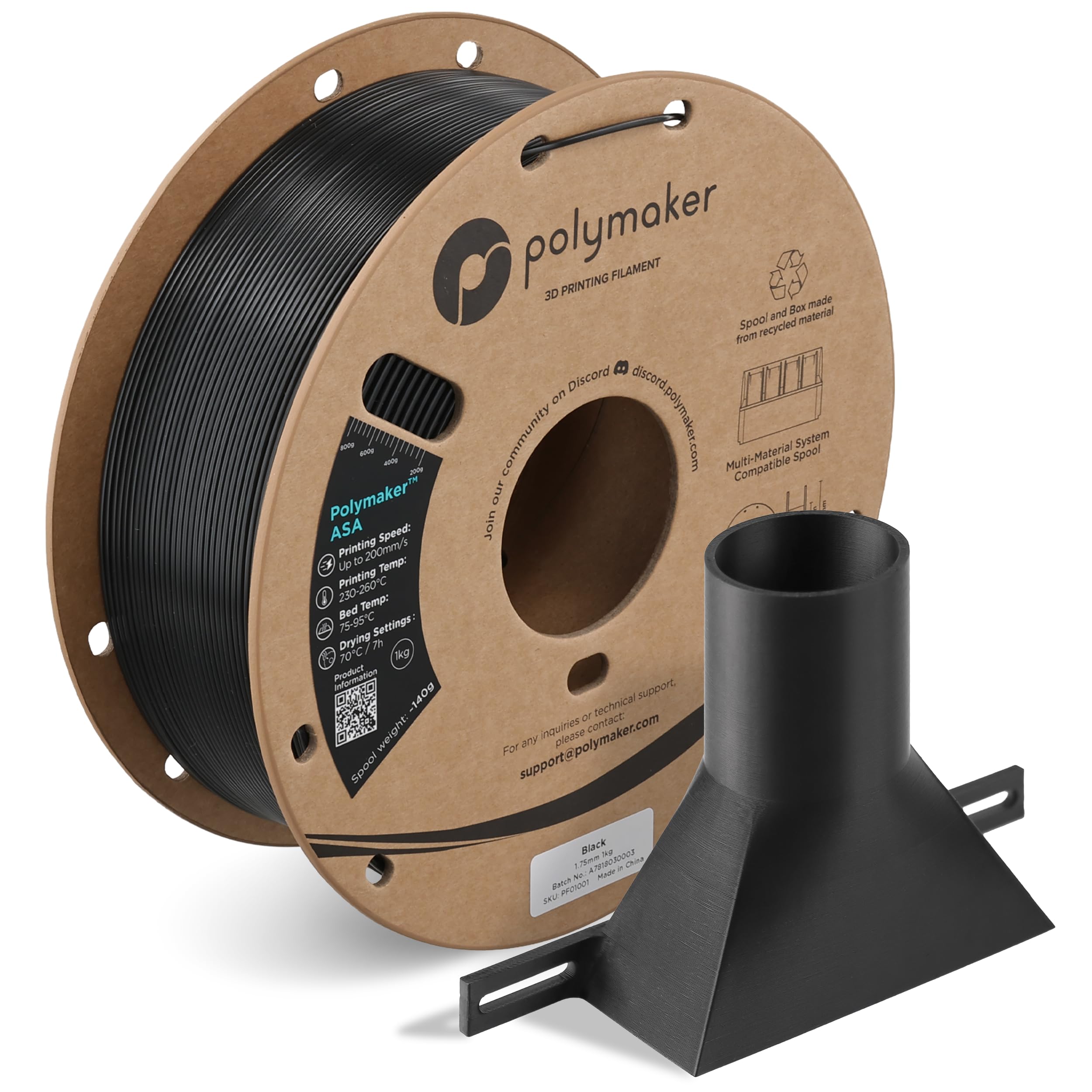
The combination that earns Polymaker ASA the top spot is straightforward: 100°C heat resistance plus UV and weather resistance, in a full-kilogram spool that prints on familiar ABS settings. That mix covers the parts most people actually need to survive heat—brackets under a car hood, outdoor mounts, fixtures near a radiator—without jumping to a nylon or carbon-fiber spool. We also like that it keeps impact resistance and layer strength in the same material; it is not a stiff, brittle engineering plastic that only looks good on a spec sheet.

Printing it is not plug-and-play. Large parts can still lift at the corners, so we treat a brim and a glue stick as part of the setup, not as evidence the spool is bad. The reward is a part that holds its shape outdoors and in heat far better than ABS, which is why it beats the cheaper ABS picks here for anything that sees sunlight.

Against the high-heat carbon-fiber picks, ASA gives up the last 90°C of headroom. What it buys back is a full kilogram, easier printing, and UV stability. If your part lives outside or under a hot hood, that trade is the right one. If it sits against an engine block or in a drying oven, step up to PET-CF or PAHT-CF.

Pros

  • 100°C heat plus UV resistance
  • Full 1 kg spool
  • Impact-resistant ASA
  • Familiar ABS print settings

Cons

  • Requires an enclosed printer
  • Can tangle on some spools
Our verdict

Polymaker ASA is our default for outdoor and high-heat functional parts because it combines 100°C resistance with UV stability and real impact strength.
Check Latest Price
2

Best for High Heat

Anycubic PET-CF

91 /100
LBD Score Outstanding

Key details

Finish
Matte carbon-fiber texture
Spool Weight
1.1 lb
Heat Deflection
190°C
Carbon Fiber Content
10% carbon fiber
View on Amazon

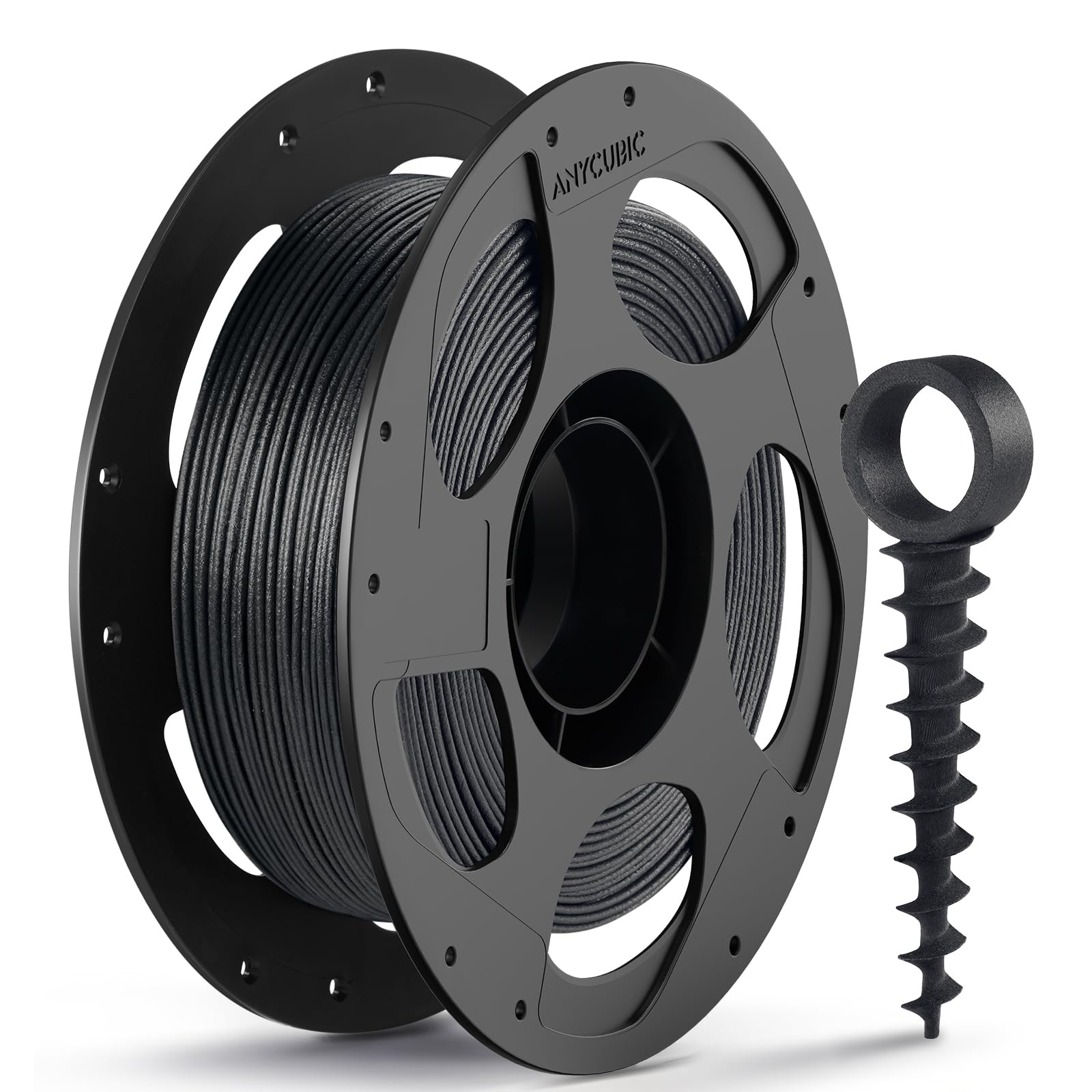
The number that stops you on Anycubic PET-CF is 190°C: a heat-deflection temperature that puts it well beyond ASA, ABS, and most nylon blends. The second useful number is the low moisture absorption. PET-CF is sold as a filament you can print without the long pre-dry that nylon usually demands, and that combination makes it the pick for large, rigid parts that see serious heat.

We like the 10% carbon-fiber reinforcement for its stiffness and low-warp behavior on big prints, and the matte, slightly textured finish looks purposeful rather than raw. The 0.5 kg spool is the catch. It is a specialty spool, not a production-size roll, so we treat it as the material for a specific bracket, duct, or fixture rather than everyday printing.

Compared with ELEGOO PAHT-CF, Anycubic's PET-CF is the lower-moisture option and the easier one to leave on the shelf between prints. PAHT-CF has the edge in nylon toughness and abrasion resistance. For a part that needs to stay flat and stiff at high temperature, we reach for the PET-CF first.

Pros

  • 190°C heat deflection
  • Ultra-low moisture absorption
  • Rigid 10% carbon-fiber blend
  • Low-warp matte finish

Cons

  • Requires a hardened nozzle
Our verdict

Anycubic PET-CF is the one for large, rigid parts that see temperatures near 190°C; its low moisture pickup and carbon-fiber stiffness make it a specialty standout.

Check Latest Price
3

Best Nylon-CF Strength

ELEGOO PAHT-CF

91 /100
LBD Score Outstanding

Key details

Spool Weight
1.1 lb
Heat Resistance
Up to 194°C
Nozzle Requirement
Hardened steel, 0.4 mm or larger
Printer Requirement
Enclosed FDM printer
View on Amazon

ELEGOO's PAHT-CF is the spool we pick when the part needs to survive heat and keep taking hits. The nylon-carbon blend is rated to 194°C, and the carbon fiber adds stiffness, abrasion resistance, and dimensional accuracy. That is a different job from ASA's outdoor weather resistance: this one is for mechanical parts, jigs, gears, and fixtures that rub or load up.

We like that ELEGOO treats this as an engineering material rather than a universal spool. The 0.5 kg roll is small enough that we plan one project at a time; it is not the spool we keep for a weekend of casual printing. That focus is the point—this is a filament for a part with a job to do.

The lower water absorption compared with regular PA-CF is the quiet advantage. Nylon's usual weakness is that it pulls moisture from the air and prints wet, so a blend that resists that is easier to trust between projects. It still needs dry storage, but it is less of a race against the hygrometer. For a tough, hot part, this is the most convincing nylon-CF option here.

Pros

  • 194°C heat resistance
  • Carbon-fiber stiffness and abrasion resistance
  • Lower water absorption than PA-CF
  • Good dimensional accuracy

Cons

  • Requires an enclosed printer
  • Needs a hardened steel nozzle
Our verdict

We recommend ELEGOO PAHT-CF for hot, abrasive mechanical parts that need nylon toughness; it is a specialty spool with real strength, not a casual everyday filament.

Check Latest Price
4

Best Budget

SUNLU High Speed ABS

91 /100
LBD Score Outstanding

Key details

Material
High-speed ABS
Spool Weight
2.2 lb
Heat Deflection
Up to 91°C
Max Print Speed
350 mm/s
View on Amazon

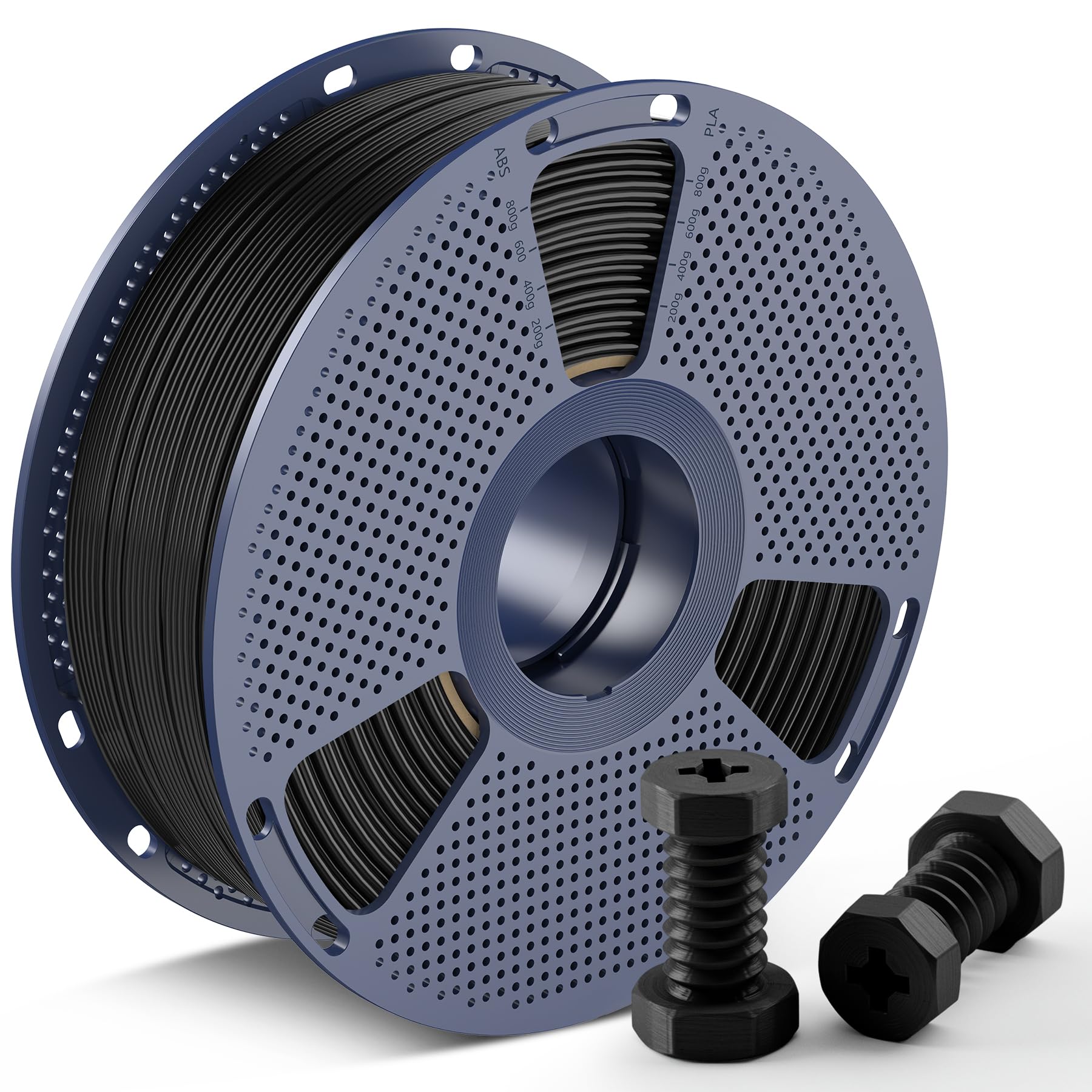
The first thing we notice about SUNLU High Speed ABS is how much it asks of your printer without asking much of your wallet. It is rated for 350 mm/s, carries a 91°C heat-deflection temperature, and comes on a full kilogram spool. That puts it in the budget slot for indoor functional parts, brackets, and enclosures where you want ABS toughness without paying engineering-filament money.

We like it for the speed claim more than the heat number. At 91°C it is a step behind ASA and well behind the carbon-fiber blends, so we do not treat it as an outdoor or engine-bay material. What it does well is print fast, hold its shape, and keep the cost per part low. The finish is a little shinier than a matte engineering filament, which is fine for hidden parts and less appealing for display pieces.

ABS still wants a hot bed and a brim, and fast printing does not excuse you from bed adhesion. We treat those as the baseline. If you need UV stability, move up to ASA; if you need maximum heat, move up to PET-CF or PAHT-CF. For cheap indoor parts, this is the spool we keep around.

Pros

  • 350 mm/s print speed
  • 91°C heat deflection
  • Full 1 kg spool

Cons

  • Requires an enclosure
Our verdict

SUNLU High Speed ABS is our budget pick for fast, tough indoor parts, with a full kilogram spool and 91°C resistance that suit brackets and enclosures.

Check Latest Price
5

Easiest High-Temp Option

Polymaker HT-PLA

86 /100
LBD Score Excellent

Key details

Enclosure
Not required
Spool Weight
2.2 lb
Heat Resistance
Up to 150°C after annealing
Print Temperature
210–230°C nozzle, 25–60°C bed
View on Amazon

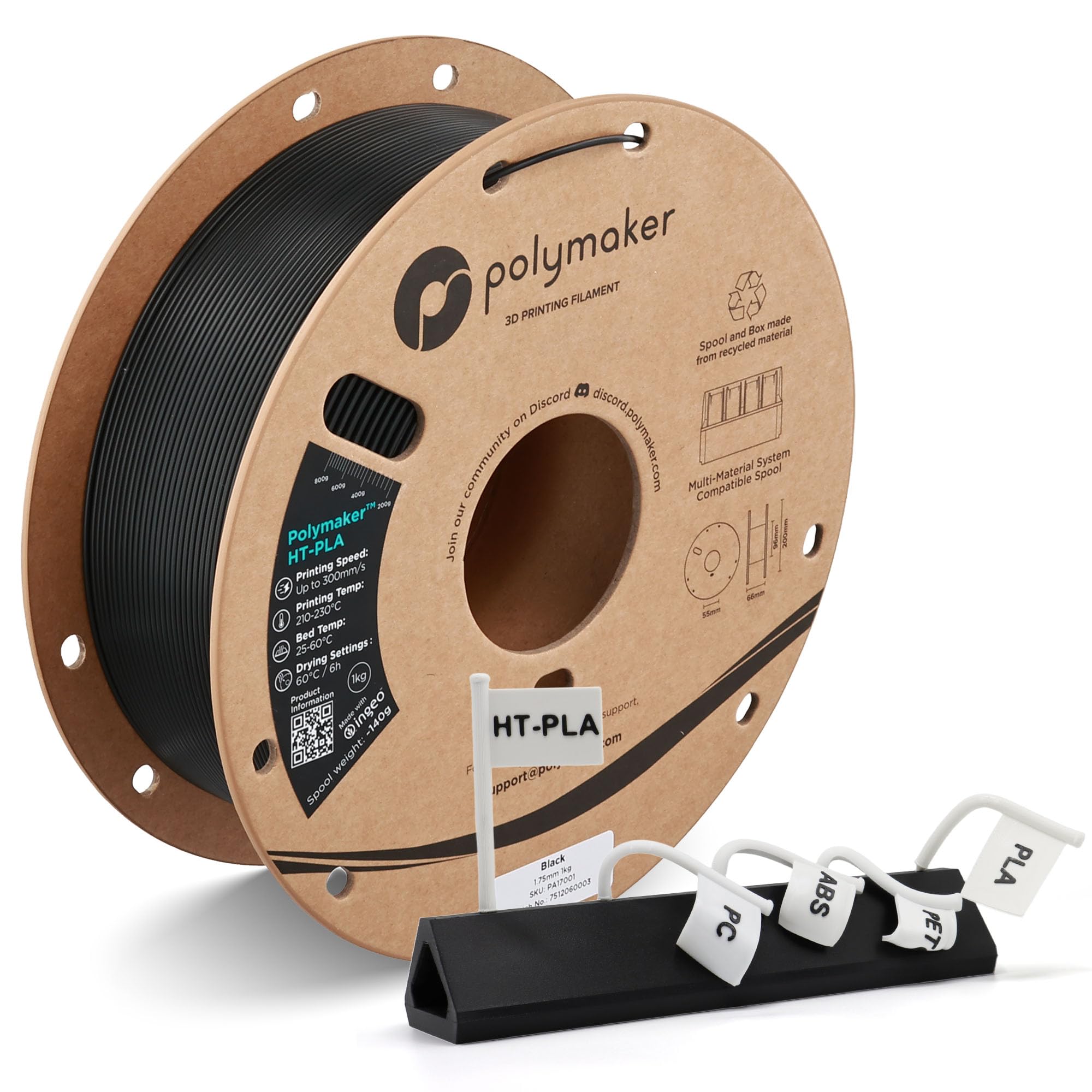
Polymaker HT-PLA is the answer for anyone who wants a heat-resistant part without turning the printer into an enclosure project. It prints at 210–230°C with a 25–60°C bed, runs the cooling fan, and needs no hardened nozzle. Those are PLA habits, not ABS habits. The heat story comes after printing: annealing is what unlocks the higher heat resistance, so the spool is really a two-step material.

We like it because it lowers the barrier to functional parts. A student with an open-frame printer can print a bracket, anneal it, and get a part that holds up in a hot car better than ordinary PLA. The catch is that the annealing step is not optional if you are buying it for heat. Skip it and you have a nice matte PLA with a modest advantage.

Compared with ASA, HT-PLA gives up toughness, UV stability, and the last measure of heat resistance. What it buys is easier printing and no enclosure. If your part is indoors, lightly loaded, and you can anneal it, that trade is compelling. If it is a structural outdoor part, stay with ASA.

Pros

  • Prints with PLA-like settings
  • No enclosure or hardened nozzle
  • Up to 150°C after annealing

Cons

  • Can be brittle with uneven layer adhesion
Our verdict

Polymaker HT-PLA is the easiest route to a heat-resistant part on an open printer, provided you anneal it and don't need ASA-level toughness.

Check Latest Price

How We Tested Heat-Resistant Filament

We started with a long list of heat-resistant spools pulled from retailer search results, review pages, and material data sheets, then narrowed it by material family, claimed heat tolerance, spool weight, price per gram, and whether the listing gave clear nozzle and enclosure guidance. That left 14 spools, which we ran for four months on two FDM printers—one enclosed, one open-frame. We logged spool fit, filament diameter at several points, nozzle clogs, and whether a spool actually needed an enclosure, because compatibility is where most heat-resistant filaments surprise people.

Every spool printed the same three jobs: a 90mm flat square with no brim to see whether corners lifted, a tall thin bracket to check layer adhesion and warping, and a small clip five times over to compare reliability. We photographed each print under raking light to judge layer lines and finish, and since all 14 spools were black, color consistency was one less variable. We counted failed prints, tangles, and spools that needed drying, which is how we weighed value.

For heat resistance, we kept printed hooks and flat coupons on a dashboard and in a hot garage for two weeks, then checked for sag and measured any deformation. We also dropped brackets onto concrete and flexed clips until they cracked to compare durability and brittleness. Bed adhesion got its own check: a brim-free first layer on both printers, with notes on whether the part held or peeled up overnight. We kept using the spools after the formal test, and the ones that stayed on the shelf were the ones that printed predictably, not just the ones with the highest temperature claim.

How to Choose a Heat-Resistant Filament

Start With the Heat Number That Matters

A filament marketed as heat resistant may reach its best number only after annealing, while an ASA or ABS part is ready off the bed. We treat 90–100°C as the practical floor for a general-purpose heat-resistant part, and 190°C and above as the specialty range. Match that figure to the real exposure: a part in a hot car or near a radiator is a different job from one bolted to an engine block.

Ask what happens if the part softens. A cosmetic cover can tolerate less than a bracket under load. If the number comes with an annealing step, budget the time and the risk of dimensional shift before you commit a spool.

Match the Material to the Environment

We prefer ASA over ABS for anything left outdoors. ASA keeps ABS's toughness while adding UV and weather resistance, which is why it is our default for brackets, mounts, and automotive trim. ABS is the cheaper indoor choice when sunlight is not part of the job.

Carbon-fiber nylon and PET-CF are for stiffness, abrasion resistance, and higher heat, not for UV exposure. They are the materials for jigs, gears, and fixtures. If the part lives outside, start with ASA; if it lives in a hot, loaded machine, move to the carbon-fiber blends.

Check the Printer Before the Spool

The filament has to fit the machine you own. ABS and ASA want an enclosure and a bed that reaches 90–100°C. Carbon-fiber nylon and PET-CF want a hardened nozzle, and some printers need a direct filament path to keep the stiff strand from binding. HT-PLA is the exception: it prints with PLA-like hardware and no enclosure.

Check the maximum nozzle temperature, the nozzle material, and whether the printer is enclosed before you buy. A spool that needs an enclosure is not a bargain if your printer is open-frame.

Plan for Warping, Adhesion, and Moisture

Warping is the failure we plan around first on ABS and ASA. A hot bed, a brim, and an enclosure do more for large parts than any slicer trick. For PET-CF and PAHT-CF, moisture is the other variable: even low-absorption blends print better when they have been kept dry.

We keep a dry box for engineering spools and dry a new roll if it has been open for a while. If a print starts popping or stringing, dry it before you retune the whole profile. Adhesion problems often follow moisture, not temperature.

Spool Size and Value

A full kilogram of ASA is the better value when you print the same bracket or fixture repeatedly. The 0.5 kg carbon-fiber spools are project rolls: enough for a specific part or a short run, without tying up money in a material you use occasionally.

Compare cost per part, not sticker price. A cheaper ABS spool that warps on large prints costs more in failed attempts, while a specialty spool that prints right the first time earns its place. Buy the smallest roll that covers the job when you are trying a new material.

Frequently Asked Questions

Final Verdict

Polymaker ASA is our default because it gives most functional parts the heat resistance they need—100°C—while also handling sunlight, weather, and impact. The 1 kg spool and familiar ABS settings make it the easiest high-heat material here to live with. For parts that see 190°C or need maximum stiffness, Anycubic PET-CF is the step up; for abrasive mechanical parts, ELEGOO PAHT-CF. If you don't have an enclosure, Polymaker HT-PLA is the workaround, as long as you anneal it.