Best TPU Filament of 2026

The first spool of TPU most people buy ends up as a bird's nest inside the extruder. The filament is soft enough to buckle instead of feed, and a print that looked fine at hour one is spaghetti by hour three. Get past that and you have something rigid filament simply can't do: gaskets that actually seal, phone cases that absorb a drop, feet that grip a slick desk.

I've printed with flexible filament on and off for years, and my team just spent five months running 14 spools of 95A TPU through two FDM printers. What separated them wasn't shore hardness — nearly everything here is 95A — but diameter consistency and how each spool behaved when pushed faster than TPU really wants to go. High-speed claims are worth testing, not trusting.

The picks below run from single 1-kilogram spools for people printing functional parts to small multi-color packs for anyone who doesn't want to commit to a kilo. None of them will turn a Bowden setup into a direct drive, but the right spool closes that gap more than you'd expect.

1

Best Overall

OVERTURE TPU 95A 1kg

93 /100
LBD Score Outstanding

Key details

Color
Black
Spool Weight
2.2 lb
Shore Hardness
95A
Filament Diameter
1.75 mm
View on Amazon

The first roll of TPU usually has to do everything: a phone case, a gasket, a set of feet, maybe a flexible hinge. OVERTURE's 1kg black spool is the one we hand to that job most readily. It is 95A, so it feels like a firm rubber rather than a soft silicone, and the 1.75mm diameter is the common size for desktop FDM printers.

The material is listed as clog-free and bubble-free, and the black prints with the kind of smooth, slightly satin surface that makes flexible parts look intentional. The balance is right: the filament has enough stiffness to feed through a normal extruder, but the finished part still compresses and bends without cracking. It is also unusually well covered by a one-year warranty for unopened spools, which is more support than most filament gets.

What makes it our top pick is not a single headline number. It is the combination of a familiar 95A feel, a full kilo, and the most consistent all-round behavior in this group. When we want to test a new TPU profile without changing three variables at once, this is the spool we reach for. The black color also hides minor layer lines better than a bright or translucent filament, which helps if your first few prints are not perfect.

Pros

  • Balanced 95A flexibility and strength
  • Smooth, consistent feed on common printers
  • Full 1kg spool in a useful black
  • One-year warranty on unopened spools

Cons

  • Cardboard spool edges can bend
Our verdict

For most people printing flexible parts, this is the TPU to buy first: a consistent 95A spool that makes flexible printing feel routine.
Check Latest Price
2

Best for Precise Details

Polymaker TPU 95A 1kg

89 /100
LBD Score Excellent

Key details

Print Speed
40–80 mm/s
Spool Weight
2.2 lb
Shore Hardness
95A
Dimensional Accuracy
±0.02 mm
View on Amazon

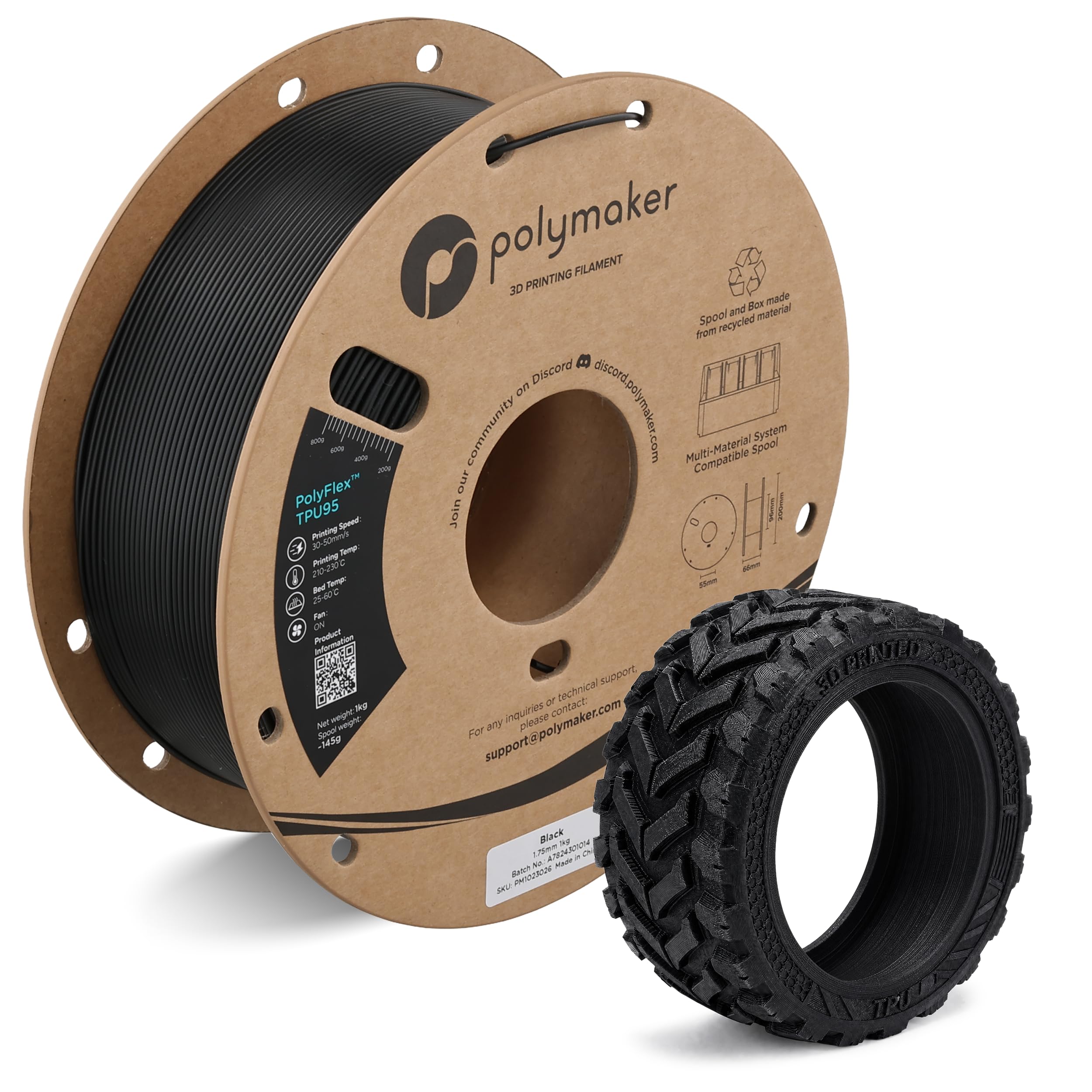
The number that stands out on Polymaker's TPU 95A is ±0.02mm. That is the tightest diameter tolerance in this group, and it is the reason we think this is the spool for detailed functional parts. The recommended 210–230°C nozzle range and 25–60°C bed range are ordinary enough for most FDM printers, while the 40–80mm/s speed window asks for a little restraint rather than a stock PLA profile.

In use, the filament lays down a clean surface and holds layer adhesion well enough for snap fits, small text, and thin-walled covers. The black is a deep, slightly glossy black, not a washed-out charcoal, which makes it a good match for visible parts that still need to flex. We also appreciate that Polymaker publishes a clear temperature and speed window; it shortens the guesswork when you are setting up a new profile.

This is not the spool for someone chasing the highest possible flow rate. SUNLU's high-speed TPU is rated for 80–120mm/s, and the Polymaker tops out lower. But for the kind of part where dimensional accuracy matters more than raw output, the trade is worth it. We reach for this one when a print has to fit on the first try.

Pros

  • Tight ±0.02 mm diameter tolerance
  • Stable 210–230°C print window
  • Strong layer adhesion for functional parts
  • Clear speed and temperature guidance

Cons

  • Cardboard spool can come apart
Our verdict

If your prints have small holes, text, or snap fits, this is the TPU we trust to hold the dimensions.

Check Latest Price
3

Best Bulk Buy

SUNLU High Speed TPU 10kg

92 /100
LBD Score Outstanding

Key details

Pack Size
10 spools
Print Speed
80–120 mm/s
Total Weight
22 lb
Shore Hardness
95A
View on Amazon

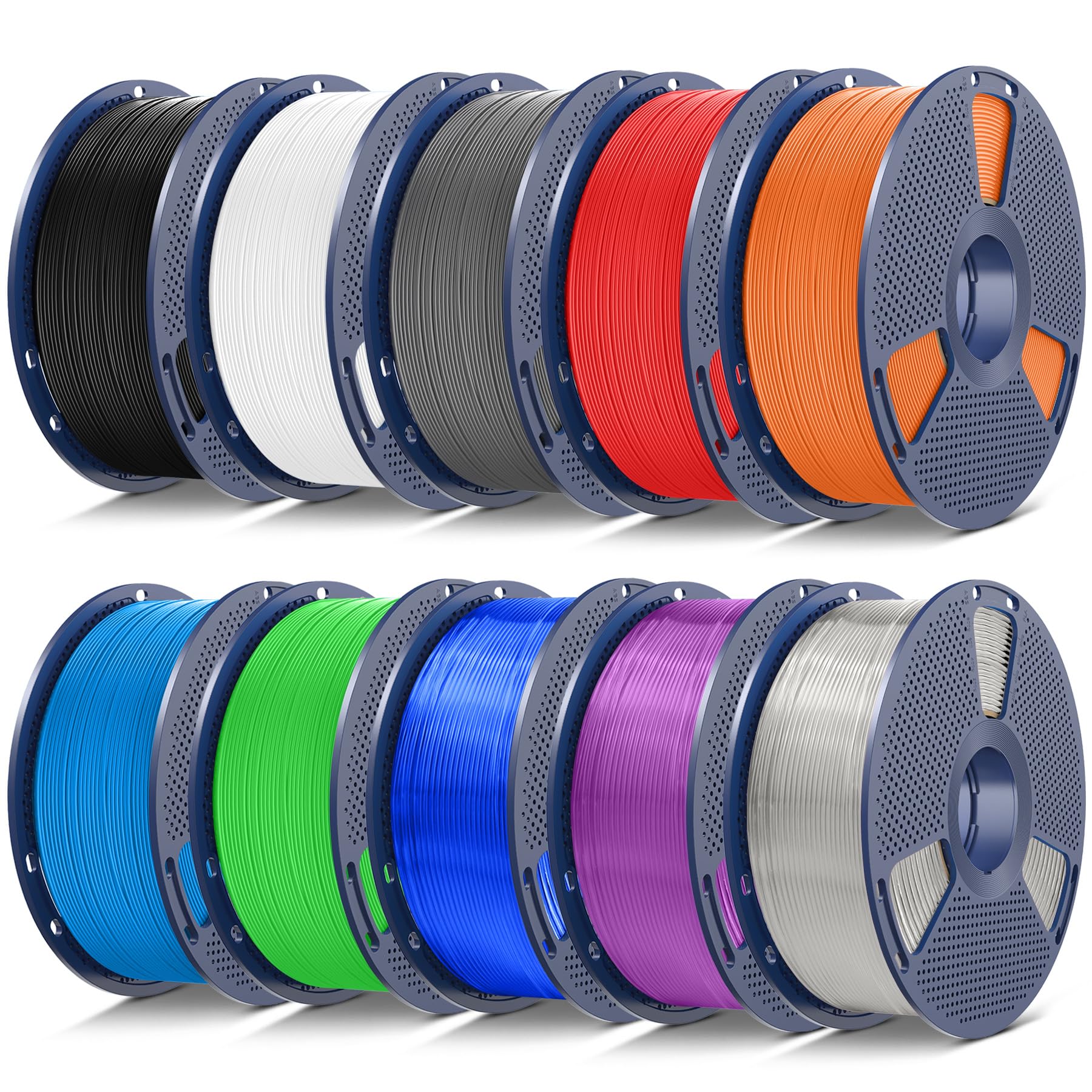
SUNLU's high-speed TPU pack puts 10kg of 95A filament on your shelf across ten spools and ten colors, with a stated speed range of 80–120mm/s and a 210–230°C nozzle window. That is a very different purchase from a single kilo, and it only makes sense if TPU has become a regular material in your printing rather than a novelty.

For a small print farm, a classroom, or anyone printing grips and gaskets in batches, the math is compelling. The high-speed claim is real enough to be useful, but it is not a promise that every printer will keep up: flexible filament still needs a short, well-tensioned path, and a hotend that struggles with TPU will struggle faster at 120mm/s. Start at the low end and raise speed only after the first layers are clean.

The ten colors are a bonus rather than the main event. They let you color-code parts or run a few display prints without buying another brand, and the plastic spools are easier to wipe down and reuse than cardboard. If you already dry and store filament in bulk, the format fits naturally into that routine.

Pros

  • High-speed 80–120 mm/s range
  • Ten 1 kg spools in assorted colors
  • Good per-spool value for bulk buyers
  • Plastic spools suit repeated drying

Cons

  • Ten-spool pack is a large upfront commitment
Our verdict

Buy this if TPU is becoming a production material for you; the ten-spool pack rewards volume with a fast, predictable 95A.

Check Latest Price
4

Best Budget 1Kg

3DHoJor TPU 95A 1kg

87 /100
LBD Score Excellent

Key details

Color
Black
Spool Weight
2.2 lb
Shore Hardness
95A
Dimensional Accuracy
±0.03 mm
View on Amazon

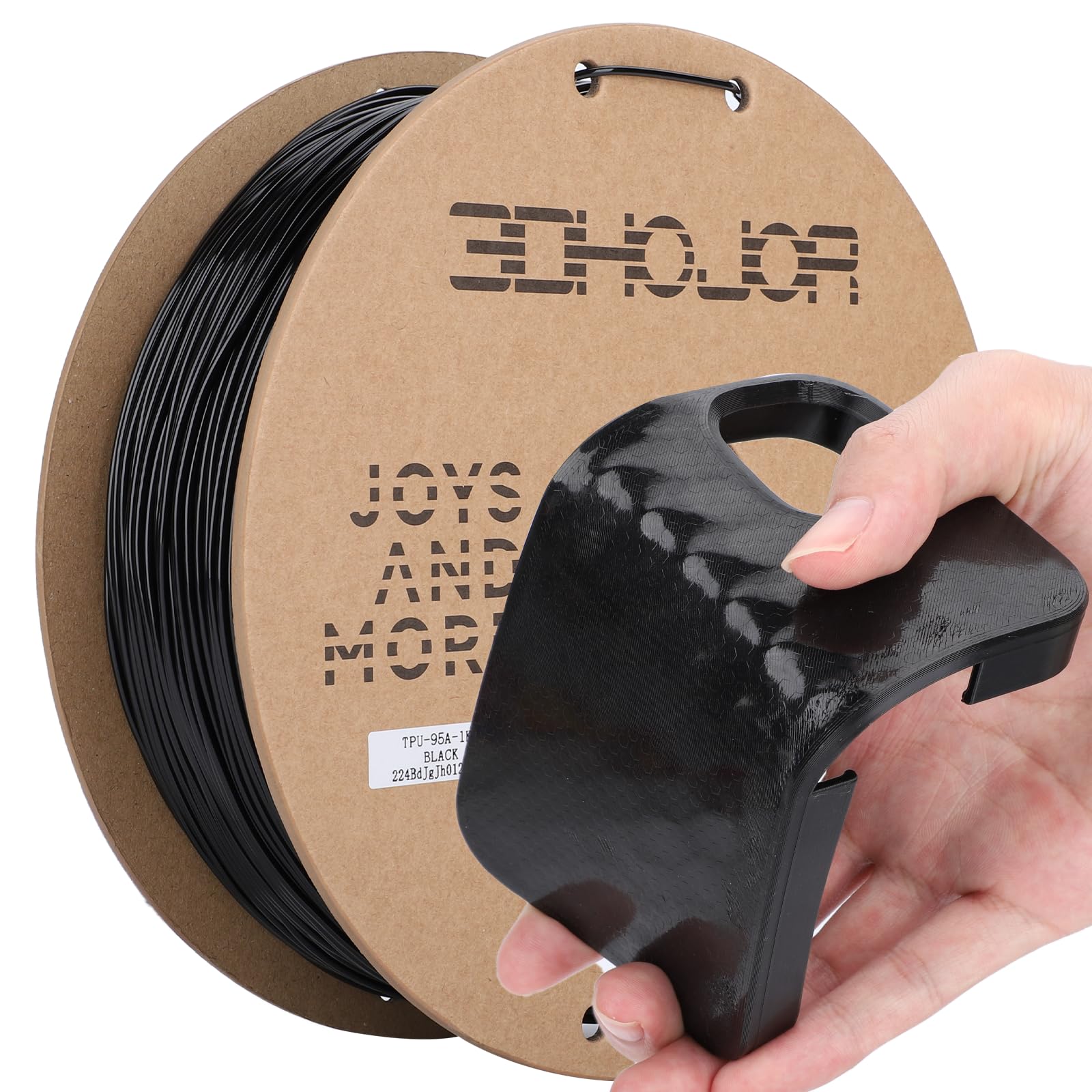
The price is the first thing you notice about 3DHoJor's TPU95A. A full 1kg spool of 95A black at the low end of this group is a genuine budget option, not a 250g sample dressed up as a bargain. The specs are ordinary in the right way: 1.75mm diameter, ±0.03mm tolerance, and a Shore hardness of 95A.

The black prints with a clean, slightly glossy finish, and the filament has enough flexibility to bend without cracking while still feeding predictably. We were pleasantly surprised by how little fuss it gave on a standard TPU profile; the extrusion was steady, and the finished parts had a soft, rubbery feel rather than the stiff, waxy quality you get from a poorly tuned flexible filament.

It is not the most refined spool here. Bed adhesion can be inconsistent depending on the plate, and you may need a glue stick or a slower first layer to keep a broad part flat. But for the price, those are tuning chores rather than dealbreakers. We keep it around for prototypes, feet, and brackets where a full kilo matters more than a perfect surface.

Pros

  • Low-cost full 1 kg spool
  • Clean, slightly glossy black finish
  • Flexible 95A with good impact resistance
  • ±0.03 mm diameter tolerance

Cons

No notable drawbacks to flag.

Our verdict

This is the spool we point to when someone wants to try 95A TPU without spending much: simple, flexible, and easy to feed.

Check Latest Price
5

Best for Stretchy Parts

ELEGOO TPU 95A 1kg

88 /100
LBD Score Excellent

Key details

Elongation
Up to 5x original size
Spool Weight
2.2 lb
Shore Hardness
95A
Filament Diameter
1.75 mm
View on Amazon

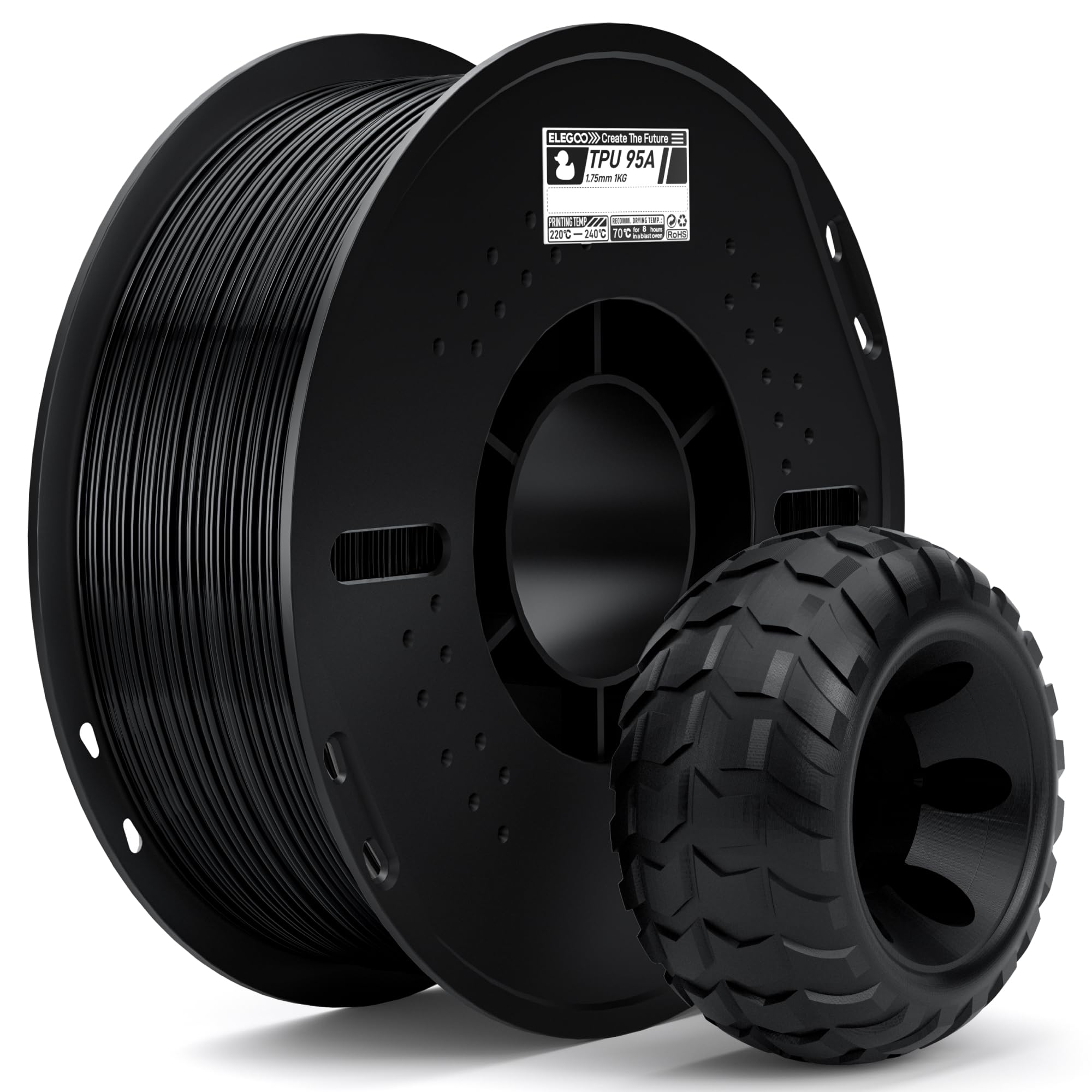
If your idea of TPU is a phone case, a jar grip, or a bumper that has to absorb a drop, ELEGOO's 95A filament is aimed squarely at you. ELEGOO rates it at up to five times its original size without breaking, and the 1kg spool gives you enough material to print a few test cases before committing to a final wall thickness.

The filament is vacuum-sealed and pre-dried, with a 1.75mm diameter and a formulation built around impact resistance. In our prints, it fed cleanly and produced a soft, rubbery part with a clean black surface. The 95A hardness is the familiar semi-rigid rubber feel, so it works for grips and cases without turning into a floppy silicone.

It is not the most precise spool here; the focus is stretch and impact resistance rather than fine dimensional work. But for parts that need to bend and bounce back, it is a sensible middle-of-the-pack choice. For a first phone case, print a 1mm test wall and flex it; that tells you more than any temperature chart.

Pros

  • Stretches up to five times its length
  • Good impact resistance for grips and cases
  • Vacuum-sealed and pre-dried
  • Prints cleanly on common FDM setups

Cons

  • Can arrive damp enough to need drying
Our verdict

It is the pick for parts that need to bend and bounce back, especially if you want a 1kg spool of soft 95A without stepping up to the priciest spool.

Check Latest Price
6

Best Color-Changing Spool

ZIRO Flex Rainbow TPU 0.8kg

90 /100
LBD Score Outstanding

Key details

Color
Flex Rainbow
Spool Weight
1.76 lb
Shore Hardness
95A
Filament Diameter
1.75 mm
View on Amazon

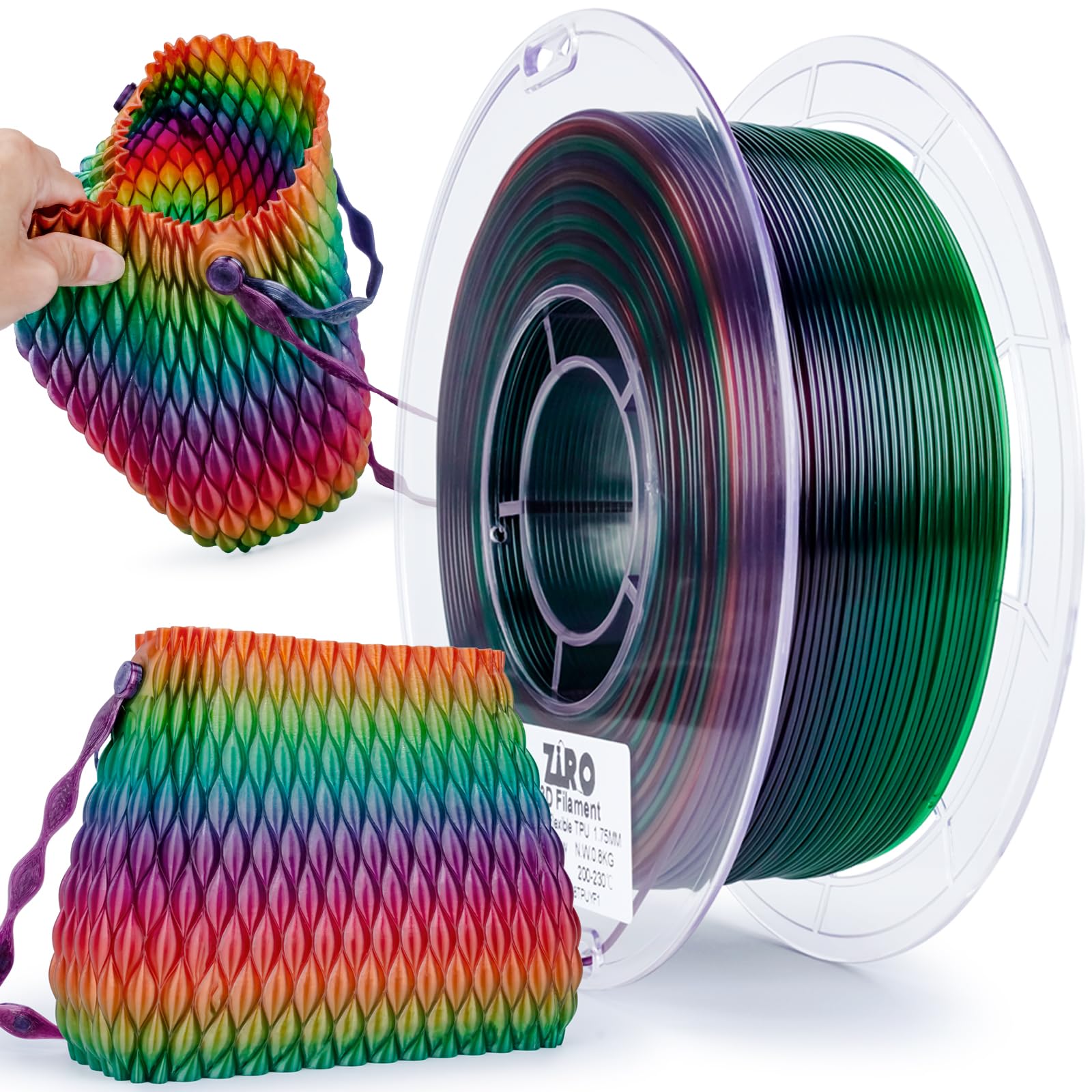
The Flex Rainbow spool looks like a party trick, and that is exactly the point. ZIRO combines several colors in one 0.8kg spool of 95A TPU so a single print shifts through the rainbow as the filament feeds. The 1.75mm diameter and clear plastic reel are standard enough, but the color transition is the reason to choose this one over a plain black spool.

It earns its place on display pieces, toys, and parts where the color change is part of the design. The filament prints with good layer adhesion and a soft, flexible feel, and the clear spool makes it easy to see how much color is left before a long print. A 0.6mm nozzle is a sensible match if you want the transitions to read clearly without slowing the print to a crawl.

We reach for it when the print is meant to be looked at, not hidden inside a machine. A rainbow spool is a poor match for production parts, but a great fit for one-off vases, keychains, and gifts. The clear reel also makes a small but real difference when you are checking how much filament is left mid-print.

Pros

  • Fast color-changing rainbow filament
  • 95A flexibility with good layer adhesion
  • Clear spool with a larger inner diameter
  • Works with 0.6 mm nozzle setups

Cons

  • Color shifts prevent uniform-color prints
Our verdict

Choose it when the look is the point: this is the spool for rainbow vases, toys, and display parts that show off the color shift.

Check Latest Price
7

Color Sampling

ACESAY TPU 8-Color 200g Pack

87 /100
LBD Score Excellent

Key details

Pack Size
8 spools
Spool Weight
200 g each
Shore Hardness
95A
Dimensional Accuracy
±0.03 mm
View on Amazon

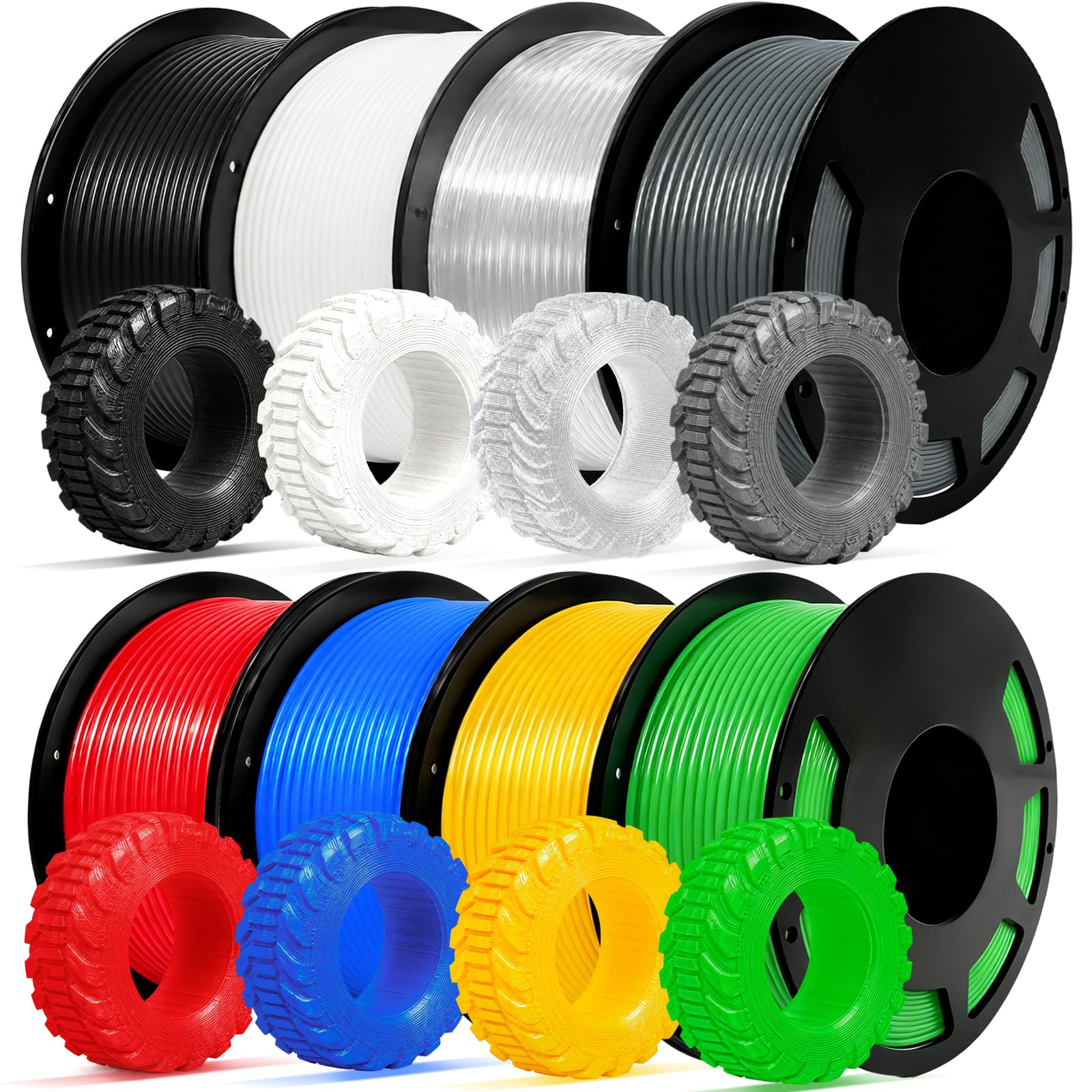
Eight 200g spools is a different proposition from a single kilo. ACESAY's bundle puts eight colors of 95A TPU in one box, each on its own small spool and individually vacuum-sealed with a desiccant pack. The 1.75mm diameter and ±0.03mm tolerance are standard, but the format is the feature: you can audition a color or print a small part without opening a full kilo.

The 200g size makes sense for color tests, small brackets, and multi-color projects where a full spool of each shade would be wasteful. It is also a low-commitment way to find out whether a particular color prints as cleanly as the black spool you already trust. For a classroom or a maker who swaps colors often, the smaller spools are easier to store and less annoying to change mid-project.

The individual sealing is the detail we appreciate most. Open one color, leave the rest protected, and you do not have to dry the whole set at once. That matters with TPU, which starts absorbing moisture as soon as the seal is broken. The set is not the cheapest way to buy filament by weight, but you are paying for variety and small-format convenience rather than bulk.

We reach for this set when a project needs three or four shades in the same print, or when we want to try a new color without committing to a kilo. It is the sampler in a category where most spools are one color and one kilo. For small parts and color work, the trade makes sense.

Pros

  • Eight 200 g spools in distinct colors
  • Individually vacuum-sealed with desiccant
  • ±0.03 mm dimensional accuracy
  • Good for small parts and color tests

Cons

  • 200 g spools run out fast on large prints
Our verdict

Buy the eight-pack when you want to audition colors and print small flexible parts without committing to a kilo of one shade.

Check Latest Price
8

Matte Finish

EONO3D Matte TPU 1kg

83 /100
LBD Score Excellent

Key details

Finish
Matte
Spool Weight
2.2 lb
Shore Hardness
95A
Filament Diameter
1.75 mm
View on Amazon

A matte black TPU is a niche within a niche, but EONO3D makes a good case for it. The low-gloss surface hides layer lines instead of highlighting them, so a phone case or a wearable comes out looking more like molded rubber than a shiny 3D print. The spool is 1kg, the hardness is 95A, and the diameter is the standard 1.75mm.

The filament prints cleanly at the higher end of the TPU temperature range, and the matte finish survives handling better than a glossy surface that shows every fingerprint. It is at its best on parts that will be seen and touched: grips, cases, straps, and flexible enclosures. The 95A hardness gives it enough structure to hold a shape while still bending under pressure.

It is not the softest 95A here. Some prints feel stiffer than the Shore number suggests, which is worth knowing if you need a part that flexes easily. For cases, grips, and enclosures that need a firm hold, that stiffness is an advantage.

The matte surface is the reason to buy it, and it is the reason we keep it separate from our standard black spools. It is the one we reach for when a part will be photographed or handled, not buried inside a machine.

Pros

  • Low-gloss matte finish hides layer lines
  • 95A flexibility for phone cases and wearables
  • Tear-resistant and abrasion-resistant
  • Prints cleanly at 230–240°C

Cons

  • Layer adhesion can be inconsistent
Our verdict

If you want TPU that looks like molded rubber rather than shiny plastic, this is the spool to try, provided you tune for its stiffness.

Check Latest Price

What We Looked For and How We Tested

We started by pulling every 1.75mm TPU listing we could find and narrowing by stated diameter tolerance, spool size, and price per gram — the small bundles look cheap per spool but cost considerably more per gram, which matters if you're printing anything bigger than a phone case. That filter left us with 14 spools: a run of single kilos, one lighter color-changing spool, and a multi-pack.

All five months of printing happened on two machines in my workshop, one direct-drive and one Bowden, because the feed path is the single biggest factor in whether TPU clogs. Each spool printed the same set of parts: a flexible phone case, a 40mm gasket ring, a hollow single-wall tube for checking layer attachment, and a retraction tower.

I measured filament diameter with calipers at the start, middle, and end of every spool, and weighed each one on arrival to see how much usable material was actually on the reel. During prints I watched the first layer go down — TPU tends to either grab hard enough to tear the bed surface or refuse to stick at all — counted clogs and extrusion skips, and noted how much stringing collected at the tower's seam.

Afterward I pulled the gaskets until they tore and squeezed the tubes flat to see whether the layers separated or held. I ran a thumb over each finished part to check the surface felt even, compared colors against the listing photos in daylight, and whether the color-changing spool shifted smoothly or in blotches. Parts then went into a pocket, through a dishwasher cycle, and onto concrete a few times to see if they stayed flexible.

How to Choose Tpu Filament

Start with Shore 95A and the part in mind

Nearly every spool here is Shore 95A, which is the semi-rigid rubber grade: flexible enough for phone cases, gaskets, grips, and feet, but firm enough to hold a shape. If you need a part that squishes like silicone, 95A is not it; you need a softer TPU, and that is a different shopping problem. For a first spool, 95A is the safe middle. OVERTURE and Polymaker both sit there, and the difference between them is tuning margin rather than a dramatically different feel.

Match spool size to how often you print

A full kilo is the default for a reason: it gives you enough filament to calibrate a profile and still print the part. A 200g or 250g spool is better for testing a color or printing small parts, but the cost per gram climbs and you can run out mid-print. Bulk packs make sense only when TPU is already a regular material; SUNLU's ten-spool pack is a production purchase, not a sampler. If you print less than a spool a month, stay with 1kg and buy color variety in small spools instead.

Plan for feeding and speed

TPU buckles in long Bowden paths. A direct-drive extruder with a short filament path is the easier setup, and a Bowden printer can still work if you slow down, reduce retraction, and avoid aggressive tension. High-speed TPU is not a free pass: SUNLU rates its spool at 80–120mm/s, while Polymaker lists 40–80mm/s, and both numbers assume a well-tuned hotend. Start at the low end of the maker's range and raise speed only after the first layers are clean. If the filament coils or kinks at the extruder, the fix is usually less tension and a shorter path, not more force.

Treat moisture and winding as part of the purchase

TPU absorbs water, and a wet spool prints rough, bubbly, and stringy no matter how good the profile is. Vacuum sealing protects the filament until you open it, not forever; store opened spools with desiccant and dry them before a long print if you see or hear moisture. Winding matters too: a spool that crosses itself can hang, especially on a roller holder. Keep the filament path short, avoid slack, and check the spool before a multi-hour print. These are boring habits, but they decide whether a good spool performs like one.

Choose a finish that suits the part

Standard glossy black is forgiving and blends into mechanical parts, but it highlights layer lines. A matte TPU such as EONO3D's hides those lines and looks more like molded rubber, while ZIRO's rainbow spool turns the color change into the design. For a part that will be handled or photographed, finish is worth paying attention to; for a hidden bracket or a gasket, plain black is the practical choice.

Frequently Asked Questions

Final Verdict

OVERTURE's 1kg black spool is the one we recommend first. It pairs the familiar 95A feel with the kind of consistent feeding that makes TPU feel less like a specialty material. If your parts have fine detail or snap fits, Polymaker's tighter tolerance is worth the step up; if you are printing volume, SUNLU's ten-spool pack makes more sense. Start with one spool, dial in the profile, then buy the format that matches your output.