Best Home EV Chargers of 2026

The best part of owning an EV isn't the car — it's the ten seconds it takes to plug in at home and the fact that you stop planning your week around public fast chargers. A Level 2 wall unit makes that real, delivering many times the power of the cord that came in the trunk, so one overnight session covers most drivers' week. The catch: hardwired or plugged in, which connector your car takes, and whether the app is any good.

We spent nine months living with eight of these chargers — hardwired and plug-in, both connector types — in garages and on driveways, and the gap between a good one and a fussy one rarely came down to raw speed. What first-time buyers overrate is peak amperage: unless your panel and your car can both feed the top number on the box, you're paying for headroom you'll never use. The eight picks below are the ones that stayed boring, in the best way.

1

Best Overall

EVIQO 48A Level 2 Charger

93 /100
LBD Score Outstanding

Key details

Connector
SAE J1772
Max Output
48 A hardwired
Cable Length
25 ft
Weather Rating
IP66 / NEMA 4
View on Amazon

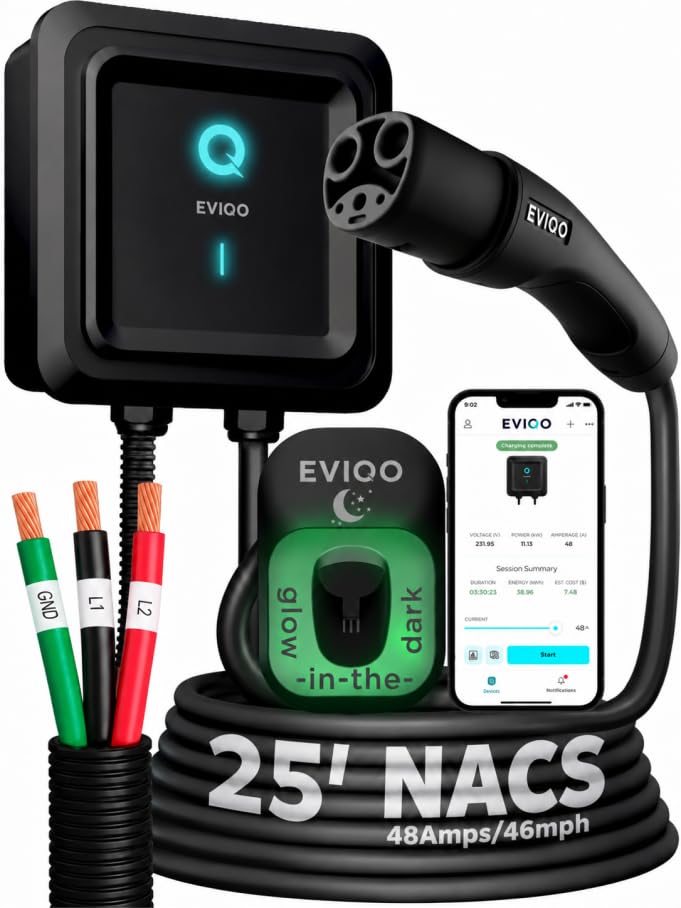
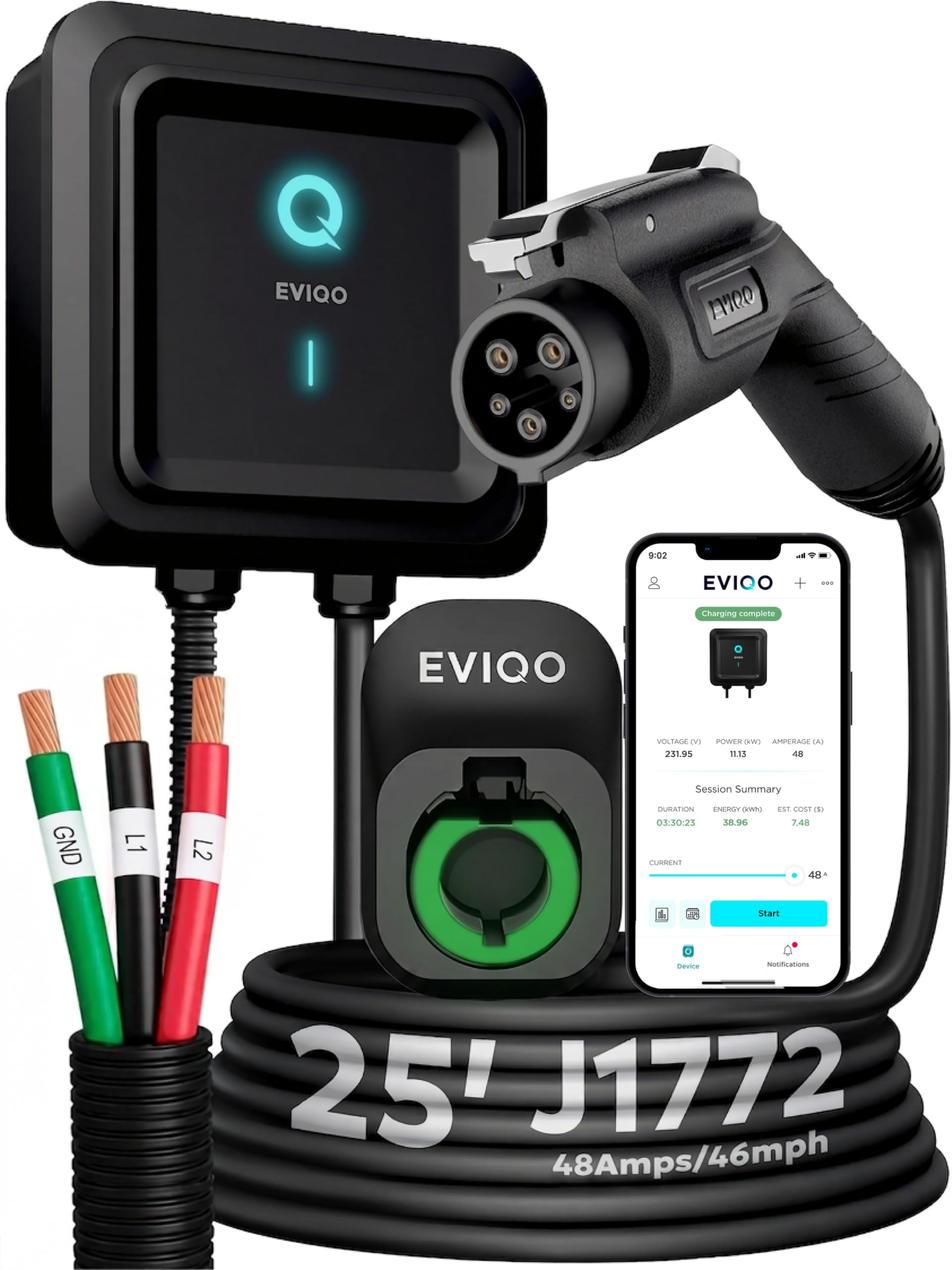
Forty-eight amps on a dedicated 60-amp circuit is as fast as most houses can charge a car, and this EVIQO is the unit we put at the top of the list because it gets there without asking you to give anything up. The cable runs 25 feet, the housing is sealed to IP66 and NEMA 4 for a driveway post or a cold garage, and it carries UL, ETL, and Energy Star certification, which is the paperwork that decides whether your utility rebate goes through.

The app is better than it needs to be. The amperage slider runs from 6 to 48 amps, so you can match the charger to the circuit you actually have and dial it back on a night when the oven and the dryer are both running. The 2.4 GHz radio held its signal from a basement garage, which is where a lot of these units quietly fall off the network. And the holster glows in the dark, a gimmick until you are docking a stiff 25-foot cable at eleven at night with your hands full.

What you give up is flexibility. There is no plug-in version: this is hardwired only, which means an electrician, a permit in most jurisdictions, and a permanent commitment to that wall. If you rent, or you are likely to move the charger to a second house, a 14-50 plug-in is the smarter shape. The connector is J1772, so a Tesla needs the adapter that came with the car, or you buy the same unit with a NACS plug, which is exactly what we recommend below.

What settles it for us is the margin. Forty-eight amps is the ceiling a normal residential service will support, the app lets you back away from that ceiling whenever you want to, and the certification list means you are not gambling on an unknown box bolted to the side of your house.

Pros

  • Full 48-amp charging on a 60-amp circuit
  • App dials output from 6 to 48 amps
  • IP66 and NEMA 4 housing for outdoor mounting
  • Glow-in-the-dark holster for night docking

Cons

  • Hardwired only, with no NEMA 14-50 option
Our verdict

If you are wiring a charger once and want the fastest charge a normal house can support, this is the one we recommend.

Check Latest Price
2

Best Simple Plug-In

Grizzl-E Classic

92 /100
LBD Score Outstanding

Key details

Max Output
40 A
Cable Length
24 ft
Installation
NEMA 14-50 plug-in
Weather Rating
IP67
View on Amazon

There is no app. No account, no WiFi, no firmware. The Grizzl-E Classic is a metal box that puts 40 amps into a car, and the longer we lived with it the more we understood why people go looking for exactly that. You open the case, set the amperage with DIP switches at 40, 32, 24, or 16 amps, plug it into a NEMA 14-50 outlet, and hang it. A single LED tells you everything it is going to tell you.

The build is the argument. The enclosure is cast aluminum and weighs over sixteen pounds, and it is rated IP67 with fire-resistant construction and protection against over- and under-voltage and ground faults. In a garage that swings from freezing to swampy, that counts for more than a dashboard does. The 24-foot premium cable is heavy and flexible enough to stay workable in cold weather, and the connector has the solid, positive feel of commercial equipment.

The hesitation is longevity. This is a simple design and it feels overbuilt, but the failures show up early, some within months and some around the two-year mark, and a repair outside warranty can run close to the price of a replacement. If you want the least expensive serious charger here and you accept that it may not be the last one you buy, that trade is worth making. Your car almost certainly schedules its own charging anyway, so the missing app costs you less than it sounds like it does.

Pros

  • Cast aluminum case rated IP67
  • Amperage selectable at 16, 24, 32, or 40 A
  • No app, account, or WiFi to depend on
  • Heavy 24-foot premium cable

Cons

  • Longevity past two years is the open question
Our verdict

For a renter, a spare garage, or anyone who wants a tough 40-amp plug-in with no software in the loop, this is the straightforward buy.

Check Latest Price
3

Best Smart Value

Emporia 48A Level 2 Charger

94 /100
LBD Score Outstanding

Key details

Max Output
48 A hardwired
Cable Length
25 ft
Installation
NEMA 14-50 (40 A) or hardwired (48 A)
Certification
UL, Energy Star
View on Amazon

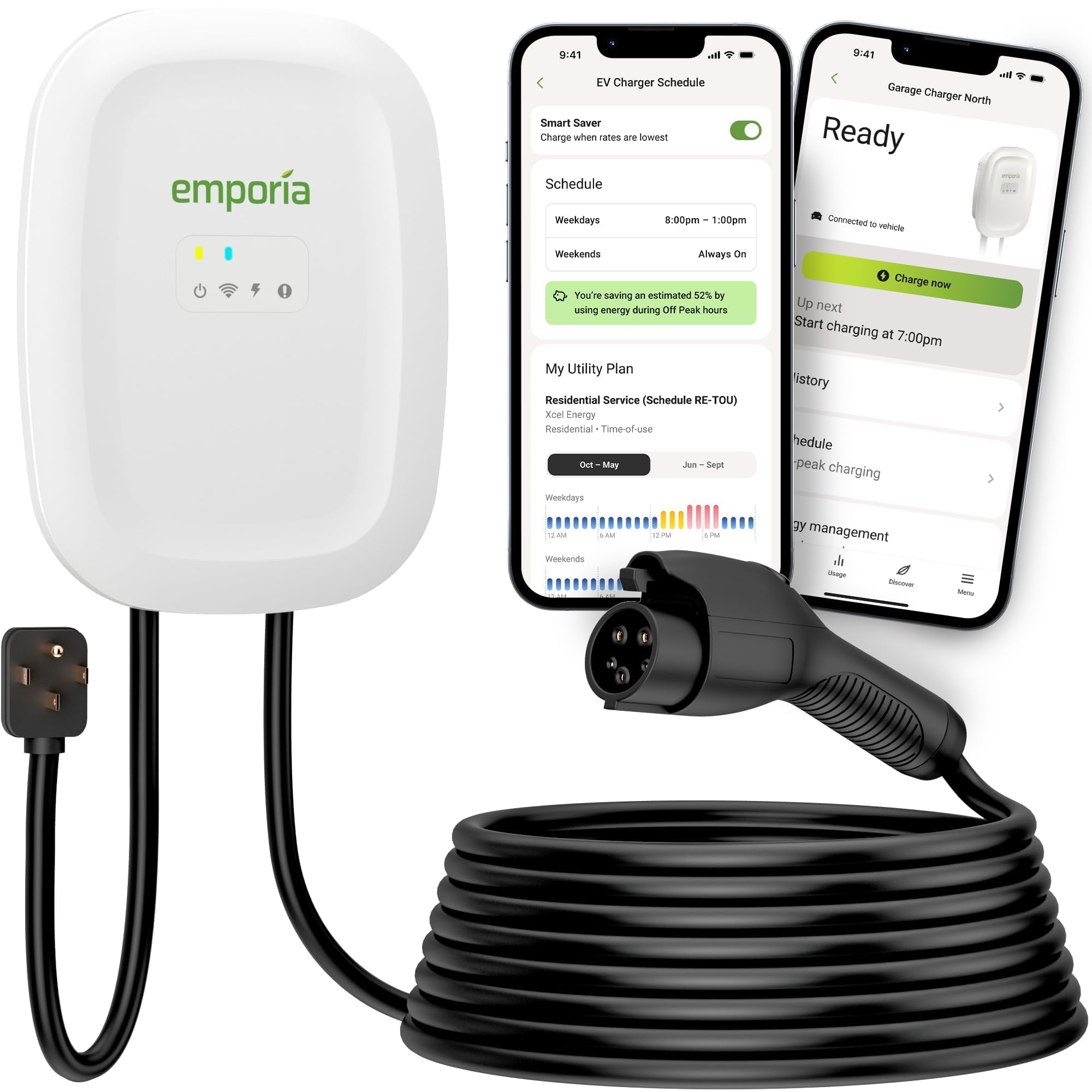
The Emporia arrives set up for a NEMA 14-50 outlet at 40 amps and converts to a hardwired 48-amp install, which makes it the one charger here that can start as a plug-in and grow into a permanent fixture later. That is not a marketing nicety. It is the difference between charging your car the week you move in and waiting on an electrician's quote that keeps sliding.

The app is where this one earns its money: real-time energy data, scheduling around time-of-use rates, and per-session cost at your actual rate. We like that the numbers are legible without exporting anything. The 2.4 GHz WiFi link is the part to watch, because when it drops, the schedule and the reporting go with it, and the charger keeps delivering power dumb in the meantime. UL listing and Energy Star certification are both there, which matters at rebate time.

One thing to weigh: this is the pick with the most visible durability question in the group. Failures soon after installation come up here in a way they do not for the EVIQO, and at three years old some units are still running while others are not. Emporia backs it with a three-year warranty and the price sits right alongside our top pick, so what you are really choosing between is plug-or-hardwire flexibility plus richer data, against a unit with more early failures attached to it.

Pros

  • Plugs in at 40 A or hardwires to 48 A
  • Real-time energy data and TOU scheduling
  • UL listed and Energy Star certified
  • 25-foot charging cable

Cons

  • WiFi dropouts take scheduling and data with them
  • Early-life failures are the durability concern
Our verdict

Buy it if you might move or upgrade later: it plugs in at 40 amps, hardwires to 48, and reports what you are spending.

Check Latest Price
4

Best for Tesla

EVIQO 48A NACS Charger

91 /100
LBD Score Outstanding

Key details

Connector
NACS
Max Output
48 A hardwired
Cable Length
25 ft
Weather Rating
IP66 / NEMA 4
View on Amazon

Tesla owners have been living with a small indignity: buy a J1772 charger, then leave the adapter dangling off the end of the cable every night. This EVIQO ends that. It is the same 48-amp hardwired unit we recommend for everyone else, with a native NACS plug on the end, so it goes straight into a Model 3, Y, S, or X, and into the growing list of other EVs that now ship with a NACS port. Everything else carries over: the 25-foot cable, the IP66 and NEMA 4 housing, the app with its 6-to-48-amp slider, and the holster that glows when the garage lights are off. That continuity is why it sits this high. It is the top pick's hardware with the connector a Tesla actually takes, and after a few weeks of not hunting for an adapter, the appeal is obvious.

The trade is coverage. With a NACS plug, a visiting Bolt or a leased ID.4 cannot use it without an adapter of its own, so in a two-car household where only one is a Tesla, the J1772 version is the better buy. It also lands in the same price band as the J1772 model, which means the connector, not the cost, is the whole decision. If your driveway is Tesla-only, this is the cleanest install on the page: nothing to lose, nothing hanging off the cable.

Pros

  • Native NACS plug, no adapter needed
  • 48-amp hardwired with full app control
  • IP66 and NEMA 4 sealed housing

Cons

  • J1772 cars need an adapter to use it
Our verdict

For a Tesla-only driveway, this is the top pick with the right plug on it: same 48 amps, no adapter to keep track of.

Check Latest Price
5

Best for Limited Panels

Emporia Pro with PowerSmart

91 /100
LBD Score Outstanding

Key details

Warranty
3 years
Connector
SAE J1772
Max Output
48 A
Load Management
PowerSmart with Vue monitor
View on Amazon

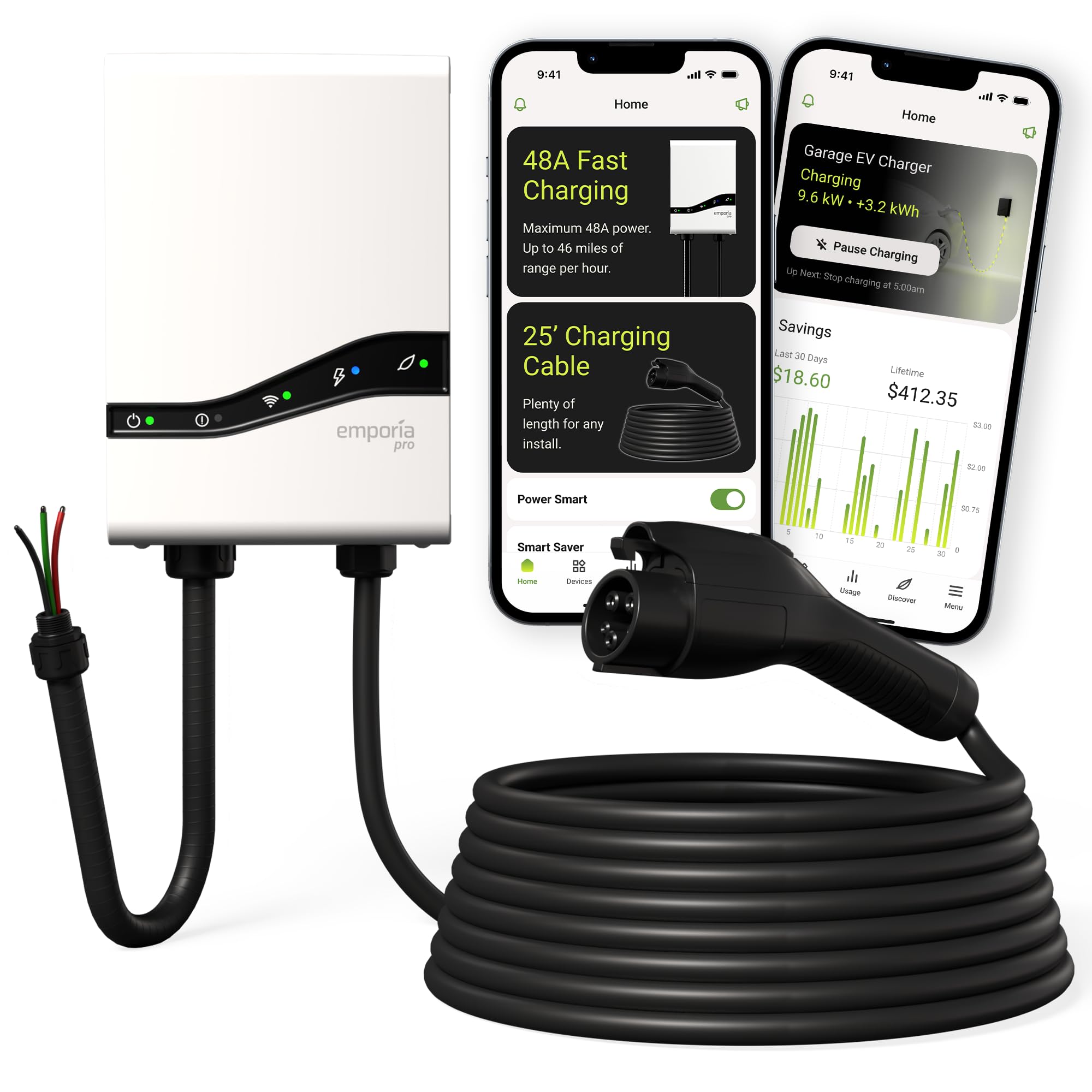
The expensive part of home charging usually is not the charger, it is the service panel. In a house with 100 amps and nothing spare, the answer is often to upgrade the panel first, which turns a wall box into a five-figure construction project. Emporia built the Pro for exactly that situation. It ships with the Vue home energy monitor and PowerSmart software, which watches the whole house's draw and throttles the charger back when the dryer or the AC kicks in, so the car takes whatever capacity is left over and the main breaker stays where it is.

We think this is the most interesting product in the group, because it solves a problem none of the others can touch. The charging hardware is the standard Emporia recipe: 48 amps hardwired or a 14-50 plug, J1772 connector, 25-foot cable, three-year warranty. The Vue adds circuit-level monitoring you would otherwise buy as a separate product. If you have solar, it gets better still, because the system can route surplus production into the car rather than exporting it at a lower rate.

Two caveats. The first is that there is less to go on here than anywhere else on this list, since this is a newer unit and the long-term picture is genuinely unknown. The second is that if your panel already has capacity, you are paying a premium for software you may never need, and the standard Emporia charges at the same 48 amps for less. PowerSmart earns its money the day your electrician tells you the service cannot take another 60-amp breaker.

Pros

  • Load management avoids a service panel upgrade
  • 48 A hardwired or on a NEMA 14-50
  • Includes the Vue home energy monitor
  • Three-year warranty

Cons

  • Newer unit with little long-term history
Our verdict

Built for the house that cannot add a 60-amp circuit: it charges at full speed and backs off automatically when everything else wakes up.

Check Latest Price
6

Best for Two-Car Garages

ApexCharger MACH 1

89 /100
LBD Score Excellent

Key details

Warranty
5 years
Connectors
J1772 plus NACS adapter
Max Output
48 A
Cable Length
30 ft
View on Amazon

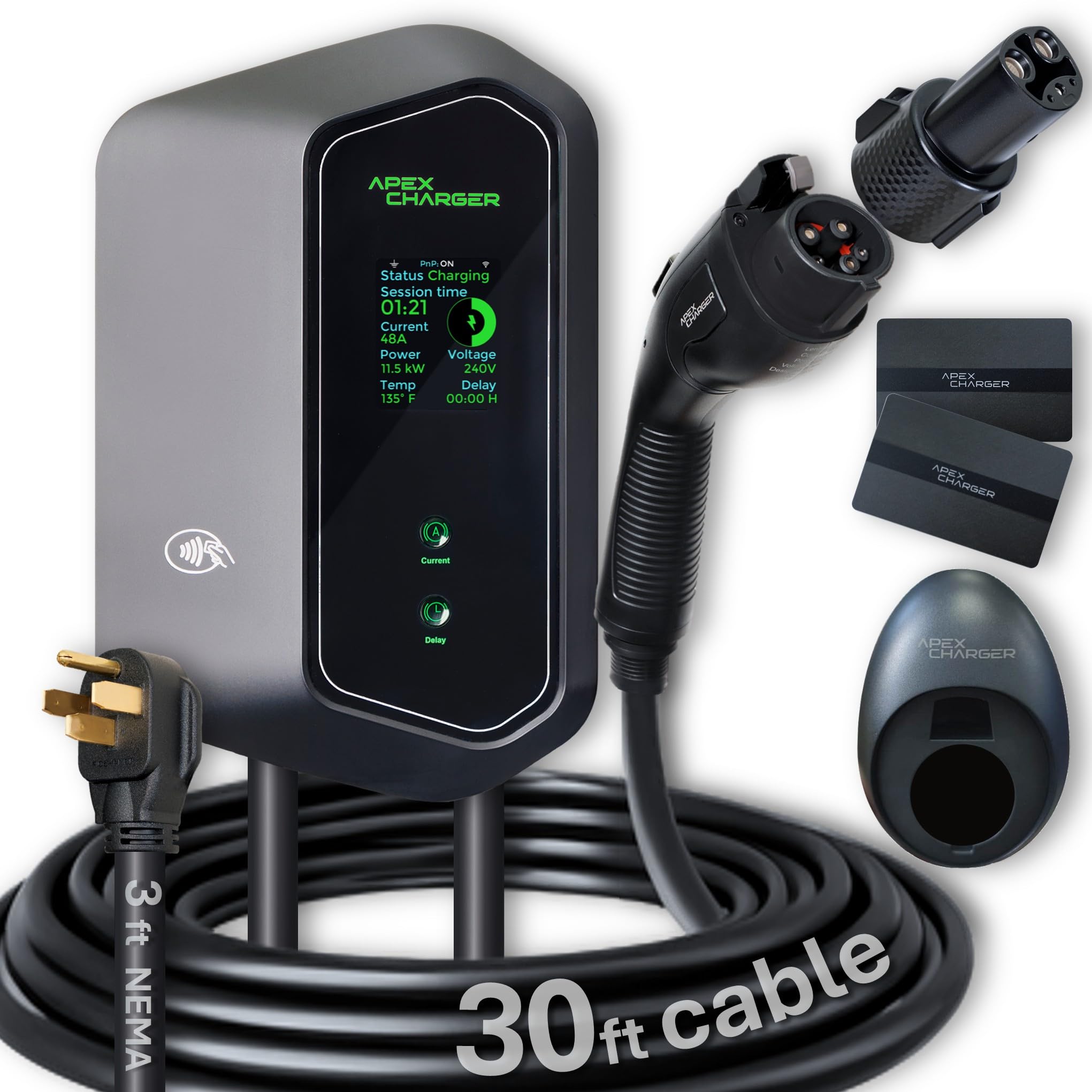
Thirty feet of cable. That number is what gets the MACH 1 onto this list, because it is several feet more than anything else here and it is the difference between a charger that reaches the second bay of a garage and one that does not. The kit is unusually complete too: a J1772 connector plus a NACS adapter in its own bag, two RFID cards for controlling who can start a session, a hardwire kit, a wall plate, and a holster for the connector.

The rest holds up. Forty-eight amps hardwired or 40 on a NEMA 14-50, a body small enough at roughly ten by seven inches to fit between studs, Bluetooth for setup and WiFi for schedules, and a five-year warranty that matches the best on this list. If you are managing a shared driveway or an Airbnb, the RFID cards are a genuinely useful inclusion that almost nobody else bothers with.

Where it gives ground is the software. The app works but it is not polished, and the WiFi radio is the fussiest of the group: Bluetooth gets you set up fine, but a charger that drops off the network loses its schedule with it. What tips it for us is the combination of reach, warranty, and the adapter in the box. For a two-car garage or a driveway where the parking spot is not fixed, that is worth more than a slicker app.

Pros

  • 30-foot cable reaches the far bay
  • NACS adapter and RFID cards included
  • 48 A hardwired or 40 A on a 14-50
  • Five-year warranty

Cons

  • WiFi pairing is the weak link
Our verdict

The one to buy when the car does not park next to the panel: 30 feet of cable, a NACS adapter in the box, and a five-year warranty.

Check Latest Price
7

Maximum Charge Speed

Autel MaxiCharger 80A

84 /100
LBD Score Excellent

Key details

Warranty
5 years
Connector
SAE J1772
Max Output
80 A hardwired
Circuit Required
100 A recommended
View on Amazon

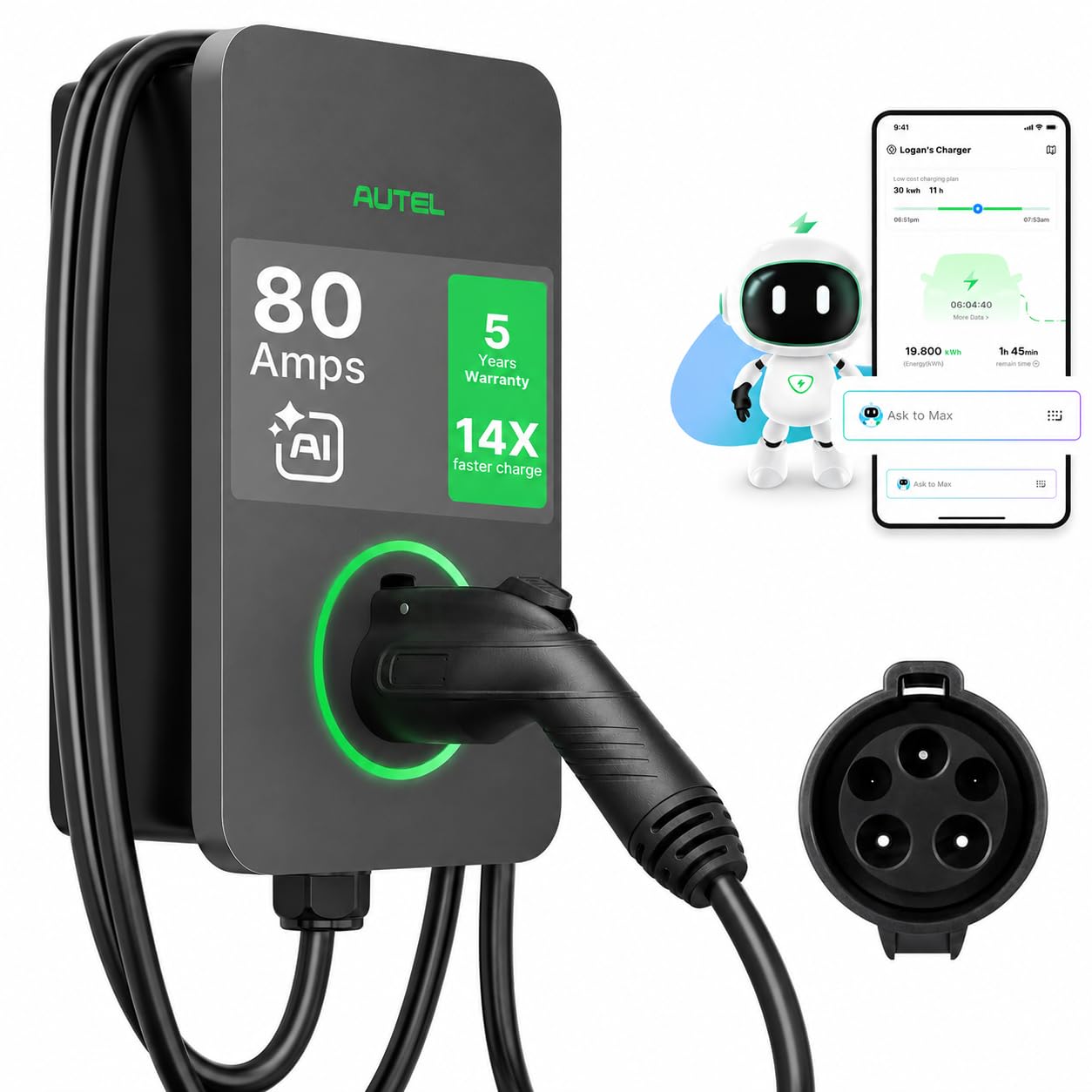
Eighty amps is a different category of purchase. Before this charger does anything, you need a 100-amp circuit dedicated to it, which most houses do not have and many panels cannot support without an upgrade of their own. So the honest framing is that the MaxiCharger 80A is not a faster version of the units above. It is a decision about your electrical service first and a charger second.

When the circuit exists, the payoff is real: 19.2 kW, about 70 miles of range per hour, and a long top-up that becomes a two- or three-hour job instead of a whole night. The build is serious, with CSA and UL certification, a flame-retardant enclosure and internal temperature monitoring, a design built around a ten-year service life, dual-network WiFi with a Wi-SUN backup radio, and a five-year warranty. The 25-foot cable is standard for the class, and the hardwired install is what gets you the full output.

The friction is all in the smart layer. The WiFi has to be coaxed, and there is a firmware update that wants a wired Ethernet connection, which is maddening once the unit is sealed onto an outside wall. The separate cable holster has a lip shallow enough that the cable slides off it. None of that touches the charging itself, and all of it is the kind of thing you notice every single day.

Our take: this is the pick only when the panel can carry it, and when it can, nothing else here charges this fast. Everyone else should buy a 48-amp unit, save the difference, and never notice the missing 32 amps.

Pros

  • 19.2 kW and about 70 miles of range per hour
  • CSA and UL certified with temperature monitoring
  • Five-year warranty

Cons

  • Needs a 100-amp circuit most homes lack
  • WiFi setup and firmware updates are fiddly
Our verdict

Worth it only with a 100-amp circuit to feed it, and then it is by far the fastest way to charge at home.

Check Latest Price
8

Network App Users

ChargePoint HomeFlex

87 /100
LBD Score Excellent

Key details

Connector
SAE J1772
Plug Type
NEMA 14-50
Max Output
50 A
Cable Length
23 ft
View on Amazon

This is the charger most shoppers find first, and living with it complicates the reputation. The hardware is genuinely nice: a slim case, a 23-foot cold-resistant cable, a connector that feels expensive in the hand. The problem sits behind it. Everything runs through a ChargePoint account and an app, and the WiFi connection that carries it is the shakiest thing about the package.

What it does well, it does well. It is rated to 50 amps, offers 16 through 50 in steps so you can fit it to the circuit you have, is UL listed, and carries a three-year parts warranty. The app shows what a session cost at your actual rate, and the account plugs into ChargePoint's public network, which is more useful than most home-charger apps if you also charge away from home.

Then there is the price, which sits near the top of the range here, and the reliability question, which is the one thing worth being sure of before spending that much. Units that stop completely are part of the picture, and at this money a charger that might quietly quit one night is a worse bet than it is at the budget end of the list.

We still like the hardware, and if you already live in ChargePoint's app and network, the integration is worth something nothing else here matches. Otherwise the EVIQO does the same job on the wall for less, with a simpler app, and that is the call we make.

Pros

  • 50-amp rating and a 23-foot cold-weather cable
  • Integrates with ChargePoint's public charging network
  • UL listed with a three-year parts warranty

Cons

  • WiFi dropouts and app account problems
  • Priciest of the mainstream units here
Our verdict

Buy it for the ChargePoint network: the hardware is excellent, but the app and WiFi behind it are the weak link.

Check Latest Price

How We Chose and Tested the Best Home EV Chargers

We started with spec sheets for every Level 2 unit sold through national retailers and directly to drivers, then filtered hard: UL or ETL certification, a connector that matched our test cars, and a clear answer on whether the unit was hardwired or fed by a NEMA 14-50 outlet. Anything without real load management or a documented way to dial down amperage got cut, since that's what keeps a charger from tripping a panel. Eight made the shortlist, and we ran them for nine months.

Each one went into ordinary service: plugged in around 9 p.m., unplugged at 6:45 the next morning, and worked hard on Sunday nights after a weekend trip had drained the battery below 15 percent. We logged miles of range added per hour at the highest setting and again at a deliberately reduced one, so we could tell you what a smaller circuit actually costs in practice rather than on paper.

Connectivity got its own pass. With the router two rooms away, we set each charger up from a dead start and timed how long it took, then pulled the network for an hour to see whether saved schedules survived and whether the app reconnected on its own or needed a manual rejoin. We also watched the small stuff — a charging history that keeps its dates, a notification that actually arrives when a session stops early.

Durability and cable management we tested by being careless on purpose: cables dropped on concrete, dragged across a garage floor, and coiled back onto the hook one-handed in the dark. We hosed each enclosure down and checked the connector for moisture, unplugged by the body rather than the cord, and noted how the latch and strain relief felt after a few hundred cycles. The chargers that scored best were the ones we stopped thinking about.

How to Choose a Home Ev Charger

Start With the Circuit

A charger's headline amperage is only a promise about your wiring. A 40-amp unit on a NEMA 14-50 outlet needs a 50-amp breaker, a 48-amp hardwired unit needs 60, and the 80-amp Autel wants 100. Continuous load can only run at 80% of the breaker rating, which is why the numbers come in those pairs. Look inside your panel before you look at chargers: if there is no room for a two-pole breaker, the charger is a small part of the project and the electrician's quote is the real decision.

Most units here let you dial the output down to fit the circuit you do have, so a smaller service costs you charging speed rather than the whole purchase. Buy for the circuit you have today, not the one you might add later.

Hardwired or Plug-In

A NEMA 14-50 outlet caps you at 40 amps of continuous charging no matter what the box claims, because the plug itself can't carry more on a 50-amp circuit. It's also your only option if you rent, might move the charger to a second house, or want to take it with you when you sell.

Hardwiring gets you 48 amps and up, a tidier install with no outlet to wear out, and a permanent commitment to that wall. The Emporia is the one here that does both — buy it as a plug-in and convert it later without buying a second charger.

Match the Connector to the Cars You Will Actually Charge

J1772 covers every non-Tesla EV sold in North America, and a Tesla can use one through the adapter that came in the trunk. NACS runs the other way: native for Tesla, adapter-dependent for everything else. In a one-car Tesla household, buy NACS and stop thinking about it. In a two-car household where only one is a Tesla, buy J1772 and let the Tesla's own adapter handle the rest, so nobody has to remember a dongle every night.

The ApexCharger splits the difference by shipping both connectors in the box, which is worth real money if your driveway is mixed.

What the App Is Really For

Scheduling around time-of-use rates is the feature that pays for itself, because the gap between peak and off-peak can be most of your charging cost. Amperage adjustment and energy reporting are the next most useful things a charger can do. What you don't need is a charger that can't charge without the cloud: if the schedule lives in an app and the WiFi drops, the session starts when you plug in, at whatever rate the meter happens to be running.

Your car can usually schedule itself, which is why the Grizzl-E's total lack of software is a legitimate choice rather than a compromise.

Cable, Weather Rating, and Rebates

Twenty-five feet is standard and usually enough for one car parked nose-in; a two-car garage or a driveway where the spot moves around is where the ApexCharger's 30 feet earns its keep. For an exposed wall, look for a stated NEMA 4 or IP66/IP67 rating — the EVIQO and the Grizzl-E both publish one, while others only say indoor/outdoor without a number, which is worth chasing down before you mount anything outside.

Certification is the part people skip. UL, ETL, or CSA listing plus Energy Star is what utility rebate programs check, and a charger that isn't on your utility's approved list can cost you the incentive entirely.

Frequently Asked Questions

Final Verdict

The EVIQO 48A is the charger we point most people to. It uses the fastest circuit a normal house can give it, the app is good enough that you will actually use the scheduling, and the certification list covers the rebate paperwork. If the driveway is all Tesla, buy the NACS version of the same unit and skip the adapter.

If your panel is the obstacle, the Emporia Pro is the only charger here that solves it without a service upgrade. And if you just want a tough box on the wall with no software in the loop, the Grizzl-E is the honest cheap answer.