Best Home Weather Stations of 2026

The console is the least important part of a home weather station. The number it shows you is only as good as the sensor sitting outside, and a decent unit mounted in afternoon sun will confidently report 104 degrees on an 88-degree day. I learned that with a cheap station I strapped above a grill, and it's why sensor placement was the first thing we standardized when we brought in a dozen stations for six months — same height, same shade, same distance from the house.

Setup, readability, and brightness are what separated the good ones from the frustrating ones. A display you can read from across a dim kitchen matters more day to day than a tenth of a degree of precision, and a backlight you can't dim at night gets old within a week. Connectivity splits the field too: some stations push readings and alerts to your phone while you're away, others sit on the counter and mind their own business.

Both approaches are legitimate — you just need to know which one you're buying. Our picks run from a simple indoor-outdoor thermometer to a full sensor array with rain gauge and wind vane.

1

Best Overall

Ambient Weather WS-2902

89 /100
LBD Score Excellent

Key details

Power
Solar sensor array; AC console
Connectivity
Wi-Fi with app and alerts
Sensor Suite
Wind, rain, temperature, humidity, pressure
Temperature Accuracy
±1 °C
View on Amazon

The WS-2902 is the station we reach for when someone wants the full backyard picture, not just a temperature readout. Its solar-powered sensor array gathers wind speed and direction, rainfall, temperature, humidity, and pressure, then sends them to a color console. That is a meaningful step up from a thermometer: you can see which way the wind is blowing before a storm and how much rain actually landed in your yard.

Wi-Fi is the reason it earns top billing. The console connects to Ambient Weather's network, so the same readings show up in the app, and you can set alerts for the conditions you care about. We found the payoff is having the station with you away from the console, whether you are upstairs or away from home. The setup asks for 2.4 GHz Wi-Fi and a steady signal at the console; if your router is on the other side of the house, sort that out before mounting the sensor.

The hardware has practical limits. The array needs an open mounting spot, ideally on a pole, because nearby trees and rooflines distort wind and rain readings. The console's color screen is readable head-on but loses contrast at an angle, so place it where you look at it straight on. The app is the better place for serious checks, and the console is the glanceable summary.

What separates this station from simpler picks is the combination of a complete sensor suite and remote access. We also appreciate that it supports calibration and can feed personal weather networks, which makes it feel like a small personal station rather than a gadget. It is not the set-and-forget appliance some shoppers hope for: the outdoor array is the part that lives in weather, and it is worth mounting where you can service it without a major climb. For the breadth it adds, that is a fair trade.

Pros

  • Measures wind, rain, pressure, and indoor-outdoor conditions
  • Wi-Fi app with alerts and smart-home integration
  • Solar-powered sensor array
  • Color console shows the full station at a glance

Cons

  • Rain gauge and temp sensor can stop reporting
Our verdict

For a complete backyard station with remote access, the WS-2902 is the one we recommend: it tracks wind, rain, and indoor-outdoor conditions and puts them on your phone.
Check Latest Price
2

Best Value Full-Feature

Sainlogic 12-in-1

92 /100
LBD Score Outstanding

Key details

Power
Battery sensor; AC adapter console
Display
6.5-inch LCD; 3-level backlight
Connectivity
Wireless; no Wi-Fi
Sensor Suite
Temperature, humidity, wind, rain, pressure
View on Amazon

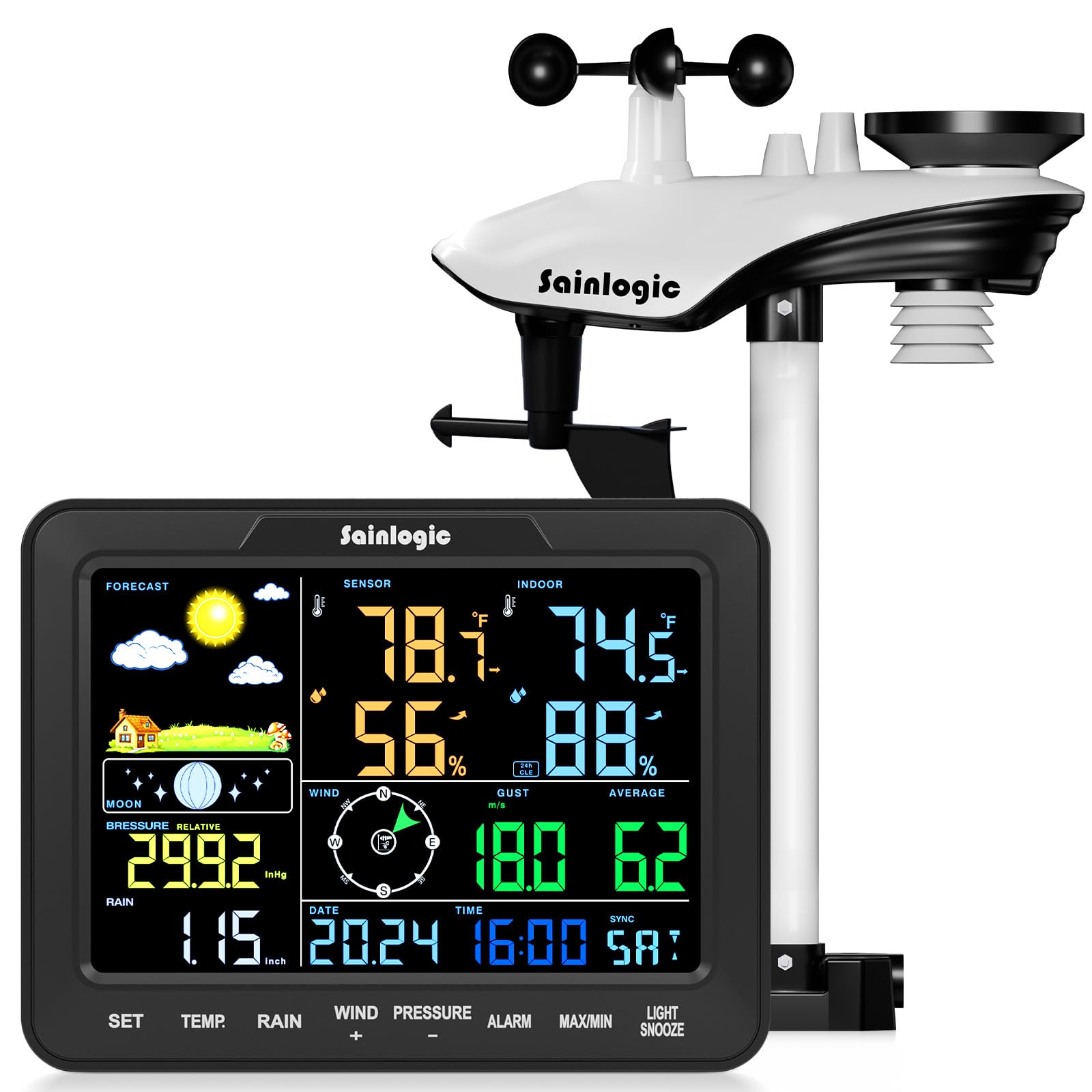
The Sainlogic is the full-feature station we point to when the console itself is the priority. It measures temperature, humidity, wind speed and direction, rainfall, and air pressure, then puts them on a 6.5-inch color screen with a three-level backlight. You mount the outdoor array, power the console, and read the screen. That simplicity is the appeal: there is no router setting to chase and no app account to maintain.

The rain gauge is the detail that makes this one interesting. Sainlogic claims ±1 mm precision in light rain, and the sensor suite includes a Swiss temperature-humidity sensor. We treat those as manufacturer claims rather than proven accuracy, but the combination is serious for the money. Mount the array clear of walls and trees, because wind and rain readings are only as good as the siting. The screen is large enough for a kitchen counter or mudroom, and the backlight can be dimmed for a bedroom. If you want a full station and a display you can read from across the room, this is the value pick.

Pros

  • Full wind, rain, pressure, and humidity suite
  • 6.5-inch screen with three brightness levels
  • Simplified local setup without an app

Cons

  • No Wi-Fi or phone alerts
Our verdict

For a full sensor suite and a large local display without paying top-pick money, the Sainlogic is our value pick.

Check Latest Price
3

Best Display-Focused

La Crosse C85845

89 /100
LBD Score Excellent

Key details

Alerts
Custom temp and humidity alerts
Display
Color LCD; adjustable brightness
Measurements
Temperature, humidity, dew point, heat index
Console Width
8.96 inches
View on Amazon

The C85845 puts its money into the part you look at every day. The console is 8.96 inches wide, with a bright color display, big indoor and outdoor temperature and humidity readings, comfort bars, and a backlight that runs continuously on AC power. It is the station we reach for when the display sits on a kitchen counter or a desk and needs to be read from across the room.

The rest is a sensible indoor-outdoor package: dew point, heat index, high-low records, custom temperature and humidity alerts, and an atomic clock that sets itself. This is a room monitor with a forecast, not a backyard weather station—there is no wind or rain sensor. Setup is straightforward: power the console, put batteries in the outdoor sensor, and give the barometric forecast several days to settle.

For the right buyer, the simplicity is the recommendation. You get the two readings most people check first, a display that is genuinely easy to read from a distance, and alarms that can warn you about a cold greenhouse or a damp basement. It is the station for a household that wants indoor-outdoor comfort at a glance, with enough forecast detail to help plan the day. If that is your list, this is our display-first pick.

Pros

  • Large color display with adjustable brightness
  • Custom temperature and humidity alerts
  • Atomic clock sets itself
  • AC power keeps the backlight on

Cons

  • Color screen loses contrast off-angle
Our verdict

Choose the C85845 for a large, readable indoor-outdoor display that earns its counter space with alerts and an atomic clock.

Check Latest Price
4

Best Budget

DreamSky 24BW02

89 /100
LBD Score Excellent

Key details

Power
AC adapter; 3 AA backup
Display
Color LCD; 5-level dimmer
Measurements
Temperature, humidity, pressure, moon phase
Extra Sensors
Up to 3 outdoor sensors
View on Amazon

The DreamSky is what we hand to someone who wants a useful weather display without paying for a full sensor array. The color screen shows indoor and outdoor temperature and humidity, barometric pressure, a 12- to 24-hour forecast, and the phase of the moon. It also has an atomic clock, five brightness levels, and support for up to three outdoor sensors, so you can keep an eye on a garage or basement as well as the yard.

Where it earns its place is as a bedside or kitchen display: the numbers are large, the backlight dims low enough for a dark room, and the USB charging port is a small convenience we appreciate on a crowded counter. The weak spot is the forecast. It is a pressure-based guess, not a local radar feed, and it needs a calibration period before the icons settle down. Use the station for temperature and pressure trends and keep a weather app for storms. If you want a low-cost station that does the everyday job and looks good doing it, this is our budget pick.

Pros

  • Five brightness levels and dimmable backlight
  • Atomic clock, barometer, and forecast
  • Supports up to three outdoor sensors
  • USB charging port

Cons

  • No wind or rain sensors
Our verdict

For a low-cost color station with atomic time, barometric pressure, and room for extra sensors, the DreamSky is our budget pick.

Check Latest Price
5

Best Simple Full Station

AcuRite Iris 01512

89 /100
LBD Score Excellent

Key details

Display
Color LCD; adjustable dimmer
Data Points
55+
Sensor Suite
Wind, rain, temperature, humidity
Temperature Accuracy
±1.11 °C
View on Amazon

The Iris is the full station we recommend when you want the sensor suite without Wi-Fi complexity. Its five-in-one outdoor unit measures temperature, humidity, wind speed and direction, and rainfall, and the color console adds pressure and more than 55 data points. Setup is about as simple as a full station gets: batteries in, sensor on a pole or post, and the console picks up the signal.

We appreciate the display layout more than the feature count. The color screen groups current conditions, forecast, and historical rain data without turning into a wall of numbers. The rain gauge is the useful part for gardeners, and the adjustable dimmer keeps it from glowing too brightly at night. As with any mounted sensor, siting matters: the rain gauge needs a clear opening, and wind readings suffer near a roof or fence.

For a simple full station, the Iris gets the balance right: enough data to be interesting, not so much that the display becomes a puzzle. It is our pick for a gardener or weather-curious household that wants local readings, a color screen, and a straightforward console. If you need remote access, go with a Wi-Fi station; if you want a local console with a complete sensor suite, start here.

Pros

  • Five-in-one sensor covers wind, rain, temperature, humidity
  • Color console with 55+ data points
  • Simple pole or post installation

Cons

  • Outdoor sensor and rain gauge are wear points
Our verdict

Choose the Iris for a straightforward full station with a five-in-one sensor and a colorful console that does not depend on Wi-Fi.

Check Latest Price
6

Premium UV Monitoring

Ambient Weather WS-2000

89 /100
LBD Score Excellent

Key details

Display
TFT color console
Connectivity
Wi-Fi with app and alerts
Sensor Suite
Wind, rain, temperature, humidity, UV, solar
Temperature Accuracy
±2 °F
View on Amazon

The WS-2000 is the premium version of our top pick. It uses the same all-in-one sensor approach—wind, rain, temperature, humidity, pressure—and adds UV and solar radiation readings. The console is the bigger upgrade: a TFT color screen that is more polished and more informative than the LCD on the WS-2902. Wi-Fi remote monitoring and alerts are still part of the package.

That makes it the choice for someone who wants a more polished dashboard and cares about sun exposure, not just rain and wind. We like the extra data for gardening and solar planning, and the display is the one we prefer to leave out in a living room. The setup is familiar: mount the array, connect the console to 2.4 GHz Wi-Fi, and tune the calibration if your siting is imperfect.

The value question is harder. You are paying a premium for the console and the two extra sensors, while the rain and wind hardware does the same job as the top pick's. If UV and solar numbers are part of why you want a station, the WS-2000 is worth the step up. If you mainly want rain and wind, the WS-2902 is the smarter buy.

Pros

  • Adds UV and solar radiation readings
  • TFT color console
  • Wi-Fi remote monitoring and alerts

Cons

  • Outdoor sensor array is the long-term wear point
Our verdict

The WS-2000 is the premium pick for buyers who want UV and solar readings and a better console; otherwise, the WS-2902 is the better value.

Check Latest Price
7

Compact Color Display

AcuRite 02077M

88 /100
LBD Score Excellent

Key details

Display
Color LCD; adjustable dimmer
Forecast
12-hour forecast
Measurements
Temperature, humidity, pressure, moon phase
Temperature Accuracy
±1.11 °C
View on Amazon

The 02077 is the station we reach for when the spot is a desk, not a wall. Its color display is compact—4.5 inches wide—and shows indoor and outdoor temperature and humidity in different colors, along with a 12-hour forecast and moon phase. The adjustable dimmer makes it easy to live with in a bedroom or kitchen.

Setup is simple: plug in the display, add batteries to the outdoor sensor, and hang the sensor on a post or tree branch with the integrated hanger. The forecast needs a calibration period, and the sensor needs to be out of direct sun for a believable temperature. Treat it as a room-and-yard thermometer with a forecast rather than a full station.

What we like most is the size-to-information ratio. It gives you the essentials without taking over a counter, and the color coding makes indoor versus outdoor readings easy to separate at a glance. The trade-off is the screen itself: it is small and loses contrast when you view it from an angle, so it works best on a desk where you look at it directly. If you want big numbers from across the room, the La Crosse is the better display; if you want a compact color station for a tight spot, this one earns its place.

Pros

  • Compact color display for tight spaces
  • Indoor and outdoor readings in different colors
  • Adjustable dimmer and 12-hour forecast

Cons

  • No wind or rain measurements
Our verdict

For a compact color station that fits a desk or kitchen counter, the 02077 is our small-space pick.

Check Latest Price

How We Tested Home Weather Stations

We started with a list of roughly 40 stations and cut it by reading spec sheets closely: which ones actually include a wind sensor and a rain gauge, which measure only temperature and humidity, how far the outdoor sensor claims to transmit, and whether there's an app behind it. That narrowed to 12 units, bought at retail so nothing arrived pre-configured, spanning simple countertop consoles to full outdoor arrays. Testing ran six months, from late summer into winter, so every station saw heat, storms, and at least one hard freeze.

Each outdoor sensor went up the same way — same height on the same fence line, out of direct sun, roughly the same distance from the house. I installed every one myself with a stopwatch running, and the spread was wide: a few were reporting to the console in under ten minutes, while others meant an afternoon of menu-diving and a trip back to the manual. For accuracy, I logged temperature, humidity, and pressure at 7 a.m. and 7 p.m. and compared each station against the others and against the nearest official reporting site. The ones that drifted were the ones with poorly shielded sensor housings, and they drifted worst in late-afternoon sun.

Displays got judged at a distance and in the dark. I read each one from ten feet away in a lit kitchen, then again at 2 a.m. with the lights off, noting which dimmed to something a houseguest wouldn't complain about. Connectivity we tested by killing the Wi-Fi router for an hour to see whether the station kept logging or threw a fit, and by checking whether readings still refreshed on a phone across town. Durability was mostly patience: six months of sun and frost on the outdoor housings, watching for yellowed plastic, fogged screens, and anemometer cups that stopped spinning freely. And on value, we counted what came in the box — a station with a rain gauge and wind vane earns its price in a way a temperature-only console can't.

How to Choose a Home Weather Station

Full Station or Indoor-Outdoor Display?

Full stations pair a console with an outdoor array that measures wind, rain, temperature, and humidity; display-only models skip the moving parts and focus on indoor-outdoor comfort, pressure, and a forecast. If you want to know whether the patio is dry or how much rain fell in the garden, choose the full suite. If you mainly want a glanceable temperature and humidity readout for a kitchen or bedroom, a display-first model such as the La Crosse C85845 is easier to live with. There is no need to pay for sensors you will not check.

Wi-Fi or a Local Console?

Wi-Fi adds remote access and alerts, which is genuinely useful if you travel, keep a workshop, or want to check the yard from another room. It also adds a router, an app account, and a setup step that can be fussy. Local radio stations such as the Sainlogic 12-in-1 and AcuRite Iris keep everything on the console and are simpler to troubleshoot. Choose Wi-Fi when remote alerts change what you can do; choose local when the display is the whole point.

Plan the Sensor Site First

Wind and rain readings are only as good as the mounting spot. Put the array in an open area away from walls, trees, and roof runoff, and keep the temperature sensor out of direct sun; a sensor baking on a south wall will read high no matter how accurate the electronics are. Check the wireless range from the proposed spot to the console, and choose a mount you can reach for battery changes and cleaning. Walk the yard before you order, not after.

Read the Display Where It Will Live

Display size is not the same as readability. A large color screen can still wash out at an angle, and a bright backlight that looks good in a showroom can be annoying in a bedroom. Look for adjustable brightness or a dimmer, and plan to view the console head-on rather than from the side. If the display will run continuously, AC power is more convenient than battery power; if it sits on a nightstand, a dimmable screen matters more than a wide viewing angle.

Treat the Outdoor Sensor as a Wear Item

The outdoor sensor lives in sun, rain, and cold, and its moving parts—rain gauge, wind cups, anemometer—are the first things to need attention. No station is maintenance-free. Before buying, check that you can reach the sensor safely, that the battery compartment is accessible, and that replacement sensors or service are available for the model. A weather station is a small piece of outdoor equipment, not a sealed appliance; plan for occasional cleaning and battery changes.

Frequently Asked Questions

Final Verdict

For most homes, the Ambient Weather WS-2902 is the station we recommend: it measures the full backyard picture and puts it on your phone, not just on a console. If you do not need Wi-Fi, the Sainlogic 12-in-1 gives you the same wind, rain, and pressure data on a larger local screen for less. And if a big indoor-outdoor display is the main attraction, the La Crosse C85845 is the one to choose.