Best Karaoke Machines of 2026

A karaoke machine looks like a guaranteed good time in the product photo: lights on, two mics in hand, somebody mid-chorus. The photo can't tell you whether the second mic drops out during a duet, whether the speaker makes everyone sound like they're singing through a paper tube, or whether the battery survives until your guests actually arrive. I've watched a living-room singalong die on all three, and the fix is almost never the wattage printed on the box.

We ran 12 machines through six months of real parties — birthdays, a backyard cookout, one basement night past midnight — because karaoke gear never reveals its flaws at low volume. The good ones power up fast, keep two wireless mics stable at once, and make a shy cousin sound decent enough to keep going; the disappointing ones squeal with feedback and get retired to a closet.

What follows is sorted by where the machine actually lives: the mini one that rides in a backpack, the loud one with wheels for the driveway, the one that plugs into your TV.

1

Best Overall

VOSOCO T-03 Karaoke Machine

89 /100
LBD Score Excellent

Key details

Mics
Two wireless
Output
15W, 6.5-inch woofer
Weight
6.5 lb
Battery
4–8 hours
View on Amazon

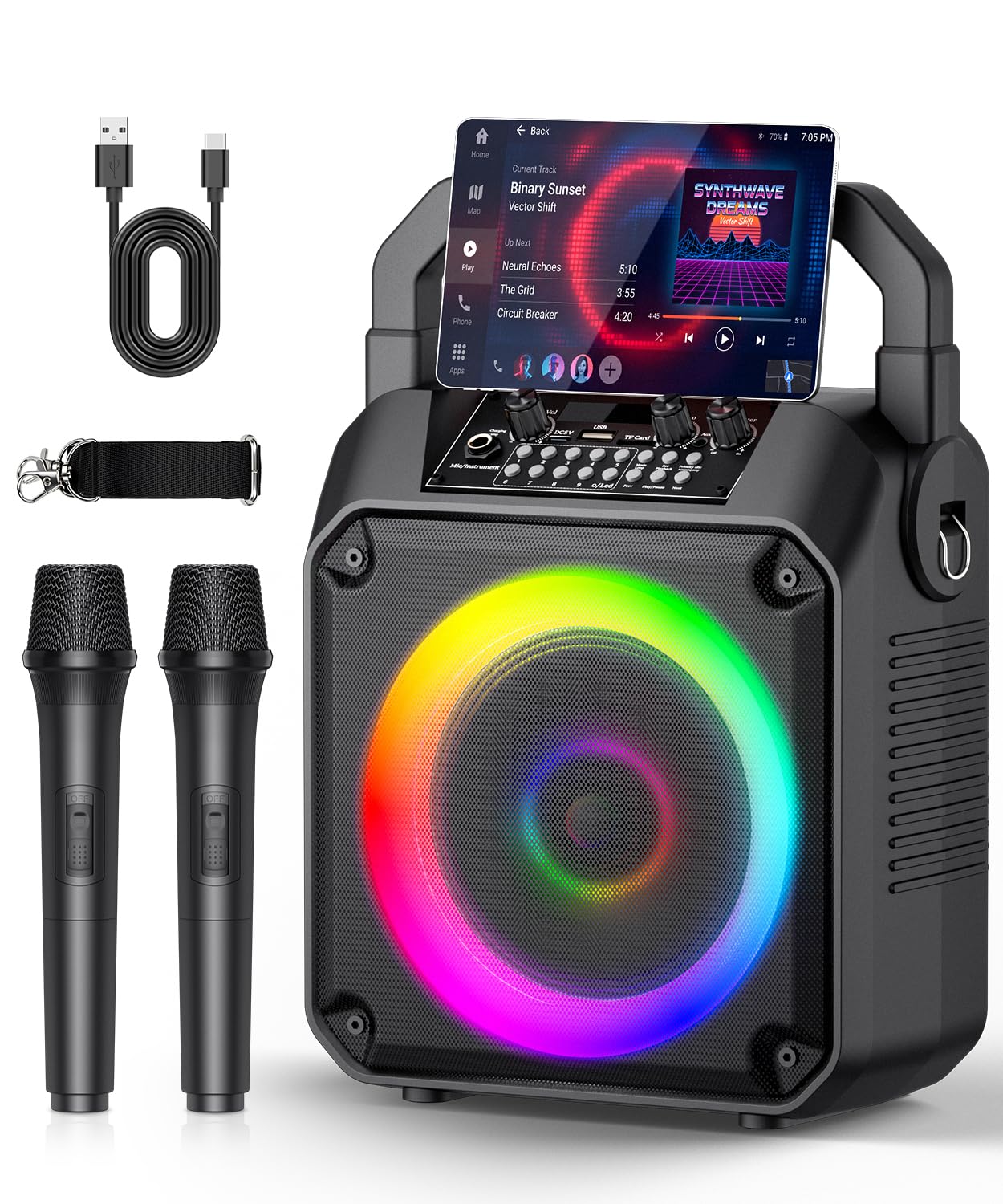
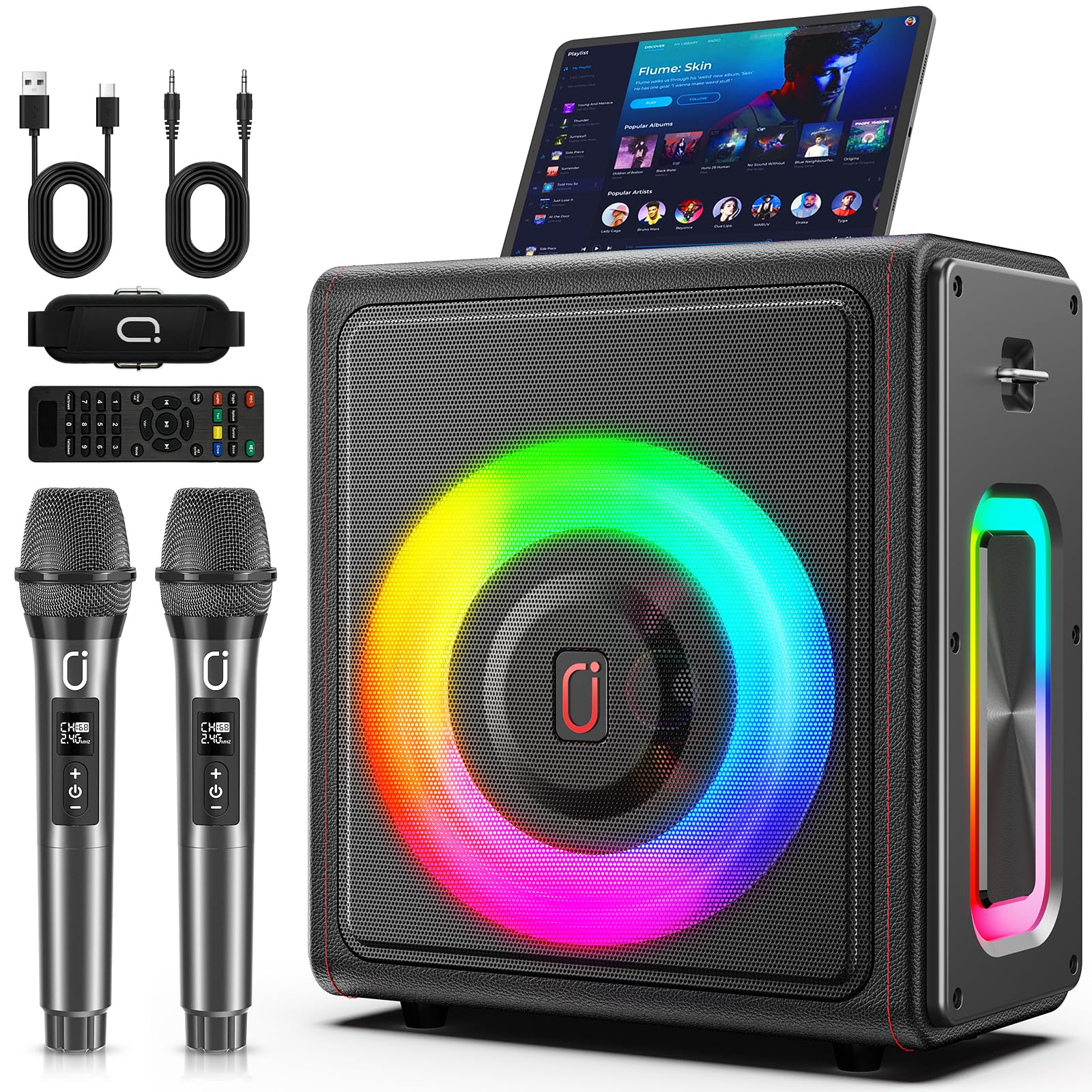
Ask a karaoke machine to do three things and most of them fail at one: keep two singers clear of the backing track, let you pull the music down without burying the voice, and stay light enough to carry onto the patio. The VOSOCO T-03 handles all three. Fifteen watts run through a 6.5-inch woofer, and the microphone level, the music level, and the echo each get their own control — that last part is the difference between a karaoke night and a phone propped against a mug.

Echo is the control people underuse. A little of it covers the gap between a shy singer and a confident one, and because it sits on its own dial here you can add it for a ballad and take it back out for anything fast without touching the track underneath. Being able to pull the microphones forward in the mix rather than pushing the whole machine louder is what keeps a small room from turning harsh.

At 6.5 pounds it moves in one hand, and the box includes both a leather handle and a shoulder strap; the strap is what makes the walk out to a yard tolerable. Playtime is listed at 4 to 8 hours, so plan on charging it the night before rather than trusting the top of that range. Two of these pair over TWS as well, if you ever want the sound spread across a wider space.

Where it runs out is headroom. In a living room we never got near the top of the dial; aimed at a full backyard it starts to sound like the 15-watt box it is, and the microphone thins out before the music does. If that is the party you are planning, the HWWR T8 is the honest answer. And nothing here holds a tablet, so the lyrics live on whatever screen you can prop up.

Pros

  • Separate mic, music, and echo controls
  • 6.5-inch woofer at a midrange price
  • Shoulder strap at 6.5 pounds
  • TWS pairing for a second unit

Cons

  • Headroom stops at living-room volume
  • No tablet rest or lyrics display
Our verdict

We recommend it as the default: a six-inch driver, two microphones, and independent vocal control cover a living-room party without the bulk or the price of a real PA.
Check Latest Price
2

Best Value

MOYLEAF HHCC-A9

89 /100
LBD Score Excellent

Key details

Mics
Two wireless, AA cells
Output
20W, 6.5-inch driver
Weight
4.4 lb
Battery
6–8 hours
View on Amazon

Two buttons on the MOYLEAF's front panel do more for a party than any light show. Mic Priority ducks the music the moment someone speaks into a microphone, which is how you make an announcement, run a toast, or give a kid instructions mid-song. The record button saves a performance to a memory card, and it is the feature teenagers find first.

The rest of the package is unusually generous: 20 watts through a 6.5-inch driver, nine lighting modes, Bluetooth 5.3 with a stated 50-foot range, and separate reverb and microphone volume. We rate this the best value in the group — it is the one we point to when someone wants a real driver and a full control panel without moving up into party-PA territory.

Budget for batteries. Each microphone takes two AA cells, so a long night with two singers is a four-cell commitment, and there is no dock to drop them into. Charge the speaker the night before a party and keep its cable within reach; of everything on this machine, the internal battery is the part we trust least.

Pros

  • Mic priority lets you talk over the music
  • Records performances to a card
  • 20W through a 6.5-inch driver
  • 4.4 pounds with a shoulder strap

Cons

  • Internal battery is the weak link over time
Our verdict

Buy it when you want the most machine for the least money — mic priority and a record button are things we have not seen elsewhere at this size.

Check Latest Price
3

Best for Serious Singers

PPMIC MS75

86 /100
LBD Score Excellent

Key details

Mics
Two wireless, AA cells
Output
200W peak
Weight
5.4 lb
Battery
6,000 mAh, up to 24 hours
View on Amazon

Pitch correction is the reason to look at the PPMIC MS75 before anything else on this list. Press the MIC Mode button and the machine lends a hand to a note that came out flat, gently enough that a room hears a better singer rather than a robot. It is the only machine here that does it, and for anyone who loves karaoke but winces at their own recordings, it changes the whole experience.

Underneath the trick is real hardware: 200 watts peak through a 6.5-inch woofer and a separate 2-inch tweeter, a 6,000 mAh battery rated at up to 24 hours, and an IPX5 rating that means a spilled drink or a damp patio table is not the end of the machine.

Setup is the part we appreciate most. The MS75 connects to a television over Bluetooth or through the AUX cable in the box, so the lyrics go on the big screen and the machine becomes the sound system; the remote handles volume from across the room. The microphones take AA batteries instead of charging in a dock, which is the one place this feels less finished than the rest of it.

Two hundred watts and a processing trick put it at the top of the middle of the range rather than in impulse-buy territory. For a household where the adults are the ones holding the microphones, that trade is worth it; for a child's birthday, the MOYLEAF does the same job for considerably less.

Pros

  • Pitch correction on a dedicated mic mode
  • 200W peak with a dedicated tweeter
  • Connects to a TV by Bluetooth or cable
  • IPX5 rating and a three-year warranty

Cons

  • Mics need AA batteries, no charging dock
Our verdict

Our pick for people who care how they sound: pitch correction, a TV hookup, and enough power for a rented hall.

Check Latest Price
4

Best for Outdoor Parties

HWWR T8 24-Inch

89 /100
LBD Score Excellent

Key details

Mics
Two anti-feedback wireless
Height
24 inches
Output
600W peak, dual 8-inch woofers
Battery
Up to 8 hours
View on Amazon

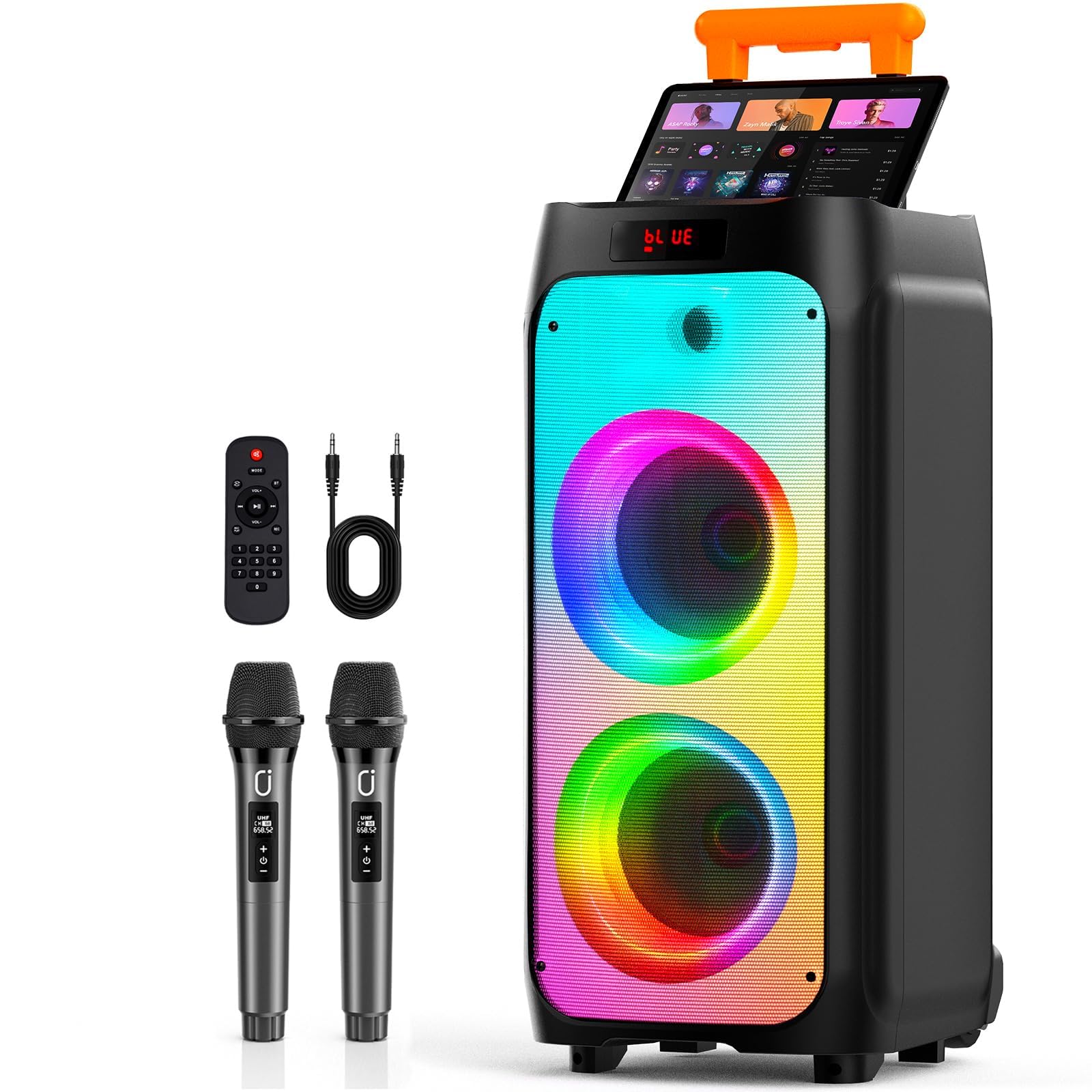
The T8 arrives looking like a small refrigerator: 24 inches tall, dual 8-inch woofers behind a lit front panel, and a telescoping handle with wheels at the base. Rolling it out is the entire setup. Nothing else in this group is remotely this large, and nothing else is built to be heard over a yard full of people who are talking.

Six hundred watts peak is the headline, but the practical details are what sold us: anti-feedback microphones with a stated 30-meter range, so a mic can travel to the back of the crowd without howling, plus inputs for a guitar and a TV or projector alongside Bluetooth 5.3. Eight hours of playtime covers an afternoon that runs into an evening.

This is a machine for a graduation party, a block party, or a garage band's rehearsal, and it is the wrong choice for an apartment living room — it wants floor space and patient neighbors. What it buys in return is the thing a compact box cannot fake: volume that still sounds clean when the room is full and half the guests are out on the grass.

Pros

  • 600W peak through dual 8-inch woofers
  • Wheels and a telescoping handle
  • Anti-feedback mics with 30-meter range
  • Guitar and TV inputs built in

Cons

  • Takes up floor space between parties
Our verdict

The one we hand to anyone with a yard, a crowd, and somewhere to park a 24-inch speaker — 600 watts and wheels make it a portable party.

Check Latest Price
5

Best Ultra-Portable

BEILIHART Mini K29

91 /100
LBD Score Outstanding

Key details

Mics
Two wireless
Size
3.15 x 3.5 x 3.5 inches
Weight
1.2 lb
Voice Effects
Five
View on Amazon

Set the K29 beside the rest of this group and it looks like a mistake — a 3.5-inch cube that weighs about as much as a paperback. Then you turn it on. It is the best of the tiny machines here, and the two microphones are why: small enough for a seven-year-old to hold properly, loud enough that the kids at the back can hear the kids at the front.

The feature list runs longer than the box suggests: five voice effects, a light ring, Bluetooth 5.0, TF, USB and AUX playback, and USB-C charging. It works as a speaker first and a karaoke machine second, which is exactly right for a bedroom or a dorm room — it plays music all week and gets pulled out when friends arrive.

What it cannot do is carry a room. Aimed at a dozen adults in a kitchen it runs out of weight and warmth, and the voice effects that delight a nine-year-old wear thin for anyone past middle school. Buy it for a child, a small space, or as a second machine that lives at a relative's house.

Pros

  • Small enough to sit on a shelf
  • Two mics sized for small hands
  • Five voice effects
  • USB-C charging

Cons

  • Won't fill a room of adults
Our verdict

One of the least expensive ways into a two-mic karaoke night, and we mean that as praise: buy it for a bedroom, a dorm, or a kid.

Check Latest Price
6

Best with a Lyrics Screen

Ikarao Shell S1

90 /100
LBD Score Outstanding

Key details

Mics
Two self-charging wireless
Output
280W peak
Screen
10.1-inch lyrics display
Weight
11.7 lb
View on Amazon

A 10.1-inch screen is bolted to the front of the Shell S1, and it changes the shape of an evening: no phone propped against a glass, no tablet passed hand to hand, nobody squinting. The lyrics run on the machine, and an HDMI output sends them to the television when the party moves into the living room.

The songs come from KaraFun, which is preloaded and runs on a subscription — a free stretch first, then a monthly fee. That is the honest cost of the screen, and it is why this is not the pick for everyone. If you sing along to whatever is already on YouTube, you are paying for an advantage you will not use.

The hardware is the best considered in this group. Two magnetic microphones drop into slots in the body and recharge there, so they are never flat when someone reaches for one; 280 watts run through dual 3.5-inch woofers and dual tweeters; Wi-Fi and Bluetooth cover streaming, and the shoulder strap makes 11.7 pounds manageable on the stairs.

We recommend it to the household that hosts often and wants a machine that feels like furniture rather than gear, because getting started is one power button. If karaoke happens twice a year, the PPMIC does the important half of this job for a fraction of the money.

Pros

  • 10.1-inch lyrics screen on board
  • Mics recharge in the body
  • 280W peak plus HDMI to a TV
  • Wi-Fi and Bluetooth streaming

Cons

  • Song library needs a KaraFun subscription
  • One-year warranty, shortest in this group
Our verdict

Worth it if you host often and want zero setup — the screen and the self-charging mics turn a living room into a karaoke bar.

Check Latest Price
7

Best for Kids

YLL K1-L Kids Karaoke

93 /100
LBD Score Outstanding

Key details

Mics
Two wireless, rechargeable
Size
4.72 x 3.93 x 5.9 inches
Extras
Voice effects, headphone jack
Weight
1.1 lb
View on Amazon

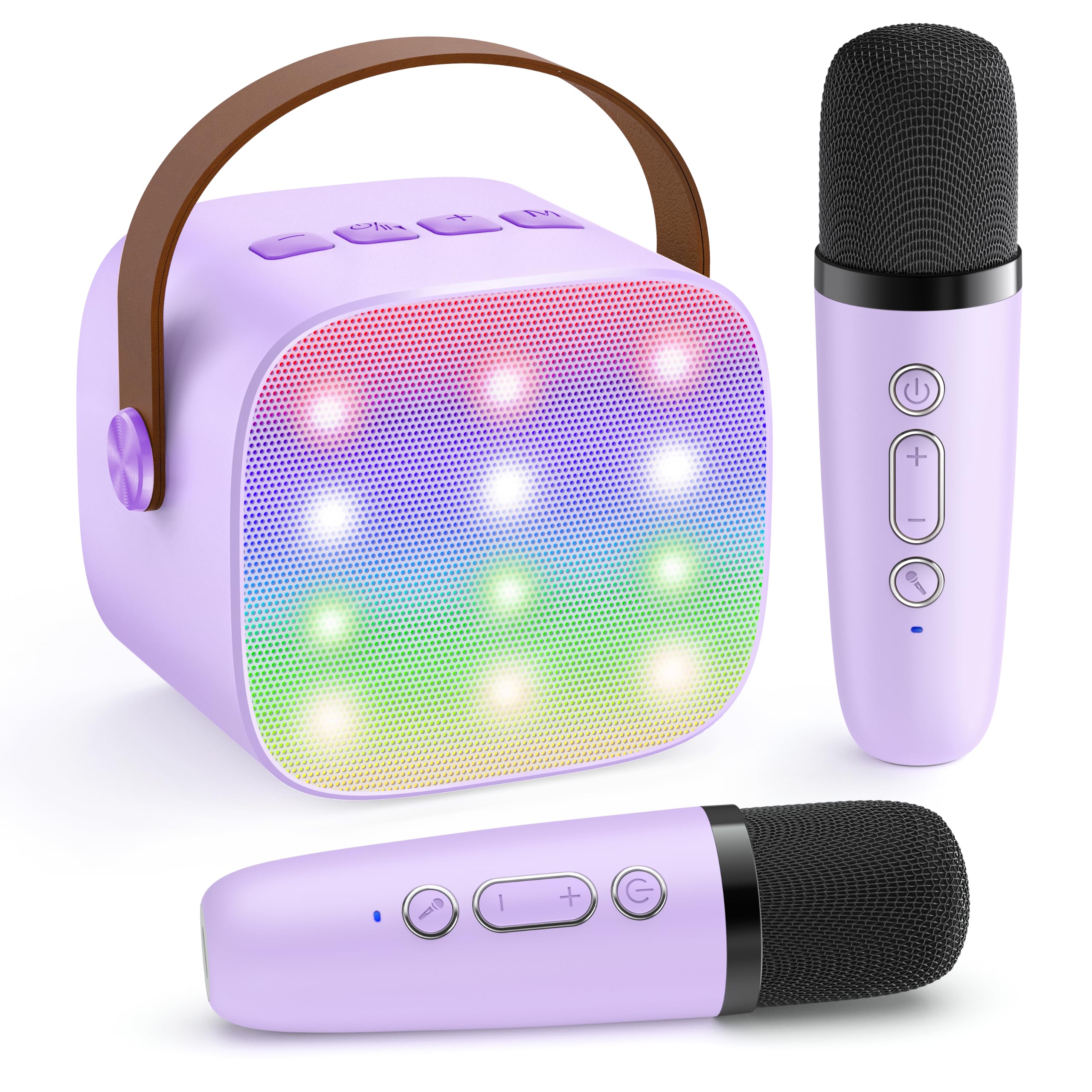
The box this arrives in is aimed squarely at a grandparent: purple, gift-ready, and light enough that a small child can carry it by one corner. Two wireless microphones sit inside, sized for hands that size, and they pair themselves to the speaker as soon as they come out — no menu, no code, no adult required.

We rate it the best kid's machine here, and the details explain why: five volume steps rather than a smooth dial, which small fingers can land on properly; voice-change effects that turn a nursery rhyme into a robot song; and a headphone jack so a determined singer can practice without the rest of the house. At 1.1 pounds it survives being carried from room to room all afternoon.

The sound is a toy's sound — clear enough for a bedroom, thin the moment it is asked to fill a living room of adults, and never going to satisfy anyone who cares about bass. It also gets outgrown: the same child who loves it at five wants the bigger machine at nine. For the shelf space and the money, that is a fair trade.

Pros

  • Two mics sized for small hands
  • Voice effects children keep using
  • Headphone jack for quiet practice
  • 1.1 pounds and gift-boxed

Cons

  • Sound stays bedroom-sized
Our verdict

The safest gift in this group for a young child: two mics their hands fit, effects they love, and a volume every parent can live with.

Check Latest Price
8

Lyrics on a Tablet

CYY K9M

89 /100
LBD Score Excellent

Key details

Mics
Two wireless
Extras
Tablet rest, shoulder strap
Output
15W, 6.5-inch speaker
Weight
4.2 lb
View on Amazon

A shallow shelf is molded into the top of the CYY K9M, wide enough for a tablet and angled so the screen faces the singer. It is a small thing that fixes a real annoyance: lyrics at eye level, hands free, no phone sliding down the front of a speaker mid-chorus. Nothing else here has thought about it.

The rest is a competent 15-watt machine with a 6.5-inch speaker, Bluetooth 5.2, TWS pairing for a second unit, five light modes, a shoulder strap, and a stated three-year warranty. At 4.2 pounds it moves between rooms without a second thought, and the separate music and microphone controls are the same setup we like on the top pick.

The microphones are what to watch. The failure that turns up here is a mic that stops working, or a pair where only one will power on — and since the microphones are the entire point of a karaoke machine, that is what keeps the K9M out of our top tiers. Buy it for the tablet shelf and the price, and test both mics the day it arrives.

Pros

  • Tablet shelf holds lyrics at eye level
  • 15W and a 6.5-inch speaker
  • Three-year warranty
  • Shoulder strap at 4.2 pounds

Cons

  • Mic reliability is the weak spot
  • Tablet sold separately
Our verdict

A smart buy if you want lyrics on a tablet and can live with the microphone risk — the shelf and the price do most of the talking.

Check Latest Price

How We Tested Karaoke Machines

We started by pulling every machine that met two basic requirements: two wireless microphones in the box and a battery that meant it could leave the living room. From there we filtered by price, size, and whether the unit could connect to a TV or pair with a second speaker, landing on 12 machines that spanned mini handheld units and rolling PA-style systems. Each one lived with us for six months, through birthdays, a cookout, and a run of ordinary Friday nights, because a karaoke machine's real job is to be dragged out often, not to perform once. We also tracked what each price step actually bought, and it was rarely raw volume.

Every machine got the same three songs: a ballad, a duet, and one shouty pop chorus. We recorded each performance on a phone and played the clips back to back, which is how we caught machines that sounded fine in the room but thin on playback. We walked each mic to the far end of a yard to find the range limit, pushed the volume until the speaker started to feed back and noted exactly where that happened, and ran batteries from full charge to dead at normal party volume with a stopwatch running.

Ease of use got tested by other people. We handed machines to a 9-year-old and to a grandparent, said nothing beyond "get a song on," and counted how many prompts they needed before music played. We paired two units in stereo where that option existed, plugged others into a TV to see whether lyrics and audio stayed in sync, and checked back at the end of six months to find which mics still held a charge and which knobs had gone loose.

How to Choose a Karaoke Machine

Match the Power to the Room

Wattage is measured loosely on these listings, and peak figures flatter a machine by a wide margin, so treat driver size as the more honest clue. One 6.5-inch woofer pushed by 15 to 20 watts — the VOSOCO and the MOYLEAF — is plenty for a living room, a basement, or a dozen people on a patio. Dual 8-inch woofers and a 600-watt peak, as on the HWWR, are for a yard, a garage, or a crowd that will not stop talking.

The trap is buying for the loudest night you can imagine. A big machine played quietly sounds worse than a small one at its comfortable middle, and it takes up floor space the other fifty-one weeks of the year.

The Microphone Is Half the Machine

Two microphones matter more than any light show, because karaoke turns into a duet whether or not anyone planned one. Beyond the count, look at how the mics are powered. Magnetic docks that recharge in the body, as on the Ikarao, mean they are never flat; AA cells, as on the PPMIC and the MOYLEAF, mean a four-cell commitment before every party and no way to top up mid-song.

Also check that the microphone volume and the music volume move independently. Without that, a loud singer and a quiet backing track are stuck together, and the machine stops being useful for anything but shouting.

Battery, Weight, and the Walk Outside

Runtime claims across this group run from 4 hours to a day, and the top of any range assumes a gentle volume. What matters more is the charging habit: a machine that lives in a closet needs to be plugged in the night before, and charging faults are the problem that shows up most often after a few months of ownership.

Weight and handles decide whether the thing actually leaves the house. Six pounds with a shoulder strap is a one-hand carry; a 24-inch cabinet needs its wheels and a place to park. If the party is in the yard, picture the walk from the closet before you fall for the sound.

Where the Lyrics Come From

Most machines here are speakers with inputs; the words come off your phone, a tablet, or a television. There are three routes: prop a phone wherever it balances, choose a machine with a tablet rest (the CYY), or pay for a built-in screen (the Ikarao, which also sends lyrics to a TV over HDMI).

The trap is assuming the screen includes the songs. It does not — the library behind it runs on a subscription, so the real cost of a screen machine is the hardware plus a monthly fee. Singing along to free videos from a phone costs nothing and buys you nothing but a propped-up screen.

Frequently Asked Questions

Final Verdict

The VOSOCO T-03 is the machine we point most people to, because it covers the ordinary case — a living room, two singers, a phone full of songs — with a driver big enough to sound like a real speaker and controls that let a vocal sit on top of the music instead of inside it.

Change the requirement and the answer changes. For a yard and a crowd, the HWWR T8; for adults who want to sound better than they are, the PPMIC MS75; for a screen and no setup at all, the Ikarao Shell S1, subscription and all.