Best Keyboards for Kids of 2026

Most kids' keyboards get played hard for a week, then live under the bed. Usually it's the board's fault: one volume, one sound, and keys that ignore how hard you press them can't survive the novelty wearing off. The ones that stay out in the open have keys that answer to a light touch and a heavy one, a speaker that's bearable from three feet away, and a size that fits the player.

Key size matters more than key count — a 37-key board with shrunken keys suits a four-year-old, but a seven-year-old learning real fingerings outgrows it in a season. We also watched the extras closely: whether light-up keys and lesson apps teach a song or just blink, whether the included headphones are usable, whether a stand wobbles. Twelve keyboards have lived in our homes for the past three months, everything from palm-sized wooden toys to 88-key starter pianos.

The picks below run from a first birthday to a first recital. What they share is that a kid can make real music on one on day one.

1

Best Overall

Alesis Recital Play 88

92 /100
LBD Score Outstanding

Key details

Keys
88 full-size, touch-sensitive
Width
49.9 in
Sounds
480 voices, 160 rhythms
In The Box
Stand, sustain pedal, headphones, carrying case, music stand, power supply
View on Amazon

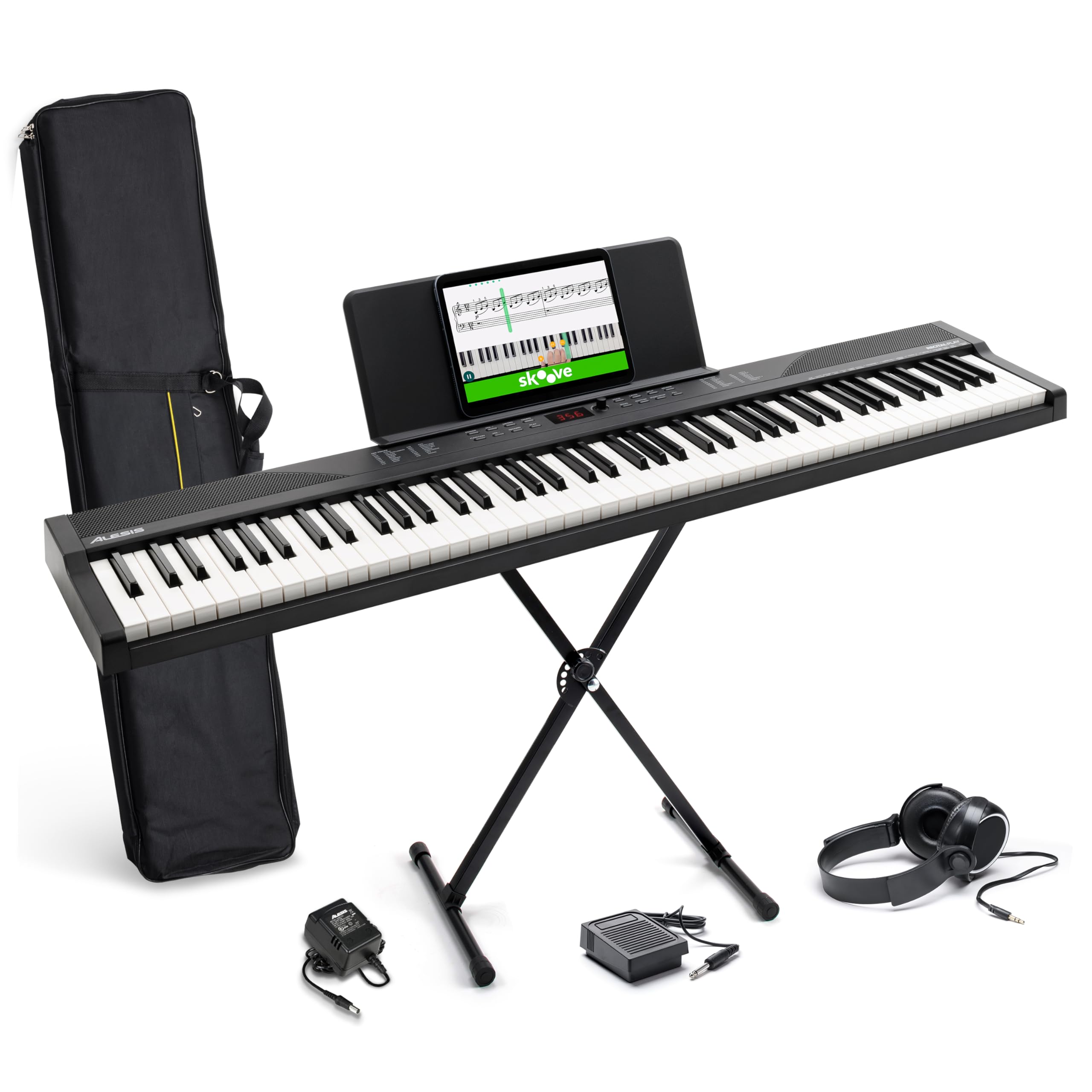
Eighty-eight keys is the number that decides this one: it's the only 88-key instrument here, and the only one that arrives with a sustain pedal. What the keys do matters more than how many there are — they respond to how hard you press, so a child can produce the loud and soft a teacher asks for in the first month instead of a month of identical notes. Full range, real touch, a pedal in the box: that combination is why this is the first keyboard we recommend for a child who is starting lessons.

The bundle removes the second shopping trip. Stand, pedal, headphones, carrying case, sheet music stand, and power supply all come with it, and premium lesson access from Skoove and Melodics is included for the app side of practice. The pedal is the piece most kits skip, and it's the one that changes how a beginner sounds, because sustain covers a lot of early unevenness.

Size is the trade. At just under 50 inches wide it wants a wall of its own, not a corner of a shared desk, and it won't move between rooms without a plan. At 5.5 kg it's light for an 88-key instrument — light enough for one adult to carry it out to the car in its bag — but it still lives in one place. What you get for the footprint is a piano voice that behaves like the instrument a child will eventually play at lessons, through speakers built for a bedroom.

The caveat worth knowing: keys can stop working and some units go silent after a few months, and the warranty runs a single year where the RockJam kits get two. Buy from a retailer with a straightforward return window, register it, and treat the first month as the audition.

Pros

  • 88 touch-sensitive full-size keys
  • Stand, pedal, headphones, and case included
  • Sustain pedal most bundles leave out
  • Lesson software and USB-MIDI for later

Cons

  • About 50 inches wide, so it needs its own wall
  • One-year warranty
Our verdict

The keyboard we tell parents to buy when a child is starting lessons: 88 touch-sensitive keys, a stand, pedal, and headphones in one box, with room to grow for years.

Check Latest Price
2

Best All-In-One Starter Kit

RockJam RJ561 Kit

91 /100
LBD Score Outstanding

Key details

Keys
61 full-size
Sounds
50 tones, 100 rhythms
Weight
19.8 lb
In The Box
Stand, bench, headphones, note stickers, music stand
View on Amazon

Keyboard, stand, bench, headphones, note stickers, music stand: the RockJam kit arrives as a complete first setup, and it costs less than the Alesis. For a family buying a first instrument, that's one delivery and no second trip for a bench that fits. The bench earns its place — a child sitting at the right height with both feet down plays with a straighter back and better reach than one perched on a dining chair.

Sixty-one full-size keys cover the range most beginner books use, and the 50 tones and 100 rhythms are there for the weeks when scales feel like homework: put a drum rhythm under a simple tune and a seven-year-old stays at the keyboard longer than a metronome keeps them. The stickers are the quiet hero, because a labeled key means a child can find C without asking. Headphones matter just as much in a shared living room, where practice only survives if everyone else can still hear the television.

Two things to know. The stand is the flimsiest piece in the box — it flexes, and it's the first thing to give if a child leans on it — so if the keyboard is going to live in one spot, a desk or a low table is the sturdier answer. And the electronics aren't the most robust in this group: dead keys and failed speakers turn up on this model. The two-year manufacturer warranty is the longest stated here, which is exactly why it's worth registering on day one.

Pros

  • Bench, stand, and headphones in the box
  • Two-year manufacturer warranty
  • Strong beginner and enjoyment signals
  • Note stickers and lesson access included

Cons

  • 19.8 lb and 36 inches wide, so it stays put
Our verdict

The kit we recommend when a younger beginner needs everything at once — bench, headphones, stickers, and the longest warranty here — and the keyboard can stay in the living room.

Check Latest Price
3

Best for Small Hands

Yamaha PSS-F30

93 /100
LBD Score Outstanding

Key details

Keys
37 mini keys
Size
19.9 x 7.9 x 2.1 in
Sounds
120 voices, 114 styles, 30 songs
Weight
3.5 lb
View on Amazon

Not every six-year-old needs 61 keys. The PSS-F30 is built for the child who is smaller than the instrument: 37 mini keys across a body that weighs 3.5 lb, laid out so a small hand can span a chord. Yamaha designs this one for children rather than shrinking an adult keyboard, and the thinking shows the first time a kid reaches an interval without stretching.

There's more inside than the size suggests: 120 instrument sounds, 114 accompaniment styles, 30 built-in songs, and a smart chord function aimed at beginners. That library is why it stays interesting after the demo songs wear thin — a child can put a string sound over a simple melody or play along with a backing style and feel like a band is behind them.

Where it stops is the same place it starts. There's no stand, no bench, and no full-size key on it, so it's a first instrument and a travel instrument rather than the keyboard a child takes to lessons for the next five years. As the thing that gets a five- or six-year-old playing real melodies in the first week, it's hard to beat here, and it's the easiest of these to carry to a grandparent's house, which is where a lot of small kids end up playing most.

Pros

  • 37 mini keys sized for small hands
  • 3.5 lb, so it goes anywhere
  • 30 songs, 120 voices, 114 styles

Cons

  • No stand or bench in the box
  • Mini keys won't carry a child past the first year or two
Our verdict

A genuinely child-sized keyboard from a piano maker: mini keys, 3.5 pounds, and 30 songs, best as a first instrument for a five- or six-year-old.

Check Latest Price
4

Best Light-Up Learning Keyboard

The ONE COLOR 61

90 /100
LBD Score Outstanding

Key details

Keys
61 full-size, LED-lit
Power
Power supply or 4 AA batteries
Sounds
256 timbres, 64-note polyphony
Connections
Bluetooth, USB-MIDI, headphone jack
View on Amazon

Press play on a built-in song and the keys light up in sequence, red LEDs stepping through the melody, and a child who has never read a note can follow along with two fingers. That's the idea, and it works. The app behind it carries more than 4,000 pieces of sheet music, 100 instructional videos, and a handful of games, and the keyboard talks to it over Bluetooth.

Underneath the trick is a proper 61-key instrument: full-size keys, 256 timbres, 64-note polyphony, and two 3-watt speakers, with a piano voice sampled from a grand. At 7.7 lb it moves between rooms without effort, and it runs on the included power supply or four AA batteries, which is how it ends up on a picnic table in July. The purple and green finishes are a real part of the appeal for a child with opinions about their room.

The catch is that the app is the product, and the app is uneven. Some songs and games sit behind a paywall, a few of the advertised extras are thinner than the marketing suggests, and the sheet-music library is far bigger than the teaching structure wrapped around it. A kid who only ever follows the lights learns songs, not reading — the lights show which key, never how hard or how long. Use it as the reward at the end of practice rather than the lesson itself.

It's also not the space-saving choice, since 61 keys here means the same footprint as the RockJam and Best Choice kits. What you're paying for is engagement, and for the right child this is the most engaging instrument in the group — the one that gets picked up without being asked. For a child who ignores the app and just wants to bang out chords, the lights are the wrong purchase.

Pros

  • LED keys plus a 4,000-song app
  • 61 full-size keys and 256 timbres
  • Battery or cord, at 7.7 lb

Cons

  • Songs and games are partly behind a paywall
  • Lights teach songs, not how to read music
Our verdict

For the kid who learns by watching, LED keys and a song app turn practice into a game — as long as you don't expect the app to teach notation.

Check Latest Price
5

Light-Up Practice

Best Choice 61-Key Set

93 /100
LBD Score Outstanding

Key details

Keys
61 full-size, light-up
Sounds
255 timbres, 255 rhythms, 50 demo songs
Dimensions
36.4 x 12 x 3.7 in
In The Box
H-style stand, music stand, padded stool, headphones, adapter
View on Amazon

If The ONE is the light-up keyboard for a screen kid, this is the light-up keyboard for a house that would rather not add another app. The same trick happens on the instrument: keys illuminate as a demo song plays, and three teaching modes meet a beginner at different stages, from pressing anything at all to following the correct note as it comes. No phone, no pairing, no account.

The bundle is generous: H-style stand, music stand, padded stool, headphones, and the power adapter, alongside 255 timbres, 255 rhythms, and 50 demo songs. The note stickers do the lights' job in slow motion, which is the version that sticks — a child who peels a C sticker onto the right key learns it faster than one who only watches it flash. A USB port lets a kid play along with a track on a stick, and the recorder catches the result.

Sound is where it comes back to earth. The speakers are fine at living-room volume and thin when a child pushes them, and the piano tone is a step behind the Alesis. The headphones in the box fix most of that, which is a good reason to keep them next to the keyboard rather than in a drawer.

What we appreciate most is the lack of fuss. Everything needed to sit down and play is in the box, the teaching modes run on the instrument, and a grandparent can assemble it without a tutorial. That makes it the easiest of the full-size options to hand over to a child who is curious but not yet committed — and the one to choose when nobody in the house wants to manage an app on top of everything else.

Pros

  • Light-up keys with three teaching modes
  • Stand, stool, headphones, and adapter included
  • Stickers and USB play-along

Cons

  • Some units stop working within months
  • 60-day warranty
Our verdict

Light-up teaching modes and a full stand-and-stool bundle without an app in sight; buy it where returns are easy and treat it as a first keyboard, not a forever one.

Check Latest Price
6

Travel and Storage

PicassoTiles Roll Up 49

89 /100
LBD Score Excellent

Key details

Keys
49 silicone keys
Size
28.35 x 7.09 x 0.87 in
Power
USB or battery
Sounds
8 tones, 6 demo songs
View on Amazon

Roll-ups are their own category, and it's worth being clear about what you're buying: 49 silicone keys that unroll on a table, 8 tones, 6 demo songs, a built-in speaker, and a body that folds down and weighs under two pounds. It is not a practice instrument. It's the keyboard that goes in a bag.

Where it earns its place is where nothing else fits — a car trip, a week at Grandma's, a kid picking out a tune on the kitchen table. The rainbow layout genuinely helps: color-coded keys make the octaves obvious to a child who is still working out where C is, and the record button earns its keep, because hearing your own tune played back is often the thing that hooks a beginner.

The sound is toy-grade — thin, and prone to buzzing near the top of the volume range — and the silicone keys don't respond to how hard you press, so nothing about technique carries over to a real piano. These also don't last forever: units that stopped working and keys that quit are part of the picture with this kind of keyboard. Buy it for the travel case rather than as the only keyboard in the house, and it's a lot of play for very little money.

Pros

  • Rolls up and weighs under two pounds
  • Color-coded rainbow keys
  • USB or battery power

Cons

  • Thin sound that buzzes at high volume
  • Silicone keys give no touch response
Our verdict

The one to buy for the car, the hotel, or Grandma's kitchen table — foldable, rainbow-coded, and toy-grade in both sound and working life.

Check Latest Price
7

Toddlers Under Three

Baby Einstein Magic Touch Piano

95 /100
LBD Score Outstanding

Key details

Keys
25 touch keys
Modes
2 play modes, 3 song sheets
Power
3 AA batteries
Age Range
6-36 months
View on Amazon

This isn't a keyboard in the sense the rest of this list means. It's a wooden slab with 25 keys, sold for babies from 6 to 36 months, and it makes music when small hands touch rather than press. For a one-year-old that's the right design: nothing has to be pushed hard, nothing sits on a stand to be knocked over, and there's no way to play it wrong.

We like the two modes more than we expected to. In free play, every touch makes a note, so a baby learns cause and effect in seconds. The three color-coded song sheets turn it into a matching game, where a toddler hunts for the colored key that goes with the next note. The low-high volume switch is the detail a parent appreciates most, and the wood wipes clean with a damp cloth after a snack-related incident.

Where it ends is 36 months. Nothing here teaches finger position, dynamics, or reading music, and a four-year-old will have moved on — which is when a 37-key or 61-key instrument takes over. As the first instrument in a house, the one that makes a piano a familiar object rather than a special treat, it does the job better than anything else here.

Pros

  • Wooden, with no buttons to press
  • Two play modes and color-coded song sheets
  • Low and high volume settings

Cons

  • Outgrown around age three
  • Batteries only, no power adapter
Our verdict

For the under-three crowd, a wooden touch piano that turns cause and effect into music and hands over happily to a real keyboard at four.

Check Latest Price
8

Preschool Play

Love&Mini 37-Key Piano

89 /100
LBD Score Excellent

Key details

Keys
37 keys
Power
4 AA batteries
Sounds
22 demo songs, 4 rhythms, 4 tones
In The Box
Stool, microphone, music stand
View on Amazon

The photo makes it look like a small upright piano. It isn't. The whole thing measures 8.9 by 16 by 23 inches, which puts it closer to a tabletop toy on legs than the little upright the listing suggests. If you're picturing a three-year-old at it in the corner of a living room, that works. If you're picturing a six-year-old at a proper bench, the picture is wrong.

The microphone is the reason to buy it. A four-year-old with a mic and 22 demo songs will perform for an hour, and the stool and music stand mean the show has a stage. There are 37 keys, 4 instrument tones, and 4 rhythms — enough for nursery rhymes and not much beyond — plus an MP3 port, so you can run a backing track through the speakers and let them sing over it.

The mic is also the reason to be careful: it's the part that fails first, and a microphone that quits within days is a familiar story on this model. The plastic is light enough that a determined toddler can tip the whole thing, and the pink is very pink, which is either the entire point or an immediate no.

Set against the wooden touch piano, this suits the older preschooler: three and up, already pretending to sing, ready for something that looks like the real thing. Set against a 61-key keyboard, it's a toy with a short career. For a birthday that gets a scream of delight and a year of performances, it earns its place; for a child who might start lessons, put the money toward the RockJam kit instead.

Pros

  • Microphone, stool, and music stand included
  • 37 keys with 22 demo songs
  • MP3 port for backing tracks

Cons

  • Smaller than it looks in the listing
  • Microphone is the first thing to fail
Our verdict

A preschool toy piano with a working mic and a stool — genuinely delightful for a three- or four-year-old, and honestly a toy rather than an instrument.

Check Latest Price

How We Tested Kids' Keyboards

We started with roughly two dozen keyboards sold for children and cut the field down by hand. Out went anything that lit up without responding to how hard a key was pressed, anything whose lesson material was thinner than the box it shipped in, and anything priced well above what its keys and speakers justified. We also tallied what actually came in each box — stand, bench, headphones, pedal — since a kit that includes them is worth more than a cheaper board you have to outfit yourself. Twelve made it through.

Those 12 spent three months in our homes: playrooms, a living room corner, a kitchen table, and the back seat of a car for the roll-up. Kids from six months to ten played them, joined by a couple of adults who can hear when a note is off. We wiped every surface after snack-heavy sessions, and we deliberately let a five-year-old carry one across a room by its handle to see what survived.

How to Choose a Keyboard for a Kid

Toy, First Instrument, or Practice Piano

A toy keyboard is built to make sound: short range, fixed volume, speakers that distort the moment a child gets excited. A first instrument adds full-size keys, a headphone jack, and enough songs and sounds to hold attention past the first week. A practice piano adds the two things a teacher asks about — touch-sensitive keys and a sustain pedal — plus a stand that puts the keyboard at playing height.

Decide by asking what happens in eighteen months. If the keyboard will live in a playroom as background noise, a wooden touch toy or a roll-up is plenty and nothing is wasted. If lessons are even a possibility, buy at the first-instrument level or above. The RockJam kit and the Alesis both sit there, and the gap between them is 27 keys and a pedal.

Key Count and Key Size

Mini keys are a real design choice for small hands, not a corner cut: 37 of them fit a five-year-old better than 61 full-size keys ever will. Sixty-one full-size keys cover the range most beginner method books use for the first several years. Eighty-eight only starts to matter when a child reaches advanced repertoire, and it costs about 50 inches of wall.

The trap is buying 88 keys because it sounds more serious. An 88-key instrument needs a permanent home and a bench; a 61-key model fits a bedroom and does everything a beginner needs. Our rule: mini keys under six, 61 full-size from six or seven, 88 only once a child practices without being reminded.

Touch Sensitivity and Light-Up Keys

These get confused, and they do different jobs. Touch sensitivity means the keys respond to how hard you press, which is how a child learns the difference between loud and soft — usually the first thing a teacher works on. Light-up keys mean the keyboard shows which key comes next, which is how a child plays a recognizable song in the first week.

Both are worth having, and neither replaces the other. Lights are a motivator and a party trick; they teach sequence, not control. If you can only have one, take touch sensitivity and add a sheet of note stickers, because stickers teach the same note-finding skill without a screen and don't stop working when an app does.

The Stand, the Bench, and Playing Height

A keyboard on a dining table is a keyboard played standing up, badly. Playing height is what makes an hour of practice comfortable instead of tiring: keys at roughly the height of a dining table, a bench the child can sit on with both feet supported, and room for the forearms to stay level.

A bundle with a stand and bench solves that in one purchase. If you buy keyboard-only, budget for both, and check the stand before you check the keyboard — bundled stands are the flimsiest components in every kit here, and a wobbly one is usually why a keyboard ends up in a closet.

Build, Warranty, and What Fails

Cheap keyboards fail in boring, predictable ways: one key stops sounding, a speaker buzzes, a stand joint cracks, a microphone dies. That isn't a reason to spend three times as much on a first instrument, but it is a reason to read the warranty. The RockJam kits carry two years, the Alesis and The ONE carry one, and the Best Choice set lists 60 days.

Buy where returns are simple, play every key on the day it arrives, plug headphones into the jack to check it, and keep the box for a month. On a keyboard at this level, a good return policy does more for you than any warranty card.

Frequently Asked Questions

Final Verdict

The Alesis Recital Play is the keyboard we point parents to, because touch-sensitive full-size keys and a sustain pedal are the two things a child can't outgrow in a year, and the stand, headphones, and lessons mean practice can start the day the box arrives. Its width is the one thing to measure before ordering.

If the room is small or the budget tighter, the RockJam RJ561 kit covers most of the same ground — a bench, a shorter keyboard, and two years of warranty cover — and for a child under six, the Yamaha PSS-F30 is the better first instrument anyway.