Best Overall
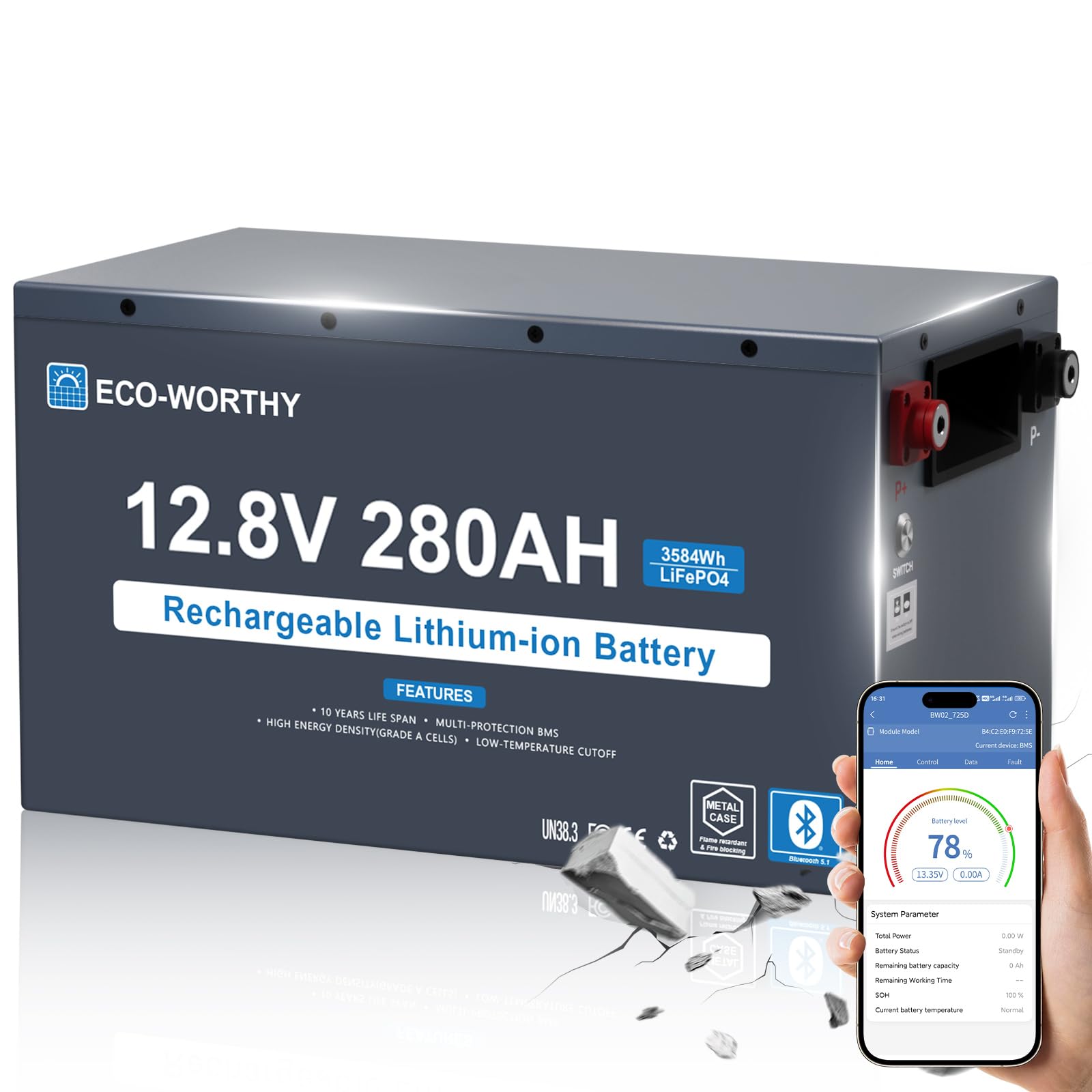
ECO-WORTHY EnergyRock 280Ah
Key details
- Weight
- 68.6 lb
- Capacity
- 280Ah (3,584Wh)
- Warranty
- 3 years
- Continuous Output
- 200A
The switch is the detail we keep coming back to. One touch on top of the case disconnects the output, so wiring a shunt or changing a fuse does not start with a live positive cable in your hand. The case around it is steel rather than plastic, with mounting feet and internal cell holders, and it is built to be bolted down and left in a trailer that shakes.
Capacity is what earns it the top spot. At 280Ah and 12.8V this is 3,584Wh in a single box, almost three times what a 100Ah battery gives you, with one set of terminals, one fuse and one cable run instead of three. For a camper, a cabin or a shed running an inverter, that is the quieter and safer way to build a bank, and it is why we spec one of these rather than a stack of small units.
The 200A BMS gives all that capacity somewhere to go: at 12.8V it works out to roughly 2,500W of continuous draw, so a 2,000W inverter has headroom rather than a hard ceiling. Bluetooth puts voltage, current, state of charge and charge status on your phone, and the low-temperature cutoff stops a charge from beginning while the cells are still below freezing.
Check one measurement before ordering: 16.6 inches of width is wider than the Group 24 and Group 27 trays most campers are built around, so this wants a purpose-made spot rather than a straight swap. Everything else about the install is easier than the dimensions suggest, from the M8 bolt terminals to mounting feet that take a real bolt.
Pros
- 3,584Wh in a single 12V battery
- Steel case with mounting feet resists vibration
- One-touch output disconnect
- 200A BMS leaves headroom for a 2,000W inverter
Cons
- 68.6 lb needs a second person
If you're building one 12V bank for a camper, cabin or shed, this is the battery we recommend: 280Ah, a steel case, and a cutoff switch that makes every later wiring job safer.