Best Microscopes for Kids of 2026

The biggest number on a kids' microscope box is the least useful thing on it. A 1000X sticker says nothing about what your kid will actually see — most of that figure is digital zoom, and at that magnification a six-year-old's handshake turns a leaf into a smear. What matters is a focus knob gentle enough for small fingers, light that lands where the specimen is, and a body that survives a backpack.

I've watched a kid abandon a handsome microscope in ten minutes because the onion skin wouldn't focus, then spend an hour with a pocket scope trained on a dead fly. Over six months, my team and I used 12 of these the way families actually do — kitchen tables, backyards, car rides — and the ones that got picked up again were the ones that produced a clear image fast.

Age splits this category more than price does. Preschoolers want something that shows a picture the moment they press it down; kids eight and up want real slides, blanks to prepare themselves, and a light they can aim. Both kinds are below.

1

Best Overall

BMDSAE Handheld Digital Microscope

89 /100
LBD Score Excellent

Key details

Screen
2.0-inch IPS
Battery
600mAh rechargeable, USB-C
Illumination
8 LEDs, 3 brightness levels
Magnification
1000x optical plus digital
View on Amazon

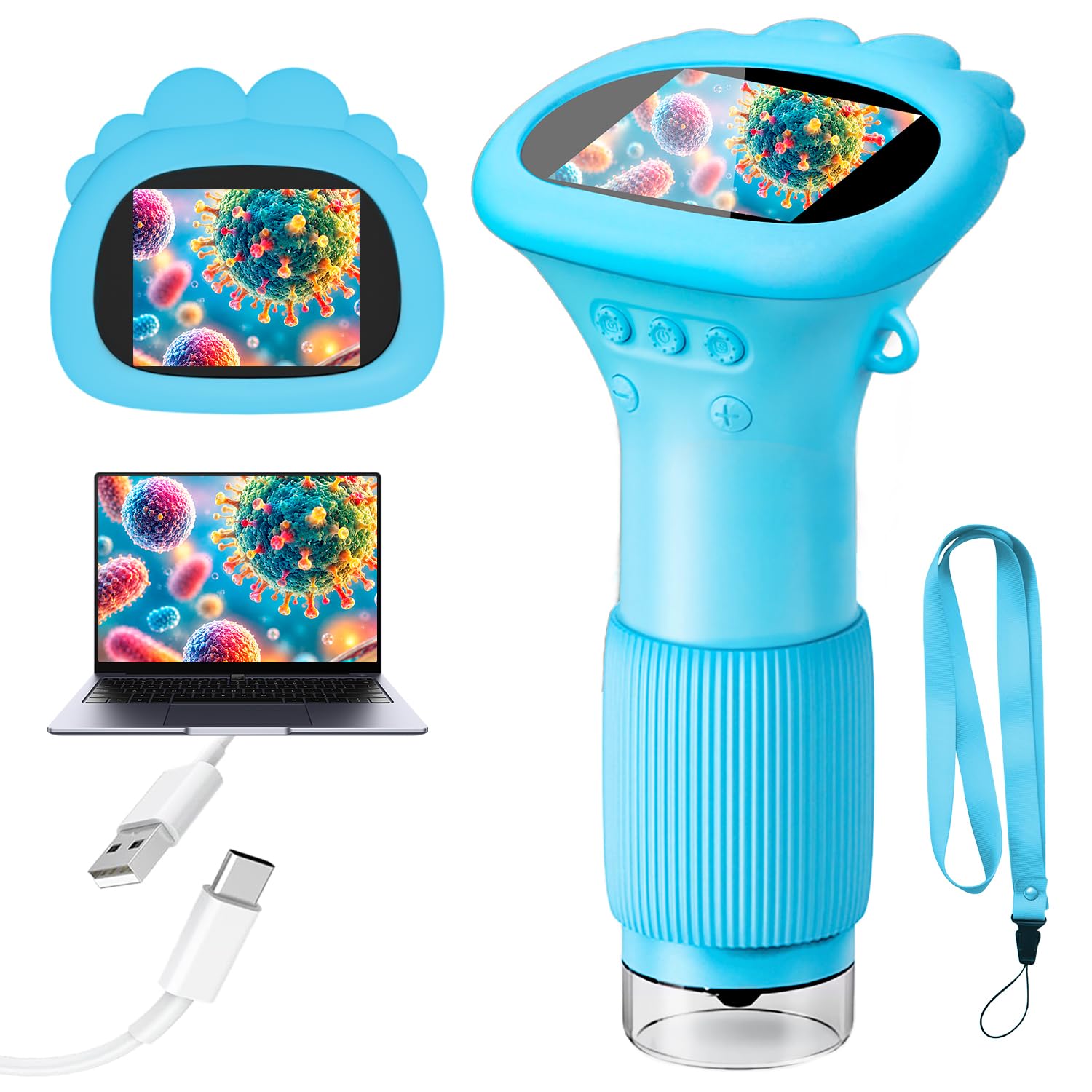
Put a screen where the eyepiece goes and a seven-year-old stops needing you. That is the whole case for this scope: a 2-inch IPS display shows what the lens sees, so a child holds it over a leaf, turns the focus wheel and gets a sharp picture without closing one eye and pressing a face against a tube. Of everything in this guide, it is the design that most reliably turns a kid loose on their own.

The rest of the hardware is built for that handling. Eight LEDs ring the lens and step through three brightness levels, so a shiny coin and a dark beetle both come up usable, and the diffuser keeps the middle of the frame from blowing out. The 2MP camera saves stills and AVI video to 32M of onboard storage, which is roughly 200 photos before anyone has to delete a kid's best find, and the 600mAh battery charges over USB-C instead of eating AAAs.

Two things to know first. The 1000x on the box is optical magnification multiplied by digital zoom, and the top of that range is soft and hard to hold steady; the useful view lives in the middle, where insect legs and leaf veins come up crisp. And the box holds the scope, a lanyard and a USB-C cable, with no slides and no case, which is the trade against the BEBANG kit below.

Pros

  • Screen replaces the eyepiece for solo use
  • Eight LEDs with three brightness levels
  • Saves photos and video to 32M of storage
  • Rechargeable 600mAh battery over USB-C

Cons

  • 1000x claim oversells the sharp end of the range
  • No slides or case in the box
Our verdict

This is the one we tell most families to buy: a child can find, focus and photograph a specimen without an adult leaning in, and that independence is what keeps a microscope in use.

Check Latest Price
2

Best Complete Kit

BEBANG Kids Digital Microscope Kit

90 /100
LBD Score Outstanding

Key details

Battery
Rechargeable, 3.7 volts
Storage
32GB card included
Slide Slot
3mm, widened from 2mm
Magnification
200x to 1000x, five levels
View on Amazon

A fitted hard case, five glass slides in their own little box, a charging cable, a neck strap and a 32GB memory card: this one arrives looking like a present rather than a component. The case has a moulded slot for each piece, which matters more than it sounds, because the accessories that vanish are the ones with nowhere to live.

What we appreciated most is the slide slot. It has been widened to 3mm so real glass slides pass through smoothly, which means a kid starts on the prepared specimens and can then swap in a flower petal without changing instruments. Five magnification levels run from 200x to 1000x, and the card holds thousands of pictures, so nobody has to choose which of a child's discoveries to delete.

The caveats are real all the same. The top of the zoom range is grainy and the 1000x figure is marketing arithmetic, so judge it on how a bug's wing looks at the middle settings. And a scope that will not power on is a return, not a repair: switch it on and charge it the day the box arrives, while the return window is open.

Pros

  • Five real glass prepared slides included
  • Hard EVA case holds the whole kit
  • 32GB card for photos and video

Cons

  • Top of the zoom range is grainy
  • Some units arrive unable to charge
Our verdict

We think this is the gift-ready pick: real glass slides, a hard case and a memory card let a kid study a specimen and keep a record of what they found.

Check Latest Price
3

Best Traditional Microscope

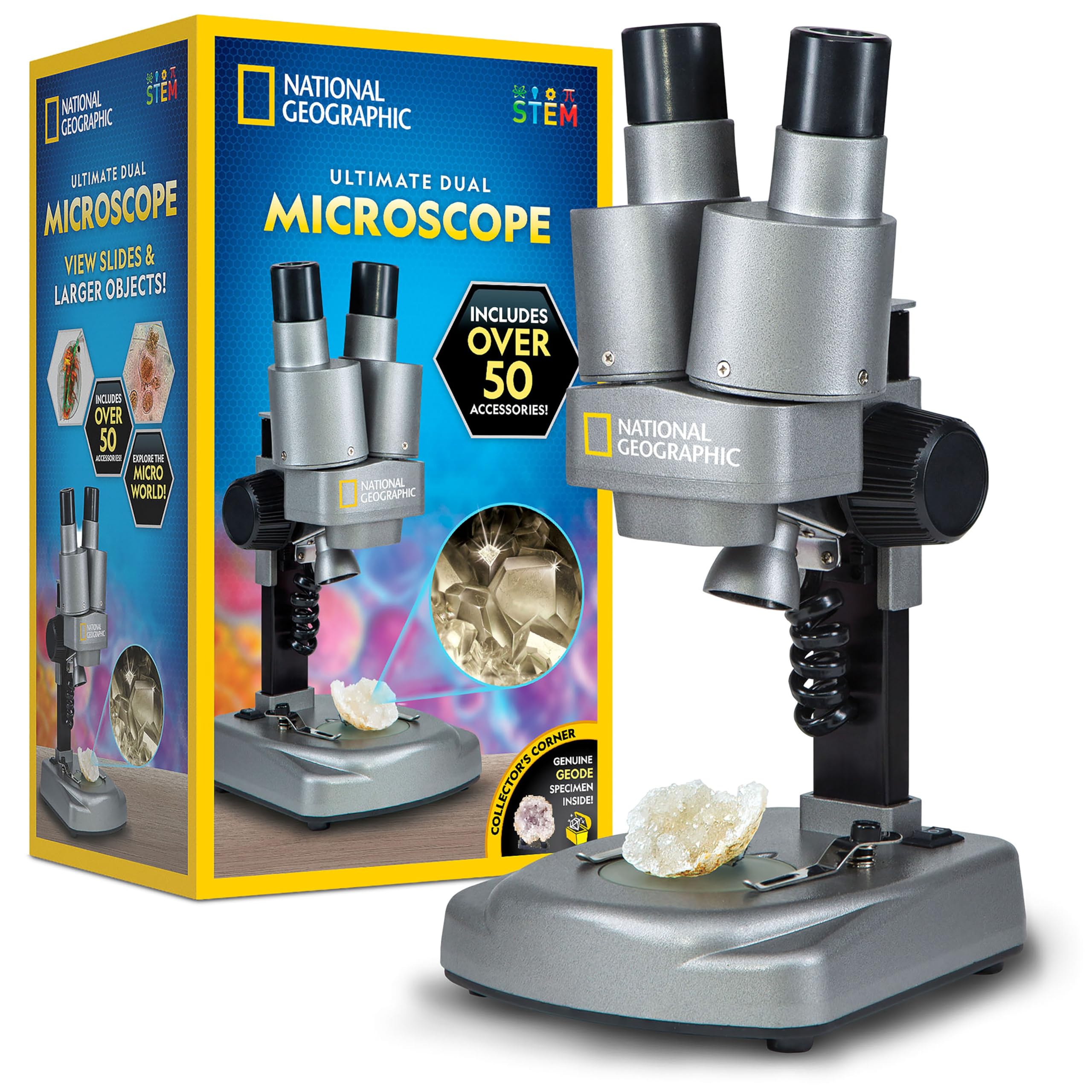
National Geographic Dual LED Microscope Kit

92 /100
LBD Score Outstanding

Key details

Kit
50+ pieces, padded case
Slides
10 prepared, 10 blank
Illumination
Upper and lower LED
Magnification
20x and 50x lenses
View on Amazon

At the top of the price range sits a microscope with a second light where most kits have a plain stage. The lower LED shines up through a slide; the upper one shines down onto whatever is set underneath, which is how a kid gets a three-dimensional look at a coin, a leaf or a beetle's wing instead of a flat smear. We think that top light is the most useful thing money buys in this category.

The kit around it is generous: 10 prepared slides and 10 blanks with covers, tweezers, an eye dropper, a geode specimen and a full-color learning guide, all in a padded storage case. The two lens settings are 20x and 50x, which sounds modest next to the digital scopes and is the right call for a first eyepiece microscope. Low power gives a wide, bright view that comes into focus easily, so a kid gets a win in the first minute rather than a lesson in patience.

That combination of true optics and reflected light is what earns the premium, and it is also the limit: 50x will not show a cell, and a child who is already hooked will want more power within a year. For a family buying their first proper microscope, though, this is the one we point to when the budget allows, because it looks and feels like an instrument and the top light keeps it in use on days when nobody wants to make a slide.

Pros

  • Upper LED for coins, bugs and solid objects
  • 10 prepared and 10 blank slides
  • 20x is easy for a beginner to focus
  • Padded case and full-color learning guide

Cons

  • Tops out at 50x for the highest price here
  • Focus can drift out of adjustment
Our verdict

If you want a real eyepiece microscope rather than a screen, we point you here - the top light makes it useful on backyard finds, not just prepared slides.

Check Latest Price
4

Best Step-Up Optical

National Geographic 400x Microscope Kit

90 /100
LBD Score Outstanding

Key details

Stage
Adjustable platform, large focus knobs
Specimens
6 plant slides, 6 rocks and minerals
Illumination
LED above and below
Magnification
Up to 400x, three levels
View on Amazon

Four hundred times is the highest optical power in this guide, and it is also the setting that will have a kid calling for help. At the top end the slice of specimen in focus gets razor thin: the sample has to be flat, thin and well lit, and the knob has to move in increments a six-year-old does not have the patience for. The large focus knobs and adjustable stage help more than they do on most kits, but they do not remove the skill.

Below that, this is a well thought-out kit. Three magnification levels let a child start wide and step up, the LED works above and below the stage, and the soft-touch eyepiece is comfortable against a small face. The specimens are the interesting part: six prepared plant slides plus six rocks and minerals, which is unusual, since most kits stop at stems and root tips. There are six blanks, a pipette, a specimen dish and tweezers for making your own.

For a nine- or ten-year-old who has already worn out a pocket scope, we think this is the right next step, and the lab guide gives them something to do beyond staring at a slide. For a younger child it becomes a test of patience: the payoff only arrives after a minute of careful knob work, and not every kid stays with it that long.

Pros

  • Real 400x optical magnification
  • Six rock and mineral specimens included
  • Large knobs and an adjustable stage

Cons

  • Fiddly to focus at 400x
  • Build quality is inconsistent
Our verdict

We recommend it for an older kid who already knows how to chase focus; the 400x view is worth the patience, and a younger child is likely to give up before it sharpens.

Check Latest Price
5

Best Budget Pocket Scope

Carson MicroBrite Plus Pocket Microscope

86 /100
LBD Score Excellent

Key details

Weight
2.08 oz
Lighting
Built-in LED
Warranty
Limited lifetime
Magnification
60x to 120x optical
View on Amazon

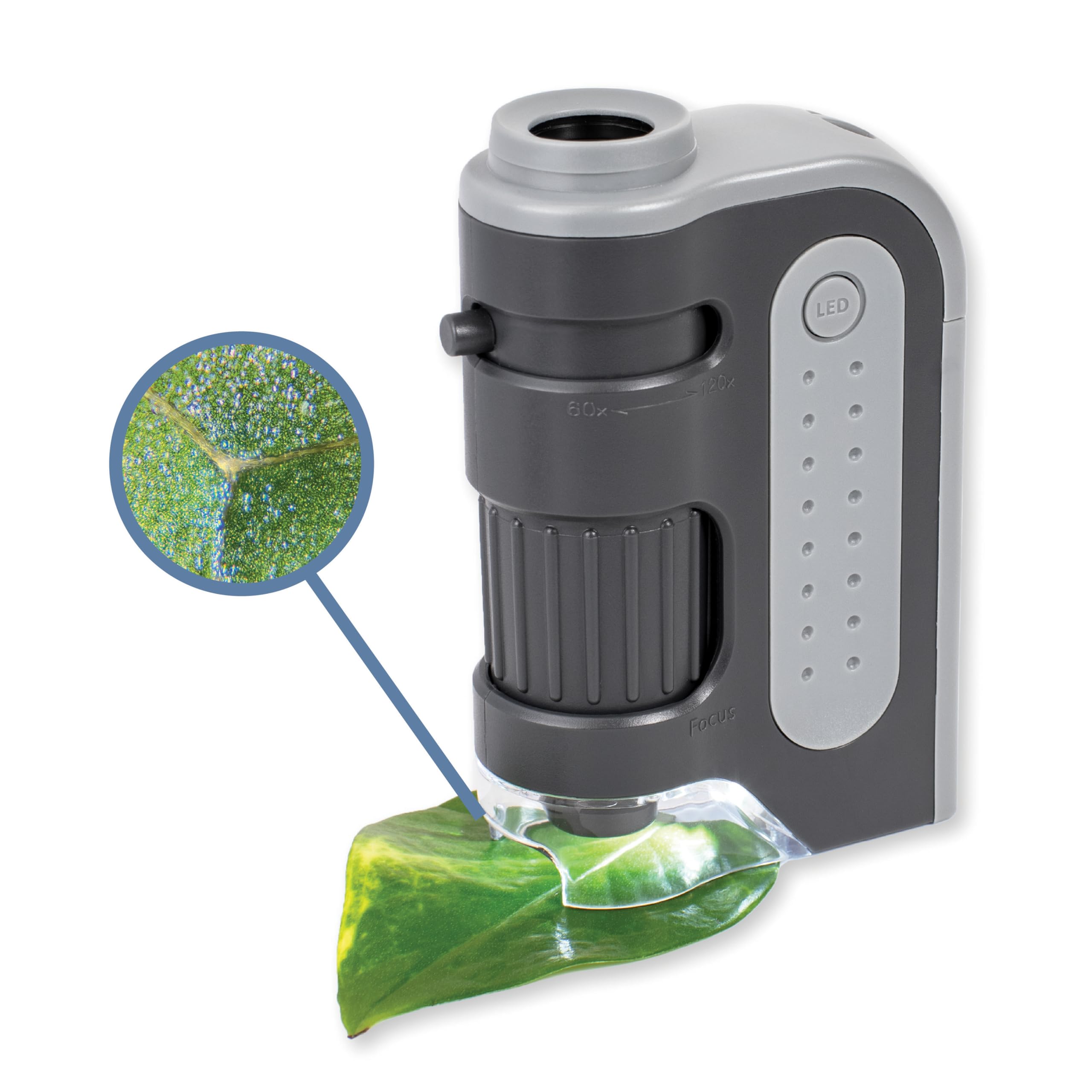
Sixty to 120x sounds like nothing beside the four-digit numbers on the digital scopes here, and it is the most honest magnification in this guide: pure optical power with no multiplier pretending to be zoom. What a kid sees through it, whether a mint mark, the veins in a leaf or the joints on a beetle's leg, is genuinely enlarged, and a built-in LED lights the specimen.

Using it is a two-handed business. The MicroBrite works best resting on the object with the object flat on a table, one hand steadying the body and the other turning the focus wheel; holding it in the air is where it turns frustrating, and that is the thing to teach a kid in the first five minutes. At 2.08 ounces it disappears into a jacket pocket, and it carries a limited lifetime warranty.

We keep one of these in the car. It is the scope that gets used on a walk because there is nothing to charge, no case to remember and no screen to scratch, and at this price buying a second for the kitchen drawer is easy. The trade is the view itself: a tiny eyepiece and a narrow field, so a four-year-old needs help finding the subject before they can enjoy it.

Pros

  • True 60x to 120x optical magnification
  • 2.08 ounces, slips into a pocket
  • Limited lifetime warranty

Cons

  • Tiny eyepiece and narrow field of view
Our verdict

The least expensive way into real optics, and the one we reach for on a walk; it demands a steady surface, so pair it with a patient kid or a helpful adult.

Check Latest Price
6

Classrooms

Acoath Handheld Digital Microscope

91 /100
LBD Score Outstanding

Key details

Screen
2.0-inch IPS
Storage
200 photos built in, card for video
Warranty
24 months
Magnification
Up to 1000x
View on Amazon

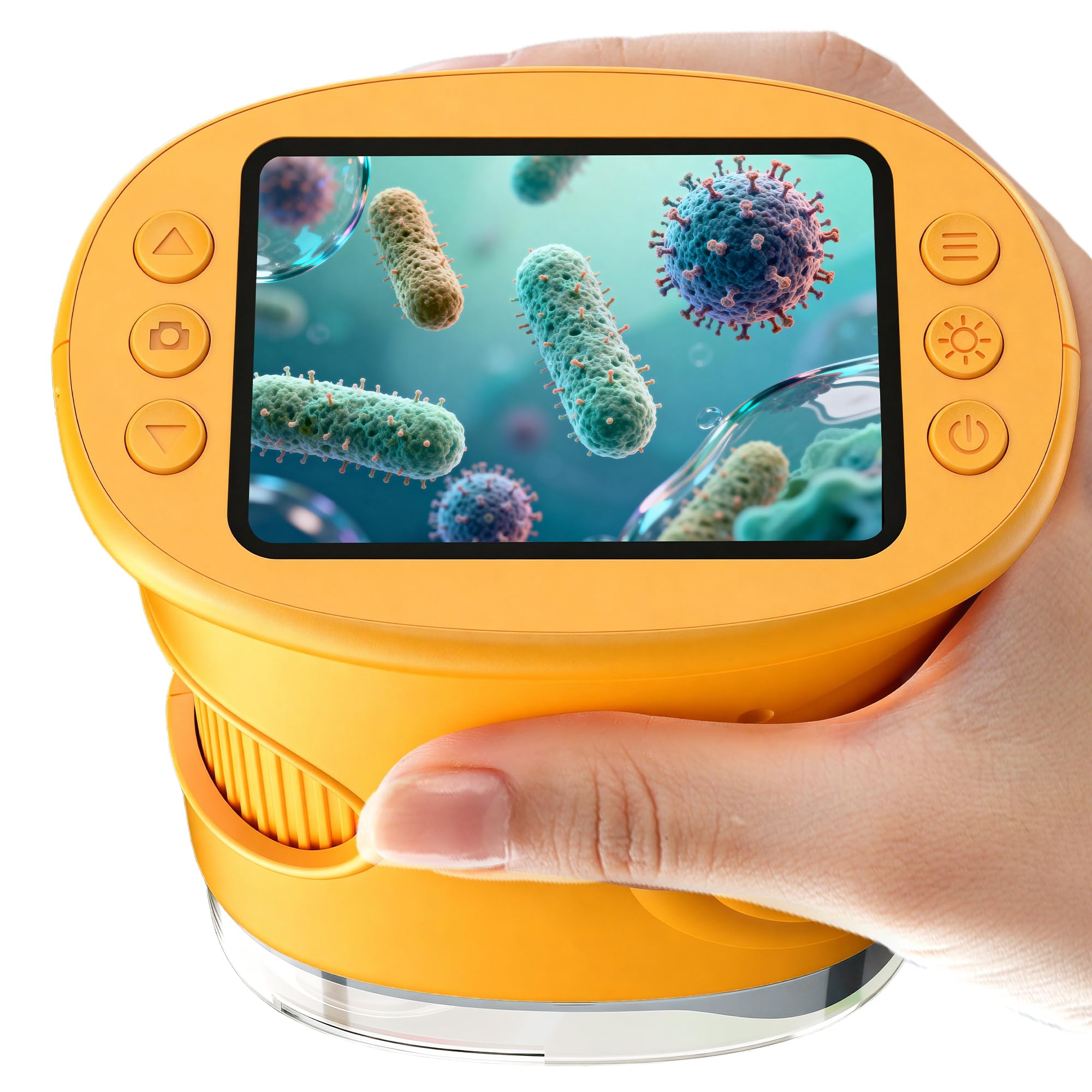
Two details tell you this one was designed by someone who has watched a kid drop something: a removable, drop-resistant screen protector over the edge of the 2-inch display, and a 24-month warranty that is the longest coverage of the digital handhelds here. The rest is familiar territory, with a bright IPS screen, eight LEDs across six brightness levels, a wide neck strap and 130 grams of weight.

The feature we got the most use from is the Type-C connection. Plug it into a laptop and the scope becomes a live camera, which turns a solo toy into something a whole class or a grandparent on a video call can follow, and it is the easiest way to help a child who cannot find the subject because you can see exactly what they are seeing. On its own the screen is bright and the picture is clear once it is focused.

Built-in storage takes about 200 photos, and a memory card adds video. Judge the 1000x claim the way you judge it anywhere in this guide, as optical power multiplied by digital zoom, and buy this one for the classroom link, the screen protection and the warranty rather than the number on the box.

Pros

  • Screen protector and 24-month warranty
  • Live view on a computer over USB-C
  • Stores about 200 photos on board

Cons

  • No slides or case in the box
Our verdict

We like it best for a classroom: plug it into a laptop and everyone sees the same image, and the screen protector and two-year warranty suit rough handling.

Check Latest Price
7

Ages 3-5

Educational Insights GeoSafari Talking Microscope

93 /100
LBD Score Outstanding

Key details

Power
3 AAA batteries
Slides
60 images on 20 slides
Eyepieces
Two
Play Modes
Fact and quiz
View on Amazon

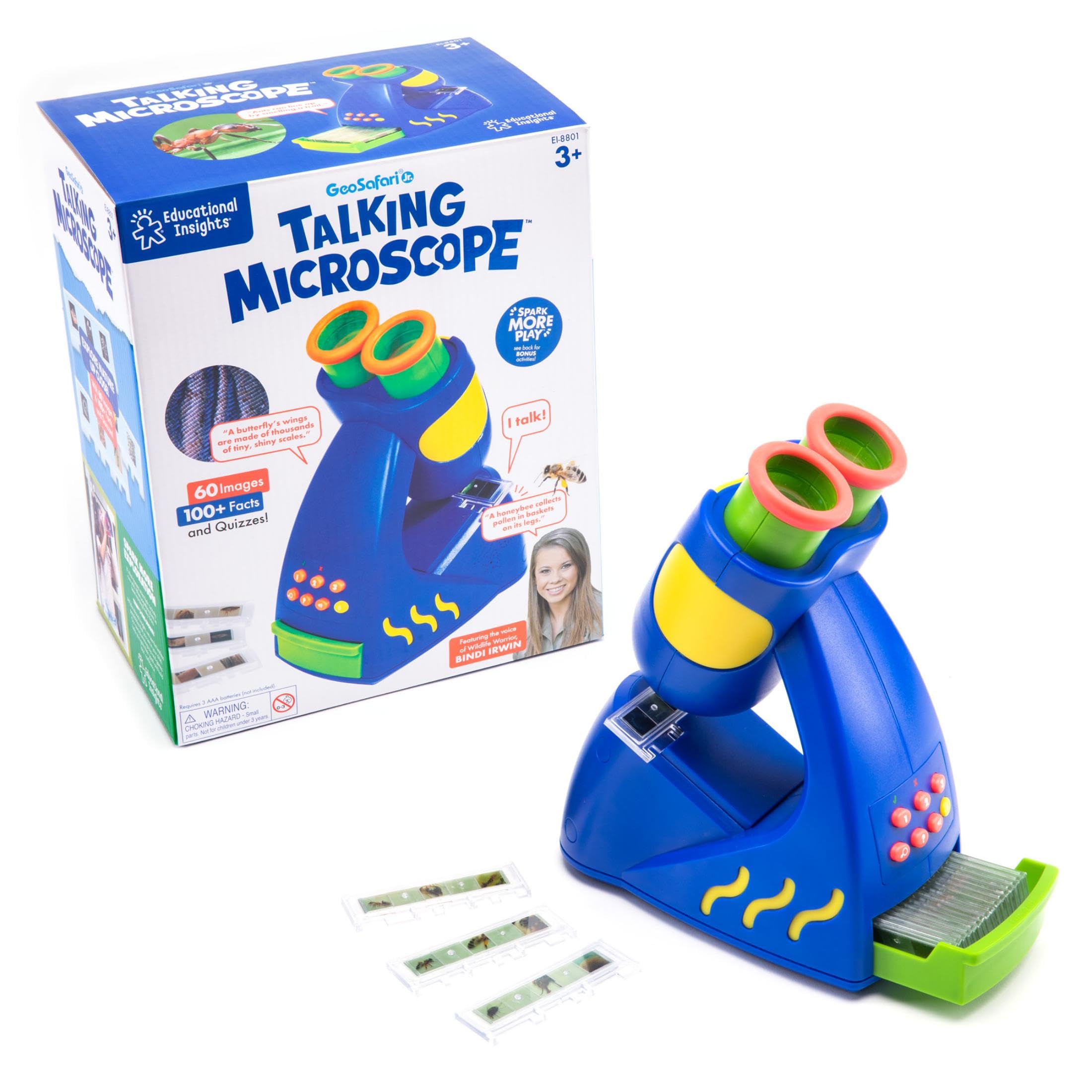
This is the one to buy for a three- or four-year-old, and it is built accordingly: two large eyepieces instead of one small one, no focusing at all, and Bindi Irwin's voice walking a child through 60 full-color images on 20 slides. Press a button in Fact Mode and you get a fact about the plant or animal in view; switch to Quiz Mode and it starts asking questions about it.

Understand what it is not before ordering. Nothing gets magnified. The slides are pictures, so a leaf or a beetle held up to the eyepiece shows a four-year-old nothing at all, and there is no knob to turn that changes that. It is not a fault in a preschool toy, but it does mean this is a science toy rather than an instrument, and it is the setting it does not serve.

It runs on three AAA batteries, and the 20 slides are the whole set, so what comes in the box is what you get. That is fine across the two or three years a preschooler will actually use it, and less fine for a five-year-old who wants a bigger collection to work through.

A slide show gets old in a week; a machine that asks a four-year-old questions about what they are looking at gets picked up again. That is the part we did not expect to matter as much as it does.

Pros

  • Two eyepieces a preschooler can use alone
  • Over 100 facts plus a quiz mode
  • 60 full-color images across 20 slides

Cons

  • Slide drawer does not stay latched
Our verdict

A talking slide viewer a preschooler can run alone: it teaches facts and vocabulary rather than microscopy, so buy it for a three- or four-year-old and expect to pass it down.

Check Latest Price

How We Picked and Tested the Best Microscopes for Kids

We started with a list of about 40 microscopes sold for kids and cut it down by reading the specifications closely — setting aside listings where the magnification claim was purely digital, and deliberately keeping a spread of ages, formats, and prices. Twelve made the cut: eyepiece scopes, screen-based handhelds, and full slide kits. Then we lived with them for six months.

Testing happened where these things actually live: the kitchen table on Saturday mornings with leaves, salt crystals, and a jar of pond water; the backyard during bug hunts; the back seat on long drives; a desk in a nine-year-old's bedroom. I handed each one to a five-year-old and a nine-year-old and timed how long it took before somebody said "I see it" — the quickest took under a minute, the slowest needed an adult to refocus. We judged prepared slides by whether the specimen sat centered under the lens or drifted to the edge, blank slides by whether a kid could load a cover slip without crushing it, and image quality by whether the view looked sharp at the edges or only in the middle.

For durability, we dropped each microscope from kid height onto a rug, wiped the lenses with a T-shirt the way kids do, and packed them loose in a backpack next to a water bottle for a week. We noted which ones fit in a desk drawer or a jacket pocket between sessions, whether photos and video were clear enough to actually keep, and whether the batteries or rechargeable cell made it through a whole afternoon. Fun is the hardest thing to write down, so we just counted how often each one got picked back up after the first session — and value came down to what a family got for the money, not the number printed on the box.

How to Choose a Microscope for a Kid

Screen or eyepiece comes first

This one choice splits the category, so make it before you compare anything else. An eyepiece microscope shows a true optical image and rewards a kid who will sit still and learn to focus; a screen scope puts the image on a small display, so a child can work alone and three people can crowd around at once. We start most families on a screen scope and move to an eyepiece once a kid asks for more power.

The trap is the headline number. Four-digit magnification on a digital model is optical power multiplied by digital zoom, which is why a cheap handheld claims more than a premium compound microscope. Ignore the figure and look at the screen or eyepiece instead.

What magnification is actually for

Low power, roughly 20x to 50x, is the range that gets used: coins, leaf veins, insect legs, anything a kid picks up outside. Those subjects need a wide view and a forgiving focus. Slides want 100x and up, and only thin, well-lit specimens look good there. A scope that does 40x well teaches more than one that claims 1000x and goes soft above 100x.

When you compare two models, compare the lowest power each offers and how easy it is to focus there. That is the setting a child will use first, and the one that decides whether they ask to use it again.

Light decides what you can look at

Transmitted light comes up through the stage and through a slide, which is what makes a prepared specimen show detail instead of a silhouette. Reflected light comes down onto the object, and it is the only way to look at a coin, a rock or a beetle without squashing it flat. Both National Geographic kits here light from above and below, and that is most of what their price buys.

Focus is what decides whether it gets used

A microscope that will not come into focus is a bad microscope, whatever else it does. Look for a large focus knob, a stage that holds a slide flat, and a body heavy enough to stay put while a small hand turns the wheel. For a child under six, remove the problem entirely: a fixed-focus pocket scope or a screen model takes the skill out of the job.

What's in the box, and what it costs afterward

Prepared slides are the fastest route to a first good view, but six of them and no blanks run out in an evening. Check that the scope takes standard glass slides so you can add your own, and count the running costs: the digital handhelds here charge over USB, while the kits take disposable batteries. A hard case is worth paying a little more for, because loose eyepieces and lost tweezers are how these sets stop being used.

Frequently Asked Questions

Final Verdict

Most families should buy the BMDSAE handheld, and it is the recommendation we are most confident in. A child can find a specimen, focus it and keep a photo of it without an adult taking over, which is the difference between a microscope that lives in a cupboard and one that goes outside.

If the box needs to arrive gift-ready, with glass slides and a hard case, the BEBANG kit justifies the extra. And if you want a real eyepiece microscope that a twelve-year-old will still respect, the National Geographic Dual LED is the one to stretch for, knowing its 50x ceiling is the trade.