Best Outdoor TV Antennas of 2026

The number on the box is the least useful thing about an outdoor TV antenna. Hundred-mile and two-hundred-mile claims assume flat ground, a clear line to the tower, and no trees in the way, and that describes almost nobody's backyard. What actually decides whether your local affiliates come in sharp is where you mount the antenna, which way it faces, and how much foliage stands between it and the signal.

I cut the cord years ago and have been climbing around with antennas ever since, so I have strong feelings about assembly instructions that assume a full toolbox. My team and I spent four months with 12 outdoor antennas — on roofs, in attics, strapped to an RV ladder, and bolted to a fence post — counting channels, watching how the picture held during storms, and timing how long a two-person install really takes. Some needed careful aiming; some didn't care. The picks below are the ones that kept their channels when the weather turned.

1

Best Overall

GE 29884 Outdoor Antenna

89 /100
LBD Score Excellent

Key details

Weight
3 lb
Mounting
J mount and clamp included
NextGen TV
ATSC 3.0 ready
Maximum Range
70 miles
View on Amazon

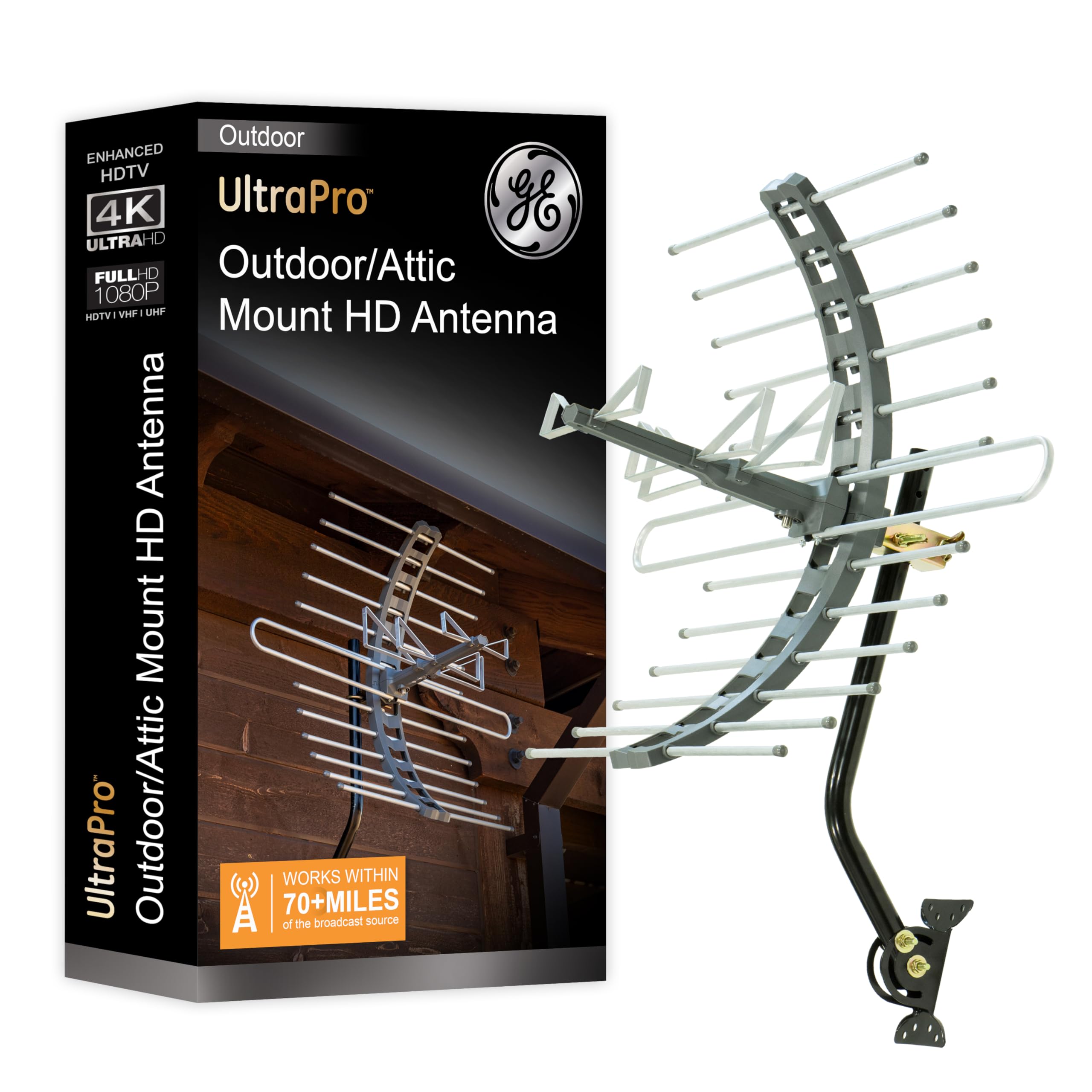
Mounting hardware is the first thing we check now, because a mast sold separately is the difference between an afternoon job and a second trip to the hardware store. The GE 29884 includes its J mount and clamp, and the rest of the package makes the same kind of sense: VHF and UHF elements, 70 miles of stated range, a weather-resistant housing, and ATSC 3.0 readiness for when NextGen TV reaches your market. For most people trading a cable bill for something on the roof, this is the antenna we point to first.

At 3 pounds and about 29 by 15 inches, it is light enough to carry up a ladder one-handed and compact enough to sit on a fascia board or an eave without a tower. Aiming takes two people the first time, one watching the signal meter while the other nudges the mast a few degrees, and the extra trip up the ladder is worth it. We paid close attention to the VHF side, because plenty of inexpensive outdoor antennas are effectively UHF-only and quietly lose everything below channel 14. This one is built for both bands.

Where it goes matters more than which accessory you buy. The 29884 is one of the few here that is genuinely at home in an attic, which keeps it out of the weather and out of sight, though a foil-faced roof deck or a metal roof can eat into what reaches it, and then the answer is outside and higher. That is also the moment to decide about a splitter: one antenna feeding two sets is usually fine, and four is where a distribution amplifier starts earning its place.

Pros

  • J mount and clamp included in the box
  • Covers VHF and UHF, not UHF alone
  • Light 3-pound body for one-person handling
  • ATSC 3.0 ready for NextGen TV

Cons

  • Assembly is fussier than the parts count suggests
Our verdict

We recommend the GE 29884 to anyone replacing a cable bill with a rooftop antenna: the mount comes in the box, it costs less than most of this set, and it handles VHF and UHF without fuss.
Check Latest Price
2

Best for Hard-To-Reach Signals

Antennas Direct ClearStream 4V

89 /100
LBD Score Excellent

Key details

Warranty
Lifetime manufacturer warranty
Dimensions
27.8 x 6 x 17.4 inches
Maximum Range
70 miles
Reception Pattern
Multi-directional
View on Amazon

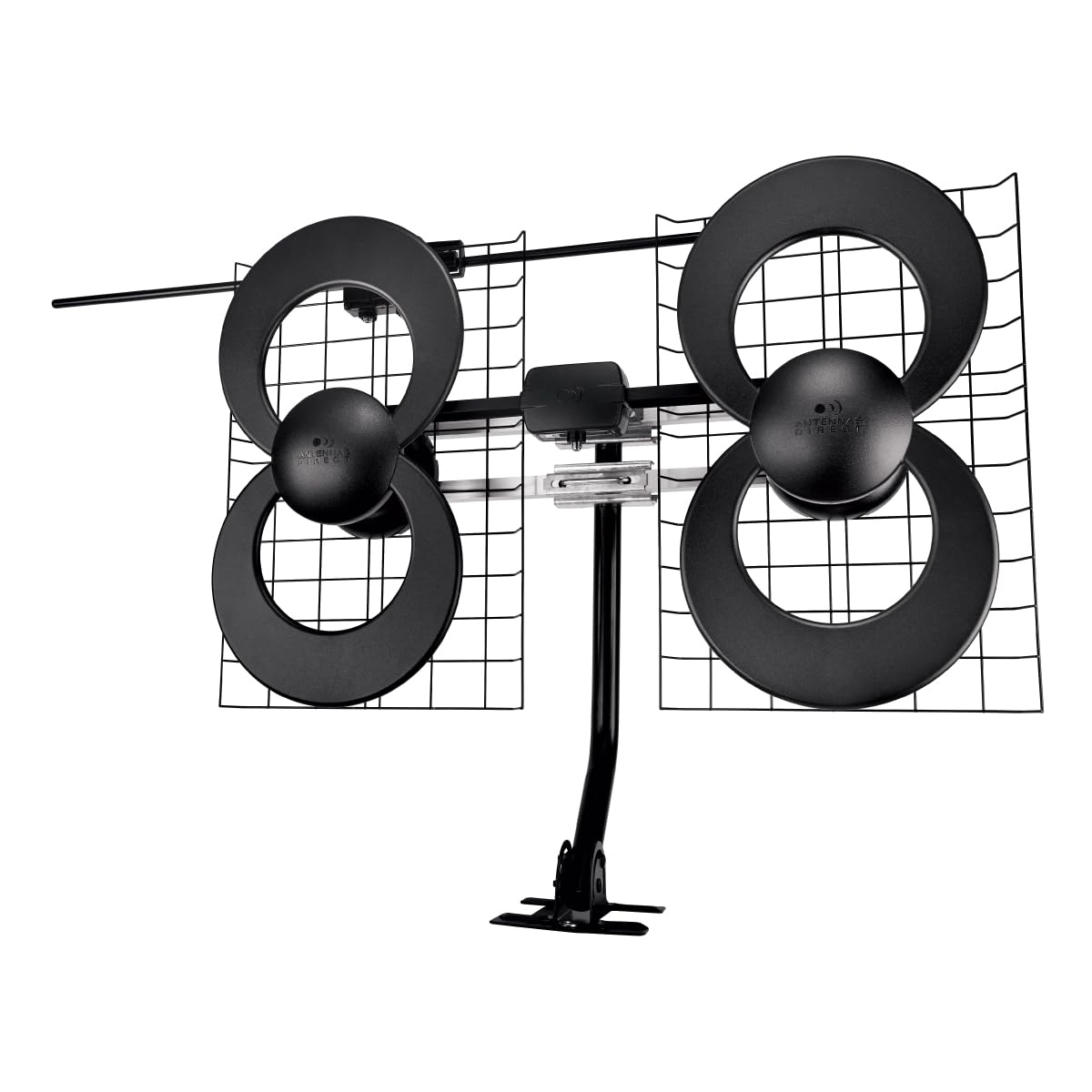
Two reflector screens, four loops, and a pair of high-VHF elements: the ClearStream 4V is the antenna in this set that looks like somebody thought about the physics. The reflectors focus gain forward and reject the multipath interference that turns a strong signal into a pixelating mess, and the separate VHF elements mean the channels below 14 are not an afterthought. If your reception problem is a hill, a stand of trees, or towers split between two directions, this is the design built for it.

Multi-directional is the word that decides it. Where a yagi has to be aimed within a few degrees, the 4V hears towers spread across a wide arc without a rotor, a remote, or a motor to freeze in February. We think that is worth more than a bigger number on the box, because aiming is the step people get wrong and then redo twice a season. Point it roughly, run the scan, and leave it alone.

The hardware matches the design. At 4.1 pounds and about 28 inches wide it feels built for a roof rather than a windowsill, the 20-inch mast covers a wall, an eave, or an existing pole, and the lifetime warranty is the longest coverage in this set. It is rated for NEXTGEN TV, 4K, and 8K broadcasts and needs no internet connection of its own.

It is also more antenna than plenty of people need. If the towers are a short drive away with nothing between you and them, a simpler design produces the same picture and goes up in half the time. The 4V is for the house where the first antenna did not work.

Pros

  • Multi-directional pickup without a rotor
  • Dedicated hi-VHF elements alongside UHF
  • Lifetime manufacturer warranty

Cons

  • Highest price in this set by a wide margin
  • Wide 28-inch array needs clear space on the mount
Our verdict

Buy the ClearStream 4V when a plain outdoor antenna has already failed you: its reflectors and separate VHF elements hold signals that the simpler designs here lose.

Check Latest Price
3

Best Omni-Directional

1byone 360° Outdoor Antenna

82 /100
LBD Score Excellent

Key details

Amplifier
Built-in preamp with 4G LTE filter
Maximum Range
100 miles
Cable Included
39 ft RG6
Reception Pattern
360° omni-directional
View on Amazon

Towers in three directions, a ridge between you and the market, or an RV that changes address every week: the 1byone omni is for anyone who cannot answer the question of which way to point it. It receives across 360 degrees, so there is no aiming, no rotor, and no remote to lose behind the sofa. Of everything here, it is the one that goes up and starts working fastest.

The electronics are where the thought went. A preamplifier sits at the antenna rather than at the TV, which is the right place for it, and a 4G LTE filter notches out the cell signal that can flatten UHF reception when a tower is close. The 39 feet of RG6 in the box is enough for most eave and attic runs, and it is the right grade of cable rather than the thin stuff that fails at the connector after two winters.

An omni hears everything a little and nothing strongly, so height matters more here than on a directional antenna. The long cable is your friend: get the unit above the roofline and clear of the wall, then run the scan twice, once as delivered and once after a small rotation of the housing. Aiming a 360-degree antenna sounds like a contradiction, but a few degrees can change which marginal channel survives, and this design rewards that kind of fiddling.

Pros

  • 360-degree reception with no aiming or rotor
  • Preamp at the antenna plus 4G LTE filter
  • 39 ft RG6 cable included

Cons

  • Single TV output, so a splitter costs signal
Our verdict

We steer anyone with towers in several directions, or an RV that keeps moving, to the 1byone, which picks up 360 degrees without a rotor to aim or break.

Check Latest Price
4

Best Directional Value

Five Star Yagi FSA-5812

87 /100
LBD Score Excellent

Key details

Mounting
20-inch mounting pole included
Amplifier
Passive, no amplifier
Maximum Range
200 miles
Cable Included
40 ft coax
View on Amazon

Two hundred miles is the number printed on the box, and it is the number to ignore. A yagi is a directional tool: long elements stacked along one axis, gain that comes from focusing in a single direction, and no magic that bends a signal over a ridge. What this one does well is hold a clean picture when every tower you want sits in one place with a clear path to it.

The package is unusually complete. The antenna, 40 feet of coax, and a 20-inch mounting pole all arrive together, so a roof or eave install does not start with a hardware order, and the elements are longer than most yagis at this size, which is where the gain comes from. It is built to be left outside and runs with no power at the mast at all.

Aiming is not optional. This is the antenna that rewards a compass bearing and a slow sweep of the mast and punishes a guess, so if your towers are spread across two ridges, buy one of the multi-directional picks and save yourself the seasonal re-aim. When it is pointed right, picture quality is its strongest card: clean HD, no pixelation, and no amplifier in the chain to overload when the transmitters are close by.

Pros

  • 40 ft coax and 20-inch pole included
  • Long elements give strong directional gain
  • Passive design, no power at the mast

Cons

  • Passive design gives no boost on very long cable runs
Our verdict

Choose the Five Star Yagi when every tower you want sits in one direction with a clear path: aim it once and the HD picture is as clean as anything here.

Check Latest Price
5

Best Budget

UltraPro 65000 Outdoor Antenna

86 /100
LBD Score Excellent

Key details

Mounting
J mount and mast clamp included
Warranty
Limited lifetime
Dimensions
2.75 x 7.9 x 17 inches
Maximum Range
70 miles
View on Amazon

The UltraPro is our top pick's idea at a smaller scale: a weather-resistant antenna for an eave or an attic, with a J mount and mast clamp in the box and 70 miles of stated range. It stands about 17 inches tall and under 3 inches deep, and for towers you can nearly see from the yard, that is all the antenna most people need.

Small is the pitch and also the trade-off. A short antenna has less capture area, so it does its best work close to the transmitters and gets fussy at the edge of the map. That is the honest boundary: a few miles out with a clear view it is excellent, and out in the country behind trees it is the wrong tool, with no amount of aiming fixing that.

The mount is the quietly useful part. A J mount plus a mast clamp means it drops onto an existing satellite pole or a fascia board in one trip, and the housing can live in an attic when nobody wants an antenna in the view. Keep the cable run short, because this is a passive design with no amplifier to prop up a long, lossy line.

Pros

  • Lowest price of the antennas here
  • J mount and mast clamp included
  • Compact enough for an attic or eave

Cons

  • Instructions are barely more than a diagram
  • Whole-home use needs a splitter and coax you supply
Our verdict

For a tight budget or an attic install near the transmitters, the UltraPro does the job for less than anything else here, as long as you do not need long reach.

Check Latest Price
6

Whole-House Setups

Five Star Multi-Directional Kit

85 /100
LBD Score Excellent

Key details

Dimensions
46 x 28 x 25 inches
Maximum Range
200 miles
Reception Pattern
Multi-directional
Included Accessories
Mounting bracket, J-pole, TV splitter
View on Amazon

One antenna, four televisions, no separate shopping trip. This Five Star kit ships with the mounting bracket, a J-pole, and a four-way TV splitter, which is the combination most whole-house installs end up assembling piece by piece. If the plan is to feed the living room, the kitchen, the basement, and the garage from a single point on the roof, it is the shortest path there.

The antenna itself is multi-directional, so it picks up towers spread across a wide arc without a rotor, and it covers VHF and UHF with ATSC 3.0 support for NextGen broadcasts. A design that hears several directions at once gives up a little gain per direction compared with a yagi, which is the trade you make for never climbing up to re-aim it.

Splitting is where whole-house plans go wrong. Dividing one feed four ways throws away a big share of your signal margin, and an antenna that is comfortable on one TV can turn marginal on the farthest set. Run the scan on the closest TV first, note the weakest channel you actually care about, then add the splitter and compare. If the picture degrades, a distribution amplifier in the line is cheaper than a bigger antenna.

Treat the range claim with the skepticism this whole category deserves, and expect to spend an afternoon on assembly and a clear line of sight. What we like is that the accessory set matches how people actually install these: one mast, one splitter, four rooms, done.

Pros

  • Four-way splitter, bracket, and J-pole included
  • Multi-directional reception, no aiming
  • ATSC 3.0 ready

Cons

  • 46-inch span catches wind on an exposed roof
  • No amplifier to offset a four-way split
Our verdict

If one antenna has to feed four sets, the Five Star kit is the straightforward answer — splitter, bracket, and J-pole all arrive in the box.

Check Latest Price
7

Exposed, Wet Mounts

Mornixol MX-AOD1B Outdoor Antenna

85 /100
LBD Score Excellent

Key details

Warranty
1 year
Maximum Range
70 miles
Cable Included
40 ft coaxial
Weather Rating
IPX5 waterproof housing
View on Amazon

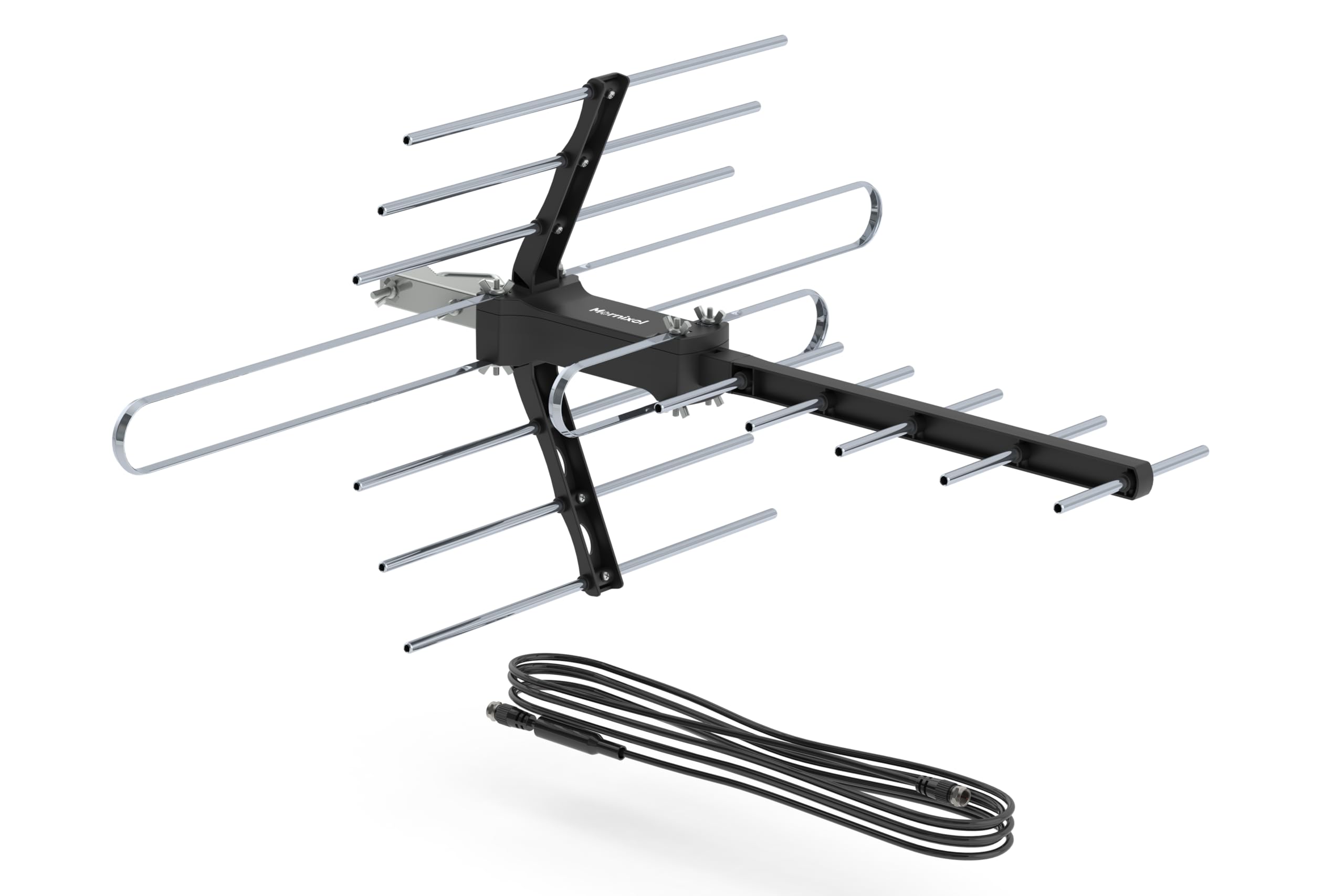
Mornixol is the only antenna here that puts a number on its weather resistance: an IPX5 rating against water jets, plus anti-UV materials, which is more specific than the weather-resistant language the rest of these use. It clamps on without tools, ships with 40 feet of coax and gold-plated connectors, and states 70 miles of range.

The bracket is the interesting part. Adjustable clamps and easy-lock fittings let you hang it on a roof edge, a balcony rail, or a mast without drilling a template or hunting for a socket set, which matters if you are renting, reusing a pole you already have, or installing it for somebody else on a Saturday.

What it does not have is an amplifier, so on a long run or a deep fringe location it is working without a safety net; keep the cable short and the mast high and it does fine. That puts it in a specific slot: a mast you can reach from a ladder, in a wet and exposed spot, where the housing and the bracket are worth more than raw gain. For that job it is a reasonable bet, and it is the pick for anyone who hates drilling holes.

Pros

  • IPX5-rated waterproof housing
  • No-tools adjustable mounting bracket
  • 40 ft coax with gold-plated connectors

Cons

  • One-year warranty, the shortest in this set
Our verdict

Consider the Mornixol when the antenna has to live somewhere genuinely wet: an IPX5 housing and a no-tools bracket do the work, backed by a short warranty.

Check Latest Price

How We Tested Outdoor Antennas (and What Tested Our Patience)

We started by gathering every outdoor antenna with a real mounting path — roof, attic, mast, or RV rail — then dropped anything that shipped without hardware or a coax run long enough to get inside the house. That left 12 antennas across the price range, from simple directional models to multi-directional units with big range claims, all bought at retail.

Each one went up the same way. I timed assembly solo and then with a second pair of hands, and wrote down everywhere the instructions left us guessing — one set pointed us toward a mast that wasn't in the box. Then we scanned for channels twice, once aimed at the nearest broadcast towers and once tuned by the TV's built-in signal meter, and counted how many channels came in and how many were actually watchable.

Picture quality got judged on a Sunday afternoon: a football game, the nightly news, and whatever subchannels turned up. We logged pixelation, audio lag, and how fast the picture recovered when a plane crossed the flight path, then watched again through two storms and after a wet snow to see whether water got into the housing or reception slid.

Last, we checked what each antenna demanded of the rest of the setup — a separate power inserter, a splitter for a second TV, whether old VHF locals survived alongside UHF ones — and weighed what came in the box, mount and cable included, against what it actually pulled in from my address.

How to Choose an Outdoor Tv Antenna

Aim or don't aim: the three designs

Yagis are directional: long elements stacked along one axis, the most gain in a single direction, and no forgiveness if you are off by twenty degrees. Multi-directional designs use loops and reflectors to hear a wide arc at once, with less gain per direction and no rotor. Omnis hear everything and nothing strongly, which suits an RV or a ridge with towers on two sides.

If your transmitters sit within a narrow spread, buy a yagi and aim it properly. If they are scattered, pay for multi-directional rather than a motor. A rotor adds a motor, a remote, and a control box to a mast where they live outdoors all year, and the moving parts are the first thing to fail.

What range numbers actually mean

Every antenna here works on line of sight, so a 200-mile claim and a 70-mile claim can describe hardware that performs much the same in your yard. Hills, wet foliage, metal roofs, and aluminum siding all cut into the path before distance does.

Look up your transmitters' distance and bearing before you order. If the last few miles run through a ridge or a treeline, put the money into height and gain rather than a bigger number on the box. Going up is usually the cheapest fix available.

Amplifiers, filters, and splits

A preamplifier at the antenna helps on long cable runs and after a split. Too much gain close to strong towers overloads the tuner and makes reception worse. A 4G LTE filter earns its place when a cell site is nearby, because that interference lands right on top of the UHF band.

Aim and scan without amplification first, then add it only where the picture demands it. Every split to another TV costs you a share of the signal you collected, so a whole-house plan needs either a short run or an amplifier at the splitter.

Mounting, cable, and the attic option

Check what is in the box before you commit to a roof. A J mount covers a fascia or an eave, a 20-inch pole covers a wall or an existing mast, and a long roof standoff is usually a separate purchase. Cable length matters too: 39 or 40 feet is generous for an eave and tight for a two-story run.

Attic mounting hides the antenna and avoids wind load, but shingles, radiant barrier, and foil-faced sheathing all cost signal. Try the attic when the towers are close. Seal every outdoor connector with coax tape, and plan the cable route before you climb.

VHF, ATSC 3.0, and the channel scan

Plenty of inexpensive outdoor antennas are effectively UHF-only, which is fine until a network affiliate broadcasts in the high-VHF band and disappears. If losing those channels would bother you, choose a design with dedicated hi-VHF elements or extended VHF elements.

ATSC 3.0 readiness is worth having — the GE, the ClearStream, and the Five Star kit all list it — but it pays off only when local stations light up NextGen TV and your TV or tuner supports it. Whichever you buy, rescan after every move, re-aim, or station change.

Frequently Asked Questions

Final Verdict

Out of seven antennas, the GE 29884 is the one we point most people to. The mount comes in the box, it covers VHF as well as UHF, and it costs less than most of the field — the three things that decide whether a rooftop install actually gets finished.

Buy the Antennas Direct ClearStream 4V instead if the signal has to fight for it: a ridge, heavy trees, or towers split between two directions, where the reflectors and hi-VHF elements earn their premium. Budget and attic installs a short drive from the transmitters can drop to the UltraPro and put the savings into coax.