Best PETG Filament of 2026

I switched to PETG the afternoon a PLA shelf bracket I'd printed for my car sagged into a noodle in the summer heat. PETG is the tougher cousin — it takes a knock, handles heat and UV far better than PLA, and it's what I reach for when a part has to actually do a job. It's also fussier: it strings, it grabs the nozzle, and a wet spool prints like seltzer.

My team spent the past four months running 14 spools through our printers, from single kilos to large multicolor bundles, and the spread surprised me. Two spools at the same price can print like different materials.

What you're really paying for is consistency — a diameter that stays on spec from the first meter to the last, winding neat enough that the spool doesn't tangle at hour six, and filament dry enough not to pop and bubble. Below are the ones that held up on real parts: brackets, jigs, plant stakes, a lampshade or two.

1

Best Overall

Polymaker High Speed PETG

90 /100
LBD Score Outstanding

Key details

Spool Weight
2.2 lb
Max Print Speed
500 mm/s
Diameter Tolerance
±0.02 mm
Nozzle Temperature
240–260 °C
View on Amazon

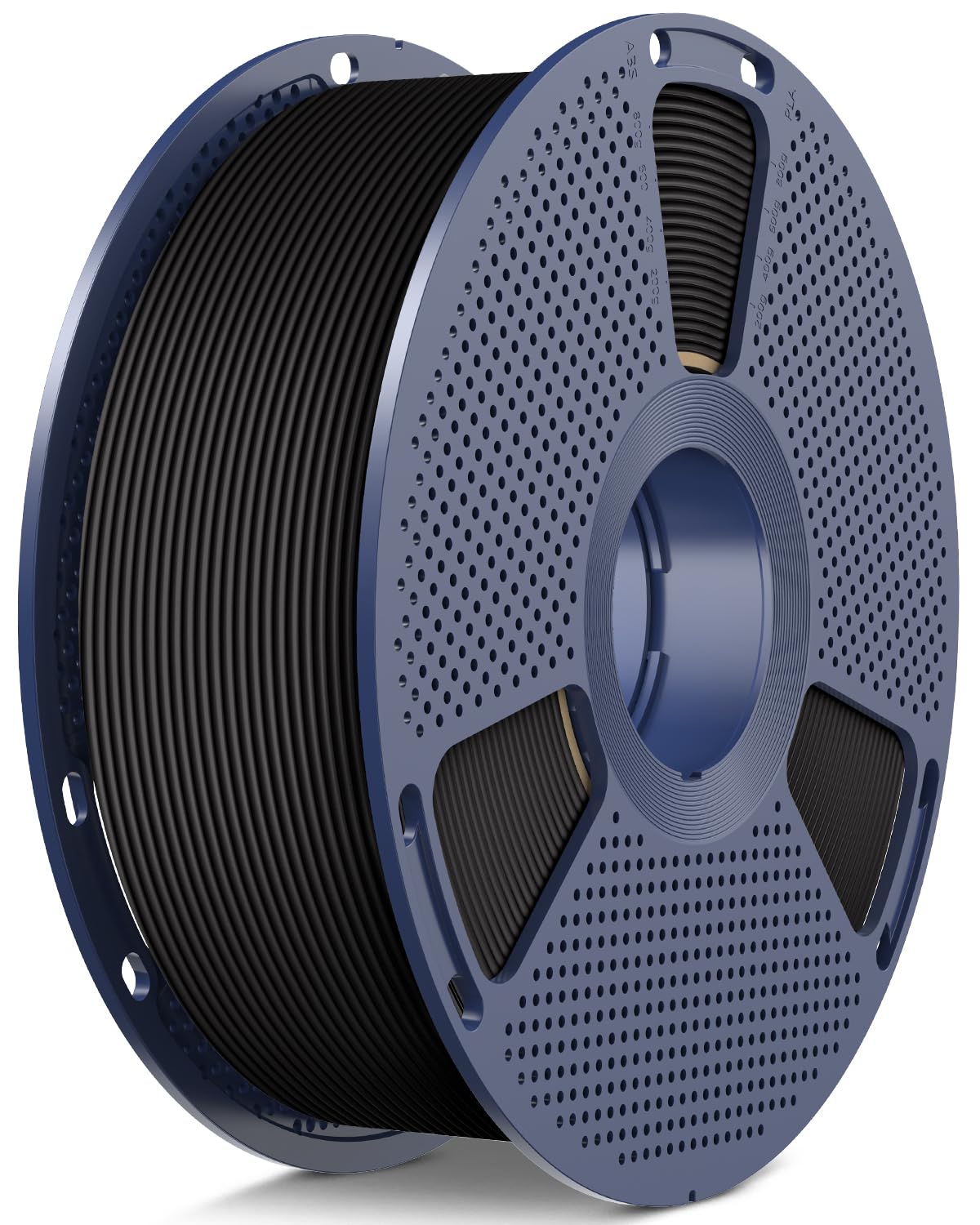
Polymaker's high-speed PETG is the spool we reach for first when a printer can move quickly but we still want PETG's toughness. The 500 mm/s rating is useful rather than decorative: the filament flows cleanly at speed, and in our prints it held sharp corners without the stringy mess that can make PETG feel like a chore. That combination is why it's our top pick.

The one-kilo spool is the right size for a first PETG purchase or a single-color project. Black is the practical choice for brackets, jigs, and replacement parts because it hides layer lines and looks tidy on functional pieces. We also appreciate the 240–260°C nozzle window and 60–70°C bed recommendation, which fit the profiles most modern printers already have.

Layer adhesion is the reason it earns the top spot. The prints feel solid, and the surface comes out glossy enough to look intentional on display pieces. The spool is the one place to pay attention: a few reels start with a tangle, so check the first wrap before a long job. On an older printer, the same spool still prints well at ordinary speeds; you don't need a high-speed machine to use it.

Pros

  • Prints cleanly at high speed
  • Strong layer adhesion for functional parts
  • Glossy black finish hides layer lines
  • One-kilo spool suits first-time buyers

Cons

  • Can be brittle in high-flex parts
Our verdict

We recommend Polymaker's high-speed PETG as the best all-around spool here for everyday functional prints, especially on a modern printer that can use its speed.
Check Latest Price
2

Best Bulk Value

ELEGOO PETG 4 kg

92 /100
LBD Score Outstanding

Key details

Color
Black
Pack Size
4 × 1 kg
Filament Diameter
1.75 mm
Diameter Tolerance
±0.02 mm
View on Amazon

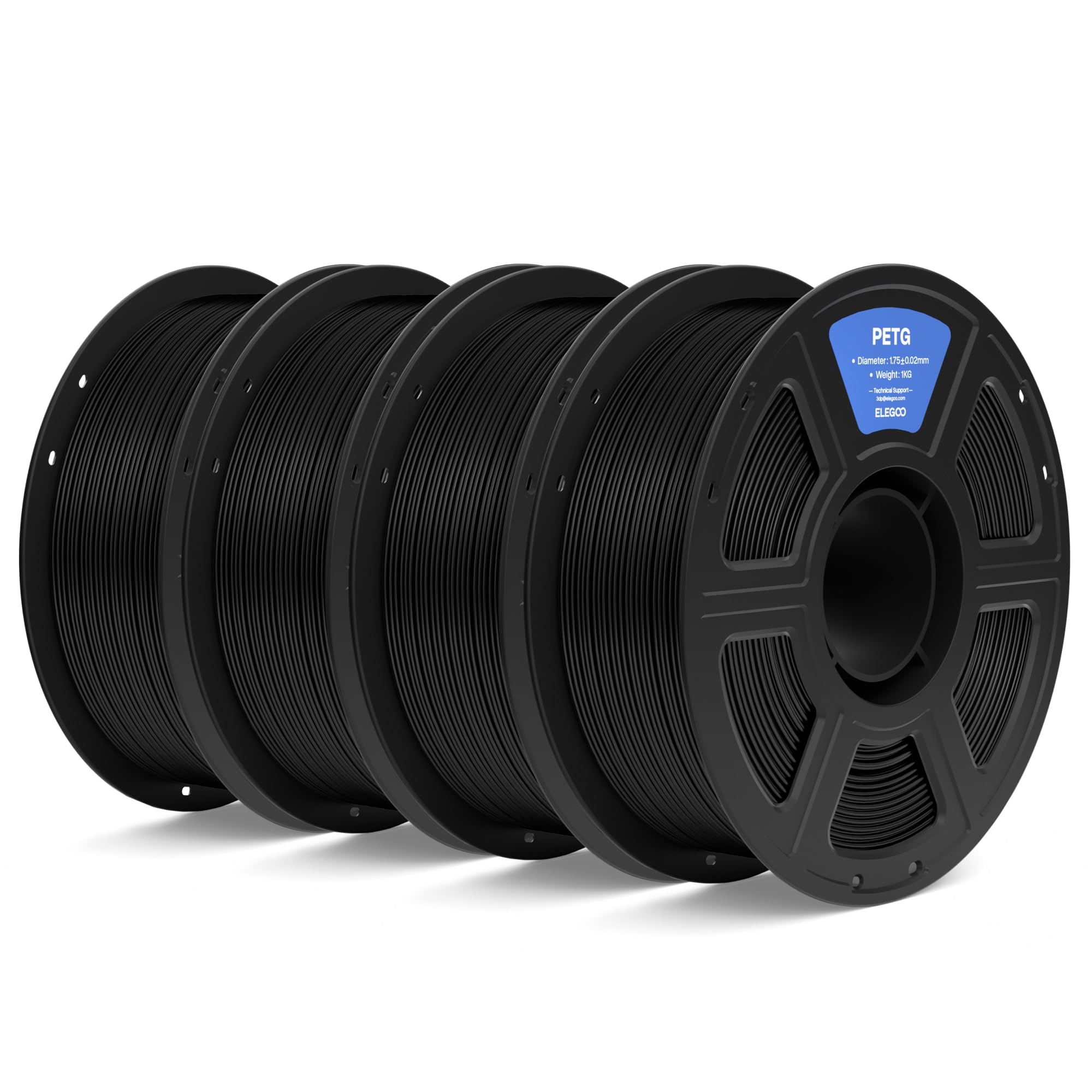
Four kilos of black PETG is a commitment, and that's the point. ELEGOO's pack is for the person who has a printer running through brackets, jigs, and replacement parts and doesn't want to reorder every week. The per-spool cost is the lowest in this group, and the filament performs like a workhorse: the prints we ran came off clean.

The diameter tolerance is ±0.02 mm, which is the spec we look for before trusting a spool to a long unattended print. ELEGOO also vacuum-seals and dries the filament before packing, so the first prints don't need a rescue dry. We found the black glossy and opaque, with good build-plate grip on a clean sheet.

The trade-off is winding. A spool that binds can stop feeding mid-print, so check the first few meters and keep the spool path straight. The filament itself is the easy part; the discipline is in the spool.

Pros

  • Lowest per-spool cost in this group
  • Consistent ±0.02 mm diameter
  • Glossy, opaque black finish
  • Four kilos keep long jobs running

Cons

  • Four-kilo commitment in one color
Our verdict

For a shop or a heavy user who prints mostly black, ELEGOO's four-kilo pack is the bulk buy we recommend.

Check Latest Price
3

Best Two-Color Starter

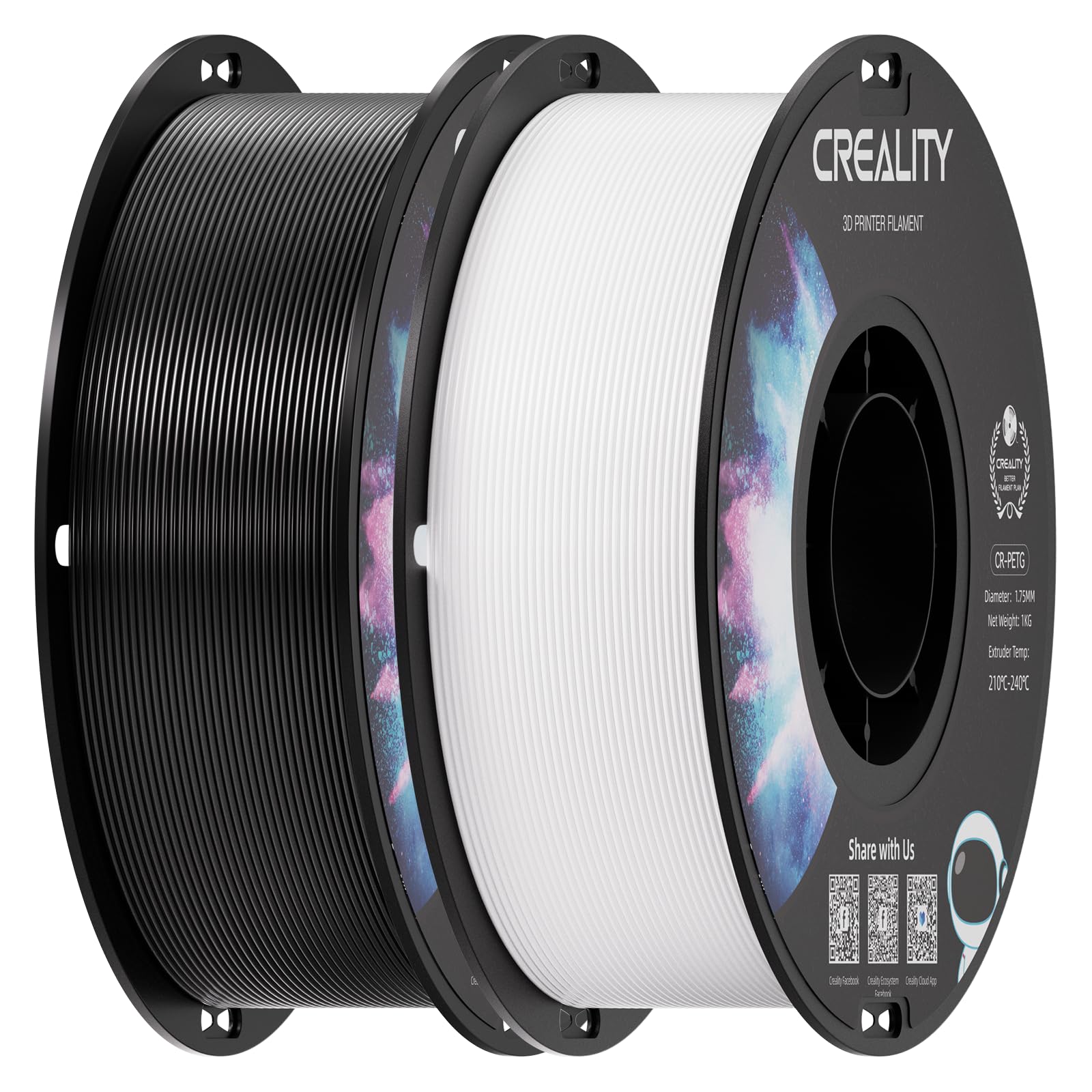
Creality PETG 2-Pack

90 /100
LBD Score Outstanding

Key details

Colors
Black and white
Pack Size
2 × 1 kg
Filament Diameter
1.75 mm
Diameter Tolerance
±0.02 mm
View on Amazon

Black and white are the two colors that keep a printer useful, and Creality's two-pack covers both without asking you to choose. It's the starter set we point to when someone has a new printer and a list of practical parts: cable clips, knobs, a bracket, a stand. The two kilos are enough to learn PETG's quirks before committing to a bigger box.

Print quality is solid. The black comes out glossy and the white is clean enough for visible parts, and the ±0.02 mm tolerance matches the better spools here. We like that the pair covers both utility and contrast; you can print a black housing and a white faceplate from the same order. The 1.75 mm diameter works with the usual FDM printers, and the 12-month support is a small extra reassurance.

The pair makes more sense than a single spool if you know you'll want both colors. The black is the shinier of the two and hides layer lines; the white shows them, so keep your extrusion consistent. At two kilos, it's a low-commitment way to keep a neutral palette on hand.

Pros

  • Covers black and white in one order
  • Solid print quality with ±0.02 mm tolerance
  • Glossy black finish and clean white
  • Low-commitment two-kilo pack

Cons

  • White spool can tangle on long prints
Our verdict

For a new printer owner who needs black and white without overbuying, Creality's two-pack is the practical starter.

Check Latest Price
4

Best for Fast Printers

SUNLU High Speed PETG

88 /100
LBD Score Excellent

Key details

Print Speed
30–600 mm/s
Spool Weight
2.2 lb
Bed Temperature
70–80 °C
Nozzle Temperature
230–255 °C
View on Amazon

SUNLU's high-speed PETG is built for the printer that spends its time at 200 mm/s and above. The 30–600 mm/s range is very wide, and the matte-leaning finish gives functional parts a flatter look than the glossy black spools. We like it for brackets, jigs, and enclosure parts that don't need to shine.

The catch is tuning. At the top of the speed range, layer adhesion is the first thing to suffer, so a temperature tower and a slower outer wall are worth the time. Once dialed in, the prints come out clean and the matte surface hides layer lines better than gloss. The recommended 70–80°C bed is on the warm side, which suits PETG's tendency to lift on a cold plate.

The black is the safe choice; some colors read off-target, so don't choose this one for a specific brand match. The spool is standard 1 kg and fits the usual holders, though the high-speed profile is where it earns its place. On a slower printer, it still prints, but you're paying for speed you won't use.

Pros

  • Very wide 30–600 mm/s speed range
  • Matte-leaning finish hides layer lines
  • Clean results after tuning
  • Budget-friendly high-speed spool

Cons

  • Spool may not fit every AMS
Our verdict

For a fast printer and a budget-minded owner, SUNLU's high-speed PETG is the spool we recommend for matte functional parts.

Check Latest Price
5

Best Budget Single Spool

EONO3D PETG 1 kg

85 /100
LBD Score Excellent

Key details

Spool Weight
2.2 lb
Bed Temperature
50–70 °C
Diameter Tolerance
±0.02 mm
Nozzle Temperature
230–260 °C
View on Amazon

EONO3D's black PETG is the least expensive single spool here, and it doesn't print like a compromise. The filament comes out glossy and opaque, with clean layer lines and the kind of dimensional accuracy that lets a bracket drop into place. For a workshop that burns through black parts, that's the whole pitch.

The ±0.02 mm tolerance is the same figure the premium spools quote, and the 230–260°C nozzle window is broad enough to tune. We like that it's vacuum-sealed with desiccant; PETG picks up moisture, and a dry start saves a step. The 50–70°C bed recommendation is lower than some PETG profiles, which helps on printers with a modest bed heater.

The catch is the spool. Long prints can hit a tangle, so check the first few meters and keep the path free. Otherwise, the value is hard to beat for black functional parts.

Pros

  • Lowest-cost single spool here
  • Clean, glossy black prints
  • ±0.02 mm dimensional accuracy
  • Vacuum-sealed with desiccant

Cons

  • Limited to black
Our verdict

For the lowest-cost single spool that still prints clean black parts, EONO3D is the budget pick we recommend.

Check Latest Price
6

Color Sampling

UGUESS PETG 8-Color Bundle

84 /100
LBD Score Excellent

Key details

Bundle
8 × 250 g
Colors
Eight colors
Diameter Tolerance
±0.03 mm
Nozzle Temperature
230–260 °C
View on Amazon

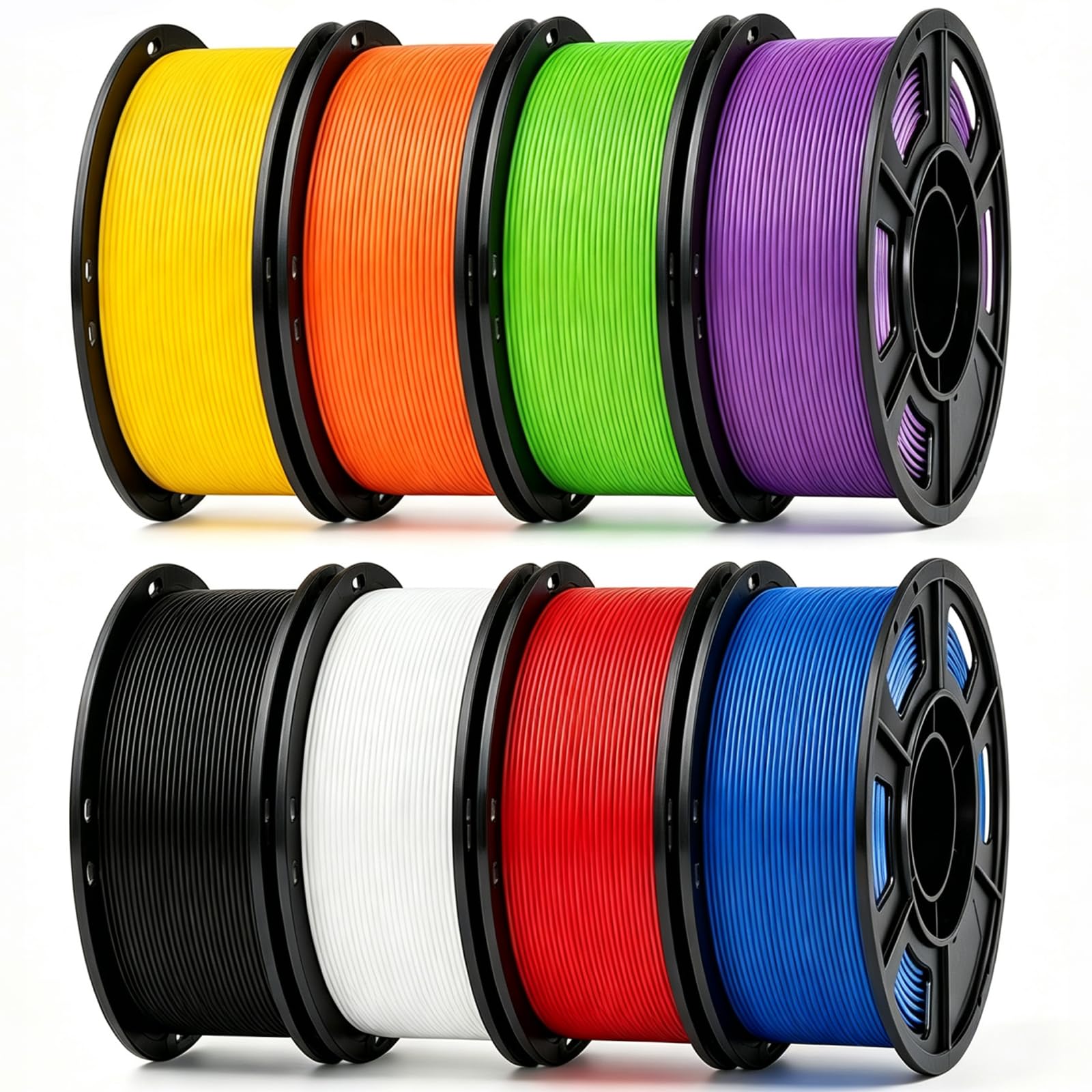
Eight 250-gram spools are a different way to buy PETG. Instead of committing a kilo to one color, UGUESS gives you black, white, red, blue, green, yellow, purple, and orange in a single box. That's useful for a maker who wants to test a palette on small parts before ordering full spools, or for a classroom that needs several colors at once.

The 2 kg total is enough for phone stands, cable clips, and small toys, and the PETG is tough enough for functional parts. The ±0.03 mm tolerance is looser than the precision spools here; for decorative prints and rough-fit parts, that won't matter, but for assemblies that need a press fit, choose a ±0.02 mm spool. We see this as a sampler, not a production spool.

The small spools have another advantage: they change color quickly, so you can print a multicolor part without buying eight kilos. For a first order, a classroom, or a gift set, the variety is the point.

Pros

  • Eight colors in one bundle
  • 250 g spools make sampling easy
  • Tough PETG for small functional parts
  • Good for classrooms and gifts

Cons

  • 250 g spools run out on large prints
Our verdict

For anyone who wants to try several PETG colors without buying full kilos, UGUESS's eight-spool bundle is the sampler we recommend.

Check Latest Price
7

Workshop Color Stock

CHCKX PETG 16-Color Bundle

86 /100
LBD Score Excellent

Key details

Bundle
16 × 1 kg
Colors
16 colors
Bed Temperature
70–80 °C
Nozzle Temperature
240–260 °C
View on Amazon

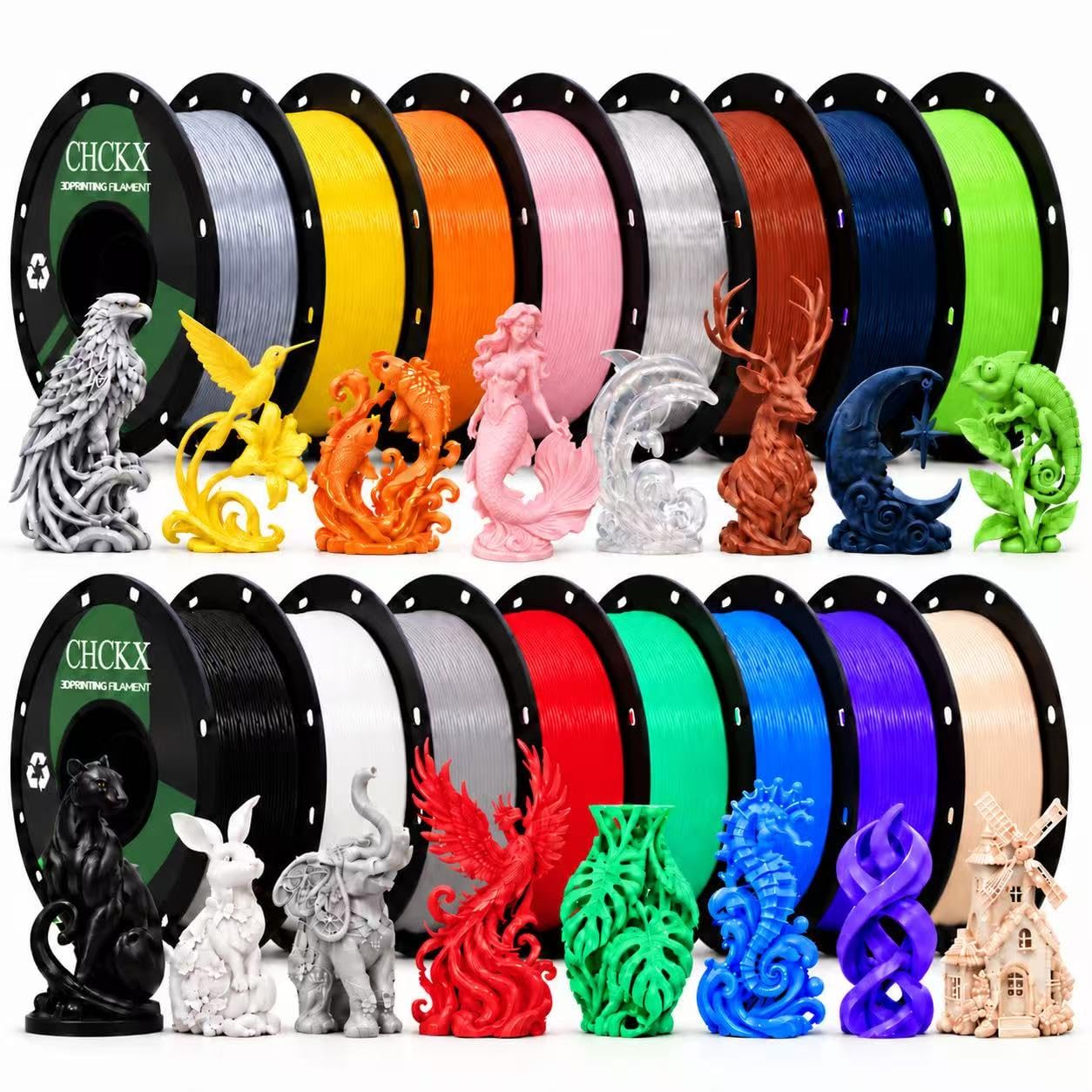
Sixteen kilos of PETG in sixteen colors is not a normal first order; it's a workshop's color library. CHCKX bundles black, white, grey, red, green, blue, purple, skin, silver, yellow, transparent, coffee, cherry blossom pink, orange, navy gray, and grass green, which covers almost any project without a reorder. The gloss black is the standout: it prints with a deep, shiny finish that makes functional parts look finished.

The filament prints smoothly right out of the box, and the 240–260°C nozzle and 70–80°C bed recommendations fit standard PETG profiles. We like the 1 kg spools for production runs; you can keep a color loaded and not babysit a 250-gram roll. The bundle also makes sense for a makerspace or a small print farm that wants a shelf of colors ready to go.

The catch is the commitment. Sixteen kilos takes real shelf space, and you'll want to store it sealed with desiccant. The gloss black is the one we reach for first; the transparent and silver shades show layer lines more.

Pros

  • Sixteen colors in one order
  • Smooth, glossy prints out of the box
  • 1 kg spools suit production runs
  • Good for makerspaces and print farms

Cons

  • Layer adhesion varies by color
Our verdict

For a workshop that wants a broad color shelf in one order, CHCKX's sixteen-spool bundle is the bulk color pick we recommend.

Check Latest Price
8

Decorative Translucent Prints

IEMAI Gradient PETG

88 /100
LBD Score Excellent

Key details

Finish
Translucent gradient
Spool Weight
2.2 lb
Max Print Speed
600 mm/s
Diameter Tolerance
±0.02 mm
View on Amazon

The blue-to-purple gradient is the reason to buy IEMAI's translucent PETG. It shifts across a print rather than changing in a hard stripe, and the light transmission makes it a natural fit for lampshades, lithophanes, and costume pieces. The glossy surface adds to the effect; this is a filament you choose for the look first.

The printing side is stronger than decorative filaments often manage. IEMAI rates it to 600 mm/s, and the ±0.02 mm tolerance and standard 1.75 mm diameter fit the usual printers. The translucency is not a fixed quality, though: thin walls glow, while thick sections read more solid. That's useful to know before you design a shade or a panel.

The gradient is not a paint job. Color placement depends on print size and orientation, so plan the model around the transition rather than expecting an exact match. Thin walls glow more than thick sections; that's useful for lamps and less useful for solid parts. For the right decorative print, the effect is worth the planning.

Pros

  • Smooth blue-to-purple gradient
  • Strong light transmission for lamps
  • 600 mm/s high-speed capability
  • Glossy, smooth printed surface

Cons

  • Spool can tangle on long prints
Our verdict

For lamps, cosplay, and display pieces where the color shift is the point, IEMAI's gradient PETG is the decorative pick we recommend.

Check Latest Price

How We Tested the Best PETG Filaments

We started by rounding up every 1.75mm PETG spool we could get our hands on and filtering on the things that matter before a printer is even switched on: stated diameter tolerance, grams per dollar, whether a brand offers multi-packs or refills, and how many colors one order gets you. That left 14 spools, which lived on our bench printers for four months.

Each spool went onto the same machine for a baseline print, then moved to whatever was running that week — a garage printer turning out brackets and jigs, a desk machine doing decorative pieces, a third churning plant stakes and hooks on weekends. We measured diameter with calipers at the start, middle, and end of every spool and logged the outliers. We watched first layers go down and noted whether they needed glue stick, hairspray, or nothing at all, and we recorded every tangle, cross-wound loop, and mid-print break.

The same test model went through each spool at its claimed top speed, and we compared stringing, surface finish, and how the layers met. We snapped finished parts by hand to see where they broke — a clean break at the layer line means poor layer-to-layer bonding, a ragged one means the plastic itself gave out. Functional pieces got left in a hot car and dropped on concrete.

Value was judged on failed prints rather than price: a cheap spool that clogged twice costs more in time than the pricier one that never did. Color got checked as a set, too — bundles were judged on whether the spools matched their swatches and whether the next spool printed the same as the last.

How to Choose Petg Filament

Diameter Consistency and Spool Winding

A tolerance of ±0.02 mm is the figure we look for on a spool that will handle long prints. It won't make a bad profile good, but it keeps extrusion steady and helps parts fit together. The looser ±0.03 mm of a sampler like UGUESS is fine for decorative work and rough-fit parts; save the tighter tolerance for assemblies that need a press fit.

Winding matters just as much. A spool can be dimensionally perfect and still bind halfway through a job, so check the first wrap and keep the filament path straight. If a roll arrives tangled, rewind the first few meters before starting a long print.

Match the Speed Rating to Your Printer

High-speed PETG is formulated to melt faster, and the 500–600 mm/s claims on Polymaker and SUNLU are useful only on a printer with the hotend and motion system to use them. On a standard bedslinger running at 60–100 mm/s, ordinary PETG is usually the better value.

If you do have a fast machine, the speed rating can change your print times and the finish. We still run a temperature tower on a new spool; the fastest profile is not always the one with the best layer adhesion.

Choose the Spool Size That Fits Your Workflow

A single kilo is the right first PETG purchase: enough to tune the profile and print a few real parts without committing to a color you may not love. Once you know the filament works in your printer, a four-kilo black pack like ELEGOO's lowers the cost per part for high-volume work.

At the other end, UGUESS's 250-gram spools are for sampling, and CHCKX's 16-kilo box is for a workshop that wants a color shelf. Buy the small spools to test, the big box only when you have storage and a plan.

Dry It, Then Dial In the First Layer

PETG picks up moisture, and a wet spool shows it as popping, bubbling, or stringing. Dry a new spool if the first print looks foamy, and store the rest sealed with desiccant. A clean build plate and a bed in the 60–80°C range do more for adhesion than most slicer tricks.

Don't over-squish the first layer. PETG likes a little room, and a nozzle too close to the bed can leave a rough finish or a part that won't release. Run a small test print before a long job, especially with a new brand.

Pick a Finish for the Part

Glossy black is the most forgiving finish for functional parts because it hides layer lines and looks tidy after cleanup. A matte or satin PETG like SUNLU's high-speed spool is better for parts that should not reflect light, while translucent gradients like IEMAI's are for lamps, cosplay, and display pieces where the color shift is the point.

The finish also changes how much post-processing you need. If you plan to sand or paint, start with a glossy black and use the finish as a guide coat; if the part is meant to show its layers, a matte spool can make them look intentional.

Frequently Asked Questions

Final Verdict

Polymaker's high-speed PETG is the spool we recommend first. It prints cleanly, bonds well, and keeps up with a fast printer without forcing you into a four-kilo commitment. That makes it the best default here for everyday functional parts.

If your workflow is mostly black and high-volume, ELEGOO's four-kilo pack is the better buy; for a two-color start, Creality's black-and-white pair is simpler. The decorative picks earn their place when the look matters more than raw stock.