Best Overall

AstroAI M4K0R
Key details
- DC Current
- 10 A
- DC Voltage
- 600 V
- Resolution
- 4000 counts
- Safety Rating
- CAT III 600V
A 12V battery-test mode is the first thing that makes the AstroAI M4K0R feel aimed at car work rather than a general household drawer. It checks 1.5V, 9V, and 12V batteries, and the same meter covers AC/DC voltage to 600V, current to 10A, resistance to 40MΩ, continuity, diode, capacitance, and non-contact voltage. We recommend it as the default because it folds the functions most DIY automotive jobs actually use into a compact 219g body without making you learn a lab meter.
The 4000-count display is the useful middle ground: more resolution than a basic 2000-count unit for spotting small voltage drops, but not so much that the screen gets busy. Auto-ranging saves time when you move from battery voltage to a continuity check, and the CAT III 600V rating, ceramic fuses, and silicone cover are the right safety basics for 12V and 24V vehicle circuits. We also like the backlight and data hold for working under a dash or on a bench.
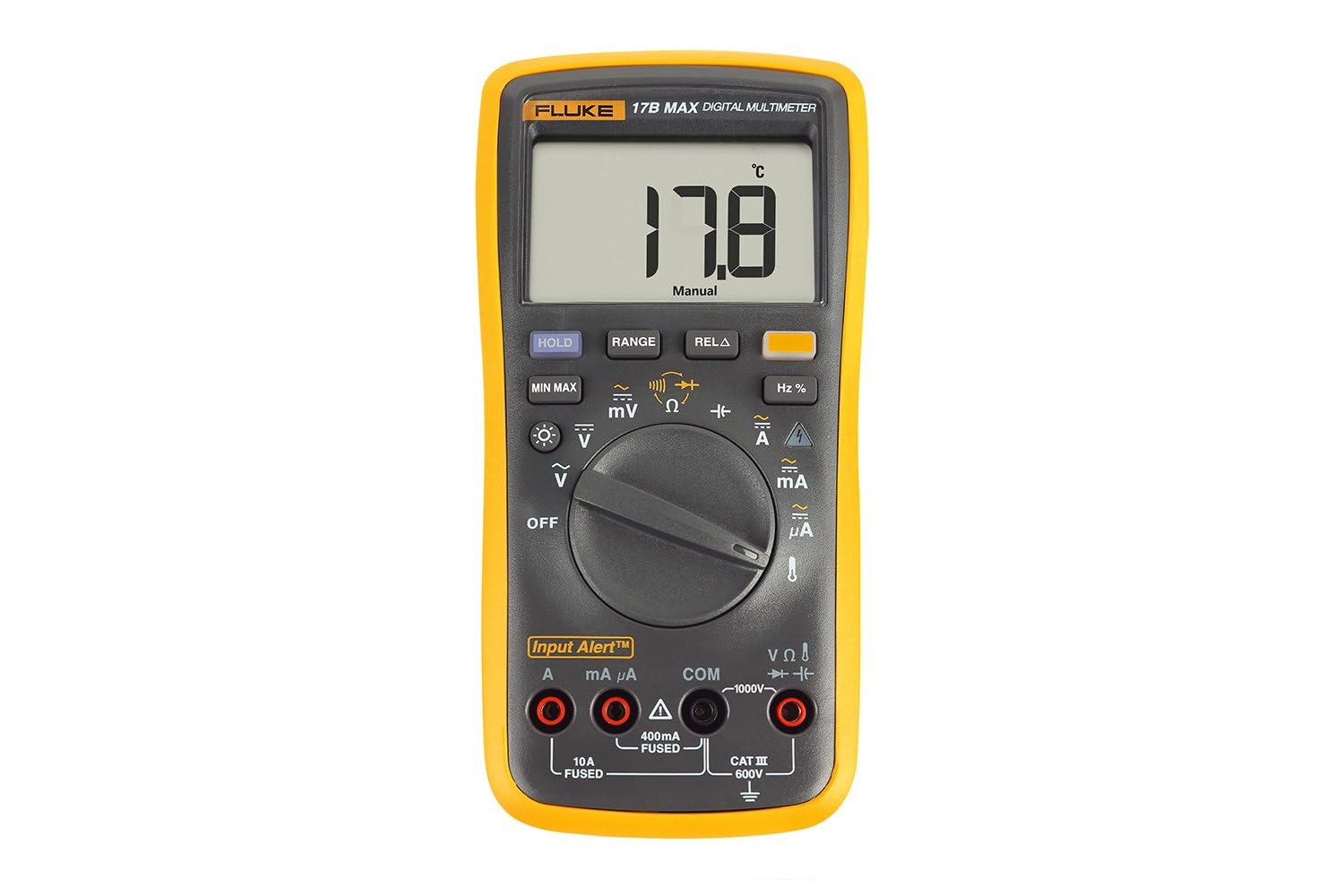
Where it stops: the 10A current range is for low-current diagnostics, not starter draw, and this is not the meter for hybrid or EV high-voltage packs. If you also need temperature and a broader electrical bench meter, the Fluke 17B+ is the step up. For most DIYers, though, the M4K0R hits the sweet spot: enough meter for real automotive tests, small enough to keep in the car, and simple enough to use without a manual.
Pros
- 12V battery-test mode built in
- Auto-ranging 4000-count display
- CAT III 600V safety rating
- Compact 219 g body
Cons
No notable drawbacks to flag.
We recommend the M4K0R as the default automotive meter for DIYers who want auto-ranging, NCV, and a 12V battery check in one compact tool.