Best PTZ Security Cameras of 2026

A fixed camera makes a bet that whatever matters will happen inside one narrow frame. A PTZ camera moves the bet: the head pans, tilts, and zooms on a motor, so it can sweep a driveway, follow a delivery up the walk, then close in on a face. That range is the appeal, and it's exactly where cheap models fall apart, with a motor that hunts around and loses the subject halfway through.

I've kept a camera over my front door for years, and the gap between a good one and a bargain shows up at 2 a.m. in the rain. My team and I spent seven months with 12 PTZ cameras — PoE, plug-in Wi-Fi, and solar — watching how each one handled a real street on a real night.

Worth sorting out early: zoom isn't one thing. Optical zoom moves glass; digital zoom just enlarges pixels until the picture turns to mush. Local storage matters too, since some models only give you useful recordings if you pay monthly. Every camera below earned its spot on a night when something actually happened.

1

Best Overall

REOLINK TrackMix PoE

86 /100
LBD Score Excellent

Key details

Zoom
6X hybrid, dual lens
Storage
microSD up to 512GB
Connection
PoE Ethernet
Resolution
4K 8MP
View on Amazon

The problem with most PTZ cameras is that zooming in costs you the wide view. The TrackMix PoE sidesteps it with two lenses in one housing: a 2.8mm wide-angle holding a 4K view of everything, and an 8mm telephoto that swings onto whatever is moving and stays with it. Both pictures sit on one screen in the app, so an alert shows you the whole driveway and the person walking up it without a single tap. Pan runs 355 degrees, tilt runs 90, and the whole camera hangs off one PoE cable.

That pairing is why we rate it above every single-lens camera here. Tracking is the most dependable of the group: it picks up someone crossing the front of a house and keeps them framed, and the person, vehicle, and pet filters cut the branch-and-shadow alerts down. The compromise is resolution. The telephoto sensor is 2MP, so the tracked close-up is visibly softer than the 4K overview. For a front yard or a driveway that is a fair trade, because you never lose the wide shot. For identifying someone far down a long drive, the long-zoom cameras on this page are the ones built for it.

Storage is the quiet win. A microSD slot takes up to 512GB, so the camera records on its own with no recorder and no subscription, and the card is the only thing you buy after the camera. If you do run it into a Reolink NVR, check that NVR's hardware revision before you order; Reolink publishes which ones support the dual-lens stream, and older units do not. At 3.6 pounds in an aluminum housing rated IP65, it also wants a proper mounting point rather than a siding clip.

Pros

  • Wide and telephoto views at the same time
  • Dependable tracking with person, vehicle, and pet filters
  • Records to microSD without a subscription
  • Single-cable PoE installation

Cons

  • Telephoto close-up is 2MP, softer than the 4K view
  • PoE only, with no wireless option
Our verdict

This is the PTZ we point most people to: a wide 4K view and a tracked close-up at the same time, over one Ethernet cable.

Check Latest Price
2

Best Wi-Fi

REOLINK E1 Outdoor Pro

81 /100
LBD Score Excellent

Key details

Zoom
3X optical
Storage
microSD up to 512GB
Connection
Wi-Fi 6, dual-band
Resolution
4K 8MP
View on Amazon

No cable, no problem is the whole case for the E1 Outdoor Pro. It is the Wi-Fi camera we keep on this list: 4K from an 8MP sensor, 3X optical zoom, Wi-Fi 6 on 2.4 and 5GHz, and a 512GB card slot that keeps recordings local. Plug it into an outdoor outlet, pair it, and you have a pan-tilt camera with real glass for less than the PoE dual-lens models. Three times optical is not much reach, but it does not have to be, because it tightens a wide driveway shot without the mush you get from digital zoom.

The number that decides where it goes is tilt: 50 degrees, against 90 on most of the others. Up under a soffit it cannot look steeply down, and you lose the ground directly beneath it. Put it nearer the height of what you are watching — a fence post, a garage corner, the top of a six-foot wall — and the shorter arc stops mattering. The wide end is also less sweeping than the 355-degree pan figure suggests, so walk the view in the app before you drill.

Two things to plan for. Motion detection is the fussiest part of this camera and wants tight zones and lower sensitivity, or passing cars set it off all evening. And the 12V adapter needs an outdoor outlet within reach of the cable; if the nearest one is inside a garage, the cable run becomes exactly the job you chose Wi-Fi to avoid. The camera itself is light and easy to hang — it is the power that is not.

Pros

  • Real 3X optical zoom, not a digital crop
  • Wi-Fi 6 on both 2.4 and 5GHz
  • Local microSD recording up to 512GB
  • Light body that is simple to mount

Cons

  • Tilt stops at 50°, so steep downward views are out
  • Needs an outdoor outlet and a weatherproof cable route
Our verdict

If there is power but no Ethernet at the wall, we choose this one: 4K, real optical zoom, and no subscription.

Check Latest Price
3

Best Budget PoE

Hiseeu 4K PoE PTZ

78 /100
LBD Score Very Good

Key details

Connection
PoE, ONVIF
Resolution
4K 8MP
Pan And Tilt
355° / 90°
Weather Rating
IP66
View on Amazon

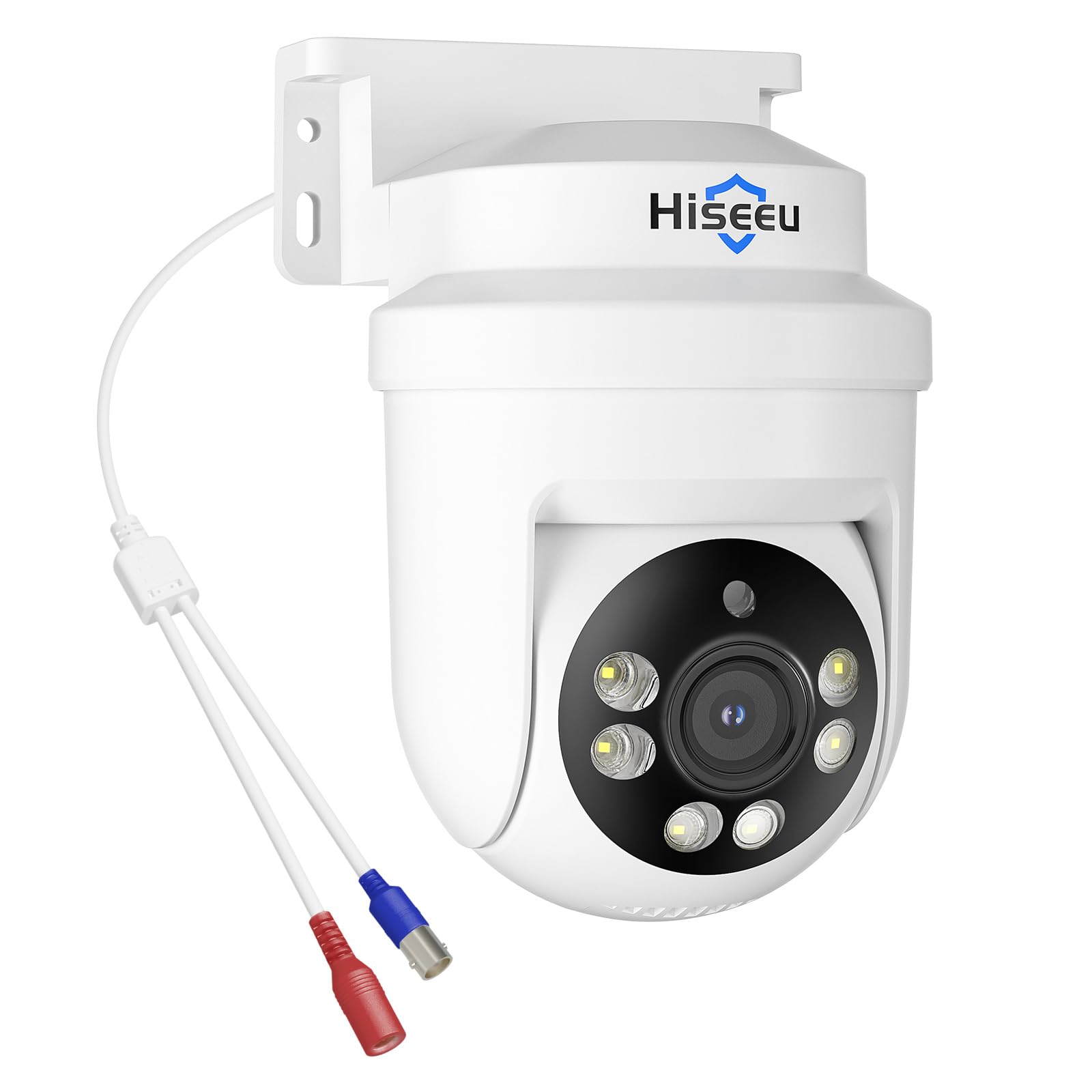
This is the least expensive way here to put a 4K pan-tilt camera on a PoE recorder, and nothing about it feels like a stripped-down special. You get an 8MP sensor, 355 degrees of pan and 90 of tilt, human and vehicle detection, a spotlight for color after dark, and two-way audio. The housing is rated IP66. It is the ordinary set of PTZ features done at the bottom of the price range, which is exactly what most first PoE setups need.

Setup is the part that surprised us. It picks up an address from the switch and settles into an ONVIF recorder without much argument, with pan and tilt responding from the recorder's own interface. The exception is software: it does not work with Blue Iris, and the camera is meant to run through Hiseeu's own PC application. If your plan is a Blue Iris box, skip this one and look at the Anpviz below.

For a first PoE camera, or a second one covering a side yard, it earns its place. Daylight picture is sharp, the spotlight gives usable color at night, and the pan is quiet enough that recorded audio stays listenable. The light coming on with motion gives you color and also tells anyone in the yard that the camera noticed them, which is a feature or a drawback depending on what you want a camera to do.

Pros

  • Least expensive route to 4K over PoE
  • Works with ONVIF hardware recorders
  • Spotlight color night vision and two-way talk

Cons

  • PoE only, with no Wi-Fi option
  • Ethernet cable not included in the box
Our verdict

The cheapest way into PoE, and the one we start with: 4K, smooth pan, and it speaks ONVIF.

Check Latest Price
4

Best Wire-Free

aosu 3K Solar PTZ

85 /100
LBD Score Excellent

Key details

Zoom
8X digital
Power
Solar panel and battery
Connection
2.4GHz Wi-Fi
Resolution
3K 5MP
View on Amazon

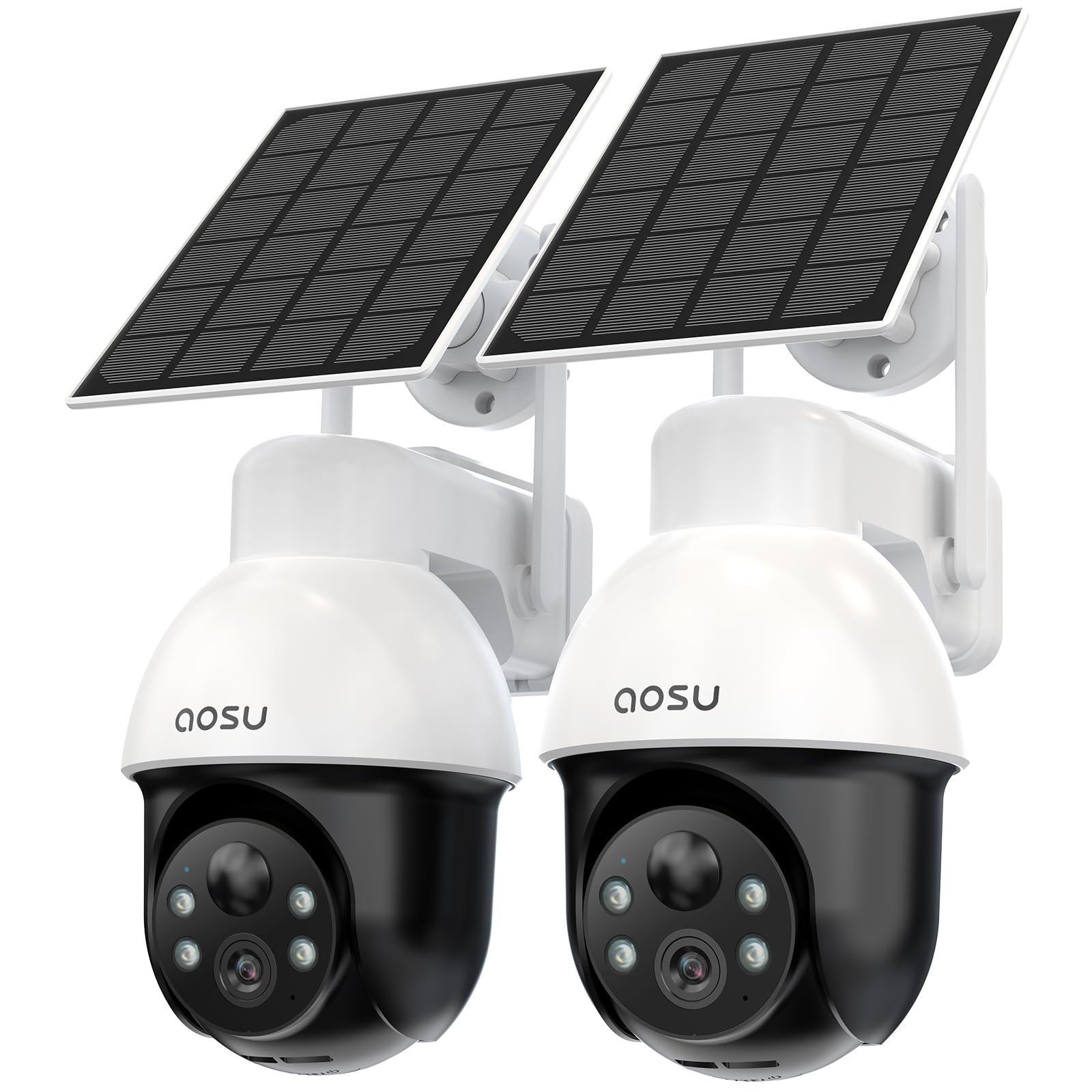
Some places you want to watch have no outlet and no hope of a cable run: the top of a driveway gate, a shed at the back of a lot, a fence line along an alley. That is the case for the aosu set. Each camera runs off a small solar panel and an internal battery, joins your network on 2.4GHz Wi-Fi, and pans a full circle with a spotlight for color after dark. Pairing happens over Bluetooth, and setup is the least painful part of owning these.

The zoom deserves a plain explanation, because the number flatters it. It is 8X digital, which means the camera crops into its 5MP frame instead of moving glass: good for a second look at a face at the gate, soft and grainy as you push further. If zoom is why you are buying a PTZ, this is not the one. If coverage in a place with no wiring is why, it very much is.

Signal and sun are the two variables. The radio is 2.4GHz only, and the wireless link is the weakest part of the package: these cameras drop off the network and want a restart more often than a wired camera ever will, so test the signal at the mounting point with your phone first. Solar charging is seasonal too, and a panel that keeps up easily in summer falls behind through a run of short gray days, which means a ladder and a USB cable now and then.

What settles it for us is the pair. The set is two cameras, which covers two sides of a yard for about what one wired PTZ costs, and the app runs both on one screen with the same tracking and siren controls. That makes it the right buy for a rental, a farm building, or anywhere you cannot put a hole in a wall for cable, as long as you accept digital zoom and the occasional reconnect.

Pros

  • No wiring at all, thanks to panel and battery
  • Two cameras in the set for the price of one elsewhere
  • Full 360-degree pan with color night vision and siren
  • Quick Bluetooth setup

Cons

  • Digital zoom only, so it crops instead of reaching
  • 2.4GHz Wi-Fi link is its weak point
Our verdict

For a gate or a shed with no power, we take this pair — just do not expect the zoom to be optical.

Check Latest Price
5

Best for Long Range

HXVIEW BU-H900

76 /100
LBD Score Very Good

Key details

Zoom
50X optical
Connection
Wi-Fi, ONVIF/RTSP
Frame Rate
10 fps
Resolution
4K 8MP
View on Amazon

Fifty times optical zoom is not a spec you can wave off. On a long drive, a dock, a field gate, or a marina berth, this camera pulls in detail the 3X and 6X models here cannot resolve, and it does it with moving glass and an autofocus lens rather than a crop. The head is quick, up to 200 degrees a second, so it sweeps a wide perimeter and settles. Eight LEDs and a 1,500-lumen floodlight handle the dark end.

The reach costs you elsewhere. The 4K stream runs at 10 frames per second, so a person walking briskly looks like a flip book and a passing car is a smear of separate frames. It draws 48 watts, several times what anything else here uses. The card slot tops out at 128GB. And CamHipro, the app, is the least pleasant control surface in this group: tapping an arrow key jogs the head further than you want, and manual pan and tilt take practice.

For the job it is built for, none of that changes the answer. It is worth the money when the alternative is a camera that cannot see the thing you need to see, and RTSP and ONVIF support mean it can feed Blue Iris, Frigate, or a NAS if you prefer not to use CamHipro at all. Mount it where that job is. As a general front-door camera it is an expensive way to get a narrow view.

Pros

  • 50X optical zoom with autofocus
  • Fast head that sweeps 360 degrees endlessly
  • RTSP and ONVIF output for software recorders

Cons

  • 10 fps at 4K makes fast movement choppy
  • App and manual pan-tilt controls are clumsy
Our verdict

We reach for this one when the detail you need is genuinely far away; 50X optical is a different class of reach.

Check Latest Price
6

ONVIF Builds

Anpviz 6MP PoE PTZ

79 /100
LBD Score Very Good

Key details

Zoom
5X optical
Connection
PoE, ONVIF
Resolution
6MP
Pan And Tilt
280° / 90°
View on Amazon

It is a small metal turret, not much bigger than a coffee mug, and it feels like commercial gear rather than a plastic dome — which fits, since Anpviz sells these into shops and small offices as readily as houses. Inside is a 6MP sensor at 25 frames per second, a 2.7 to 13.5mm lens with 5X optical zoom, spotlights and a sound alarm, and three night vision modes. It is also NDAA-compliant, which matters if the camera is going on a school, a municipal building, or a federal site.

Where it earns its place is software. This is the most agreeable camera here for a self-built system: ONVIF throughout, comfortable in Blue Iris, and already proven in Frigate and Synology Surveillance Station. The pan is the catch — 280 degrees, not 360 — so a corner mount leaves a wedge behind it unwatched. For a driveway or a side passage, 280 degrees covers the approach and the money goes into the lens and the housing instead of the motor.

Five times optical is modest next to the long-zoom cameras, and that is the honest limit: it tightens a plate at the end of a drive, it does not read one across a field. Detection is the other thing to tune, since foliage and headlights trip the human filter until the zones are tightened. Neither is unusual for the category, and at this size and price neither is a reason to walk away.

Pros

  • ONVIF support that plays well with software recorders
  • Metal housing that feels like commercial gear
  • 25 fps at 6MP for smooth motion
  • Three night vision modes with spotlight alarm

Cons

  • Pan limited to 280°, leaving a blind wedge
  • 5X zoom will not carry across a long field
Our verdict

The camera we hand to anyone running Blue Iris or a NAS: small, metal, ONVIF, and priced for a 5X optical zoom.

Check Latest Price
7

Analog DVR Upgrades

Hiseeu 5MP TVI Dome

80 /100
LBD Score Excellent

Key details

Connection
TVI/AHD to DVR
Resolution
5MP
Night Vision
IR up to 100 ft
Pan And Tilt
355° / 90°
View on Amazon

This is a replacement camera, not a system. It is built for the analog HD recorders still sitting in a lot of garages: TVI and AHD over coax, 5MP, 355 degrees of pan and 90 of tilt, infrared good to about 100 feet, and an IP67 housing. It does not zoom at all. Pan and tilt come from the recorder's controls, so how well it works depends on your DVR's menu, and there is no power adapter or BNC cable in the box. With those conditions met, we only recommend it as a cheap way to add movement to an old system.

In use it is about as plug-and-play as analog gets. The recorder picks it up as a 5MP source immediately, the head answers the DVR's controls, and the infrared lights a garage well enough to see what you are looking at. If you are building anything new, stop here and buy a PoE camera instead, because the picture is a generation behind and the missing zoom is the half of PTZ you miss most.

Pros

  • Cheap way to add pan and tilt to an old DVR
  • Recognised immediately by an existing recorder
  • Useful infrared reach for a garage or shed

Cons

  • No zoom at all
  • Power adapter and BNC cable sold separately
Our verdict

We only recommend it if you already own a TVI or AHD recorder, but there it is a cheap way to add pan and tilt.

Check Latest Price

How We Tested These PTZ Cameras in Real Yards

We started by pulling every camera we could find that genuinely moves its lens — pan, tilt, and zoom on a motor — then cut the list by power source (PoE, plug-in Wi-Fi, solar), zoom type (optical versus digital), and whether footage lands on a memory card or a drive without a subscription. That left 12 cameras, which we mounted at our own homes for seven months: above front doors, over driveways, on back decks, and one on a rural outbuilding where the Wi-Fi barely reaches.

Setup came first. I timed each one from box to first live view, working alone with a phone, and noted whenever it demanded a hub, a recorder, or an account before showing a single frame. Then we spent weeks doing things on purpose in front of them — walking the driveway at different speeds, carrying boxes, backing a car out, standing at the far edge of the frame after dark — and logged whether each camera caught the motion, followed it, labeled it correctly, and swung back to where it started. Branch sway, headlights, and rain got noted too, because a camera that pings every ten minutes gets ignored within a week.

For picture quality we pulled stills at dawn, dusk, and full dark, compared color night vision against infrared, and read a license plate at the end of the driveway at each zoom step. Reliability meant leaving them running: we tracked dropouts, reconnects after a router reboot, and weak-signal stalls at the far corner of the yard. The solar model got checked weekly through a cloudy stretch to see how fast the battery fell. Value got the last word — what you get out of the box versus what quietly needs a subscription.

How to Choose a Ptz Security Camera

Power and connection decide more than the camera does

PoE is the easy recommendation when a cable can reach the spot: one Ethernet run carries power and data, the camera never competes for Wi-Fi bandwidth, and it comes back on its own after an outage. The cost is a PoE switch or injector and the willingness to drill and pull cable.

Wi-Fi saves the cable but needs an outdoor outlet at the mount and a strong signal at that exact corner — test it with your phone before you commit, because a router on the far side of a brick wall is not the same thing. Solar suits the places neither reaches, provided the panel sees sun and the radio still gets a signal. Note that wireless usually describes the video link, not the power.

What optical zoom actually buys you

Optical zoom moves glass and keeps every pixel; digital zoom crops the frame and throws pixels away, and the picture goes soft fast. Three to five times optical is enough to tighten a driveway or a doorway. Sixteen times and up is for a long field, a dock, or a perimeter, and it comes with a narrow wide end — a long-zoom camera zoomed in watches a keyhole.

Dual-lens cameras get around the trade by fitting a wide lens and a telephoto in one housing and showing both at once, which is what our top pick does. If you can only have one view on screen, decide whether overview or detail matters more before you pay for reach.

Resolution is only half of image quality

A 4K badge tells you nothing about how the picture behaves when something moves; frame rate does. Twenty-five frames per second gives smooth motion, while the 10 frames per second one camera here runs at 4K turns a walking person into a series of stills. Read both numbers on the same line of the listing.

The same caution applies to dual-lens models, where the second lens is often lower resolution than the main one. A 4K overview paired with a 2MP close-up is a deliberate and useful design; a 4K overview with a 2MP close-up you did not know about is a disappointment. Check the sensor spec for each lens, not just the headline.

Auto tracking is the feature to test, not trust

Every camera here claims tracking, and it is the most variable thing in the category. Sensitivity set high chases branches, shadows, and headlights; set low, it drops a person who stops moving. Start with person and vehicle filters on, draw detection zones around the paths you care about, and lower sensitivity until the alerts get boring.

Then listen to a full pan. Pan and tilt motors are audible, and on a camera near a bedroom window or a patio where you take calls, that whirring becomes part of ownership. A gable mount puts the noise further from ears and gives the head a cleaner sweep.

Storage and the cost after the box

Local storage is what keeps a security camera cheap to own. A microSD card — 128GB on the most limited camera here, up to 512GB on several — records on its own, while an NVR adds continuous recording across several cameras and RTSP or ONVIF lets a NAS or a software recorder take over. None of that carries a monthly bill.

Decide where the footage lands before you buy, because it constrains everything else. A card gives you days, not weeks, at 4K, so set motion-only recording if the card is small. A recorder with a multi-terabyte drive is what buys continuous history across a whole property.

Frequently Asked Questions

Final Verdict

The REOLINK TrackMix PoE is the camera we recommend first, because it removes the choice that makes PTZ shopping annoying: wide view or close-up. It gives you both at once over a single cable, and the tracking that drives the close-up is the steadiest of this group.

If there is no way to run Ethernet to the spot you care about, the E1 Outdoor Pro is the same idea on Wi-Fi with a shorter tilt range. If there is no power there either, take the aosu pair and accept digital zoom.