Best Rechargeable Lanterns of 2026

The worst time to find out your lantern is dead is the night the power goes out — usually the same night you realize the switch is impossible to find by feel. A rechargeable lantern solves both, but only if it holds its charge while sitting in a closet for months and then throws enough light to get a family through dinner and a card game. The good ones also double as a phone charger and a tent light, and they cost little enough to keep one on every floor.

I've sat through enough blackouts to distrust big lumen claims, and four months with 16 lanterns proved that right: the headline number only holds on the most battery-hungry setting, and runtime slides once you step down to light you'd actually read by. What separated the keepers was how they charge, how honest their battery life is, whether the light comes out even and warm-ish instead of a harsh blue spot, and whether the price holds when you're buying four at once. The ones below earned their drawer space.

1

Best Overall

ZMNT C10 Lantern

93 /100
LBD Score Outstanding

Key details

Weight
9.17 oz
Max Brightness
1,000 lumens
Longest Runtime
Up to 300 hours
Battery Capacity
6,700 mAh
View on Amazon

The C10's trick is that it mounts as easily as it sits. There's a magnet in the base and a folding hook on top, which between them cover the two places a lantern actually gets used: hung from a tent loop or a branch, and stuck to something metal when there's nothing to hang from. At 260 grams and about 3 inches across, it disappears into a pack pocket. The 6,700mAh battery is the other half of the argument — up to 300 hours on the lowest setting means a long weekend or a multi-day outage never turns into a charging problem. That combination is what earns it the top spot.

Brightness is where it gives a little ground, since 1,000 lumens is mid-pack next to the AYL's 1,800. What the C10 does with those lumens is the more useful thing. Output is dimmable from full down to a glow, and there are three color temperatures: a warm setting that reads like a lamp rather than a flashlight, and cooler ones for cooking and map-reading. Sat on a picnic table, it lights the whole surface evenly, with no hotspot in the middle.

There's no spotlight mode, so it's the wrong tool for picking out a trail marker or finding a dog at the far end of a field — the AlpsWolf handles that job. For tent, table, and shelf duty, the 360-degree wash is exactly what we want from a lantern.

A two-year warranty, matched only by the Glocusent here, is more than we expect at this level. One habit worth forming: top it up when you get home rather than the night before the next trip, because with that much reserve a short charge goes a long way and you'll never open a dead lantern in the dark.

Pros

  • Magnet and hook cover almost any mounting spot
  • Up to 300 hours on the lowest setting
  • Three color temperatures with smooth dimming
  • 260 g and about 3 inches across

Cons

  • IPX5 only: rain and splashes, not immersion
Our verdict

The best all-around rechargeable lantern here: 1,000 lumens, 300 hours on low, and a magnet and hook for wherever you need it.
Check Latest Price
2

Best for Tents and Rooms

Glocusent C12 Lantern

91 /100
LBD Score Outstanding

Key details

Weight
10.5 oz
Max Brightness
1,500 lumens
Longest Runtime
Up to 200 hours
Battery Capacity
5,000 mAh
View on Amazon

Glocusent sizes the C12 for a room rather than a table. There are 135 LEDs behind a 360-degree diffuser, a stated 201 square feet of coverage, and 1,500 lumens at the top end. That is the widest, most even pool of light in this guide, and it's the one we point at anyone who wants a tent or a cabin lit properly rather than a bright point in the middle of it.

The controls are where it pulls ahead. Three color temperatures run from a 3000K warm through cooler whites, there are five brightness levels, and a single button cycles the lot — the right call when you're fumbling in the dark. At full output it will light a group's cooking area; on the lowest setting the 5,000mAh battery is quoted at up to 200 hours, which covers a week of evenings without a charger.

What it won't do is get rained on. IP45 handles splashes and dust, not a soaking, so plan on it living inside the tent or under the awning rather than out in the weather. Everything else about the design points the same way: this is an indoor-ish lantern, and for lighting a space indoors or in a tent it's the best of these.

Pros

  • Fills a room with even 360-degree light
  • Three color temperatures, five brightness levels
  • Up to 200 hours on the lowest setting
  • Red SOS strobe for emergencies

Cons

  • 7.3-inch body takes more pack space than the compact picks
Our verdict

Buy this one when the lantern has to light a whole tent or room — the even 360-degree wash and three color temperatures are the best of these for that job.

Check Latest Price
3

Best for Maximum Brightness

AYL 1800LM Lantern (2-Pack)

95 /100
LBD Score Outstanding

Key details

Weight
2.56 lb
Pack Size
2 lanterns
Max Brightness
1,800 lumens
Battery Capacity
4,400 mAh
View on Amazon

1,800 lumens is the ceiling of this set, and it changes what a lantern can do. The AYL throws enough light to cover a group's cooking area, a garage, or a whole shelter rather than just the table under it — and there are two of them in the box. We think that's the right pick whenever the area matters more than what the light weighs in a pack.

The rest of the design aims at the same job. The body is metal with rubber feet, so it stays put on a tailgate, the handle hangs from a hook, and four modes cover daylight, warm, a mix of both, and a flash, all of them dimmable. The 4,400mAh battery doubles as a power bank, which means a dead phone on day two of a trip has somewhere to go.

Weight is the honest trade. At about 1.16 kg each, these are lights you carry from the car to the campsite in one trip, not ones that live in a daypack — for that, take the C10 instead. What you get back is a light that sits still on a windy picnic table and doesn't flinch when someone knocks the bench.

Pros

  • Brightest output here at 1,800 lumens
  • Two lanterns in the box
  • 4,400mAh battery charges a phone
  • Four dimmable modes including warm light

Cons

  • IP44 covers splashes only
Our verdict

The one to buy when output matters more than pack weight: 1,800 lumens, two in the box, and a battery that can rescue a phone.

Check Latest Price
4

Best Multi-Pack

EZORKAS 4-Pack Lanterns

96 /100
LBD Score Outstanding

Key details

Warranty
24 months
Pack Size
4 lanterns
Power Source
USB charge or 3 AA batteries
Water Resistance
Water resistant
View on Amazon

Every one of the four lights in this kit runs on its built-in battery and also takes three AA cells. That second path is the reason to keep a set: in a long outage, a lantern you can feed from the drawer of batteries you already own doesn't go dark when its lithium cell does.

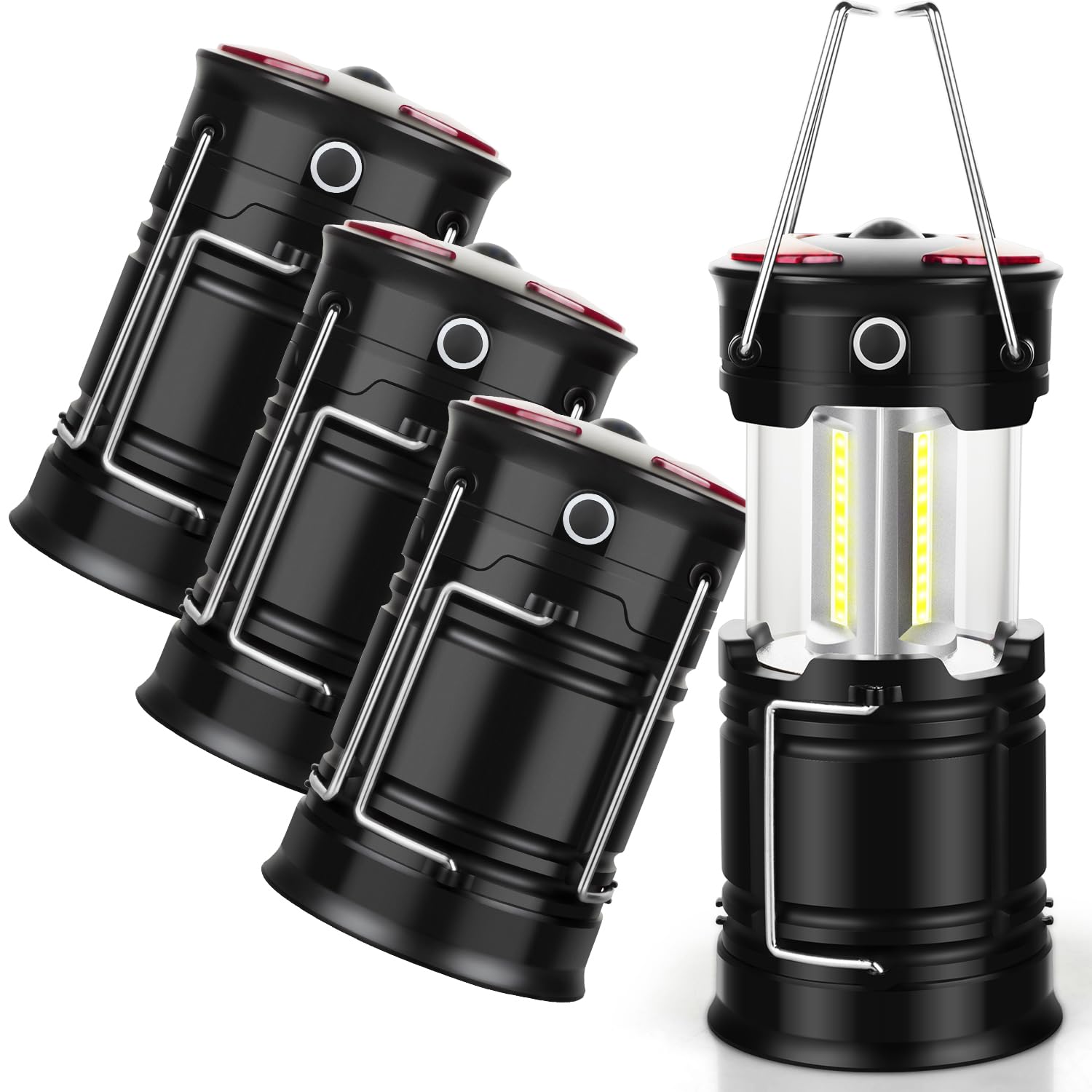
What we appreciate most is how little thought they need. Each one switches on when you pull the handle up and off when you push it down, so there's no button to hunt for in the dark, and the magnets in the base hold it to a fridge door, a breaker panel, or the underside of a shelf. Output is adjustable, there's a red strobe, and the body is small enough to hang from a nail or stand on a nightstand.

The catch is that each unit is a room light, not a floodlight — the 5-watt COB sits closer to a bright table lamp than to the 1,000-lumen picks here. For outages, shelves, and tents that's no loss; for lighting a whole campsite, buy one strong lantern and treat these as the backup.

Four lights also solve the problem of remembering where the one lantern went: one in the kitchen drawer, one in the car, one by the bed, one in the camping bin. That redundancy is the real product here, more than any single specification.

Pros

  • Four lanterns in one purchase
  • Runs on USB charge or three AA cells
  • Pull-up handle switches on with no button
  • Strong magnets in the base

Cons

  • 'Water resistant' with no IP rating behind it
Our verdict

The kit we recommend for a whole house: four lights that each run on a USB charge or three AA cells, so a long outage never leaves a room dark.

Check Latest Price
5

Best Lantern-Flashlight Hybrid

AlpsWolf T80G Lantern

93 /100
LBD Score Outstanding

Key details

Weight
0.8 lb
Beam Distance
1,640 ft
Max Brightness
800 lumens
Water Resistance
IP65
View on Amazon

There's a camera-style thread in the base of the AlpsWolf, which is the detail that turns it into a work light: screw it onto a tripod or a clamp and you can aim it at a job instead of propping it up. The spotlight behind that idea is rated to 1,640 feet.

Four tools share the body — spotlight, 360-degree lantern, flashlight, and a red emergency strobe — cycled from one power button, with a swivel handle that works as a stand or a hook. IP65 is the highest weather protection stated on any lantern here, which is the number we trust most in a wet field, and at 0.8 pounds it drops into a glovebox without a second thought. A three-hour charge fills the 3,600mAh battery.

Where it earns its place is the car. A light that can throw a beam down a dark road, stand on its own base, hang in a tent, and turn into a red flasher covers the situations a table lantern doesn't, and it does all of that from eight ounces and one battery.

Pros

  • Spotlight and lantern in one body
  • IP65: the best weather sealing here
  • 8-ounce body with a swivel handle
  • Screws onto a standard camera mount

Cons

  • Lantern mode trails the dedicated area lights
  • One-year warranty
Our verdict

The glovebox light: a long-throw spotlight that also glows as a lantern, sealed to IP65 and light enough to forget you packed it.

Check Latest Price
6

Best Budget

Blukar 116-LED Lantern

92 /100
LBD Score Outstanding

Key details

Runtime
10 to 48 hours
LED Count
116
Battery Capacity
4,800 mAh
Water Resistance
Not water resistant
View on Amazon

Blukar folds. Collapsed, it's a 5-inch cylinder that throws a tight, concentrated beam; pull the sides open and the body fans out into a wider, softer light, with the head tilting up to 90 degrees so you can aim it at a wall or a ceiling. Not many lanterns let you change the shape of the light rather than just the brightness.

Seven modes is more than anyone needs, but they're arranged sensibly: side light only, bottom light only, both, and a red SOS, at high and low, plus a strobe. The 4,800mAh battery is quoted at 10 to 48 hours depending on mode, and it charges over USB-C with the cable in the box.

The limit is weather. There's no water-resistance rating at all, so this is a dry-weather, in-the-tent, in-the-drawer lantern — don't leave it out overnight and don't count on it in rain. Within those terms it's the least expensive way into a good light here, and we like it best as the one that lives in a kitchen drawer or a glovebox.

Pros

  • Folds and fans open to widen the beam
  • Seven modes including a red SOS
  • 4,800mAh with 10 to 48 hours quoted
  • Charges over USB-C

Cons

  • 394 g is heavy for its size
Our verdict

Spend the least and still get a genuinely bright light — as long as you keep it out of the rain, which its missing water-resistance rating demands.

Check Latest Price
7

Solar Backup Kit

LETMY 4-Pack Lanterns

92 /100
LBD Score Outstanding

Key details

Weight
1.1 lb
Pack Size
4 lanterns
Power Source
Solar, USB, or 3 AA batteries
Max Brightness
600 lumens
View on Amazon

A small solar panel sits in the top of each of these four lanterns, which is the sort of feature that sounds better than it works. Treat the panel as a top-up for a light that lives on a windowsill, not as a way to run off-grid for a week — the built-in battery and the USB cable are what you'll actually rely on.

The third option is the practical one in an outage: each lantern takes three AA cells, so the kit keeps working when the internal batteries are flat and there's no power in the house to charge from. They collapse small, hang from a folding handle, and the COB element is quoted at 600 lumens — enough for a tent and a good part of a room.

Four lights means four places to leave one, which is the same argument the EZORKAS set makes and the same reason a kit beats a single lantern for a household.

What we like here is the redundancy rather than the solar. Buy it when the goal is coverage instead of one great light, and keep the USB cable in the same drawer as the lanterns so a top-up is never a search. If one lantern has to be good rather than plentiful, the C10 is the better spend.

Pros

  • Solar, USB, and AA power in one lantern
  • Four lanterns per set
  • Collapsible body with a folding handle
  • 600 lumens from a COB element

Cons

  • Short runtime at useful brightness
Our verdict

Buy the LETMY set when redundancy beats performance: four lights, three ways to power each one, and no single failure leaving you in the dark.

Check Latest Price
8

Hanging Tent Light

Lepro 1000LM Lantern

93 /100
LBD Score Outstanding

Key details

Light Modes
Cool, warm, combined, flash
Max Brightness
1,000 lumens
Battery Capacity
4,400 mAh
Water Resistance
IPX4
View on Amazon

Two hooks — one on the top and one in the base — is a small thing that changes how you use a lantern. Hung upside down from a tent loop, the Lepro throws its light down onto a table instead of out at eye level, which is the difference between a bright tent and a usable one.

The light itself has four modes: cool white around 6000K, a warm 3100K, both together, and a flash. The warm setting is the one we want over a picnic table, because it makes a tent feel like a room rather than a campsite, and the 1,000 lumens of output is dimmable.

The 4,400mAh battery can top up a phone, and IPX4 means rain at an angle is survivable as long as the lantern isn't sitting in a puddle. The plastic case is ordinary and the warranty runs a year — nothing special, nothing alarming.

What you're buying is the warm-light hanging lantern with a charger built in: the one to hang over a table for the evening, then unhook and carry to the tent. It's an unglamorous design that does the two things a tent lantern needs, which is warm light and somewhere to hang it.

Pros

  • Hooks top and bottom for downlighting
  • Warm 3100K, cool, combined, and flash modes
  • 4,400mAh battery doubles as a power bank
  • 1,000 lumens with dimming

Cons

  • Runtime at higher output is a fraction of the 12-hour claim
  • Bulky at 550 g and 7.8 inches tall
Our verdict

The warm-light hanging lantern: a base hook, three color temperatures, and a power bank, so long as you accept a bigger body and a shorter evening than the claim suggests.

Check Latest Price

How We Tested Rechargeable Lanterns in a Real Blackout

We started by pulling every rechargeable lantern we could find in stock and sorting them the way a shopper does: brightness and battery capacity claims, how they charge, whether the price makes sense once a multipack is divided down to cost per lantern, and whether the packed size suits a kitchen drawer or a glovebox. That cut the field to 16 lanterns, and we've spent four months with them — through a scheduled lights-out night at home, a real overnight outage, backyard tent weekends, a garage, and the trunk of a car.

Each one arrived and went straight onto a charge with a stopwatch running, so we knew how long a dead-to-full charge takes from a wall outlet and again from a power bank in the car, and whether the cable in the box actually fit the port. Then we drained them, first on the brightest setting and again on a middle one, noting the moment the light stopped being usable for reading rather than the moment the lantern quit, and checking whether it could fall back on standard batteries when the cell ran flat.

In a dark room we looked for hot spots thrown across the far wall, judged whether the light read blue-white at eye level, and cycled through every brightness level and color mode to see if the dim settings were genuinely usable or just decorative. Each lantern got weighed and measured in its packed-down state, and multipacks were judged on whether a single lantern was worth owning on its own.

Durability got the rough treatment: dropped off a picnic table onto pavement, shoved into a duffel with cast-iron pans, sprayed with a hose, and left out in a drizzle, with a check for fogging behind the lens and a look at whether the hanging hook or strap still held.

How to Choose a Rechargeable Lantern

Start With the Shape of the Light

A 360-degree lantern and a spotlight can carry the same lumen figure and behave nothing alike. Lumens measure total output, not how the light lands: a diffused cylinder spreads it over a table, a tent, or a room, while a reflector throws a narrow beam you can point at something. For camping and outages the diffused shape does more work, and a well-diffused 500 lumens fills a small tent better than a 1,000-lumen hotspot. Pick the shape that matches where the light has to go, then compare numbers within that shape.

Runtime Is a Setting, Not a Number

Long runtime claims come from the dimmest mode. Two or three hundred hours is real, but it's a glow you'd use as a night light, not light to cook or read by, and full output costs you most of it. Battery capacity in mAh is a rough way to compare lanterns of similar efficiency; the honest question is how many hours you get at the brightness you'll actually sit in. When a listing says 'up to', read it as the ceiling and plan on a fraction of it.

Ports, Cables, and Solar Panels

Charging is where budget lanterns cut corners. USB-C is worth having if the light gets charged often; several models still use older USB connectors and ship with a short cable and no wall adapter, though any 5V phone charger works. Solar panels built into a lantern are small, and a day on a windowsill adds a fraction of a charge — a useful top-up, a hopeless plan. Put a cable in the kit and treat solar as a bonus rather than a power source.

Hooks, Magnets, and Weather Sealing

Think about where the lantern will sit before you think about modes. A hook suits a tent loop or a branch, a magnet suits a breaker panel or the underside of a shelf, and a flat base suits a table. One trap: a 360-degree lantern on a table at eye level is glare, not light — hang it higher or pick one with a hook in the base. Sealing is stated as an IP rating, where IPX4 and IP44 take rain, and IP65 adds dust.

One Good Lantern or a Four-Pack?

A single good lantern puts the whole budget into output, battery, and a decent diffuser. A four-pack spreads the same money across placement, which is what an outage actually needs, and kits often add an AA fallback so a flat internal battery isn't the end of the light. Our rule is one strong lantern for camping and travel, a cheap pack for the house and the car. Buy the single first if you camp; buy the pack first if your worry is the grid.

Frequently Asked Questions

Final Verdict

Our pick is the ZMNT C10. It's the only lantern here that pairs a genuinely long reserve — 300 hours on low from 6,700mAh — with mounting that suits a tent loop, a shelf, or a metal panel, and it does it at 260 grams with a two-year warranty behind it.

If the job is lighting a room rather than a table, the Glocusent C12's 360-degree wash and three color temperatures are the better answer. If you're outfitting a house for outage season, buy the EZORKAS four-pack for the rooms and keep the C10 for yourself.