Best Robot Vacuums of 2026

Most of the time, a robot vacuum's best quality is that you forget it's there. The floor gets done while you're on a call; the dog hair you'd have swept at 10 p.m. is gone. The trouble is that some machines are forgettable for the wrong reason: they high-center on a rug fringe, quit at 40 percent battery in the middle of the hallway, or leave a wet mop pad brewing in the dock.

Sorting that out took nine months and 12 robot vacuums, run through real homes with mostly hardwood, one determinedly sheddy dog, and a few low-pile rugs. The pattern had little to do with the suction number on the box. Navigation and brush design decide whether a machine finishes the room; a modest vacuum that maps properly beats a monster that wedges itself under the same chair daily.

The pricier models do buy something real: docks that wash and dry their own mop pads, side brushes that reach under the cabinet toe-kick, mop pads that lift clear of the rug. Whether that's worth the jump depends on how much you mind touching a wet mop. Below are the ones that earned their floor space.

1

Best Overall

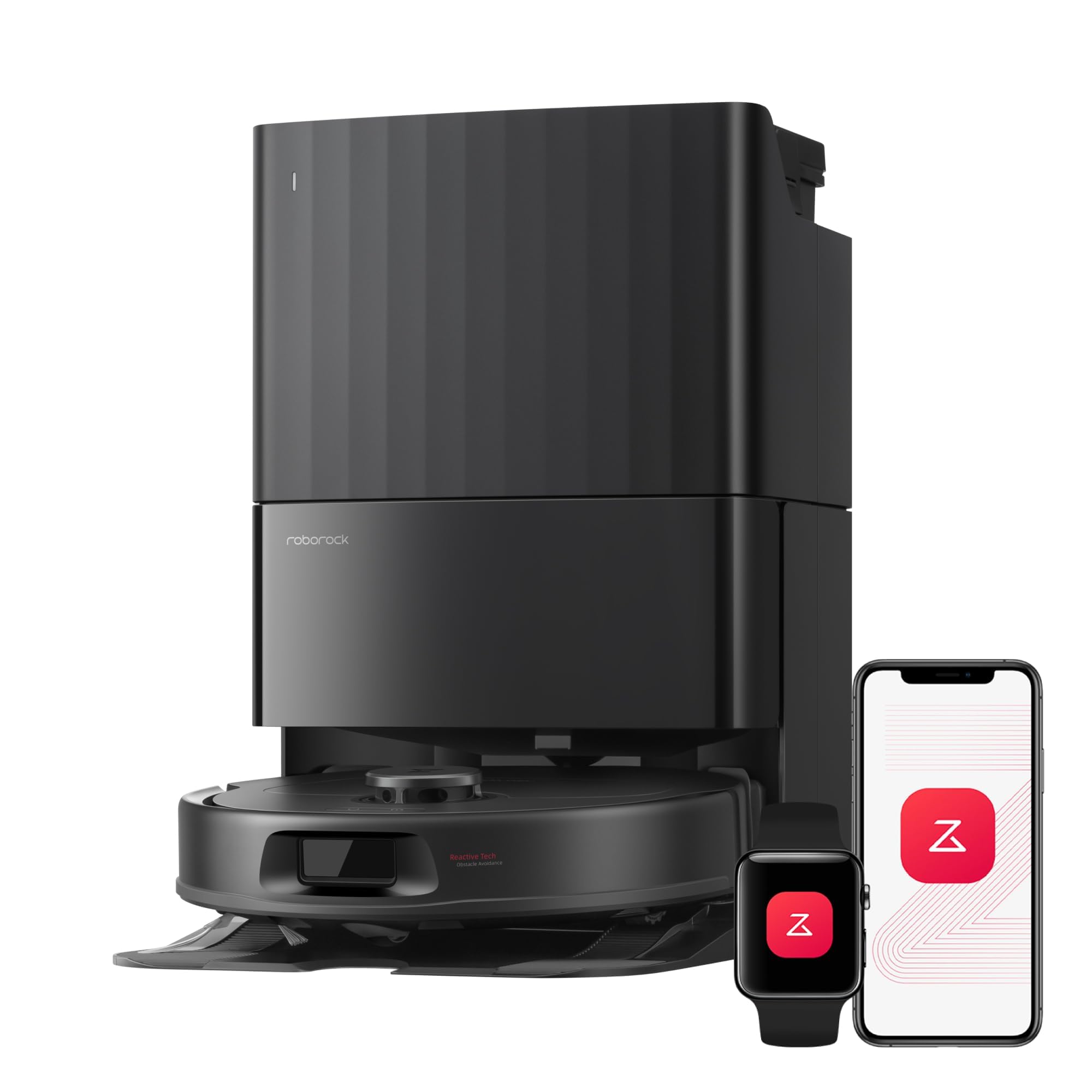
Roborock Qrevo S Pro

84 /100
LBD Score Excellent

Key details

Runtime
180 minutes
Suction
18,500Pa
Mop System
Dual liftable spinning mops
Self-empty Bag
2.7 liters
View on Amazon

A dock that empties the bin, washes the mop pads in 167°F water, dries them, and refills the robot's tank is the difference between a vacuum you run every day and one you stop running. The Qrevo S Pro has all of it, and that's why it leads this list. The sealed 2.7-liter bag takes seven to nine weeks to fill, and the liftable spinning mops rise clear of a rug instead of dragging a wet pad across it.

In use, the parts we noticed were the boring ones. Dust goes into a sealed bag rather than a cup you tip over a bin, and the pads come out of the dock washed and dried — which is what stops the sour smell that follows a wet mop left in a corner. The 18,500Pa of suction is more than this robot needs on tile; it's on carpet that you feel the difference.

Navigation is LiDAR with obstacle avoidance, and it does what a mapped robot is meant to do: room-by-room runs, no-go zones, and a schedule you set once. Our one reservation is pet hair on carpet. With a heavy shedder, one pass can leave strands behind, and while mopping, hair can get pushed rather than picked up. Running it vacuum-only first and then a mop pass is the workaround we settled into.

The dreame has more raw suction and reaches further into corners, and the eufy is the one to look at if long hair is the entire problem. For a house that's mostly hard floor with some rug, this is the balance of automation, navigation, and cost that we keep coming back to.

Pros

  • Self-empties, hot-washes its mops, and dries them
  • 18,500Pa suction with LiDAR obstacle avoidance
  • Liftable spinning mops clear carpet
  • 180 minutes of runtime per charge

Cons

  • Large dock needs a clear wall spot
Our verdict

Our pick for most homes: it empties, washes, and dries its own mops, and the LiDAR navigation plus a 180-minute battery covers a whole floor on one schedule.
Check Latest Price
2

Best for Hard Floors

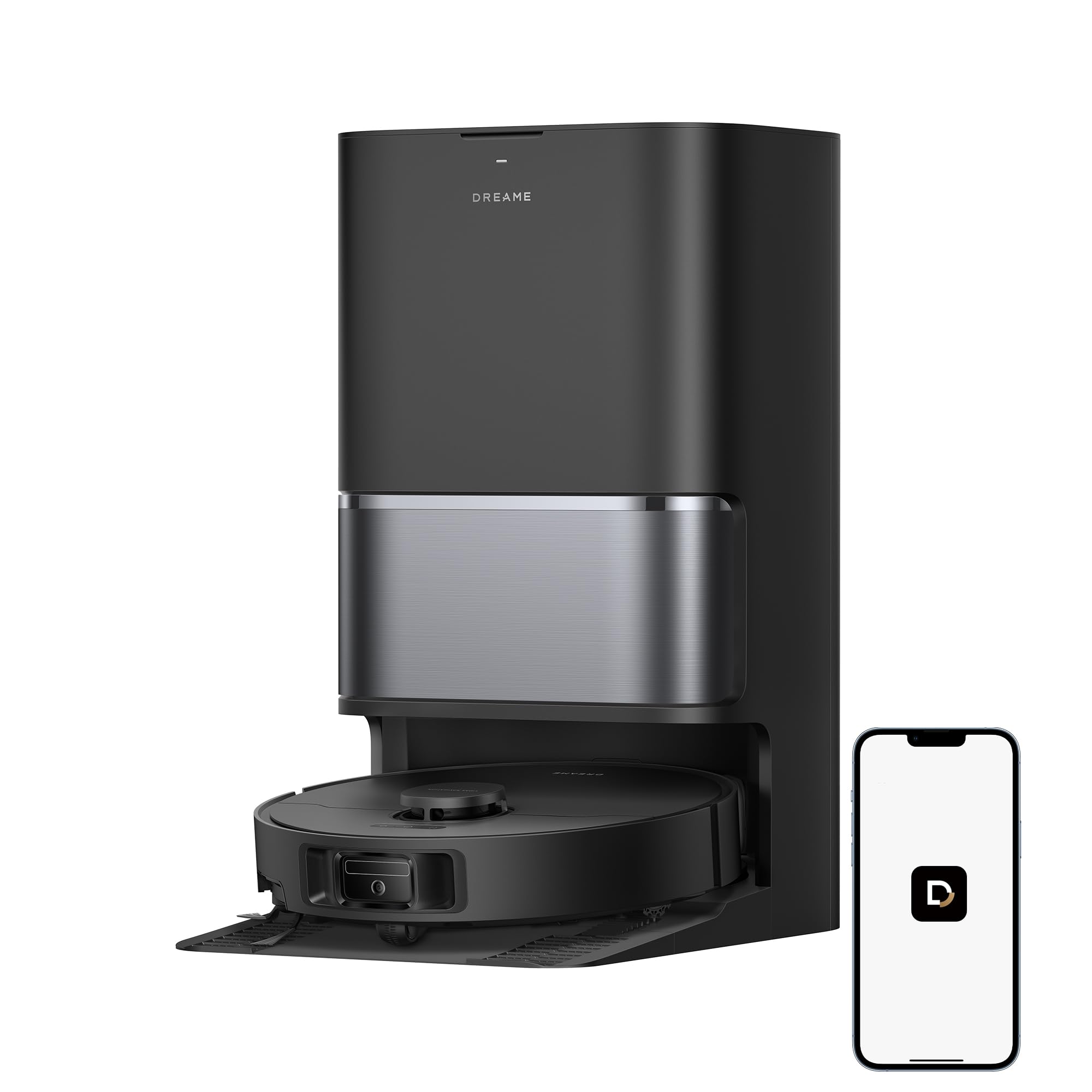
dreame L40 Ultra Gen 2

87 /100
LBD Score Excellent

Key details

Dock
Self-empty, mop wash, hot-air dry
Runtime
231 minutes
Suction
25,000Pa
Mop Lifting
10.5mm
View on Amazon

The L40 Ultra Gen 2 has something none of the other robots here do: an arm. Its side brush and one mop pad slide outward to sweep a corner and the recess under a toe-kick, which is exactly where a round robot leaves a crescent of crumbs untouched. We watched it work a corner that normally needs a hand brush, and it got there. The rest is premium on paper: 25,000Pa across five suction levels, dual spinning mops that lift 10.5mm, and a dock that empties, washes, and hot-air dries.

That reach is the difference between a floor that looks swept and one that looks cleaned, and it's why this is our pick for tile and wood. On rugs it's competent rather than special — the mops lift and the carpet modes do their job on low pile, but the surfaces it's built around are hard ones. If your ground floor is mostly hard flooring with a couple of flat rugs, this is the machine that shows it.

Two other things stand out. The 231-minute runtime is the longest in this group, and the obstacle avoidance reads shoes and toys rather than bumping through them. What you give up is money and history: this is the most expensive pick here and the newest, so there's less of a track record to lean on than the Roborock has.

Pros

  • Extending brush and mop reach corners and toe-kicks
  • 25,000Pa across five suction levels
  • 231-minute runtime, the longest here
  • Dock empties, washes, and hot-air dries

Cons

  • Highest price in this group
  • Built for hard floors; rugs are secondary
Our verdict

Buy it if your floors are tile or wood and the crumbs in corners annoy you — the extending brush and mop reach where round robots don't, and the dock handles the rest.

Check Latest Price
3

Best for Pet Hair

eufy C28

89 /100
LBD Score Excellent

Key details

Runtime
140 minutes
Suction
15,000Pa
Mop System
HydroJet roller, self-wash and dry
Self-empty Bag
3 liters
View on Amazon

Long hair is what finishes most robot vacuums: it wraps the roller, stalls the brush, and eventually takes the motor with it. The C28 is built around that. Its DuoSpiral brush is rated for hair up to 11.8 inches without wrapping, and the 28cm roller mop spins at 270 RPM with water fed through 24 ports, rinsing itself as it turns. That combination is why it's our pick for shedding pets and long-haired households.

The station does the rest: a three-liter bag that runs about 75 days, automatic mop washing, 50°C hot-air drying, and a clean-water tank that refills the robot on its own. Navigation is LiDAR without a camera, which matters if you'd rather a vacuum didn't carry one around your home, and it steers around anything bigger than roughly three centimeters.

The roller is the other difference worth knowing. One that rinses itself handles a kitchen floor better than a damp pad dragged behind, and it doesn't smear a spill across the room the way a flat pad can. Runtime is 140 minutes — mid-pack here — and a single roller covers less edge than the dreame's extending arm does.

Pros

  • Brush rated for 11.8-inch hair without wrapping
  • Roller mop rinses itself as it spins
  • Dock empties, washes, dries, and refills
  • Camera-free LiDAR navigation

Cons

  • Carpet limited to short wool pile
  • Suction trails the top picks here
Our verdict

For shedding dogs and long hair, this is the one: an 11.8-inch tangle rating and a self-rinsing roller mop make the mess that kills other robots a non-event.

Check Latest Price
4

Best for Multi-Level Homes

iMartine D16S MAX

87 /100
LBD Score Excellent

Key details

Height
3.93 inches
Runtime
180 minutes
Suction
18,000Pa
Base Dust Cup
1.3 liters
View on Amazon

At 3.93 inches, the D16S MAX is the tallest robot in this group — the two Tikoms and the ILIFE all sit at or under three. That's the number to check against your sofa before anything else, because a robot that can't get under the furniture leaves the dust line exactly where it was. What you get in exchange is 18,000Pa, 360° LiDAR with five saved floor maps, and a bagless self-emptying base.

Bagless is the detail that sold us. Every other self-emptying pick here feeds a bag you buy again and again; this one dumps into a 1.3-liter cup in the base that you empty and rinse. Add five floor maps and a 180-minute battery, and it's the sensible choice for a two-story house where the robot has to learn more than one layout and you'd rather not buy consumables forever.

Setup runs through the Tuya Smart or Smart Life app rather than a first-party one, and it handles room select, schedules, no-go zones, and Alexa or Google voice from there. It also climbs 18mm thresholds, which is what gets it over the lip between a kitchen and a hallway without your help.

Pros

  • Bagless base
  • Five saved floor maps for multi-level homes
  • 180-minute runtime and 18,000Pa suction
  • Climbs 18mm thresholds

Cons

  • Pad mop wipes rather than scrubs
  • 45-day base capacity, the shortest of the self-empty docks here
Our verdict

A two-story house on a midrange budget gets the most here: five floor maps, 18,000Pa, and a bagless base with no bags to buy for it.

Check Latest Price
5

Best Budget Self-Emptying

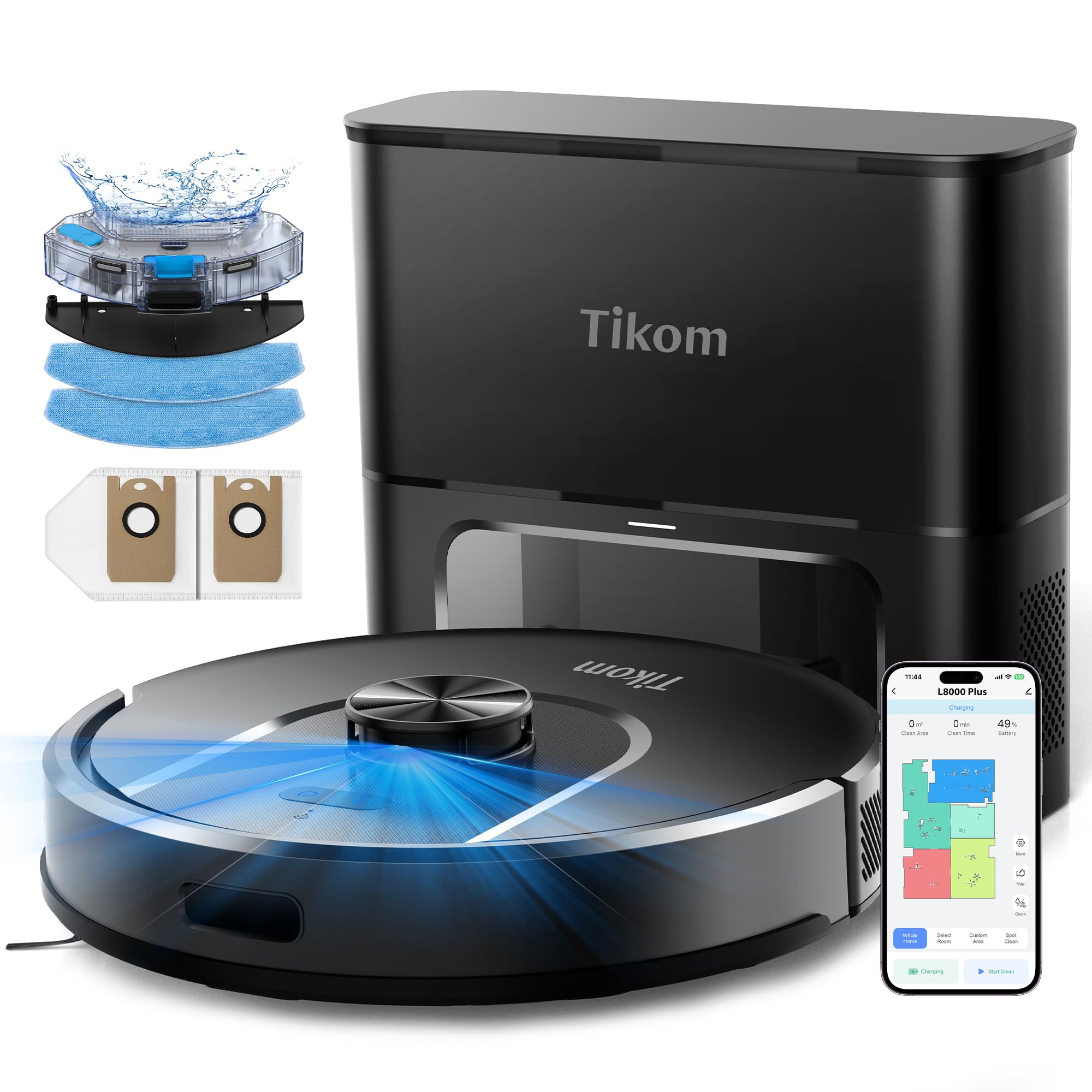
Tikom L8000 Plus

88 /100
LBD Score Excellent

Key details

Runtime
150 minutes
Suction
6,000Pa
Navigation
360° LiDAR with home mapping
Self-empty Bag
3 liters
View on Amazon

Two things usually vanish when a robot vacuum gets cheap: the laser mapper and the self-emptying base. The L8000 Plus keeps both. A 360° unit draws the rooms, holds no-go zones and virtual walls, and lets you send it to a single room from the app, while the dock swallows debris into a three-liter bag that runs about 90 days.

On the floor it's a 6,000Pa machine with three suction levels and three water-flow settings, sweeping and mopping in the same pass. The 150-minute runtime covers an apartment in one go, and 60dB means you can hold a conversation in the next room while it works.

What surprised us at this price was how little fuss the mapping caused — it drew the rooms on the first run and respected the no-go zones we set. If the top pick is more than you want to spend, this is the one that does the real work: it maps, it empties itself for months, and it doesn't ask you to think about it.

Pros

  • LiDAR mapping with no-go zones and room select
  • Three-liter bag empties itself for about 90 days
  • 150 minutes of runtime at 60dB
  • Sweeps and mops in one pass

Cons

  • Suction trails the flagships here
  • Bagged dock means buying replacement bags
Our verdict

If the top pick is more than you want to spend and your floors are hard, this maps like the expensive ones and empties itself for three months.

Check Latest Price
6

Small Apartments

Tikom G8000 Max

88 /100
LBD Score Excellent

Key details

Height
2.99 inches
Dustbin
450 ml
Runtime
150 minutes
Suction
5,000Pa
View on Amazon

If you live in a one-bedroom with a tiled kitchen and one rug, the G8000 Max is sized for you. It's 2.99 inches tall, so it goes under the bed and the sofa; it weighs a little over five pounds, so carrying it to another floor is nothing; and at 45dB it's the quietest thing in this group by a wide margin. We didn't have to raise our voices over it while it worked through the kitchen.

The 5,000Pa motor runs up to 150 minutes in quiet mode and recharges itself on the dock. A 450ml dustbin and a 300ml water tank ride on board together, so it vacuums and mops in one pass, and you get four modes including spot and edge plus four ways to start it: app, voice, a physical remote, or the button on top. The remote isn't a gimmick — it's how you run this without setting up an account.

Where it needs help is the floor itself. A curled rug edge, a phone cable, the gap under a low bookshelf: those are what stop it mid-run, and the fix is a two-minute tidy before you press start rather than anything you do to the machine.

As a first robot vacuum, that's a fair trade. You get daily hard-floor cleaning, quiet operation, and an app you can ignore, and you find out whether a robot fits your routines before spending flagship money on one.

Pros

  • Quietest listed machine here at 45dB
  • 2.99 inches tall and about five pounds
  • Vacuums and mops in one pass
  • Remote, app, voice, and button control

Cons

  • No self-emptying base
  • Least suction of the picks here
Our verdict

For a first robot vacuum in a small flat, it's quiet, slim, and simple to run, as long as your floors are hard and your rugs are flat.

Check Latest Price
7

App-Free Hard Floors

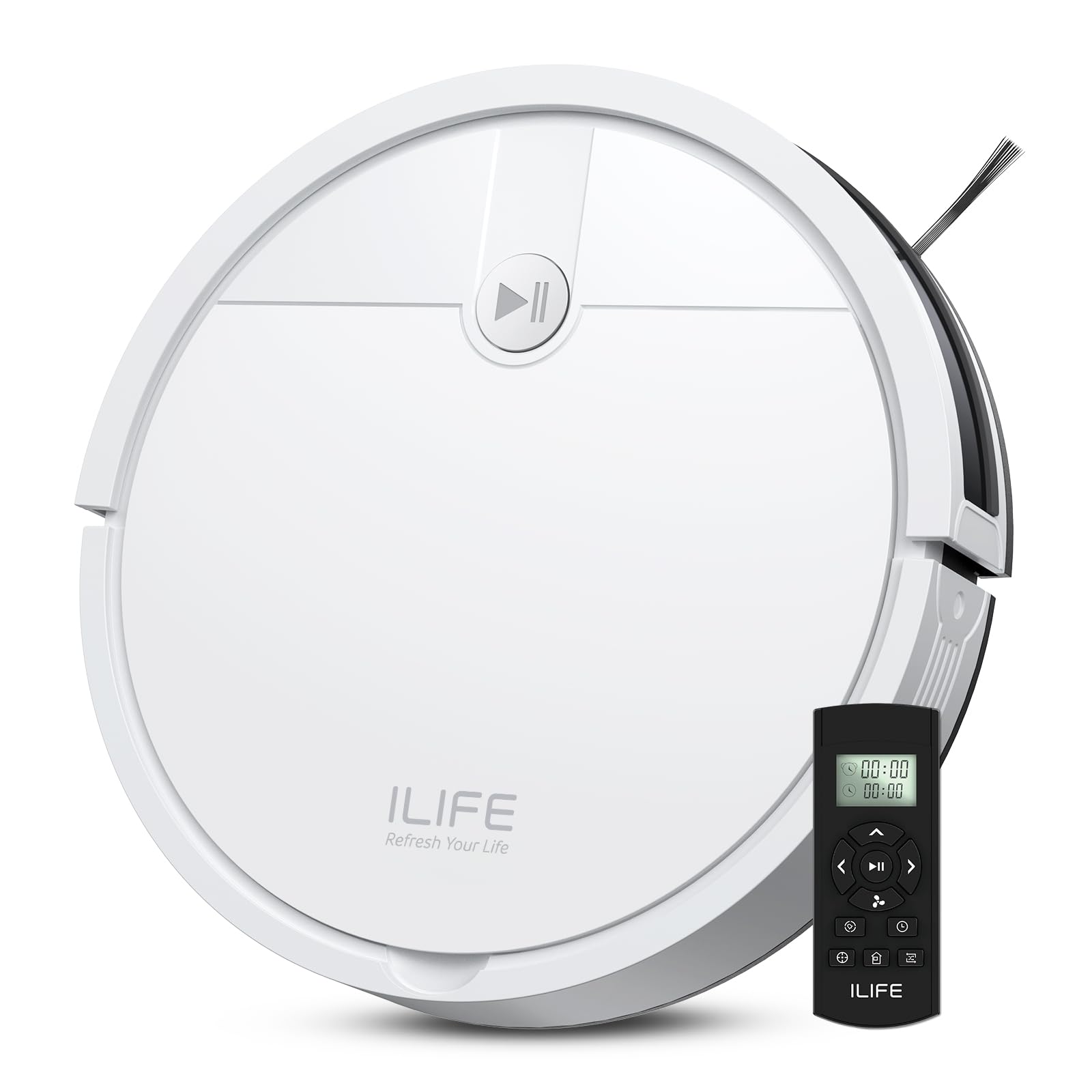
ILIFE V2

86 /100
LBD Score Excellent

Key details

Height
2.99 inches
Control
Remote control, no Wi-Fi required
Dustbin
300 ml
Runtime
120 minutes
View on Amazon

The V2 is the only vacuum here you can run without a phone. There's a physical remote in the box, a button on the machine, and no Wi-Fi or account anywhere in the setup — a genuinely rare thing in a category that assumes you want an app. It's also 2.99 inches tall, which puts it under most beds, and it runs 120 minutes on a charge.

Instead of a roller it uses a brushless suction port: hair goes up the pipe and into the 300ml bin rather than wrapping a brush you have to cut free. We didn't miss the roller on tile, and for a long-haired cat and no carpet it's the easiest of these to live with. On rugs the lack of an agitator shows — it lifts surface dust and leaves the deeper grit.

For a studio apartment, a rental, or a household that doesn't want another login, this is the simplest thing here: three modes, a schedule, and a bin you empty. That's the whole feature list, and for a lot of floors it's enough.

Pros

  • Runs from a remote with no Wi-Fi or app
  • Brushless suction port has nothing to tangle
  • 2.99 inches tall with a 120-minute runtime

Cons

  • 300ml bin needs emptying after most runs
  • Loudest of the picks at 69dB
Our verdict

Buy it if you don't want an app: a remote, a button, and a brushless port that doesn't tangle, on hard floors, for the least money here.

Check Latest Price

How We Tested the Best Robot Vacuums

We started with every robot vacuum that had real navigation, a working app, and a price that made sense for its features, then cut the ones with dock designs we'd already seen fail. The final 12 ran from simple bump-and-run machines to all-in-one units with self-washing docks, so we could judge what the extra money actually buys.

Every unit ran in a home for at least two weeks, some for the full nine months, moving between a hardwood-heavy house with two long-haired people and a carpeted living room with a dog that sheds year-round. They ran overnight, during dinner, and from our phones at work. Each had to map the same floor plan, and we noted where it lost its bearings, how much of a charge a single run used, and whether it recharged and picked up where it stopped.

Getting stuck was what we watched hardest. We staged the hazards that actually live on a floor — a charging cable, a stray sock, a rug tassel, chair legs, a pet bowl, a raised threshold — and logged how quickly each vacuum freed itself, how often it needed a rescue, and whether the app told us where it was. For hair, we spread measured piles of dog and human hair across carpet and hard floor, then checked what was left behind and whether the roller needed scissors. Docks were graded on the unglamorous stuff: whether they slid across the floor when the vacuum parked, how loud self-empty was, and whether the mop pad still smelled clean the next morning.

Reliability was a running tally rather than a single test: dropped Wi-Fi, phantom tank warnings, error messages that cleared on their own, and whether each machine still held its schedule in month eight. We weighed value the same way, since a self-emptying dock means little if you're still scrubbing the tray by hand every week.

How to Choose a Robot Vacuum

Navigation first, suction second

A robot that maps cleans in straight lines, remembers your rooms, and can be sent to the kitchen alone. One that works on sensors and pattern alone covers the same ground by repetition, so every run is a whole-floor run and the no-go zone you want around the dog's bowl doesn't exist. Most of our picks use LiDAR; the budget ILIFE V2 doesn't map at all.

If your home is more than one open room, or you have rugs and thresholds to cross, mapping is the first thing to pay for. Suction is the second. The exception is a single hard-floor room, where a simple machine that bumps and turns is genuinely enough.

Decide how much dock you want

Self-emptying is the big divider. A two- to three-liter bag in the dock buys you weeks between bin duty, and a bagless base skips the bags but needs the cup rinsed. Above that, the dock can wash the mop pads in hot water, dry them, and refill the robot's tank, which is the difference between a machine you run every day and one you avoid because the pads smell.

If you mop once a week by hand anyway, skip the wash-and-dry dock and put the money into navigation. If you want the robot to run daily while you're out, the full dock is the step up that keeps it running.

Match the machine to your floors

On tile and sealed wood the mop matters more than the suction figure, and mop designs feel different. A flat pad dragged behind wipes up dust; spinning pads scrub; a roller that rinses itself handles a spilled dinner. What separates the good ones is lifting — the dreame raises its mops 10.5mm to cross a rug, and the Roborock lifts its pads clear, so a damp mop never gets dragged across carpet.

If your ground floor is wall-to-wall carpet, spend the money on suction and a brush that resists tangling instead, and treat mopping as a bonus for the kitchen.

Pets and long hair

Hair is the failure mode. It wraps rollers, stalls brushes, and takes motors with it, so brush design matters more than another thousand pascals. Three approaches cover our picks: an all-rubber roller that resists wrapping, a brush rated for long hair, and a brushless suction port that sends hair straight into the bin with nothing to tangle around.

If you have a long-haired shedder, choose on that first. If you also have carpet, prefer a roller backed by strong suction, because a suction port alone won't lift grit out of pile.

Measure before you order

Two dimensions decide whether a robot works in your home: its height and the space at its dock. Our picks run from 2.99 to 3.93 inches, and that inch decides whether the thing goes under the sofa or leaves a dust line along the skirt. At the dock you need a wall, an outlet, and clearance for a unit that can stand over 20 inches tall and nearly 20 wide.

Check the threshold between rooms too — one pick climbs 18mm — and look at your worst rug. A curled edge is a daily rescue unless you tape it down.

Frequently Asked Questions

Final Verdict

The Roborock Qrevo S Pro is the robot vacuum we point most people to. It empties itself, washes its mops in hot water, dries them, and maps a floor properly — the whole list of things that decide whether you keep running one.

If your home is mostly tile and wood and the corners bother you, the dreame L40 Ultra Gen 2 reaches further for more money. If a dog and long hair are the problem, the eufy C28 is the safer bet. And if the budget is tighter, the Tikom L8000 Plus still maps and still empties itself.