Best Robotic Pool Cleaners for Vinyl Liners of 2026

Ask a vinyl-liner owner what's holding them back from a pool robot and you'll hear some version of the same fear: that a machine crawling the walls will scuff, wrinkle, or snag the liner. It's a fair worry — vinyl is softer than plaster, and the same suction pulling the robot up the wall is tugging at the seams. What a good one actually fixes is your Saturday: no more pushing a vac head around on a pole, and no more fine silt settling back into the corners before you get to it.

Wall climbing also means something different on vinyl. A robot that grips plaster can slide right back down a slicker vinyl wall, and a short runtime often quits before it ever reaches the waterline. My team and I spent the past eight months running eight cordless robots in vinyl-liner pools — watching them climb, timing their batteries, rinsing out filters — and the ones worth keeping share a few traits the spec sheet buries. A finer filter, for instance, catches silt that a coarse basket just stirs back into the water, though it needs rinsing after nearly every run. The eight below are the ones we'd drop into our own pools.

1

Best Overall

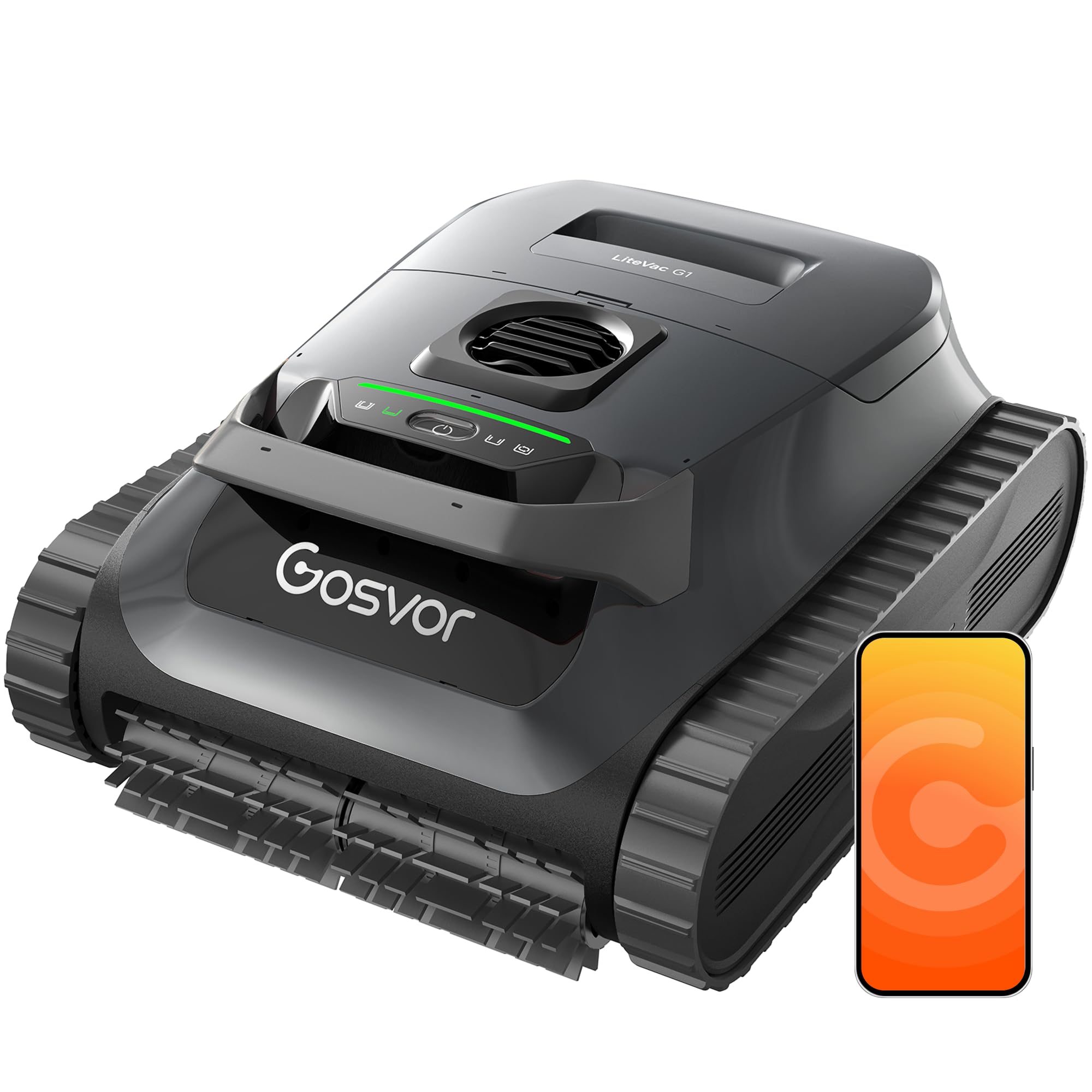
Gosvor LiteVac G1

85 /100
LBD Score Excellent

Key details

Weight
15.2 lb
Runtime
Up to 200 minutes
Pool Size
2,153 sq ft
Filtration
3-micron and 180-micron
View on Amazon

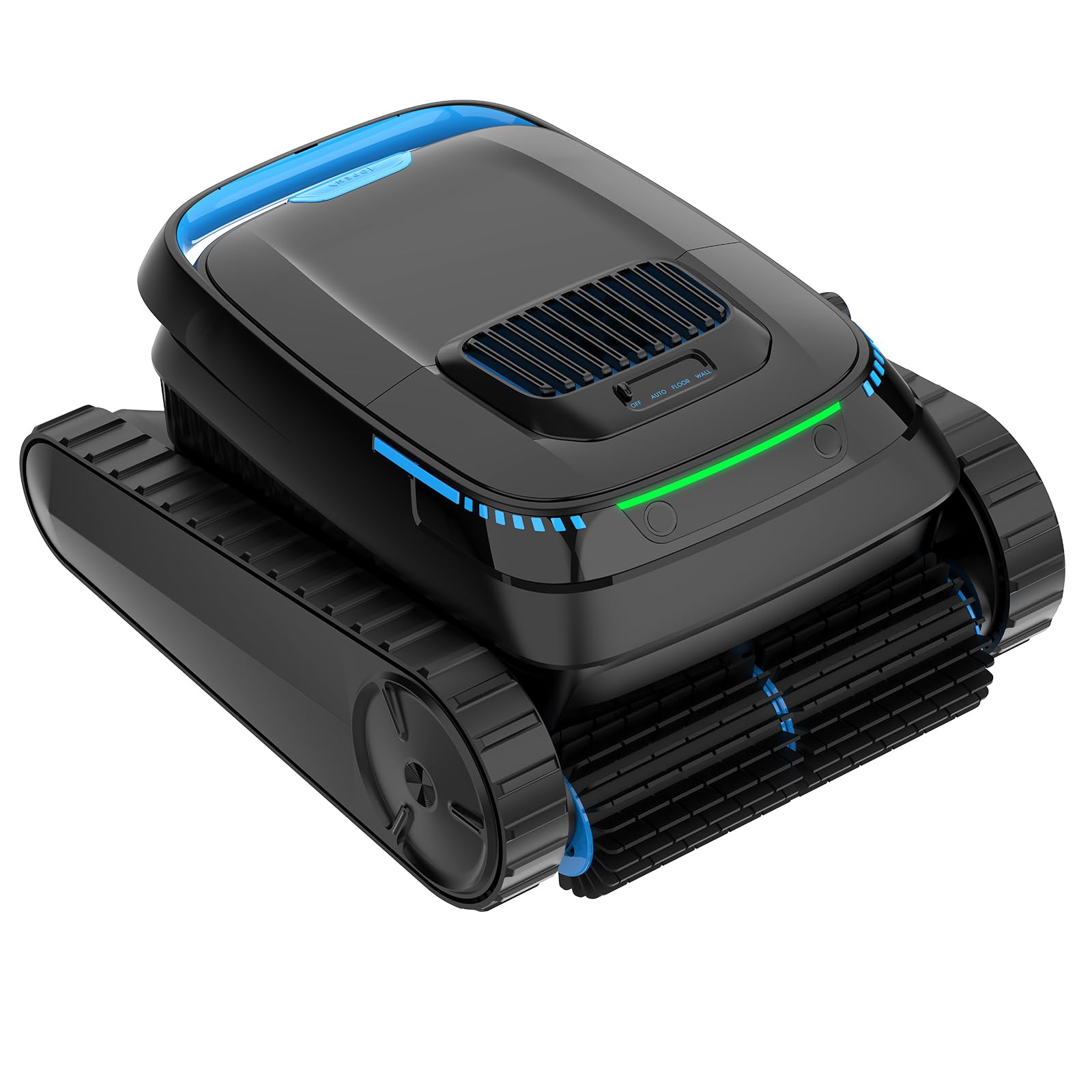
Pale vinyl shows fine silt the way dark tile never does, and the LiteVac G1 is the robot here built around that problem. Inside the basket sits a 180-micron screen for leaves and grit and a 3-micron layer for the dust that settles after a windy week, so it leaves with the rinse water instead of drifting back through the return. Among the picks here, only the AIPER Scuba V3 filters as finely.

The filtration is where the case starts, not where it ends. The G1 scrubs with a pair of 260 mm roller brushes rather than stiff bristles, grips with caterpillar treads, and weighs 15.2 pounds, light enough to swing over the coping one-handed at the end of a cycle. Up to 200 minutes of run time and a claimed 2,153 square feet per pass put it near the top of this set for coverage, and it does that at midrange money.

Run time is the number to plan around rather than trust blindly. Two hundred minutes is the ceiling in the gentlest mode, a leaf-heavy pool will want a second pass before a party, and the three-hour recharge sets the pace between them. The 3.6-liter basket lifts out of the top and rinses in about a minute, which matters because it is the task you repeat most.

What surprised us was the shallow end. The G1 is rated for water as little as 12 inches deep, and the cross-pattern routing is designed for awkward shapes — bowls, diamonds, vinyl-covered steps — where robots tend to wedge into a corner and stay there. On a liner that records every mark, that thoroughness is the difference between a robot you run and one you babysit.

Pros

  • 3-micron layer traps fine silt
  • Soft roller brushes suit a vinyl floor
  • 200 minutes and 2,153 sq ft per cycle
  • 15.2 pounds lifts out easily

Cons

  • App works only on land
  • Fine filter needs replacing every 30 cycles
Our verdict

Our pick for most vinyl pools: the LiteVac G1 filters down to 3 microns, scrubs with soft roller brushes, and runs 200 minutes at a midrange price.
Check Latest Price
2

Best Premium

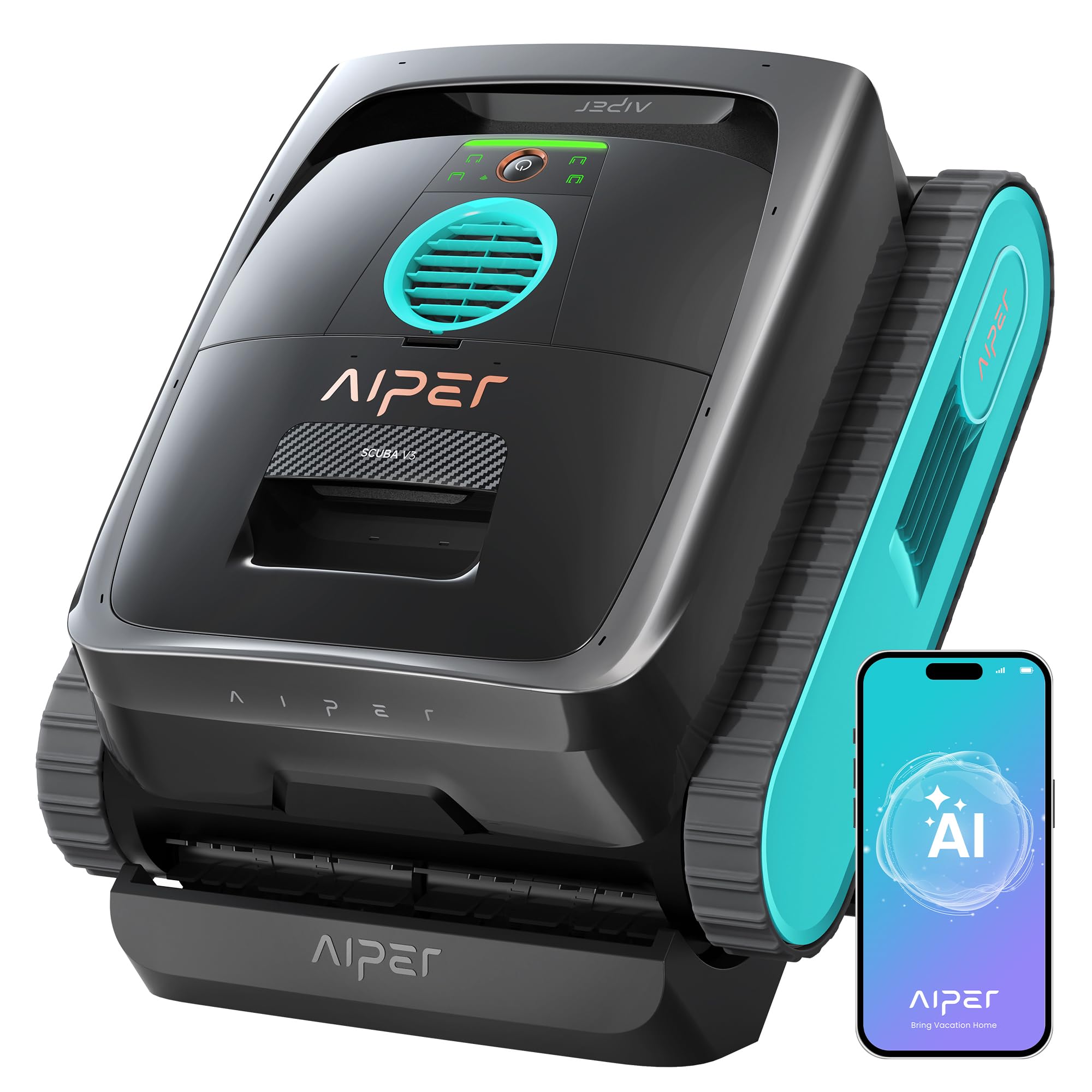
AIPER Scuba V3

93 /100
LBD Score Outstanding

Key details

Weight
18.1 lb
Runtime
Up to 240 minutes in Eco
Filtration
3-micron and 180-micron
Debris Capacity
3.5 liters
View on Amazon

The charging dock is the detail that explains the Scuba V3. There is no cable to plug into a wet connector and no lead draped across the patio; the robot settles onto its pad and charges, which turns the end of a cycle into a two-second habit rather than a small chore.

The rest is specified like a flagship. A single forward-facing camera recognises more than 20 kinds of debris and drives at what it sees instead of sweeping a fixed pattern, the MicroMesh stack pairs a 180-micron screen with a 3-micron layer, and run time reaches 240 minutes in Eco or about 180 in the standard modes. The 3.5-liter basket comes out from the top.

The end of a cycle is the part we appreciated most. Instead of settling wherever the battery gives out, the V3 returns to the waterline, holds there for ten minutes, and sends a notification, so retrieval is a reach rather than a dive and you know it has finished without walking outside to check. That is the kind of automation that actually changes a routine.

It is a lot of money for a robot on a vinyl floor, and the honest case against it is that the Gosvor filters just as finely for far less; the Scuba's extra spend goes on convenience rather than a cleaner pool. What you are buying is the version of pool care where you think about it roughly never, and in a household that swims daily that is worth paying for.

Pros

  • Dock charging with no wet connector
  • 3-micron filtration matches the top pick
  • Returns to the waterline and notifies you
  • Up to 240 minutes in Eco mode

Cons

  • Heaviest robot here to lift out
  • Four-hour recharge is the longest here
Our verdict

Buy the Scuba V3 if you want the closest thing here to a pool that cleans itself — the dock, the camera steering, and the waterline parking carry the price.

Check Latest Price
3

Best Budget Wall Climber

Lodoba SAT25

78 /100
LBD Score Very Good

Key details

Runtime
Up to 190 minutes
Suction
4,800 GPH
Pool Size
Up to 2,150 sq ft
Charge Time
2.5 hours
View on Amazon

We keep the SAT25 in this guide because it is the cheapest way here to get a robot that climbs walls and covers a full inground pool. The numbers behind that: 190 minutes of run time, a claimed 2,150 square feet per cycle, and rubber tracks rated for slopes up to 40 degrees, which is enough for the hopper wall on most vinyl ingrounds.

Two brushless motors turn at 3,200 RPM and pull 4,800 GPH through the head, and vinyl sits on the rated surface list alongside tile and concrete — the sentence a liner buyer wants to find. Sonar navigation paces it across the floor instead of letting it wander, and a 2.5-hour recharge is among the quickest here, so a second pass on the same afternoon is realistic.

Raised main drains are where it hangs up. On a pool with a dome or a tall drain ring, expect to fish it free now and then, or set full-coverage mode and spot-check the drain before you walk away. It also finishes where it stops rather than floating up for collection, so the last step is a reach into the water.

For a first robot on a mid-size vinyl pool, none of that is disqualifying. What counts is that it climbs without scuffing and filters what the floor collects, and on both it does the job for less than the robots above it in this list.

Pros

  • Least expensive wall-climbing pick here
  • 40-degree slope climbing on rubber tracks
  • 2.5-hour recharge

Cons

  • Charging faults after a few months
Our verdict

We keep the SAT25 in this guide because it is the cheapest way here to get a robot that climbs walls and covers 2,150 square feet.

Check Latest Price
4

Best for Walls and Waterline

Ondraiz ONZ-SAT25

93 /100
LBD Score Outstanding

Key details

Weight
14.3 lb
Runtime
Up to 150 minutes
Pool Size
Up to 2,150 sq ft
Filtration
3-micron
View on Amazon

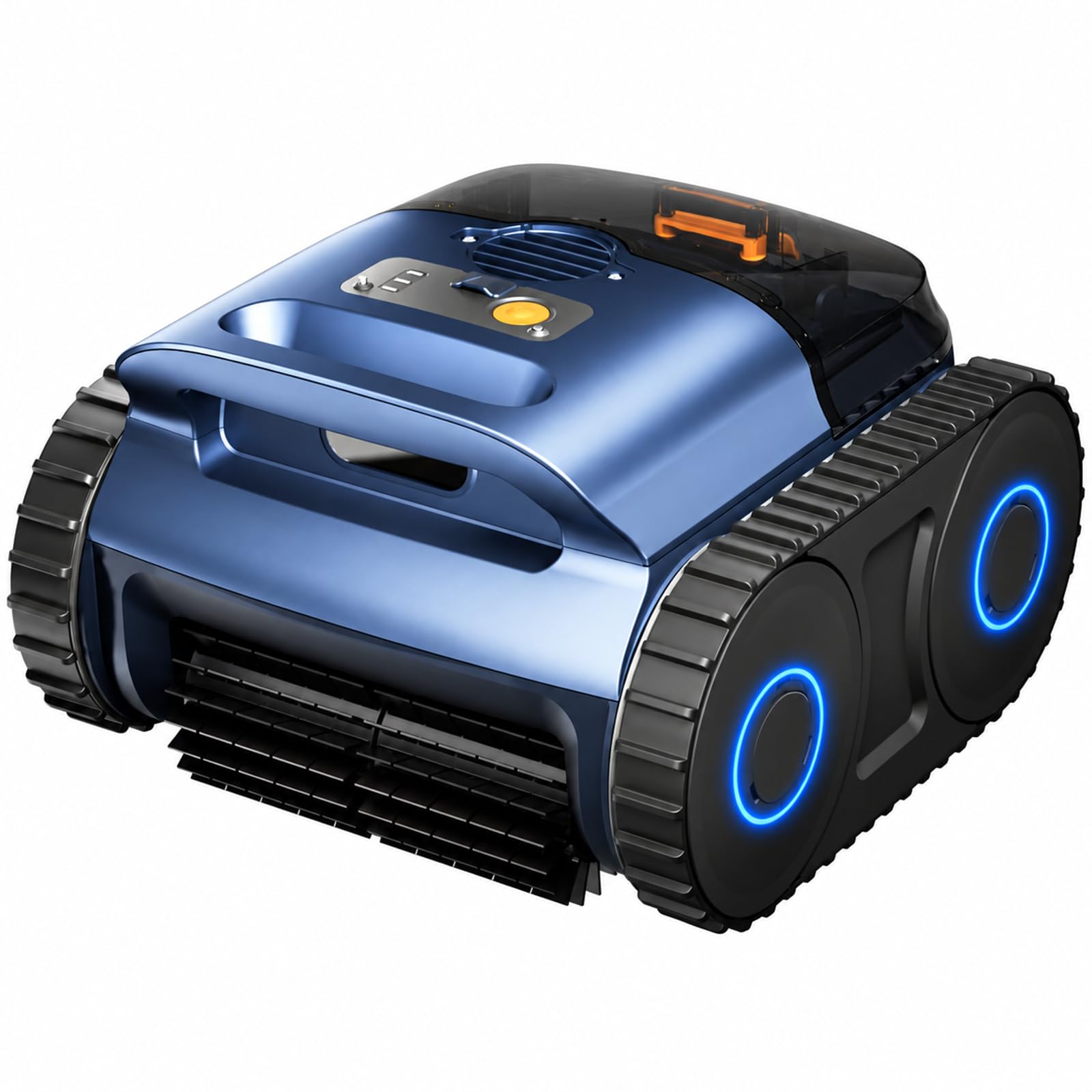
Most robots in this set treat the wall as an afterthought and the floor as the job. The ONZ-SAT25 is the other way round: heavy-duty tracks, a wall-only mode, and two independent 180 W brushless motors claiming 45,000 Pa of suction, all aimed at the surfaces a vinyl buyer actually looks at — the wall and the scum line.

It earns the wall-and-waterline label on more than marketing. At 14.3 pounds it is one of the lighter full-size robots here, so hauling it out is not a two-handed job, 150 minutes of run time covers a claimed 2,150 square feet, and the 3-micron micromesh filter puts it in the same fine-filtration bracket as our top pick.

The trade-off is control. There is no app, no timer, and no schedule: you press the button and drop it in, which is genuinely simpler and also means nothing happens unless you are standing there. And 150 minutes is the shortest run time among the big-pool robots here, so a very large pool wants a second cycle; on a 1,500 to 2,000 square foot vinyl inground, one pass covers it.

One-touch operation makes it the easiest of these to hand to someone else, a housesitter or a teenager, without a tutorial in app pairing. On a pool where the waterline is what looks tired first, that simplicity is the whole appeal.

Pros

  • Wall-only and waterline modes
  • 3-micron micromesh filtration
  • 14.3 pounds, light for a full-size robot
  • One-button start with no pairing

Cons

  • No app, timer, or remote scheduling
Our verdict

If the wall and waterline are the parts that never get scrubbed, the ONZ-SAT25 is the one here we trust to climb them — no app required.

Check Latest Price
5

Best for Above-Ground Pools

BRINBO S2

84 /100
LBD Score Excellent

Key details

Runtime
Up to 90 minutes
Pool Size
Up to 861 sq ft
Dimensions
14.6 x 11.8 x 7.1 inches
Filtration
Dual-layer
View on Amazon

The S2 does not climb, and that is the design brief rather than a fault. It is a 90-minute floor cleaner for flat-bottom above-ground pools, which describes most of the vinyl above-grounds out there, and it is the least expensive robot in this set — the two facts explain each other.

What you get is compact, 14.6 by 11.8 by 7.1 inches, with a dual-layer filter basket, a claimed 861 square feet of coverage, and cordless operation with no hose to drag across the lawn. We think that coverage figure is worth translating: 861 square feet is roughly a 33-foot round, so anything up to that size finishes in one charge and smaller pools finish with time to spare.

What you give up is everything above the waterline — no wall climbing, no waterline scrubbing, no app. If your above-ground has an algae ring at the seam or a ladder you keep meaning to scrub, this is not the robot for it. If the floor is the problem, it is the cheapest solution here and it asks nothing beyond a rinse.

Pros

  • Lowest price in this set
  • 90 minutes covers about a 33-foot round
  • Compact enough to store on a shelf

Cons

  • Floor only, with no wall or waterline cleaning
Our verdict

For a flat-bottom above-ground vinyl pool up to roughly 33 feet round, the S2 cleans the floor for the least money here.

Check Latest Price
6

Best for Frequent Short Cycles

BOTLIFE PC10

86 /100
LBD Score Excellent

Key details

Runtime
Up to 120 minutes
Pool Size
Up to 1,830 sq ft
Filtration
150-micron
Debris Capacity
4 liters
View on Amazon

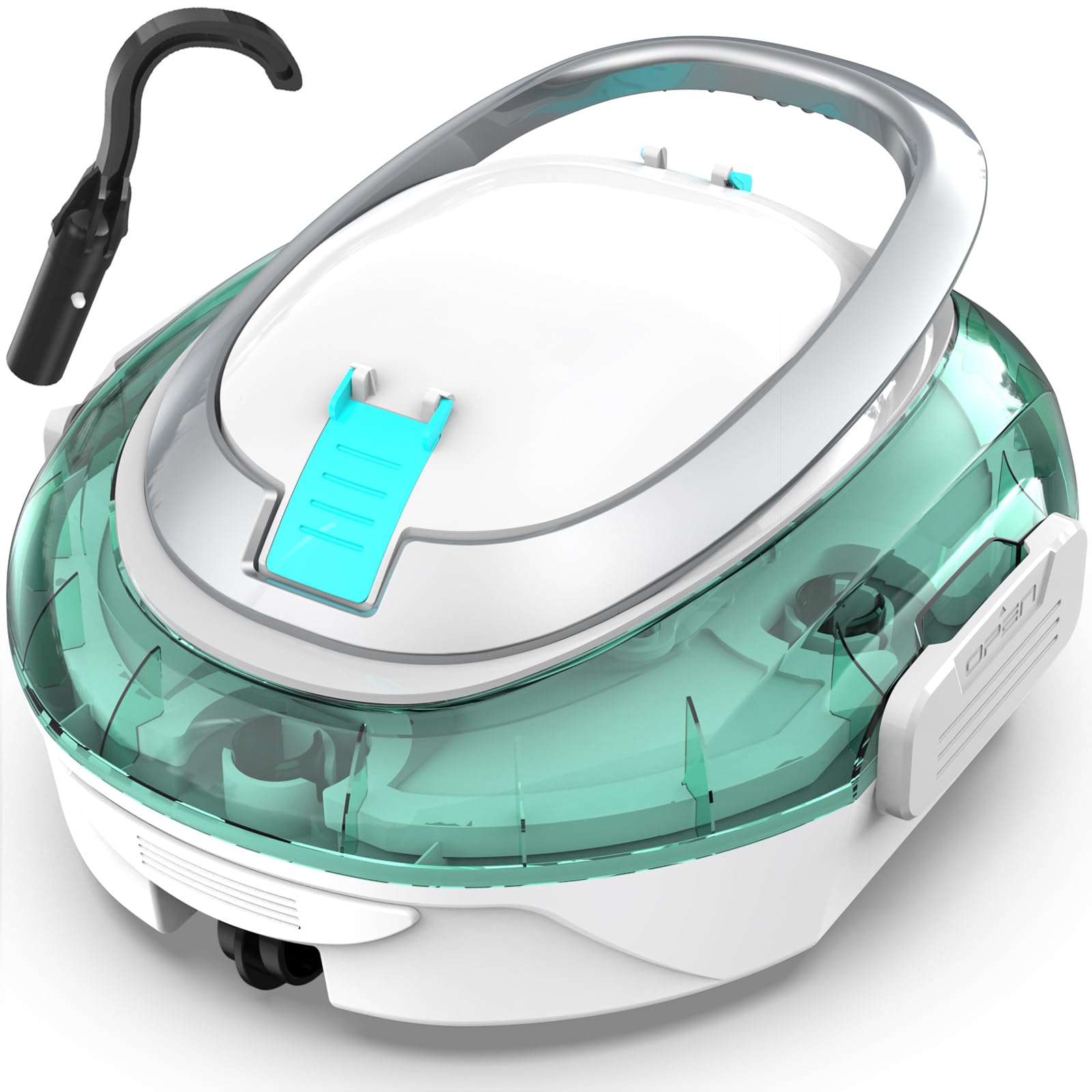
Retrieval is the part of life with a robot that nobody puts on the box: the cycle ends and you are leaning over the coping to fish out a wet machine. The PC10 handles that better than most of the robots we ran. It parks near the edge when the cycle finishes or the battery runs low, and the hook in the box means you lift without getting in.

The rest is built for repeat use. A 5,000 GPH pump and two active brushes lift leaves, sand, and the film off a liner, the 4-liter basket is the largest here and comes out from the top for a hose-down, and the 5,200 mAh battery recharges in about two and a half hours for up to 120 minutes of cleaning across a claimed 1,830 square feet. Floor-only and wall-only modes let you send it at one job.

Where it fits is a pool that gets a short cycle every couple of days rather than one long weekend marathon. The fast recharge and easy retrieval reward frequency, 120 minutes suits a pool under about 1,800 square feet, and the top-load basket makes maintenance a rinse at the hose rather than a disassembly job.

Pros

  • Self-parks at the edge for retrieval
  • Largest basket here at 4 liters
  • Recharges in about 2.5 hours
  • Top-load basket rinses fast

Cons

  • Coarse 150-micron filter misses fine silt
Our verdict

Short cycles are what the PC10 is built for — self-parking, a fast recharge, and a four-liter basket that rinses in a minute.

Check Latest Price
7

App-Controlled Cleaning

WYBOT C1

82 /100
LBD Score Excellent

Key details

Runtime
Up to 160 minutes
Dimensions
17 x 13 x 18 inches
Debris Capacity
3 liters
View on Amazon

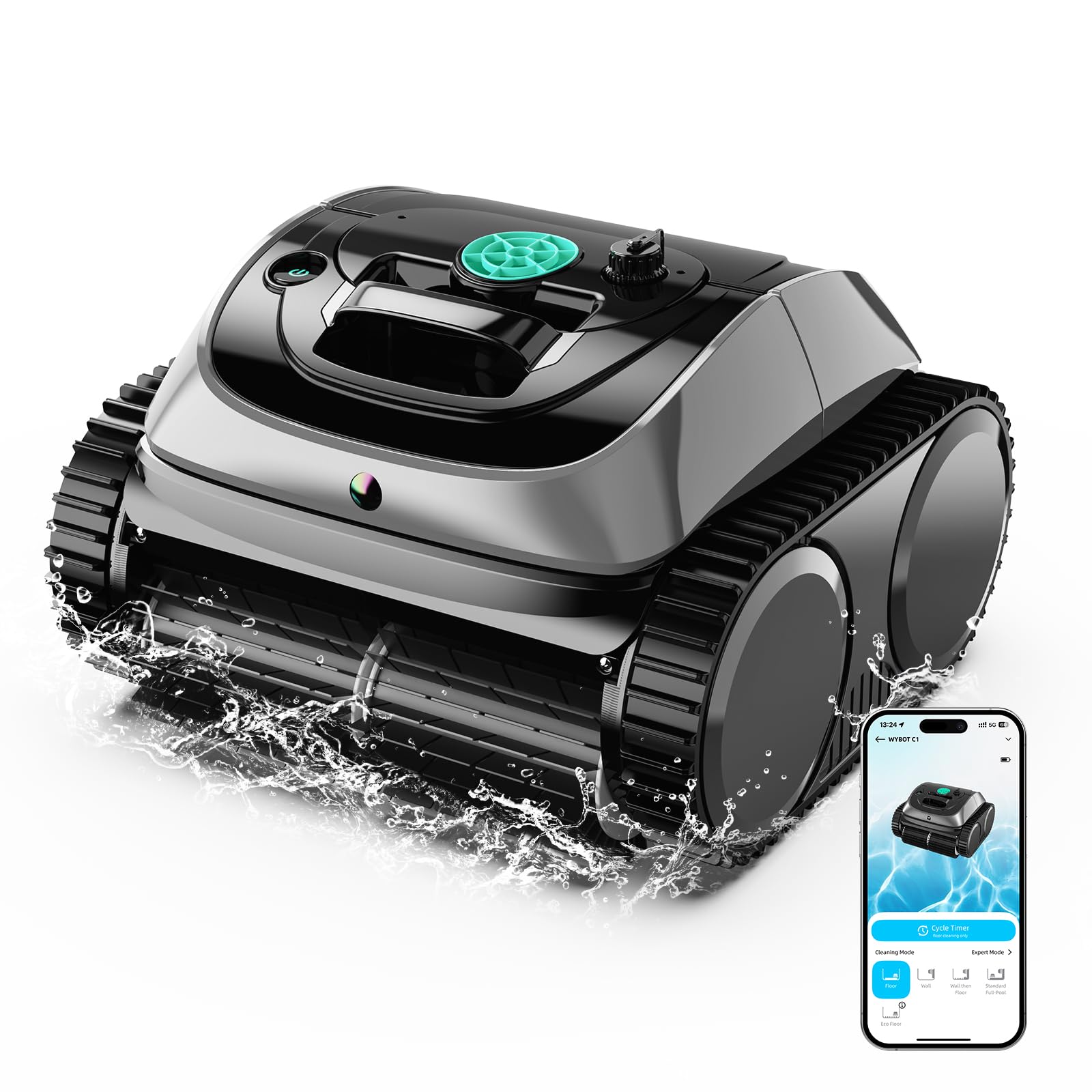
The C1 sells on navigation, and the hardware backs the pitch: a gyroscope steers it through N-paths and S-paths rather than letting it ricochet off the walls, and the app lets you choose modes, set a schedule, and push firmware updates over the air. At this price, the routing is the part that feels more expensive than it is.

It cleans, too. Floor work is the strongest thing about it — fine debris, leaves, the dust that collects in the deep end — and the 4-in-1 modes add floor, wall, and waterline coverage when you want them. The 3-liter basket is the smallest in this set, so on a leaf-heavy week you will empty it mid-cycle; the top-load design makes that a one-minute job.

Run time is the practical constraint. Up to 160 minutes is the ceiling, and on a big or dirty pool that is one pass rather than a whole afternoon of scrubbing, with a recharge of about four hours between them. Plan the second cycle for later in the day.

On balance the C1 is a good floor cleaner with genuinely useful app control and a two-year warranty behind it. What keeps it off the top of this list is the risk of a unit that stops powering on a few weeks in — the failure that matters most with these machines — and it is why we send most buyers to the Gosvor first.

Pros

  • Gyroscope N- and S-path routing
  • App scheduling and over-the-air updates
  • Two-year manufacturer warranty

Cons

  • Three-liter basket is the smallest here
  • Units that stop powering on soon after setup
Our verdict

Good floor cleaning and the strongest app control here, provided you plan on shorter, more frequent cycles than the headline suggests.

Check Latest Price
8

Modest Inground Pools

BRINBO C1

84 /100
LBD Score Excellent

Key details

Runtime
Up to 180 minutes in Eco
Warranty
2 years
Pool Size
Up to 1,615 sq ft
Cleaning Modes
7
View on Amazon

Three hours of run time reads like the answer to a big pool until you notice the qualifier: 180 minutes is the Eco figure, and the higher-power modes eat into it. That is less a knock than a reminder to match the robot to the water, because Eco on a leaf-strewn floor is not the mode you will use.

Within its envelope it is well equipped. A triple-motor layout drives suction through dual filtration, seven cleaning modes and seven path patterns are selectable in the app, four timer settings let you schedule the week, and a two-year warranty covers the hardware. The 96 Wh battery and ABS shell put it in the same size class as the Lodoba.

What we cannot do is give it the top-pick treatment on specification alone. Seven modes and four timers are more configuration than most vinyl-pool buyers will touch — what earns it a place is the dual filtration and the long Eco run, and both are here. Treat it as a capable midrange robot for a modest inground, and step up to a 2,150-square-foot model if your water stretches further.

Pros

  • Dual filtration with triple-motor suction
  • Seven modes and four timer settings
  • Two-year warranty

Cons

  • Coverage tops out at 1,615 sq ft
Our verdict

A well-equipped midrange robot for a modest vinyl inground: dual filtration, seven modes, four timers, and a two-year warranty.

Check Latest Price

How We Tested Robotic Pool Cleaners on Vinyl Liners

To build the shortlist, I started with several dozen cordless robots sold for vinyl-liner pools and cut anything corded, anything without a wall-climbing claim, and anything whose coverage rating was wildly out of proportion to its runtime. Eight models made the cut, and we ran them for a full swim season — about eight months — in a vinyl-liner inground pool, with a stretch in an above-ground vinyl pool for a second read.

Each robot got a weekly Saturday cleaning after a week of leaves, a second run after a storm pushed sand and grit into the deep end, and one pass during a heavy pollen week. We timed every full cycle, noted whether the battery died mid-floor or the unit parked itself at the waterline, and compared that against how much of the pool actually got covered. After each run we hosed out the filter, weighed the debris it caught, and noted how much fine silt had passed through into the water instead.

Wall climbing got its own attention: we watched from the deck to see whether a robot crested the waterline or slid back down the slope, then ran a hand along the liner and seams looking for scuffs, track marks, and lifted edges. Ease of use came down to how long one person needed to lower it in, pair the app, and set a schedule, plus how long a full charge took from empty. Across the eight months we also watched brushes and tracks for wear, since durability is usually where a cheaper unit shows its price first.

Value was the last filter. We asked whether each model's extras — app scheduling, waterline parking, a finer filter — were things we'd genuinely pay for or features that sat unused, and whether stepping up a tier bought better cleaning or just a nicer app.

How to Choose a Robotic Cleaner for a Vinyl Liner

Brushes and Traction Come First

The brushes are the only part of a robot that touches your liner, so they set the risk. Roller brushes — the pair of 260 mm cylinders on the Gosvor, for instance — sweep debris up without the scouring action of stiff bristles, and rubber caterpillar tracks spread the load on a wall far better than hard wheels. Look for vinyl named on the rated surface list; several of these picks list tile, concrete, and vinyl together, and that sentence is worth more to you than a suction figure.

Filtration: Read the Micron Number

Suction moves debris; the basket decides what leaves with it. A 3-micron layer, as on the Gosvor, the AIPER Scuba V3, and the Ondraiz, captures the silt that clouds a pale liner, while a 150-micron basket like the BOTLIFE's holds leaves and sand and lets the fines drift back into the water.

Finer filtration costs upkeep rather than money up front: rinse the coarse screen after every cycle and expect to replace a fine layer from time to time. That trade is worth it on a light-colored liner, where a haze is visible from the patio.

Size the Run Time to the Water

Coverage claims are the easiest specification to over-trust. A 90-minute robot rated at 861 square feet is right for a 33-foot round above-ground; a 2,150-square-foot claim like the Lodoba's or the Ondraiz's suits a full inground. Then read the recharge time, because a pool that needs two passes needs a charger that turns around in two and a half hours, not four.

Plan for the Lift

Every cycle ends with you pulling a wet machine over the coping, and dry weight understates the job. An 18-pound robot full of water and debris is a two-handed lift, which is why the 14-to-15-pound models here are easier to live with, and why self-parking on the BOTLIFE and the waterline return on the Scuba V3 are more than gimmicks.

Above-Ground and Flat-Bottom Pools Need Their Own Answer

A floor-only cleaner like the BRINBO S2 is the wrong purchase for someone with algae on the wall, and a wall-climbing robot is wasted money on a pool whose only vertical surface is a few inches of liner above the water. Decide which surfaces genuinely need scrubbing before you pay for climbing gear.

Frequently Asked Questions

Final Verdict

The Gosvor LiteVac G1 is the one we point most vinyl-pool buyers to: 3-micron filtration for the silt a liner records, roller brushes instead of bristles, 15.2 pounds to lift, and 200 minutes across 2,153 square feet at midrange money. It is the least compromised balance of liner care and price in this set.

If you want the routine to disappear and the budget allows, the AIPER Scuba V3 buys dock charging and waterline parking. For a flat-bottom above-ground pool, the BRINBO S2 covers the floor for the least money here, and the Ondraiz ONZ-SAT25 is the one to take if your walls and waterline are the surfaces that always get skipped.