Best RV Backup Cameras of 2026

Backing a 30-foot trailer into an unfamiliar site is manageable in daylight. Doing it at dusk, with a spotter you can't hear over the engine and a picnic table lurking somewhere behind your rear bumper, is the part people dread. A good rear camera turns that into a slow, boring, one-person job: watch the screen, creep back, stop.

I was skeptical of the magnetic, battery-powered cameras that promise a one-minute install with no drilling and no fishing cable through the frame. But after eight months with a dozen systems on the back of a travel trailer — plug-and-play units built for pre-wired ports alongside fully wireless models running their own solar panels — the differences turned out not to be where the spec sheets put them.

Resolution is table stakes now. What separates these is whether the picture keeps up as you roll, how many days the battery actually gives you off-grid, and whether the magnet mount stays put on washboard gravel. Here's what held up, across a wide span of budgets and wiring setups.

1

Best Overall

Yakry Y27

89 /100
LBD Score Excellent

Key details

Mount
Furrion bracket and pigtail
Screen Size
7 inches
Field Of View
150 degrees
Camera Channels
4
View on Amazon

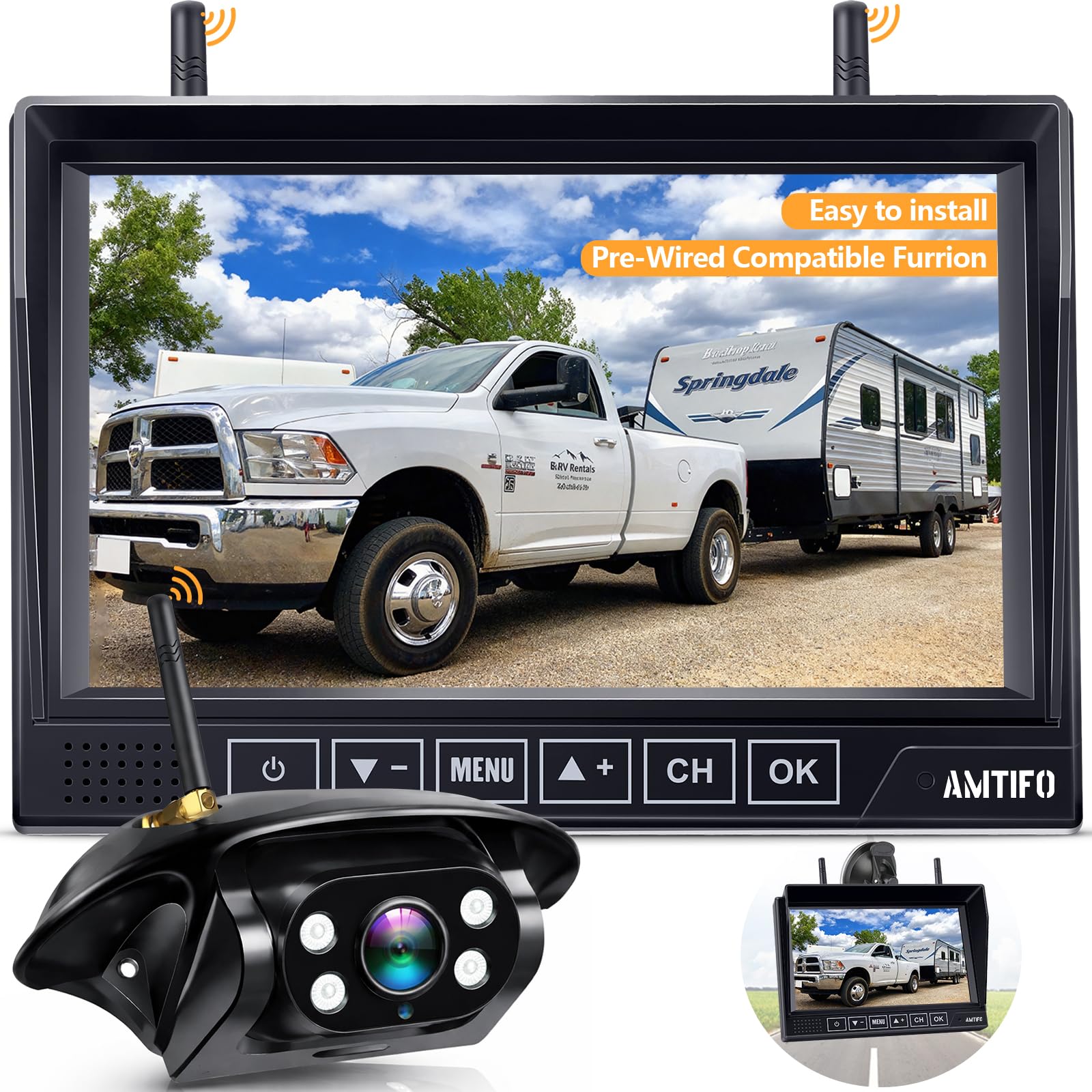
Most travel trailers and fifth wheels leave the factory with a Furrion mounting plate and a pigtail wire on the rear corner, and this kit is built to land on it. The bracket and connector are in the box, so the work is one connection at the back and a 12-volt plug for the monitor up front. That pre-wiring is why it takes our top spot: the hardest part of fitting any camera is getting power to the rear wall, and this one does not ask you to solve it twice.

The view holds up its end. A 7-inch screen, 1080p, a 150-degree lens and infrared night vision rated down to 0.1 lux add up to a picture that shows the lane beside you and the campsite post behind you in the same glance, and it stays usable in an unlit lot — which is when a backup camera earns its keep.

Two details we appreciate beyond the install: the touch keys sit along the monitor's edge where you can find them without looking down, and the system accepts up to four cameras, so a side camera on a long fifth wheel or a second trailer later on does not mean a second monitor. The monitor draws from its own 12-volt socket, so plan on giving up one plug on a crowded dash.

Pros

  • Furrion bracket and pigtail in the box
  • Four channels for a second or third camera
  • Clear 1080p picture day and night
  • Touch keys you can find by feel

Cons

  • Wireless link can stutter on very long trailers
Our verdict

For a Furrion-prepped rig, this is our pick: installation is one connection and a plug, the 7-inch view is wide and clear, and four channels leave room for a second camera.
Check Latest Price
2

Best for Off-Grid Trips

Yakry Y33

89 /100
LBD Score Excellent

Key details

Mount
Magnetic
Battery
26,800 mAh
Resolution
1296P
Screen Size
7 inches
View on Amazon

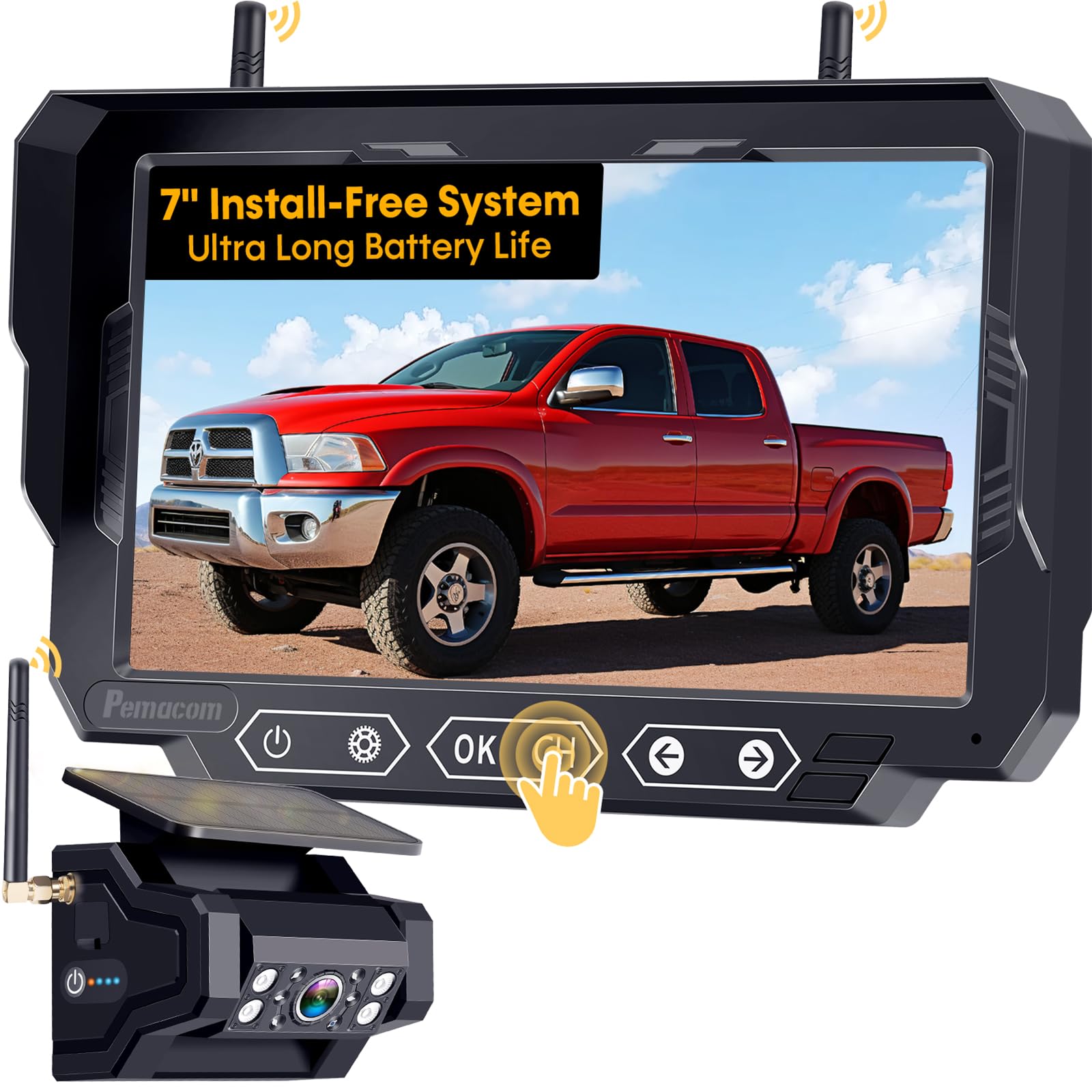
Take the pre-wired plate out of the equation and the question becomes how the camera gets power. The Y33 answers with a 26,800 mAh battery, a 7-watt solar panel, and a magnetic base that clamps onto steel and lifts off again in a second.

That capacity is the reason we recommend it for boondockers. A full charge is rated for a week of trips, and the panel tops the battery up while you drive, so the camera is not flat the week before a trip because it sat in a storage lot for two months. A camera you have to remember to charge is a camera that eventually stops going up.

The rest of the kit aims at the same buyer. Camera and monitor both run 1296P, the lens covers 170 degrees, and the transmitter pushes 24dBm through dual receiving antennas on the monitor — the part of the design that matters when the picture has to cross the length of a trailer at highway speed.

The magnet is the compromise. It grips steel; an aluminum-sided trailer or a fiberglass cap needs the included iron plate stuck on first, which is still a permanent change to the trailer's skin. The pull is strong enough that we prefer it to drilling, and the whole unit lifts off when you want it out of the weather or off the rig at a storage yard.

Pros

  • 26,800 mAh battery rated for a week of trips
  • 7-watt solar panel tops it up while driving
  • 1296P on both camera and monitor
  • Lifts off the magnet for storage

Cons

  • Heavier than the bracket-mounted kits here
Our verdict

Camping without hookups is the whole reason to own this one: a week of trips between charges and a solar panel that refills it as you drive.

Check Latest Price
3

Best Two-Camera System

pemacom M1

87 /100
LBD Score Excellent

Key details

Battery
15,200 mAh
Cameras
2, split screen
Screen Size
7.2 inches
Waterproof Rating
IP69K
View on Amazon

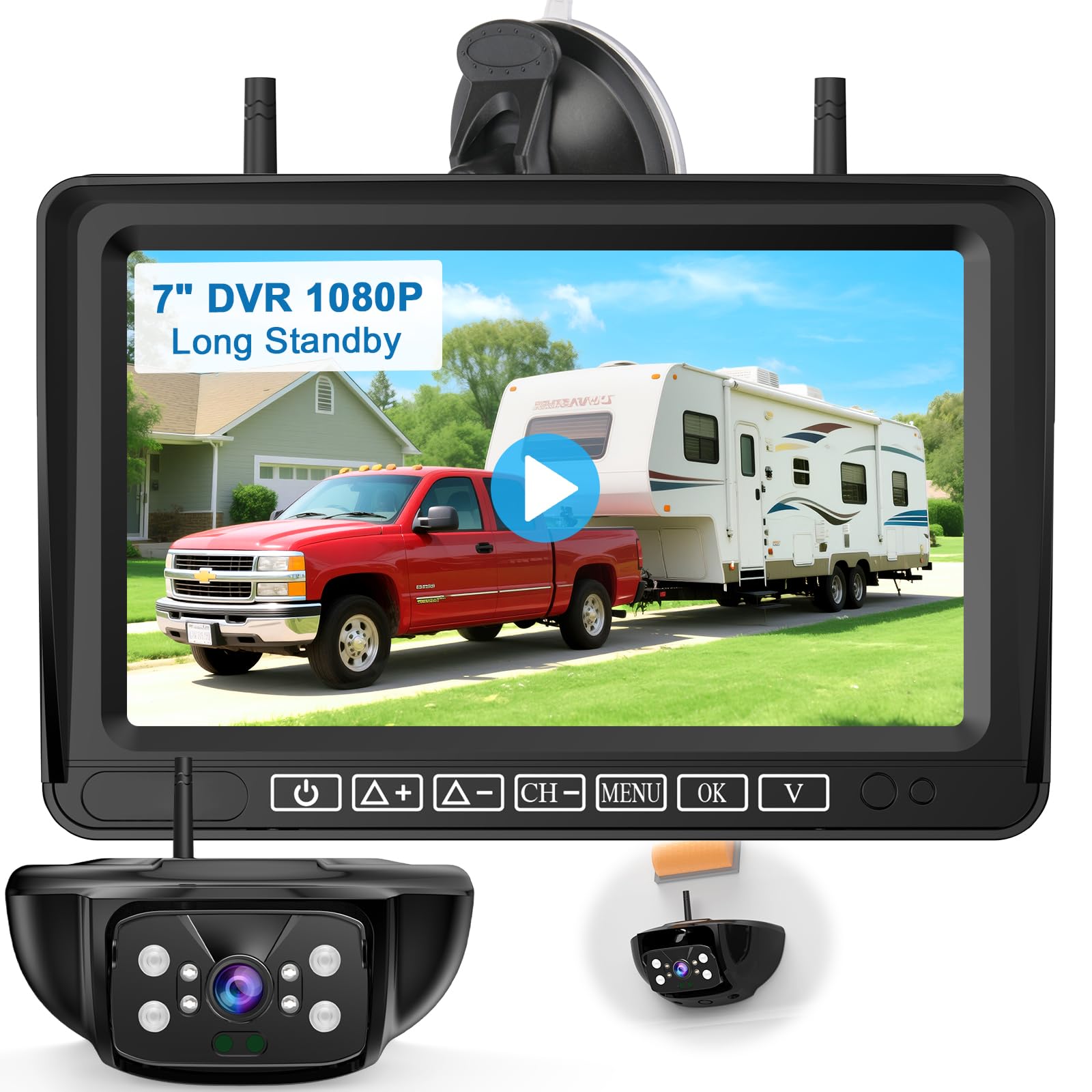
One camera tells you what is directly behind the trailer. It will not line up a hitch ball, and it will not show you what is happening inside a toy hauler. The M1 ships with two magnetic cameras and a 7.2-inch monitor that splits the screen between them, so the rear view and the second view are both live at once.

The hardware behind that: 15,200 mAh of battery with a solar panel, IP69K sealing on the cameras, a 170-degree lens on each, and a suction-cup mount that lets the monitor move between the windshield and the dash. Both cameras mount magnetically, so the second one can sit on a hitch, a bumper or the off side of the trailer without a hole anywhere.

Two live views from one kit is the whole argument, and it holds up if you tow a fifth wheel with a blind corner or back a boat trailer down a ramp. Before ordering, decide where the second camera lives — on the bumper for hitching, or on the far side of the trailer. A camera that moves between jobs ends up in a drawer.

Pros

  • Two cameras on one split screen
  • 15,200 mAh battery with solar
  • IP69K sealing on both cameras
  • Magnets mount without drilling

Cons

  • Costs more than the single-camera kits here
Our verdict

If you have two things to watch — the lane behind you and a hitch or a toy hauler — the split screen keeps both live, and that is worth paying for.

Check Latest Price
4

Best Durable Build

AMTIFO SZNZWX

87 /100
LBD Score Excellent

Key details

Recording
SD card loop recording
Screen Size
7 inches
Field Of View
150 degrees
Camera Channels
4
View on Amazon

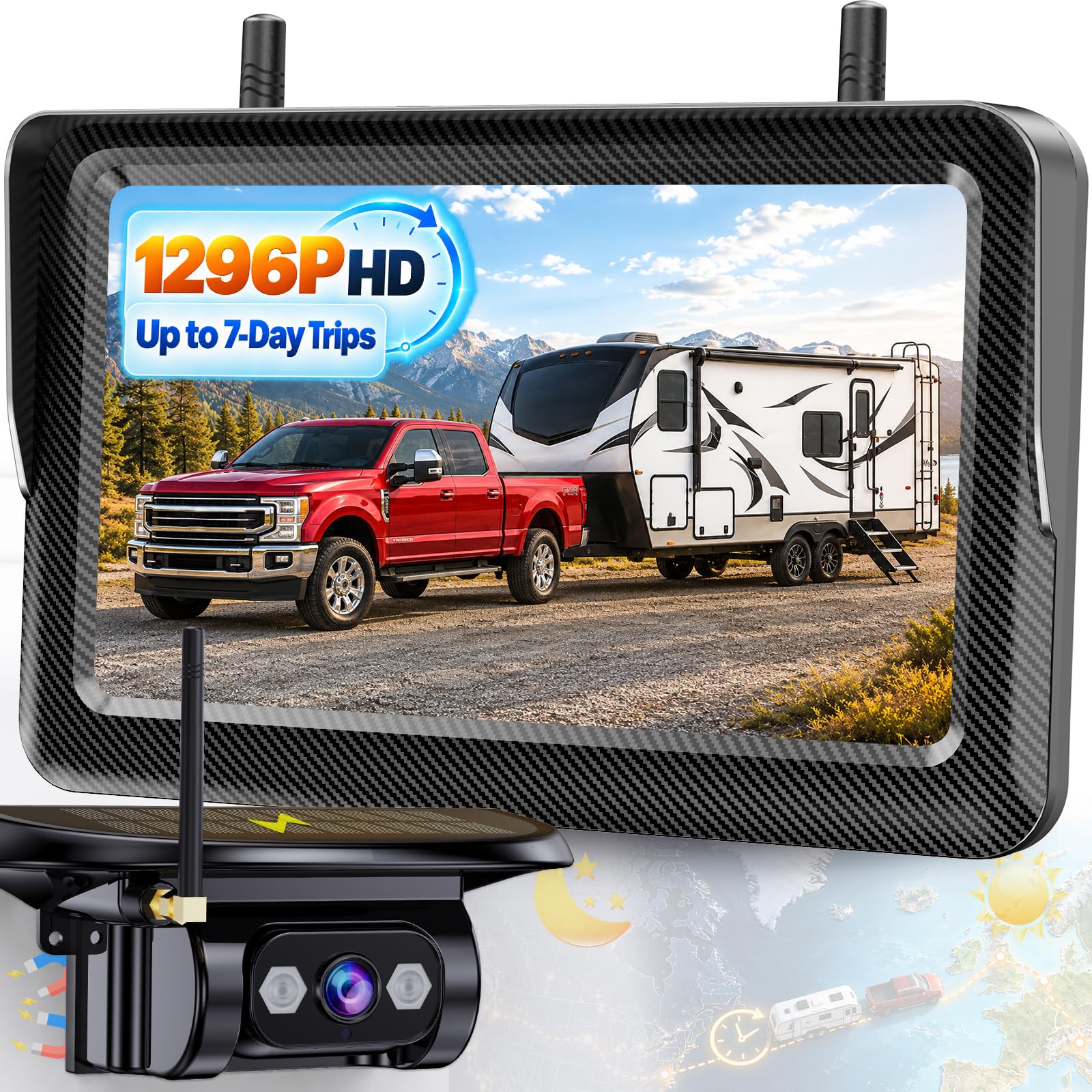
The housing is metal rather than plastic, the camera is rated IP69 against water and dust, and the kit weighs 2.7 pounds. This is the one in the group we trust to sit on the back of a trailer through a few winters of sun, salt and road spray.

It is built for Furrion-prepped rigs, too: the mounting bracket adapter plate and pigtail are in the box, so a trailer that is already wired takes this as a plug-and-play replacement. That is the same install story as the Yakry Y27, and for plenty of buyers the choice between the two comes down to details rather than the job.

The details are a 7-inch touch-key monitor with a built-in sunshade, SD-card loop recording, four camera channels, a 150-degree lens and infrared night vision. The sunshade and the metal body are the pair that matter most in practice — a monitor that washes out at noon is a monitor you stop glancing at.

The box carries the monitor bracket, the pigtail, a test wire and the lighter plug; the memory card for recording is the piece you add yourself. Mount the monitor high on the dash rather than flat, where the sunshade actually shades the screen and the reflection lands on the glass instead of your eyes.

Pros

  • Metal housing rated IP69
  • Furrion bracket and pigtail included
  • Sunshaded 7-inch recording monitor
  • Four camera channels

Cons

  • Narrower 150-degree view than the 170-degree picks
  • Pairing occasionally needs a second try
Our verdict

An all-metal camera, a sunshaded recording monitor and four channels: this is the Furrion-ready kit we hand to people whose trailer lives outdoors year-round.

Check Latest Price
5

Best for Switching Vehicles

pemacom P15

87 /100
LBD Score Excellent

Key details

Mount
Six-magnet base
Battery
15,000 mAh
Screen Size
7 inches
Field Of View
170 degrees
View on Amazon

Six rare-earth magnets hold the camera to a truck bed, a trailer wall or the tongue of a boat trailer, and the unit lifts off with a twist. Nothing is drilled, nothing is wired, and the base stays put while the camera comes and goes.

That removability is the feature we care about most here. One camera can serve a tow vehicle and a trailer if you are willing to walk it back and forth — a hitch view while you are hooking up, a rear view once you are rolling — and it comes inside at the end of the season instead of sitting on a bumper through the winter.

The rest of the package is built around the idea: a 15,000 mAh battery with a solar panel, a 7-inch anti-glare screen, a 170-degree lens and a sleep mode that kicks in when you switch the monitor off at the lighter plug. That last one matters more than it sounds. A camera that wakes with the monitor is a camera whose battery lasts the weekend instead of the morning.

Pros

  • Six magnets, no drilling or wiring
  • 15,000 mAh battery with solar top-up
  • 170-degree lens on a 7-inch anti-glare screen

Cons

  • Aimed at trucks, trailers and small RVs
Our verdict

The magnet is the point: one camera that moves from trailer to truck to hitch with nothing to wire and a battery that lasts the weekend.

Check Latest Price
6

Best Wired Budget Kit

FEISIKE ADC703

82 /100
LBD Score Excellent

Key details

Connection
Wired
Screen Size
7 inches
Field Of View
150 degrees
Camera Channels
2
View on Amazon

There is no radio link here at all. A cable runs from the camera on the back of the trailer to the monitor on the dash, which means no dropped frames in a crowded campground and no pairing ritual at the start of every trip.

The hardware is straightforward: a 7-inch 1080p monitor with a sunshade, a 150-degree lens, LED night vision, IP69 sealing, parking guidelines you can switch on and off, and a lighter plug for power. Two camera channels leave room for a second view, and the monitor switches between them.

Where it lands in this group is the budget wired option, and we mean that as a recommendation rather than a consolation: if a wireless kit has cut out on you mid-lane-change, a cable is the cure. The picture is the weakest of the set, though — the image can come up dim or black, and night footage loses detail. Test the whole run in your driveway while you can still send it back.

Pros

  • Cabled link with no dropouts
  • 7-inch monitor with sunshade
  • Two camera channels
  • Parking guidelines you can toggle

Cons

  • Picture quality trails the rest of the set
  • Cable must be routed the length of the rig
Our verdict

When a wireless kit has already let you down, this is the answer — a cabled link that cannot drop, at the lowest price here.

Check Latest Price
7

Best Budget Pre-Wired Kit

Fodkh Y31

85 /100
LBD Score Excellent

Key details

Screen Size
7 inches
Night Vision
4 infrared LEDs
Field Of View
170 degrees
Waterproof Rating
IP69
View on Amazon

Among the Furrion-ready kits here, this one has the widest lens: 170 degrees against 150 on the Yakry Y27 and the AMTIFO. On a long trailer that extra width is the difference between seeing a car in the next lane and seeing the front of it.

It is a plug-and-play replacement on a pre-wired rig, with dual antennas and 2.4GHz frequency hopping to hold the link, four infrared LEDs for night work, an IP69 rating and a plain 7-inch LCD monitor on a suction mount.

Night work is where the four LEDs earn their place: the picture holds up in an unlit lot, which is where a backup camera does the most good. The camera arrives paired with the monitor, so the first trip is a plug-in rather than a setup session, and the suction mount lets you try two or three monitor positions before you commit to one.

The lens is where this one wins. A 170-degree view in the pre-wired group's lowest price bracket is a lot of picture for the money. Where it gives ground is expansion — the Yakry Y27 takes four cameras, and if a side camera is in your future that settles the choice. For one rear camera on a trailer you tow a dozen weekends a year, the extra width is worth more than the extra channels.

Pros

  • 170-degree lens, widest in the pre-wired group
  • Arrives paired and plug-and-play
  • Four infrared LEDs for night vision
  • IP69 sealed housing

Cons

  • Suction-cup mount is the flimsiest part here
Our verdict

For one rear camera on a pre-wired rig, this is the value call: the widest view in the Furrion group at the lowest price in it.

Check Latest Price
8

Crowded Campgrounds

Thybro A8

84 /100
LBD Score Excellent

Key details

Wireless
5.8GHz digital
Screen Size
7 inches
Field Of View
170 degrees
Waterproof Rating
IP69K
View on Amazon

Thybro's kit transmits on 5.8GHz rather than the 2.4GHz band most of this group uses. That band is less crowded — fewer campground networks, fewer rival monitors — and a clear channel is worth more than a big number on the box when the park Wi-Fi comes on at seven in the evening.

The hardware around it is current: 1080p, a 170-degree lens, a 7-inch touch-key monitor with loop recording, IP69K sealing, a solar panel backed up by USB-C charging and NdFeB magnets rated at 50 pounds of pull.

The magnet is the part we keep coming back to. Fifty pounds of pull is enough that the camera snaps into place and stays there over washboard gravel, and the iron plate in the box means a fiberglass or aluminum panel can take it too. On a steel surface, the mount is the entire installation.

On a mid-size trailer in a busy park, the band choice alone justifies a look, and the hardware around it is not parts-bin. What we cannot shortcut is time: this is among the newest designs here, so the first season is the audition. Pair it at home, confirm it reconnects on its own every time the ignition cycles, and take it on a familiar highway before an unfamiliar one.

Pros

  • 5.8GHz band dodges crowded 2.4GHz traffic
  • 50 pounds of magnetic pull
  • 170-degree lens and 1080p video
  • Solar plus USB-C charging

Cons

  • 5.8GHz signal gives up range sooner than 2.4GHz
Our verdict

A less crowded band and a magnet that holds through gravel — this is the one we suggest for a mid-size trailer in a busy park.

Check Latest Price

How We Tested a Dozen RV Backup Cameras

We started by pulling every wireless and pre-wired system we could find with a 7-inch monitor, since anything smaller is hard to read from the driver's seat in motion. From there we sorted by mounting style (magnetic versus bracket), power source (hardwired, battery, solar-assisted), and whether the box contained everything needed to pair up and drive off. After cutting near-duplicates, we landed on 12 units and ran them for eight months.

Every unit went on the back of the same travel trailer and got the same treatment. I installed each one solo with a stopwatch running and counted the steps between opening the box and seeing a live picture, then noted how easy the menu and touch keys were to work with gloves on. On the road we towed at highway speed, merged, and backed into tight sites while watching for dropouts, and I deliberately parked so the trailer sat between the cab and the camera, which is where weak signal shows up first. For latency, I backed toward a traffic cone and watched how far the bumper traveled between the moment it appeared on screen and the moment it actually reached it.

Image quality got judged at the worst times of day — low sun straight into the lens, full dark, rain on the housing — and by what I could actually resolve, like a curb, a post, or a kid on a bike, rather than the resolution printed on the box. Battery units ran with solar charging switched off until they quit, so we know roughly how many days of real towing each one delivers. Magnetic mounts did a 200-mile tow plus a stretch of washboard gravel, then got a hard shove by hand to see if they'd shift. We also kept the receipts, because prices varied enormously for what was often the same picture.

How to Choose an Rv Backup Camera

Where the camera gets its power

The camera on the back of a trailer needs 12-volt power, and where it comes from decides the whole install. A Furrion-ready rig already has a mounting plate and a pigtail at the rear corner, which narrows the field to kits with the right bracket — the Yakry Y27, the AMTIFO and the Fodkh among them. A battery camera such as the Yakry Y33 skips the wiring altogether, at the cost of owning a charging routine. Look for that plate before you shop; it is the single fact that most changes what you should buy.

The wireless link is where kits differ

Range claims are measured in open air, and a trailer is not open air: the camera sits behind aluminum, bedding and a bathroom wall, and the monitor sits behind your passengers. Dual antennas on the monitor and a stronger transmitter help, which is why the Yakry Y33 pairs a 24dBm transmitter with dual receiving antennas. Band choice matters too — 2.4GHz travels further, while the 5.8GHz the Thybro uses has less competition from campground networks. On a long rig, treat any wireless kit as something to prove on a highway before you trust it on a trip.

What the picture is actually like

Resolution sells kits; the lens and the night performance decide what you see. A 170-degree lens shows more of the lane beside you and makes everything in it smaller, while a 150-degree lens is easier to read at a glance and leaves a little more blind. There is no universal right answer — we favor the wider lens on a long trailer and the narrower one where the camera sits close to the action. After dark, infrared LEDs and a sensitive sensor matter more than pixels, and an unlit lot is the test worth running.

Mounting: magnets, brackets and reach

Brackets are permanent and secure; magnets are removable and need steel. If the trailer's rear wall is aluminum or fiberglass, a magnetic kit needs its iron plate bonded on first, which is less work than drilling and still a change to the skin. Mount high and centered so the lens can see past both corners, angle it down until the frame catches a car length behind you rather than sky, and put it somewhere you can reach to wipe — road film ruins more night vision than sensor specs do.

Channels and recording

Two channels cover a rear camera plus one more view: a hitch, a blind side, the inside of a toy hauler. Four channels are for people who expect to add cameras over time, and they cost more. Recording is worth having if you want a record of a lane change or a scrape — several kits here write to a card, including the Yakry Y27, the AMTIFO and the pemacom M1. Buy for the job in front of you and the camera count you will actually reach for.

Frequently Asked Questions

Final Verdict

Start with the plate on the back of your trailer. If there is a Furrion bracket and pigtail there, the Yakry Y27 is the kit we recommend without much hedging: it installs in one connection, it shows a clear 150-degree view day or night, and four channels leave room for a second camera later.

If there is no plate — or you camp without hookups — the Yakry Y33 earns its extra cost, because a camera that is always charged is the only kind that helps. And if a wireless kit has already cut out on you mid-lane-change, accept the cable and buy the FEISIKE.