Best Smart Home Gyms of 2026

A home gym machine sells the dream of a full weight room in one corner of the garage, and the math is sound: one station replaces a rack, a bench, and a cable tower. What the brochures skip is that it only pays you back if switching from lat pulldown to leg extension takes seconds. Machines that make you pull three pins and hunt for a handle end up folded against the wall by spring. I've had a weight stack in my basement for years, and every keeper shares one trait: you can move between stations without breaking your rhythm. My team and I spent eight months building, adjusting, and training on eight of these to see which ones earn their footprint.

The exercise count on the frame tells you less than you'd expect; fit and adjustability are what separate these machines. Whether the seat lands right for both a shorter and a taller lifter, whether the resistance moves in small enough increments to progress, and whether the cables still run smooth after months of use all show up by week three. The picks below run from compact folding trainers to full cages, so start with the space you actually have.

1

Best Overall

Mikolo HGS Pro Home Gym

87 /100
LBD Score Excellent

Key details

Stations
10-in-1 with leg press
Footprint
75 in. D x 36.3 in. W x 80 in. H
Weight Stack
154 lb (12 levels)
Max User Weight
300 lb
View on Amazon

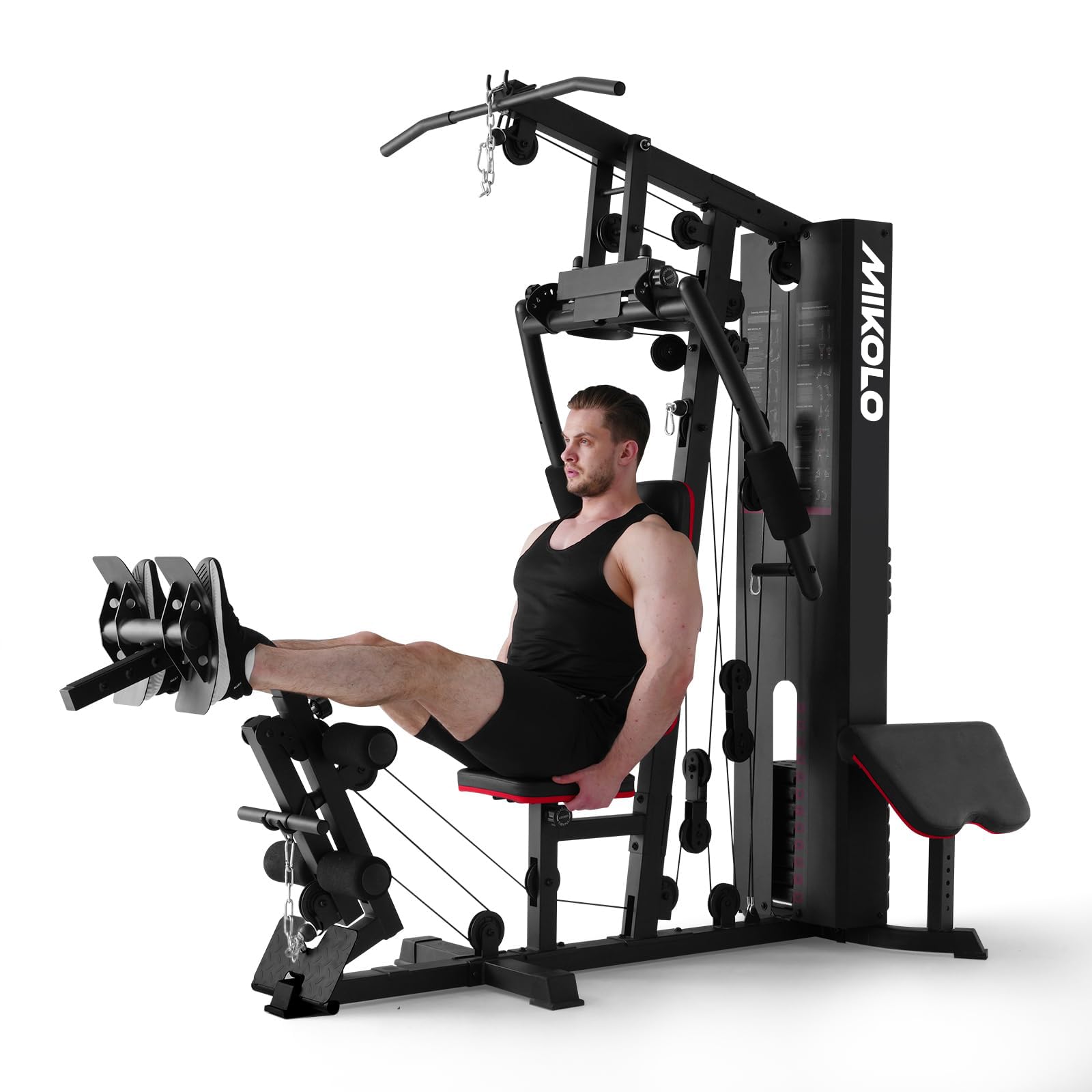
The number we kept coming back to is 36.3 inches. That is the width of the Mikolo HGS Pro, and it is why this is the machine we recommend first: it gives you a 154-lb selectorized stack, leg press, preacher curl, pec fly, lat pulldown, and low row in a footprint that can live along a garage wall or in the corner of a spare room. Most full-station gyms make you choose between a useful stack and a room you can still walk through. This one makes that choice easier.

The 10-in-1 station count is not marketing math in our view. The pulleys switch between high, mid, and low positions, and the leg press and preacher curl pads come off when you want them out of the way. We like that the attachments are quick to swap, because a home gym only earns its space when you can move from one exercise to the next without rebuilding the machine.

The 154-lb stack is the real limit. For general strength work, it is enough; for a lifter who already benches or rows heavy, it is a ceiling you will meet quickly. The 300-lb user capacity is generous for a compact frame, and the lifetime frame warranty is the kind of backup we want on a machine this size. Assembly is the trade-off: plan for a helper and a clear afternoon, not a 30-minute build.

What seals it for us is the balance. You get a narrow footprint, a useful stack, and enough stations to train your whole body, without the two-user footprint of the SunHome or the barbell footprint of the Mikolo SM02. The included exercise sheet and assembly video are useful, but the real draw is the machine's geometry: it lets you train hard without dedicating the room to it.

Pros

  • Narrow 36.3-inch footprint
  • 154-lb stack with 12 levels
  • Leg press and preacher curl attachments
  • Lifetime frame warranty

Cons

  • Stack tops out for heavy lifters
Our verdict

We recommend the Mikolo HGS Pro as the best overall because it packs a 154-lb stack and 10-in-1 stations into the narrowest footprint here, making it the smart default for a garage or spare room.
Check Latest Price
2

Best for Tight Spaces

WFLGFT 148-lb Home Gym

90 /100
LBD Score Outstanding

Key details

Exercises
35+
Footprint
63.4 in. D x 34.7 in. W x 80.7 in. H
Weight Stack
148 lb
Max User Weight
450 lb
View on Amazon

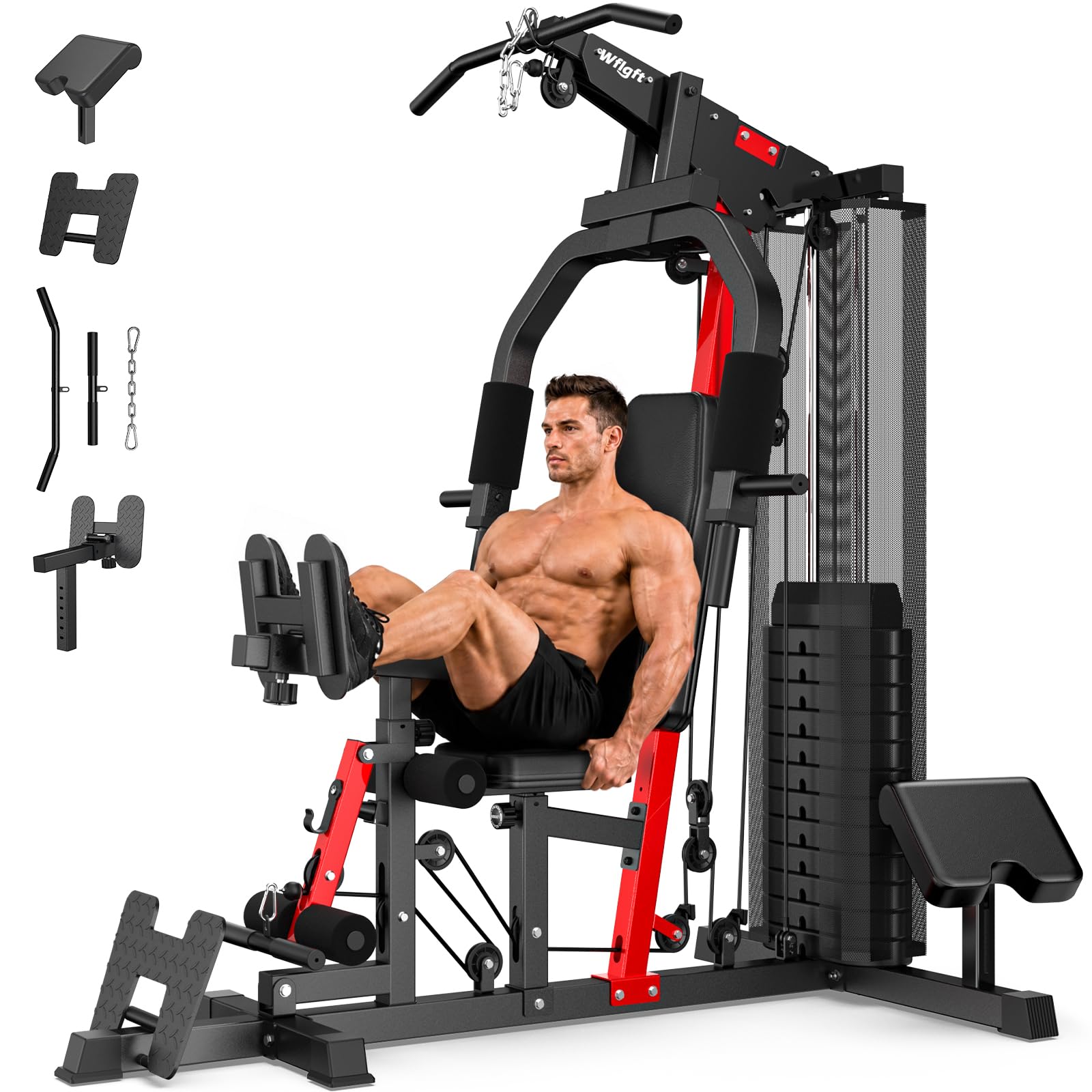
The WFLGFT is the pick for the room that barely has a wall to spare. At 34.65 inches wide and 63.4 inches deep, it is the smallest full-stack machine in this group, and the listed weight is light enough that moving it into place before assembly is not a two-person ordeal.

We like that the 148-lb stack and 35+ exercise range do not feel like a compromise for a small room. The adjustable seat, pedals, and multi-position butterfly arms give you a better chance of finding a usable position than a fixed-geometry budget machine. The 450-lb user-weight rating is also the highest among the compact picks here, which matters if the machine will be shared.

The 148-lb stack is the other limit; it is fine for most general training, but not for someone chasing heavy compound numbers. Assembly is not a 20-minute job either. The payoff is that you get a full station in a footprint small enough to keep in a spare bedroom.

Pros

  • Smallest full-stack footprint here
  • 148-lb stack with 35+ exercises
  • 450-lb user-weight rating
  • Adjustable seat, pedals, and arms

Cons

  • 148-lb stack limits heavy lifting
  • Assembly can take an afternoon
Our verdict

Choose the WFLGFT if your room is the binding constraint: it is the smallest full-stack machine here, with a 148-lb stack and 450-lb user rating that make it more than a token home gym.

Check Latest Price
3

Best Value Full-Feature

Sportsroyals HPM02 Home Gym

86 /100
LBD Score Excellent

Key details

Exercises
35+
Footprint
75.2 in. D x 51.5 in. W x 81.1 in. H
Weight Stack
150 lb (11+1 levels)
Max User Weight
265 lb
View on Amazon

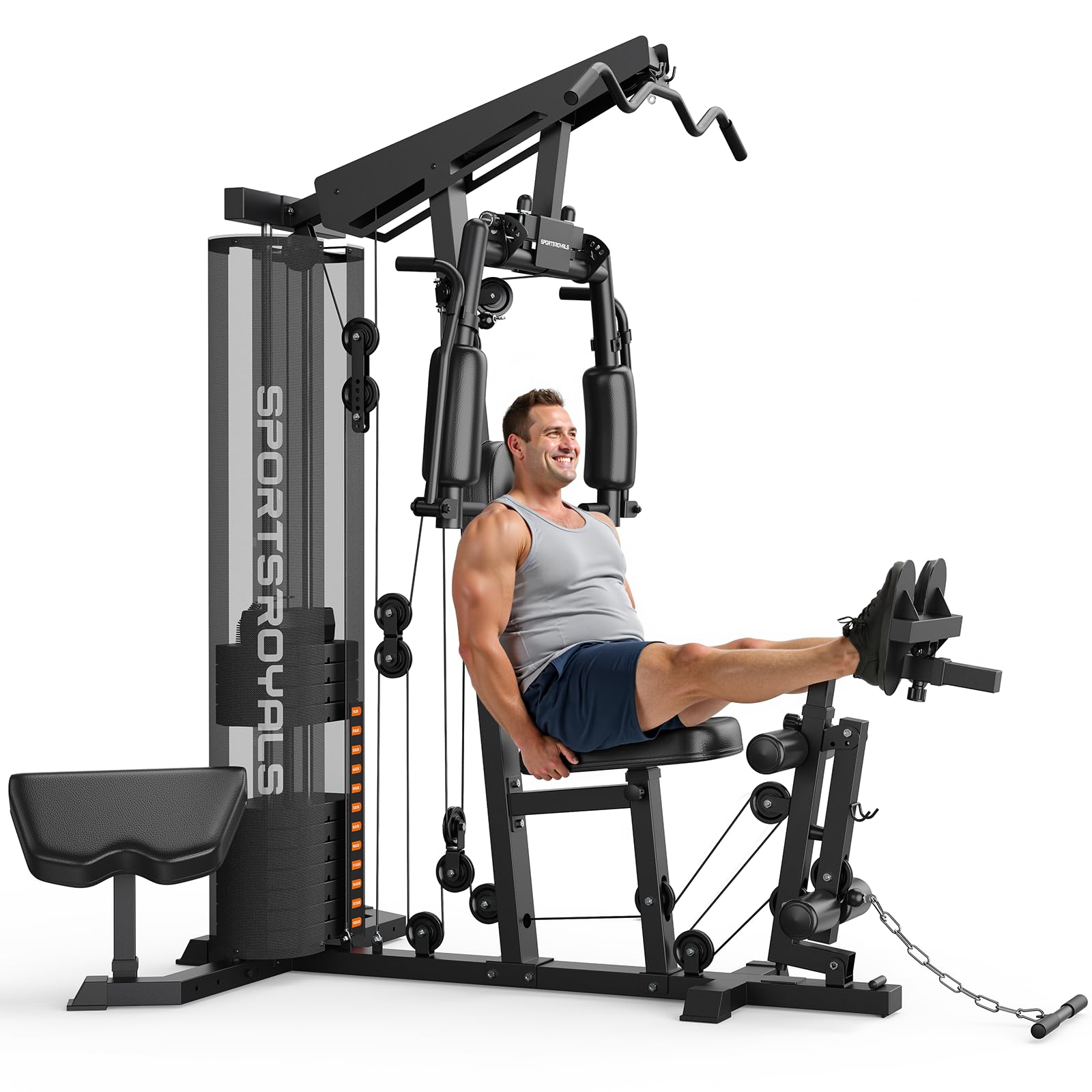
Sportsroyals takes a different route to the same goal: a wide H-base, a 150-lb stack, and a station list that includes chest fly, leg press, preacher curl, lat pulldown, and low row. It is 51.5 inches wide, so it wants more wall than the Mikolo HGS Pro, but it also gives you a broader platform and a 265-lb user rating. For a garage with a little more room, that trade is worth considering.

We like the H-base specifically. A wide stance is what keeps a tall cable machine from feeling tippy when you are pulling from the high pulley, and the 70 x 50mm steel tubing is the sort of overbuilding we want in a machine that holds a stack above your head. The 35+ exercises are laid out around six stations, and the leg press footplate adjusts front to back, which helps shorter and taller users find a useful range.

The 150-lb stack is the same story as the rest of this group: enough for general strength work, not enough for a dedicated lifter who needs to keep loading. The 265-lb user limit is lower than the WFLGFT and Mikolo HGS Pro, so bigger users should check that number first. We also noticed the footprint is deeper than the width suggests; 75.2 inches of depth is real, and you need to leave room to walk around it.

Pros

  • Stable H-base and thick steel
  • 150-lb stack with 35+ exercises
  • Leg press with adjustable footplate
  • Lifetime frame warranty

Cons

  • 265-lb user limit is lower than some
  • 150-lb stack tops out for heavy lifters
Our verdict

The Sportsroyals HPM02 is our pick for a fuller-feature home gym when you have the wall space: its 150-lb stack, leg press, and stable H-base make it a strong value for general strength training.

Check Latest Price
4

Best for App-Guided Workouts

BowFlex PR1000

92 /100
LBD Score Outstanding

Key details

Exercises
25+
Footprint
84 in. D x 38 in. W x 82 in. H
Resistance
200 lb Power Rod
Max User Weight
200 lb
View on Amazon

The integrated device holder is what makes the BowFlex PR1000 the most natural app-guided pick here, and the rowing conversion is the bonus. This is the old-school answer to the smart home gym question: 200 lb of Power Rod resistance instead of a weight stack, a bench that converts to a rolling seat, and a place to put your phone or tablet. If you want to follow a guided workout on your own screen, this is the easiest machine in the group to set up that way.

We appreciate the rod resistance for a different reason: it is smooth, quiet, and does not need a stack of plates or a cable stack to maintain. The multiple pulley positions let you change the angle of resistance, and the 25+ exercises cover the major muscle groups. The rowing conversion is a nice bonus because it turns the bench into a cardio option without adding a second machine.

The limit is the load. The rods deliver 200 lb, but the practical resistance per side is lower, and the machine is not the right choice for anyone who already lifts heavy. The 84-inch depth is also substantial; this is not a fold-into-a-closet machine despite what the footprint might suggest. We think it makes the most sense for a beginner or a household that wants one machine for light-to-medium strength and rowing, not for a powerlifter.

Pros

  • Integrated device holder
  • 200-lb Power Rod resistance
  • Converts to rowing
  • 25+ exercises

Cons

  • Less resistance per side than the total suggests
  • Large 84-inch depth
Our verdict

The BowFlex PR1000 is our pick for app-guided workouts: its device holder, 200-lb rod resistance, and rowing conversion make it an easy, low-maintenance way to train at home.

Check Latest Price
5

Best No-Assembly

Total Gym XLS

92 /100
LBD Score Outstanding

Key details

Resistance
6 incline levels
Folded Size
19 x 51 x 9 in.
Open Footprint
19 x 90 x 43 in.
Max User Weight
400 lb
View on Amazon

The Total Gym XLS is the one we point to when assembly is the dealbreaker. It arrives ready to train, folds to roughly 19 x 51 x 9 inches, and uses six incline levels to turn your bodyweight into resistance. That makes it a different kind of home gym from the stack machines here, but for a beginner, an older lifter, or anyone who wants low-impact strength and stretching without a construction project, it is the easiest place to start.

We like the range of exercises: 80+ movements across strength, cardio, and stretching, plus a squat stand, wing attachment, and leg pull accessory. The padded glideboard and pulley system feel more controlled than a lot of bodyweight trainers, and the 400-lb user capacity gives it a broader fit than its light frame suggests. The six incline levels are also easy to understand: steeper means more resistance, and you can change it between sets without touching a pin.

The trade-off is that bodyweight resistance is not the same as a 150-lb stack. If you are already strong, you may run out of challenge on some movements, and the machine is not designed for heavy barbell-style lifting. The folding design is genuinely useful, but it still needs a clear floor when open. We see it as a complement to, not a replacement for, a weight stack if you lift heavy.

Pros

  • No assembly required
  • Folds to 19 x 51 x 9 inches
  • 80+ exercises with accessories
  • 400-lb user capacity

Cons

  • Bodyweight resistance limits heavy lifters
  • Still needs clear floor when open
Our verdict

The Total Gym XLS is our no-assembly pick: it folds flat, supports 80+ bodyweight exercises, and gives beginners or low-impact trainees a complete workout without a weight stack.

Check Latest Price
6

Best for Two Users

SunHome 925 Home Gym

89 /100
LBD Score Excellent

Key details

Exercises
100+ combinations
Footprint
96.9 in. D x 55.1 in. W x 86.6 in. H
Weight Stacks
Dual 138 lb
Frame Capacity
2,000 lb
View on Amazon

Two independent 138-lb stacks are the reason the SunHome 925 exists: it lets two people train at the same time, with dual stations and a listed 100+ exercise combinations. One person can use the lat pulldown while the other works the leg press or cable crossover. If a couple or training partners share a garage, that changes the math: you are not buying one machine, you are buying two stations in one footprint.

The frame is serious: 2 x 2-inch commercial-grade steel with a 2,000-lb capacity, and the dual stacks mean you do not have to strip and reload between users. We like that the stations are independent rather than a single stack with a split pulley, because it keeps the resistance honest when both people are working.

The footprint is the first thing we would measure. At 96.85 inches deep and 86.61 inches high, it needs a dedicated room, not a corner. The seat and bench adjustment is the other weak point: the machine does not give every user the same range, and shorter or taller users may find the leg press or cable positions compromised. For a shared gym where both users are average-sized, it is a strong two-person setup; for a tight room or a single lifter, it is more machine than you need.

Pros

  • Dual independent 138-lb stacks
  • Two users can train simultaneously
  • 2,000-lb frame capacity
  • 100+ exercise combinations

Cons

  • Needs a dedicated room at 96.9 inches deep
  • Seat and bench adjustment limits fit
Our verdict

The SunHome 925 is our pick for couples and training partners: its dual 138-lb stacks and independent stations let two people train at once without waiting for the other to finish.

Check Latest Price
7

Best Premium Power Cage

Mikolo SM02 Smith Machine

86 /100
LBD Score Excellent

Key details

Footprint
68 in. D x 56 in. W x 87 in. H
Pulley Ratio
2:1
Weight Stacks
Dual 128 lb (256 lb total)
Frame Capacity
2,200 lb
View on Amazon

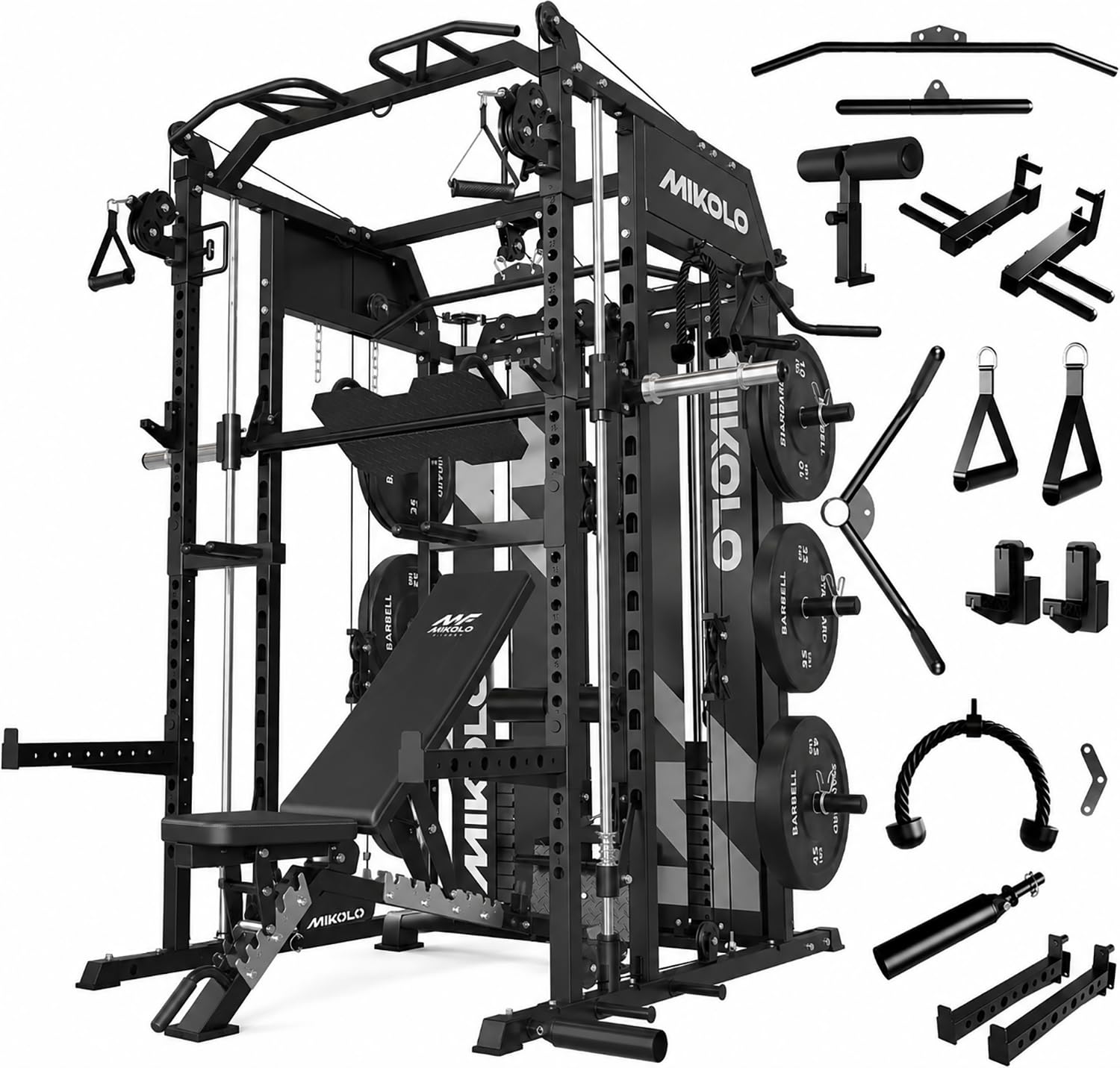
A Smith machine and two 128-lb stacks are what set the Mikolo SM02 apart from the all-in-one stations here. It combines barbell work, a power cage, and a dual-pulley cable system, and the 2:1 pulley ratio gives the functional trainer a longer cable travel than a simple 1:1 setup. If you are building a garage gym around a barbell, this is the most complete machine here.

We like the dual-stack design because it lets two people train independently or lets one person superset without changing the pin. The 2,200-lb frame capacity and 50 x 50mm steel are built for serious loading, and the included bench and attachments mean you are not piecing together a rack and a cable tower separately. The 87-inch height is tall but still within a typical garage ceiling; check before you commit if your space is tighter.

The 128-lb stacks are the compromise. They are fine for cable work and accessory lifts, but a strong lifter will max them out on rows or pulldowns, and the Smith machine is the place to load plates. The footprint is also wider and deeper than the all-in-one stations, and assembly is a bigger project.

For us, the SM02 makes sense when a barbell is already part of your training and you want the cable work to happen in the same footprint. It is not the first machine we recommend for a general buyer, but it is the one we point to when the garage gym is being built around a rack.

Pros

  • Smith machine plus dual cable stacks
  • 2:1 pulley ratio for cable travel
  • 2,200-lb frame capacity
  • Includes bench and attachments

Cons

  • 128-lb stacks limit heavy cable work
  • Large, complex assembly
Our verdict

The Mikolo SM02 is our premium pick for a garage gym built around a barbell: it adds a Smith machine, dual 128-lb stacks, and a smooth cable crossover to one serious frame.

Check Latest Price
8

Plate-Loaded Cage

pooboo P43 Power Cage

93 /100
LBD Score Outstanding

Key details

Footprint
62.9 in. D x 43.3 in. W x 82.6 in. H
Attachments
20+ included
Cable Capacity
1,000 lb
Frame Capacity
2,000 lb
View on Amazon

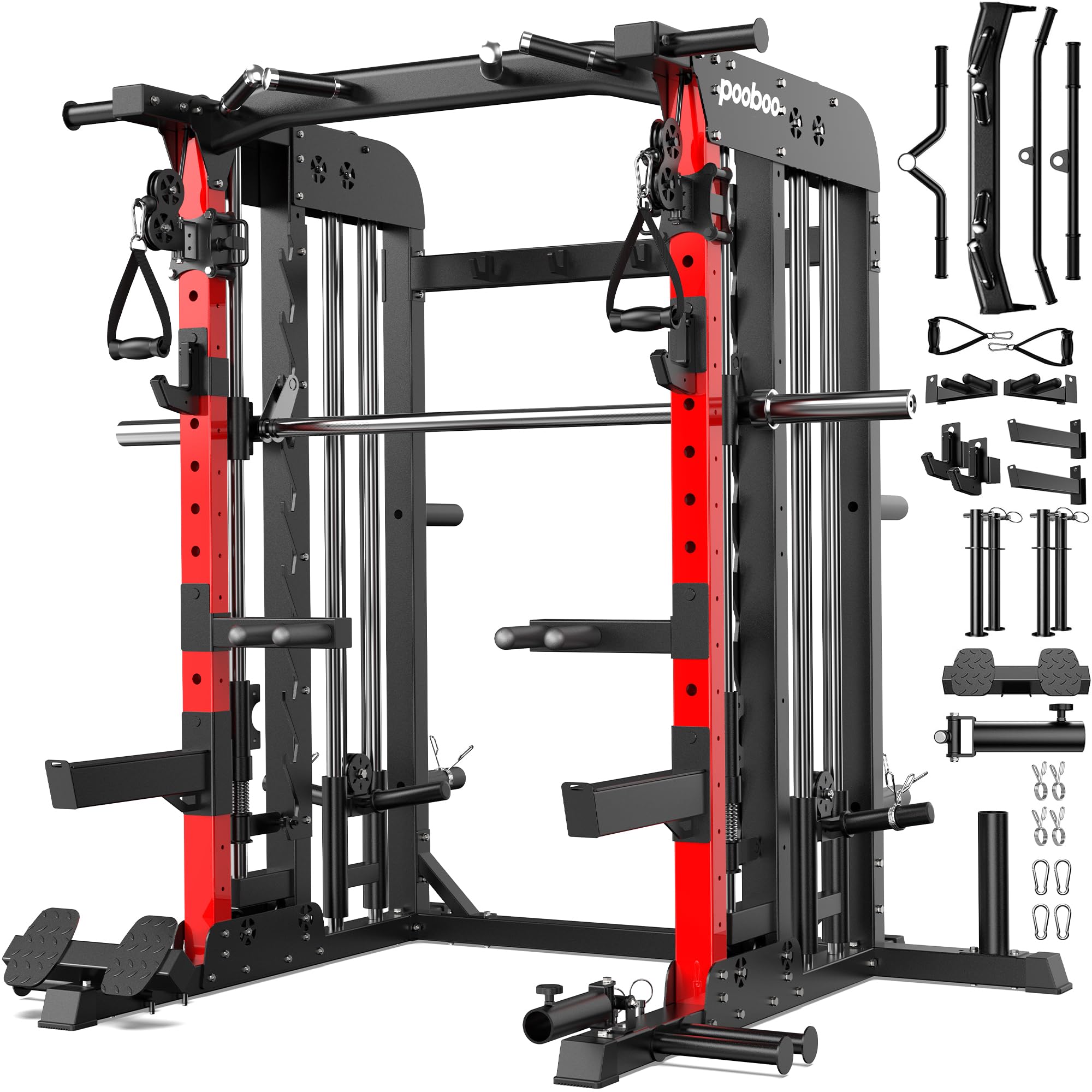
A 2,000-lb frame rating is the first thing that separates the pooboo P43 from the all-in-one stations. It is a power cage first and a cable machine second, with a 1,000-lb cable system and 20+ attachments including J hooks, safety spotter arms, dip bars, a lat pulldown bar, and cable handles. It does not include a weight stack, so you supply the plates. For a lifter who already owns plates or wants to add them over time, that is a more flexible way to spend the budget.

We like the safety-first layout. The spotter arms and J hooks are the pieces that make solo barbell training realistic, and the dual pulley crossover gives you cable work without a second tower. The 62.9-inch depth and 43.3-inch width are compact for a power cage, and the steel and cable specs are among the strongest here. The cable system is rated to 1,000 lb, so it has headroom for most home lifters.

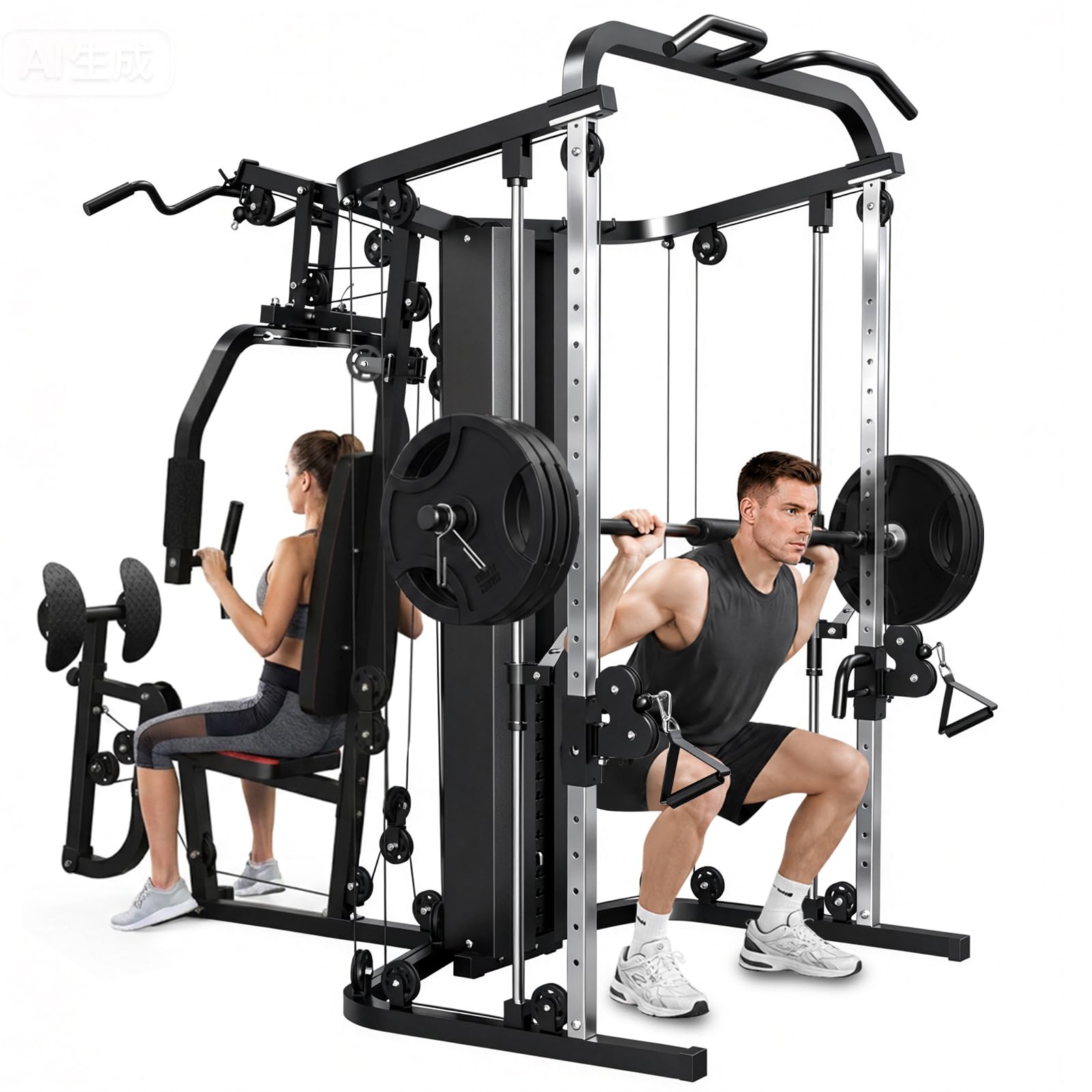
The catch is that the plates are not included, and the cable stacks you see on the other machines are replaced by a plate-loaded pin. That is not a downgrade for a serious lifter, but it is a different purchase: you need to budget for plates, and you need space to store them. If you want a self-contained station with a selectorized stack, the Mikolo HGS Pro is the easier buy; if you want a cage that can grow with your barbell work, the P43 is the better foundation.

That makes the P43 the right choice for a lifter who wants a cage and cable crossover with room to grow, not for someone who wants a finished, all-in-one station. Pair it with a set of plates and a bench; the machine is the foundation, not the whole gym.

Pros

  • 2,000-lb frame with spotter arms
  • 1,000-lb cable system
  • 20+ attachments included
  • Compact power-cage footprint

Cons

  • No weight stack included
  • You must supply and store plates
Our verdict

The pooboo P43 is our pick for a plate-loaded power cage: its 2,000-lb frame, 1,000-lb cable system, and 20+ attachments give serious lifters a flexible base without a built-in stack.

Check Latest Price

How We Tested the Best Home Gym Machines

We started with a list of about 40 machines and cut it down by the things that disqualify a home gym before anyone lifts a plate: footprint, ceiling clearance, stack size, the frame's user-weight rating, and whether the stations you'd actually use are included rather than sold as add-ons. That left eight, ranging from compact folding trainers to full Smith machine cages, and we bought every one at retail.

Assembly came first, because it's where these machines lose most people. We timed every build, noted which steps genuinely required a second set of hands, and checked whether the parts in the box matched the labels in the manual. From there, each machine lived in a garage or basement for eight months and got used the way a home gym actually gets used: a rushed 6 a.m. session before work, and a longer weekend workout where two of us traded sets.

We measured adjustability with a stopwatch — how long it took to get from lat pulldown to leg extension, whether the seat back moved without tools, whether the pin or resistance level could be changed mid-set. Our two testers, at 5'2" and 6'4", checked whether the pads, handles, and foot rollers landed where they should for both of them, and whether the exercise placards actually named what each station does or left you guessing at cable routing.

Sturdiness got checked at the worst moment: the top of a heavy pulldown, watching for frame rock and listening for squeaks, then shifting each machine across the floor to see if it walked. After eight months we went back over every cable for fraying, every pad for compression, and every bolt for loosening.

How to Choose a Smart Home Gym

Measure the Room Before You Compare Features

Start with depth, width, and ceiling height, because those numbers decide which machines are even possible. A compact all-in-one like the Mikolo HGS Pro is 75 inches deep and 36.3 inches wide; the SunHome 925 is nearly 97 inches deep, so it needs a dedicated room rather than a corner. The tallest pick here is 87 inches, so an 8-foot ceiling leaves about 9 inches above it. Leave clear space in front for loading and getting on and off. The trap is the word compact: a machine can be narrow and still run most of the way across a garage.

Choose the Resistance That Matches Your Strength

Selectorized stacks are the easiest to live with: you move a pin, and the resistance changes in small steps. A 150-lb stack is enough for general strength work and most accessory lifts, but a lifter who already benches or rows heavy will run out of resistance. Power rods and bands are quieter and less expensive to build around, but they do not feel like plates. Bodyweight incline trainers like the Total Gym XLS are excellent for low-impact work and stretching, not for maximal loading. If you want to progress past the stack, choose a plate-loaded cage such as the pooboo P43.

Check the Stations Against Your Body

A long exercise list is only useful if the machine's geometry fits you. Look for an adjustable seat, a leg-press footplate that moves front to back, and butterfly arms with more than one position. Those adjustments are what let a shorter or taller user get a full range of motion instead of a shortened rep. The SunHome 925 is a good example of the trade-off: it has two stations and a huge exercise count, but the seat and bench adjustment is the weak point. If you are near the top or bottom of the height range, try the leg press and cable row before you commit.

Plan for Assembly, Anchoring, and Guided Training

Assume a full-stack machine will take a helper and a few hours, even with a good video; the Total Gym XLS is the exception because it arrives ready to use. Once it is built, anchor or stabilize the frame, keep the cables and pulleys clear, and inspect them before use. For guided training, most home gyms in this category give you a device holder or a training video rather than app-controlled resistance. That is still useful: a tablet on the BowFlex PR1000 or a workout guide video on the Sportsroyals HPM02 can structure a workout without adding a subscription.

Frequently Asked Questions

Final Verdict

For most people, the Mikolo HGS Pro is the home gym we recommend first. It has the narrowest full-stack footprint in this group, a 154-lb stack that covers general strength work, and enough stations to train the whole body without turning the room into a gym.

If your room is even tighter, the WFLGFT is the better fit. If a barbell is the center of your training, the Mikolo SM02 is the premium upgrade. Those are the two requirements that change the answer; everything else is a matter of how much space and station variety you want.