Best Smart Pet Feeders of 2026

A smart feeder proves itself on the morning you're three states away and the house is empty. Anyone can drop a portion while you're standing in the kitchen. The real question is whether the thing still dispenses the right amount on day twelve, when the hopper is half empty and nobody's there to fix a jam. The second thing people trip over is the WiFi: plenty of these feeders only speak 2.4GHz, so a 5GHz-only network makes a perfectly good unit look broken before you've scheduled a single meal.

I've spent the past six months living with 14 of these, from bare-bones timed models to units with night vision and two-way audio, and the differences show up fast — in portion accuracy, in how long pairing takes, in how the app behaves when you change a schedule, and in whether a jam gets caught before the dog notices. Capacity matters more than the listings let on, too: a 3-liter hopper is a week of food for one cat and about three days for a pair, and the seal on the lid is what keeps the last cup from going stale.

What follows is sorted by household rather than by feature count, because the right feeder for a single grazer and the right one for two cats who bully each other at the bowl are genuinely different machines.

1

Best Overall

Yuposl 4L Camera Feeder

88 /100
LBD Score Excellent

Key details

Wi-Fi
2.4 and 5 GHz
Camera
1080P HD, night vision
Capacity
4 liters
Feeding Plan
1-15 meals, 1-99 portions
View on Amazon

A feeder has one real job: put the right amount of food in the bowl at 6 a.m. whether or not anyone is awake. That's the test we kept coming back to with the Yuposl, and it's the reason this is the one we point most people to. It's the most dependable all-rounder in this group, and the camera is the bonus rather than the reason to buy.

The numbers are sensible rather than spectacular — a 4-liter hopper, a plan that runs from 1 to 15 meals a day in up to 99 small portions, and dual-band 2.4/5 GHz Wi-Fi so you aren't hunting for a 2.4-only router. The hopper is the small end of this group at 4 liters, which mostly matters in a two-cat house where you'll be topping up more often.

What we appreciate most is the feeding record: the camera captures a meal as it happens and pushes the notification to your phone, so you get a picture with a timestamp instead of a bare log line. Low-food and low-battery alerts come through the app, the rubber rotor and lid keep kibble from going soft, and the stainless bowl lifts out for a wash.

The one wrinkle is the buttons on the unit itself, which can be sluggish to respond — do your programming in the app and you'll rarely touch them. Otherwise this is the least fussy way into a camera feeder here: a 1080P view with night vision, two-way audio, and a schedule you can leave alone.

Pros

  • Reliable scheduled feeding
  • 1080P camera with two-way audio
  • Dual-band 2.4/5 GHz Wi-Fi
  • Snaps a photo when your pet eats

Cons

  • 4-liter hopper means more refills
  • On-unit buttons can respond poorly
Our verdict

Our default pick: dependable scheduled meals, a 1080P camera with two-way audio, and dual-band Wi-Fi at a mid-range price. Best for one cat or an easygoing pair.
Check Latest Price
2

Best With Battery Backup

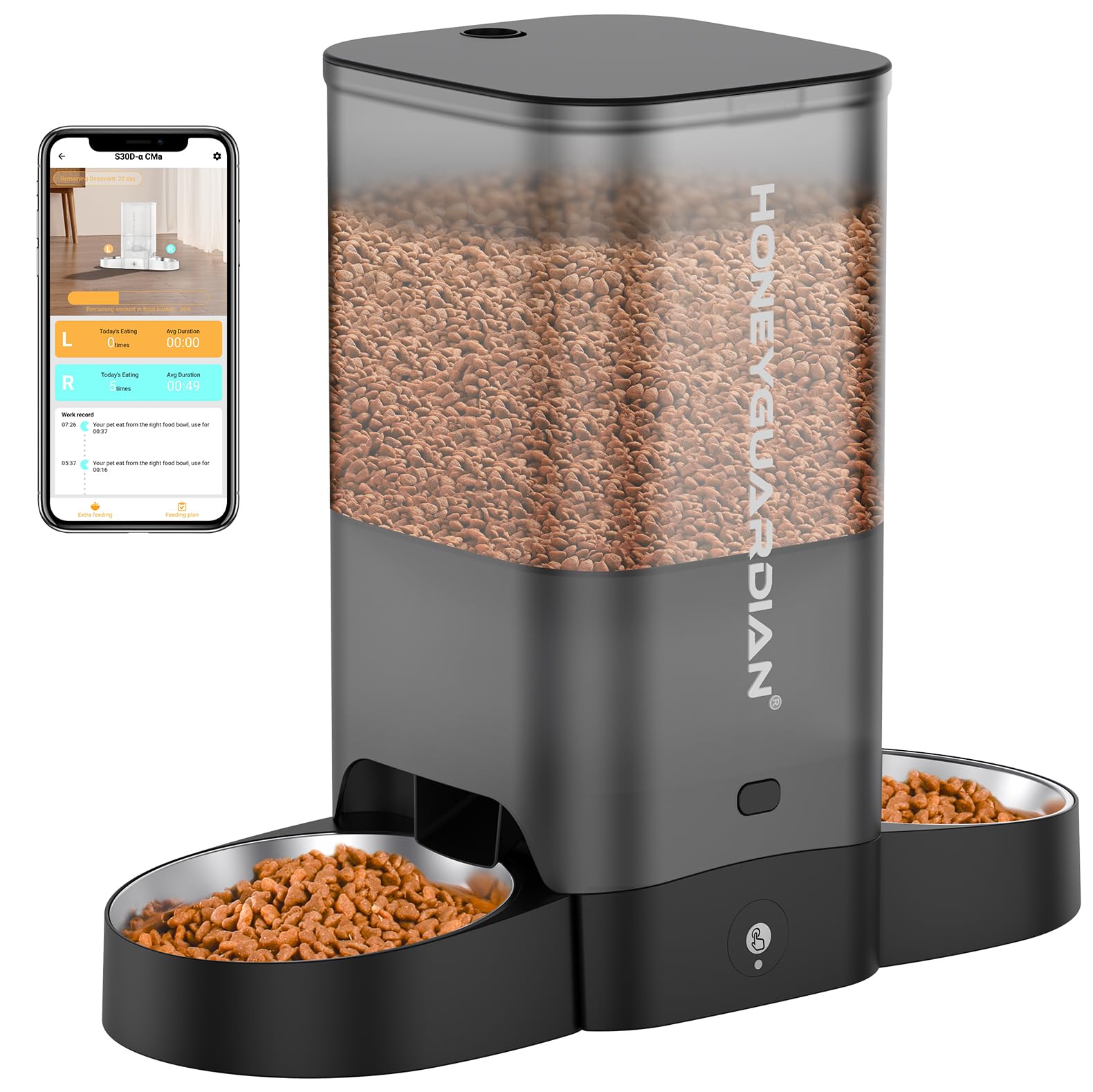
HoneyGuaridan S305D

88 /100
LBD Score Excellent

Key details

Bowls
Two stainless steel
Power
Adapter plus 3 D-cell batteries
Capacity
5 liters
Meals Per Day
Up to 6
View on Amazon

Three D-cell batteries in the base are the reason to look at this one. Plugged in, it runs from the Type-C adapter; pull the plug, or lose power in a storm, and the HoneyGuaridan carries on with its schedule on cells. That's a small feature until the one night it matters.

Pros

  • Runs on batteries during an outage

Cons

No notable drawbacks to flag.

Our verdict

A big-hopper two-cat feeder with a battery bay that keeps meals coming through an outage. Buy it for capacity and backup power, not for app tricks.

Check Latest Price

How We Tested Smart Pet Feeders

We started with the models shoppers actually land on, then cut anything that failed a basic hurdle: a hopper under 3 liters, no battery or power-cut backup, portion control no finer than a quarter cup, or a bowl that couldn't come out for washing. That left 14 feeders, which we set up in our own kitchens and ran for six months — through work trips, weekends away, and plenty of ordinary weekdays.

Setup was timed from the moment the box opened to the first scheduled meal actually landing in the bowl. We noted whether the app found the feeder on a 5GHz network or demanded we switch bands, how many taps it took to build a multi-meal schedule, and what happened when we rebooted the router mid-week — whether the stored schedule kept firing locally or the feeder went quiet waiting for the cloud. We also pulled the power cord on each one to see whether the backup batteries took over cleanly or the whole thing reset.

Portions got weighed. We ran ten consecutive drops onto a kitchen scale and compared what landed against what we'd programmed, then repeated it with three kibble sizes, including a small round one known for bridging in the auger. Hoppers were deliberately run empty to time the low-food alert, and camera models were left running overnight in a dark hallway to check night vision and how quickly a motion alert reached the phone. Over the months we watched lids, hinges, and augers for the kind of wear that shows up around month four.

Because half these feeders are sold for two cats, we also watched a second cat shoulder in at the bowl, timed how loud the motor runs at 5 a.m., and put every detachable bowl and hopper through repeated washing. Value was judged on what a feeder did over six months, not on what it promised on the box.

How to Choose a Smart Pet Feeder

Start with the Wi-Fi, not the feature list

Every feeder in this group connects on 2.4 GHz; the dual-band models also take 5 GHz, which matters if your router splits the two and your phone prefers the faster band. The practical question is placement, because a feeder at the back of a utility room is competing with a fridge, a boiler, and a wall. Put it where your phone already gets a solid signal.

Then check what a dropped connection actually costs. The oneisall, for one, keeps feeding to its saved plan while the app shows it offline, so an outage takes the camera and the remote control rather than the meal. A feeder that stops dispensing when it loses the network is a feeder you'll stop trusting.

A portion is not a standard unit

Portion size is manufacturer-specific, so 'four portions' means nothing until you've seen it in a bowl. The Yuposl runs up to 99 portions a meal, which only makes sense because each one is tiny; other feeders use a much coarser step. Look at the smallest increment rather than the biggest meal, because a cat on a diet needs the fine end of the scale.

The most useful first week you can spend is running the feeder over a kitchen scale for a few days and adjusting portions until the amount matches what you were scooping by hand. The oneisall's smallest portion is generous enough that splitting a meal into two is the usual fix.

Capacity is really about refill trips

Three liters, five, seven: the number that matters is how often you're topping up. A 5-liter tank is rated for around ten days with two adult cats, which covers a week away with margin. A 7-liter hopper takes a big bag and buys more slack, at the cost of counter space.

Buy for the animals you actually have. One cat is well served by a 4-liter body that's easier to place; a pair drinking from the same hopper will empty a 3-liter tank quickly, and the PETKIT's capacity is the main thing we'd flag before putting it in a two-cat kitchen.

Camera: angle beats resolution

Resolution sells feeders; angle is what makes the picture useful. A lens pointed down at the bowl shows you a head and the floor, which is exactly what you need to confirm a meal disappeared and not much else. A wider lens — the PETLIBRO Granary lists 145 degrees — takes in more of the room.

Decide what you actually want to check. If the answer is 'that the food went', a downward camera is fine and cheaper. If it's 'that the cat is okay', pay for the wider view and the night vision, and expect to place the feeder where the room behind it is worth seeing.

Two cats: split bowls or real separation

Two bowls fed from one hopper split the food evenly, which is enough for cats on the same diet and useless for a cat that needs different food or a smaller amount. Read recognition features closely, because they are not the same thing: AI recognition identifies who is eating and logs it, while a collar tag or microchip is what physically keeps one cat out of the other's bowl.

If your vet has put one cat on a diet, you need the second kind. If both eat the same kibble on the same schedule, the even split is simpler, cheaper, and easier to clean.

Frequently Asked Questions

Final Verdict

The Yuposl is the feeder we recommend for most people: it feeds on schedule, gives you a 1080P look at the bowl with two-way audio, and connects on either Wi-Fi band without the premium markup. That combination is why it sits at the top of this list rather than the fanciest or the cheapest option.

If the camera is the whole reason you're shopping, the Frienhund ACF100W does it for less with a bigger hopper. If your power flickers, the HoneyGuaridan's battery bay is the feature that decides it.