Best Softbox Lighting Kits of 2026

The first time I tried to film something after dark, I balanced two desk lamps on a stack of cookbooks and called it a lighting setup. The footage came back flat, faintly orange, and shadowed in all the wrong places. A softbox fixes exactly that: it turns a bare bulb into a broad, even panel that wraps light around a face or a product instead of blasting it. It's also why two kits that look identical online can behave very differently in a small room.

Over the past six months my team and I have assembled, shot with, and packed away 10 kits, from single lights to two-packs, in a spare bedroom, over a kitchen counter, and on video calls that needed better light. Brightness turned out to be the least interesting variable. What separates a good kit is whether the color runs cleanly from warm to cool, whether the stand holds a tilted softbox without drooping, and whether the remote works from where you're sitting.

A kit that takes fifteen minutes to assemble stops getting used by February. The ones that held up are below.

1

Best Overall

NiceVeedi 2-Pack Softbox Kit

89 /100
LBD Score Excellent

Key details

Softbox Size
16 x 16 in
Color Temperature
3000-6000K
Color Rendering Index
97
Maximum Tripod Height
63 in
View on Amazon

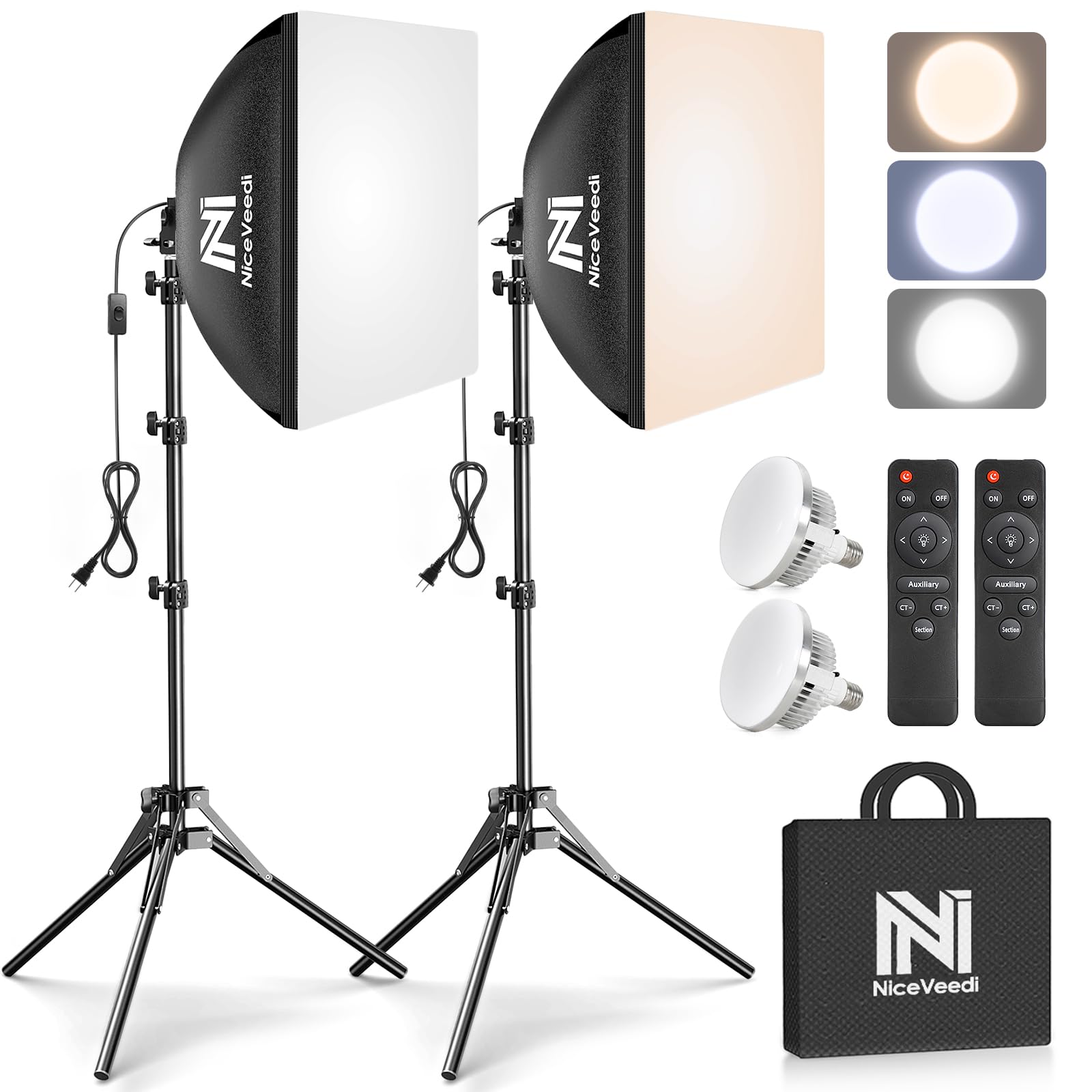
Two remotes is the detail that settled our top pick. On most of the two-light kits here, one remote drives both bulbs at once, so every brightness change moves your key and your fill together. With the NiceVeedi each light has its own controller, and we could pull the fill down two steps and leave the key exactly where it was — the move you make constantly when you are shaping a face or a product. The bulbs are also built not to strobe at 4K60 or 1080p30, which is the difference between clean footage and a band rolling up the frame.

Sixteen-inch boxes and 63-inch tripods put this in the small-room class, and that is a real boundary. At about three feet from a seated subject the light wraps nicely; back the boxes off to six feet for a full-length shot and the shadow edges tighten and the source starts to show. The tripods top out below the 78- and 83-inch stands on the bigger kits, so this is a kit for a desk, a chair, and a corner rather than a standing set.

What we did not expect to appreciate: it all packs into one bag with the diffusers left on the frames, and the bulbs are replaceable, so a dead one does not retire the kit. CRI 97 keeps skin tones and product colors close to what your eye sees. The hardware is nylon and light aluminum rather than road-case metal, but nothing here needs to survive a van.

Pros

  • Separate remote for each light
  • Flicker-free at 4K60 and 1080p30
  • CRI 97 for accurate skin and product color
  • One bag for the whole kit

Cons

  • Screws work loose on the softbox mount
Our verdict

For most people shooting video, streaming, or tabletop photos, this is the kit we point to first: two lights we can dim separately, clean flicker-free output, and a bag that carries the lot.
Check Latest Price
2

Best for Portrait Softness

RaLeno 20-Inch Softbox Kit

92 /100
LBD Score Outstanding

Key details

Bulbs
2 x 50W LED
Softbox Size
20 x 20 in
Stand Height
27-80 in
Color Temperature
2500-7500K
View on Amazon

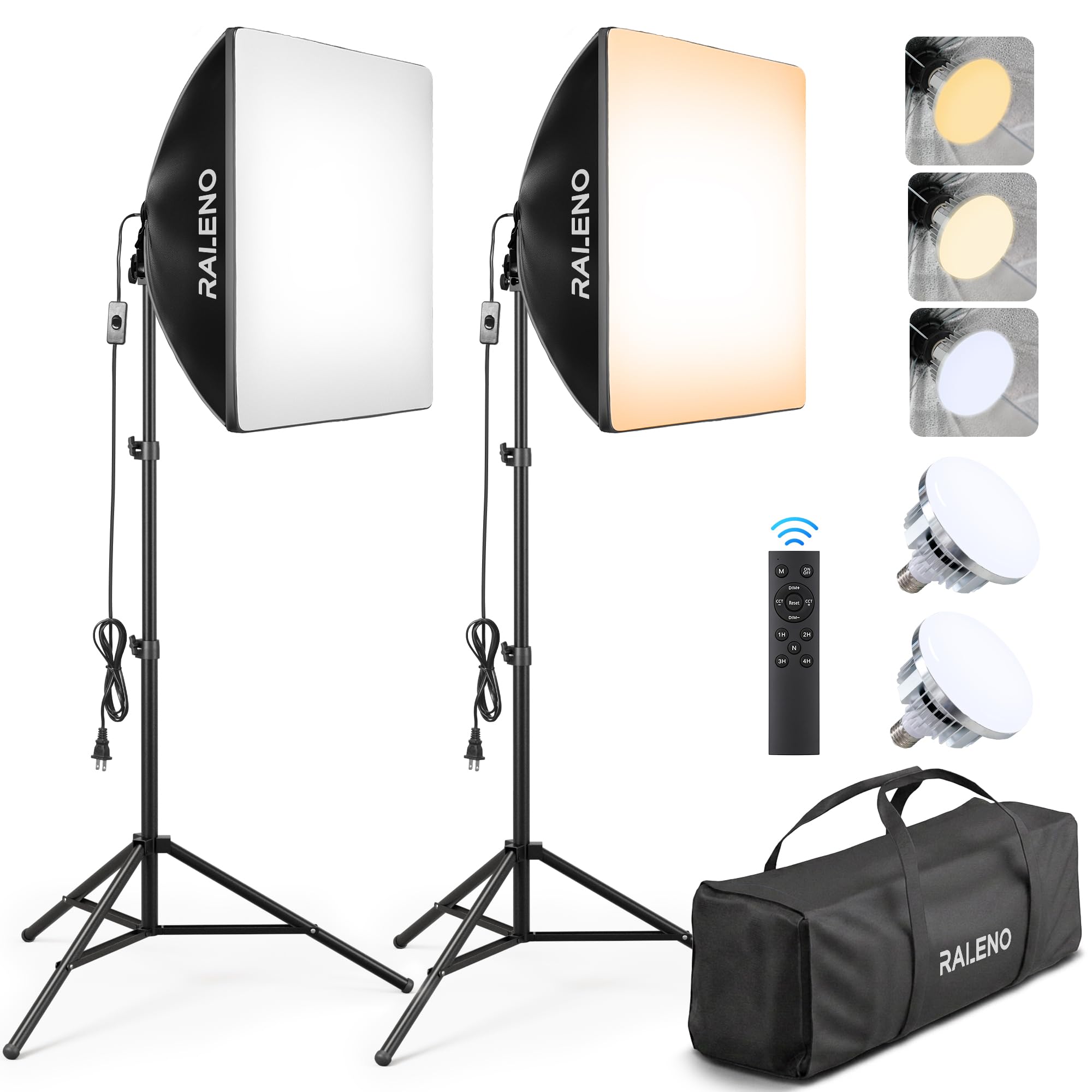
Twenty-inch boxes are the reason to look here. Against the 16-inch kits that fill this guide, the bigger front panel spreads the same bulb across more area, so at four to six feet the light stays broad instead of collapsing into a hot center with a hard edge. Color runs 2500-7500K, the widest range in this set, and the diffuser is rated CRI 97 or better, which matters if you are matching a product's actual color rather than just getting it bright.

One remote for two lights is the compromise. Both bulbs answer it together, so you set your ratio by distance and by turning a box, not from your seat. For portraits in a fixed spot we take that trade, because the larger source does more for the look of a face than independent dimming does. Setup is quick too: the heads open umbrella-style, press down and they lock, with no threading a diffuser over a rigid frame.

The stands run 27 to 80 inches and everything goes back in the bag. Two 20-inch boxes on light aluminum tripods are sails, so keep them indoors and out of the path between a door and a desk. Power cords are the other annoyance — they are short enough that your outlet ends up deciding where the fill light goes.

Pros

  • Larger 20-inch boxes hold softness further back
  • Widest color range here at 2500-7500K
  • Press-to-open head speeds setup
  • Packs into an included bag

Cons

  • One remote drives both lights together
  • Short cords dictate stand placement
Our verdict

For portrait-first work, the bigger boxes and widest color range here are worth more than a second remote — this is the kit we take when faces are the subject.

Check Latest Price
3

Best for Standing-Height Work

MOUNTDOG 2-Pack Softbox Kit

89 /100
LBD Score Excellent

Key details

Bulbs
2 x 85W LED
Softbox Size
19.7 x 27.5 in
Maximum Stand Height
78 in
Color Rendering Index
85
View on Amazon

Seventy-eight inches of stand is what separates this from the desk-sized kits. Raised to full height, the 19.7 x 27.5-inch boxes sit above a standing subject and throw light down at a natural angle — the arrangement you want for full-body portraits, a standing recipe segment, or two people at a table where the lights have to clear heads.

Both lights come with their own remote for brightness and color temperature, and the heads turn through 210 degrees on a locking knob, so one box can be feathered at the background while the other stays on the subject. CRI 85 is the lowest rating in this guide. For streaming and social video that is invisible; for catalog work where a red has to read the same in every frame, it is not what we choose.

The compromise sits in the legs. A 27-inch box on a 78-inch stand catches air, and these tripods are aluminum tubes rather than weighted cine stands — spread the legs wide, keep the kit indoors, and drop something heavy on the back leg if the floor gives. What you get back is the biggest boxes on the tallest stands in the midrange, with a bag that makes the pair carryable.

Pros

  • 78-inch stands clear a standing subject
  • Two remotes with brightness and temperature control
  • 210-degree heads let you feather one box
  • Wide 19.7 x 27.5-inch boxes

Cons

  • CRI 85 limits color-critical work
Our verdict

If your lights have to stand above people, this is the kit we choose: tall stands, big boxes, and a color ceiling we can live with for video.

Check Latest Price
4

Best for a Fixed Studio

NEEWER 24-Inch Softbox Kit

90 /100
LBD Score Outstanding

Key details

Bulbs
2 x 35W LED, 5700K
In The Box
2 softboxes, 2 bulbs, 2 stands, bag
Softbox Size
24 x 24 in
Maximum Stand Height
83 in
View on Amazon

What this kit leaves out tells you who it is for: no remote, no dimming, no color control. What it puts in their place is size — 24 x 24-inch softboxes, the largest here, on 83-inch aluminum stands — plus fixed 5700K daylight bulbs at 3,150 lumens each and UL listed. In a studio where the lights stay put and exposure is set on the camera, that is a cleaner trade than it sounds.

The E26 sockets are the quiet advantage we did not expect to care about. Because the fitting is standard, a burnt-out bulb is a swap rather than a service call, and you can drop in a warmer bulb later, though without a controller it will run at whatever brightness that bulb produces. Quick single-action locks get everything up in a couple of minutes.

Twenty-four-inch boxes are also the biggest sails in this guide, so this is an indoor, stays-put kit; the included bag is for storage more than transport. You are paying for the size of the source, and that shows in the boxes, the stands, and the price tier.

Pros

  • Largest 24-inch softboxes in this guide
  • 83-inch stands with quick single-action locks
  • E26 sockets accept replacement bulbs
  • 3,150 lumens per bulb, UL listed

Cons

  • No remote, dimming, or color control
  • Fixed 5700K daylight bulbs
Our verdict

For a permanent daylight studio, we give up remote control happily for the biggest, softest boxes and tallest stands here.

Check Latest Price
5

Best Single-Light Starter

EMART Single Softbox Kit

88 /100
LBD Score Excellent

Key details

Bulb
85W LED, 3000-6000K
Softbox Size
16 x 16 in
Stand Height
18-65 in
Color Rendering Index
90
View on Amazon

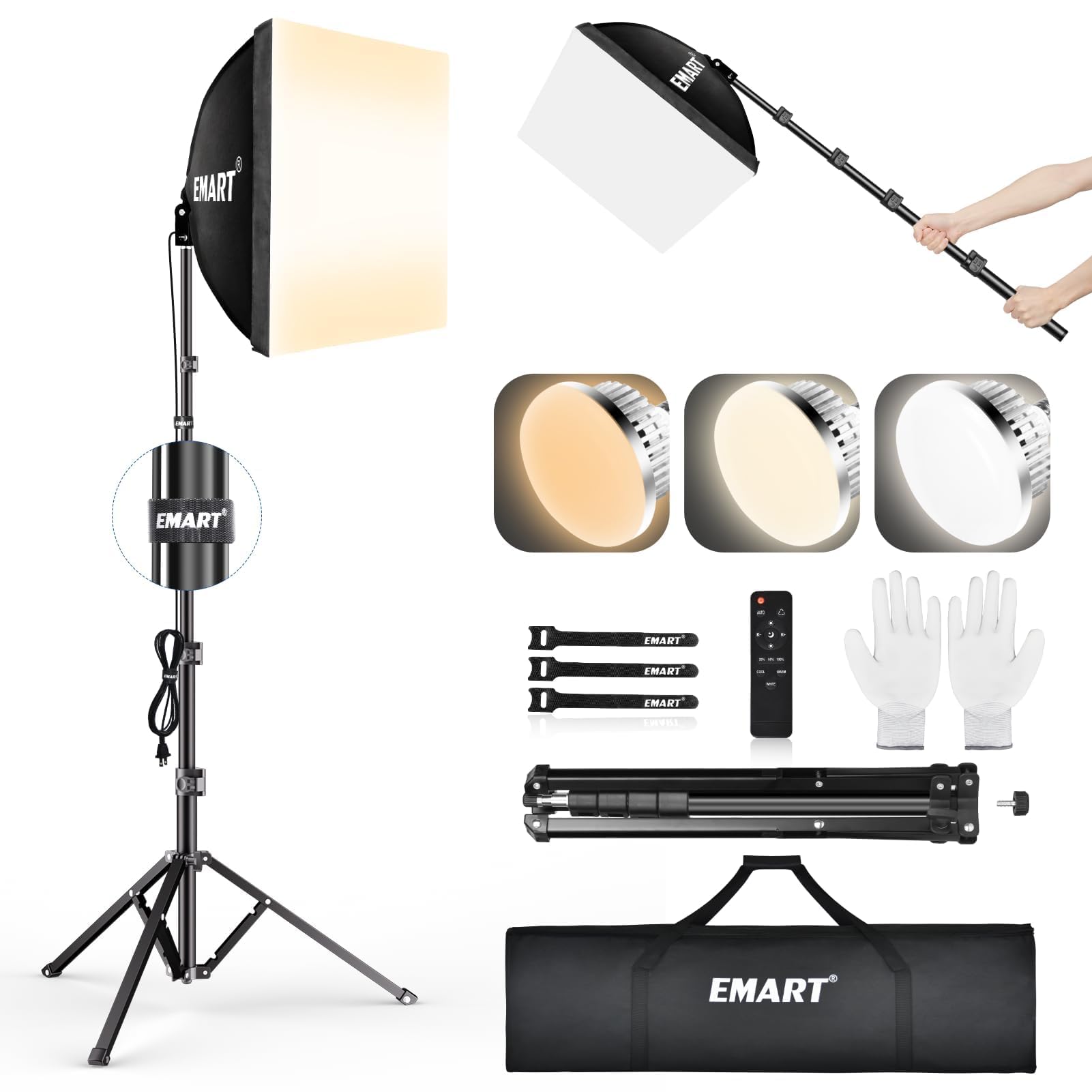
One box, one 85W bulb, one stand, and a remote that walks the bulb from 3000K to 6000K: that is a single-light kit done properly. Set beside a desk, it fills a webcam frame or a self-tape without asking for the floor space two tripods need. As a second light it gives you a fill or a hair light for less than another two-light kit costs.

Brightness and temperature both run through the remote, and the three color settings cover warm, neutral, and cool well enough for a talking head. The stand is the light-duty part — 18 to 65 inches, reverse-folding, steady as long as nobody clips it with a chair.

The extras beat the tier: a carry bag, three velcro cable ties, even a pair of gloves for handling the bulb. CRI 90 keeps skin tones reasonable. Nothing here is built for a rental van, but nothing here needs to be.

Pros

  • Remote covers brightness and 3000-6000K color
  • Reverse-folding stand packs down small
  • Carry bag and cable ties included

Cons

  • Remote presses do not always register
Our verdict

A single 85W box, a remote, and a bag make this the first light we recommend for a desk setup — as long as you do not need it to light a whole room.

Check Latest Price
6

Packing Small

RaLeno 16-Inch Softbox Kit

90 /100
LBD Score Outstanding

Key details

Bulb
50W LED, 2500-7500K
Softbox Size
16 x 16 in
Stand Height
60 in
Folded Tripod
About 16 in
View on Amazon

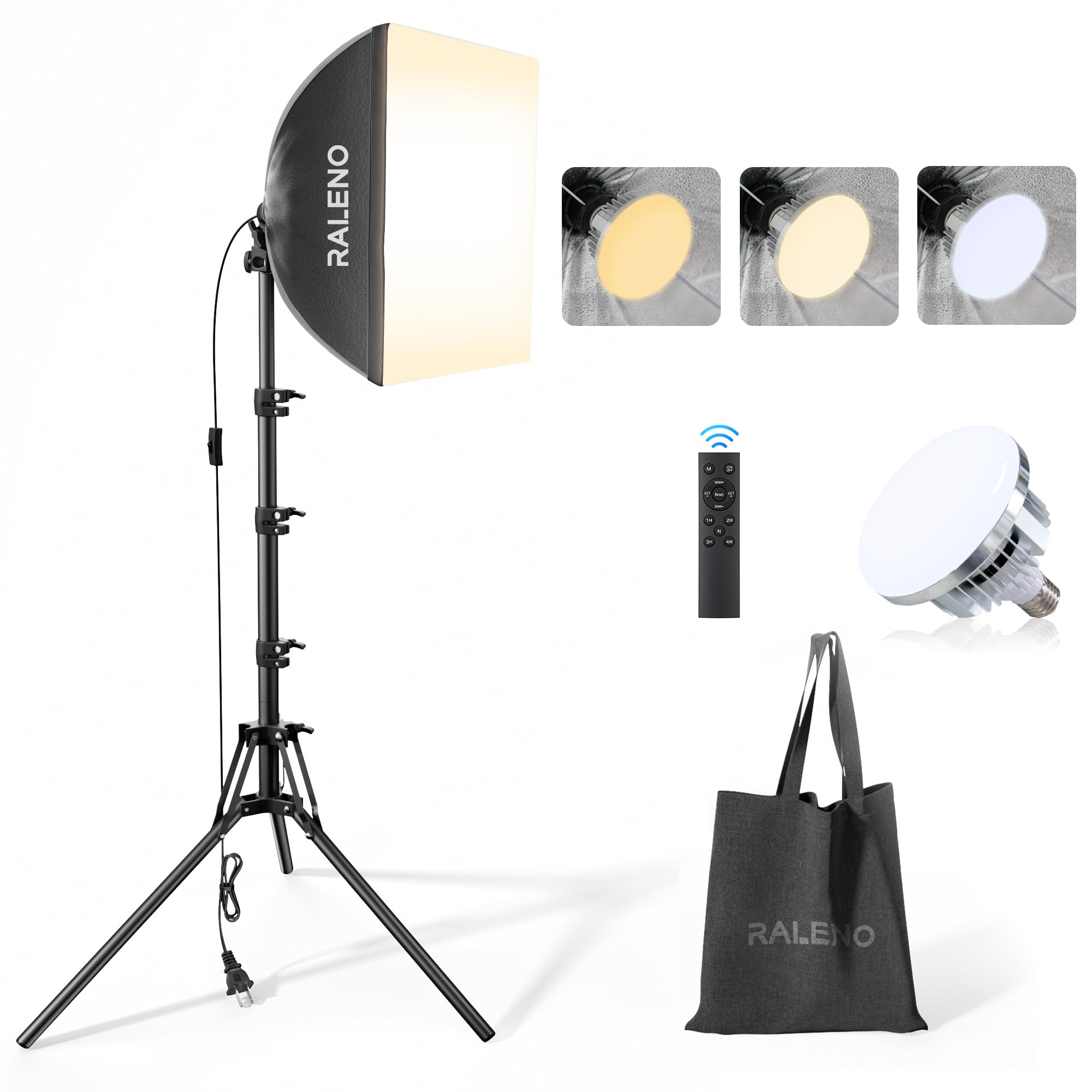
The tripod folds to roughly 16 inches, which is the smallest packed footprint in this guide — short enough to drop in a backpack beside a laptop and forget about until the interview.

The light itself is a 50W LED running 2500-7500K, adjusted from a small remote that takes two AAA batteries, not included. Fifty watts through a 16-inch box holds a head-and-shoulders frame at about three feet. The head opens and closes like an umbrella, so setting up in a hallway takes a minute.

This is the kit we reach for when the car is small and the shot is one person: a 60-inch stand, one box, one bag, and no second tripod to find floor space for. That is the whole case for it, and it holds up.

Pros

  • Tripod folds to about 16 inches
  • Wide 2500-7500K range from one bulb
  • Includes diffuser and storage bag

Cons

  • One light only, so no key-to-fill control
  • Small box thins out a few feet back
Our verdict

The pick for one person, one camera, and a small car: we take it because it packs to 16 inches, sets up in a minute, and lights a head-and-shoulders frame cleanly.

Check Latest Price
7

Growing Studios

mmcrz 2-Pack Softbox Kit

83 /100
LBD Score Excellent

Key details

Bulbs
2 x 85W LED
Softbox Size
16 x 16 in
Head Movement
210° tilt, 360° swivel
Color Temperature
2700-6500K
View on Amazon

The stands outlive the softboxes. Each tripod ends in a standard 1/4-inch screw, so when the box comes off you can hang a ring light, an LED panel, a reflector, or an umbrella on the same legs — a kit that keeps earning after the lights are replaced.

The rest of the package is two 85W bulbs with 2700-6500K adjustment, two remotes, and 16-inch boxes. The heads tilt 210 degrees and swivel a full 360 degrees on a locking knob, which is more aiming freedom than the tilt-only heads on several kits here: you can swing a box flat toward a wall for a bounce without moving the stand.

Build quality is a pleasant surprise at this end of the set. The frames open without a fight, all the pieces check out, and everything repacks into the included bag in a couple of minutes.

Where it lands is a first studio that plans to grow: the lights are good enough to start with and the legs are good enough to keep, which is not true of every tripod at this price tier.

Pros

  • 1/4-inch screws take other modifiers later
  • 360-degree swivel as well as 210-degree tilt
  • Two bulbs, two remotes in the box

Cons

  • Both remotes control both lights together
Our verdict

We buy this one for the stands as much as the lights — a two-light kit that keeps working when you upgrade the softboxes.

Check Latest Price
8

Three-Point Setups

Andoer 3-Light Softbox Kit

82 /100
LBD Score Excellent

Key details

Bulbs
3 x 85W LED
Boom Arm
Included
Color Temperature
2800-5700K
Softboxes Included
3 at 20 x 28 in
View on Amazon

Three softboxes and a boom arm is a different proposition from every other kit here. The third light lets you put a box on the background and separate your subject from it, and the boom gets one overhead for a hair light or a top-down product shot without a second stand in the frame.

The rest is familiar: 20 x 28-inch boxes, 85W bi-color LEDs covering 2800-5700K, three aluminum stands running 26 to 78 inches, and E27 sockets so bulbs are swappable. The remotes are not paired to individual bulbs, so pressing one can move more than one light at a time.

The costs are real. CRI 80 is the lowest rating in this guide, and color-critical product work will show it. Light aluminum legs are carrying three boxes and a boom, and a boom only behaves when the back of the stand is weighted, so plan on a sandbag before the first shoot.

If you want to walk onto a set that already has a background light and a hair light, this is the only kit on the page that gets you there in one purchase. For everything smaller, we think the two-light kits make more sense.

Pros

  • Three softboxes plus a boom arm
  • Bi-color 2800-5700K output
  • E27 sockets make bulbs swappable

Cons

  • CRI 80 limits color-critical work
  • Remotes are not paired per light
Our verdict

If you are building a fixed three-point setup in one order, this is the kit we point to; as a first light for one person on camera, we look elsewhere.

Check Latest Price

How We Tested Softbox Lighting Kits

We started with every two-light and single-light kit a first-time buyer would plausibly land on, then cut anything that couldn't take a standard screw-in bulb you could replace at a hardware store, anything with a softbox too small to soften light at head-and-shoulders distance, and anything whose price crept up once you added the second stand the listing didn't include. Ten kits made the cut, and we shot with them for six months.

They got used where these things actually get used: a spare bedroom set up as a shooting corner, a kitchen counter for product photos, a dim living room for headshots, and one weekend where I broke a kit down, drove it across town, and rebuilt it in a basement. I set each one up alone with a timer running, then switched the same setup between a standing subject, a seated one, and a flat-lay on the counter to see how much repositioning each kit demanded.

Stands got a shoulder-height nudge to see whether the softbox swayed or tipped, and I tilted each box fully downward and left it there to watch for a joint that crept under the weight. Remotes were tested from across the room and from behind the softbox, since losing line of sight is where cheap ones quit. I shot the same white shirt and red fabric under each kit at its warmest, middle, and coolest settings and compared the files for color casts and for detail in the highlights, then unpacked every box on camera to note what was really inside: bulbs, stands, softbox, remote, carry bag.

How to Choose a Softbox Lighting Kit

How Many Lights, and Do They Need Separate Remotes?

Two is the practical minimum for a person on camera: one light shapes the face, the other fills the shadow side or lifts the background off the subject. A single-light kit is a reasonable first purchase for a desk or a self-tape, but it lights one side and lets the other fall away, which you notice the first time you film someone in glasses or shoot a wide product.

Then check the remotes, because that is where two-light kits quietly differ. On several kits here a single remote drives both bulbs, so every brightness change moves key and fill together. If you want to set a ratio from your seat, look for one remote per light.

Softbox Size: Softness Against Floor Space

A softbox reads as soft because it is large relative to the subject. A 16-inch box is beautifully diffused at three feet and contrasty at eight; a 20- or 24-inch box holds its softness much further back. That is the argument we make for going bigger: working distance, not wattage.

The cost is space and air. A 20 x 28-inch box on a tall stand is a sail, and it needs the legs spread wide and a sandbag on the back leg before it lives near a doorway. In a small room, a big box you can only set two feet from the wall may be less useful than a small one placed properly.

Color Temperature, CRI, and Flicker

Bi-color bulbs run roughly 2700-6500K, which lets you warm a scene or match the room's existing light; fixed 5700K daylight is simpler and entirely workable in a studio where nothing changes. CRI tells you how honestly color reads — 95 and up for skin and product, mid-80s for streaming where nobody is holding a swatch up to the screen.

Flicker is the spec that never makes the box, and it is the one we check first on video kits. Record thirty seconds at your camera's frame rate, including a slow-motion clip, and watch for bands rolling through the frame before you commit a shoot to the kit.

Stands: Height Sets the Job

Match the stand to where the light has to land. Somewhere around 60 to 65 inches puts a box just above a seated subject or a desk, which covers most streaming and tabletop work; 78 to 83 inches clears a standing person and lets the light come down at a natural angle for full-body shots.

Taller is not automatically better. A reverse-folding tripod that packs to 16 inches is a genuine travel convenience, but it is not a stable base for a 24-inch box, and light aluminum legs flex under weight. Buy the height the shot needs and weight the legs for everything above it.

Frequently Asked Questions

Final Verdict

For most people filming, streaming, or shooting products at a desk, the NiceVeedi two-pack is the kit we point to first: two 16-inch lights with their own remotes, clean flicker-free output at the frame rates phones and cameras actually shoot, and a bag that makes the whole thing portable.

If faces are the subject and you can live with one remote for both lights, the RaLeno 20-inch kit buys you a bigger, softer source and the widest color range on this page. And if the lights will never move, the NEEWER's 24-inch boxes are the most forgiving source here.