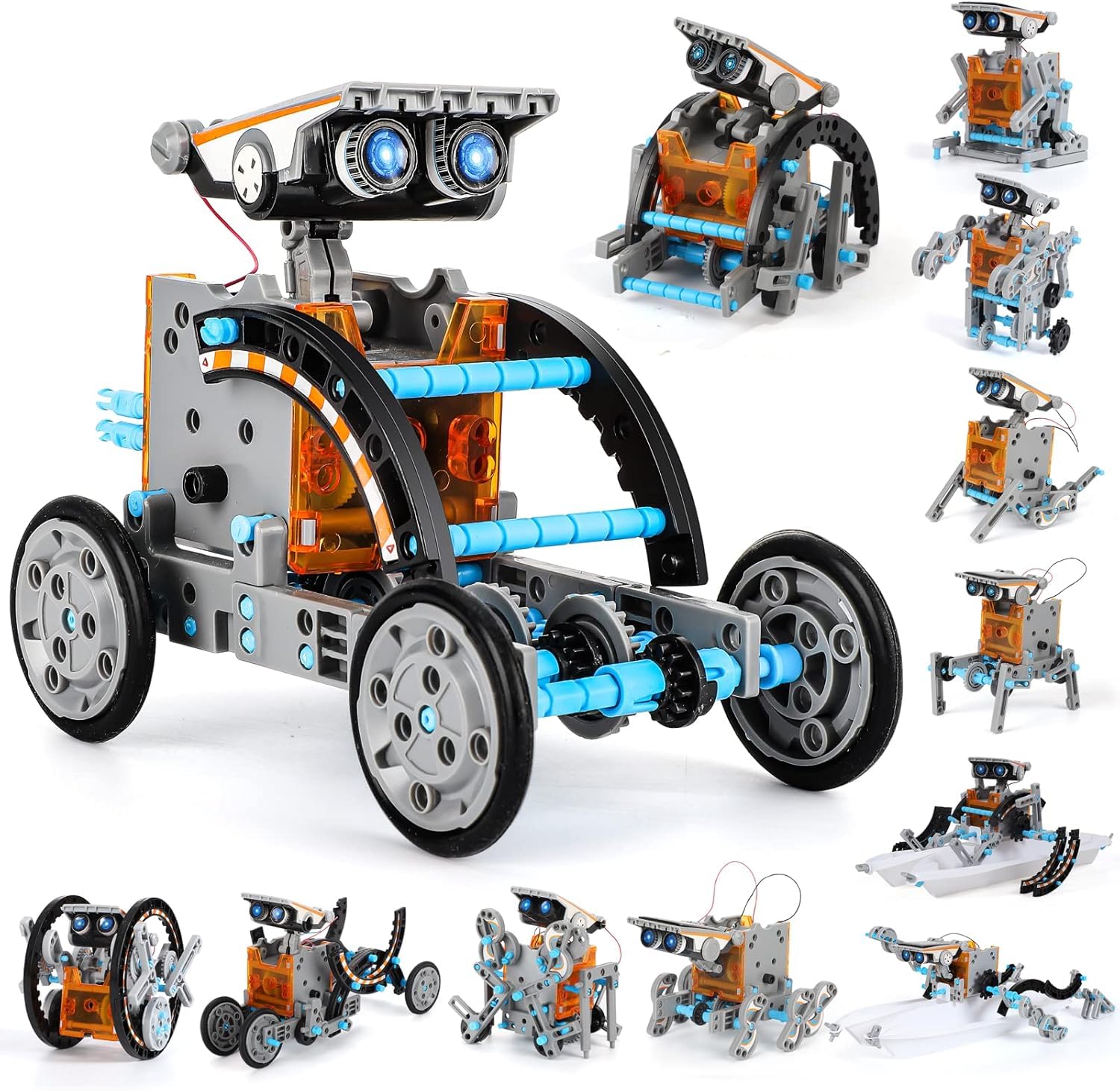
Best Solar Kits for Kids of 2026

A solar robot kit is one of those gifts that looks like a sure thing on paper: a box of parts, a robot, no batteries needed. The trouble usually shows up about 40 minutes in, after the robot is built, when it wobbles across the table once and never leaves the closet again. We built 14 of these kits with kids ages 8 to 12 over four months, and the ones that stick around all give a kid a second and third build worth coming back for.

The number on the box is the first thing to distrust. A 12-in-1 kit is usually one chassis rebuilt a dozen ways, and what decides a kit's fate is whether the first build takes 45 minutes or turns into a two-hour session with an adult doing the snapping. Solar has a catch as well: a panel that only turns the motor in direct sun makes for a short afternoon, so I noted which kits include a battery fallback. The picks below are the ones that survived the after-school builds, the patio Saturdays, and the rainy Sunday indoors.

1

Best Overall

SCAEMO 4-in-1 Solar STEM Kit

90 /100
LBD Score Outstanding

Key details

Assembly
No soldering or tools
Materials
Laser-cut wood
Recommended Age
8 to 13 years
Projects Included
Solar car, solar plane, wind car, electric fan
View on Amazon

Four separate kits in one box, each in its own bag with its own parts: a solar car, a solar plane, a wind-driven car and an electric fan. That packaging is why it's our top pick. The big robot sets in this group hand a child one chassis and a dozen bodies to rebuild it with; this one hands over four complete projects, each with a clear moment where the building stops and you carry it outside.

The two solar builds carry the set. In direct midday sun the plane's propeller turns fast enough to be genuinely exciting, and the car covers a flat patio at a decent clip. Both quit in shade or behind window glass, which is the lesson rather than a fault — we spent a while sliding the panel in and out of shadow just to watch the cutoff, and it's sharper than you expect.

Building is the easy part. The circuit is a couple of leads and a connector, there's no soldering and no tools, and the printed steps are short enough for a nine-year-old to follow without an adult reading over a shoulder. The parts are laser-cut wood that slots together, and they are small: fine at ten, fiddly at seven, and worth a supervised first build at the younger end.

The trade-off is that wood. It's thin, it's light, and a model knocked off a table is unlikely to go back together — the wiring especially. None of which makes the set a bad buy; it makes it four good afternoons rather than a toy that lives in the playroom. Build one, run it, put it on a shelf, then open the next bag.

Pros

  • Four separately packed projects, each finished in one sitting
  • Solar car and plane both run in direct sun
  • No soldering, no tools, short printed steps
  • Widest spread of power sources here: sun, wind and a motor

Cons

  • Thin wooden parts won't survive a fall
  • No robots
Our verdict

The first solar kit we point most families to: four small projects, each finished in one sitting, each proving the panel works before a child loses interest.
Check Latest Price
2

Best for Indoor Play

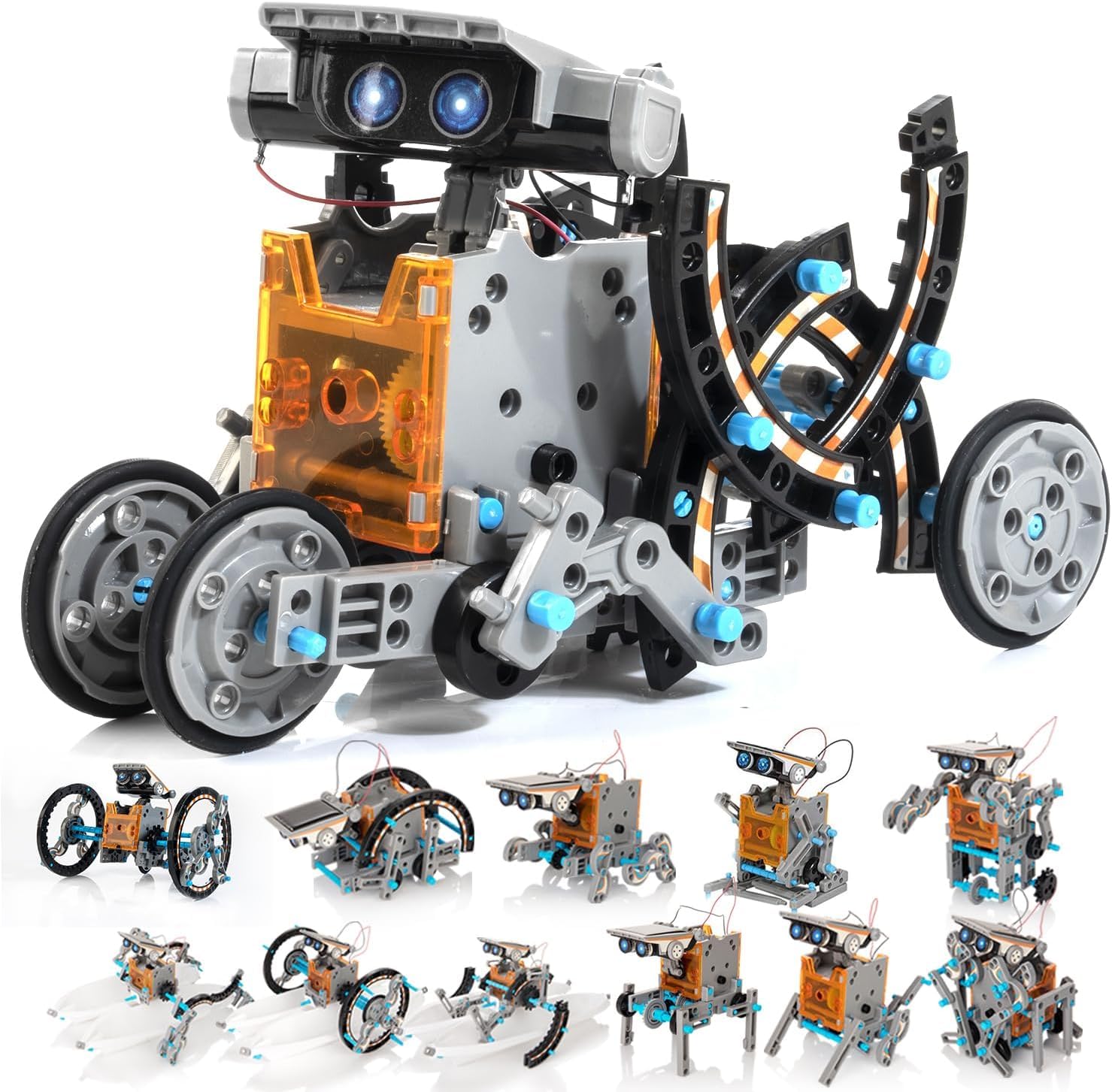
KIDWILL 14-in-1 Solar Robot Kit

88 /100
LBD Score Excellent

Key details

Instructions
Illustrated step-by-step
Power Source
Solar panel or 1 AAA battery (not included)
Models To Build
14
Recommended Age
8 years and up
View on Amazon

The story that follows solar kits too often goes like this: it gets built, it gets carried outside, and it doesn't move. The KIDWILL set answers that with a battery bay. One AAA and the robot runs at the kitchen table in November; the panel is still the main power source outdoors, but it stops being the thing that decides whether the afternoon works. The battery isn't in the box, so buy one before the birthday.

Fourteen models come out of the same kit, from a simple rolling bot up to builds that use the whole gear train, and the illustrated manual ramps the difficulty instead of dropping a child into the deep end. That ramp is the feature we value most: a kid who finishes the easy build has proof they can manage the next one, which matters more with a nine-year-old than any single model in the set.

Gears are where these kits live or die. A shaft that isn't pushed fully home will stop a finished robot dead, and the transmission here rewards slow assembly with the plates seated square before anything is tightened. The ABS parts take a firm push and give a clean click when they're right; forcing a piece is how you crack one.

What surprised us was how much the battery changes the kit's role. It becomes a table toy that works after dinner and in December, and the solar panel becomes the experiment rather than the gatekeeper — which is the order most children need it in.

Pros

  • Solar panel plus a one-AAA indoor fallback
  • Fourteen builds with a difficulty ramp
  • Illustrated step-by-step manual

Cons

  • AAA battery not included
  • Assembly tests the patience of younger builders
Our verdict

If the kit gets opened on a rainy birthday or lives on a kitchen table, this is the one we point to — the panel does the teaching, and a battery takes over when the sun won't.

Check Latest Price
3

Best Space Theme

COBFDHA 6-in-1 Space Robot Kit

89 /100
LBD Score Excellent

Key details

Theme
Space robots
Pieces
120
Models To Build
6
Recommended Age
8 to 12 years
View on Amazon

Space is the hook, and it's a good one. Six builds with rocket-and-rover silhouettes beat another generic humanoid, and that matters more than it sounds when the child in question has already decided that robots are boring.

Underneath the theme it's the familiar arrangement — 120 pieces, a solar panel for outdoors, a battery for indoors, and a manual that walks through each build a step at a time. The piece count is the lowest of the robot kits here, and that's mostly a feature: fewer parts means shorter builds, fewer places to go wrong, and an eight-year-old who reaches a finished model in one sitting rather than three.

The instructions are where our enthusiasm cools. They're drawn rather than written, and the diagrams are small — more than one step on the later builds needed a second look to work out which way a bracket faced. Nothing a parent and a bright child can't push through, but it's the difference between a kit a kid builds alone and one that needs a co-pilot.

Where it lands: this is the kit for the child who wants the thing on the shelf to look like a spaceship, and for the adult who'd rather not supervise 243 pieces to get there.

Pros

  • Space-themed models instead of another humanoid robot
  • 120 pieces keeps each build inside a session
  • Solar panel with a battery option for indoors

Cons

  • Six models
Our verdict

Six space-themed builds, 120 pieces and a solar panel with a battery backup: we think it suits a nine- or ten-year-old who wants the finished model to look like something.

Check Latest Price
4

Most Builds

Wesfuner 30-in-1 Solar Robot Kit

88 /100
LBD Score Excellent

Key details

Pieces
243
Power Source
Solar panel or battery in head unit
Models To Build
30
Recommended Age
8 to 13 years
View on Amazon

Thirty finished models is the pitch. The honest version of that number is one robotics kit rebuilt thirty ways: the panel, motor, gearbox and chassis are the same each time, and what changes is the body around them — a car, a boat, a walker, a robot.

That's not a criticism, it's the format, and this set does it better than most here. The head unit takes a battery as well as the panel, so an indoor evening isn't wasted, the 243 pieces have enough substance to make a build feel like an afternoon's work, and the plastic takes being taken apart and put back together — which is the whole point when the box promises thirty of anything.

The manual is the thing to flag. The print is small, and the later diagrams are dense; an adult ends up doing the reading on the more complicated builds. Running the pages through a copier at a larger size before you start takes two minutes and removes most of the friction.

Where it lands: 243 pieces is a real kit, and thirty builds is the longest runway on this list. If the child is the type to finish a model, run it for ten minutes and ask what's next, this is the answer to that question for a long while.

Pros

  • Thirty builds from 243 pieces
  • Solar panel plus a battery in the head unit
  • Parts survive being rebuilt into the next model
  • Builds are substantial without running long

Cons

  • Motor wiring at the head unit is the delicate part
Our verdict

Thirty builds from 243 pieces, and the set we reach for when a child has already worked through something smaller and still wants more to build.

Check Latest Price
5

Older Builders

AoHu 15-in-1 Solar Robot Kit

88 /100
LBD Score Excellent

Key details

Pieces
212
Power Source
Solar or battery
Models To Build
15
Recommended Age
8 to 13 years
View on Amazon

At the top of the range sits the AoHu set: 15 builds, 212 pieces, and the most expensive of the six. What the extra buys is range — the build list starts at a simple rolling model and works up to cars and boats that use the full transmission, and the illustrated manual is laid out to be followed alone rather than read out loud by an adult.

Dual power is standard at this level and it's here: panel outdoors, battery indoors. The ABS parts have the smooth, burr-free edges you want in something a nine-year-old handles, and pieces go together with a positive click rather than a shove, which is less true of the cheaper kits in this group.

What keeps it out of the top tier is arithmetic. It does the same job as the Wesfuner with half the builds and a higher price, and a child who finishes fifteen models has run out of kit long before one who finishes thirty. None of that makes it a bad set — the part quality is a step above the budget picks and the manual is genuinely followable — but the case for it is a household that wants fewer, better-feeling builds and doesn't mind paying for them.

Pros

  • 212 smooth ABS parts with clean edges
  • Fifteen builds from simple through advanced
  • Solar panel plus battery for indoor play

Cons

  • Costs more than kits with twice the builds
Our verdict

The priciest kit here, and the one we point to for a patient older builder: 15 builds, 212 pieces, and a chassis that carries a real gearbox.

Check Latest Price
6

Sunny-Day Play

Lucky Doug 12-in-1 Solar Robot Kit

86 /100
LBD Score Excellent

Key details

Pieces
190+
Material
BPA-free ABS plastic
Power Source
Solar only, no battery
Models To Build
12
View on Amazon

No battery bay, no indoor mode. The Lucky Doug kit runs on the panel or it doesn't run at all, which is either the most honest thing in this category or a reason to keep looking, depending entirely on your weather.

Twelve builds from 190-plus pieces cover the usual ground — crawlers, rollers, one that floats — and the pieces are BPA-free ABS with the smooth edges the better kits here have in common. The booklet is written for beginners and steps through each build without much interpretation needed.

We rate it the purist's option, and that's a real recommendation rather than a consolation. A child who only ever sees the robot move when they've found genuine sun learns the cause and effect properly, and a cloudy Saturday becomes a lesson about the panel instead of a reason to reach for a battery. Buy it for a summer birthday and it earns its place; buy it for a December one in an apartment without a sunny window and it will sit in the box.

Pros

  • Runs on the panel alone, with no batteries to buy
  • 190-plus pieces across twelve builds
  • BPA-free ABS with smooth edges
  • Cheapest robot kit in this group

Cons

  • Useless in shade, indoors or on a cloudy day
Our verdict

Solar only, no battery, 190-plus pieces and twelve builds: we like it for a household where the sun is the whole lesson, and it's the cheapest robot kit here.

Check Latest Price

How We Tested the Best Solar Kits for Kids

We started with the kits that dominate the 8-to-13 gift aisle, plus a handful from science-toy specialists, and narrowed by three things we could verify from the listing: a solar panel backed up by a battery option, a real parts list, and instructions written for kids rather than for the adult assembling it. Fourteen kits made the cut, and we spent four months with them — after school at the kitchen table, on the patio on clear afternoons, and indoors on a stretch of rainy days.

For each kit, I handed the box to a kid between 8 and 12 and started a timer, noting whether they could get through the first build alone or stalled on the same step twice; we then ran the same build with an adult to see how much of the work was really the child's. Out on the patio, we set each finished robot in full sun and timed how long it kept moving, then moved it into shade to see whether the panel kept up or the build needed the battery pack, and asked each kid to explain in their own words why the robot had slowed. We counted the models a kid built without being asked — a 30-in-1 box that produces one robot worth keeping is a worse buy than a smaller kit that gets rebuilt all weekend.

Durability showed up in the hands, not on the box: we noted which pieces snapped together cleanly and which needed an adult's grip, whether tabs cracked after a second or third build, and how the solar panels held up to being set down hard on concrete. We also counted pieces against the listing and tracked which kits came back out of the box a week later — the clearest sign of whether a kid had actually enjoyed it or was finished with it.

How to Choose a Solar Kit for Kids

Solar Only or Dual Power

Almost every kit in this category now offers both, and the difference is bigger than it looks. A solar-only kit is a summer toy: it needs direct sun, it slows in haze, and ordinary window glass is enough to stop it dead. A dual-power kit takes a battery indoors, which turns the panel into an experiment rather than a gatekeeper.

If the kit is a winter birthday present, or the child will build at a kitchen table after dinner, pay for the battery option. If you want the lesson to be that energy comes from somewhere real, solar-only teaches it more strictly — just make sure the birthday lands in the right season.

Match the Build to the Child, Not the Number on the Box

Thirty models sounds like better value than six, but most of these kits rebuild the same motor-and-gearbox chassis into a new body, so the thirtieth build teaches less than the third. What actually varies is how long one build takes and how much of it a child can do alone.

Fewer, larger parts suit an eight-year-old; 200-plus pieces with a dense manual suit a ten- or eleven-year-old. As a rule, plan to sit alongside anyone under ten for the first build, then hand the manual over and step back.

How the Parts Fit Together

Two constructions dominate: molded ABS that snaps and screws together, and laser-cut wood that slots. Plastic is the more forgiving of the two and survives being taken apart, but molded parts can arrive with burrs or a fit that needs persuading, and a small file is the most useful thing you can keep beside the box.

Wood is quicker and needs no tools at all, and it's also the more brittle — a wooden model is a build-and-display object, not something that goes back in the bag. Either way, seat every shaft fully before moving on; a gear that isn't home will stop a finished model dead.

What Happens After the Build

This is the question the box never answers. These kits produce a model that runs while the sun is out and then sits on a shelf. Very few are designed to be rebuilt indefinitely, and the wiring on a finished model is usually the first thing to go.

Plan for it: build one model at a time, keep the manual with the parts, and don't expect a solar kit to replace a construction toy that gets handled daily. The pleasure is in the build and the demonstration, not in a long afterlife on the playroom floor.

Frequently Asked Questions

Final Verdict

We recommend the SCAEMO four-kit set as the first solar kit in most homes. It proves the idea fastest: four projects, each finished in an afternoon, two of them running on nothing but sunlight, and no tools or soldering between a child and the payoff.

If the kit will be opened indoors, or the child has already outgrown small builds, the KIDWILL 14-in-1 is the better buy. The battery fallback keeps it usable in November, and fourteen builds give it a much longer life on the shelf.