Best Synthesizers of 2026

A synthesizer doesn't play back a recording — it builds the sound in real time, which is why the first knob you turn usually decides whether you keep going. The category stretches from palm-sized noisemakers you can carry in a jacket pocket to tabletop boxes with sequencers and MIDI ports, and the spec sheet won't tell you which one you'll still be reaching for once the novelty wears off.

We've spent the past four months with 12 of them within arm's reach, and the pattern had little to do with how many oscillators or presets each one claims. What separated the keepers was feel: whether the knobs invited one more tweak or sent you menu-diving, whether the keys and ribbon strips responded to how hard you played, whether a built-in sequencer actually helped you build a part or just ate half the front panel. Battery power mattered more than I expected — the synths that could go anywhere got played.

The picks below run from first-timer toys that are honestly fun to the ones I'd carry to a gig, and each one earns its spot on how it plays rather than how it reads on paper.

1

Best Overall

Arturia MicroFreak

90 /100
LBD Score Outstanding

Key details

Keys
25-key poly-aftertouch touch plate
Weight
2.3 lb
Connectivity
CV, USB, MIDI
Oscillator Modes
21 paraphonic modes
View on Amazon

We expected to dislike the MicroFreak's keybed. It isn't a keyboard at all — it's a flat printed circuit board with no moving parts, and it plays when you touch it and push rather than when you press a key down. We were wrong about it: notes land as fast as you can think them, and pressure gives you a second way into a sound that keys don't. If you need weight and travel under your fingers, this is the one pick here that won't give it to you.

The engine is why it's our top pick. There are 21 paraphonic oscillator modes, running from physical modeling to wavetable, and the four knobs under the oscillator section always control whichever mode you've loaded — so the shaping happens under your hands instead of in a menu. Add a 12 dB SEM-style filter, a vocoder, and a sequencer with per-step notes and randomization, and you have a synth that still has corners to explore after a month.

Connections are where it beats everything else in the group. Pitch, gate and pressure CV outputs will drive a modular rig, two 3.5mm-to-5-pin DIN adapters come in the box for MIDI gear, and USB handles the computer side. We came back to the arpeggiator and sequencer constantly for sketching ideas without opening a laptop.

The catch is power: it runs on mains only, with no battery, so 2.3 pounds of portability means moving between desks rather than playing in a park. That's a trade we'll take for the sound, but it's why the S-1 is the one that stays in our bag instead.

Pros

  • 21 oscillator modes, wavetable to physical modeling
  • Pressure-sensitive touch keybed plays very fast
  • CV, USB and MIDI cover modular and DAW setups
  • Sequencer with per-step editing and randomization

Cons

  • Mains power only; no battery
Our verdict

We recommend the MicroFreak to anyone who wants one synth to grow into: the widest sound range here, an expressive keybed, and CV for the modular habit you might develop.
Check Latest Price
2

Best for Travel

Roland AIRA Compact S-1

87 /100
LBD Score Excellent

Key details

Type
Micro polysynth
Weight
1 lb
Battery
Lithium-ion
Dimensions
10.25 x 6.6 x 3.5 inches
View on Amazon

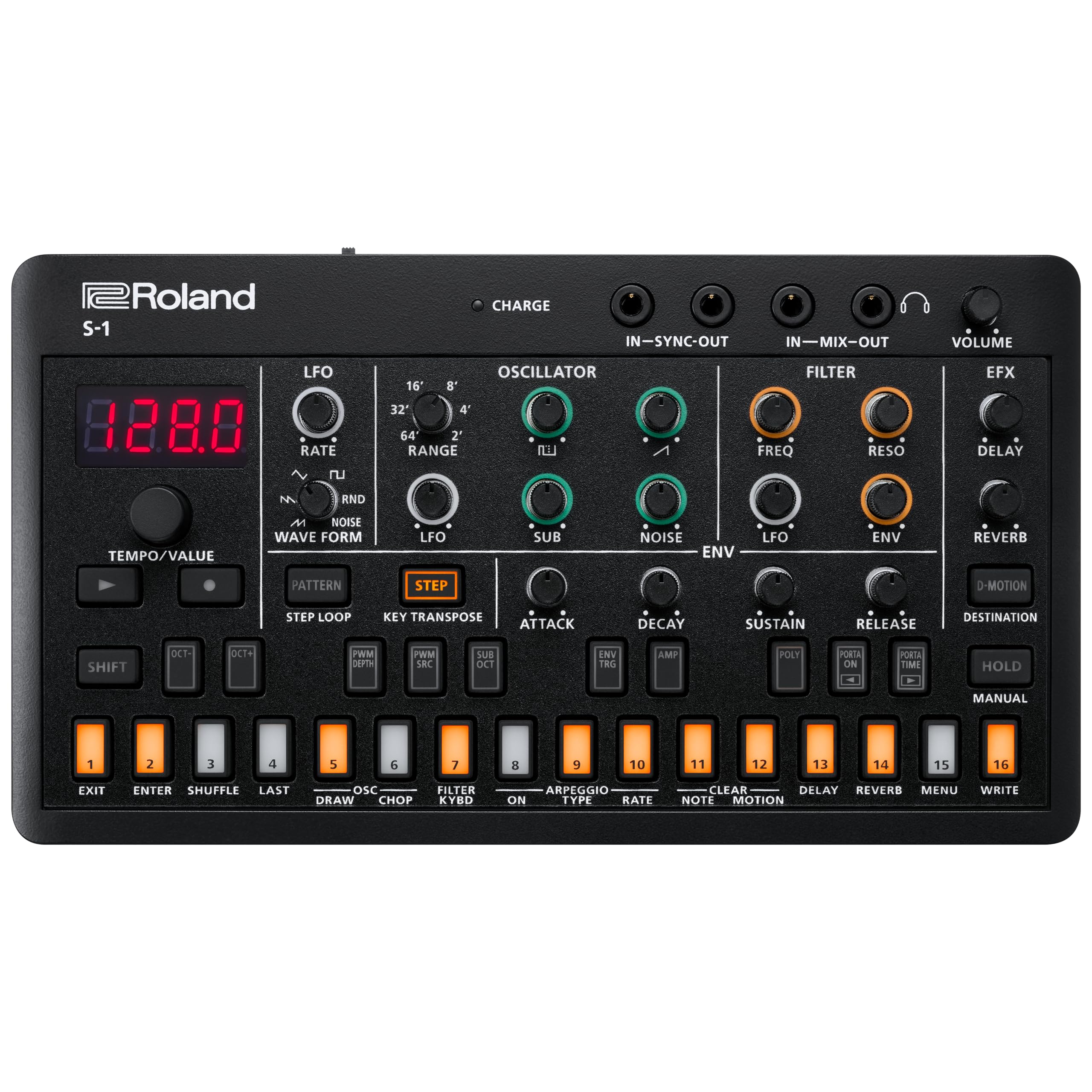
At a pound and about ten inches across, the Roland S-1 is the one here that goes into a bag without a second thought. It sits beside a laptop on a café table, it doesn't need a case, and it takes up less desk than a hardback book. Of everything in this guide, it's the one that gets carried rather than transported.

What surprised us is how little the size costs you in sound. The knobs and buttons are arranged for shaping a tone rather than scrolling through one, the preset library runs from basses to leads to sounds that aren't either, and it plays polyphonically, so chords are on the table rather than just single lines. Set it next to the MicroFreak and it gives up range in the oscillator department. Set it next to a laptop and it doesn't feel like a toy.

The part we didn't expect to care about is the lithium-ion battery. There's no stash of AAs to manage and no outlet to hunt for halfway through an idea, which is exactly what makes a small synth worth carrying. It's our pick for the couch, the train, and the ten minutes before a session actually starts.

Pros

  • One pound and ten inches, so it travels easily
  • Polyphonic engine with a broad preset library
  • Lithium-ion battery frees it from a desk

Cons

  • Deeper parameters sit in shared sub-menus
Our verdict

Buy the S-1 if the synth has to leave the house with you — it's the best size-to-sound balance in this group, and the battery makes it genuinely portable.

Check Latest Price
3

Best for Finishing Tracks

Novation Circuit Tracks

91 /100
LBD Score Outstanding

Key details

Battery
4 hours
Sequencer
32 steps, chainable to 256
Connections
MIDI, USB-C, microSD
Synth Tracks
2 polyphonic digital
View on Amazon

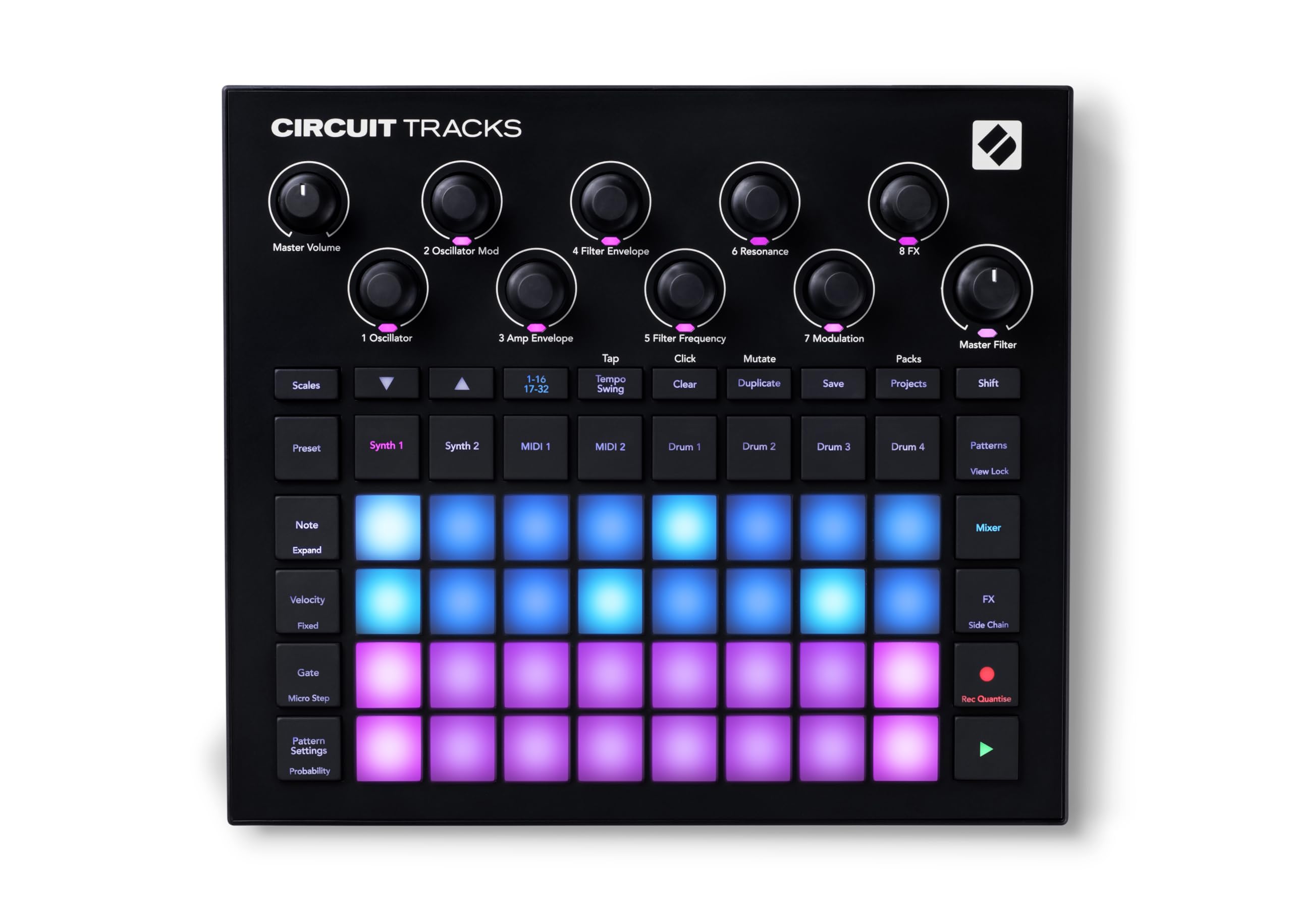
There are no keys on the Novation Circuit Tracks, and we think that's a fair trade for what you get instead: the most complete songwriting tool in this group. It's a groovebox — pads and encoders rather than a keybed — with two polyphonic digital synth tracks, four drum tracks and two MIDI tracks for driving external hardware. If you write by playing chords with your hands, one of the keyed synths here will suit you better.

Where it earns its money is arrangement. Patterns run to 32 steps and chain to 256 per track, microtiming pushes notes off the grid, probability keeps a loop from repeating exactly, and Mutate throws out variations when you're stuck. It's quicker to learn than the feature list suggests — you can have a beat going before you've read the manual — and the free sound packs give you somewhere to start.

Your own samples load from a microSD card, the MIDI tracks will sequence a rack of hardware if that's where you're headed, and four hours of battery at 1.9 pounds make it a couch and tour-van machine. The three-year warranty is the longest in this group, which tells you something about how much use Novation expects it to survive.

Pros

  • Two synth, four drum and two MIDI tracks
  • 32-step patterns chain into 256-step sequences
  • Four-hour battery in a 1.9-pound body
  • Three-year warranty, the longest here

Cons

  • Only two synth tracks to build melodies with
Our verdict

For finishing tracks without a computer, the Circuit Tracks is the one we point to — just don't buy it expecting to play melodies with your hands.

Check Latest Price
4

Best Budget Analog

Korg monotron DUO

88 /100
LBD Score Excellent

Key details

Weight
6.4 oz
Connector
Auxiliary
Dimensions
6.4 x 1.6 x 9.2 inches
Sound Profile
Analog
View on Amazon

The Korg monotron DUO has no keys — just a ribbon you slide a finger along — and at 6.4 ounces it's smaller than the photos suggest. Both of those things are the point. It's a synth you hold and steer rather than sit down and play, and it disappears into a jacket pocket next to a phone.

What comes out is real analog, and the cross-modulation control is where the rude, squelchy tones live. Slide along the ribbon while you sweep the filter and it stops sounding like a small device at all. Every sound is one you made and will lose the moment you move a knob, which is either the joy of it or the frustration, depending on the kind of player you are.

We think it's the most honest way to learn what an oscillator and a filter actually do, because nothing is hidden behind a menu and every change is audible immediately. It's a bassline, drone and sound-effect machine rather than a song machine, and at this price it's what we hand to someone who isn't sure yet whether synthesis will stick.

Pros

  • Real analog voice with a filter and cross modulation
  • 6.4 ounces and genuinely pocketable
  • Nothing hidden

Cons

  • No MIDI, presets or sequencer
  • Ribbon plays one note at a time
Our verdict

Buy the monotron DUO to learn synthesis by ear for the price of a pedal — it's the most direct analog thrill here, as long as you don't need it to remember a sound.

Check Latest Price
5

Best Gift

Stylophone Original

93 /100
LBD Score Outstanding

Key details

Body
Metal
Power
3 x AA batteries
Weight
8.8 oz
Dimensions
2.05 x 3.41 x 1.86 inches
View on Amazon

The Stylophone has been making the same noise since 1968, and that noise — a buzzy, slightly wobbly analog tone you trigger by touching a metal strip with a stylus — is the entire reason to own one. It's also the only instrument here that gets a reaction from a room before anyone has played a tune on it.

Playing it takes about two minutes to learn: tap the stylus on a segment for a note, slide it for a glide, and pick out a melody by eye because every note sits in plain sight in front of you. It runs on three AA batteries, has a built-in speaker, weighs under nine ounces, and has a 3.5mm connection for running into other gear. It's a coat-pocket instrument in the most literal sense.

As a musical tool it's a sketchpad rather than a workstation. The one thing worth doing is playing it the day it arrives: a unit that stays silent out of the box should go straight back rather than get diagnosed, and that's much easier while the packaging is still in the room.

Pros

  • Iconic analog tone you won't get elsewhere
  • Stylus playing is learnable in minutes
  • Built-in speaker and AA battery power

Cons

  • Lightweight build won't take rough handling
  • Single buzzy voice with no sound shaping
Our verdict

The Stylophone is the gift synth we recommend without hesitation — instant, funny and genuinely playable, provided nobody expects it to be a studio instrument.

Check Latest Price
6

Curious Kids

Synth-a-Sette

90 /100
LBD Score Outstanding

Key details

Keys
13-key monophonic touchpad
Weight
5.29 oz
Connector
USB Type-C
Dimensions
4 x 2.6 x 0.5 inches
View on Amazon

Ten alligator clips come in the Synth-a-Sette's box, and they're the reason it exists. Clip them to a banana, a fork, or a row of friends holding hands, and the touchpad plays a note whenever the circuit completes. As a party trick it's excellent. As a first lesson in circuits and conductivity, it's better.

Strip that away and you have a 13-key monophonic touchpad with an octave-up button, an optional vibrato switch, a built-in speaker and a line out, all in a cassette-sized case with a printed sheet for your first song. We were surprised by how full it sounds for 150 grams. There's almost no learning curve, and the two-year warranty is longer than most here.

The people who get the most from it don't need it to be a whole instrument: a curious kid, a science-minded teenager, a friend with a rack who wants something strange to plug in. It's a gateway and a gadget at once, and it's the one thing here that makes a room laugh.

Pros

  • Alligator clips turn everyday objects into keys
  • Speaker, line out and touchpad in a cassette case
  • Two-year warranty, longer than most

Cons

  • 13 keys and one note at a time
  • Costs about as much as more capable pocket synths
Our verdict

Buy the Synth-a-Sette for the person who already has instruments and would enjoy turning fruit into a keyboard — it's a clever teaching tool and a great gift.

Check Latest Price

How We Tested 12 Synths Over Four Months

We started by pulling every current synth we could find in three rough camps — pocket and battery-powered units, desktop boxes with sequencers and drum tracks, and small keyboard synths with real keys — then cut anything discontinued, anything that needed a paid app to make a sound, and anything with no way to connect to other gear. That left 12 units, which lived on my desk and in my bag for four months.

Ease of use got tested by handing each one to someone who had never touched a synth and timing how long it took them to land on a sound they liked without opening the manual. For sound quality, I recorded the same short riff on every unit and listened back through cheap earbuds and a small speaker, which exposed thin low end and noisy outputs fast. Build quality meant pressing every knob and slider sideways, then tossing the unit in a canvas bag with cables and a laptop for a weekend trip to see what rattled or cracked. Size was judged by whether a synth ended up on the couch or back in the closet.

Connectivity was a matter of patching each one into a MIDI keyboard, an audio interface, and a drum machine to check whether clock sync held and whether the manual made the routing obvious. For reliability, I left every unit powered on for a full afternoon and noted dropped notes, drifting tuning, or a boot loop after a power cycle. Functional range got the longest look: I tried to pull a bass line, a pad, and a lead out of each, and wrote down which ones I reached for unprompted a week later — the fun factor no spec sheet lists. Value came down to what was in the box and whether the synth did enough on its own that you didn't immediately need to buy a companion piece.

How to Choose a Synthesizer

Start with the interface, not the feature list

Keys, pads, a ribbon and a stylus are four different invitations. A keybed is for chords and melody lines, a pad grid is for patterns, a ribbon is for slides and bends, and a stylus is for poking out a tune. Decide which of those you want your hands doing before you compare oscillators, because the interface quietly decides what kind of music you end up making.

The MicroFreak sits between categories with a pressure-sensitive plate where the keys should be — brilliant if you play by touch, wrong if you need something to push against. Handle one before you commit if you can.

Know what paraphonic means before you buy

A monophonic synth plays one note at a time; a polyphonic one plays chords. In between is paraphonic, where several notes sound together but share a single filter, so a big chord moves as one shape instead of swelling note by note. If you play sustained pads and stacked chords, pay for true polyphony. If you play bass, leads and one-finger lines, a mono or paraphonic synth does everything you ask for less money.

Decide whether it has to work without a computer

Standalone just means the synth makes its own sound. A sequencer or arpeggiator is what turns a patch into a part you can build on, and it's the difference between a synth you switch on for ten minutes and one you actually write with. Pair that with power: a mains-only unit is a desk instrument, while a battery model can leave the room. Check both before you fall for a sound, because you can't add either later.

Match the connections to what you already own

Five-pin MIDI remains the standard for talking to other hardware, though plenty of small synths use 3.5mm jacks with adapters — the MicroFreak ships with two. CV and gate outputs only matter if you have a modular or semi-modular rig, and they're part of why some small boxes cost more than they look like they should.

Watch the USB trap: on most synths it carries MIDI data rather than audio, so it won't replace an audio interface when you want to record. Plan on a cable into something.

Weigh the panel against the footprint

A synth you learn quickly has one knob per job and labels you can read at a glance. A synth that fits in a bag usually hides half its parameters behind a shared knob and a sub-menu, and that's the honest trade — smaller panel, more listening and less looking. If you learn by twiddling, spend on the bigger panel. If you learn by ear, a compact box with a strong preset library takes you further than a wall of controls you never touch.

Frequently Asked Questions

Final Verdict

The MicroFreak is the synth most people should buy first, and the reason is range: 21 oscillator modes, a filter with real character, a touch keybed that plays faster than it looks, and CV outputs that keep it useful as a setup grows. It's the pick here you're least likely to outgrow, as long as it can live near an outlet.

When it can't, the Roland S-1 is the one that leaves the house, and the Circuit Tracks is the better buy for anyone whose real goal is finishing tracks rather than designing sounds.