Best TDS Meters of 2026

A TDS meter is a deceptively simple thing: two electrodes measure how readily your water carries a current, and the meter turns that into parts per million of dissolved solids. It is not a safety test — a low number won't rule out lead or bacteria, and a high one doesn't mean the water is dangerous. What it gives you is a baseline you can watch.

That baseline is worth exactly as much as the pen's consistency. A meter that reads 210 one minute and 245 the next tells you nothing about whether your filter is spent, and that's the trap here: most of these look identical on paper, all claiming a four-digit ppm range, 1 ppm resolution, a stated accuracy of 2 or 3 percent, and TDS, EC, and temperature readouts. After three months with 16 of them in my kitchen, at my aquarium, and next to a hydroponic bucket, the differences came down to whether the number held still.

Two things nobody warns you about: the instructions, since half ship with a folded card that never mentions calibration — the one procedure that keeps a reading honest — and readability, because a display you have to squint at is a display you stop using. The meters below are the ones that held their number and made sense to people who never read the card.

1

Best Overall

HoneForest HFTDS-M7

91 /100
LBD Score Outstanding

Key details

Display
Backlit LCD with auto-lock
Measures
TDS, EC, temperature (°F/°C)
TDS Range
0–9990 ppm
In The Box
Meter, instructions, carrying pouch
View on Amazon

A TDS pen lives or dies on whether you can read it while it's in the water. The HoneForest settles that with a big backlit LCD that auto-locks the number a couple of seconds after you stir, so you can lift the probe out and read it in ordinary kitchen light instead of crouching over a glass. That one behavior is most of why it's our default, and the rest of the meter holds up around it.

It reads TDS in ppm, EC, and temperature in °F or °C, on a range that runs to 9990 ppm — enough for tap water in the hundreds, RO output near zero, a pitcher filter, or an aquarium. Accuracy is what decided the top spot: it has the longest record of steady readings in this guide, and it's also one of the easiest of the group to read at a glance. The kit is unusually complete, with instructions and a carrying pouch in the box, which is more than several meters here manage.

Two things to know before you order. There's no user adjustment, so if you want to trim the reading against a standard solution, the HM Digital TDS-EZ is the pen here that lets you. And it's a handheld meter, not a lab instrument — a single number is an indication, so judge a filter on the trend across a few weeks rather than on one dip. Within that, it's the one we point friends to.

Pros

  • Backlit screen holds the reading after you lift it
  • Reads TDS, EC, and temperature on one screen
  • Instructions and a carrying pouch in the box

Cons

  • Readings can repeat across very different samples
Our verdict

Our default pick is this one, and it has earned it: TDS, EC, and temperature on a backlit screen that holds a number you can read, plus the steadiest accuracy record in this guide.

Check Latest Price
2

Best for Hydroponics

HM Digital COM-80

87 /100
LBD Score Excellent

Key details

Scales
EC (µS/mS), TDS (ppm/ppt)
TDS Range
0–5000 ppm
Response Time
0.5 seconds
Temperature Compensation
Automatic (ATC)
View on Amazon

Hydroponics is where a ppm pen stops being enough. The COM-80 reads EC in both µS and mS and TDS in ppm and ppt, with 1 µS/ppm of resolution and automatic temperature compensation — the combination that lets you follow a feed chart in its own units instead of converting in your head.

That's why it's our pick for growers. Adding nutrients and watching EC climb on the same scale your schedule uses is a much cleaner loop than guessing at ppm, and the meter's 0.5-second response makes a repeat dip painless. We also like how deep it goes: the stated immersion depth is 15.5 cm, so it reads in a reservoir or a five-gallon bucket without you tipping the container. It's water resistant and rated to 80 °C, well past what the drinking-water pens here will take.

The trade-off is money. It's the priciest meter in this guide, and the plainest — three LR44 cells, a wipe-clean body, and nothing in the box but the battery. For an instrument that lives beside a grow tank rather than in a kitchen drawer, that's the right trade. Buy calibration solution with it; on a meter you're using to protect expensive plants, a drifted probe is the expensive mistake.

Pros

  • Four scales, including EC in µS and mS
  • Automatic temperature compensation built in
  • Reads from a 15.5 cm immersion depth
  • 0.5-second response for quick repeat dips

Cons

  • Tops out at 5000 ppm
Our verdict

We send growers here: EC in the units feed charts use, automatic temperature compensation, and a probe that reads from deep in a reservoir. Drinking-water households can spend less.

Check Latest Price
3

Best Simple Meter

HM Digital TDS-EZ

89 /100
LBD Score Excellent

Key details

Accuracy
±3%
TDS Range
0–9990 ppm
Resolution
1 ppm to 999; 10 ppm above
Calibration
Factory-set at 342 ppm NaCl
View on Amazon

Turn the TDS-EZ over and there's a printed chart on the back that tells you what your reading means. In a category where the documentation is often the first thing to go missing, that sticker is the most useful thing on the meter — and it says something about how this one is put together.

One button, one number, a large LCD, and a reading that settles in seconds. It runs to 9990 ppm and holds 1 ppm resolution to 999, then switches to 10 ppm steps with a blinking x10 on the display. That detail is worth understanding before you compare it against a pen advertising 1 ppm at 1,500, because up there ten ppm isn't the error you should be worrying about. A hold function, a ten-minute auto-off, and roughly 1,000 hours on two button cells round it out.

What we value most is boring: it can be recalibrated. It ships set against 342 ppm NaCl and trims with a mini screwdriver, which is the difference between a meter you trust for years and one you toss when the numbers drift. Reliability is where we hold back — some units quit within a couple of months, so buy where returns are easy and test it in the first week. As a plain, adjustable, one-number pen, it's the one we hand to people who don't want to think about settings.

Pros

  • Chart sticker on the back explains the number
  • 1 ppm resolution, stepping to 10 ppm above 999
  • Recalibratable with a mini screwdriver

Cons

  • No case included
  • TDS only, with no EC or temperature
Our verdict

What we like is what it refuses to do: one number, no menus, a chart printed on the back, and a screwdriver adjustment when the reading drifts.

Check Latest Price
4

Best Warranty

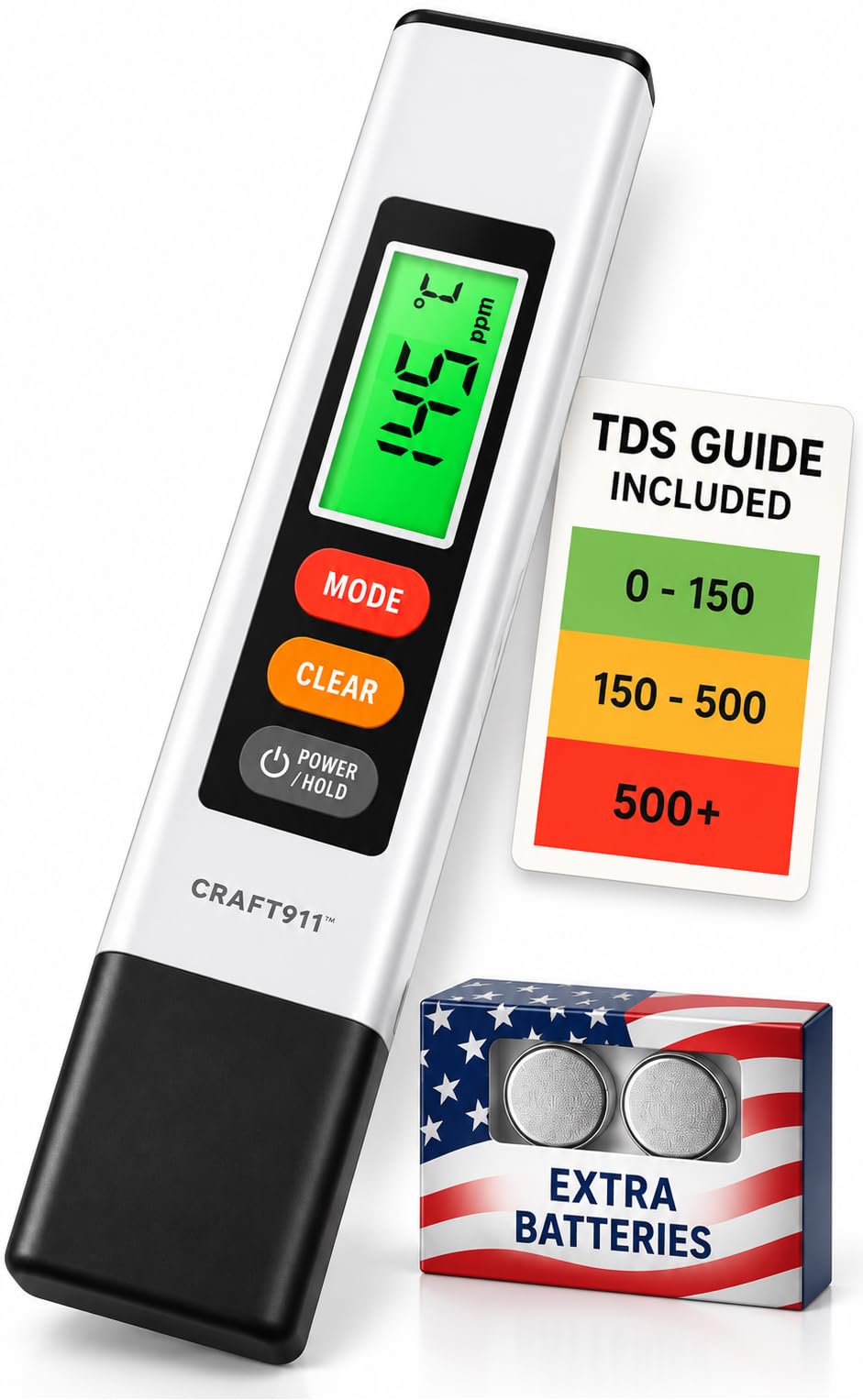
Craft911 3-in-1 TDS Meter

89 /100
LBD Score Excellent

Key details

Accuracy
±3%
Measures
TDS, EC, temperature
Warranty
3 years
TDS Range
0–9999 ppm
View on Amazon

Three years of warranty on a meter that costs less than most of this group, plus a 90-day money-back window — the Craft911 is the only meter here with coverage worth mentioning, and coverage is exactly what this category lacks. The failure that stings is a pen that quietly stops working a few months in, when the return window has closed and you're back to guessing.

It isn't a warranty with a probe attached. The readout covers TDS, EC, and temperature, the range runs to 9999 ppm, the stated tolerance is ±3%, and the probe is titanium alloy. A backlit screen and an auto-lock that freezes the number when you lift the pen out make it easy to work one-handed at a sink, and at 6.06 inches it reaches into a tall glass without your knuckles getting wet.

The ±3% tolerance is the same figure HM Digital publishes for its economy pen, which is a fair map of where this class of meter sits: good enough to catch a filter going bad, not good enough for lab notes. What makes it worth carrying is what happens when a pen in this class dies — you usually find out through a number that makes no sense, and here that's a phone call instead of a replacement purchase.

Pros

  • Three-year warranty and a 90-day return window
  • TDS, EC, and temperature at a stated ±3%
  • Auto-lock freezes the reading in your hand

Cons

  • Repeated dips shift by a few ppm
Our verdict

We put it in for the coverage — three years of warranty — and kept it for the TDS, EC, and temperature readout at a price below most of this group.

Check Latest Price
5

Best Compact

Pmlilb TDS Water Tester

87 /100
LBD Score Excellent

Key details

Probe
Titanium alloy
Weight
1.13 oz
TDS Range
0–9990 ppm
Calibration
Automatic
View on Amazon

At 1.13 ounces, this is the lightest meter in the guide, and the difference shows up the moment it goes into a shirt pocket. If your testing happens away from home — a rental, a hotel, a friend's well — that's worth more than an extra scale you'll never switch to.

It covers 0-9990 ppm with a titanium alloy probe and settled on a number within a second or two every time we dipped it; its light build never felt like the weak point. What we tell a buyer is simple: this is a ppm pen first, so if you want EC and a temperature switch on the same screen, the 4-in-1 picks here give you more for the money. It's the meter that lives in a bag and comes out when something tastes odd.

Pros

  • Lightest meter here, at 1.13 ounces
  • Titanium alloy probe spans 0-9990 ppm
  • Readings arrive in a second or two

Cons

  • No manual calibration to check drift
Our verdict

We take this one when testing happens away from home: the lightest meter here, quick to settle, and simple enough to hand to a neighbor.

Check Latest Price
6

Best Budget

Arendsace 4-in-1 TDS Meter

89 /100
LBD Score Excellent

Key details

Display
Backlit LCD
Measures
TDS, EC, temperature (°C/°F)
Batteries
2 LR44 (included)
TDS Range
0–9990 ppm
View on Amazon

Take the top pick's formula — backlit screen, three readings, a range that runs to 9990 ppm — and cut the price to the lowest in this guide, and you have the Arendsace. It's what we hand someone who wants to know whether a filter is still doing anything, without paying for settings they'll never touch.

For that job it's genuinely good. One button, a bright display, a reading in seconds, and ease of use is the strongest thing about it. The screen also changes state once the reading passes 40 ppm, which turns the meter into a glance instead of a read: hold it under the RO faucet and you can see low-TDS water without parsing digits. Two LR44 cells come in the box.

It's the cheapest meter here we're comfortable recommending, and it handles the household job — hard versus soft, working versus spent — without asking you to learn anything. Nothing in the design needs babying, the batteries are the kind you already have in a drawer, and it's small enough to live in the kitchen without becoming a thing you have to store. If the number is a yes-or-no question, this is the meter.

Pros

  • Least expensive meter in this guide
  • Screen changes state above 40 ppm
  • One-button operation with a backlit display

Cons

  • Repeated dips drift by a few ppm
Our verdict

We recommend it to anyone who wants to spend the least and still watch a filter work: instant readings, a bright screen, and nothing to learn.

Check Latest Price
7

Best Two-Pack

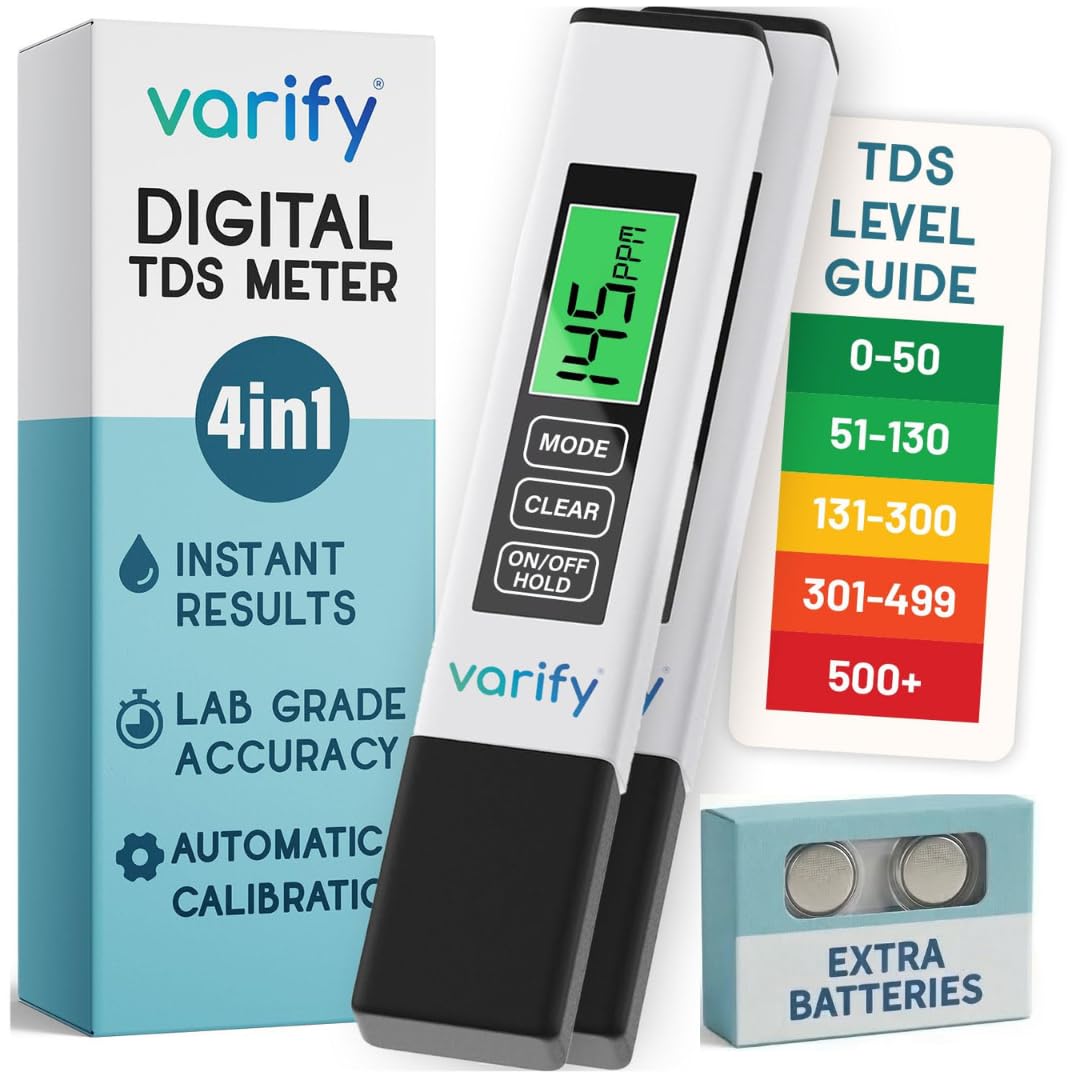
Varify 4-in-1 TDS Meter (2-Pack)

90 /100
LBD Score Outstanding

Key details

Pack
2 meters
Measures
TDS, EC, temperature (°C/°F)
Batteries
Spares included
Read Time
3 seconds
View on Amazon

Two meters in one box solves a problem single pens create. A meter that lives in the kitchen and a meter that lives with the aquarium stop being the same object, and you're not rinsing tank water off the probe before you check your drinking water.

The meters themselves are pleasant. One button, a backlit display, TDS, EC, and temperature in °C or °F, and readings in about three seconds by the maker's claim. Extra batteries and a quick-start chart come in the box, and a downloadable guide explains what the numbers mean — more hand-holding than almost anything else here offers.

Accuracy is the honest caveat: a share of these meters read noticeably off, and a few temperature readings came back clearly wrong. The pair gives you a way to check — dip both in the same glass, and if they disagree by more than a few ppm you have a bad unit and a return to make while the window is open.

That cross-check is why we still recommend the set for a two-location household. One pen can't tell you it has drifted; two can, on the same afternoon, in the same glass. Buy it when convenience is the point and a ballpark number is enough, and take the single meters above when you need one instrument you can calibrate and trust.

Pros

  • Two meters keep kitchen and aquarium separate
  • Spare batteries and a quick-start chart included
  • Downloadable guide explains what the numbers mean

Cons

  • Costs more than a single budget pen
Our verdict

We recommend the pair for a household that tests in two places; the spare batteries and the interpretation guide mean the second meter is never the spare.

Check Latest Price
8

First-Time Water Testing

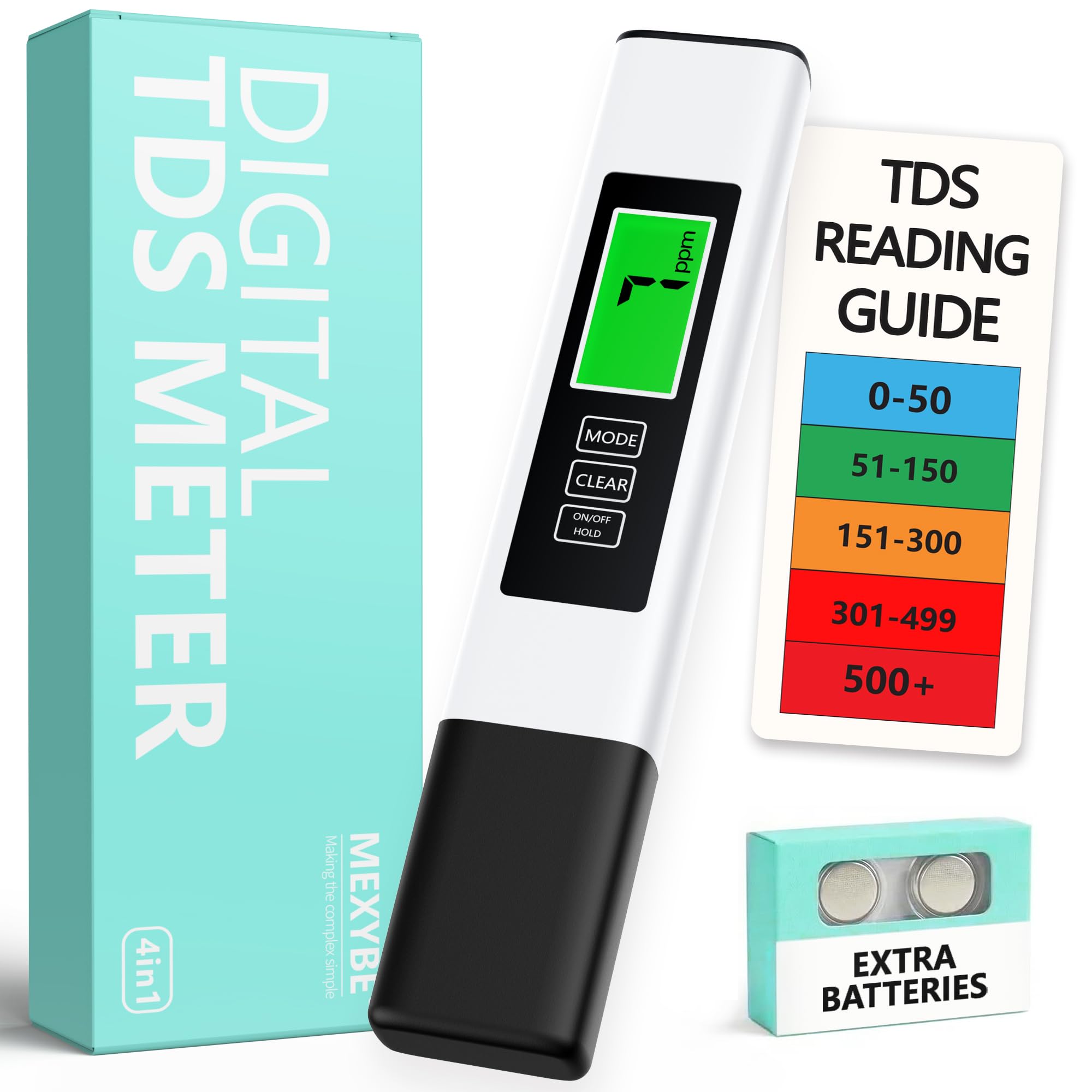
MEXYBE 4-in-1 TDS Meter

89 /100
LBD Score Excellent

Key details

Weight
3.53 oz
Display
Backlit LCD
Measures
TDS, EC, temperature (°C/°F)
TDS Range
0–9999 ppm
View on Amazon

For the money, nothing here gives you more screen. The MEXYBE's backlit LCD is, by the maker's count, a quarter larger than the older 3-in-1 designs, and it holds TDS, EC, and temperature in °F or °C on a range that runs to 9999 ppm. At a sink with the light behind you, that size is the whole argument.

It's also easy to live with: one button, a reading in about a second, a temperature toggle that takes one press, and a body small enough to keep in a drawer. Of everything here, it's the closest to a single-purpose gadget — pick it up, dip it, read it, put it away.

Consistency is where it gives ground. Readings on the same glass of water don't always repeat, and the spread is wider here than on any other meter we're recommending, which makes it a poor judge of a small change. Rinse the probe and dip twice and you'll get a usable ballpark; you won't get a reference.

We're comfortable recommending it to someone buying a first meter: it's fast, bright, and inexpensive enough to leave in a drawer without a second thought, and the screen is the reason to pick it over the other budget pens.

Pros

  • Backlit screen a claimed 25% larger than older models
  • Reads TDS, EC, and temperature to 9999 ppm
  • One-button operation, results in about a second

Cons

No notable drawbacks to flag.

Our verdict

We think it's a good first meter — bright, fast, and cheap enough to leave in a drawer — as long as the number is a ballpark rather than a verdict.

Check Latest Price

How We Tested: Same Glass, Sixteen Meters, Three Months

The shortlist started with a spec sweep: meters under about $30 with a four-digit ppm range, an EC and temperature readout, and a stated accuracy figure. Anything with no documentation at all got cut before testing began. Sixteen made the cut and stayed in rotation for three months, living in a kitchen drawer and getting used on morning tap water, on the inflow and outflow of an under-sink RO/DI system, at a 20-gallon aquarium during water changes, in a hydroponic reservoir that swings hard between top-offs, and on a friend's well water.

Accuracy and consistency are really the same test, so I ran them together. For each meter I filled one clean glass and took three readings back to back, then passed that same sample around to every other meter in the lineup. A pen that moved more than a few ppm against itself got set aside no matter how good its first number looked. I also checked each one in distilled water and in a 342 ppm calibration solution; the meters I could adjust to the solution held their footing over the following weeks, while the sealed ones wandered. Every reading went into a spreadsheet with the date attached so I could watch a unit drift instead of guessing at it.

Then I handed them to people who'd never used one — including my father-in-law, who got each meter cold with the instructions face-down while I timed him to a stable number. I read displays in a dim kitchen at 6 a.m. and in direct July sun, with wet hands, and noted which ones needed a second look. The rest was the small stuff that decides whether a $20 pen earns its drawer space: batteries in the box, a hard case versus a flimsy cap, whether the buttons and battery door felt like they'd survive a drop to tile, and how long the auto-off gave me before the screen went dark.

How to Choose a Tds Meter

Know What the Number Can and Can't Tell You

TDS is inferred from electrical conductivity: the meter runs a current between two electrodes and converts the result to ppm. That makes it excellent for spotting dissolved minerals and for tracking whether a filter is still stripping them out, and it is not a safety test — it can't see bacteria, and a low reading doesn't certify water as safe to drink.

Buy it as a trend instrument. Take a baseline on day one, write the number down, and compare against that rather than against a chart written for someone else's water.

Pick a Range That Fits Your Water, and Watch the Bottom End

Most meters here run to 9990 ppm, which covers RO output near zero and hard well water in the high hundreds. What matters more than the ceiling is the low end: the TDS-EZ holds 1 ppm resolution to 999 and then steps in 10 ppm, so a display showing 1,240 really means the nearest ten.

If you're monitoring a membrane you live near zero, which is exactly where fine resolution earns its keep. If your water runs in the hundreds, that precision buys you very little.

Read the Accuracy Claim, Then Calibrate

±2% against ±3% sounds decisive until you do the arithmetic: on 300 ppm water those are 6 and 9 ppm, both smaller than the day-to-day swing in most supplies. Neither claim survives a drifted probe.

If you plan to make decisions on the number, buy calibration solution and check the meter against it. HM Digital ships its pens set to 342 ppm NaCl, and the TDS-EZ trims with a mini screwdriver. A meter you can't adjust means trusting the factory forever.

The Screen, the Hold Function, and the Probe

You read these at a sink, usually with the light behind you, so a backlit display earns its keep. Just as useful is an auto-lock that freezes the reading so you can lift the probe out and read it in your hand — the HoneForest and the Craft911 both do it.

Check how the probe is made and how far the tip can be submerged; the COM-80 reads from 15.5 cm down, which is why it works in a bucket. If the meter is going near a tank or a reservoir, make sure the body is rated water resistant.

Decide Whether You Need EC and Temperature

Drinking-water households need ppm and little else. Anyone mixing nutrients needs EC, because feed charts are written in mS or µS, and that is where a four-scale meter like the COM-80 pays for itself.

Temperature is the least important of the three: good meters compensate for it automatically, so a °F/°C switch is a convenience rather than a reason to choose one pen over another. We put automatic temperature compensation ahead of a temperature display every time.

Frequently Asked Questions

Final Verdict

The HoneForest HFTDS-M7 is the meter we recommend first: it reads TDS, EC, and temperature, its backlit screen locks a number you can read without squinting, and its readings have been the most dependable of the meters here — which is the only thing that really matters in a pen this simple. Growers should take the HM Digital COM-80 for its four scales and temperature compensation, and a household that just wants to watch a filter on a tight budget gets everything it needs from the Arendsace. Buy the HoneForest unless one of those two describes you better.